
Image courtesy of Blain|Southern
Featuring: Bruce Nauman, Jannis Kounellis, Max Neuhaus, Lawrence Weiner, and Gilberto Zorio.
ANALOG
November 30, 2013 – February 1, 2014
Blain|Southern
4 Hanover Square
London
blainsouthern.com




Image courtesy of Blain|Southern
Featuring: Bruce Nauman, Jannis Kounellis, Max Neuhaus, Lawrence Weiner, and Gilberto Zorio.
ANALOG
November 30, 2013 – February 1, 2014
Blain|Southern
4 Hanover Square
London
blainsouthern.com
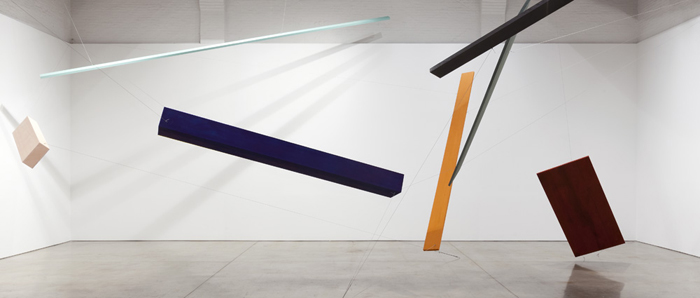
Joel Shapiro
January 25 – February 22, 2014
Paula Cooper Gallery
534 W 21st Street
New York City
paulacoopergallery.com
From February 17 – 19 2013, Sarah Gold and Karlyn De Jongh introspected Ben Vautier in Nice, France. Through different performances – round table conversations, body painting, communication through written texts, or by lying together in bed in the ‘Ben Room’ of their hotel – ‘Ben’ was investigated, openly discussing any topic. The following text is part of one of these performances, whereby Sarah and Karlyn each hold a mirror in front of their faces and ‘introspect’ Ben, while he is looking into these mirrors. The total project was recently published by the Global Art Affairs Foundation under the title Ben Vautier: Introspection Truth Sex & Art and a video of the project was exhibited at the 55th Venice Biennale in the exhibition PERSONAL STRUCTURES at Palazzo Bembo.
Sarah Gold: This is an introspection on Ben.
Ben Vautier: Introspection… This is a nice word ‘introspection’. I’m looking at myself in the mirror and I‘m hoping I change, and the more I look at myself, the more I see a stupid old man who is always the same and cannot change. So, art is change, but we cannot change; we are just the same.
Karlyn De Jongh: I think you are too afraid of change. You do not seem to go into reality, you do not act.
BV: I would be a serial killer, if I could change. I would kill humanity.
SG: Why would you kill humanity?
BV: Because all humanity is ego. We cannot get rid of ego.
KDJ: What do you mean, ego?
BV: Ego means you cannot get rid off thinking, I, I, I… I want this, I am there, I am here. Je suis, je suis, je… Always ‘I’.
KDJ: But you are, your work is about that. You are ‘I’.
BV: But I do not want to be. That is why I want to become a serial killer.
SG: Are you a jealous person?
BV: I am jealous of other artists, never of women. Not ‘never’, really… I say I am not jealous, but maybe I am jealous of my wife fucking with someone else, that could be… It excites me, it excites me but at the same time that it excites me, it gives me anguish, both… It goes up and down.
KDJ: So why are you jealous? Is it because you cannot do it yourself?
BV: Because you do not want to do it with me. No, no… It is because I cannot do it myself. I am jealous, because… it’s complicated.
SG: Are you afraid?
BV: We are always afraid. Afraid of being oneself, afraid of death, afraid of losing or not being who we want to be, afraid of wanting to be another.
KDJ: Who do you want to be?
BV: I want to be truthful. I just want to find the truth and to say, “I am not a liar.”
SG: Do you think, you have been truthful in your life?
BV: No, I have been a liar. You know, once George Brecht told me he liked a painting in which I wrote, “I am a liar.” I said, “why do like that painting?” He said, “Because it is not true, you are not a liar! And if it is not, and if it is the truth, then you are not a liar. So, to write ‘I am a liar’ is a truthful sentence.”
KDJ: Can you still look in the mirror and be serious about yourself?
BV: When I look in the mirror, I … I once did a piece called Mirror Piece, in which I looked into the mirror, hoping to see myself change. But it takes a lot of time. Now, when I look at myself in the mirror, I have bags under my eyes. When I was young, I did not have bags under my eyes.
KDJ: But that is a visual impression. Can you look at yourself in an human way? Are you proud of yourself?
BV: No, I always see the same. I suppose, I always see the same ego.
SG: If you have to choose one: art, sex, truth. Which one would you choose?
BV: Truth!
KDJ: What does it mean, ‘truth?’
BV: I do not know.
SG: What is the most elementary emotion you have?
BV: Anguish. Not knowing what to do.
KDJ: Not knowing what to do? Or not daring to do?
BV: Not knowing. Anxious. Looking for. Worrying. Thinking of.
SG: Where do you think this comes from?
BV: Survival. Art survival.
KDJ: Is art about your survival?
BV: Yes.
SG: Is it survival of the fittest?
BV: It could be.
KDJ: Are you fit enough, Ben?
BV: No. Truth is sometimes against survival.
KDJ: Are you afraid? Of yourself?
BV: I am tired. I want to go to sleep. I have been afraid, but not of myself, no. I want to go on, continuing…
SG: Who am ‘I’?
BV: I do not know. I’m tired.
KDJ: Who is Ben?
BV: A boring artist, who is looking for something new and does not find it.
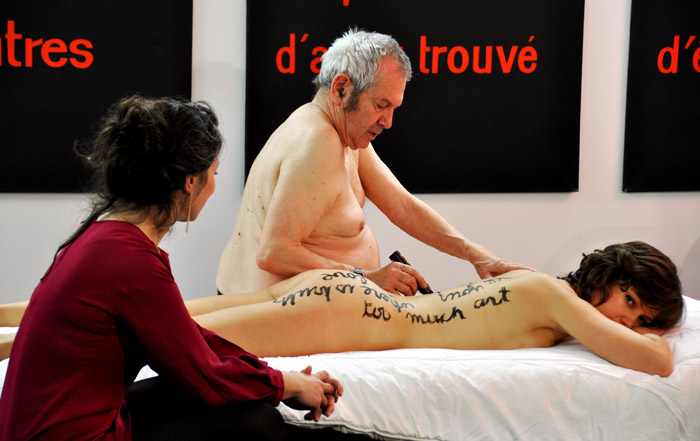
Ben Vautier, Introspection, Truth, Sex & Art, 2013. Art project with Karlyn De Jongh & Sarah Gold. Photo Credit: Global Art Affairs Foundation.
KDJ: Is there a difference between I and Ben?
BV: Who is I? Who is behind there? We are all the same in a way. A mirror is … I wonder who discovered the first mirror and what he thought when he saw himself for the first time. He must have said, “what is that?!”
KDJ: I think you are trying to avoid giving an answer.
BV: Yes
KDJ: Why?
BV: I do not know the answers. I am not so clever. I do not know the answer.
KDJ: After fifty years of performance, of making art, can you not give an answer to the question ‘what is ego?’
BV: I can show off, that is all. To know ‘why’ and philosophy is too complicated this morning.
SG: We spoke about your mother yesterday, tell us about her.
BV: My mother was very, very important to me, because I lived with my mother and she used to say, “Ben, the only thing that counts is the truth, the truth, the truth!”
KDJ: What did she mean?
BV: She always used to meet her friends and play bridge together, and my mother used to make horrible fights between them, because she used to say, “In the name of the truth, I must tell you that you went with another man and your husband does not know it!” So, they were horrible stories!
KDJ: If you cannot say now who ‘I’ is, can you tell us: who is the other?
BV: Who is the other? On a morning like this, I am not a good philosopher. I would love to talk with you about it. The other is always. You cannot be someone else, but another. Marcel Duchamp once said, “c’est le regardeur qui fait le tableau.” This means, “the man who looks at the painting, makes the painting.” Then you always need another to exist; a big one to become small; a rich one to be poor; a poor man to be richer; a strong man to be a weak man. You always need another, you cannot be alone. You are beautiful, because there are girls who are—I suppose—less beautiful. You are tall because there are people who are less tall, because there are little people. In a world full of little people, maybe one of the little people would be a giant compared to some other little people. So, to be another is always to be in comparison with others. And let’s say in art, we have those who succeed in bringing something new and those who repeat themselves and are not new enough. We are fighting to try to find newness. We are trying to find something that makes our difference. If I am different from the others, people will say, “I recognize it! That is a Ben!” Or, “I recognize it! That is a Rembrandt!” So to be, to exist, is to be someone in comparison to the others. But maybe today it is interesting for artists not to look like one another, but to (on purpose) look like everybody. So that is another simple art, too. But then they also cannot get away from being different. When John Cage says, “Everything is music.” At the same time he is changing the games, the world’s games. In previous times composers had a certain personality. The personality of John Cage was to open up a window through which everything else could pass.
KDJ: If it is like you told us that ‘ego is jealousy.’ I am not a jealous person. Do I still have ego?
BV: Maybe you do not know your jealousy sometimes. I think, jealousy is culturally different. Maybe. I do not know, I can’t tell you. For myself and I think for most artists when they look at another artist, they think in their mind, “Oh, that’s good! I would have liked to have done it.” So, “Oh that’s good, I can do better” or “that’s not good, mine is better.” It’s a way of ‘the other.’ It is a degree different in jealousy, it is the presence of the other. There could be jealousy in a way, when you say, “I did this! He took my idea. Why did he get success and I don’t, and I did it before him?” So, there I would say is a more condensed jealousy. But that is always, for example when you go into a show and you look at the work, you think, “That is good! I would have liked to have done that.”
KDJ: So when you see some writing and you know that you have done it before, then the jealousy starts? Or how does it work? I think you have a very strong tendency to prove yourself. You want to prove that you were there first.
BV: That was true. I even used to write texts, but now it’s different. Now it is 2013, and I have changed. These days I am pleased when somebody recognizes what I did, and I am less anxious than before. It is not becoming more ‘zen,’ but it is about taking life as it comes. Now, I do not bother as much. But when I was 30 or 40… Now I am 78. I think time has changed me a bit.
KDJ: But now we have been speaking with you the last days for this PERSONAL STRUCTURES Art Project and you mention it very often. So, that would mean that during your 30’s and 40’s, you must have been impossible!
BV: No no, it is that time, Lu-ci-di-té. Lucidité means… Sometimes you meet people who reject art. I say: “be lucide”. Do not tell yourself stories! You can say: “I’m not jealous.” Others might say, “I don’t care. I do this for God. I will pay for others to help humanity.” I say, “be lucide”. Your ego is there. You are in front of the world. You react to the world. To be lucide, means to be aware.
SG: You just mentioned God, do you believe in God?
BV: Yes, I could believe in God. But I am closer to being an atheist than to believing in God. But still when I look at science and we are talking about the Big Bang, and we are talking about our ego presence, then I think there is an interrogation point.
KDJ: So you did not throw God away completely? You threw him out of the country, but then you were traveling quite a bit and took him back home?
BV: He does not look like me and he does not do bad things. He is a kind of … I have some theories … I do not know. I cannot tell you … It is a mystery. But I had to take him away. But there is a mystery in the words ‘life,’ ‘survival,’ ‘ego,’ ‘reproduction,’ ‘time,’ ‘space’… and if you put all of these words together and combine ego with time and space, you only get an interrogation point. You do not get an answer. To see time, space, ego, survival … these ‘things’ exist. But the ‘why,’ the ‘when,’ ‘how’… We don’t understand them.
SG: Are you fine with not knowing?
BV: No! I’m always trying. But you see… When Copernicus said that the world is round; and when Newton said that the world has gravity; and Einstein said the world is time; then Hawking said something about the black holes and that the universe started many millions of years ago and before that was a Big Bang; each one has given an explanation. Then came another explanation, and another one. Today we have the explanation of the quantity. The world is full of explanations.
KDJ: What is your explanation?
BV: My explanation of the universe is a funny one. [Ben starts drawing] My explanation of the universe is that there was—at the beginning of time—an ejaculation. Just as when I fuck. This ejaculation contains ego, reproduction, survival. Now, what happened before, I do not know. But I feel that the world today is an expansion. The universe expands, the galaxies … This is the ejaculation of ego. Why do I see ego as more important than galaxies? It is because ego contains the explanation of these galaxies. I mean to say that we need the ego of Hawking to say this-and-that about the world, we need the ego of Einstein, we need the ego of Freud, we need the ego of Heidegger, we need the egos of the ones who spend their time explaining things. So what do we have? We have the universe, which is full of explanations. These explanations come from ego, because Einstein was jealous of so-and-so. All these egos are there.
That interests me as a theory. I’m actually trying to find the particle of ego, which I want to be able to scientifically find. And then I will call it ‘particule de Ben’ [Ben’s particle]. And people will be able to say: “Of course, the particule de Ben! C’est très important!” And it is all a joke! But somebody will see the particle of love, which is very important too!
SG: So what you drew here, that is all? Everything?
BV: Yes, it contains all. The ‘particle of ego’ means lucidité. It means ‘introspection’. You cannot speak of ego unless you know what it is made of. What is ego? Ego is the name of jealousy, ambition, wanting to be, not wanting to be, lucidité, lucidité over the others. What means ego? We come back to my famous verse [Ben searches the right plate out of the collection he made that day.) This one! And it becomes this one! How did the ejaculation come? It comes from an ego, which was all alone in the universe. There was nothing. And he met another ego by chance, we do not know how they met. He became very angry and started to fuck the other one. And then… bang! … The ejaculation! The bang of two egos gave the ejaculation.
KDJ: Are you afraid of sex because your ejaculation is not as powerful as this one?
BV: Yes this one is very powerful … But I have two children and five grandchildren.
SG: This was such an intense ejaculation that he must have died after his ejaculation and we do not want that to happen with you, of course.
BV: This one? Yes! But I have another theory. Today we have the extremes, the extreme world. We have the extreme big and the extreme small. We are losing this sense of knowing where is the middle. So, I was thinking, if you take your brain … Your brain is full of billions of neurons. It could be that my ‘ejaculation of ego’ has led to tons of other egos that are ejaculating too. So, we have not one universe but we have many universes. I’m still working on this. It is very complicated.
By Karlyn De Jongh and Sarah Gold
In one of his poems, Charles Simic talks about stopping before a closed butcher shop on a late-night walk, where “There are knives that glitter like altars/ in a dark church.” Michael Brennan’s new razor paintings have this feel to them, that of wandering your neighborhood after dark and making it strange again and again.
It is with an eye toward reduction, scale, and color that Brennan has created these smaller, monochromatic pieces for MINUS SPACE, a gallery known for its attention to reductive, concept-based, site-specific art. Brennan moved to Gowanus seven years prior, and these paintings reflect the shift in his environment and his heady fascination with adaptive, first-strike deliberations of form and color.
Brennan has always been invested in economy over minimalism. “I am interested in drawing down to the bone, and my paintings at this point are literally made with two coats of paint, black and white,” he says. In an interview with MINUS SPACE, Brennan describes why he has veered toward monochrome. “I had to address questions of how far I wanted to go with color, and architectural forms. I really just wanted to put all of that aside and embrace some of the simpler qualities that had defined my works on paper already. It was a sorting out process that took some time.” He wanted to embrace a simpler process and to absorb new qualities into his work as a way of interacting with this new landscape. What emerged in this simplification was letting go of color in favor of honing subliminal imagery and creating an altar of sorts for contrasting values.
His razor paintings, however, are deceptively monochromatic: he has worked in a variety of greys, whites, and blacks, some of which are quietly tinted with other hues. As we’ve seen in his double-horizon paintings, color is critical to Brennan, and his paintings pay tribute not only to contemporary painting but also to historical print and film-making. Walter Bernstein, says the artist, would go to the movies, yet find himself disappointed as more and more came out in color. These seemed “paradoxically pallid” next to the black-and-white versions. “In fact,” said Bernstein, “they had no shadows. Color had diminished them; they had lost the quality of dream.” Brennan’s paintings gain this quality of lucid dreaming: the fact that they are nearly monochromatic does not lessen their impact. Brennan seeks to go simpler, more reductive, quieter. He is paying attention. He is reducing things to forms that allow the brain to settle, to sink, to mire itself in new textures that the viewers feel at their cores.
Apart from color, scale is another crucial element of Brennan’s work. The decision to go smaller was inspired, in part, by Myron Stout. He thinks about hands and face, parts of the body on a scale to which we are attuned. Stout’s work was typically 24 x 36”. Brennan’s paintings are 20 x 16 inches and 12 x 19 inches, yet, like Stout’s pieces, they have the feel of telescoped monstrosities, a kind of mountain-presence whose heft is large and deep. “I’ve been thinking a lot about what the scale of our time might be,” says Brennan. “We live in an era where an enormous amount of information is concentrated on small objects like smart phones or tablets.” What he found was that going smaller enabled him to reach a better object/painting correlation comparable to a flat screen TV or the “tricked-out tech things we are all surrounded by.” Another consideration was that many images of paintings are seen and shared online, which means the sense of scale is the first thing to go.
The writer Charles Baxter has often talked about how silence and stillness can act as intensifiers in fiction. Baxter posits that silence strengthens whatever stands on either side of it. It takes on a different emotion, a different color, for whatever it flows through or between. Brennan’s paintings can be examined along the same vein. How does this reductive stillness intensify the surrounding space, the borders, and the color? What does American culture, gadget-obsessed and screen-staring, accustomed to low-grade heroics, do when confronted with these colossal plays on scale and color? Can we look at the paintings like they are smart phone screens, altars, or butcher shops visited on night walks?
One of Brennan’s greatest qualities is his deep attention to reduction and abstraction, to pinching out aspects of scale and beauty in these variations. “I think most people think of abstraction as something striving to be apart from the world, like geometry, but nothing is entirely apart from the world. Euclid was of this world, and I often think of my own abstract painting as earthy.” Keep an eye out for what this incredible mid-career painter comes up with next, and for MINUS SPACE’s upcoming shows (next up: Michael Rouillard and Roberta Allen) as the gallery continues to grow and expand.
Maria Anderson was also able to contact Michael Brennan, engaging him in conversation about his recent work and the inspiration that fuels his creative process.
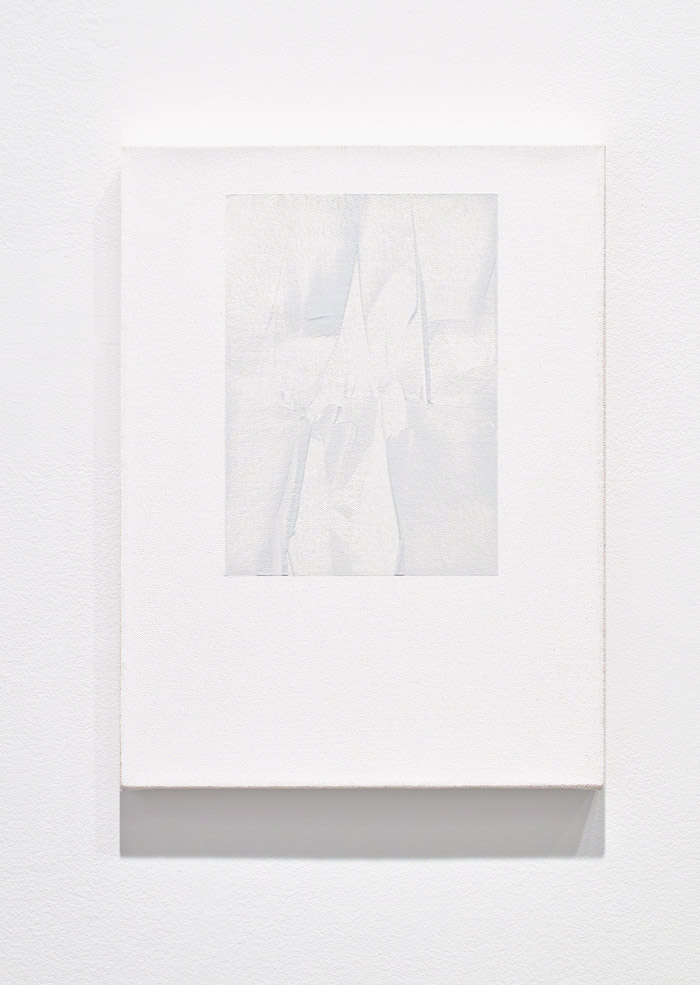
Michael Brennan, Poem Card For Noor Al-Fayez, 2013, Oil and wax on canvas, 12 x 9 in. Image courtesy of Minus Space.
Maria Anderson: You talk about abstract painting as a form of never-ending adjustment. Can you talk more about what you mean exactly by adjustment? Is it mental, spiritual, environmental (i.e. becoming accustomed to and absorbing, in some sense, your neighborhood?)
Michael Brennan: I think “never-ending adjustment” stems from a kind of attitude adjustment—when one is working deeply with materials those materials are always revealing unknown properties, ones that an artist might want to exploit, or for a time even ignore, but alternate pathways always appear at every stage of the investigation. Even the most rigid artists often are seduced by the question “What if I tried…?” which may or may not lead them to their imagined goal. There’s just such an infinite amount of variables to painting. Even if I were to dogmatically insist, “I will now only ever paint black paintings” an artist could still spend a lifetime deciding between a chromatic black, a coarse carbon black, a copper derived black, etc. Each choice is substantially different and could potentially alter the content of the work. The paradox of working minimally is that every decision (assuming there are fewer) becomes paramount. And this of course is just the crude part, the material level. I believe, as many artists do, that everything we absorb has some residual effect. We may try to cling to some kind of cultural moment, but nothing is static.
MA: I love what you said in a Visual Discrepancies interview about lesser heroes:
‘I walk around Brooklyn a lot, and sometimes I imagine the people I encounter are the lesser heroes of another epic, that they are the same type I’ve already discovered in Homer. I figure that in this age of avatars, compromised, and de-professionalized super-heroes that this is somehow appropriate, and that kind of thinking gives me fuel for images and titles.’
Can you say more about this? Is modern man some kind of low-grade (not in a bad way) hero? I feel this way walking around Brooklyn as well, that there is something mythical about the struggle and the gargantuan effort people put forth to pay rent, be successful, and enjoy themselves doing it.
MB: This may be very old fashioned of me, perhaps too romantic, but I think that artists are meant to poetize their environment, to mythologize the mundane. I don’t live in the south of France, so I can’t realistically paint like Matisse. I spend a lot of time walking around Myrtle Ave., Third Ave., and think “What can I do with this?” because this is what I have to work with. What can my imagination do with this? I want my work, abstract as it is, to be of my own time and place, to reflect the conditions that can and do only exist now, and that means paying attention to the world around me. I think the local is generally undervalued.
MA: You also mention Philip Roth. As a fiction writer, I’d be interested to know whether you have any other literary influences, or if any played a part in your mindset when you were creating these paintings.
MB: I’m very bookish. I have fantasies about teaching American Literature (Hawthorne, Melville, Poe), I worked in publishing for a time, and have worked in many bookstores over the years. I have eighth-grade English teacher taste in books. I’m currently re-reading The Centaur by John Updike mostly because I’m interested in how he localizes mythic content. He does so in a much less grand way than Joyce with Ulysses, but that clearly was the precedent. Basically all the townie figures are gods and goddesses and Alton (“All Town” or Reading, PA) becomes the scene of a minor epic, but an epic nonetheless. I guess I use literature as parallel inspiration. It’s never a direct link. I question the use of language, the examination of culture. Maybe this will help me make better minimal paintings of mythic standing that somehow still connect to Myrtle Ave.? That’s a desire of mine anyway. I learned a few things from this forgotten Updike book.
By Maria Anderson
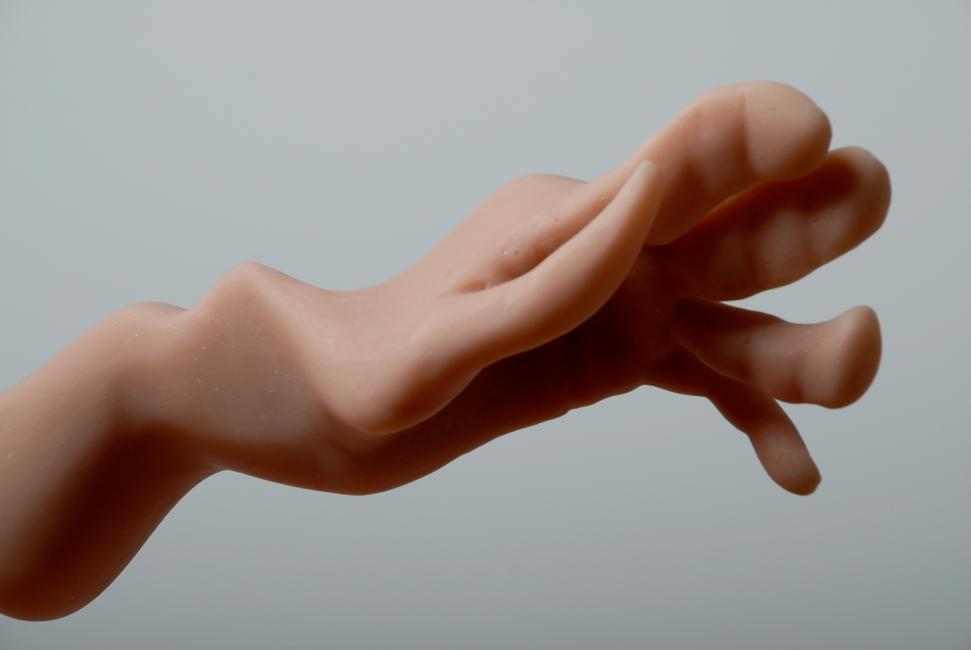
Image courtesy of Museum of Arts and Design
A Talk on “Intro to 3D Printing, Software, Materials, and Processes”
Thursday, February 13, 2014 at 7:00 pm
2nd Floor Galleries at Museum of Arts and Design
2 Columbus Circle
New York City
madmuseum.org
Driven by a wish to do good for society, Yoko Ono (1933, Tokyo, Japan) creates works—ideas, scores, performances, sculptures, installations, music—that address the effect of ideas on the actions of human beings, allowing the viewer to see things in a new light.
Yoko Ono’s new work Arising was presented at the 55th Venice Biennale at Palazzo Bembo, as part of the exhibition “PERSONAL STRUCTURES” and it will soon be published with the Global Art Affairs Foundation as a limited edition book titled Yoko Ono: Arising. On 9 June 2013, Ono visited Palazzo Bembo, where she did an interview with Karlyn De Jongh and Sarah Gold.
Sarah Gold: Yoko Ono, it is a great honour to be sitting here with you, and to have your work Arising in our exhibition “PERSONAL STRUCTURES.” I think this work is an amazing opportunity for women to express their experiences, and this seems to be confirmed when considering the response that we have gotten already: women from all over the world have been sending letters and emails. Also in the exhibition itself, women are contributing by sitting down and writing their stories behind the desk that you placed here in Palazzo Bembo. It seems to help them to express their experiences, to share their stories. And it seems to open doors for other women who did not participate in your work, too.
Yoko Ono: I am very, very happy that my work is presented here in this “PERSONAL STRUCTURES” exhibition. I think it is always important that we reach other women. After I did this, I thought, “Did I forget about men?” But let’s do women first, because women have really been in trouble for over 2000 years. All that time, there was a male society. So, we just have to hear what women had to go through. I think it is very interesting to hear their stories and did not expect it would open such a big door. Now this door is open! And there are so many women who wanted to say something, and they are coming here to Palazzo Bembo. It is a very big thing: it is as if the whole world of women is getting the opportunity to say something.
Some of my work is just asking people for conceptual participation, but many of the works ask people to physically participate. This is why it is interesting to me that these women are talking to me and there is a big exchange. I hope that this is going to help the world a little. It is also Interesting, I thought we would be needing only about twenty letters from women.
Karlyn De Jongh: The response has been overwhelming. You got many, many more letters!
YO: Yes! As soon as we opened the website (www.imaginepowerarising.com), 84 women immediately came with their story. I thought, “What am I going to do?” I am going to treasure each one of them and we are going to make a book out of it as a record of the women’s right in our society.
KDJ: Yoko, in this work Arising that you are presenting here at the 2013 Venice Biennale, in “PERSONAL STRUCTURES,” you have also asked women to send or give a photo of their eyes. Why do you wish to connect the visual image of the person with their story? And why did you choose to ask only for a photo of their eyes?
YO: I am so glad that you ask that question. The reason is because many women are in danger of speaking out. We have to protect them. We cannot have a full face, because maybe they will be attacked again. So, I just wanted something from them—a part of the face—so that we can connect with that woman. When I saw some of the eyes, it was remarkable to see how destroyed some of the eyes are. Some of the eyes are really frightened or shocked. The things that these women went through are visible in their eyes. I think it worked. The fact that we cannot ask them to show their faces nor to spell their full names, is because of how our society is nowadays. That is how much we are threatened and how we are scared. We are human beings, so naturally we are going to be scared and that is all right. We have to protect each other.
SG: Your work is called Arising. What does the title mean to you?
YO: We, women, are now rising together. Arising expresses the rising of our spirits.
KDJ: Arising is now presented in Venice, a city that is visited by tens of thousands of people every day. Why did you choose Venice as the location for showing this work?
YO: It is not about choosing the location. It happened. Many of my works have some kind of strong faith that I did not create. It just came to me and I really appreciate that. I found out that it is very difficult to do something here, with the burning of the silicone female bodies. “Did I make a mistake?” I thought. No! When you see the work and the video, you see that it was totally important that it was done here in Venice.
The sound that you can hear in the video is my voice, from my 1996 record Rising. The recording is approximately 14 minutes in length, but it is like that from beginning to end—no editing, nothing. I created that work a long time before this work ARISING. It just fits very well.

From left to right: Karlyn De Jongh, Yoko Ono and Sarah Gold at Palazzo Bembo, Venice, June 9th, 2013. Photo Credit: Global Art Affairs Foundation.
SG: What was for you the relation between Arising and your record Rising? Why do you think the two works fit so well together?
YO: Rising was telling all people that it is time for us to rise and fight for our rights. But in the process of fighting together, women are still being treated separately in an inhuman way. It weakens the power of men and women all together. I hope Arising will wake up Women Power, and make us, men and women, heal together.
It was very interesting, the way this record was created. I was about to do a recording session with my son and my son’s friends. At that time, my son was a teenager. He and his friends were just impossible people. They came to my recording session and I thought, “What am I going to do? Can I trust them with playing my work?” I thought I would just do one harmony and said, “Just play that from beginning to end.” It just went “whooom!” like that. No editing, no rehearsal.
I think it is important that I did it, because it is the voice of a woman who went through a lot of pain, which was me. The reason why I created such a vocal—many people disliked it, so I might as well get a credit for it—was because when I was a young girl, my mother told me: “Never go near the servants’ room, because they are talking about things you do not want to know.” Of course, I wanted to go there! I sneaked up and heard them speak, “Did you know that my aunt just had a baby? And having a baby is a very strange thing, because she was going, “whoa, whoa, whoaaa!”.” I thought, “Hmm, this is scary!” and ran back to my room. I never forgot that.
Later I realised that in society, woman are liked for being pretty and making pretty sounds and singing pretty songs. Those are the ones that sell the most, not someone who sings “whoaaa!” If you can’t sell it, what are you going to do?
I thought, I have to tell the world that women are not just pretty, but they created the human race. We brought the children into this world. And that is a very difficult act. It is not very often spoken about, but giving birth is a very dangerous thing to do. Many women die from it. It is a very important and dangerous thing and we all have to go through it. It is not a pretty and happy thing at all. It is a very important and serious thing! It is even much more powerful than a huge earthquake. Each child that comes into this world is going to influence our society.
So, what are we doing when only showing the pretty side? The reason is that men cannot have babies. They do not want to know that the other sex can do that, in a way it is a competition between the people. They do not want to talk about it, not think about it. Men want to euphemise the situation, saying that it is such a beautiful thing and that women love to do it. Women love to do it? Let them do it! Then men will see that it is not that pleasant.
I learned all that and thought I should at least use some sounds that we, women, make. As soon as I sang, “Whooaaaa!” the teenagers stopped working and all went into the bathroom. Because they could not say they wanted to escape, so they just went to the bathroom. When we made the song, John said, “did you get that?” checking if the song was recorded. It was one of the rare moments that it was recorded.
This is the kind of thing that women go through and when you listen to that song, you will understand that it is your emotion. It is your experience that is turned into music.
KDJ: When we burnt the silicon bodies for your work, we went with a whole group of people to one of the islands in the Venetian Lagoon. There were also many men present. To burn these bodies, was a very strong experience for everybody I think, not only for the women that were there. It seemed to me that also for the men it was a strong experience.
YO: Yes, it would be unfair to say that men just like pretty voices. They are nobody without the presence of women. When you face them with this, then they start to understand. Now there are also what I call ‘new-age men': there are many men who are very understanding and they are also suffering because of that understanding. John was one of those men and he always said he felt lonely, because there were not many men around who understood it. He wished there to be a group of men to talk about it, because he felt very alone. Now there are many new-age men and that is great. When I am in New York and go to Central Park, I see many men pushing a baby car. Now this is a natural thing, nobody is surprised about it. But they do not know that when John did this, nobody did it. No man wanted to be seen with a baby car. I am very happy that now it is a normal thing. I thank John for being so courageous.
SG: Do you think that by addressing these themes in your work and at the same time asking people to participate in your works, that you contributed in educating our society?
YO: Yes, very much so. The more you participate, the more you make this a normal thing. It became normal that women are strong. It is ok to be strong. We were so scared of being strong and we made ourselves small, I made myself small. In China they for example had to make their feet very small. Women were suffering from it. Every night they cried. That is how bad it was. That is how bad the society was to women.
Now it is getting better and better, but we have to understand: we are not the only ones in a society. We also have to understand the suffering of the opposite sex. They have suffering too, you know. I started to learn about this, when I was reading a lot of books about WWI and WWII, for example. The books described how men’s faces were destroyed and how they lost their limbs. It was a terrible situation that men went through. Men have a different way of dealing with it. They are so macho that they do not want to complain. But we have to understand all the difficult situations that they have, which they cannot speak about because they are macho, but they are very lonely. We women make men lonely in that sense. So, this work Arising reaches out to men as well.
KDJ: I have the feeling that through the participation, in this work particularly, the women feel really part of it. They can share their thoughts, and maybe even share ‘your’ work. It seems almost as if ‘the group’ is making the work, rather than only you as an individual.
YO: Yes, this thing—participating and telling your story—is almost like a therapy. They can send in their stories of what they had to go through. It is like a therapy. However, it is better than therapy, because with a psychologist you can talk about your feelings and it is being taped. Your personal words are being taped by the psychologist and you have to pay for it. In my work, it is really just about saying it. I feel the power of the people.
KDJ: What is it that you hope for the future?
YO: Well, for the future, I am always hoping that we are able to create a better society and we are doing it. Some people are skeptical about it, because we still have war. Ok, but you know, the thing is that the world did not collapse. Maybe we are holding up the sky, but at least we are still ok. We no longer have the luxury to indulge in negative thinking, because this is becoming incredibly dangerous and complicated. If we want to survive as a human race, we have to start by being positive. Be positive first and then complain later.
Leah Oates: How did you become an artist and what is your family background?
Greg Sholette: To be honest, growing up outside Philadelphia watching Jacques Cousteau specials on television, my real childhood ambition was to become a marine biologist not an artist. You know, slip on a wetsuit, jump in a submersible, discover new types of sharks and crustaceans.
LO: And?
GS: All that was before my unhappy encounter with higher mathematics. We didn’t get along. Science was out. But my parents were. Though neither professionals nor academics (my dad sold automobile insurance for a living) I was encouraged to explore my obsession with drawing and making things out of cardboard to play with. Around age six they managed to set aside some money to send me to weekly art classes with a local watercolorist named Jeanne Doan Burford (who in fact just turned ninety).
I think its worth noting, Leah that I really don’t think before starting these lessons I was consciously making “art.” I mean drawing and so forth seemed more like a half-magical, half-megalomaniacal ritual or tool with which to manage, or escape the big, sometimes intimidating world of adults. Jeanne began to channel this intensity, focusing it with such classical exercises as collage, illustration, color mixing and the like. She effectively opened-up to me the possibility of my becoming an “artist,” something that my family background would have probably foreclosed as a serious option.
LO: Why do you say that?
GS: Because so much depends on seeing oneself succeed in a particular role don’t you think Leah, and there were simply no role models to follow. None within reach so to speak.
LO: But this was also what, the mid-1960s, there must have been other influences on you as well?
GS: Yes, and as clichéd as it sounds radical change was filling the air it seemed in those days. Nor was it lost on me. In 1970 I was caught stuffing student lockers at my Junior High school with an anonymous “underground” newspaper that my friends and I printed on a mimeograph machine, then state of the art reproduction technology. Bluish-green and terribly naive, the cover showed Mickey Mouse raising a clenched fist to decry the war in Vietnam, imperialist “Amerika,” and police brutality in nearby Philadelphia. I believe we also reviewed LPs by Jimi Hendrix and Janis Joplin.
LO: How did other students respond to this?
GS: I don’t recall any of our twelve to thirteen year old peers showing much interest in our paper, our politics, or the music we recommended. We on the other hand smoked pot, listened to protest rock, and worried about being drafted some five or six years down the road. I also can’t recall being invited to many parties.
LO: When did you actually realize you were going to be an “artist?”
GS: Not until about 1976 I think when I attended Bucks County Community College in Pennsylvania. There I met the artist Charlotte Schatz who was a brilliant teacher. She pretty much figured me out. She helped me get into The Cooper Union and once in New York my previous political leanings found an ally and mentor in professor Hans Haacke. But I also took some memorable classes with Louise Bourgeois, filmmaker Robert Breer, and art historian Dore Ashton.
LO: And after that?
GS: Well, after graduating in 1979 I became involved with the artists’ collective called PAD/D or Political Art Documentation/Distribution, which was co-organized with Lucy R. Lippard among others. About a decade later I co-founded the group REPOhistory with another gang of artists, educators and activists including Jim Costanzo (AKA Aaron Burr Society today), Tom Klem, Lisa Maya Knauer, Todd Ayoung, Lisa Prown, and Neill Bogan and among others.
LO: What does REPOhistory mean and what did you do?
GS: The name is a spin on the 1984 indy film Repo Man with Harry Dean Stanton, but our objective was to “repossess” lost or forgotten or suppressed histories of working people, women, minorities, radicals and then mark these in public spaces around New York City.
In 1992 we managed to get City permission (under Mayor David Dinkins) to install dozens of temporary, metal street signs around lower Manhattan revealing such things as the location of the first slave market on Wall Street, the shape of the pre-Columbian island coast line, Nelson Mandela’s historic visit to New York just two years earlier, and the offices of a famous 19th century abortionist named Madame Restell—once located where the Twin Towers also once stood. One side of each sign had an image. The other told the story.
LO: So you collaborated making art projects for quite a few years?
GS: Yes, but I continued to make my own work all along as well: wall pieces, dioramas, photo-based bas-reliefs.
LO: But how do these public, collective practices you’re your own art making overlap and inform each other?
GS: In retrospect I think my individual art making has functioned as a sort of refuge for experimentation that in turn feeds back into my more public practices, writings, teaching and so forth. For example REPOhistory was founded in 1989 with a sizable group of other people. However, my interest in exploring alternative ways to represent history had already found expression earlier that year in a nine-foot wide panoramic-collage entitled “Massacre of Innocence” about the death of children in historical battle zones. One year before that I produced a three-part photo-relief piece entitled “Men Making History/Making War:1954” about the politics of the McCarthy era. More of this work can be found on the back pages here.
LO: And this cross-pollination continues today?
GS: Sure, something similar is happening today, for example with my book “Dark Matter” whose themes about history, archives, and resistance reappear in my graphic novel “Double City” that is still in progress. I supposed this is why I prefer to describe what I do as an expanded art practice rather than calling it post-studio, or relational aesthetic, or even social practice art. Besides, as you know I like to make “things.”
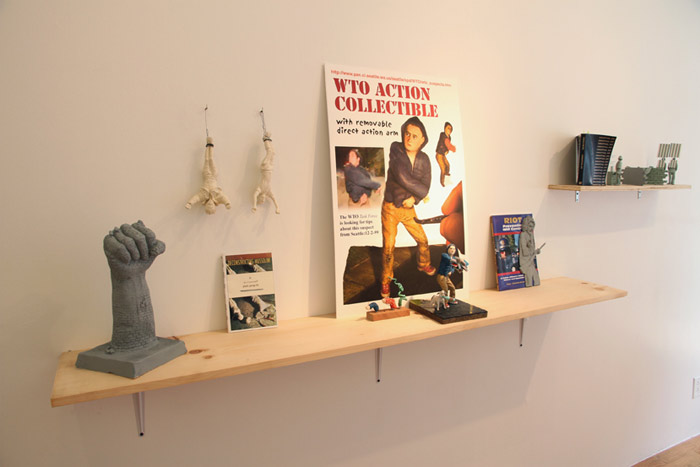
Installation view of assorted Greg Sholette collectibles, 2013. Image courtesy of the artist.
LO: But when did you become a teacher?
GS: Short version is that during the mid-1980s I also tried to run a business. It was a prop and model-making shop located in the Gowanus area. The techniques I still use in some of my art stem from this venture, which, shortly after the financial crash of 1987 collapsed along with the local advertising industry. I decided to get my MFA. Heading west I attended the University of California in San Diego where, between 1992 and 1995, I worked primarily with French new wave filmmaker Jean-Pierre Gorin. No, I wasn’t making films (though I taught film theory), I was instead creating installations and sculpture influenced by cinema. After that I returned to New York as a critical theory fellow in the Whitney Independent Studies Program (ISP) where Benjamin Buchloh, Mary Kelly, and Ron Clark encouraged me to write about the kind of collective, political art of PAD/D and REPOhistory. It was excellent advice. But even with all this education and experience finding a teaching position took a long time to land. Its even harder today.
LO: Do you think the art world has gotten out of hand in terms of money and class elitism? Would it be better to go back to the good ol days of Max’s Kansas City and Warhol’s Factory?
GS: Those particular good ol’ days were somewhat before my time Leah, though I did arrive here as the East Village scene unfolded in the 1980s. Young artists showed their work in galleries like Nature Morte and Fun Gallery and also at various clubs including the Palladium, Danceteria, and Pyramid. Some even sought to reenact aspects of a 1960s SoHo they had only read about in magazines including Warhol’s Factory. In general East Village art was a compilation of campy gestures, or perhaps campiness to the second power, and its ironic self-consciousness dovetailed neatly with dominant versions of post-modernist theory.
LO: Where did you fit into this “scene” then?
GS: Yeah, well my outlook, as well as that of my friends and collaborators, was pretty skeptical. PAD/D for instance produced a critical parody of the East Village art scene in 1984. We claimed to open up four “new” galleries showing anti-gentrification art. In reality these exhibition spaces were just boarded up buildings on street corners east of Second Avenue. We named them “Discount Salon,” “Another Gallery,” and the “Guggenheim Downtown.” For several weeks that summer a group of about eight wheat-pasted posters denouncing real-estate speculators and spray-painted stencils calling on our peers to fight the displacement of low-income residents.
LO: Artists fighting gentrification? Did it work, did you reach your audience with the message?
GS: Yes, and no. But one way or the other our ersatz art venues and the actual galleries they satirized were soon enough replaced by trendy restaurants and boutiques.
LO: So things have really changed for the worse?
GS: Also yes and no. I mean maybe the feeling today that the art world has been swallowed by hedge fund operators, global real estate tycoons, and finance capital is not entirely new, no, but you could also say it is really like the 1980s art scene turned up full volume.
LO: That seems pretty bleak, no?
GS: Thankfully there is still push-back by artists and their allies. I am thinking of Groups like Temporary Services, Aaron Burr Society, Chto Delat, and Pussy Riot and many others who continue to do the kind of resistance PAD/D and REPOhistory were engaged in today, just as PAD/D and REPOhistory were continuing to do the work of Art Workers’ Coalition, Black Emergency Cultural Coalition, and Angry Arts and other groups that came before them.
LO: What about your own work? You might best be described as a conceptual artist and a political activist, writer, curator and educator, yes?
GS: Conceptual Art? Right because of my association with Haacke, Gorin, Lippard and the ISP of course this aligns me with this legacy. I guess that is true in a way.
LO: Correct, though?
GS: It’s an honor to have my art connected to theirs. Then again, labels are hard to make peace with (as much as they are impossible to live without). So yes, while I do try to maintain a theoretically informed practice at the same time my work does not look like “conceptual art.” In fact it often seems just the opposite: hand made, figurative, with low-brow, pop-cultural references. Sometimes my art even comes off as conspicuously “rearguard.” I mean, over the years my projects have made use of an odd assortment of things such as artificial plants, diorama techniques, comic book imagery, miniature tableau, and sculpted action figures in order to present narratives about history, class, and political injustice.
LO: So what is your working process like?
GS: Hard to describe, but I just finished David Joselit’s recent book “After Art,” and thought for a while I had the answer. Joselit starts off discussing the far too many images that are constantly coming at us from the Internet, advertising, cinema, TV, etc… And then he counter-intuitively argues that “art” is not getting lost in this image-blizzard. Instead it has become a powerful generator of what he calls format. What is format? He explains that if traditional artistic mediums lead to object making, then format establishes patterns that create links and connections across images and long threads of content. The format therefore, is how an artist re-uses images, or ideas in order to produce a work. One of his favorite examples is Pierre Huyghe whose art always changes form, but there is a range of ideas lurking behind each piece. So After Art is when artists stop making discrete “works” and instead reiterate and comment on existing materials, sort of like recycling with a mission.
LO: I can see a certain connection to what you do Greg.
GS: Me too. But then when I finished After Art and really thought about it I realized that if Joselit’s concept is correct, then my work suffers from format failure! I mean he subordinates mediums, materials and content to his morphing paradigm. But I still retain a relationship with all three in my “expanded” practice. When I make art, or when I write a text for that matter, I find that I am assailed by the specific concrete nature of form and content.
LO: Please Explain.
GS: Lets say I am trying to write about the concept of the archive. Despite every attempt to discuss it conceptually, I know sooner or later that I will be forced to dip down into the archive’s specificity: its sprawling mass of missing practices, lost details, and dog-eared documents. Its as if some archive-agency commanded attention from below. And this dusty dark matter force tears up holes in smooth surfaces and turns abstraction pathological.
LO: A conceptualist!
GS: Ok, why not. Because what has shaped my art and its working process is less some profound inner drive to become an “artist” (although I admit I am as attached to that romantic idea as anyone) and is much more like the result of a string of fortunate encounters involving certain individuals and groups, certain institutions and historical moments, even certain objects and materials. As much as I would like to claim I am in full command of this process it’s a collaboration of sorts, a collaboration with the past –thus my interest in archives and history– as much as it is with the future expectations of a more egalitarian society. So that when all is said and done “art” is for me at least the way we think thought in material, plastic terms, but also reciprocally, it is how certain events, ideas, hopes and encounters become thinkable to us. And it’s a process that sort of bypasses our best attempts at exercising total authority or control over it.
LO: What are your upcoming projects?
GS: I am currently working on a new iteration of Imaginary Archive (http://www.gregorysholette.com/?page_id=587) for Kiev Ukraine this Spring, which, given the situation there should prove pretty compelling. I am also continuing to add chapters to my graphic novel Double City, and I am especially looking forward to the solo exhibition of new work I am preparing for Station Independent Projects in the Fall.
LO: What advice would you give an artist who has just arrived in NYC and who is not sure where to begin?
GS: Do your research. Seek out like-minded people. Map out the terrain. Stay tough.
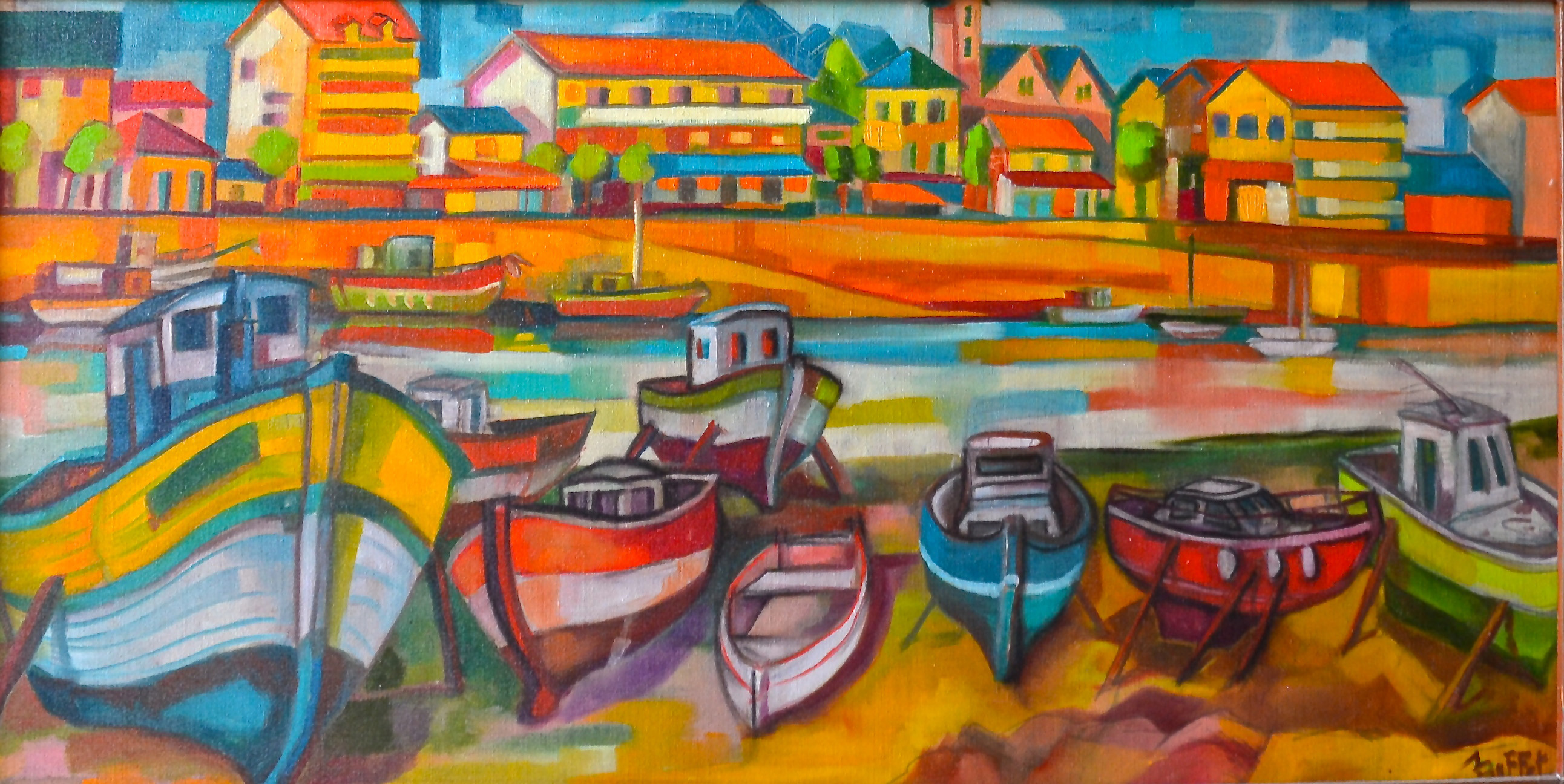
Image courtesy of the artist.
I have studied architecture several years before becoming an autodidact painter. Colors, people, and buildings combined in my oil paintings are created to be shared with you. I get inspired with very different themes: harbors and people on beaches from the French western coast where I live, tango and pubs’ friendly ambiance, the circus of our childhood, and, of course, architecture. I work daily in the very heart of my house and family. This is the origin of my inspiration and where the energy of my creation comes from. I am a happy painter!
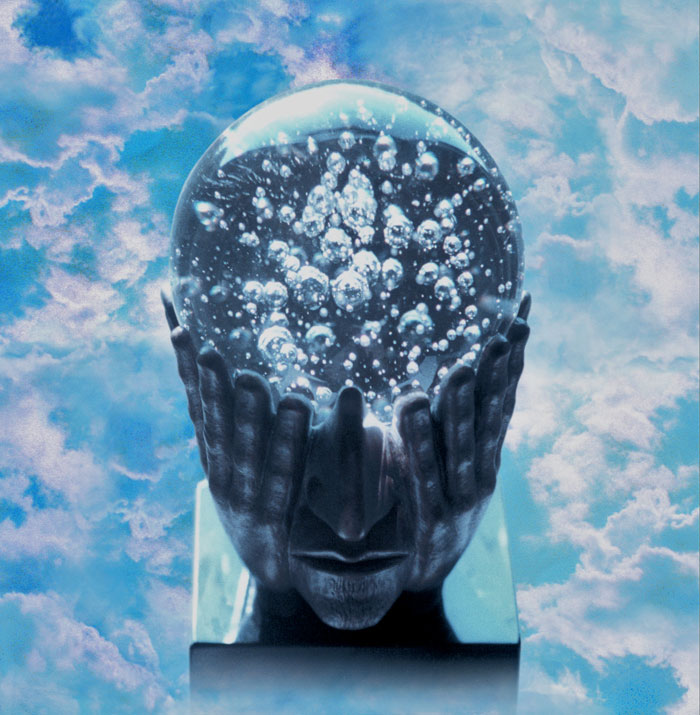
Image courtesy of the artist.
In my work I follow the traditional form of sculpture but also include some modern elements. A human in a calm, contemplative state, deep in dream or meditation is the most interesting theme for me. I strive to transfer into my sculptures the human world inside its own mind, when one is calm inside his own world.
I work intuitively, with no pre-conceived plans. I don’t analyze what my work means or try to express any particular idea. A visual image comes to me, and I make a sketch. When I start sculpting, it often changes, taking on a life of its own and sometimes developing into something quite different. Materials are important. An unexpected juxtaposition of contrasting materials, like bronze and glass, attracts and inspires me. I think the creative process is a part of my quest for self- knowledge.
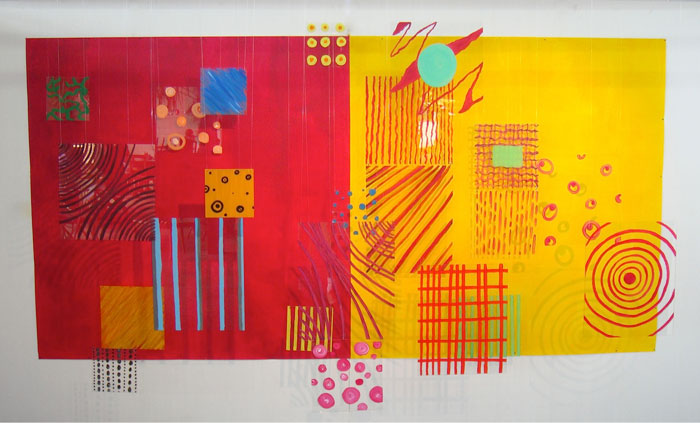
Image courtesy of the artist.
My work aims to take a fresh view on what you see, far away from conformity. It is not that I take on a distant or distinguishing view: it is rather through my very personal and individual perspective and power of expression that the work speaks to the spectator.
Living today in a world with multiple stimuli from all kinds of sources, I visit my inner spiritual inspirations and thoughts rather than the external world for my work. I combine and compose different shapes, moods, and colors to become very close to nature, the nature which gave birth to all of us and which is still inherent in us.
Isabelle Habegger studied from 1994-1998 at the University for Design (Schule für Gestaltung) in Zurich. She is also a sculptor; Art teacher and a performance artist.











