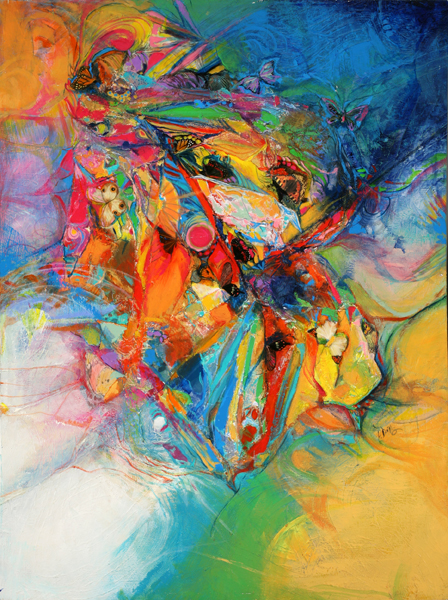
After earning my BFA, my career took the path of graphic design; however, my body of work encompasses a variety of styles including realism, portraiture, and charcoal drawings. Abstractions are my favorite creative release. I’ve always been interested in color, texture, and patina, and they pave the way for each of my abstracts to evolve. I have no color plan, fear, or direction, leaving my mind open. These paintings are truly mixed media: layers of sculpted compound fibers, shells, insect wings, and charcoal; anything I find can serve as inspiration. I continue to marvel at the spiritual energy that guides me in the process.
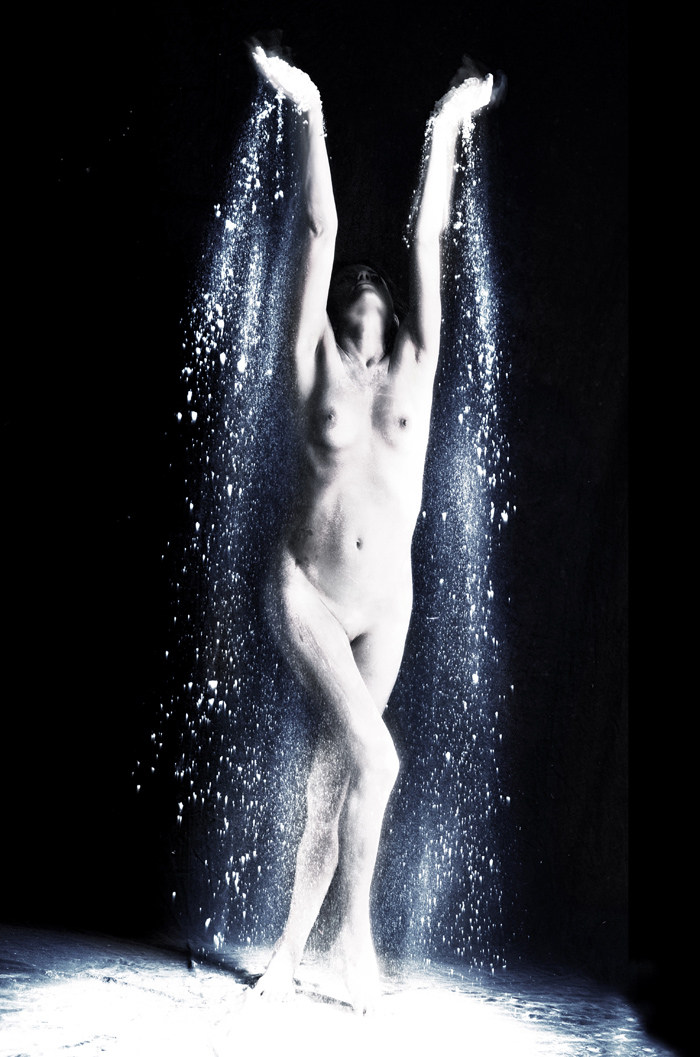
My shots come from the instinct of the soul.
My main distinctive works are self-portraits, which have a strong emotional impact.
Through the image of my body, my hands, and my face, I want to stimulate deep inner reflection and introspection and to communicate freely without barriers.
I create the images using touch-ups to a minimum, and a perform them on my own. The photographs convey energy and light and involve the viewer beyond its pure aesthetics, with very intense suggestions.
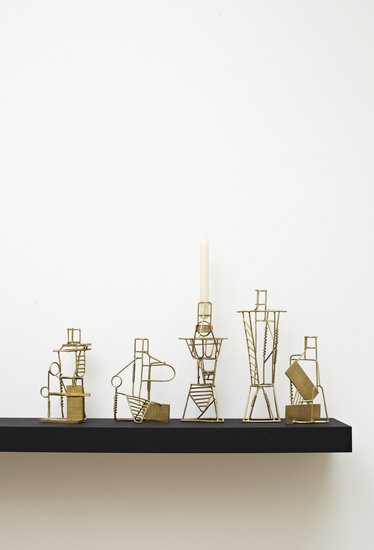
Featuring: Anton Alvarez, Fabien Cappello, Philipp Grundhofer, Simon Hasan, Hunting & Narud, Peter Marigold, M/M (Paris), Nicholas Le Moigne, Paola Petrobelli
Drawn From
January 14 – March 1, 2014
Gallery Libby Sellers
41-42 Berners Street
London
libbysellers.com
Vincent Desiderio is perhaps settling too comfortably into the role of master. Long considered one of the more skilled and thoughtful painters of our generation, his impressive 2011 showing at New York’s Marlborough put him amongst our best. The exhibition remains a peak moment in Desiderio’s career, where decades of discipline, contemplation, experimentation and deliberate execution came together in an inspired and powerful grouping. His Mourning and Fecundity II, I liberati, and Sink are contemporary masterworks, while little else in the series fell exceedingly short. The collection spoke of an artist in that perfect present tense, aware as much of a considered audience as in the assured lead of his own explorative hand. The best of these paintings hung with a consciousness above craft, their ranging stories both lucid and open. You do not stand in front of Morning and Fecundity II without wending imaginatively through the grave hours prior, nor is it possible to stave away the nearer end. The effect, long one of the great pleasures in Desiderio’s work, is a movement within and beyond the canvas that feels wholly cinematic.
Little of that movement exists in the new collection now on view at Marlborough. And though the theme of this series is “reification,” which suggests a solidification that might intend a termination of movement in the technical narrative as well, too many of these paintings nevertheless feel inert beyond the theme, which should not preclude a heartbeat.
Two works in particular highlight the contrast. In Transubstantiation, one of few paintings in the exhibition with any kind of pulse, we are witness to a collection of statues in an Indian temple. That they are statues indeed warrants scant motion upon the canvas, and considering the theme it is what we might expect. Parrying those expectations, however, Desiderio charges these figures with animating energies that bring them fluidly into being. They are not just alive, they are actively so. This “activity” is borne out mostly in the technical landscape of the painting—a push of orange from a severed limb, prods of shadow, the weighted applications of legs, the bracketing of bodies and positioning of hands—all nudge the eye inward toward a highlighted rump, then onward and around. The movement in itself generates a kind of sub narrative in the painting we are obliged to participate in, be it consciously or not. Our contribution here is in reading motion into the hips; an erotic thrust that course upward and outward through each of the four figures, infusing each with an enlivening, sensual spirit. The figures spark alive at the play of our eyes and in that instant their entire domain shamanically shifts. Transubstantiation becomes the most interesting piece in the show because the artist forges pathways on a technical level that encourage a reciprocal viewing. The painting opens itself to the eye and allows our imagination to wander and take root. It comes alive because we are the living presence moving through it. We, then, become comrade in the artistry.
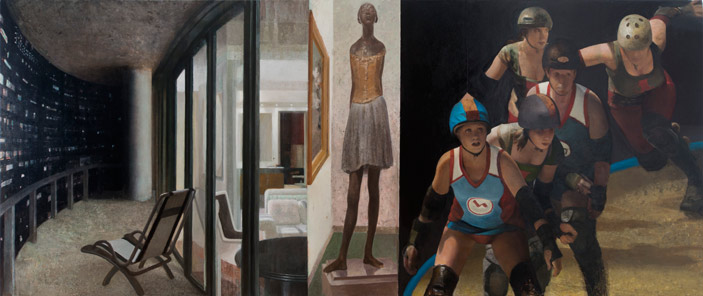
Ekphrasis, on the other hand—an enervate triptych mere footsteps down the wall—attempts to capture in one of its three panels an instance of outright motion: five stop-framed skaters in a roller derby match. Roller derby is that grand spectacle where teams of women brawl and spit and elbow each other headlong out of the rink—a pleasurable display of thuggery that generally whips the crowd into a playful frenzy. The sport, the women, and the crowd all allow wholesale license for the artist himself to be equally playful in the rendering, joining in his subject’s good fun, but Desiderio will have none of it. What he gives us instead is a sour, sad little portrait of women who are more skittish than draped in natural swagger. They mope, as if shrinking from some stern scolding. Observing them is no easy task (nor is it pleasant), for nothing in the scene pulls us in, particularly not these symbolic creatures, but nothing in the artistry as well. There are the gauzy delineations of craftsmanship, but the effect is thin and insubstantial. Worse, the image is utterly devoid of presence, which makes our viewing slightly unsettling because a suspicion creeps in that the Desiderio we’ve warmed to over the years has in the interim been snatched off by Pod people. As with the Pods, something of a replacement hand feels at work here, one fallen soft, somnolent, and one-dimensional. Lacking in particular is any distinctive voice, which in absence strangely unspeaks the painting’s title.
“Ekphrasis,” by the way, literally means to “speak out,” and it refers to the act of describing an object of art in a dramatic and lively manner, as when, for instance, a poet describes a vase. Keats’ Ode on a Grecian Urn is a high example of ekphrasis. The artfulness of the description is part of a long rhetorical tradition dating back to the Greeks who laid out rules as to how an ekphratic description should play out. Implicit is the obligation on the part of the storyteller to communicate the essence of the art piece—its timeless nature, its internal poetry—so as to conjure in the mind of the audience a vivid representation. The third panel of Ekphrasis clearly fails in that obligation.
But so too does the second. The middle panel in this large triptych is a sliced view of Degas’ bronze sculpture, The Little-Fourteen-Year-Old Dancer, though lost are the curves and bursting adolescence of the original. Desiderio’s depiction, far from being in the ekphratic tradition, is more egregiously dispirited and dull. His languorous dancer is either tired, bored or simply can’t be bothered. She is given 1/8 of the canvas to express herself and, frankly, even that feels too much. Its tandem placement with the skaters, rather than producing an interesting juxtaposition or an amplifying linkage on some compelling idea, instead only siphons our interest further off. By the time we’ve taken in the complete canvas, which includes in the first panel a terrace view of an apartment/office bloc, we, like Degas’ stand-in, can no longer be bothered trying to thread meaning into the disparate, if impenetrable narrative.
Ekphrasis emphatically fails, and for many of the same reasons so too do the majority of paintings in this listless exhibition. One feels the artist has become overly bound in his own rigorous discipline and is now trammeled in ways no longer healthy to a lyrical, creative expression. Karloff’s mummy in The Awful Indifference (a lovely new work!) might offer a word of caution against wrapping oneself too tightly in the cloth of the ancients. Apart from the intellectually stimulating Three Acts of Defilement, which reads as a tacit indictment of the art world, few other paintings in this new series have anything to say that hasn’t gone buried in hermeticism and glaze. On display here are the exquisitries of craft, and that is not enough.
By Christopher Hassett

Featuring: Tanyth Berkeley, Michael Cline, Chantal Joffe, Makiko Kudo, Eddie Martinez, Amy Bessone, Nicole Eisenman, Kasper Kovitz, Nathan Mabry, Justin Matherly, Dana Schutz, Denis Tarasov, Alexander Tinei, Andra Ursuta, Marianne Vitale, Jansson Stegner, Henry Taylor, Francis Upritchard, Helen Verhoeven
Body Language
November 20 – March 23, 2014
Saatchi Gallery
Duke of York’s HQ, King’s Road
London
saatchigallery.com
Sreshta Rit Premnath
January 25 – March 1, 2014
Kansas Gallery
59 Franklin Street
New York City
kansasgallery.com
Creativity and art can bring society towards a more responsible and sustainable world. With this, the final phase of Michelangelo Pistoletto’s work, one which looks to the future, the “Terzo Paradiso” (Third Paradise), is announced. The artist exhibits recent works and old pieces in an ongoing solo show at the Galleria Continua, which reflects eighty years of accomplishments, all created with the same dynamic energy.
Pistoletto has recently been awarded the Praemium Imperial and the Nobel Prize in Art for his painting. The Louvre in Tuscany has given him international recognition for his quadri specchianti, (Mirror Paintings) which have been at the center of his poetry from the early sixties. This work continues through to his last few pieces, Vortice (Vortex) a pair of works in black and white. The consistency of his research is evident from his projects conceived in 1976, contained in the essay “Cento mostre nel mese di ottobre” (One-hundred Exhibitions in the Month of October), some of which have been realized and exhibited with a surprising modernity.
Working for everyone, there is an inscription on a wall ironically closed by four cages that states, “Art is always free.”
Pistoletto states that, “Freedom brings a responsibility, both of which finish in change.” This is illustrated and ties together the recent production of “Terzo Paradiso,” the hallmark of which is a thematic symbol of a stylized infinity. Three juxtaposed circles have been drawn which represent original nature, the artifice of present-day society, and the grembo generativo (generative womb) of a new phase which will change the relationship between humanity and the world. The artist states,
“The perspective—one born in Florence in the fifteenth century—has shaped the world by bringing new modes of progress, but today this phase has concluded. The new renaissance should be put in motion, and thus I have called it Terzo Paradiso. This sign is the new perspective. It is not personal, but perspective, and it speaks of a rapport between the infinite and the finite, between the nature of the first paradise and the artifice of the second paradise, and of the need to return them to a state of balance in order to enter the third phase.”
Challenging the Mayan prophecy, Pistoletto declared December 21, 2012 “Rebirth Day,” the day of rebirth and the year zero. This date recurs every year and will serve to reflect upon his progress in the future. There are big plans linked to the new infinity sign, which is going to be drawn in the sand, sculpted in stone, projected in silhouette through a light and lined with rags, and drawn by people in public performances. It has also become the symbol of a “Manifesto of Sustainability in Italian Fashion,” a guidebook which promotes the sustainable and responsible production of textiles.
The final area investigated by the creativity of Pistoletto is music, in recent collaborations with Enrico Rava and Gianna Nonnini, and with the Tuscan percussion orchestra of Bandao.
By Bianca Nasi
For his first solo exhibition in New York, Jesse Greenberg reveals himself as a sensual materialist who balances freely between the two seemingly incongruous worlds of the natural and synthetic. The works range in scale from midsized to small sculptures and reliefs, and are arranged in a way that is comfortable, intimate, and results in an installation that is not too sparse or crowded.
Warm, transparent, hues of honey and coral, alongside lush ultramarines, powder blues, deep purples, blacks, and cool whites, result in a palette of harmonious tranquility. The colors are subdued and muted aside from a rebellious burst of monochromatic hot pink emanating from a hanging wall sculpture nestled in the corner.
Greenberg’s approach to abstraction is not a transcendental experience, instead it’s very earth bound, celebrating corporeality. Seduced by materials, Greenberg reveals an expansive knowledge of his favored medium from piece to piece, manipulating urethane resin and pigment. Although there is an underlying structure and plan throughout all the work, whether it’s the molds used in the process or the hard-edged, geometry of the welding, Greenberg still allows the powers of chance and accident to come into play. This brings to mind the process artists of the sixties, and specifically Lynda Benglis.
Two pieces stand out because of their larger scale and their prominent placement on the first wall walking into the gallery. They seem bodily, in that the fleshy, transparent resin adheres to the welded skeletal forms. The one to the left has a simple, black, tumescent welded bar running through its middle. A chalky, mid-hued blue and black color scheme creates a mood of somber elegance. The sculpture hanging next to it is equally long, but slightly narrower. The more intricate rectangular, orange metallic under structure, along with its sunnier, amber colored resin, together create a nuanced contrast to its companion.
Three brick sculptures, each on their own pedestal are neatly placed in a diagonal line, in front of the two wall sculptures. Each of the bricks is not completely formed, and the inchoate quality imbues each brick with a tenuous sense of instability. If bricks are the building blocks of civilization and architecture, then Greenberg’s bricks are the remnants of time, and entropy, from a place in which ideals of progress and advancement are irrelevant or no longer exist.
Five smaller tablets hang in a straight line to the left. Their translucent surfaces ooze, percolate, foam, drip, and quiver with climactic enthusiasm. Reminiscent of both mucous as well as bacterial cultures, the finishes become simultaneously enticing and repugnant. All of these works provoke and tease the viewer with their contradicting mixture of decoration and repulsion. Shredded, torn, and embedded with bb pellets, both the forms and materials evoke violence. The ferocity along with the fetishized, sultry surfaces are reminiscent of the sadomasochism of Alexander McQueen. In the end, Greenberg achieves his own chilling and perilously engaging vision of sinister beauty.
By Irena Jurek
Björn Meyer-Ebrecht and Osamu Kobayashi
January 31 – February 23, 2014
Storefront Ten Eyck
324 Ten Eyck St
Brooklyn
storefrontteneyck.com
Anna-Sophie Berger
January 26 – February 23, 2014
JTT
170 Suffolk Street
New York City
jttnyc.com
-
Tarsila do Amaral: Inventing Modern Art in Brazil
Tarsila do Amaral: InventingModern Art in Brazil “I want to be the painter of my country,” Tarsila do Amaral. Her signature style was ... -
ASIA WEEK MARCH 15 – 24,
15 Thu 16 Fri 17 Sat 18 Sun 19 Mon 20 Tue 21 Wed 22 Thu 23 Fri 24 Sat... -
NYC ART FAIRS MARCH 2018
The Armory Show March 8 – 11, 2018 New York, NY NYC Art Fairs March 2018 The New York City Art Fairs for March is referred to as Armor... -
17 Cuban artists: All That You Have Is Your Soul
Dear Abraham, Gallery 8 New York opens in Harlem next Thursday with an inaugural exhibition 17 Cuban artists from FACTION Art Project... -
Currents: Abortion A.I.R Gallery January 4-February 4
Abortion is our country’s Scarlet Letter, an impassioned “A” writ large on our conscience. We shame, blame and deny wome... -
CURRENTS: ABORTION
CURRENTS an exhibition in which artists respond to the theme of ABORTION. In this turbulent moment in history, abortion remains a signifier ... -
No Image
Guantanamo art in NYC makes Washington nervous
“Untitled (Alan Kurdi)” [Courtesy of Muhammad Ansi/John Jay College]... -
No Image
7th Moscow Biennale
Being late to speak at the 7th Moscow Biennale, I try the Russian car service Yandex, rather than taking the ornate Moscow subway. My driver... -
Louise Bourgeois at MOMA
The MOMA exhibit, Louise Bourgeois: An Unfolding Portrait, showcases the prints, books, and creative process of the celebrated sculptor Loui...


br> br>