• Image courtesy of the artist.

    Image courtesy of the artist.

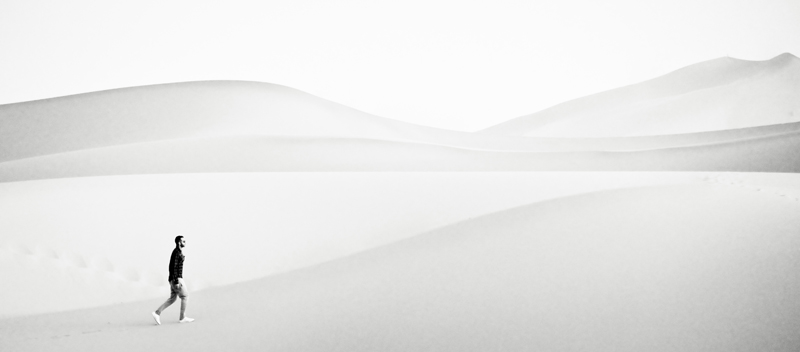
    When we off-load our certainties and drop our conditionings, when looking at things as if they had never been contemplated before, free of any definitions, interpretations, or value judgements; then the reality appears as it really is—enlarged and filled with beauty.

    That’s what I am trying to convey with my artworks; throughout anthropologic, fine art, and dreamscape photography, by sharing a broad and unexpected vision on life, nature, and humanity, their primordial beauty and essential benevolence, a kind but deep invitation to renew our point of view and perspectives.

    nabilghandi.com

    Associated Gallery is an artist run space fueled by the combined energies of artists Jen Hitchings, Theresa Daddezio, and Julian Jimarez-Howard. They recently got together with Leah Oates to talk about what it means to be young artists running a gallery out of Bushwick.

    Leah Oates: How did Associated Gallery form and what is your collective vision for the gallery?
    Associated Gallery: Associated evolved out of Weeknights Gallery, a previous curatorial project that Jen had been running in her studio at The Active Space. When time came to renew the lease in the space, Theresa and Jen, who are both painters and had neighboring studios, thought to combine forces and share studio #28 for painting and turn #27 into a full gallery, which became Associated when they asked another friend, artist, and curator, Julian Jimarez-Howard, to join. We collectively aim to engage the community of artists and showcase those who are underrepresented. We also have aimed to bring totally new ideas to the curatorial world, like with our plant show, “You Are My Sunshine,” in the fall, which received a Critic’s Pick by Jerry Saltz in New York Magazine.

    LO: Bushwick has a thriving art scene composed of galleries, non-profits, artists studios and performance spaces. How do you see Bushwick changing and growing and is it the place where the newest, freshest art is being created and/or is its now getting to expensive to pull these things off as much?
    AG: We were just talking about this! We are excited for the possibilities that the growing community lends itself to, but also nervous that the increasing rent costs will drive out the thriving art scene before artists really have a chance to settle in the neighborhood. We are worried that Bushwick is becoming more about commercial consumption rather than artistic production. This might seem to be good news for us as a gallery because we rely on people buying work from us (hey collectors!!), but it’s a kind of double-edged sword as we constantly consider the eventuality of being priced out of this neighborhood that we all consider home, or even worse, being stuck in an overly commercial and artificial neighborhood, like what has happened in lower Manhattan since the 80’s.

    LO: Are the three of you artists and what do you think of artist run spaces?  There seems to be a resurgence of artist collectives and artist run spaces in the NYC area. Do you think that artists bring something to the table that non artists do not?
    AG: We are all artists actually. But our energy as a group isn’t really like an artist collective. Artist run spaces like ourselves, Regina Rex, or Parallel Art Space operate like a standard gallery, showing the work of other artists, and not our own work. The fact that we are artists definitely informs our curatorial approach and aesthetic, but at the end of the day, at Associated, we’re three curators working together to create professional and compelling exhibitions.

    LO: What advice would you give to emerging artists who are just out of BFA/MFA programs or who have just settled in NYC?
    Julian Jimarez-Howard: Buy lots of vegetables because they’re cheap and healthy, even better, farm them.
    Theresa Daddezio: Stay positive and motivated.
    Jen Hitchings: You have to work together, and stay in touch with your mentors/professors.

    LO: Who are your favorite artists and why?
    TD: Artemisia Gentileschi because she’s badass.
    JJH: Gabriel Orozco and Francis Alÿs have been decent sources of inspiration for me over the years, but really my favorite artists are my friends. I think that probably goes for all of us, though.
    JH: Allison Schulnik, John O’Connor, Lisa Sanditz, and some musicians such as The Caretaker, since music makes a big impact on my painting practice.

    LO: What shows and projects do you have coming up at Associated Gallery or elsewhere.
    AG: Our next show, opening in late February, is a group show of artists who work with materials in the outdoors, or who create work that exists just outside of the “art world.” It’s a broad take on “outsider art.” The following show is a two-person exhibition concerning landscape, and in May we will be showcasing some BFA candidates from SUNY Purchase (where Theresa and Jen graduated are alumni). We hope to eventually have some exhibitions travel elsewhere, but that’s an idea for the future.

    It’d be funny to say that Konrad Smolenski is someone you will soon have heard of. Already a pretty big deal throughout Europe, he had the honor of representing Poland at the Venice Biennale this year and made quite the lasting impression. The exhibition, titled Everything Was Forever, Until It Was No More situated two handcrafted bells, a large standing wall of broadband speakers, and a third element consisting of a wall comprised of familiar yet nondescript square metal doors within the exhibition space. The elements worked as a sonically symbiotic structure in that the periodically sounding bells would be coerced to ring out simultaneously, their sonic expulsions being recorded and played back through the wall of speakers within the exhibition space, one wall of which was this harsh, aurally reflective and unforgiving skin of metal.

    In a certain light, Smolenski’s entire body of work seems to be encapsulated within this project. Having learned a lot from his time working as a student in an influential sound lab in the Fine Arts Academy of Poznan, Smolenski always saw audio and visual art pursuits as being two elements of the same exploration. From Smolenski’s view, sound work seems to be the contemporary zeitgeist in the Polish art scene. More and more visual artists are beginning to express themselves within the realm of audio art, in part stemming from the forward thinking of a scene growing out of the audio culture fostered by sound labs, including the one where Smolenski got his start at the Fine Arts Academy of Ponzan.  It’s an exciting trend and Smolenski finds himself right in the thick of it.

    One of the artist’s more exciting current projects is being an elemental member of the band BNNT.

    Acting as a duo, Smolenski teams with Daniel Szwed to become two members of a sound-bombing experiment, traveling about performing sonic assaults on improvised public settings, gallery spaces, and musical festivals as BNNT. The project has been ongoing since 2007 and serves as a fitting example of Smolenski’s understanding of art being equal parts audio, visual, and performance; a creative cocktail of expression which the artist sees as integral pieces to the same experiential puzzle. Smolenski’s work seems to present a disdain for making distinctions between audio and visual creations, about this the artist states, “There are no definitions or clear cut distinctions. I try to blur them in search for a total reception…Often the perception of art is limited by habits. I aim at creating a more open experience.”

    BNNT’s sound is raucous and dissonant, ominously dark and distorted. Incorporating recorded elements such as political speeches, crowd grumblings, and other sonic disruption to build a sonic output defined by a feeling of unrest and unease, the work as a whole seems very much about the nature of politics both in the subjects approached by their songs and the nature of how they put together performances.

    The DIY style of their work is immediately present in their mobile truck stage, guerrilla approach of their often unannounced shows, and outfits styled after balaclava-wearing revolutionaries and other agents of forced change and dissatisfaction. Smolenski’s creation of a baritone electric guitar with a body styled after a hollowed out tomahawk missile adds the finishing touch that points to a need to be taken seriously as a carefully considered art performance bent on change.

    The work seems appropriately timed given Smolenski’s ideas about the lack of open minded-ness in the public’s approach to art paired with the state of flux and economic difficulty the European union has undergone as of late.

    The venue that seems likely to be the most in need of the change Smolenski and Szwed can provide would probably be the world of art, although it is hard to say in most instances whether politics guides culture or if things actually happen the other way around. We are pulling for the latter. In either case, the next time the BNNT rolls into town we would all do well to bum a ride.

    By Matthew Hassell

    Coinciding with their current two-person exhibition at Longhouse Projects, NYC, The Other Side and In Between, Christian Bonnefoi and Ana Cardoso had a conversation on painting.

    Christian Bonnefoi: The title proposed by the exhibition, The Other Side and In Between, names a divergence and modification of the rules of painting to the extent that the work’s realization is accomplished by and through the pictorial medium, having as its sole common denominator what we call the “tableau”.

    The Other Side is not a metaphysical or mysterious beyond but the obverse of painting in the material sense of the term, the back of the support; this reversal is not done in ignorance of its “face” (the surface and frontality):

    1) The reversal preserves its specificity because, in the last account, it finishes with the arrival of the surface.
    2) It adds another dimension or depth as its own proper space or, more precisely, as its “place.”
    3) Its location is not only a gap, i.e. a fragment of space, but also a spacing to the extent that it is a product of a movement (reversal), that is to say, of a duration.

    Therefore, the production of a place is the necessary condition for painting to remove itself from the conditions of space and to settle in those of temporality.

    In Between represents the containment of this space that doesn’t have, strictly speaking, figures but instead their possibility, both as: storage (quantitative) and in motion (qualitative). It’s a bit like memory: where stored layers of memories are reactivated. Painting has its own mode of activation or reactivation, which is technique associated with experiences.

    In general, for your work and for mine, it is about enlarging the pictorial field by giving it means that are apparently external. These means are outside of its field (place). That is to say: “in space”. This requires a further step that consists, after the spatial detour, of integrating this external input into the specific place that I call “tableau”. I call this operation of ‘condensation’ the conversion of spatiality into temporality.

    For my part, and for a long time, I have opposed the idea of ​​the end of painting. The many dimensions of the “tableau“ exceed the conception of painting imagined as simple material deposition on a surface.

    That is why I use the phrase ‘what makes the tableau’ [ce qui fait tableau] rather than the single word “tableau”, giving painting a greater extent than in its traditional sense.

    I find in your work comparable positions and I would like to ask you what is the path that led you to use painting as you do – as means [moyen] more than form?

    Ana Cardoso: I also think, starting with the idea of In Between, it implies the possibility of space (the exhibition space in this case) as temporary container, context, or score where the idea of a figure becomes the active counterpoint to painting. The “figure” is anyone; the body roams the space between the objects and triggers their potential connections.  I look at painting this way: in a timeline, an action with a history and a lineage. For me each painting is an element in an infinite proposition (1+1+1 … µ=1), making the process of painting continuous. Therefore, the installation is an open source and the paintings, objects in between, exist for the meandering “figure.” This presentation structure allows me to work from alternating positions.

    Moyen in French could be translated into medium, but painting now, this broad field, is post-medium. As you have also indicated, it is a way of working through which gestures emerge and submerge.

    Painting and abstraction are so inclusive and formative that they exist in contemporary practices which seek to avert them; they are a language based on assumption, now. My project is self-reflexive and heterogenic, with some circuits and knots between these categories.

    I like the concept you use, ‘condensation,’ to explain the event of painting. I think of it as ‘compression.’ Your work divides the surface back and forth between its temporal and physical interstices – up to a point. In my process, a multitude remains outside that surface and is literally linked as I compress materials of different shapes, planes, or origins. I enjoy the complexity resulting from the unexpected collage of objects and signifiers. I think of this as an effect or expansion on the discoveries of Cubism.

    For instance, I use the signifier of the chain-link fence to interlock the corner paintings to the concrete slabs filled with studio debris and then back to the modular panel paintings. The traced silhouette figure that appears in the fence painting is my template for the body, which I think of as an enabler (it could be myself, the painter). The fence becomes the vernacular of this installation, the stitch between each work.

    Painting happens between the surface and the body. That space contains an activity. I’m interested in the totality of painting, the whole suite of historical and unconscious connections that drive you through the potentiality of the visible. I link material surplus to signifiers that are anchored in the history of painting itself. Painting is inclusive and generative, and as a woman painter, I’m interested in looking for anchor points in a predominantly male-centered, modern history. So, painting’s structure allows me to work from within my own unstable and displaced position, where syntax or style can be subjectively privileged over semantics, so to speak.

    Another space that I find generative in this exhibition is the gap that lies between our two bodies of work and our different positions. Historically, you, Christian, have a specific place within the history of abstraction and material painting. Also, you formulate fluently on your process. For you, painting is a practice where technique holds meaning, not as medium specific but as a specific becoming. I know that you have very precise thoughts on the event of painting, its process, and its emergence.
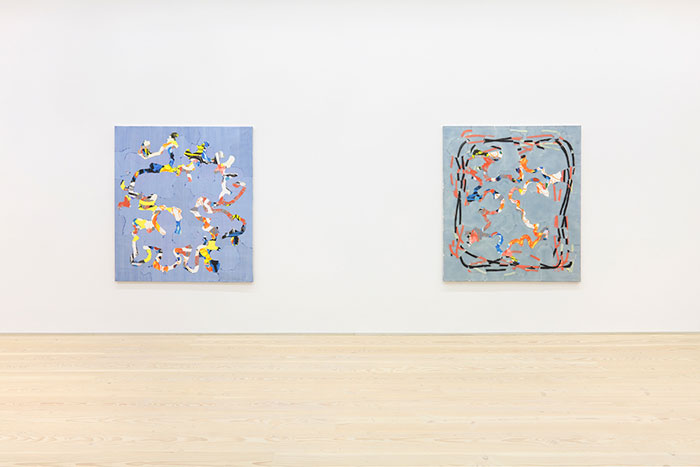
    Christian Bonnefoi, Installation view, The Other Side and In Between, 2013. Image courtesy of Longhouse Projects.

    Christian Bonnefoi, Installation view, The Other Side and In Between, 2013. Image courtesy of Longhouse Projects.

    Christian Bonnefoi: For my approach to technique I use Ezra Pound’s definition: “the technique is a way of fixing impression on the thing.” In other words, it is the conveyance of a sensation onto an object; it is, itself, the movement of sensitive material onto the material support and its inscription. As displacement, it embodies the process in its duration and gives it the time to extend. In this duration, the process, in turn, gives the technique – by way of the unpredictable events that it generates – the resulting amount of information that updates the project. Technique must then recompose itself to continue the development, which means that, if at first it is a condition for the production of form, it is also what the form transforms, at least giving it new directions.

    The consequences are that painting acts in two directions. One is the exhibition of forms produced by technique and process: the work (so to speak), the visible, the subjective. The other strengthens the methods of exhibition: the invisible part, the objective. In my work, I often use objects or structures which I call “machines.” These are the manifestation of that kind of objectivity that has no place in the work itself but that I show on the side: transitional objects, like devices. This goes into the history of ‘the machines of seeing’—the first model being without a doubt: “Brunelleschi’s experiment.”

    I give the technique an exhibition space of its own.

    It is the spacing that is never reduced (never disappears) in one or the other of its terms; thus, Cubist collage, which is without a doubt the most decisive ‘the machine of seeing’ of the twentieth century, is, on one side, the proper condition to the Cubist form, and on the other, it is a mode of transformation of reality in general and is seen across all the successive styles (Suprematism , Constructivism , … ) up to Matisse’s cutouts.

    I’ve introduced elsewhere (see the interview with J. Clay and Y. A. Bois in Macula) the difference between the mode of production (the technique) and the mode of exhibition (the form) in a very compartmentalized way, with the terms remaining strictly on their own. This was a critique of ‘process art’ where it seemed to me that these two dimensions merged during production to the point of reaching a tautological quality of the final image that is not unrelated to the ready-made. Observing Ryman’s paintings helped me understand that, to even take the counterpoint by inserting in the process a certain heterogeneity, by various means: introducing tension, a rhythm, and a polysemy that is the reality of technique in the sense that I understand it.*

    The result was, as opposed to installation, a re-elaboration of the concept of the “tableau” as a place that presents a form sufficient for itself, cut from space while maintaining in its material thickness the conditions of its own transformation.

    Now, I’m more interested in what I called the “after-tableau;” it is the movement of the process and its course, which constitutes the “tableau” as the most important of its steps, but which does not stop there and is all that pours into the visible. It has to do with the ‘mark’ and the ‘word’ Benjamin examines in his article On Painting, or: Sign and Mark. This is the sense of my wall compositions of collages.

    What is your point of view in relation to this distinction, collaboration, and conflict between the process and the completed form?

    Ana Cardoso: I used to imagine the relation of craft to painting as one that privileged labor over all, and I thought that was empowering. But, the process, as I see it, is a suite of experiments, mistakes, and events enabled by the drive to find connections. Techne, for me, is the very inclusive process of painting that encompasses the transitional installation phase—a necessary cut in the activity. My paintings are always suspended and unformed—I work around the “figure.” I incorporate transversal studio objects such as painting leftovers into the process itself; I like the process to be autophagic.

    So, form, and it does happen in the process, is another sort of cut or imposition in the ongoing investigation. It is the vertical axis versus the horizontal. When the paintings occur, at some point they leave the horizontal plane of production to become visible, “vertical,” placed on the wall. I sometimes like to stack them, to ‘pause’ them. This is again a moment of compression or maybe what you call condensation.

    Still about form, when I recently decided to work in the modular mode, I was conscious of the project’s utopian premises and interested in its web of connections, both symptomatic and indexed. I wanted to understand repetitive forms and thought of tiled surfaces, globalization, distribution, and the neo-concretist work of Lygia Pape. The modular paintings are viral, rhizomatous, harmonized, and efficient, and they shatter formality through their pattern tendencies and incompleteness as well as their excessive and infinite compositions.

    The project’s rule is: each square module is made of two sewn pieces of found fabric centered on the stretcher. On top of this structure, two triangles are painted along the seam, drawn from the sub-division of the square canvas into four triangles. Each module can rotate and assume any spatial position to match the adjacent module, or not. Soon after, I added the triangular subdivision as a shaped triangular canvas and enhanced the tensions of figure/ground. These are the ‘same’ triangles stacked in the corner of the exhibition at Longhouse.  The lozenges are derived from the negative space between four triangles.

    I think of Blinky Palermo and Ellsworth Kelly. Palermo’s formalism was mismatching, disarming, and followed an anti-monumental logic, one that was performative and portable. I read, in a recent exhibition of the complete Chatham Series by Ellsworth Kelly at MoMA, that Kelly worked with the principle of 1+1=1, which I mentioned earlier. It was the moment when he started joining two panels to make one painting.

    As a way to summarize our conversation, I was hoping you could end with telling me a bit more about your book, The Treatise on Painting. How do you approach this long history up to the present? Can you reveal some of it?

    Christian Bonnefoi: No problem. In fact, it deals with some of the things we have been discussing.

    I begin by focusing on a new definition of the “tableau,” considered as a place independent of space. “The place is something that the soul produces to gather images” (Albert Le Grand). It will be a question of memory: the ability of the “tableau” to store images of facts and events as well as methods and techniques which allow the stock to unfold again and re-emerge on the surface.

    I devote a section to technique and how, as a process, it changes over time. Through examples of specific works, I discuss how technique can change nature, become form, and return to its primary function. I also build on what I call “functions” and how artists have developed modes of intervention to reach a greater objectivity.

    Finally, I address something I announced in a 1976 interview in Macula that was left suspended, namely the “after-tableau.” This is most critical to the book. I see this as the consideration of affect itself, what reaches us, the spectators, beyond the material and the color. As for here “place, there is not” (St. Augustine). Much attention will be paid to the writings of Jean-Louis Schefer and his perspective of the continuous thread that runs from image to word.

    The exhibition will continue to be on view until February 28th, 2014.

    Jenn Dierdorf

    Smart Painting is an activity. Through this activity, the ten artists in this show pose a range of questions. At their most basic level these include: what does a painting look like? How was it painted? And what was it painted on?

    Featuring: Blake Shirley, Sharon Butler, Deborah Dancy, Zachary Keeting, Ben Piwowar, Jenn Dierdorf, Rob D. Campbell, Derek Leka, Clare Grill, and Tatiana Berg.

    Smart Painting
    February 7 – March 22, 2014

    Art Space New Haven
    50 Orange Street
    New Haven, Connecticut
    artspacenh.org

    I first learned about Bodega over three years ago when they were only on their third exhibition—a solo presentation of Nicholas Gottlund, an interdisciplinary artist who runs an exquisite press, Gottlund Verlag, between Los Angeles (where he now lives) and Eastern Pennsylvania (where he started it). The following month, one of my best friends and favorite painters, Michael Kennedy Costa, was asked to participate in a group exhibition there. When Michael came back from the opening in Philadelphia, I remember him telling me that the space and the folks who ran it were incredibly charming.

    I finally met Elyse Derosia and Eric Veit, the co-owners of Bodega, in October of 2012 when I was in Philadelphia to give a poetry reading across town. I felt fortunate that the reading was taking place during the run of “Floor Routine,” a group show featuring three of my friends—Ethan Cook, John Roebas, and Maria Walker. It was an insightful introduction to the space, as well as the owners’ ideas for the space, as the works and how they were arranged felt as if they were meant for the space and the other way around, which is a rare feat for a gallery to achieve.

    In March of 2013, I came back to give another reading—this time at Bodega. Like Michael and everyone else I’ve spoken with who has worked with them, I too have been charmed by Elyse and Eric. They are warm and inviting like small town B & B owners, yet whip-smart and ambitious, which is why I have no doubt they are going to prove to be an invaluable addition to the always-thriving downtown New York art scene. Over the course of their time in Philadelphia, they were regularly exhibiting artists who have come to be some of the hottest names in contemporary art. Some of the folks on this lengthy and varied list of rising stars include Joshua Abelow, Sebastian Black, Lucas Blalock, Elaine Cameron-Weir, Paul Cowan, Alex Da Corte, Sam Falls, Andrea Longacre-White, Ben Schumacher, Travess Smalley, Stewart Uoo, and Artie Vierkant.

    The lineup for their first New York show confirms that they plan to stay on the upward curve. They will be officially opening their new space on March 9th (6-9 pm) at 167 Rivington St., Lower Level East, New York, NY 10002 with a group exhibition, featuring Tomer Aluf, Sam Anderson, Tova Carlin, Rochelle Goldberg, Carlos Reyes, and Chloe Seibert. The exhibition will run until April 13th.

    Below is a recent e-mail exchange between me (from my somewhat new home of Los Angeles) and Elyse and Eric (from their somewhat new home of New York). 

    Keith J. Varadi: How and when did the gallery start, and how has it evolved?
    Bodega: The two of us and three other friends from college opened the gallery in Philadelphia in 2010. We had all recently moved to Philly and were really interested in creating a space that would provide artists with the time and space to make and show new work. During our three years in Philly, we worked with artists from all over the country, and we like to think that we expanded and fostered the art scene while we were there. We didn’t start with any preconceptions about what it should or should not be. We just rented a space and began putting together shows. Since then, we’ve grown to now publishing artist books and editions, as well as participating in group shows and guest-curating at other spaces.

    KJV: What inspired the move from Philadelphia to New York?
    B: Other projects beckoned the other three founders away from Philly, and the two of us felt ready for a change in location as well. We still felt very committed to Bodega, so we decided to move it to New York with us. It doesn’t feel like that big of a change so far, as so many of the artists we’ve worked with and people interested in what we do are located here.

    KJV: What sorts of differences do you see between Philadelphia and New York?
    B: There are so many differences. In a way, Philadelphia’s strengths are New York’s weaknesses and vice-versa. Philly is a very easy place to live and have a studio. Rents are cheap and the city is small, so transportation is easy. But Philadelphia is very much a small pond, in terms of artists, galleries, and critics. Relative to New York, there is not a lot of money in the city that goes to artists, and as a result, most artists have day jobs and there are very few career artists. For these reasons, the DIY and collective art gallery models flourish.

    KJV: What is the new physical space like, and how does it compare to the old one?
    B: Our old space in Philly had lots of character that was always interesting to contend with: an old elevator shaft, a lofted stage-like area, a trap door, and really gnarly old wood floors. The new space is considerably smaller, but it’s still the same shape. It’s as if someone just scaled down every dimension.

    KJV: The old space was located in a very specific area of Philadelphia (Old City); can you talk about your relationship with that space and that area?
    B: If there was a neighborhood considered to be the gallery district in Philadelphia, it would be Old City, but there are interesting contemporary art spaces scattered throughout the city. Although we didn’t aim to be located in Old City, it’s a pretty neighborhood and centrally located, so it ended up working out really well

    KJV: What were you looking for when you were seeking out a new space and location, and how much do you anticipate this new space and location will influence future exhibition planning?
    B: Location definitely matters. There is a big difference between a commercial street in a busy neighborhood, a third floor walk-up in a residential area, or a loft in an industrial district. But, at the same time, one could make the argument that location doesn’t really matter. I think that a lot of people who are aware of us to date had never been to the Philly location. The Internet enables the visibility of so much that would otherwise be inaccessible and the increasing importance of photography, documentation, and networks for visibility are perhaps the most drastic changes in art over the last decade.

    That said, we really value face-to-face interaction and were very pleased to find a spot on the Lower East Side that’s so easy for people to get to.

    KJV: What sort of programming are you planning for the new space?
    B: We plan on continuing to have exhibitions, performances, readings, and other events. Whatever feels interesting at the moment!

    KJV: Do you intend to represent artists and do things like participate in art fairs?
    B: We find it very important to support the artists we work with and think it’s possible to do so without using a representation model. We’ve considered fairs, though we haven’t participated in one to date. We can’t talk from experience here, but fairs present a lot of complicated issues for us. We have spent a lot of time promoting art and artists who aren’t necessarily part of commercial markets, and because fairs are so expensive, you can’t really go to one expecting to lose money. Participating in fairs then, seems like the opposite of what we strive to do otherwise. That said, we don’t think it’s impossible to participate in interesting and tactful ways.

    KJV: In addition to exhibitions, the gallery has also produced books, prints, and performances; what can people expect moving forward?
    B: More of it. All of the above. The performances and other temporal programming we’ve done in the past have been some of our favorites and will definitely continue to play a large role in what we’ll be doing in New York. We’re working on a few new book projects at the moment, including books with Kayla Guthrie and Dena Yago.

    KJV: Given the fact that you’re both artists as well as gallerists/curators, how do you balance these two practices, and how do the two affect each other?
    B: Running a gallery and curating other artists into shows has definitely broadened our network of artist peers. Doing studio visits and meeting new artists continues to be very inspirational to our personal practices. But, curating shows and maintaining a space takes a lot of time and creative energy, and sometimes takes over the ability to go to the studio.

    KJV: What are some of the most impressive shows you’ve seen recently?
    B: The Jason Rhoades show at the ICA in Philly was one of the strongest retrospective-style exhibitions we’ve seen. Andrew Gbur and Joe Brainard at Know More Games was also great. We were recently in LA for the art book fair and were able to go to Paramount Ranch, which was cool, complicated, and fun.

    Bild-Nr

    Image courtesy of the artist

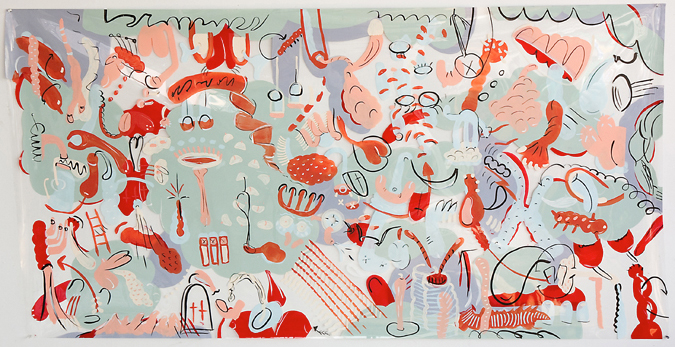
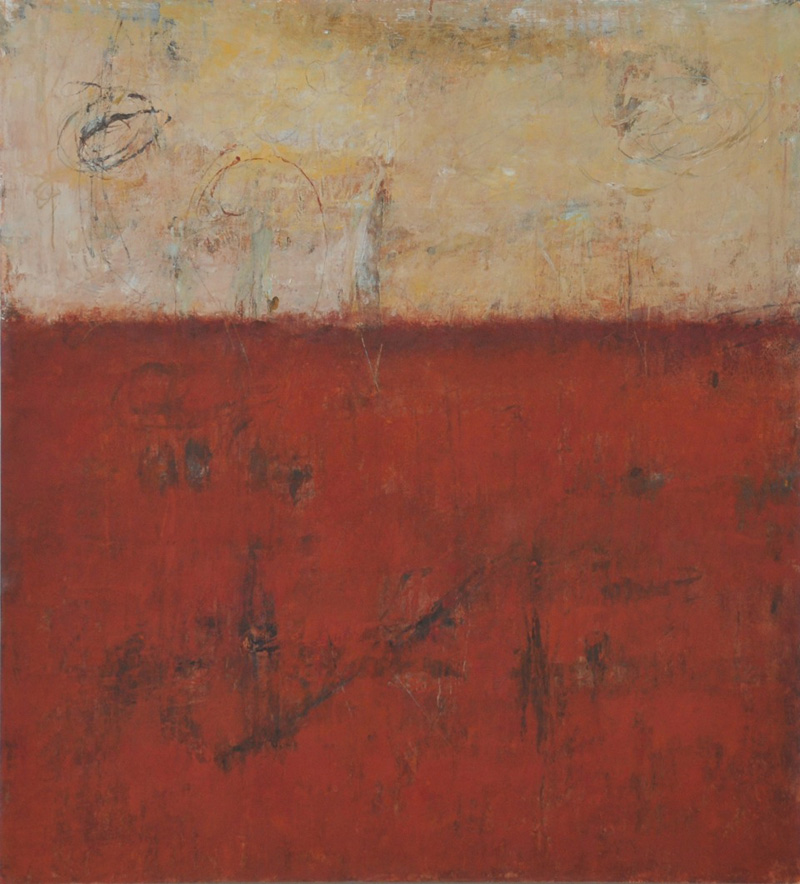
    I am painting. When we have become friends, my painting and I, when our intimate and intense interaction has proved successful, when we have found ourselves to be soul mates—then my work is done.

    dominique-belvedere.ch

    Image courtesy of the artist.

    Image courtesy of the artist.

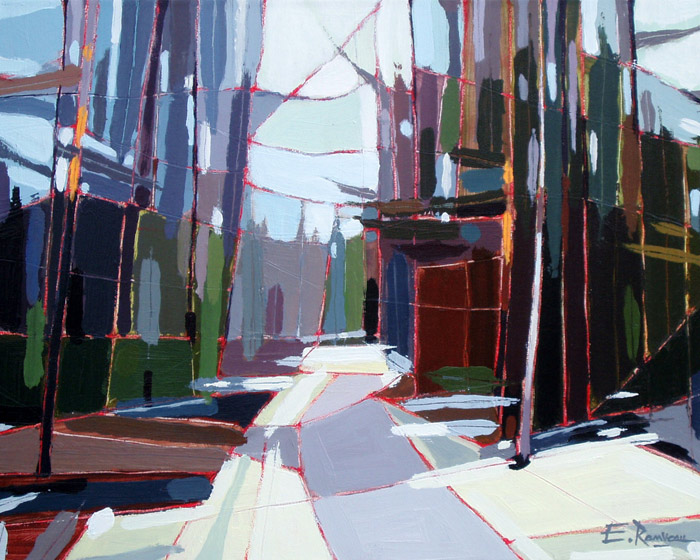
    I look for the common language between figurative and abstract art. Where does the first end and where does the second begin? For 24 years, I have heard both, “You are abstract!” and, “You are figurative!” In fact, I am very interested by both and with the natural mix created my own style. So, why this focus? I may never have the answer, but as a French master said to me 22 years ago, ” The most important and essential part is to find pleasure when you paint.”

    ericranveau.com

    With watercolors in hand, she was painting clouds from a window seat in an airplane. As Yvonne Jacquette relates her story, “Then the clouds rolled away and I had to face that gigantic spread of cities.” That aerial scene that we’ve all experienced, mysterious, remote, and voyeuristic, would come to define her life as an artist. Making pastel drawings and taking photographs onsite, from multiple angles and heights, she gathers the references that will be distilled into a uniquely personal view of her own. From airplanes, helicopters and the highest floors of skyscrapers, she has found the atmosphere where she can move most freely.

    Rather than using flat color, Jacquette’s forms are slowly built with layered, short strokes, creating textures that shimmer with the sensual richness found in the works of the Impressionists.  In New York Natural History Museum II the foreground roof structures and rooftops almost vibrate with brilliant blue purples and ceruleans enveloped in roof tar black. Foliage, painted in mauves and dark browns, encircles the Museum and its neighbors.   It’s a view that overlooks Central Park, with a delicate line of night-lit buildings at the top edge of the canvas and a New Yorker’s wit of a miniscule Guggenheim, in pale blue green, poking out above the trees of the far East Side.

    From the velvet, almost iridescent-toned pastels on paper, basic positions and relationships are noted. Beautiful in the haunting way that comes only from a first impression, their saturated color and intense blacks create a depth that is almost vertiginous.  It is enlightening to compare them to the larger paintings in these rooms.

    With Whitney Museum Under Construction II, what were faint and secondary elements in the original drawing, the streets and roads on either side of the site, have developed into essential components in form and color. The highway by the Hudson River becomes a powerful circular force that directs the eye right to the blue center of the canvas, the point of the Museum’s steady growth. The headlights of the moving cars and the motion lines added around the vehicles on both the right highway and the pink-hued streets on the left edges, add an energy that contrasts with the quiet stability of the building in process. A strip of raised gray and pale blue rises up, like the nearby street, from an entirely different angle, alongside of architect Renzo Piano’s massive construction site. Blue shapes of its empty floors seem to transition into the flow of the river itself.

    Most intriguing is a series of collages where, as in a Cubist dream, shapes cut out from a previously made landscape print are playfully reconfigured as pure geometric form. Changing perspectives and realigned structures create variations of each landscape and the homes scattered across them.

    Yellows, golds, white and blue lights infuse the darkness of the multiple perspectives of Late Sun Above Madison Square Park II.  Pattern against pattern is used to convey spatial distance.  Round, warm salmon-pink shapes indicating the ground level balance each other on the lower corners. Somehow we hover above both. Although it is a nocturnal scene, the sky is a vibrating blue that matches the building’s lights. The lush mound of trees is built over the same blue, with a multitude of dots of black, brown, and dark green. There is a rare sighting of human forms on the glowing path through the Park.

    By A. Bascove

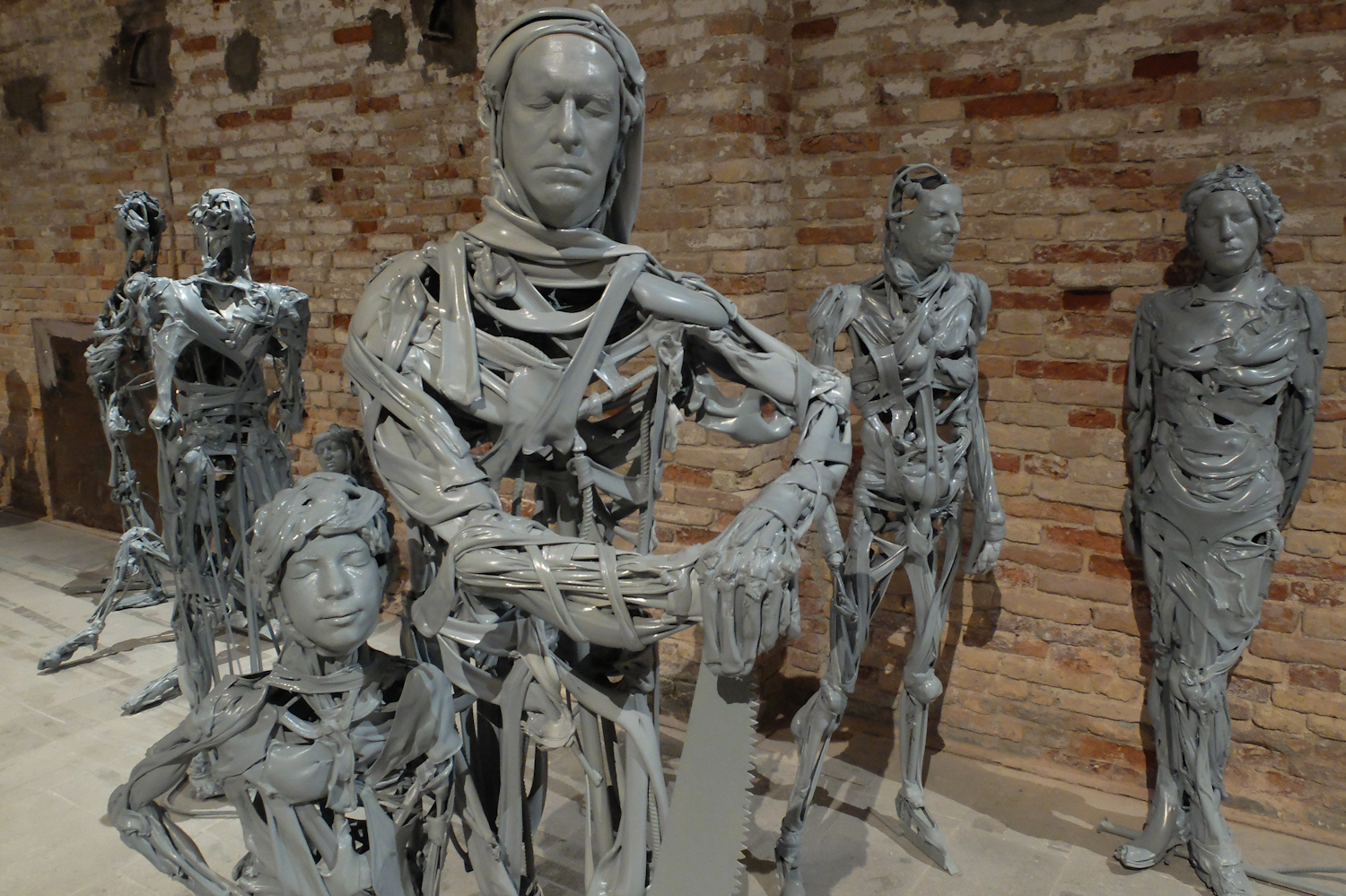
    Artist-Pawel-Althamer-at-the-Arsenale-Biennale-Venice-11

    Image courtesy of LC Journal

    Pawel Althamer: The Neighbors
    February 12 – April 13, 2014
    The New Museum
    235 Bowery
    New York City
    newmuseum.org

    News | Exhibitions