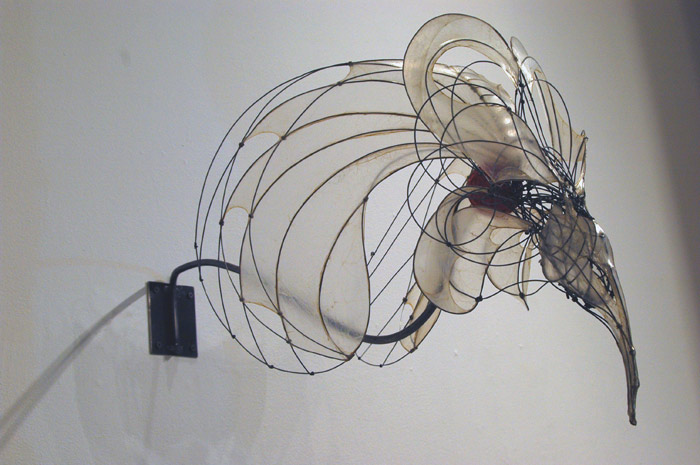
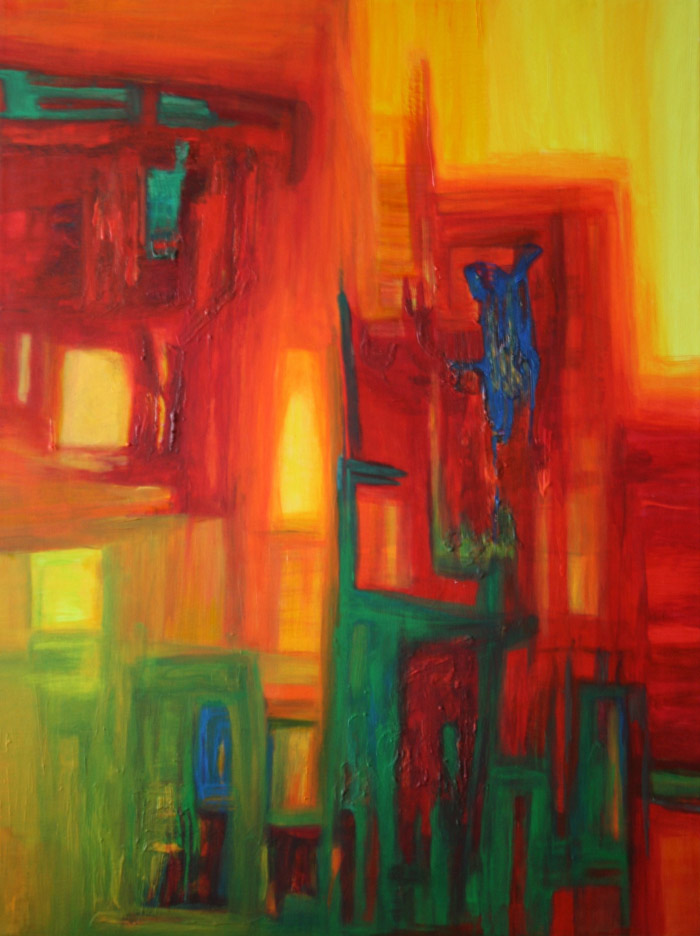
Each individual is an ecosystem. Tending to the apparition of mind and soul are practices which art can have a most profound effect on in ones life. Creating works of art is a ritual, a habit for ones spirit to dwell on, toil over, and eventually let go of self-centered temporal states of being that no longer serve us. I express, procure, and interpret life based on the experiences of creating piece as identity. I understand identity as a motion moving amidst an unconscious self, a calling to nature rooted deep, and a pouring out upon the sub-straight of reality to discover the world from within.
I try to present my longings, dreams, and memories of a distant world in my paintings. I hope that these aspects are revealed to the viewer, and that he can use my images to dream.
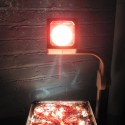
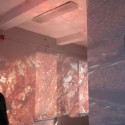
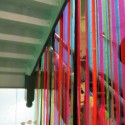
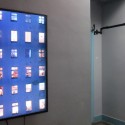
The Spring/Break Art Show is the surly new kid on the block and everyone involved could not be more excited. Now in its third year, this rough little gem of a fair is organized by Ambre Kelly and Andrew Gori in what was once an old school house in NoLita. This is in fact the name of the venue: Old School. The charm of the location was left completely intact as hardly anything has changed when you look around. Equipped with the same bathroom stalls you can remember being stuffed into, dusty chalkboards waiting for you to write your sorry excuse for an answer in front of the class, and that lovely patchwork of worn linoleum squeaking under your feet, Old School isn’t short memories for anyone who went to elementary school somewhere in the United States.
The art that inhabits these spaces fits the theme as well. It is curated by a group of independent curators who each have their own space, giving each former classroom it’s own distinct style and feel. The artists are of the younger generation for the most part, pumping out ambitious work that still feels slightly less polished, and teems with that obvious creative excitement that young hands seem to have in ample supply.
This isn’t to say that this fair leaves anything to be desired. If you look around on opening night, you see smiling faces sharing laughs, making connections, and congratulating one another on putting together a great show. The pretension and thick, stuffy air that can be found wafting through most any other fair is nowhere to be found at Spring/Break. I think the artists and curators alike do their best to keep it that way.
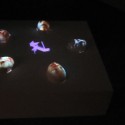
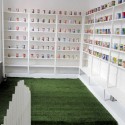
It should go without saying that the experience is not to be missed. You may never get another chance to rumble through classic movie make-out scenes in a custom painted VW bug, to make a wish on a sumptuous wishing pelt, or hang with a sculpture made out of actual human bones. Go back to grade school before it’s too late.
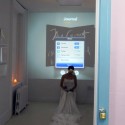
The following images are a selection of some of our favorite works to be seen throughout the exhibition. We won’t tell you who they were made by. You have to go to Spring/Break to find out.
By Matthew Hassell
Joshua Liner Gallery houses a diverse group of established and emerging artists, but as a faction they present a united front against creative tedium. Ai Yamaguchi’s celluloid expressions and frail lines depict lives of young prostitutes. Evan Hecox portrays urban environments through amplification and select graphic elements. Julie Opperman’s dissonant paintings use the viewer’s perception as a medium. The common thread among artists at Joshua Liner is this: they all work to erode boundaries. They are eager to jump the old divides between traditional and contemporary, puppeteering and sculpture, graphic design and fine art. They shun categorization. Pema Rinzin is no exception.
Rinzin employs traditional thangka painting techniques and materials to create contemporary work. He has taught and traveled in Germany and Japan, translated for monks on tour with the Grateful Dead, and spent time at the Rubin Museum of Art in New York. His paintings are held in various public and private collections, including the Dalai Lama’s.
These pieces are simple, powerful, and abstract. The content is forms distilled to their essences, with the exception of the Auspicious Dreams series, which contains vastly detailed forms from all walks of the animal kingdom that surge in pleasant turmoil around a golden orb. Rinzin’s paintings appear both biological and intergalactic in a way that speaks to the enigmatic scale of daily life. Shapes within could be cells, spores, or immense bodies of matter floating in space. He uses ground mineral pigments as a medium—gold, as seen in the three Auspicious Dreams paintings, as well as green malachite, and lapis lazuli. All of these are of gem quality. The intensity of the colorants enhances the qualities of playfulness and surprise in his work.
I was able to ask Rinzin a few questions about his paintings, process, and hopes for this “Abstract Enlightenment.”
Maria Anderson: This is your second solo show at Joshua Liner Gallery. What is most important to you about this exhibition?
Pema Rinzin: Naturally, there is the hope that people like it. Not only this, but that these paintings will cause people to believe that today is not the only life we have. We have tomorrow. We have the next day, and the next. We don’t have to sell our paintings today. We don’t have to be successful today. What I want is to pause time.
MA: You’ve mentioned that you abstract impressionist is a description you would place, however loosely, on your work. Why the name Abstract Enlightenment?
PR: It has to do with the feeling of your mind opening up—everything spans out, like a sun. Bubble of Wishful Gems is like this, with the two concentric circles. It has a lot of movement, a lot of joy and expression. The inside looks like seeds, so it’s almost like a flower petal. In Tibet, this shade of blue is considered the highest color of emptiness and ascension. Nature yields a lot of energy, and I’m making use of this. Enlightenment is when you’re abstract in the composition and the subject. It’s about trying to represent the essence of all things in a simple way.
MA: Does meditation, or, to use a word with fewer associations, contemplation, play any role in your creative process? In other words, how do you reach a state of mind that allows for long hours of intuitive, focused painting?
PR: There is a principle on how to use meditation: the best meditation for me is not how people typically think of it. If you are a focused person, you might wake up in the morning and exercise—something like this is the best meditation. You meditate to purify yourself to do things right. If you’re a teacher, and if you teach and use your heart, then this is a great meditation. If you teach by example and not from the mouth or the book, this becomes like a meditation. It is more of a belief system.
After a while, when you paint more and more, it becomes automatic. You connect. It’s a natural meditation. You can close your eyes and sit quietly and meditate, but doing just this won’t help you paint. You have to use your hand, your mind, your body. Oh, if you focus in this way, you will be happy! You can’t separate it from your work.
MA: What else is crucial to your process?
PR: Intention and discipline. You have to know how to clean your house. If you are a good artist, you have to know how to cook. This makes other people happy, and then you are happy. Making yourself happy first is even more important than making others happy. If you do a very good painting today, then the next painting will be more challenging, and when you are challenged, you are better able to be good to others.

Piero Golia was introduced to Abraham Lubelski shortly after he arrived in New York. He was instantly given his first opportunity to exhibit at Broadway Gallery as well as contribute to the design and editorial side of NY Arts Magazine. Piero has since catapulted to the upper crust of the art world, and has been featured in shows all across the globe alongside some of the largest art stars of today. His latest body of work, a promising series including a number of clever miniatures, is set to open tomorrow, February 28th at Gagosian Paris. We continue to follow his dynamic, independent, and whimsical views of society and ourselves as we wish him as always the best. A significant number of Golia’s early drawings remain part of Abraham Lubelski’s personal collection.
For more information click Here.

Jonny Briggs: “Monstrares”
February 26 – March 30, 2014
Julie Meneret Contemporary Art
133 Orchard street
New York City
juliemeneret.com
James Salter’s short stories provide the underpinnings in which characters explore aspects of their relationships to both themselves and to others in “Last Night,” a subtly perceptive group exhibition curated by Merrill Mahan at Salomon Contemporary. Diverse media augment the narrative force of the stinging disclosures and personal inclinations inherent in the show’s theme. Framed and matted black and white ink jet prints, a color c-print, a pastel on paper and a text wall piece of poured mirrored glass, plus colorful paintings on linen, canvas and nylon, as well as graphite drawings on paper enhance the individuality that reinforces the theme “Last Night.” The roster of artists intent on making their personal statements features Richard Pasquarelli, Jocelyn Hobbie, Andrew Bush, Yvonne Jacquette, McDermott and McGough, Will Cotton, Ridley Howard, Amy Bennett, Matthew Pillsbury and Alexi Worth. From steamy disclosures to dreamy musings, prime ground is being mined.
This visual show is more cerebral than one might expect; it is in effect a compassionate salute to mankind’s groping efforts to clarify its feelings and achieve its desires in life. The select images illuminate concepts so varied in origin and execution that the display challenges viewer perceptions as to the creative uses and functions of media within the province of the visual. This unexpected challenge, paired with the post-modern and art historic trends within the structure of the show, lends the singular works on view a stellar sense of power. There is a thread in each unique vision (with the exception of Matthew Pillsbury’s prints), which lends an undercurrent of separation to the motifs. If this connotes the presence of an underlying existential angst, these artists experience the usual feelings fraught with hardships inherent in relationships through time.
While each artist’s issues vary, there are a few with tandem concerns that link their feelings and visions. Matthew Pillsbury’s evanescent archival pigment ink prints present beautifully realized interiors peopled with subjects who delight in both privacy and in company. These works relate to Richard Pasquarelli’s cropped enigmatic drawings of home exteriors, whose lighted facades suggest the presence of life and warmth within. Views of harmony at home veer sharply with the sensitively conceived Jocelyn Hobbie allegorical painting entitled Party, in which the pretty bright colors bring tension to the eternal narrative of the old being replaced by the young. This work makes a connection with the picture called Prognosis by Amy Bennett, that highlights the story of a group of relatives caught in the grip of the banal waiting that overlays the imminent terrors of a doctor’s utterances on the fate of a loved one. The small format projects a tense universal theme: that of death and its dreaded frightening impact.

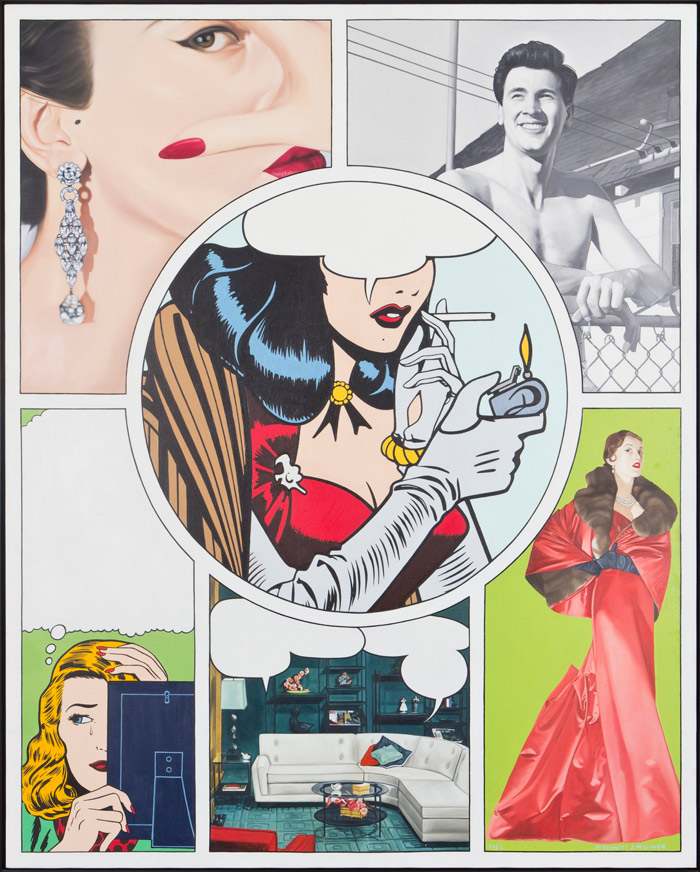
McDermott & McGough, Something I’ve Never Had, 1965, 2006. Oil on canvas, 60 x 48 in., Photo credit Dave Rittinger. Courtesy of Salomon Contemporary, New York.
Taking a turn toward less critical, but still painful matters, the McDermott & McGough painting Something I’ve Never Had expresses a palpable emptiness; it highlights fashionable women, a handsome celebrity, designer clothing, jewels and fancy furniture in a remorseful expression of regrets for objects of desire that we perceive as permanently beyond our reach. The piece is created in a graphic, cartoon vernacular that features blank “word bubbles” conveying a sense of emotional bereftness. This sentiment is reiterated obliquely in Will Cotton’s Coconut Cake, a painting that yields a glimpse of a succulent girl whose mind seems preoccupied by the hopes of a wedding, as signaled by a small mountain of white cake. The piece recalls the French painters Boucher and Watteau; the girl is in effect a lovely piece of pastry. Her sad expression suggests thwarted wedding plans. Alexi Worth’s (oil on nylon) piece entitled Formalists and Ridley Howard’s (oil on linen) painting called Brown Leather Boots delve narrowly on select visions of the female form, as expressed within the limits of a specific sense of feminine allure.
On first glance, Richard Pasquarelli’s work Night Sky (a sly reference to Van Gogh) has “romantic” underpinnings; it is after all a sublime vision of nocturnal majesty. But the spidery dark web-like leaves hover over and mingle with the moonlit night sky, obliterating its unblemished purity. There is a viewing distance to this work; a close look reveals the subtle tonal shifts in sky and leaf fringes that imbue the work with richness and sophisticated painting variations. The drawings, which at first appear to be nondescript views of the doors and windows of suburban dwellings, exude an aura of secrecy. One wonders what goes on inside these closed doors and shuttered windows. On another note, the Andrew Bush digital c-print displays a lone itinerant driver set in an isolated car with no visible landmarks to indicate its location. The title speaks to the aimlessness that is bred by the American car culture. It is practically an essay in itself; Man Drifting Northwest at Approximately 68 M.P.H. on U.S. Route 101 Somewhere near Camarillo, California, One Evening in 1989.
There are more poetic subtle interpretations and variations of individuals, their lives, their fantasies, their families, our earth and its promises than one observes on a first view. Yvonne Jacquette’s pastel, Maine Night Lights A, displays a dark ariel view of colored urban night-lights that form the outline of a satirical sky-lit bird constellation. Living bird formations could hardly survive in the murky sky that speaks of the possible presence of smog, or a brewing storm that mars the night sky view. The variety of expression with the attendant tension of opposition within the show, in response to the open-ended narrative of the theme, provides an emotional edge that accelerates the charged proceedings. The Andrew Bush c-print adds a touch of Americana, in the car culture in which people seek answers to life’s problems by taking road trips. Rob Wynne’s ironical wall work entitled Chemistry, conveys with its irregular fonts the vagaries of that human phenomenon that explains so much, without saying a word!
By Mary Hrbacek
Featuring: Tamar Ettun, Clynton Lowry, Trevor Tweeten, and Felix R.Cid
A-Z USE: Body of Work
February 28th – March 6th, 2014
Sushi Bar Gallery
62 18th Street
Brooklyn
sushibargallery.com
Creating acrylic abstract and semi-abstract artworks allows me freedom of expression. It has no rules, no boundaries, and no limits. I paint from an inner impulsion, free from any worry of what the critic may think or feel. Satisfaction, to me, comes from knowing that I have expressed my thoughts, desires, and uncertainty in my paintings. The unique nature of abstract art enables various representations. It is necessary for the viewers to take time in contemplating each work to discover their own interpretation.
A girl is left alone sleeping in an unlocked rental car at the parking lot where lot of criminal activities often take place. The person at right is a car hiker coming to note the mileage and gasoline level. Finding her he gets horrified.
With my work, that is always autobiographical, I try to slightly disorient the viewer by choosing an unusual angle (point of view) in the composition. In doing so, one actively has to become a part of the situation by searching for their position within the painting.
-
Tarsila do Amaral: Inventing Modern Art in Brazil
Tarsila do Amaral: InventingModern Art in Brazil “I want to be the painter of my country,” Tarsila do Amaral. Her signature style was ... -
ASIA WEEK MARCH 15 – 24,
15 Thu 16 Fri 17 Sat 18 Sun 19 Mon 20 Tue 21 Wed 22 Thu 23 Fri 24 Sat... -
NYC ART FAIRS MARCH 2018
The Armory Show March 8 – 11, 2018 New York, NY NYC Art Fairs March 2018 The New York City Art Fairs for March is referred to as Armor... -
17 Cuban artists: All That You Have Is Your Soul
Dear Abraham, Gallery 8 New York opens in Harlem next Thursday with an inaugural exhibition 17 Cuban artists from FACTION Art Project... -
Currents: Abortion A.I.R Gallery January 4-February 4
Abortion is our country’s Scarlet Letter, an impassioned “A” writ large on our conscience. We shame, blame and deny wome... -
CURRENTS: ABORTION
CURRENTS an exhibition in which artists respond to the theme of ABORTION. In this turbulent moment in history, abortion remains a signifier ... -
No Image
Guantanamo art in NYC makes Washington nervous
“Untitled (Alan Kurdi)” [Courtesy of Muhammad Ansi/John Jay College]... -
No Image
7th Moscow Biennale
Being late to speak at the 7th Moscow Biennale, I try the Russian car service Yandex, rather than taking the ornate Moscow subway. My driver... -
Louise Bourgeois at MOMA
The MOMA exhibit, Louise Bourgeois: An Unfolding Portrait, showcases the prints, books, and creative process of the celebrated sculptor Loui...


br> br>