• Image courtesy of the artist.

    Image courtesy of the artist. Photo Credit: Lance Feagan.

    Everything is energy, vibrating frequencies. I am simply a vessel, a conduit, a channel for Divine Universal Energy to flow, express, and communicate through me information and healing frequencies to raise the vibration and energy of the viewer and the space in which this work is displayed.

    This artwork is Spiritually based and for the last seven years, I have independently studied human behavior and experience, brain function, metaphysics, spirituality, Resonance Repatterning®, and the Law of Attraction and Abundance. This intensive examination transformed my mind, body, and spirit allowing me to become a healer and messenger for our Universal Source Energy.

    EugeniaOrtizArt.com

    Image courtesy of the artist.

    Image courtesy of the artist.

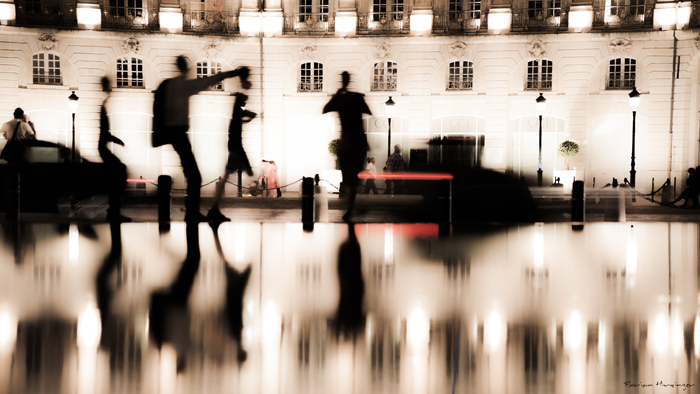
    My work is visualizing emotions by means of photography which takes its form in the eye of the viewer. That’s the goal of my work. I strongly believe that it’s the photographer’s job to capture unique moments. However it is up to the viewer to interpret the emotions of that moment and make the artwork live.

    For years I’ve been taking my camera all over the world to get hold of such special moments from Bangkok to San Francisco.

     fh-ap.com

    Image courtesy of the artist.

    Image courtesy of the artist.

    In my art I combine the classical and modern principles and methods of oil painting. I think that all of the techniques (the more, the better) are a path toward creating good art. I don’t look for another way of expression than the stretched white canvas. In this way, I could be called conservative, but working in my own way on the canvas, I consider myself an innovator and a discoverer.

    A goal of my work has always been for my personal language of expression to resonate with the viewers, and to leave not only a long lasting impression, but also a sense of spiritual enrichment.

    grigormalinov.com

    Courtesy of the artist.

    Courtesy of the artist.

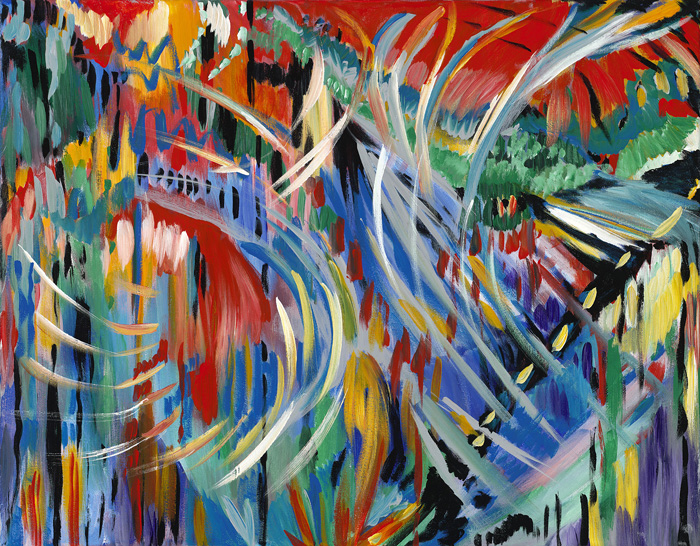
    It’s basically impossible for me to define my art. All I can say, is that it carries strong spontaneous energy featuring Abstract Expressionism. My artistic career started in 1990s—the crisis times of Post-Soviet Georgia. Total disorientation of this complicated space greatly inspired me. Through observing the environment I lived in, I used to experiment with different media and forms. It was a big experience. Nowadays, I’m interested in possibilities of art by exploring the resources of painting and texture. The research of various styles, movements, and my artistic practice serve to express blurred threshold between abstract and figurative painting.

    kokaart.ge

    Image courtesy of the artist.

    Image courtesy of the artist.

    Nature is art and I love how it flows full of color, lines, and shapes.  My own technique has evolved to encompass varying styles combining measured realism with free color and hidden images. I would describe myself as an Abstract Realist. Acrylic paints have been my medium of choice for many years. They present the challenge of working at a fast pace while moving colors across the canvas. The brilliance of the colors used to capture abstract interpretations of reality is becoming my signature.

     artherway.com

    Matthew Day Jackson explores an ambitious hybrid fusion of art, science, and technology in his multi-media exhibition entitled, Capture, on view at Hauser and Wirth. The biological underbelly of life’s undeniable dark side is richly expressed in sculpture, framed wall works, and digital photography, where themes of dehumanization mediated by technological interventions create a hyper-tense subtext. The artist systematically explores and catalogues the inevitable, inexorable metamorphosis of living beings, as their evolution towards disintegration marches from phase to phase in a process of constant flux. The striking metaphysical implications of the works, while semi-submerged in technical applications, are nonetheless a strong feature of the show’s content.

    Jackson investigates the correspondences between human anatomical forms and botanicals, exhibiting in linear succession the visually similar structures of human hand bones, networks of veins, and tree root systems. Trophy, a collaborative piece created with Swedish forensic scientist Oscar Nilsson, demonstrates a telling sequence of Jackson’s silicone heads, as they morph loosely from skeleton, to brain, to fossilized ridges, and finally to a system of tree roots.

    The work highlights our transition from a distinct flesh and blood personality to anonymous, calcified biological matter. It comprises a visual paraphrase of the traditional phrase used at burials, “ashes to ashes, dust to dust…” The bodies, veins, nerves, muscles and skeletons presented individually in glass cases are reminiscent of the glass vitrines employed in the film Independence Day to house the captured alien invaders for scientific observation. The skeletons of several Egyptian Pharaohs are on display for the curious, and with a similar callousness, in the Museum of Antiquities in Cairo.

    Jackson seems to regard Earth’s territory and rock formations as imbued with a mystical intelligence; the view of Yosemite Valley, juxtaposed with an enlarged replicated Chinese Scholar’s Stone, transmits the message that Earth and man are linked in invisible but irrepressible ways. The darker side of the artist’s view excludes any romantic references to Nature’s cycles of night and day or to the rhythmic changing of the seasons.  In the piece Inside/Outside (Quartered) he seems to view humanity as a waning life form, as he explores murky inner bodily systems, encompassed in shadow, that evoke broken tree roots as much as they resemble human veins. The attributes he retains in view are only slivers of flesh, strands of hair, nipples, or mere glimpses of visible features. There is a harsh side to his vision, as the examples of humanity’s inner and outer manifestations, seen within glass vitrines, are pierced with spikes like St. Sebastian. The apocalypse in Jackson’s schema is in progress; it may be too late, but he delves into layer upon layer of the human skull, seemingly driven to contemplate the inner mechanisms for clues that illuminate a creature that is out to annihilate his own species.  In the digital c-print entitled Me, Dead at 39, Jackson’s body, wrapped in a dark shroud, is affixed with rope to a tree limb. This wrenching piece exposes the artist’s desolation, his hopeless view as in death he finally connects with a nature whose existence he sees to be as imperiled as he is.

    The artist links a modern adaptation of Michelangelo’s Pieta (comprised of a chunk of concrete aggregate) to his reeling sense of the world and its inhabitants imperiled, already over-the-top toward doom. There is a sad flickering hope for the kind of redemption symbolized in Mary’s figure as she cradles Christ’s crucified body. Jackson’s morbidity finds expression in the flaming ambiguous sky of the multi-media wall work, Looking into Yosemite Valley, where the sky-form expresses the glow of rampant wild fires, more than it conveys the conclusion of a scenic rosy sunset.  In the large-scale motorized c-print entitled We, Us, Them, the viewer longs to see each landscape view, not sequentially presented by a mechanical device, but as separate discrete images, each worth the time it would take to contemplate the view at length.

    Jackson’s sense of destitution and loss spills out into the multi-media wall works August 6, 1945, and Farside (burnt wood) that focus respectively on the blackened earth after a nuclear holocaust has decimated it, and the most distant realm trodden by man, the surface of the moon. These works reach beyond the average person’s level of existential angst. They combine an individual’s trepidations with death’s legacy of genetic decay and fears that resonate with our presently endangered existence on the Earth itself. Jackson’s musings include the possible subjugation of the remains of the human race in an unthinkable scenario of horrifying captivity and certain annihilation. The artist’s vision evokes the existentialists Albert Camus and Jean-Paul Sartre, whose books The Plague and Nausea, respectively, resonate with a similarly uncompromising world, showing only a passing glimmer of hope that in death there might remotely be a chance of resurrection. Jackson’s questing, risk-taking nature, coupled with a “kid in a candy shop” enthusiasm for technological experiments, provides a challenging subtext. The artist informs these ambitious works with wide ranging complexities that speak of confounding multiple meanings.

    By Mary Hrbacek

    The claws of a big brown and white animal hugging a tree trunk—that was the first image I saw from Meryl McMaster a few years ago. The figure was completely hidden behind the tree. Was it hiding from some predator? Or was it a predator itself, ready to fly up and attack us in the next moment? What species was it? Hard to decide. It was fearsome and playful at the same time. Perhaps it was an animal hiding in a human body or maybe a human in an animal skin—a very strange photograph. I soon forgot the artist’s name but not the image.

    Wandering around and slightly bored on a Saturday afternoon, I found myself at Katzman-Kamen Gallery in Toronto. There I saw a large photograph depicting a young woman with skin painted white holding a strange metal wire form in front of her face. It was an unsettling portrait with elements that didn’t belong together. Then in 2012, NY Arts Magazine included a similar image in its list of young artists to be watched. Meryl McMaster was young, talented and seemed to have a unique imagery at her disposal.

    In Toronto’s CONTACT 2013, she had a solo show, titled In-Between Worlds, which honored her mixed background. Both of her parents are from Saskatchewan; her father is Plains Cree and her mother is of British, Scottish, and Dutch heritage. “This always caused conflict for me and posed a challenge in presenting them as a synergistic strength, not as a struggle between opposites.” said McMaster.

    Identity has been the central theme in her art from the beginning. The Second Self series (2010-11) reconsiders portraiture by incorporating drawing and sculpture into the photographic image to evoke a world that is not normally seen. McMaster was influenced by New York Times illustrator Saul Steinberg’s work Le Masque, and especially by his idea that everyone wears masks, either real or metaphorical. The head is the embodiment of our self-perception and is often misrepresented. McMaster wanted to show the real and the masked self of a person in one image. She asked friends to draw blind-contour portraits of themselves. Then, using wire, she created sculptures that were exact replicas of these drawings. She painted her models’ faces white, to make them “naked,” and suspended the blind-contour wire versions in front of them. In this way she created dualistic images, which appear confrontational and challenging while at the same time light-hearted and playful.

    In In-Between Worlds McMaster focused her interest on historical and tribal identity in order to express her mixed heritage through different symbols. In Brumal Tattoo, she constructed a sculptural, armor-like garment of pinecones. The figure is beating a large drum. Historically, Europeans used “field music” to control troops on the battlefield as well as for entertainment. In Native Canadian culture, the beating of a drum represents the beating heart and the soul. The braided, many different patterned fabrics show the merging of her two ancestries. “Brumal” means wintery and “Tattoo” means either a signal sounded on a drum or a permanent mark on the skin. The sound and vibrations leave patterns depicted in red paint splattered on the landscape and on the body. For McMaster it is a tattoo of the past, present, and future.

    Nature is a great influence on McMaster. From her teenage years on she has been exploring and working in Canada’s remote natural landscapes. As part of these trips everyone had to learn to survive by going through a “solo” experience in which they were left by themselves with only a little food and shelter supplies for 3 days. For McMaster it meant not only being bored because she was not allowed to bring anything with her (eg. a book or music) but she was also scared at times as her imagination ran wild listening to all the forest noises, especially at night. “Following the struggle of seclusion, I began to feel a sense of empowerment. It was these moments of being both in the group, as well as alone in such a harsh foreign environment that profoundly affected me and changed how I see the world.” said McMaster. Reflecting on this experience, she discovered many similarities to the vision quest in which Plains Cree youth go out alone into the wilderness, and, through a combination of isolation and fasting, try to find themselves and their life direction.

    Some of the photographs in In-Between Worlds are a further embodiment of this transformation. She gave the images dream-like qualities as she remembered odd and unexplainable situations from her “solo” experience. In Terra Cognitum, the concentric circles depict a topographic map overlaid on the artist’s body and on the ground representing the colonization of the land and McMaster’s connection to it. The small colorful seed beads she used were part of traditional Cree clothing as well as currency during the colonial period. She intentionally left out sections of the map to reference her ongoing exploration of herself.

    All the images are “staged” photographs. While photography is McMaster’s primary medium, she often incorporates other artistic media, including sculpture. This synergy creates a surreal, augmented imagery. In-Between Worlds was photographed in Ottawa in the middle of winter using natural light. McMaster is the model in all of these photographs. As she explained, “I inserted my own body into visual spaces that reflected both the inspiration I felt from my time alone in nature as well as the concept of being ‘betwixt.’”

    McMaster’s stories might have their roots in both native and colonial tales but in the end she dreams up hybrid heroes. Then she gets into their skins, dances with the spirits, and creates her own myths.

    By Emese Krunak-Hajagos


    AIPAD Photography Show
    More than 80 of the world’s leading photography art galleries will present a wide range of museum-quality work, including contemporary, modern and nineteenth-century photographs, as well as photo-based art, video, and new media, at the historic Park Avenue Armory in New York City’s Upper East Side.

    Aipad
    April 10-13, 2014

    Park Avenue Armory
    643 Park Ave.
    New York City
    aipad.com

    Jen Mazza’s latest paintings mix trompe l’oeil with the school of appropriation. Adding overlays of heavy punctuation marks and solid geometric shapes, they can convey the harmony of a duet, or the mischievous twist of black bars hiding the face of someone in a compromising position.

    The muted colors and meticulous details perfectly evoke the reproductions in art books and catalogs of the 1930’s and 40’s. She has lovingly observed and recreated their discolored, brittle pages, corners often bent or missing, and brown stains of once clear mending tape now long gone. The copies of pages are usually somewhat askew on a pale warm gray background. The art is carefully reproduced, the text identification done with a keenly precise hand.

    Mazza has chosen the works of Non-Objective artists Mondrian and Klee, and several lesser-known Cubists like Rudolf Bauer, Jean Xceron, and George Morris. Anyone willing to sink into the sensual pleasures of a second-hand bookstore, with its fragile volumes of aging paper and unexpected discoveries, will share in her delight. Seeing familiar paintings, now icons of non-representational art when they were freshly created and relatively unrecognized, one will understand her desire to both preserve and integrate her own voice with that history.

    There are also several paintings obsessively reproducing small open notebooks complete with penciled note-taking and opened security envelopes in varied states of undress. Mazza shares a world of the signs and language of intimate communication.

    A Bascove: What brought you, someone who painted brightly colored, highly-charged female nudes and lush still lifes, to work in the subdued tones of this recent work?
    Jen Mazza: Good question!  Funny, I did not really think about the figurative works as nudes as there is so little of the body shown, but I suppose they could just as well be nude as clothed. To me the work has always been about painting and about language. From the still life, to the narrow focus in the figurative pieces on the mouth and the hands—both locations of expression; verbal and gestural language—to the new images focused on formal elements of both written and painting language: the abstractions, the intervention of shapes or structural aspects of written language—punctuation etc.  But I suppose, although what I depict in any given series is certainly not an accidental choice, I do generally consider the “subject” is a means to an end, a catalyst in articulating an idea, so it is common for my subject matter to change. And though it is probably surprising to say it, my palette has not changed much as far as what colors I use—the grays still have a lot of color in them—though you are right that the overall effect is quite subdued, no more the flush of blood just under the skin!  The chromatic grays allow the background to operate as surface, but also as space — keeps it more ambiguous, more open.

    AB: What drew you to the images of Cubism and Russian Constructivism?
    JM: Though I have been looking a lot at Malevich and his contemporaries, the new series of paintings relies on reproductions of abstract paintings that are mostly American, or made in the U.S., and usually from the 1940’s. These usually black and white reproductions are on pages I have literally cut or torn from books with heroic titles like ,”Pioneers of American Abstraction” or “New Frontiers in American Painting.” Black and white reproductions once frustrated me in their lack of correlation to the original artworks, now seem somewhat in the nature of “authorless texts”, or perhaps unwitting collaborations between painter and printer. In the paintings, the formalist reproductions are represented still circumscribed within the rectangle of the page, which, with its dog-eared corners or other signs of age serves both to enclose the image and to push it back in time. In this way the images seem to remain in a citational form, as quotations of an original.

    Though initially, through the process of painting, I really do inhabit these works as a maker, when this layer is complete I subvert the images by overlapping my own interventions: geometric shapes — and constructivist forms as you mentioned; an organic shape quoted from a Moholy-Nagy painting or a red oval taking its color palette from a Liubov Popova painting — add to these the formal compositional elements of written language: punctuation, parentheses, asterisks and so on.

    AB: Your subject matter seems to be constantly evolving. What’s inspiring you now? 
    JM: I am still interested in verbal and written language and the language of painting, though what form the upcoming work will take is still vague and illusive — I am sure it will come into focus soon enough. I’ve come to trust the process over time.

    Last spring I took a trip to Bulgaria, out of a desire to be confronted with a language that would not only be opaque to me, in that I did not speak it, but would also be visually incomprehensible: Cyrillic characters literally make no sound when I look at them. Whether this experience was a parallel to the “soundless texts” of symbols I was already incorporating into the “Graft” paintings, or if it will lead to some new level in the work I have yet to discover.

    This month, the Center for Book Arts is displaying 12 of the 72 volumes of Journals I’ve kept since age 11 in 1959, along with my 1986 book Homo Futurus and the Homo Futurus wall work as part of “Silence Unbound” curated by Heather Powell. The Journals had been something I kept parallel to my work, which is predominantly camera-based. But, in 1979, Alex Harsley of the Fourth Street Photo Gallery offered me a show and asked what else I did.

    When he saw the Journals, he suggested I create a book. That first book, Clues to Myself, 1981, and three subsequent ones: Sensations, 1984; Homo Futurus, 1986; and Soul & Psyche, 1998, were all published by Joan Lyons at Visual Studies Workshop Press. A fifth, Cold Turkey at the Dog Run, will be published by Joseph Quintela and Katie Peyton at Deadly Chaps Press later this year. They all contain edited journal-text, Surreal Photography, and elements from the outer world.

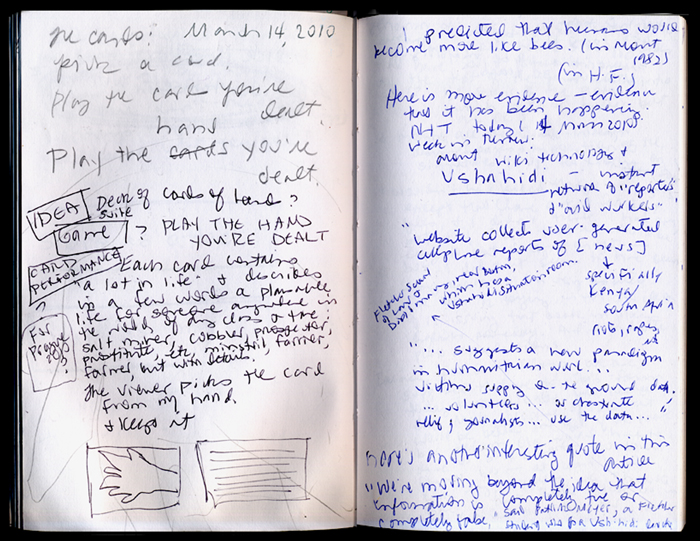
    -4BR Journal2010March14-2All the books and Journals depict a re-visitation of pages and texts to hone ideas and use as arenas upon which texts and images are placed in graphic and emotive relationships, rather than a linear one. This was first pointed out to me by Martha Wilson in her curatorial “The Page as Alternative Space‚” at Franklin Furnace in 1982, when she hung pages from Clues to Myself. This use of the surface is true for all my books and wall art, too.

    The Journals themselves, however (which I capitalize as a project), didn’t become of interest until 2010. I’d had a few shows of Existential Video and Surreal Photography in Berlin, and in discussions after, I was often asked how I got ideas. During one such talk at Lettrétage: Das junge Literaturhaus, Tom Bresemann invited me back to do a show called “Das Tagebuch gibt mir Ideen,” (The Journal Gives Me Ideas). Then, with some variation, I reprised that presentation in 2011 at Maddy Rosenbeg’s artspace, Central Booking, in New York, and in 2013 at Metro Arts in Brisbane, Australia. The Journal pages you are looking at now, from various volumes, show how ideas for artworks stem directly from life experience. Thinking about events of the day give rise to insights which inspire the works.

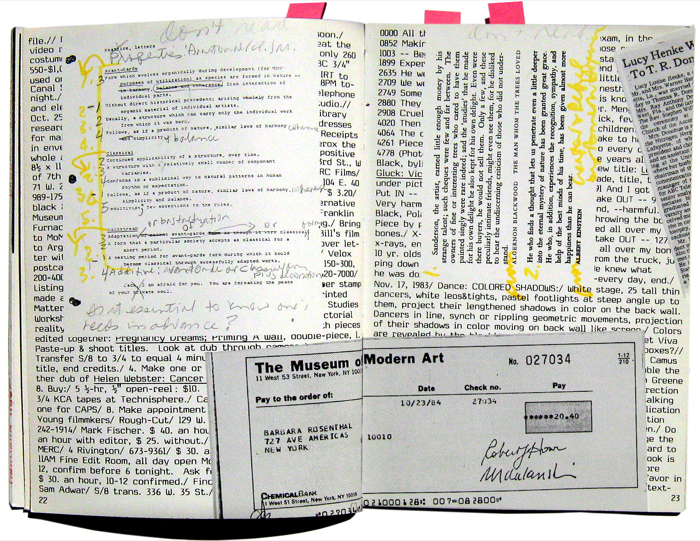
    BR_HomoFuturusReadingBookPgs22-23

    The pages here from Homo Futurus are from the particular volume I do readings from. You can see the bookmarks, pencil changes, and highlighted text portions I read. I almost always tweak when I see things I’ve “completed” before. For me, it seems, nothing is ever finished, and this aspect of continual evolution, continually striving for perfection, is one of my themes.

    All my themes, such as time, space, and motion, are seen in the context of identity. I don’t mean confined investigations, such as “ethnicity” or “gender,” but rather a search along the extremities; what I am as a single individual, and what the species Homo sapiens is as a whole. In 1984, I had the idea that our next hominid would be genetically engineered, and that’s when I coined the term “Homo Futurus.” For the book, I used the material from my Journals and Archives as an individual, plus items from the news, to glean what might be engineered in, and out, of that next creature.

    The cover indicates that Homo Futurus is a book within a book, and comprises photographs. Those on the cover appear within. They are from the Surreal Photography project, and reflect my visions of instability borne out by text, reflecting the world-view developed via journal-keeping, of everything in constant motion and metanoia.

    By Barbara Rosenthal

    News | Exhibitions