
Image courtesy of team (gallery, inc.)
Pieter Vermeersch
March 30th – April 27th 2014
Team (gallery, inc.)
83 Grand Street
New York City
teamgal.com




Image courtesy of team (gallery, inc.)
Pieter Vermeersch
March 30th – April 27th 2014
Team (gallery, inc.)
83 Grand Street
New York City
teamgal.com
Nicholas Alexander Boyd: What made you decide to become a film critic?
A.O. Scott: It wasn’t entirely my decision. I was always interested in criticism as a form of writing, and started out professionally writing about books. I had always been drawn to movies and interested in trying to write about them. I got a chance in late 1999 when an editor at Slate let me write a piece about Martin Scorsese, which got the attention of some editors at the New York Times, who had the absurd idea that I might be qualified to be a film critic.
NAB: What do you look for in movies that you see?
AOS: I like to be surprised. I like to feel some human reality has been illuminated.
NAB: Who would you say has had the biggest influence in the field of film?
AOS: Thomas Edison
NAB: What is the state of film now?
AOS: The state of film is that it is almost no longer “film” in the technical, photochemical sense. At the same time, moving pictures are everywhere, and there is more cinema in our daily lives that would have been imaginable even a generation ago.
NAB: Where do you see the field of film headed?
AOS: Film has been dying since the introduction of sound. It kept dying through the rise of television, home video, and now the Internet. I expect it to continue its death spiral for another 100 years or so.
NAB: What is your favorite movie genre, along with your favorite movie, and why?
AOS: I don’t have a favorite genre, unless “Italian” counts. I love just about anything made in Italy between 1945 and 1970, and also anything that shows the influence of those films. I like the naturalistic look, the theatricality of the post-synch sound, the sound of the Italian language. If I had to single out a favorite it might be “La Dolce Vita.” “La Dolce Vita” presents both a distillation of history–the West in a moment of what would turn out to be a perpetual, slow-moving, terminal crisis—and also a beautiful cinematic world. I have never been able to resist the desire to live in the world, or the fantasy, on some days, that I already do.
NAB: Who is your favorite actor and why?
AOS: At the moment I like what Joaquin Phoenix is doing. In his last few performances—thinking of “The Immigrant,” “The Master,” “Her”—he has completely resisted playing his characters as types. That is not easy to do—most actors slide back into familiar, pre-made ideas of the kinds of people their characters are, and in each of these cases he could have done that. There’s a way of playing an unstable alcoholic, a suave deceiver, an anti-social nerd, but the characters are none of those things. They are unpredictable, original and volatile in ways that are very rare in screen acting.
NAB: Who is your favorite actress and why?
AOS: Marion Cotillard. She is an actress of limitless bravery and supernatural poise, who is both beauty and beast.
NAB: Who is your favorite director and why?
AOS: This past year it was the Coen Brothers, among active American directors. The Coen brothers just now seem completely free to do what they want to do, and utterly confident in their story-telling and visual powers. “Inside Llewyn Davis” is by far the most perfectly realized movie of 2013.
NAB: What do you most enjoy about your job?
AOS: I love the variety of movies I get to see, and the way that movie permits me to travel to places I would otherwise never go, and know them in a way a tourist never could.
I happened to be at the premiere of the new production of Rigoletto by Boston Lyric Opera. Unlike any other Rigoletto I’ve seen, this particular production hits you right in the gut. To find out why, I went behind the scenes to interview the director, costume designer, set designer, and main character. I wanted to see how through their personal stories, as well as their collaborative work, the ultimate vision of Rigoletto was created.
Vita Tzykun, costume designer:
Masha Froliak: What time period did you work with on this production?
Vita Tzykun: The approach we chose was that of Mannerism—when the Renaissance went out of control. If during the Renaissance all the shapes were absolutely symmetrical, during this period they became much more distorted: figures became elongated, dresses became larger, shoulders became wider. The society of Rigoletto is one during which the Duke has absolute power of his court. We wanted to present it in this exaggerated mannerist period.
MF: There must have been a lot of historical research?
VT: It was like learning a new language, really. They had many pieces of clothing that we don’t currently have today; they all had different names, they were made differently, and connected together differently. The colors, shapes, and layers had their own meanings. The larger your silhouette was, and the more fabric you had in your clothing—the wealthier you were. That is why you could see the duke wearing really voluptuous pants, a broad shoulder doublet, and a large fur-lined cape.
MF: Apart from being accurate to the historical time, this production had a variety of stylistic decisions. Can you tell about some of them?
VT: The production is quite stylized in the sense that after Rigoletto is cursed, we see the events through his mind. When Gilda is violated by the Duke, Rigoletto starts seeing her in all-white like an innocent flower. It was important for me to create this pure white and the somewhat non-specific, abstract silhouette. In the end she becomes a ghost; so the symbol of white changes from innocence to ghostly innocence–an impossible ideal. Also, it was a costume decision to make Rigoletto progressively crippled. After the curse, his deformity becomes steadily worse–his hump grows bigger and his leg has a support that grows taller, making it more difficult for him to walk.
Michael Mayes, Rigoletto:
MF: Did the costume influence the evolution of your character?
Michael Mayes: Rigoletto is one of the crown jewels of baritone repertoire; it is a pinnacle, and it is where you want to get your whole life. It is also a very difficult role emotionally, technically, and physically. In the beginning, I was at a loss at how to play this character. Then I got one of Vita’s sketches of a thin, frail man. He was bent over, dragging his jester’s outfit and holding a hat. Her sketch really defined for me what my character was going to be. It inspired my entire vision of Rigoletto.
MF: How did you prepare yourself emotionally for this role?
MM: It sounds very simple–I read the story. I don’t know what it is like to be the father, but I do know what it is like to lose everything you care about in your life. It has happened to me and so I tap into those emotions when I am on stage, I tap into what it feels like to watch your entire world being taken away from you. That is what happens to Rigoletto. No matter what he does, it is one further step towards desolation.
MF: You probably have heroes or role models among baritones who sang Rigoletto–how did that influence your performance? Did it help or distract you?
MM: My heroes in this role are Cornell Macneil, Sherill Milnes, and Leonard Warren, among others. The Met has great on-demand recordings, and I have been listening to them my whole life. But, at some point you have stop listening to those guys. You have to find your own voice. We are living in a time haunted by the ghosts of the greatest baritones that had ever lived. Now when a great baritone dies there are four or five versions of his Rigoletto that you are always fighting. Sometimes you simply have to turn it off.
MF: I assume it is very difficult for an opera singer to sing and act simultaneously. In your performance you were bent over most of the time. How did you manage?
MM: This is the most difficult thing I have done on stage. It is incredibly technically difficult. Plus, the emotions in this piece are really powerful. But I am always an actor first. I am an actor who sings, not a singer who acts. My acting and emotional state in every moment is the source from which everything else comes. To be bent over all the time makes it hard to access your support, because you are really cut in half, it is a constant battle to be present in the moment, to react to everything that happens on stage, but also to be aware of the fact that I have to breathe and sing.
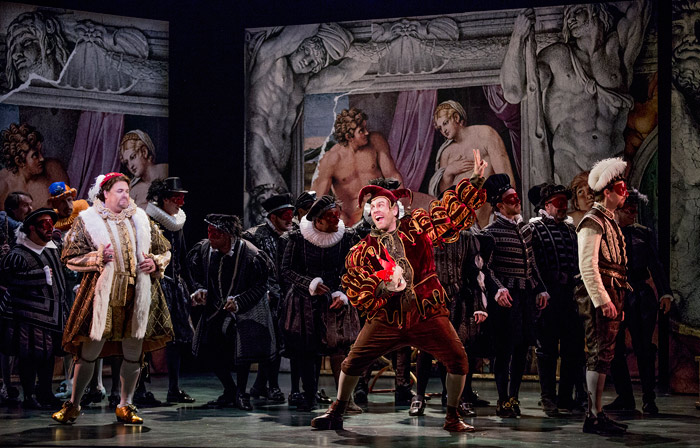
A scene from Boston Lyric Opera’s Rigoletto. Photo by Marina Levitskaya.
John Conklin, set designer:
MF: Can you explain the interplay of outside and inside in your sets—a marble model of the city, which represents an illusion of something ideal on the one hand, and at the same time dark brick walls on the inside?
John Conklin: The opera itself is divided in two: the more opulent, rich, and decadent world of the court, juxtaposed against the dark side of Rigoletto’s mind. The scenery is literally two-sided; on one side there are court paintings, and on the other just dark material. I felt that there was also a division between an ideal world and a world of passion, revenge, murder, and dark impulse. The brick walls are the container of violent action, and then above them there is a white marble city, which looks down ironically on the actions below.
MF: What is the symbolism of the imagery and your choice of paintings?
JC: I wanted to find a painting which provides contrast against the pure Renaissance of the city above (the Renaissance of Piero della Francesca). The paintings were based on Annibale Carracci, who is more connected with mannerism. We see Venus, Mars, and Cupid presented in an erotic way. There is also a naked figure of a boy from Michelangelo’s fresco in the ceiling of the Sistine Chapel. There are gigantic nude male figures, and also a naked woman in the midst. There is an erotic side, but also the question of the meaning of love. In the opera we see paternal love and we also see the sexual attraction shared between the Duke and Gilda. I think that the combined images of love and sexuality are part of the ambiguity of the whole piece.
MF: What would you say was your main idea or aim in this piece?
JC: Rigoletto is a very powerful piece and it is very strongly written in its musical and narrative structure. The idea was to tell two stories—to tell the narrative, the plot, but also to get beneath the surface of the story.
Tomer Zvulun, Director:
MF: What was the most difficult part for you in this production?
Tomer Zvulun: I had a very clear idea of what I wanted to do with it. But, the most beautiful and the most challenging thing about opera itself is the work’s collaborative nature. As the director, you have to take your idea and share it, enhance it with a few hundred people: your designers, conductor, singers, prop people, makeup artists, etc. Opera is a very collaborative art form and if your vision is clear people will join it.
MF: The deconstruction-deformation process seemed to be a crucial element in your vision of Rigoletto. Could you elaborate on this?
TZ: We really wanted to get into his mind. Costumes, sets, lighting, and of course staging were geared towards that goal. From the moment he is cursed, the lighting changes and the scrim separates him from the rest of the world. He starts to see things through the scrim—things that are threatening to him, such as the Duke, and also things that are precious to him, such as his daughter. As the show progresses, the different things he sees in his mind become continually worse. The lighting is also moving gradually from colorful and happy to yellow and deceased. The acting, sets, lighting, and costumes all show deterioration.
MF: So you kept the production in its original time period, yet you gave it a new perspective through a subjective view of Rigoletto?
TZ: The whole team is highly theatrical and cinematic. Personally, my greatest influence is cinema. Vita is also a designer for both theater and cinema. That prism is part of our aesthetics. We live in a world that is highly visual, highly modern, and highly ADD. If we don’t keep the attention of the audience, we are going to lose them. This is why it is very important that a production moves forward relentlessly. Even though it is in-period, our perspective is very modern, psychological, cinematic, and theatrical.
MF: Audience had a very strong reaction to this piece. How do you feel about your work? Are you satisfied with the result?
TZ: I could not be happier. I was very moved at the opening night. The cast was completely and utterly committed to this production. During the final scene when Gilda appears one last time and says good-bye to her father, you could hear the audience breathing, you could hear the drop of a pin. That kind of miracle doesn’t happen often in opera.
By Masha Froliak

Image courtesy of Marlborough Broome Street Gallery
Roland Allmeyer
March 29th – April 27th, 2014
Marlborough Broome Street
331 Broome St
New York City
marlboroughchelsea.com
Charlotte Meyer: The Hotel Rehearsal contains all the elements of your previous work; architectural space, the dynamics of living in the public, revealing habits that sometimes we keep hidden—but in contrast it takes on popular culture in a seamless presentation. You have created a completely transparent hotel room containing little more than a bed/sofa raised into the sky by a scissor lift, from the back of a parked van.
Alex Schweder: Yeah one of the things I’m trying to get to in recent works, is how do you include popular culture? How do you include everyone in the work so that it becomes much more about the person’s experience than me disseminating an idea, they come to it and make it their own?
CM: So that’s deliberate, how do you reach as many people as possible?
AS: Exactly, what is going to titillate people so that they want to come and play in this little floating room? It exists in this pop up world which is only a 5 x 7 space, the bed inflates and pushes the sofa shut, this back and forth, this little soft space.
CM: The thing that is incredible about the work is that you have taken the idea of the hotel—a place to sleep, to deflate, to take care of yourself, to have the space be as desirable as possible. Its sexy to spend a night in a hotel room, although you are taking away some of the comforts, like a bathtub. Instead you make it into a viewing space, having a window view in one’s chosen destination would inherently be the best possible scenario, and you have done that on a 360-degree rotation.
AS: And it was important to me being able to sleep in this space in the middle of the city and look up at the sky. The curtains come up at night. It’s not usually a view we think of when thinking of an urban space, just the sky, and the parking lot is one of the few open spaces in the city.
CM: This parking lot theme suggests that it’s a portable hotel and that you can take it with you wherever you want to go.
AS: I can take it wherever I want to take it.
CM: The scissor lift is also an icon of popular culture. They are used everywhere, in construction all over New York, but we might not notice them. You are bringing attention to something that is quite literally happening all around us in this city, being under construction constantly. Is that how it functions architecturally for you?
AS: Yes, the van and the scissor lift combine the two most common modes of transportation, the elevator and the automobile. So, you’ve got the vertical and horizontal in the same piece, that moveable opposite is a distinctly urban piece.
CM: How high could you get the piece, not just how high does the lift go but how far up could you drive the piece? Hypothetically could you drive to the top of a hill or a six-story parking lot.
AS: One of the decisions has to do with defining it as a distinctly urban piece, not a rural piece at all. I could have added a generator but it relies on a regular outlet for power.
CM: You wanted the city experience.
AS: It basically ties in to the city through this umbilical cord, on the side of the van is this little plug and you have to find an outlet. Every parking lot that I visited has an outlet somewhere; you have to look for it because it’s not something you think about. It’s like a little building that has an umbilical cord to the city.
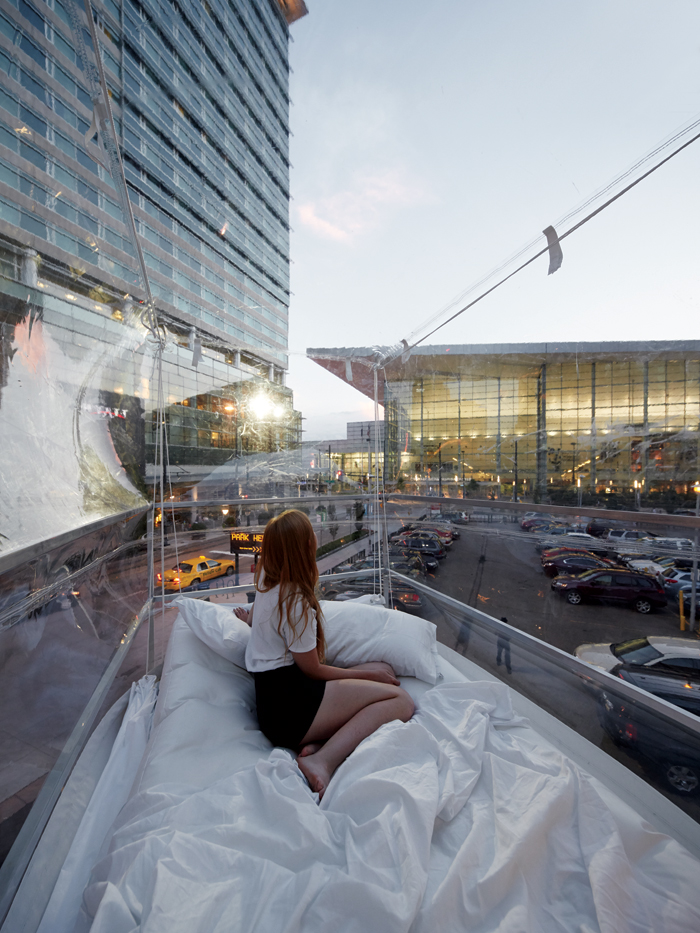
Alex Schweder, The Hotel Rehearsal, 2013. Performance image courtesy of Cristobal Palma.
CM: Is your interest focused solely on bodies in buildings?
AS: That, and the performative nature of the work—the understanding of the city as something that you can practice and rehearse. Basically, the parking lots are open spaces; they are potential buildings, and the hotel is just one of the many types of possible buildings that could go into a parking lot. I chose a hotel. I made this little hotel based on the desire of this site. What I like about the parking lot is that you can drive something in and you can practice. It’s a kind of autonomous thing; it could be a hotel, a library, any number of inserts, and that for me was really exciting about the parking lot.
CM: Which is curious when considering perception and physical awareness of space and how you get to thinking that a parking lot has desirability. The idea of what people generally consider a parking lot to be in terms of an aesthetic, you are turning that around. The temperament of how a parking lot is represented in ones mind is not usually rife with possibility. How did you get to that thought system?
AS: I’ve been working with parking lots for quite some time. When I was in graduate school doing my research I chose parking lots because there is nowhere to go but up in terms of making them interesting, usually it’s just a totally functional place. Questions arose as to why you would go there, why would you go to a parking lot as an experience. I had 16 parking lots in the underground city, in its ruinous landscape that no one can access, and if you open that landscape up and give it a lobotomy, you can make it safe for people. With a car you’ve got this little zone of safety through which you can drive into a dangerous landscape or a landscape which is not pretty and thereby charged—you have this pocket of safety in a danger zone. It became a way of cleaning up something that was ugly and seeing that treacherous area as something that you want to see.
CM: How does the performative aspect tie into the piece?
AS: I have been working with performance architecture for about seven years, studying how you perform the space. For instance, the wall texts that I put on the walls in the Chinati Foundation residency, a body of work called Architectural Performances in Geological Times, were a set of instructions. I had two studios in Chinati, the locker plant and the ice plant, which used to be butcher shop. What’s interesting about that is there was this sunny space facing the sidewalk and then just behind it was the meat locker, which is completely cool with thick walls. Without having mechanical cooling it was about 10 degrees cooler in the dark room than it was in the sunny room, so one of the instructions that I came up with, was: “inhale this warmer room and exhale it into the cooler room until their temperatures are the same.” Your body takes over the room and shifts that bit of warm space again and again, but its not like you would ever accomplish or realize this change.
CM: Its about being cognizant about what that means, taking a moment to actually think about what your body is doing in space.

Image courtesy of Anna Zorina Gallery
Micha Patiniott: ZzzzzZzzZzz
March 27th – May 3rd, 2014
Anna Zorina Gallery
533 W 23rd St
New York City
annazorinagallery.com

Image courtesy of Planthouse
Featuring: Glen Baldridge, Ian Cooper, and David Kennedy Cutler
Thousand Year Old Child
March 25th – May 2nd, 1014
Planthouse
107 W 28th St
New York City
planthouse.net
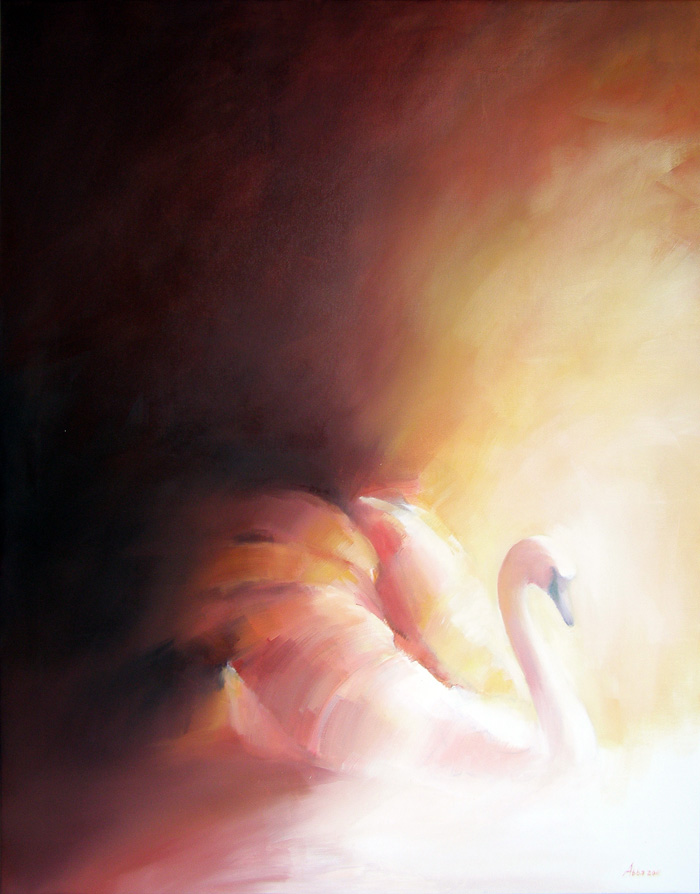
Image courtesy of the artist.
I’m from Iceland, a land of extremes, long and dark winters and short summers where the sun never sets. Here in this vast land lives a small nation with strong tradition of believing in folklore and adventures.
Swans have always fascinated me. Their light and beauty has earned them a symbolic and mythical status throughout the world. They are a link between heaven and earth; a bridge between life and death, between the material and the spiritual.
Icelandic nature and the mystic of folklore inspire my work, but the main objective of my paintings is capturing the play of light.
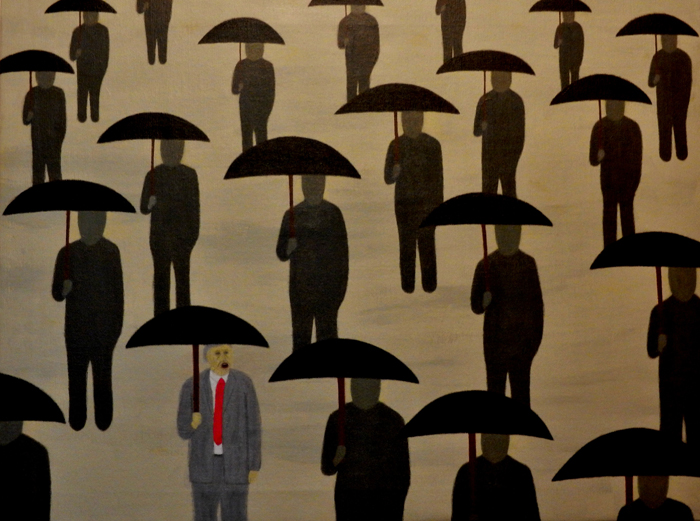
Image courtesy of artist.
Rarely do I willingly speak of my paintings. What I see is not necessarily the same as you see. The paintings should only be seen in the viewer’s own eyes. However, in my last solo exhibition during the fall in Milan, organized by Camaver Kunsthaus, an Italian asked why the people in the paintings are always blind. The answer is simple, although people may see physically, it does not make them look mentally. Unfortunately, most people are blind.











