• Jim Elledge’s, Henry Darger: Throw Away Boy presents a rich portrait of the outsider artist’s life, scaffolded with a decade’s worth of research. Arguing against claims that Darger “was a pedophile, a sadist, or a serial killer”, Elledge has produced a fascinating, and frankly heart-wrenching, account that explains Darger’s work through the context of it’s creation. The narrative is so devastating and compelling that the reader begins to regard the mere of existence of Darger’s art as a miracle.

    Bereft of his mother at the age of four, Darger was raised by an alcoholic father in one of Chicago’s poorest neighborhoods, the Madison Street vice district. Growing up in the era that Upton Sinclair published The Jungle (1906), Darger’s life began in unspeakable circumstances and went from bad to worse. At twelve he was abandoned to the care state institutions, in which he remained until he escaped at sixteen. The places in which Darger lived from the time he was four until his early twenties exposed him to repeated traumas as victim and witness to rape, beating, torture and murder.

    Young Darger’s life is full of shocking and upsetting details, and Ellidge connects them directly to his epic illustrated manuscripts, giving real life names to Darger’s fictional events and characters. He is shown to be not only a victim of a terrible set of circumstances but also a homosexual at a time when the word was not spoken in good company. An interesting facet to the book, Elledge’s expert knowledge of the gay culture of the time sheds an entirely new light on Darger and his world.

    Though misinterpretations of his work have focalized Darger as a predator, Elledge disproves these snap judgements by exploring his history and traumas. He re-posits Darger as a man full of love, hope, and sometimes rage – a man who used art to express and cope with a truly tragic lot in life.

    Reviewed by Alta Buden

    This book is available from The Overlook Press.

    İrfan Önürmen plumbs the intricacies of existence with a postmodern process-oriented painting strategy that fuses a cartoon drawing aesthetic, tulle collage, and cubist planar construction; effectively obscuring formal classification and raising more questions than it answers. His current show at C24 Gallery persistently mines the many shades and guises of the human condition in subtle works that span sculpture, portraits, subconsciously focused paintings, paintings based on imagery culled from Instagram, and more. The absence of vibrant hues reinforces the enigmatic impression that the paintings are imbued with vague memories or undefined dream states. Önürmen’s knack for evoking ambivalence sets his art apart from the narrative strain that characterizes current painting trends. His innovative methods compel the audience to apprehend the visual material from a fresh, unfamiliar viewpoint.

    In the Gaze Series, the out-sized proportions of female heads represent the entire body and personality of each subject. They span youth to maturity in a shattering psychological series that pivots from an untroubled girlish visage to a progression of faces etched with the signs that age and pain engrave on one’s face. Önürmen’s vertically stacked Imagefall group introduces a technological spin that offers a variety of pictures from daily life, as seen online via Instagram. The subjects embrace a casual headshot of two kids, a posed snapshot of a couple set against a sunset at the beach, and a performing gymnast, among others.

    The artist employs overlapping planes to recreate reflected light, and in doing so, realizes the visual aftereffect of exposure to bright light. Önürmen’s creative scope is rich; he succeeds in diverging from his interior focus by extracting the online images to better realize the everyday concerns of a broad spectrum of humanity, from the profound to the mundane. While many works represent serious subjects, others feature only a pair of sneakers or a handbag. The artist’s softly blurred, separated layered tulle sculpture features whimsical cutout shapes with natural underpinnings, whose airy exuberance evokes a bright, playful condition.

    Önürmen’s obsession with replicating emotionally charged, confrontational interactions is enhanced by his evocative use of layered tulle and painted pixel-like squares. The pixels incorporate a hint of technology into a personal worldview rife with memory, loss, and regret. In Listening, 2013, the large-scale heads of a man and a woman are represented in a conversation where the man is apparently the listener. With closed eyes and solemn visage, he seems penitent. Two Women is similarly strewn with pixels and tulle, but is more perplexing. In both works, the subjects seem engaged in heated dialogues over unresolved issues. Applause is a veiled, rapturous work whose forms appear to float between an indeterminate foreground and the deep space behind. The paintings evoke a reality marred by tragic memories; some of his works are reminiscent of the realist phase of Gerhard Richter’s painting oeuvre.

    Önürmen’s F Series of abstracted figures enmeshed in modulated spatial grounds comprises another group of cryptic paintings. The forms appear to move forward in an essentially indeterminate terrain.  In the artist’s moodily evocative T-Series-2 paintings mingle blurred architectonic forms, redolent of shadowy doorways and darkened windows. They feature slender, solid lines that carve the surface space, infusing heightened tension to the pieces without shattering pictorial unity. Some of the paintings conjure time-lapsed photography, thereby reinforcing the impression of many media at play. This amalgam manages to recreate the overloaded consciousness of city-dwellers confronted daily with moving urban forms that only just avoid collision. The exhibition is perhaps best summed up in the words of Percy Bysshe Shelley, “Lift not the painted veil which those who live call Life.”

    By Mary Hrbacek

    In the wake of Marcel Duchamp’s celebrated and oft-misunderstood debunking of the myth of the sacred artwork, is it still possible to ask what “Art” signifies in our contemporary cultural context? That is to say, is art necessary in a globalized and confusing world? Does art name an external object of perception (“objet d’art”) as unattractive as it might appear to its contemporary spectators and consumers as Duchamp’s “Fontaines” still do? Or, rather, does art (to borrow the expression of my avant-garde fashion designer friend, Ilanio) express the “visceral experiences” of its creators and viewers? True, such questions are not new and asking them, in general, would not necessarily amount to undertaking an intellectual revolution. Yet, this does not at all mean that asking them in a specific socio-cultural context would not be critically necessary or even revolutionary.

    In San Francisco, the oft-overrated capital of contemporary American cultural “radicalism,” asking such questions is most pertinent for a variety of reasons. In a 1950 letter, addressed to his friend and poet René Char, George Bataille wrote, “Literature, when it is not indulgently considered a minor distraction, always takes a direction opposite the path of utility along which every society must be directed.” By “literature,” Bataille was referring not only to writing novels but also to all serious art which names the sovereign activity that “conforms to the devil’s motto”—“I refuse to serve” (Non serviam in Latin).

    Defined rigorously, true art cannot be made to serve a “master.” That is why, as Bataille put it amusingly, art is “diabolical,” but above all, “sovereign” in character. Indeed, it is in the very nature of art to designate a “movement that is irreducible to the aims of social utility.” Admittedly, after the emergence of post-World War II consumer society, terms such as utility and consumption have acquired connotations that differ from how Bataille employed them in his 1950 text. Yet, Bataille’s essential point remains valid. That is to say, art cannot be understood adequately if its movement—which could potentially result in the creation of an object-work—is subordinated to an end other than that of be-speaking the supreme “privilege of humanity.”

    Today, this means that all high art must actively contribute to the liberation of the self from the necessity of undertaking productive labor in the struggle to preserve one’s existence in an external world of homogenized objects. This movement of liberation from different sorts of limits (psychological, social, political, etc.) is what Bataille terms sovereignty and constitutes the ultimate aim of all human existence. In historical terms, this means that, in the wake of the decline of Christianity and the public execution of the its last absolute vicar, Louis XVI, the ultimate aim of each individual and collective will must be the joyful celebration of life’s fragile and free nature. After the death of Louis XVI and the abandonment of the “God-Head” whom he had traditionally embodied, high art no longer had, at least in principle, a “master.” Be it the king or anyone else.

    After this shift in power, high art’s only legitimate ambition seems that of expressing man’s “measurelessly divine desire” for eternal being—a “deep joy in being” to echo Nietzsche’s famous poem. Can high art be expected, more than two centuries after Louis XVI’s dramatic beheading, to subject itself to what Bataille calls “downward pull of self-interest?”

    The self-interest in question has been, historically, that of the traditional and oft philistine American and European bourgeoisie for whom art was either a minor distraction or a means of self-promotion. Yet, in present day Northern California, the historically illiterate nouveaux-riches, the intellectually under-educated, or upstart cultural actors have also managed to debase the inspiringly unproductive expenditure of excess wealth (which the exhibition of high art requires) by devising a system of “petty displays.”

    In San Francisco, such petty displays are not necessarily those of expensive art objects. Rather, the term here denotes the stultifying overestimation of oneself and one’s actions, which frequently bedevils the entire socio-cultural context of the region. For example, a mere reference to the Franco-American artist Suzanne Husky on the much-hyped Wendi Norris Gallery’s website dared to style itself an essay whilst referring to the “sophisticated US media-cracy” as a “persistent topic” of Husky’s “media practice.” N’est pas intellectuel qui veut, a well-read observer might have thought after encountering such pretentious dabbling in a cultural context as allergic to serious theoretical reflection on high art as that of San Francisco’s vaunted art institutions.

    Nonetheless, Husky’s work has the great merit of examining the contemporary sense of our productive relation to nature by placing that relation in the historical lineage of the “Physiocrats,” an 18th Century school of French economic thought. One might not share her fascination with the practices of those who purport to live “off the grid,” but her manner of underscoring the complexity of the contemporary sense of our productive relation to nature stimulated much-needed theoretical reflection on the inherent limits of all production. In a film entitled Wash, Husky portrays the unorthodox bathing practices of members of the so-called counterculture. The film portrays people who don’t use regular tap water and have drawn on other methods of heating and using it. As alternative as these methods might appear to outsiders, their profound implication was perhaps as simple as the French neoclassical painter François-André Vincent’s depiction of the 18th Century bourgeois’ education in his piece The Plowing Lesson, which Husky replicated in a work with the same name. Animals do not transcend nature and self-preservation. In contrast, our trajectory veers towards pleasure in self-transcendence. Only humans would heat water and wash themselves in a bathtub. Such washing is, above all, a pleasurable act of self-purification. Strictly speaking, washing in a bathtub filled with hot water is not just pouring water on oneself for it amounts to as uselessly indispensable a luxury as all high art. Yet, Husky’s fashionable, Northern Californian ecological “primitivism” (reflected in her over-emphasis on alternative objects made to address man’s needs) tends to obscure this unique trait of man’s creatively sovereign interaction with nature.

    This same confusion permeated the display at the Legion of Honor’s important exhibition, “Treasures of the Louvre Museum: From Louis XIV to Marie Antoniette.” The well organized and historically informative exhibition featured objets d’art that the Louvre Museum in Paris has lent to the Fine Arts Museum of San Francisco. Among these, some have been displayed outside of France for the first time.

    I thought it a pity that, despite its laudably detailed character, the catalogue of the exhibition made no reference to the “uniquely sovereign” character of the patronage of the art which Louis XIV’s boîte à portrait (the king’s portrait encircled by large diamonds and given as a gift to foreign diplomats) exemplified. Far from being a luxurious objet d’art used to impress the Sun King’s foreign equals, its highly symbolic construction was meant to convey a novel notion of royal sovereignty in Europe. Indeed, the image of Louis XIV at the center of the boîte à portrait suggests the equidistance of the King in relation to the surrounding diamonds (perhaps various rival factions of French society).

    Of course, today, the absolutist kingdom over which Louis XIV ruled no longer exists. Yet, the profound signification of the objet d’art that celebrated it transcends its history. It reminds us that the movement of sovereign transcendence of man’s finite existence, namely high art, exceeds its historically specific utility. Much like the eclipsed but irreducibly contiguous backdrop of Louis XIV’s portrait, sovereignty oft lets itself be spoken by an objet d’art. Yet, no matter how spectacular or expensive the objet d’art may turn out to be, the transcendently sovereign movement of its creation—high art—typically exceeds its social value. For such is the accursed privilege of all high art. As the enduring expression of the appearance of sovereignty in history, high art must, as Bataille put it, “prevail over the political and the financial consequences of its manifestation.” Will the practitioners of tiresome petty displays of art ever begin to understand this simple truth? I would say, lucidly, that it is high time for them to do so. But when I say this lucidly, this also means, to quote Bataille again, “without the least hope.”

    by Simon F. Oliai

    I come from a musical background; my mother studied music in school, later teaching vocal and instrumental music in Newark public schools, and I grew up learning and playing multiple instruments. As a young person, I didn’t have much exposure to the visual arts, other than the occasional visit to the Met or the Newark Museum on grade school field trips. As a teenager, I began venturing into New York on my own, and would sometimes stop into museums. Probably the most formative exposure to visual arts I can remember would be a visit to the (now defunct) Guggenheim Soho. It was here that I can recall Nam June Paik’s America, a few neons by Bruce Naumann and some LED works by Jenny Holzer were on view.

    A later trip to MoMA on the occasion of the Chuck Close solo exhibition before I left for college spurred my registering in an art history class during my freshman year. Initially enrolled as a film student. I responded most to time-based media, which later unfolded into many years of interest and study.

    I took studio art classes (mainly sculpture) in college, which didn’t work out so well for me. Fun and embarrassing fact—I failed drawing in college; equal parts lack of ability and also absences accumulated because I went on tour with the band I was playing in at the time.

    I moved to Chicago in 2001, and became active in the DIY art and music scene. Since Chicago is far less expensive than New York you can get rather huge spaces to do pretty much anything you’d like. I began booking music in a space I founded; eventually, we got kicked out of that place and I moved into a live/work space that was being operated by a number of School of the Art Institute students. They were already doing visual arts programming, and I brought music into the mix. Organizing and working with bands really appealed to me, and I was already taking studio and art history classes, while living in this amazing 5000 square foot loft. With some encouragement from professors at school, I began working on what would become my first exhibition. It was a sound and homemade instruments show coalescing both my interest in art and music.

    I’m a conceptually driven curator. The idea for exhibitions starts from something that I’m puzzling over—relationships, or the desire to further examine and unpack some connection I’ve seen between one artist’s work and another. Generally, I’ve worked top down; that is, coming to a question or problem I’d like to answer, and bringing works or artists to the table that I think work best in helping me arrive at some solution. Sometimes, a formal relationship evolves, but I wouldn’t say this is always a driving factor in how I organize exhibitions. With a variety of perspectives on the table, it only makes sense that each work or artist will have a personality or visual character of its own, and I’m not especially interested in privileging one approach or style over another.

    The world of television has given me some of my better ideas. I expanded on this in a lecture I gave at MoMA PS1 last fall with the Center of Experimental Lectures. I spend a good amount of time after work watching television on the internet—my “stories,” as I like to call them, and I would be lying to say media hasn’t influenced my thinking, even in the smallest way.

    The art world is not impervious to pop cultural influence, and if there’s one thing I can appreciate about the steaming landfill that is pop and celebrity culture today, it is that it doesn’t take itself too seriously—and I think we can all gain something from that attitude.

    I’ve mostly worked with emerging artists, but I’ve had opportunities to work with established artists as well. Putting both younger/emerging artists side by side with the more established ones can be a great curatorial tool. It helps to show how a relationship can emerge both laterally between artists and over time.

    Feedback is most helpful, as is the working friendships developed with artists I’m collaborating with on a project. As an emerging curator, each exhibition is an opportunity to refine my process and expand my way of curatorial thinking. The feedback and support I receive is undoubtedly critical to my growth.

    In summer 2012, I was part of the curatorial team for Dirty Looks: On Location, an extension of the LGBT traveling film series, Dirty Looks. The premise of DLOL was to activate spaces in New York with some connection to queer social history.

    For my contribution, I set up mobile screening units in front of (or near) places that no longer exist—ghost spaces, if you will. I powered a television monitor or projector from the battery of a rented U-Haul, and people could come and hang out in the van and watch video art. The works I screened were Marlon Riggs’s Anthem (1990), Joan Braderman’s Joan Does Dynasty (1986), and Cheryl Dunye’s She Don’t Fade (1991). The sites I activated were the former homes of Peter Rabbit’s, a black queer nightclub on the West Side Highway (near Chelsea Piers, a once legendary cruising zone, and the “Trucks”, where one could have quick and easy no-strings attached sex); the Flamingo, which was home to the longest running lesbian dance night; and Uncle Charlie’s Downtown in the West Village, which hosted a weekly Dynasty night throughout the 80s.

    At this moment, I’m most interested in painting. I didn’t expect this to ever happen, since I was, until a few years ago, quite hostile to it. Still, the multiplicity of approaches to this timeworn tradition leaves many points of entry, and I think the de-emphasis on “pure” painting (that is, non-medium specificity, the “casual” or “provisional”, etc.) is what’s attracted me to study it more. I also respond to things that are incongruous, weird, “ugly,” uncanny, or unexpected.

    I am my own worst critic, and like many other “cultural producers” I am deeply neurotic, and often have serious doubts about my work. I recently had the experience of having an established artist I love and respect very much telling a colleague of mine they thought my most recent exhibition, Brothers and Sisters was “beautiful.” Talk about affirming! It’s moments like that that encourage me to keep working and to relax.

    I’m taking a little breather this fall to concentrate on applying to doctoral programs and to teach a short seminar at RISD. I’m still confirming a possible 1-2 person exhibition for January in Brooklyn. In the spring, I’ll be working with Vox Populi in Philadelphia, curating a 2 month program of performances, screenings and lectures for their new space, AUX. Philadelphia in spirit reminds me of Chicago and Baltimore, where I really got my start with curating, so I’m very excited to spend more time there!

    Image courtesy of the artist.

    Image courtesy of the artist.

    Vibrant colors and piercing eyes drive my pieces. I love the impact of bright colors, and the joy they radiate. To have a blob of magenta and spread it alongside a bright orange delivers instant excitement and sunshine.

    The amazing variety between individual faces fascinates me; how is it that only minimal changes in in proportions are recognizable to the human eye and determine likeness? The eyes give so much information; enveloping their roles as the windows of our soul. Our mouths manifest happiness, yearning for a kiss, and anger. In any moment, we are our emotion.

    sabinepoppe.com

    Image courtesy of the artist.

    Image courtesy of the artist.

    My childhood was spent drawing on the last pages of my notebooks during class. The school year was torture for me; the best days were summer vacations spent with family and loved ones.

    I always wanted to create something; to draw or to paint, to the despair of my teachers and parents. I was facing the challenge of being an artist, something that was not seen as having proper potential for a future. So I searched for the love of life, having hope that there is always something good and beautiful everywhere, despite it sometimes being stifled.

    Since my arrival in Quebec, my life has changed. I learned to “breathe,” to be less complex, and to take things as they come. I want to exist, to be myself. My personality emerges and it is painting that helps me. Painting is my refuge, my own personal island, my castle in the clouds.

    hervechardronnet-art.com

    Leah Oates: How did Momenta form and what is the mission of the gallery?
    Eric Heist: Momenta began in 1986 as a group of five young artists in Philadelphia that were interested in having some critical dialog about their work after undergraduate school. We were working day jobs and felt isolated in our studios with few exhibition opportunities. We needed some place to meet and feel our studio work was meaningful. That began as nomadic critique groups and later became an exhibition space. We became a not for profit in 1990 and the mission was pretty broad, but as we started showing more, we developed the idea that art could have a real influence on how the world is perceived and could be a component of meaningful change.

    LO: What are some of the highlights from Momenta’s 27 (26?) years in operation? Best shows, artists, performances, etc…?
    EH: The first exhibition that made us realize this was “Reimaging America,” in 1987. It was a group exhibition guest-organized by social practitioner Mark O’Brien. Titled “Reimaging America,” It included some known and lesser known artists whose work addressed strategies of art practice that parallel social concerns of activism at that time: education, social justice, and the embracement of marginalized individuals (including native Americans, African-Americans, prisoners, gays, and lesbians), and suggested to us that art could have a larger social function than visual experience alone. The idea that you can simultaneously present, through an exhibition, a critique of the society we live within and a vision of the world we would want to live in, has become a guiding principle of the work we show.

    We moved to Williamsburg, Brooklyn in 1995. Our aim there was to present exhibitions that reflected a diversity of visions from a multitude of perspectives. First solo exhibitions of artists including Omer Fast, Wangechi Mutu, Ricardo Miranda Zuñiga, and Momoyo Torimitsu serve as examples. At that time, Williamsburg was designated by the press as the new art neighborhood defined by a DIY, funky style. Momenta presented an alternative vision of Williamsburg as an international destination for artists with a diversity of backgrounds brought together because of the availability of relatively inexpensive industrial space, close to the center of art appreciation. With very limited means, Momenta presented group shows by artists from Uruguay, Thailand, Mexico, and elsewhere.

    LO: What do you think of the Bushwick art scene, i.e. how it was, how it’s changing, and why its important to a larger NYC art scene?
    EH: The gentrification of neighborhoods follows a pattern of searching for a space to create meaningful discourse. We look for places that will allow us to perform these dialogs. As these places are capitalized that space is lost and we look for another place for them to continue, to watch them grow. As artists we bemoan the loss and fear that space will disappear and we will lose any sense of connection between production and meaning. Our progress is being increasingly monitored and calculated because capital knows our worth. But that worth is another system of valuation that we do not recognize. Without these spaces of dialog capital will exist, however, without even the semblance of meaning. New York should fear this loss. As dialogue gets replaced by lifestyle, we lose the bedrock of cultural significance.

    LO: Please talk about your work and how it intersects with running a non-profit art gallery?
    EH: Recently I’ve been studying the Biosphere2 science/art project in Tucson in the early 1990’s. It was an experiment in a “closed system,” in which nothing came into or left the system. All food to sustain them was grown and harvested by the “Biospherans,” the system providing all their needs. It was both a utopic project, and a project that was defined by capital and ruled by class. It has a rich metaphoric content to reflect the desires of individual versus social needs within a capitalist discourse, about escapism and privilege. It ended badly, with the participants not speaking to one another, malnourished, and overworked. I am interested in the construction of ideals and the way these ideals are actually manifested, and what that says about us. These are the concerns that draw me to particular artworks and the administration of an organization.

    LO: What do you think of artists as curators? Do artists bring something different, if at all?
    EH: It’s difficult to generalize and I don’t know what other artist/curators get from it personally, or intend to contribute. For me it is an externalization of studio practice, a more public place for the presentation of ideas that is outside myself, that involves others. It may appear to be generous, but it is more complicated than that, and I have to wonder why I seem to need this space of control/lack of control.

    LO: What advice would you give to emerging artists who are just out of BFA/MFA programs or who have settled in NYC?
    EH: I have taught at NYU, Cooper Union, and Pratt. I cannot say that I feel good about art school. I enjoy having that place to speak together, to talk about their work, and what it could signify. But the slavery that lies below that freedom is disturbing. I am concerned about the debt that an “art education” incurs. How, on top of that debt, can one be expected to maintain a studio as a “professional artist” after school, or to “afford” to question the assumptions that we live with? Perhaps we need to find alternatives to institutionalized education.

    LO: Who are your favorite artists and why?
    EH: My favorite artists are the ones who want to talk about the world we are living in now, not just about their own practice. Artists that have an awareness of the complications of generosity, of the systems of power that we live with, use, and are not exempt from as artists.

    LO: What shows and projects do you have coming up as an artist and at Momenta?
    EH: I am presenting my Biosphere2 project at the Galveston Artist Residency in November. Upcoming exhibitions at Momenta include a solo exhibition by Jacqueline Nguyen concerning immigration policy in Canada in the 1960’s, an exhibition of Chilean artists organized by Christian Viveros-Faune, and an exhibition that examines art and power in the US in a historical context with Paul Lamarre and Melissa Wolf of Eidea Projects.

    Everybody agrees that “Hey Ya!” is the greatest song. Viscerally and emotionally powerful, its references to history and form leave no doubt as to Andre 3000’s intelligence and artistry. It isn’t often that a piece can create such unanimity of judgment. And, what exists at the other end of the spectrum?  Can a work actively decide against romancing an audience and still induce a positive response?  Can a work lead with intellectualism and still include the humanity associated with art?

    Phil. 176/OBIT, an episodic performance installation showing this month at Brooklyn’s Bushwick Starr, is approaching these questions. To borrow an analogy from the event, whether we, the audience, enter a room which is holding these questions or we merely stand at the doorway looking in at them, we are nonetheless becoming familiar with their proposal.  Shelly Kagan, a philosophy professor at Yale, is largely known for his course entitled “Phil. 176: Death,” which covers topics ranging from “free will and near-death experiences” to “the rationality of suicide.” This popular material has since been produced as a book and has also been captured and made available as an online video. Independently, performer Andrew Dinwiddie and director Daniel Fish have collaborated to present a precise recreation of these lectures, a verbatim sampling of Kagan’s semester syllabus.

    Reframing concepts surrounding the greatest question of all, death (or is it life?), in a performance space and an artistic realm, implies the presence of an individual voice or a collective expression. It can be argued that this happens in all art, or at least durational art; a created mimic of a life cycle is presented for us to know through the scope of an artist’s perception. Within a series of moments, vast ideas become graspable, temporarily replacing our inability to know the entirety of our own lives and the lives of those around us.

    Phil. 176/OBIT approaches this topic with a scholarly and mindful foot forward, taking lengths to obstruct identifiable characteristics. The work is put forward with the most minimal of aesthetics. An audience of silhouettes shifts through the empty black box, one with the least amount of light possible within a public space. Purely the resurrected sounds of the professor prominently holding the ideas to be learned and to be taken beyond are sensible. The voice, clinical and articulate, is peppered occasionally by a dry joke or a vocal crack. His dark form gesticulates in the postures of a lecturer, leaning and sitting cross-legged on a table.

    Is one then left to simply experience and intake the information, same as the students at Yale University?  And, can we assume that the conditions in that lecture hall were similar to this deprived theater space? Thoughts and observations compound. Phil. 176/OBIT is logically consistent, with the option to continue deciphering the messes of one’s own mental and bodily distractions while aiming to move towards a gain or curious finality. It provides the option of doing so within a construction designed for collecting with social creatures outside of oneself.

    by Anna Marie Shogren

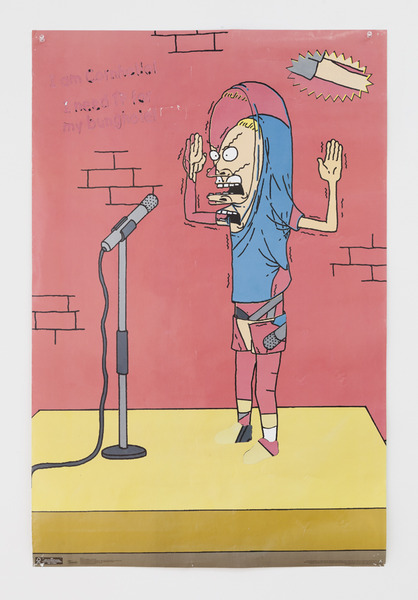
    Image courtesy of JTT

    Image courtesy of JTT

    Borna Sammak
    March 9 – April 27, 2014

    JTT
    170a Suffolk Street
    New York City
    jttnyc.com

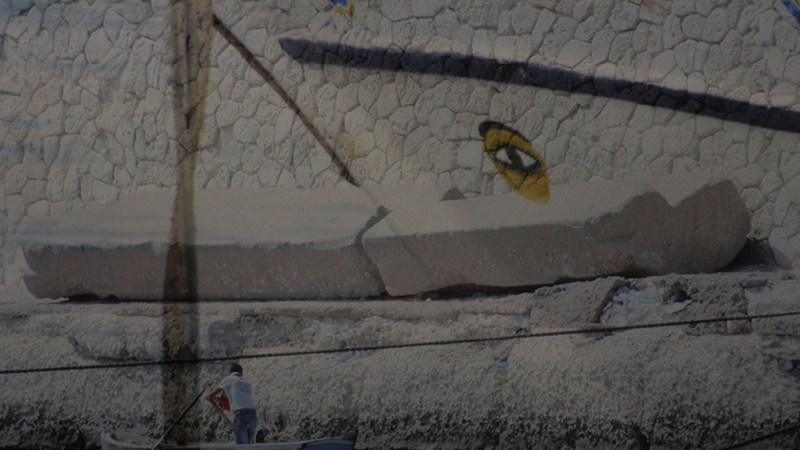
    Image courtesy of Bureau Inc.

    Image courtesy of Bureau Inc.

    Ellie Ga: “Four Thousand Blocks”
    March 23 – April 27, 2014

    Bureau Inc
    178 Norfolk Street
    New York City
    www.bureau-inc.com

    News | Exhibitions