• Cheim & Read is pleased to present Louise Bourgeois: Holograms, the first exhibition devoted exclusively to this little-known aspect of the artist’s long, groundbreaking career.


    In 1998 Bourgeois was approached by C-Project, a New York-based fine arts holographic studio (the C stands for the speed of light) dedicated to exploring the creative potential of three-dimensional photographs through the talents of top-flight painters and sculptors. The plates from Bourgeois’ resulting suite of eight holograms will be on display at the gallery from January 5 to February 11, 2017.


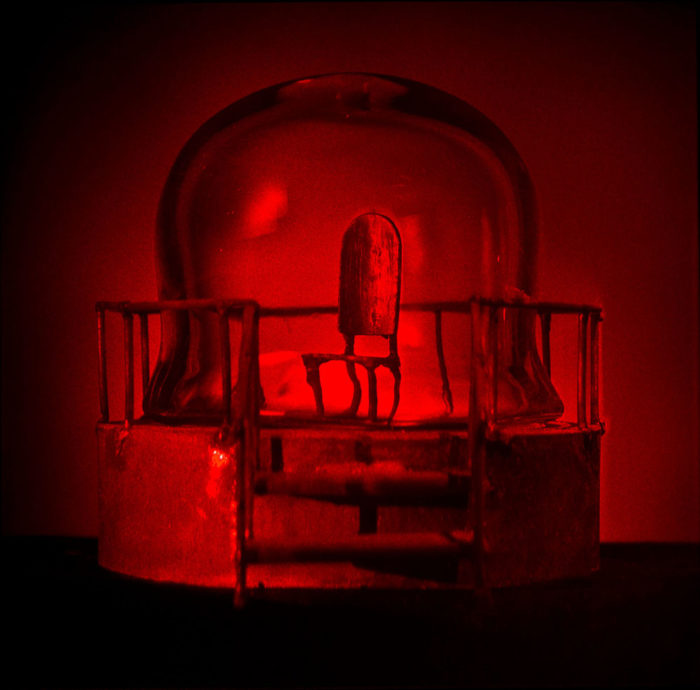
    The dream imagery conjured by Bourgeois for this new art form is in keeping with the probing psychodynamics of her widely admired sculptures, drawings, and prints, but the intimate confines of the hologram seem to have tapped into a particular strain of theatrical freedom. Within these self-contained universes, each measuring approximately 11 x 14 inches, she pieced together a cast of motley, emotionally resonate entities—miniature chairs, a bell jar, a pair of lovers (indicated by disembodied feet on a doll-house-size bed)—that combine the incipient dread and satirical playfulness that marks much of her work.


    Louise Bourgeois: Untitled (detail), 1998-2014, suite of eight holograms (Photo: Matthew Schreiber, The Easton Foundation).

    Louise Bourgeois: Untitled (detail), 1998-2014, suite of eight holograms (Photo: Matthew Schreiber, The Easton Foundation).

    The holographic image is created by laser beams that record the light field reflected from an object, burning it onto a plate of glass. The image is scaled at a one-to-one correspondence with the original material, so that peering at these works conveys the sensation of looking at an actual assemblage by Bourgeois, but at an eerie remove.


    One of the most striking aspects of these works is their color, a saturated red that recalls the illumination of an old-fashioned darkroom. While it fits the content perfectly, Bourgeois’ use of this shade of red is actually the result of a materials-based decision. Holograms are glass plates that appear black until they come to life when struck by light at a particular angle. Depending on the way the glass plate is originally encoded, the hologram will have a base color of red or blue. The master plates for Bourgeois’ editions are red, and it was her intention not to tamper with the purity of the diffracted light carrying the image to the viewer’s eye. The dazzling clarity inherent to the process, which allows for close scrutiny of such details as the threads dangling from the bottoms of chairs and the light reflected off the surface of the bell jar, elicits both childlike wonderment and a Beckettian sense of slapstick horror.

    Louise Bourgeois was born in Paris in 1911 and lived in New York from 1938 until her death in 2010. She was named Officer of the Order of Arts and Letters by the French minister of culture in 1983. Other honors included the Grand Prix National de Sculpture from the French government in 1991; the National Medal of Arts, presented to her by President Bill Clinton in 1997; the first lifetime achievement award from the International Sculpture Center in Washington D.C.; and election as a fellow of the American Academy of Arts and Sciences. In 1993 she was chosen to represent the United States at the Venice Biennale. Her work appears in the most important museum collections worldwide and has been the subject of several major traveling retrospectives organized by the Tate Modern, London; Centre Georges Pompidou, Paris; The Brooklyn Museum; and The Kunstverein, Frankfurt.

    Louise Bourgeois: Holograms
    January 5 – February 11, 2017
    Cheim & Read
    547 West 25th Street
    New York, NY 10001
    Telephone: (212) 242-7727
    Fax: (212) 242-7737

    Courtesy of Cheim & Read – Press Release

    Years ago, feeling good, the artist stumbled upon an old book at a Goodwill store: The Personal Atmosphere, by Frank Channing Haddock PhD. He bought it. Years later, feeling bad, he opened the book and used its questionable power to make this show.

    This, however, is not the first show Howlett built based on literature. His 2010 exhibition, also in Susan Hobbs Gallery, borrowed a title from an essay by French philosopher Henri Bergson, The possible and the real. Through his work, Howlett examined concepts related to Bergson’s interpretations of the “possible”, the “real” and the possible exchanges between pasts, presents and futures.

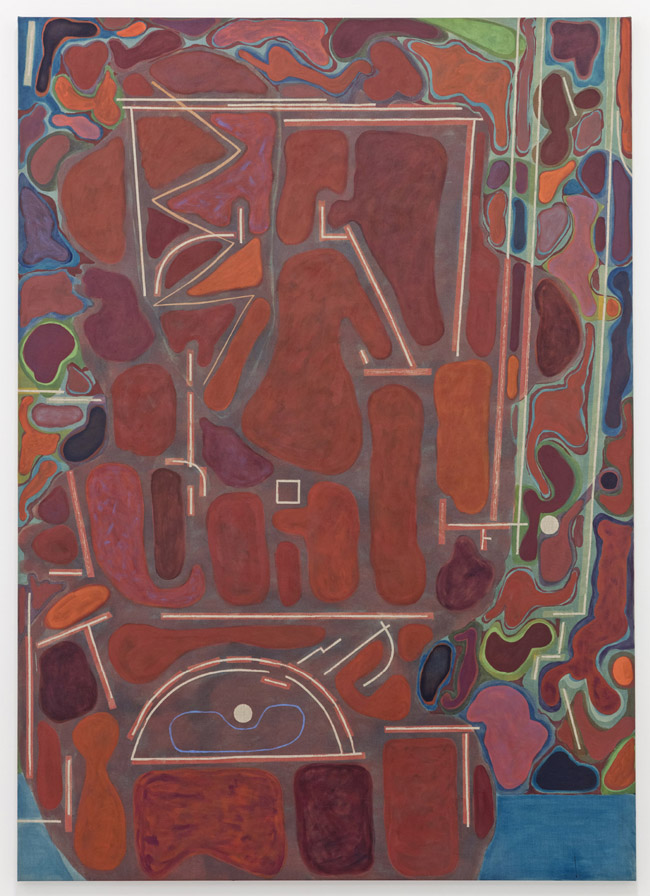
    Patrick Howlett, soft, flabby and factice, 2016, distemper and oil on linen 213.5 x 152.5 cm. Photo Toni Hafkenscheid

    Patrick Howlett, soft, flabby and factice, 2016, distemper and oil on linen 213.5 x 152.5 cm. Photo Toni Hafkenscheid

    The Personal Atmosphere: Ten Studies in Poise and Power by Frank Channing Haddock (1908. J.F. Tapley CC, New York) is a self-help book of that time, that focuses on positive thinking and the mood changes caused by electro-magnetic vibrations. In this book the “personal atmosphere“, some might call it aura, is the energy a person exudes and the way people feel when they come into his/her orbit. It is unique for everyone and has a dominant theme and emotional tone, and it goes through stages. During depression, the personal atmosphere is under construction. The individual is in the process of re-evaluating life to allow a deeper expression of peculiarities and eccentricities. This is a procedure that is filled with tension that both the person and others around them will feel – and it may be inspiring. A perfect state of mind for starting a new painting series.

    Howlett posted a page full of quotations from Haddock’s book on Susan Hobbs website and I foolishly attempted to pair them up with his paintings – which is, of course, impossible. It wasn’t the power of the words but the power of the vision that the artist created from them that can give us some guidance. I decided to start with this one: “Begin by thinking beauty and good cheer (70).”

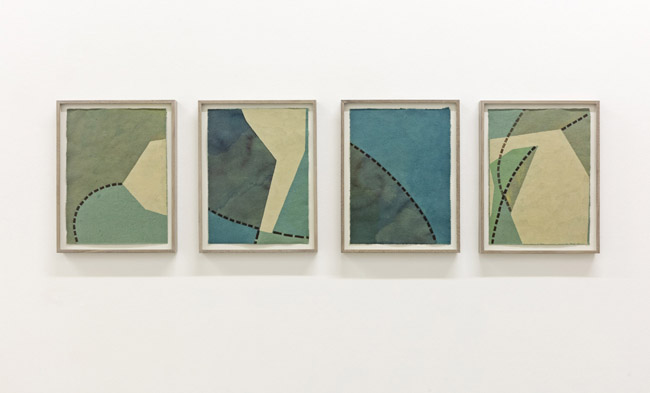
    Patrick Howlett, the effort becomes confusing, 2016, gouache and watercolour on paper, in 4 units, 42.5 x 192 cm. Photo Toni Hafkenscheid

    Patrick Howlett, the effort becomes confusing, 2016, gouache and watercolour on paper, in 4 units, 42.5 x 192 cm. Photo Toni Hafkenscheid

    I love to read and I love the alphabet. Growing up in Europe where education means focusing on letters at an early age, I have always been mesmerized by them. On entering the Susan Hobbs Gallery, and seeing half the walls covered by alphabet letters, I was immediately enveloped in a friendly atmosphere The memory of picturesque codex letters that tell an entire story came up, followed by the more rational Guttenberg ABC and the opportunity that printing bought to us readers. Howlett’s letters don’t follow any traditions. They come from the artist’s personal history and imagery. He is the only one who knows their hidden meaning. A large, three-dimensional P captures a smaller P. The latter is comfortable sitting in a dark blue oval (an O maybe) surrounded by a lighter blue rectangular shape. It is very playful. I call it POP, pop, pop, pop – a movement, a sound. An N surrounded by an O (NO) and O with a + sign in the middle (Opus) – there is an endless opportunity for guessing games.

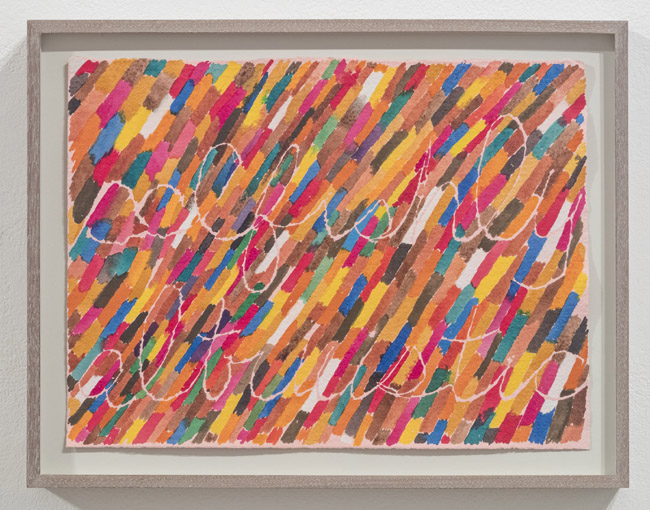
    Patrick Howlett, New Thoughts Selfishly Altruistic, 2016, watercolour and gouache on paper, 28 x 37.5 cm. Photo Toni Hafkenscheid

    Patrick Howlett, New Thoughts Selfishly Altruistic, 2016, watercolour and gouache on paper, 28 x 37.5 cm. Photo Toni Hafkenscheid

    A big O is the central element of Outlet or maybe it’s a circle or an open mouth. The motif and the composition bring Philip Guston’s paintings to mind. The blue shape in the centre might be a protruded tongue, like the Rolling Stones emblem cooled from its burning red to calm blue, or a little bag for treasures surrounded by stitches that form a string. Dotted lines and cut-out shapes create the compositions of The effort becomes confusing – showing the steps of creating the pieces. ‘’The painting is teeming with clues and with traces that the artist has left here like signposts” (Françoise Barbe-Gall. How to Look at a Painting, London, Frances Lincoln Limited, 2010, p. 195) quotes Alex Bowron in his essay Frame Work 12/16, that accompanies Howlett’s show. Indeed, there are many possible interpretations for Howlett’s work, like all abstract compositions.

    Howlett’s painting are layered with intellectual meaning. His symbols are sophisticated. Not just that he is well versed in literature and philosophy, familiar with modern art and the work of his contemporaries, and a music lover, but also that he is a critical thinker on his own. His compositions are unique and a product of a long meditation as well as compositional experimentation. He uses everything a contemporary artist can – from art history to the never-ending richness of internet images – to create his own work. “I make paintings that I hope are novel in some way. I like the transformative nature of making a painting, and I am conscious of that idea when creating an image.” – said Howlett in an interview (blogspot March 22, 2011).

    In one of the largest painting of the exhibition, Soft, Flabby and Factice, we can find all the painterly elements of the show concentrated into one. Like Paul Klee, Howlett brings together many elements into one composition. It is hard to know what it is about; the motifs are soft and hard, geometric and organic, seemingly kept together by factice, an oil used as a processing aid in rubber. From a distance the geometrical shapes stand out but looked at more closely the organic forms become stronger – creating harmony. The paint layers of the organic shapes give the illusion of transparencies while the straight and curved geometric lines are almost neon-like. The painting has a rich palette from the cold blues of water, surrounded by thin green lines of vegetation to the reds of sunsets and the deep browns of earth. The whole composition reminds us of aerial photographs when the plane is still close to the ground so the landmarks are still outlined but slowly disperse into shapes only. The overlapping geometrical structure must be man-made but entirely environmentally friendly as they follow the forms of the land. There is a lot of movement and an almost musical rhythm in this composition.

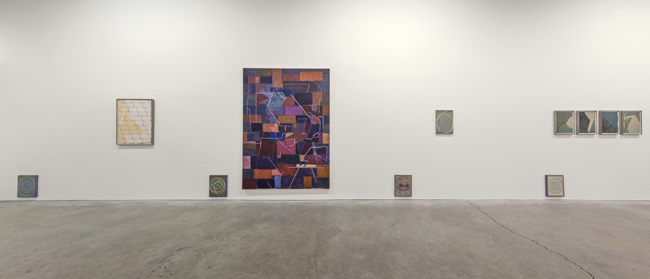
    Patrick Howlett, The Personal Atmosphere, installation view, 2016. Photo Toni Hafkenscheid (3)

    Patrick Howlett, The Personal Atmosphere, installation view, 2016. Photo Toni Hafkenscheid (3)

    The installation of the exhibition is structured and site-specific but still feels intuitive. Visitors are compelled to look up and down, their eyes constantly shifting, because the works are hung at various heights and at uneven distances – emphasizing the show’s nonlinear nature.

    Let me finish with a Haddock quote, again from Howlett’s picks: “It is as if we had the more than Gorgon power of transmuting every object around us into forms beautiful or hideous, and of sending the transmuting process forward through time and eternity (53-54)” – and this is exactly what these paintings do.

    Emese Krunák-Hajagos

    *Exhibition information: December 1, 2016 – January 28, 2017, Susan Hobbs Gallery, 137 Tecumseth Street, Toronto. Gallery hours: Wed – Sat, 11 am – 5 pm.

    With one dramatic no, a major artist has just escalated the culture world’s war against Donald J. Trump.

    For more than 20 years, the artist Christo has worked tirelessly and spent $15 million of his own money to create a vast public artwork in Colorado that would draw thousands of tourists and rival the ambition of “The Gates,” the saffron transformation of Central Park that made him and Jeanne-Claude, his collaborator and wife, two of the most talked-about artists of their generation.

    But Christo said this week that he had decided to walk away from the Colorado project — a silvery canopy suspended temporarily over 42 miles of the Arkansas River — because the terrain, federally owned, has a new landlord he refuses to have anything to do with: President Trump.

    His decision is by far the most visible — and costly — protest of the new administration from within the art world, whose dependence on ultra-wealthy and sometimes politically conservative collectors has tended to inhibit galleries, museums and artists from the kind of full-throated public disavowal of Mr. Trump expressed by some other segments of the creative world. Last week, the artist Richard Prince fired an opening salvo, returning a $36,000 payment for an artwork depicting Ivanka Trump, the president’s daughter, owned by her family.

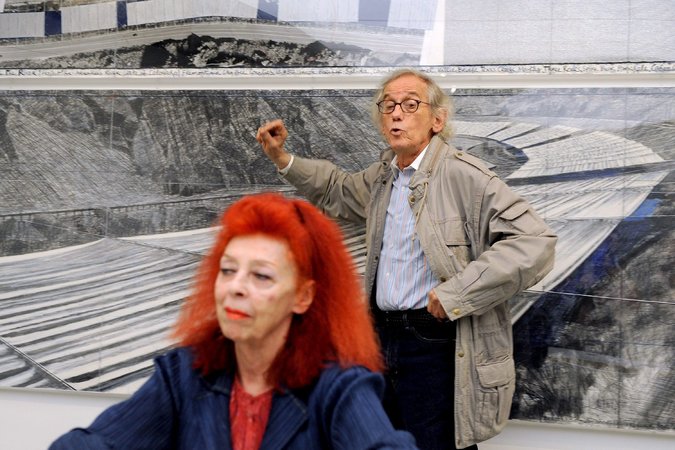
     Christo and Jeanne-Claude at a news conference for “Over the River” in 2009. Credit Dominic Favre/European Pressphoto Agency

    Christo and Jeanne-Claude at a news conference for “Over the River” in 2009. Credit Dominic Favre/European Pressphoto Agency


    Read more


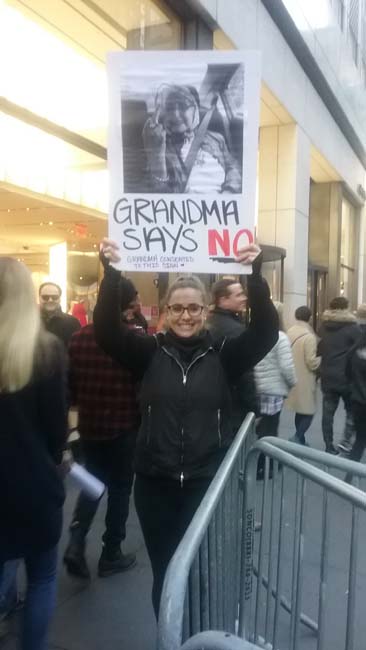
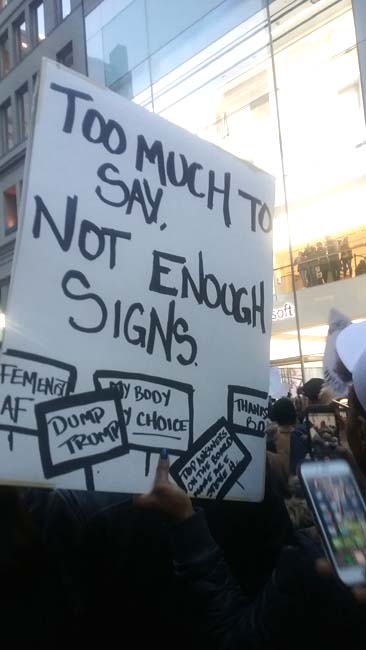
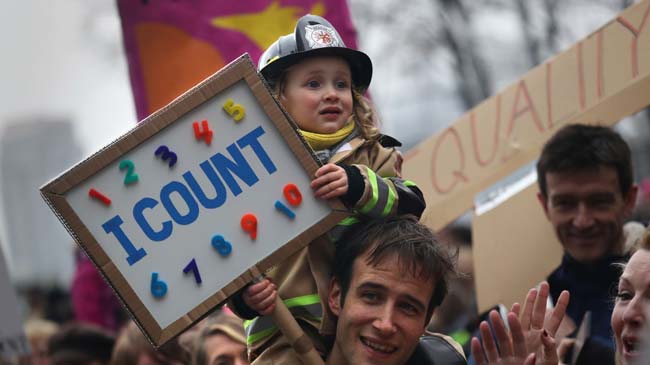
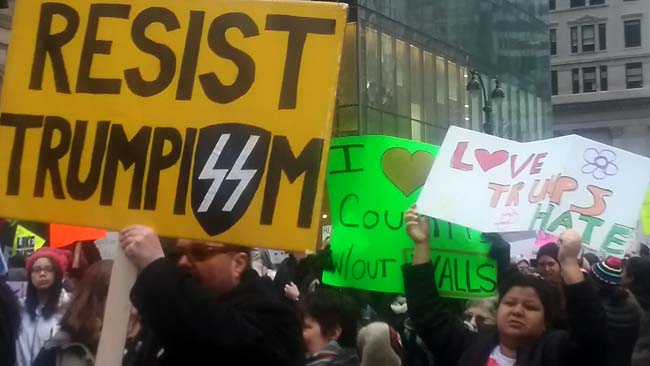
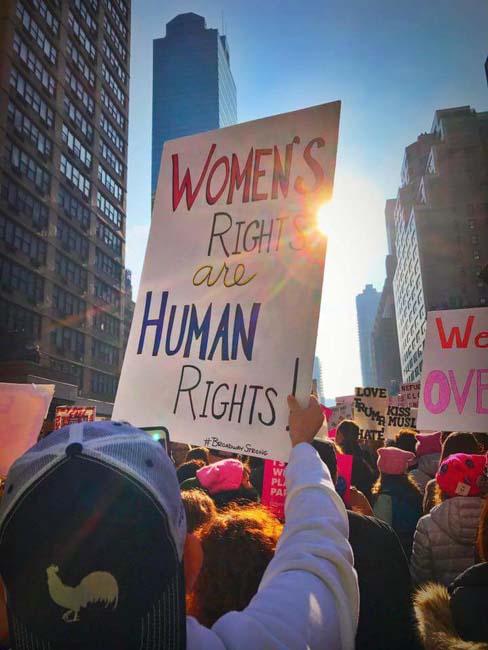
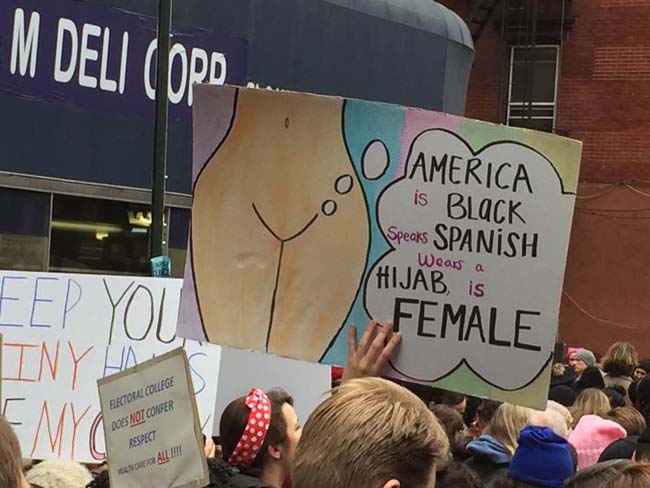
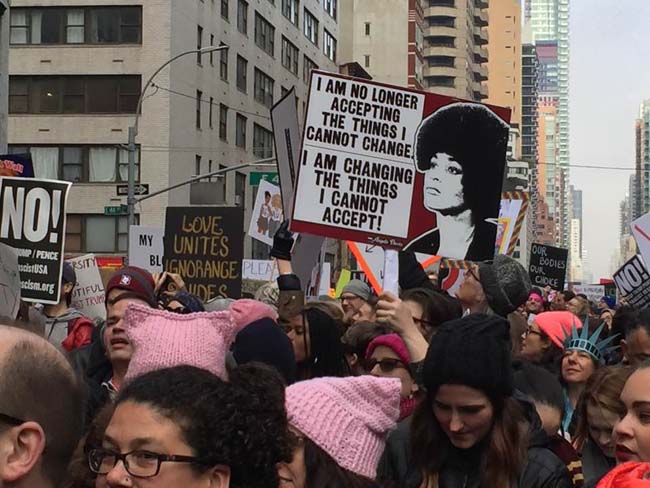
    More than 400,000 people marched through Manhattan on Saturday in solidarity with the Women’s March on Washington on January 21st, 2017:

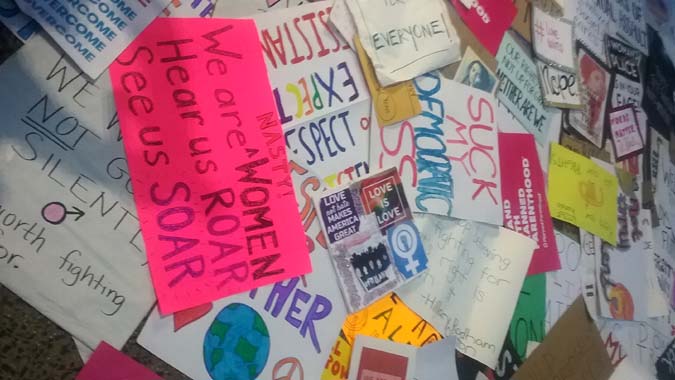
    Collection of posters from the Women’s March on January 21, 2017 in New York City. ( Credit: NY Arts/J.Gora)

    Collection of posters from the Women’s March on January 21, 2017 in New York City. ( Credit: NY Arts/J.Gora)

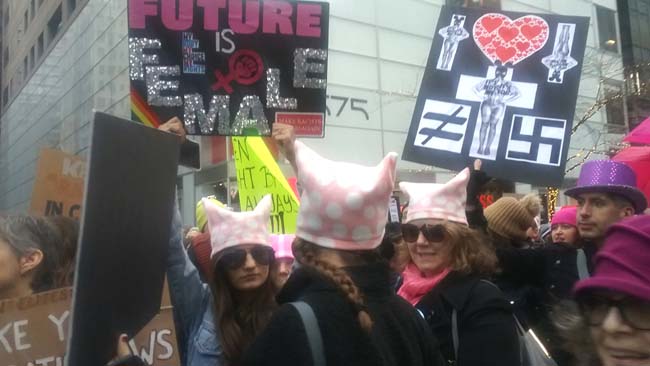
    Protesters march in Manhattan during the Women’s March on January 21, 2017. NY Arts.

    Protesters march in Manhattan during the Women’s March on January 21, 2017. (Credit: NY Arts/ J. Gora)

    Protesters of all ages take part in the Women's March on NYC on Jan. 21, 2017, in Manhattan. (Credit: NY Arts/ J. Gora)

    Protesters of all ages take part in the Women’s March on NYC on Jan. 21, 2017, in Manhattan. (Credit: NY Arts/ J. Gora)

    Protesters march in Manhattan during the Women’s March on January 21, 2017. (Credit: NY Arts/ J. Gora)

    Protesters march in Manhattan during the Women’s March on January 21, 2017. (Credit: NY Arts/ J. Gora)

    Protesters in the Women's March on NYC on Jan. 21, 2017, in Manhattan. (Credit: Getty Images / John Moore)

    Protesters in the Women’s March on NYC on Jan. 21, 2017, in Manhattan. (Credit: Getty Images / John Moore)

    Protesters march in Manhattan during the Women’s March on January 21, 2017. (Credit: NY Arts/ J. Gora)

    Protesters march in Manhattan during the Women’s March on January 21, 2017. (Credit: NY Arts/ J. Gora)

    Protesters march in Manhattan during the Women’s March on January 21, 2017. (Credit: Michael Tessaro/Facebook Feed)

    Protesters march in Manhattan during the Women’s March on January 21, 2017. (Credit: Michael Tessaro/Facebook Feed)

    Protesters march in Manhattan during the Women’s March on January 21, 2017. (Credit: Aaron Burr-Society /Facebook Feed)

    Protesters march in Manhattan during the Women’s March on January 21, 2017. (Credit: Aaron Burr-Society /Facebook Feed)

    Protesters march in Manhattan during the Women’s March on January 21, 2017. (Credit: Aaron Burr-Society /Facebook Feed)

    Protesters march in Manhattan during the Women’s March on January 21, 2017. (Credit: Aaron Burr-Society /Facebook Feed)

    Video feed via Staten Island Advance /YouTube


    By NY Arts, Jan. 21, 2017


    As capitalism in its neoliberal form spreads worldwide, and populism – from Trumpism to Brexit – rises in all corners of the Western world; wall building emerges as a sign of a period one could call ‘post-political’. From the US-Mexico border to Italy’s Lampedusa, more and more fences and checkpoints are appearing, creating zones of exclusion.

    The theorist Wendy Brown considers the proliferation of separation barriers, both within and between nation-states, a symbol of societal disruption. This resurgence in wall building uncannily appears in a context of transnational power intensification and the erosion of national sovereignty.

    Globalisation, the quality of which is connectedness rather than division, should have reduced the need for separation barriers and yet it seems to only have increased their establishment. However, cultural production is contradicting this trend, as exchange across the globe – even if maintaining North-South hierarchies – has been growing since the end of the Cold War.

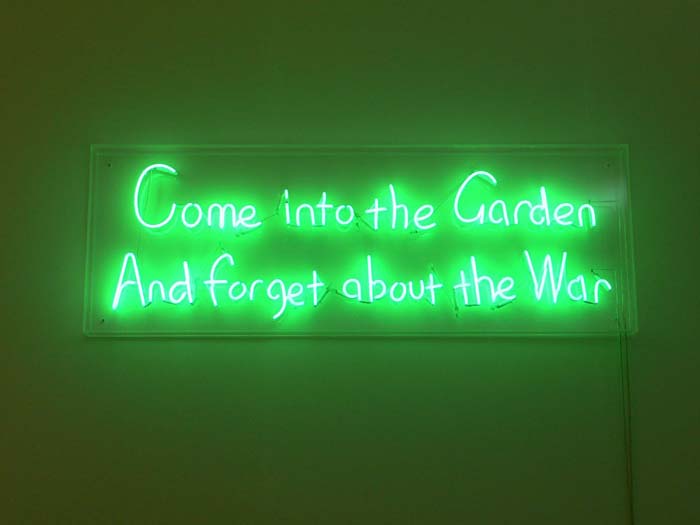
    Graham Fagen, War-Garden (after-Tubby), 2007. Courtesy of Golden Thread Gallery, stand P21b

    Graham Fagen, War-Garden (after-Tubby), 2007. Courtesy of Golden Thread Gallery, stand P21b

    Within the field of art, a phenomenon derived from this situation is what could be designated as a ‘geographical turn’ in Western institutions. In the past twenty-five years or so, museums, galleries, art fairs, auction houses and other players have been seeking to broaden their horizons with respect to non-Western art and other ‘subaltern’ practices – ‘art from elsewhere’, as the curator Okwui Enwezor puts it – including those rooted in gender and ethnicity as well as belonging to craft and outsider traditions.

    This 2017 edition of ‘Dialogues’ reflects the challenging conditions in which one lives today, attempting to grasp these recent developments in society and culture. The section includes galleries based in distinct parts of the UK – from London to the regions, and from England to Wales to Northern Ireland – and areas such as Dublin, southern Europe, the interior of the United States, and sub-Saharan Africa.

    By its own nature, ‘Dialogues’ suggests interaction among the participating galleries, and thus the section is even more relevant this year, as the walls that typically split the multiple stands of an art fair are literally broken, metaphorically referencing the need to knock down the walls that have been, are being or will be erected. The featured artists address the issues of our times, looking at history, race and collectivity; alongside explorations of imaginaries, representation and subjectivity.

    The galleries from outside the UK are from peripheral, often uneven geographies – particularly in economic terms – but it is in these new ‘centres’ that many of the most engaging art is being made today. Putting them in conversation among themselves and with their UK counterparts – who include representatives of some of this country’s innovative art scenes – is intended to contribute to the expansion of a progressive cultural scene, and by consequence to a public sphere in which cosmopolitanism is the rule.

    Miguel Amado, ‘Dialogues’ 2017 curator

    This edition of ‘Dialogues’ presents collaborations between the following UK and international galleries:


    Courtesy of London Art Fair 2017.  Copyright © London Art Fair 2017.


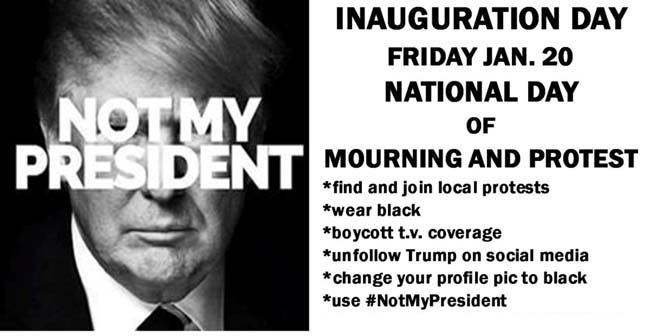
    anttrumpCall for submission: “Not My President”

    NY Arts Magazine is inviting all artists to submit the artworks and comments in response to Donald Trump’s presidency.

    All entries will be published on NY Arts for public view in Spring 2017.
    You can post your comments or send an artwork.
    editor@nyartsmagazine.com

    NY Arts Team

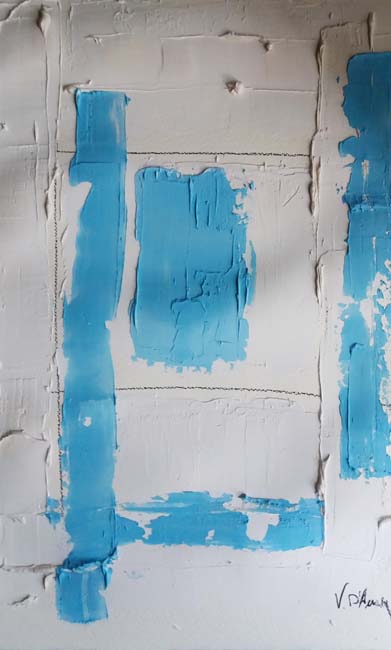
    the-1980s

    – 1980’s Free to run on pre-established roads –
    Who suggested to me that working makes us unique and independent sets us apart from each other and makes us independent to choose and realize our dreams, or and ‘something’ that is born with us and must be cultivated over the years and make us less parasites?

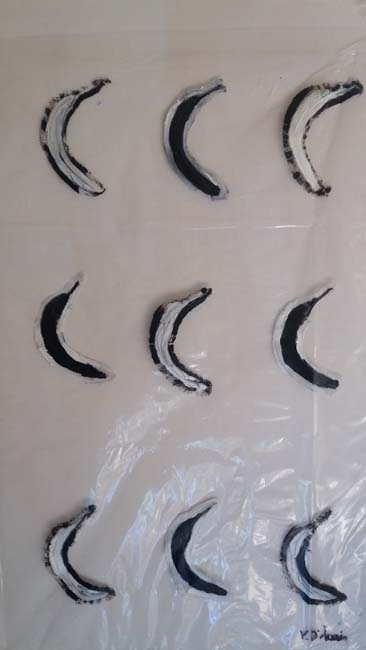
    man-in-black
    -Man in Black-

    the-machines
    -The machines-

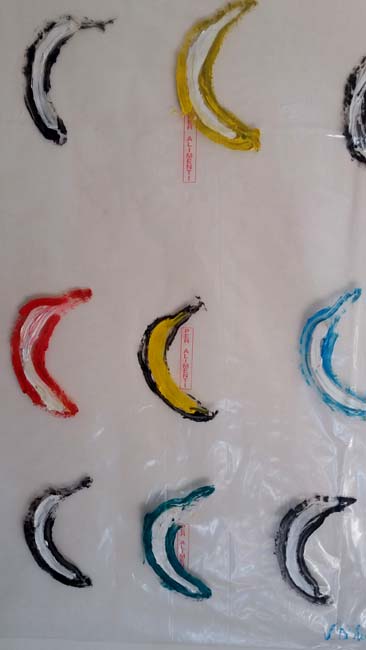
    nothings-changed
    -Nothing’s changed-
    Not wanting to copy Lucio Fontana, but I’m just saying that nothing’s changed since then. I understand that it is for all those who feel suffocated by a absence of authenticity, it is for those who are compelled to leave their belongings in the name of a God who just wants to get rich at the expense of others ‘ intelligence and not by anything of his.
    Dedicated to all those who want to live.
    – Vincenzo D’Auria

    Ai Weiwei: Laundromat

    On view till December 23, 2016
    Jeffrey Deitch gallery
    18 Wooster Street, NYC

    Many artists engage with current political issues in their work, but it is the rare artist whose message transcends the art discourse and influences a wide international audience. Ai Weiwei has built on the moral authority of his work to focus attention on some of the world’s most urgent problems. Through his work, he has become one of the most important advocates of human rights. Laundromat is an extraordinary exhibition project that addresses the current refugee crisis. The exhibition focuses on the refugee camp at Idomeni on the border of Greece and FYROM, the former Yugoslav Republic of Macedonia. Ai Weiwei explains the back- ground and the concept of the exhibition in the following Q &

    A: How did the refugee project begin?

    The refugee project began while I was living under soft detention in Beijing. Following my arrest and secret detention in 2011, my passport was confiscated and I was prohibited from traveling outside of China. Although I could not leave the country, I was able to stay engaged globally through the Internet. I have participated in hundreds of exhibitions in absentia.

    For the 56th Venice Biennale, the Ruya Foundation asked me to make a selection of drawings for a publication entitled Traces of Survival. The drawings were made by refugees living in the Shariya refugee camp in Iraq. This gave me an opportunity to get further involved and I asked to make a visit to the camp. I designed a survey and, be- cause I could not leave China, had two assistants travel to the camp. The survey asked of the refugees several basic and essential questions: Who are they? What kind of life did they have before? How did they become refugees? What did they think of their future? In total, my assistants conducted over a hundred interviews at the Shariya camp.

    In July 2015, I received my passport back from the Chinese authorities and traveled to Berlin. There, I visited some refugees who had recently arrived from Syria. I decided to become more involved. I was unfamiliar with the situation and the scope of the issue was wide enough for me to study. During Christmas, I visited the Moria refugee camp in Lesbos, with my son and partner. I saw how the refugees arrived on the Greek shore, many of them women and children. The conditions at the camp were shocking.

    I thought back on my own experience as a refugee. When I was born, my father, Ai Qing, was denounced as a ‘rightist’ and was criticized as an enemy of the party and the people. We were sent to a labour camp in a remote region far away from our home. We carried almost nothing with us to the camp, only trying to survive. It was an extremely difficult time being seen as a foreigner in your own nation, an enemy of your own people, an enemy of those my father loved most. I know what it is like to be viewed as a pariah, as sub-human, as a threat and danger to society.

    How did you first get involved in Idomeni?

    The refugees leave their homes because of the war. They are trying to escape immediate danger. They have lost their relatives. I met a young boy, only 18 or 19 years old, and he was shaking. I put my arm around him. He told me that, underneath his blanket, he had lost his right arm. I also began to shake. He’s so young and you can only imagine what he has been through, what his future will be like. That fear, even after having arrived in Europe, can still be seen in their eyes. I can imagine that fear has not dissipated, but their new reality has given them even more to worry about.

    I cannot give them food or tea, or money, but rather I can let their voices be heard and recognized.
    I can give them a platform to be acknowledged, to testify that they are human beings. During the saddest moments in our history, mankind has had to prove their worth as humans to their own kind. Unfortunately, this has proven to be the most difficult task. As an artist, this is something I would like to take on. I decided to follow the refugees’ path. I went to the Idomeni refugee camp. It had become a bottleneck when the flow of refugees entering Europe was completely shut off. Be- fore, the refugees would travel through Idomeni on the so-called Balkan Route to reach Europe. Once the Macedonian government closed the border, the camp swelled to over 15,000 refugees.

    They stayed in the field next to the railroad tracks, living in temporary tents provided by the NGOs. They stayed there with no government assistance. The NGOs provide support for the flow of refugees, but many things are beyond their power. They cannot handle things such as registering the refugees and they have no authority to enact order. They cannot establish basic sewage or clean water systems. During my visit, it rained constantly. The Idomeni fields turned to mud. The refugees, many of them women and children, lived through these extremely difficult conditions, waiting to be handed a cold sandwich and news of what would come next. With great frustration, we couldn’t do much. I start- ed to take many photographs, to try to record the moment. The harsh reality can act as evidence and make us reflect on these conditions. This is a condition many people refuse to see, or try to distort or ignore. Many willfully believe this isn’t actually taking place. When you see so many children out of school, 263 million children worldwide, you can easily predict what our future holds.

    By this point, we had already decided to make a documentary. We had several teams covering different people’s stories: a young pianist from Syria, a lady who brought her cat with her on the long journey, a family of thirty from Afghanistan, an economics student who hoped to finish his PhD in Europe but who is, today, still stuck in a Greek refugee camp. We have filmed in Greece, Turkey, Lebanon, Jordan, Israel, Gaza, and Kenya. We will film in Afghanistan, Iraq, Pakistan, Bangladesh, and Mexico. I have personally visited over twenty camps in different locations and interviewed over a hundred people including politicians, NGOs, volunteers, smugglers, gravediggers and countless refugees.

    How did the concept of Laundromat come together?

    When we started filming in Idomeni, the first thing we noticed was people trying to change their clothes. These are the clothes they wore from Syria, wet and soiled from the difficult journey across the ocean, over mountains and through woods. They had no chance to wash their clothes until they were forced to stop in Idomeni. They would hand wash the clothes and throw it on the border fence to dry. There was nowhere else to hang dry their laundry. We photographed the clothes, but we did not, and could not, imagine they could later be included in an exhibition. The clothes were some of the few posses- sions they could take when they decided to leave their homes. There is not much else they could take. Off the coast of Lesbos, I found an abandoned boat drifting in the sea. Inside, I found a copy of the Bible and a baby’s bottle. You would also find small objects wash up on the shore. These objects were the most precious things a person could have, the last things they brought with them as they sought a new life.
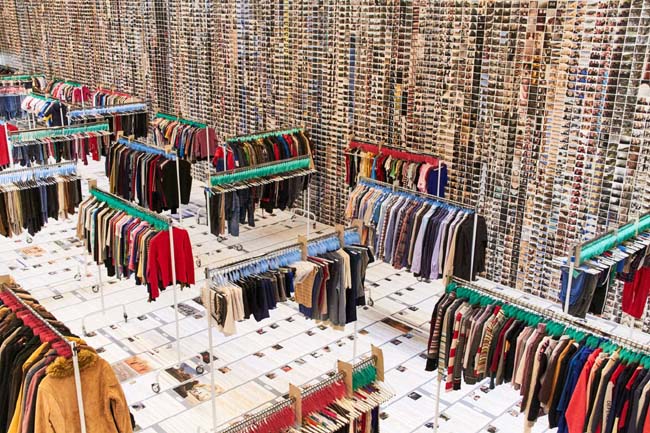
    Ai Weiwei: Laundromat on view till Dec. 23, 2016 at Jeffrey Deitch gallery, NYC.

    Ai Weiwei: Laundromat on view till Dec. 23, 2016 at Jeffrey Deitch gallery, NYC.

    Once the refugees were forced to evacuate to different camps from Idomeni, many of those possessions were left behind. Trucks came in and loaded these items up to take towards the landfill. I decided to see if we could buy or collect them so they would not be destroyed.

    Previously, my studio collected many life jackets from the local officials in Lesbos and made an installation with them at the Berlin Konzerthaus. My team negotiated with local officials who agreed to let us have the collected material. They were aware of our presence and were supportive. With a truckload of those materials, including thousands of blankets, clothes and shoes, all impossibly dirty, we transported them to my studio in Berlin. There, we carefully washed the clothes and shoes, piece by piece. Each article of clothing was washed, dried, ironed, and then recorded. Our work was the same as that of a laundromat.

    The work that will be shown at Jeffrey Deitch, let’s talk about some of the parts. You will be showing the clothes on the clothing racks in the main space. Is that the evidence of the work, evidence of what happened in Idomeni?

    My work is a total work. What I do everyday, shooting documentary footage, doing research, archiving materials, that is all part of the same effort.

    It could be called an individual work, but it’s really part of a total effort. One of the aspects included in the exhibition is the Allen Ginsberg poem…

    Allen is an old friend of mine. He has always had a strong compassion for those in need of help. With the help of the Allen Ginsberg Project and Larry Warsh, we received Allen’s early poems and readings. I think this is the best location for New York City to experience its own poet, the son of an immigrant, reading September on Jessore Road. His voice reflected the Bangladesh refugee crisis, which he saw when he visited the West Bengal refugee camps in the 70s. It’s a very touching poem evoked by a gentle, human voice. The story it tells is the same one unfolding today, the same story from a thousand years ago and, unfortunately, one that might continue into the future.


    Courtesy – Press Release, Jeffrey Deitch gallery, NYC. ©Jeffrey Deitch gallery


    headliney


    Israel Brushstrokes

    The only Summer Teen Program in Israel that focuses on Art!

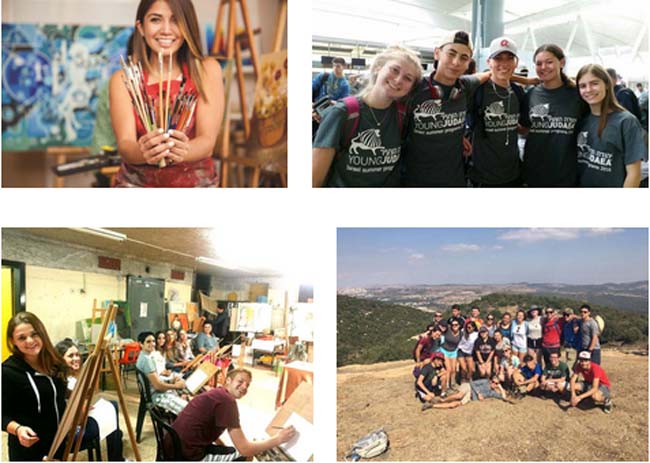
    Spend your summer in Israel building your portfolio and expanding your art repertoire alongside Israeli artists. You will also travel off the beaten path in Israel exploring sites and immersing into the art scenes in Jerusalem and Tel Aviv.

    Program Dates: July 13 – August 11
    Ages: 15 – 18 years old

    The program!
    3 days a week, you will be at the famous Betzalel Art Academy in Jerusalem working on projects such as painting, sketching, sculpture, pottery, photography and animation. You will also travel off the beaten path in Israel exploring sites and immersing into the art scenes in Jerusalem and Tel Aviv. There will be opportunities to hike, volunteer, and meet hundreds of other students from around the world resulting in an unforgettable summer.

    To learn more and to register call 1-866-599-25234 or click here
    http://www.youngjudaea.org/home/programs-in-israel/teen-summer-programs/israel-brushstrokes/

    Betzalel Academy of Art and Design is Israel’s top school of art, design and architecture. Participate in their workshops alongside their teachers and students for an experience that will make you stand out.

    Young Judaea is a leading organization specializing in high quality Jewish and Zionist education with over 60 years of experience in Israel programs.

    Young Judaea’s Israel Brushstrokes is a recipient of support from the New York Teen Initiative. The New York Teen Initiative is jointly funded by UJA-Federation of New York and the Jim Joseph Foundation. The Jewish Education Project serves as lead operator of the initiative.

    sponsors-logos


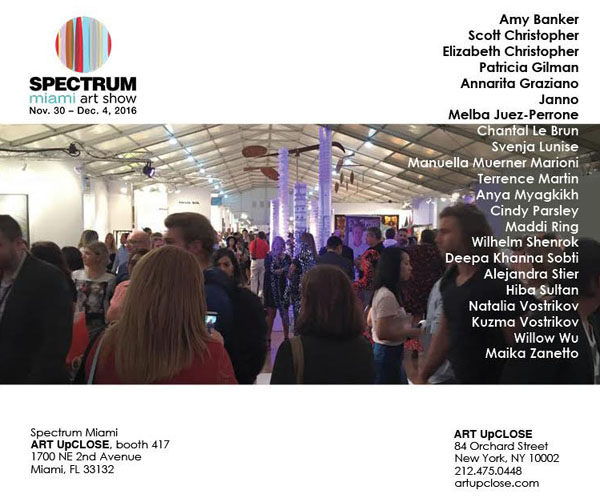
    We are delighted to announce Amy Cohen Banker participation in Spectrum Miami http://spectrum-miami.com during Art Basel Miami on November 30 – December 4, 2016. During that week thousands of people will visit this vibrant nexus of North and Latin America creating a global art marketplace. Visit us at Booth #417.

    Spectrum Miami
    www.spectrum-miami.com
    Art Basel Miami: November 30 – December 4, 2016
    Booth #417

    spectrum


    About the artist:

    A New York based artist, Amy Cohen Banker explores the interplay of painting and poetry. Her canvasses, inscribed by traces of their making as well as by the erasure of marks, show the process of painting as a double of writing. Banker has exhibited extensively in NYC and internationally. The artist is expecting her next solo exhibition titled “Paintings Today” at Artifact NYC Gallery, NY in April 2017.

    www.amycohenbanker.com

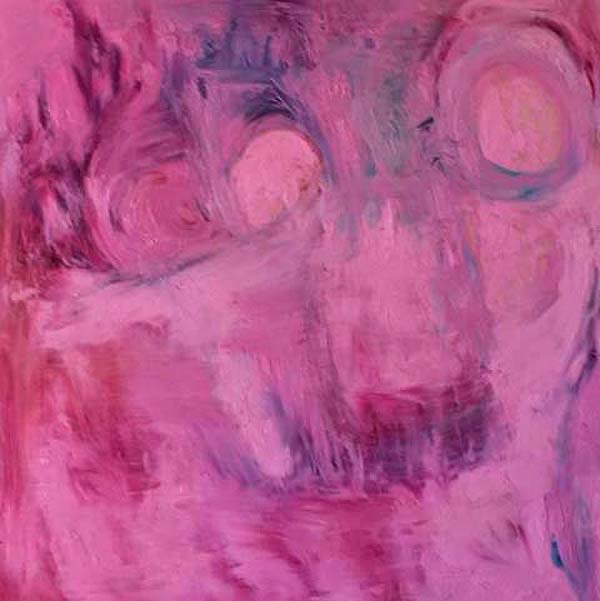
    Dianthus, Oil on wood 30x30 inches. 2016

    Dianthus, Oil on wood 30×30 inches. 2016

    News | Exhibitions