• My roommate and I felt slightly out of place as the Bryant Park Hotel doorman directed us to an elevator that was violently painted red. We pressed a button that would take us to a mysterious lower level.

    We got off and it was quiet. But, around the corner was a smiling employee, inviting us into a screening room. Next to the doorway was a table with boxes of popcorn and bottles of water. Many guests—myself included—took two of each.

    The seating consisted of large and comfy leather couches (which was far better than the stiff and non tiered seating I was used to, thanks to AMC Loews). I expected an ambiance of professional gravitas, but the other guests were chatting loudly and happily while we waited for the film, Belle, to start.

    This paradox of sophisticated informality remained throughout the experience, which certainly enhanced both the film and post-screening question-and-answer segment. The movie-watching experience is always better when the audience doesn’t withhold laughter or involuntary sounds of outrage at a character’s nasty behavior. Likewise, the questions and comments addressed to director Amma Asante and lead actress Gugu Mbatha-Raw were a balance of personal reactions and thought-provoking inquiries.

    The bildungsroman-esque film Belle (opened May 2) follows Dido Elizabeth Belle (Mbatha-Raw) in a rigid society as she attempts to find her place as a girl who is the daughter of both a black slave and an upper class white man. In the words of director Amma Asante, Dido must answer the question, “Who defines you? You or society?”

    Unfortunately, Belle does not necessarily stand as strongly without the extensive and articulate answers Asante provided after our particular screening. The film was sometimes diluted at the expense of its PG rating. And although it focuses on the struggles of a half-black woman, it does not provide insights into the average black woman’s life in England at the time.

    Many of the noteworthy aspects of the project were not revealed until the Q&A. Aside from her pleasantly strong female directorial presence, Asante’s research of the real Dido and her world was apparent. Character growth is heavily dependent on the development and outcome of the Zong case. At the time, Dido’s aforementioned great-uncle was the Lord Chief Justice of England. The case would be severely influential on future laws surrounding slavery and civil rights, which is clearly demonstrated and explained in the film.

    Historical influence extends to the story of Dido in general—Asante was inspired by a postcard she received that portrayed a painting of the real Dido and her cousin Elizabeth. This painting, appropriately, is strongly present—just like the film itself, the painting depicts a black woman as dominant and attractive rather than the more common portrayal through submissive body language or the display of grotesque white idolization in similar artworks of 18th century England.

    On the other hand, there are many aspects of the film itself that are refreshing. Although Belle may not be as raw as other films that involve race and slavery, this sometimes benefited the story and its themes. There were few stereotypical scenes that are sometimes common but perhaps not necessarily relevant to the plot of many 18th century period pieces (e.g.: sexual assault).

    The perspective of a biracial person, let alone that of a woman, of this time is part of what makes this film so refreshing. Additionally, a main focus of the film is love—but as Asante puts it, Belle is a “dual love story.” There is the predicted handsome and open-minded gentleman that catches Dido’s eye (Matthew Goode), but there’s also a compelling friendship between Dido and her cousin, Elizabeth (Sarah Gadon). There’s even an interesting dynamic and development of the relationship between Dido and her adopted father figure, Dido’s great-uncle Lord Mansfield (Tom Wilkinson).

    In the small screening room at Bryant Park Hotel, the audience’s enthusiastic cheers at Dido’s witty comebacks and disgusted gasps Lady Ashford’s (Miranda Richardson) hateful comments attests to the film’s contemporary qualities. In fact, Asante admits one of Lady Ashford’s more racist lines was inspired by her ex-mother-in-law (look for the scene in which Lady Ashford first meets Dido).

    Belle is the first period piece to have a black female lead—even in modern films a majority of leading roles are white men. Asante tells a story worth telling and did the homework to make it as true—both historically and universally—as possible.

    Belle is no masterpiece, but it is, nevertheless, a film we need.

    By Zoe Halsne


    Courtesy of Matthew Marks Gallery.

    Courtesy of Matthew Marks Gallery.

    Ken Price: Large Sculptures
    May 9 – June 28, 2014

    Matthew Marks Gallery
    522 W 22 Street
    502 W 22 Street
    New York City
    matthewmarks.com

    In regards to the curatorial field, the Internet has facilitated international collaborative projects and generated new possibilities for online exhibitions and platforms. For instance, I am currently part of an international curatorial collective called 7×8 comprised of 7 curators based in New York, Paris, Rome, Toronto, Vienna, and Singapore. Our recent projects include: contributing articles to our blog 7×8 Curatorial Conversations, featuring artists in each of our respective cities, and creating an online exhibition for Art:I:Curate. While the Internet has facilitated communication, critical feedback, and the expansion of our networks to a larger scale, online exhibitions have certain limitations, as with any website or digitally based experience. That is, the viewer cannot fully explore a physical space and engage with an artwork from any given angle; those interactions with the artwork are transformed to a finite experience of looking, scrolling, and clicking through a virtual space.

    I think the proliferation of social media has allowed larger institutions to interact with their publics more directly. Some bigger museums have begun crowd-sourcing public opinion, something which provides institutions with a deeper understanding of their audiences while making museum visitors feel they have made an impact on the institution. As an example, Brooklyn Museum’s GO project invited the people to make studio visits with 1,700 Brooklyn-based artists and nominate particular artists for a group exhibition at the museum. By integrating public opinion into their artist selection, the museum reconstituted the traditional, omnipotent curatorial voice to include other perspectives from the community. Another effect of the rise of social media in museums is the perceived accessibility of these large-scale institutions. With the ability to do things like comment on an organization’s Facebook page or Tweet directly at a museum, visitors can actively engage with the institution, exhibitions, artists, programs, and fellow museum-goers. In this way, direct feedback and visitors’ experiences are publicly addressed by the museum—a traditionally inaccessible entity.

    It seems that the contemporary curator needs to be more mobile than before, able to travel within and outside of the institution more fluidly than the once traditional “one curator, one space” model may have dictated. As an emerging curator, I would apply to open calls for exhibition proposals in cities around the world with the hope of to acquiring funding necessary for travel and installation. This model of the independent curator necessitates an itinerant lifestyle of pursuing research, meeting with artists, visiting paces, and overseeing exhibition installations. Curating an exhibition without knowledge of the local context and audience is highly problematic, so ideally, a curator might have a sustained relationship with a specific location in order to produce a relevant, meaningful exhibition for a given space and audience. When conceptualizing an exhibition or initiating a project, the curator’s role requires a nuanced understanding of the context and audience, since things like the socio-political climate of a particular location and the audience’s existing knowledge and exposure to contemporary art inevitably affect the works selected for an exhibition.

    I recently worked with Anna Witt, whose work often explores the political sphere, relationships of power and submission, and public interventions. For a recent work entitled Breaking New (2013), Witt employed a group of local craftspeople to re-purpose found rubbish by collecting bulk waste, building new furniture, and leaving these refurbished objects on the streets for public use. Even though this work was specific to the steel industry town of Marxloh, Germany, it addresses broader issues of waste and regeneration, and activating public social change.

    By Kimberly Kitada

    Image courtesy of The Hole.

    Image courtesy of The Hole.

    Featuring: Alek O., Ayan Farah, Evan Robarts, Gabriel Pionkowski, Graham Wilson, Hank Willis Thomas, Johnny Abrahams, Kadar Brock, Moffat Takadiwa, Nika Neelova, Penny Lamb, Shinique Smith, Tonico Lemos Auad

    Warp & Woof
    May 7 – June 20, 2014
    The Hole
    312 Bowery
    New York City
    theholenyc.com

    Courtesy of the artist.

    Courtesy of the artist.

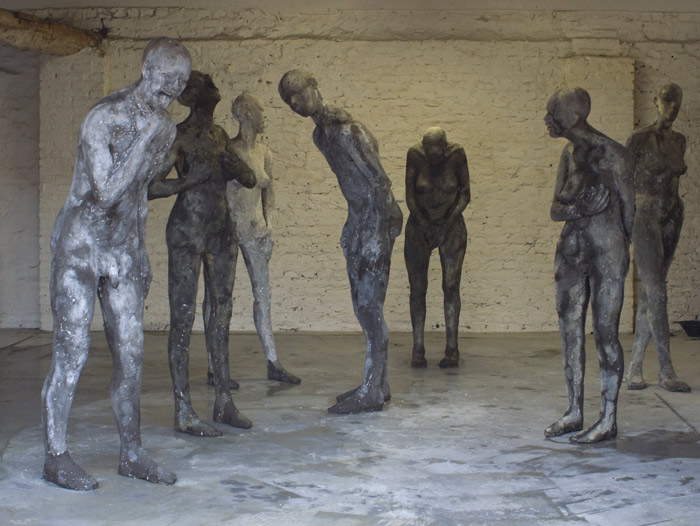
    My work draws upon the century-long tradition of handmade sculpture. I would describe my pieces as visceral; the sculpting technique I use when working with clay reveals a flesh-like quality. As such, my work has everything to do with the materiality of life. My sculptures wear the heaviness of being; their surfaces reveal every sign of corrosion that originates in the confrontation of the body’s skin to the abrasiveness of time and life itself. Often larger than life, they are turned inward; silent and introverted, their reticent pose heightening the expressiveness of the emotion they hold captive. These works scream in silence.

    nadinedemeester.be

    Courtesy of the artist

    Courtesy of the artist

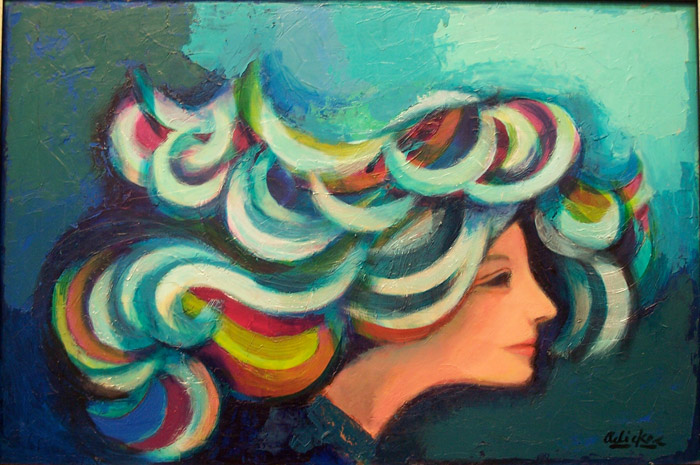
    Although I was born in Texas, my art education came from France; my influences are European art and architecture. I studied two years at the Atelier Fernand Leger in Paris (1948 -1950) and I traveled extensively, including a two year tour around the world settling at Antibes on the Cote d’Azur. My art is collected by several museums and hundreds of private collections. Adickes Foundation is a museum in Huntsville, Texas devoted to my art.

    adickes.net

    Courtesy of the artist.

    Courtesy of the artist.

    As an artist, my artwork comprises multiple dimensions in both aesthetic and educational values.  I try to emphasize the little nuances of what we see in our daily lives by using multiple mediums to accomplish this while educating the viewer.

    I wish to educate the viewer of my work by taking advantage of the opportunity, but without the viewer knowing they are being educated.  Also, I wish to educate what “can be” seen even if it is not seen in reality. This is why my body of art work is very colorful and detailed, to show the little and often vague subjects we miss in the “blink of the eye.”

    martharosecardotgreiner.com

    Courtesy of the artist

    Courtesy of the artist

    I am focused and spontaneous when I paint in a way that is very liberating and timeless to my spirit. This mystical quality of the creative process is unlike any other life experience, and is part of the energy that is self nourishing. I use palette knives, expressive kinetic brushstrokes, cotton swabs, and other instruments to gradually build layers of color, scrape, or wipe away paint to expose underpainting layers. I permit the painting process to guide me to its completion.

    dougsimon.com

    Courtesy of the artist.

    Courtesy of the artist.

    Painting for me is a need; a way to express myself and at the same time to play and experiment with different colours and forms and in that process communicate what I feel. I like to draw and paint and work in different media, oils, acrylics, ink, and collage. In each media I find different challenges and each time I learn new things. I always return to oil painting because the colours and textures I can get are infinite; I am identified with it. My themes are women and their different roles in society; space and architecture in that space; the ocean and sea shells. Sometimes a piece comes out “a la prima” other times it requires hardwork! Sometimes, after that hard work I do not like it and have to say , “next.” “Every concession is a lie,” Leslie Lee, my dearest professor, told me. I have to be satisfied with every piece of work.

    cfarrospide.com

    NY Arts:  If you had the opportunity to start a playful Biggie/Tupac style art world beef, who would you choose to go after and why? 
    Rachel de Joode: I would be Tupac and Biggie would be Jeff Koons. For one, I like to pick a fight with a contemporary archetypical male artist. Then, I guess Biggie/Tupac-wise we have a few things in common. But, Koons grossly manufactures toys for rich old boys. I say fuck plastic and let (little or big) emotions return to the arts!

    And, fuck capitalism as a whole. Let mistakes pour down. Also, I’ll pick a fight against irony any day, and let’s not forget personal labor, I am a big, big fan of sweat. One needs a strong calvinist work ethic when making art. I would absolutely like to teach him a lesson or two.

    News | Exhibitions