
Image courtesy of Matt Taber and Columbia University
2014 MFA Thesis Exhibition
April 28 – May 19, 2014
Fisher Landau Center For Art
38-27 30th Street
Long Island City
arts.columbia.edu




Image courtesy of Matt Taber and Columbia University
2014 MFA Thesis Exhibition
April 28 – May 19, 2014
Fisher Landau Center For Art
38-27 30th Street
Long Island City
arts.columbia.edu
Walking up the short flight of steps to enter in to Team Gallery‘s 83 Grand Street location is often it’s own reward, providing a nice break between the busyness of the SoHo street as you cross over into the relative silence of the polished white cube. The result is often confounding in the best possible way, presenting you with a viewing situation that you may not have expected and could not get a solid glimpse of from street level.
Daniel Turner’s current exhibition in the space is no exception. The viewer is immediately greeted by a twin pair of sculptures resembling utilitarian workstations of some kind, but at a peculiar height and seemingly erased of their functionality. Two long, low tables sit side-by-side, mirror images of one another in the center of the gallery space. With nothing on the walls, the space feels almost emptied out, but this initial impression fades as one begins to think about the work on hand. Their pale yellow color seems to speak to a domestic origin, but their length being over twenty feet long directs one to imagine them in a larger environment, such as a factory setting.
Each piece features a brushed metal basin that calls to mind a feed trough or industrial sink, though without a drain. A residue of evaporated liquid coats the bottom of these basins, presenting a vestige of recent action, or an idea of the artists presence that resists spelling out exactly what has transpired.
The work raises many classic ideas about the value of a sculpture, making a naked case for why objects can be vehicles for thought rather than necessarily being tied to a particular use. In this way, Turner presents more questions than answers with this work. It seems to be about creating a situation where the importance lies inside the viewer’s mind as we willingly engage in this aesthetic game of cat and mouse. It’s an experience that connects the viewer to the space, returning to the work in our minds as we turn it over and over, casting speculative theory as to what it may mean. The more it makes one think, the more we are able to recognize that perhaps this mind exercise alone can be enough.
By Matthew Hassell

Christian Meade, A Chair for Bucky, 2013. Augmented chair. Image courtesy of artist.
The Cyclorama Show: Master of Fine Arts Thesis Exhibition, SMFA, Boston
May 13–18, 2014
Boston Center for the Arts
539 Tremont St
Boston
smfa.edu
Jacqueline Hoang Nguyen: Space Fiction & the Archives
May 16 – June 29, 2014
Momenta
56 Bogart Street
Brooklyn
momentaart.org
As described by the Lincoln Film Society, its Chaplin Award honors the “distinguished film artist whose body of work and lifetime of achievements represent a significant contribution to the art of film”. With classics and fan favorites like Stand By Me (1986), The Princess Bride (1987), and Misery (1990), it is no wonder director and actor Rob Reiner was honored at the 41st Chaplin Award Gala on April 28, 2014.
The star-studded event was full of amusing anecdotes, nostalgic looks to the past, and anticipatory mentions of future projects.
Reiner’s friends and colleagues—including but not limited to James Caan, Michael Douglass, and Meg Ryan—each introduced one of Reiner’s films or projects. Ryan and her co-star, Billy Crystal, introduced When Harry Met Sally (1989).
“For those of you who have waited 25 years for a sequel, this is it!” Crystal said, inducing laughs from the audience. Crystal and the other presenters recounted stories and unknown aspects of their personal and working relationships with Reiner.
For instance—on the set of When Harry Met Sally, as Ryan and Crystal described, Reiner actually performed the famous orgasm scene at Katz Deli so Ryan knew exactly what he was looking for. The offscreen demonstration was also in front of Reiner’s mother, who played the woman that says, “I’ll have what she’s having.”
Along with these hilarious yet perhaps slightly disturbing vignettes, the gala also provided glimpses into Reiner’s most recent endeavors. A clip of his upcoming film And So It Goes was played as was a clip from the upcoming Proposition 8 documentary, The Case Against 8—in addition to filmmaking, Reiner is an outspoken activist for gay rights.
The actual award was presented by 1998 Chaplin Award recipient and fellow legendary filmmaker Martin Scorsese. With a few of his own words regarding his admiration of Reiner, the man of the hour finally walked onto the stage.
Reiner expressed mutual respect of Scorsese and mentioned how grateful he was to be included in his latest film, The Wolf of Wall Street, in which he played the father of Leonardo DiCaprio’s character. Reiner joked: “Which is more unbelievable—that Leonardo DiCaprio is a Jew, or that I’m his father?”
Reiner continued to express his gratitude to both his colleagues and to his family—he stressed that although he loves filmmaking, nothing is more important than his wife and kids.
The night’s presenters joined Reiner onstage after his heartfelt acceptance, and the audience rewarded him again with a much-deserved standing ovation.
By Zoe Halsne

Joe Fleming, Untitled
Joe Fleming: Suckerpunch
May 15 – June 14, 2014
Mike Weiss Gallery
520 W 24th Street
New York City
mikeweissgallery.com

Dani Tull, Eye (tabula rasa), 2014 Encaustic wax, oil and acrylic, acrylic glass, wood. 18 by 18 by 9 inches (45.75 by 45.75 by 48.25 cm).
Featuring: Basim Magdy, Dani Tull , Nabil Nahas, Zipora Fried
13 Essential Rules for Understanding the World
May 18 – June 21, 2014
On Stellar Rays
1 Rivington street
New York City
onstellarrays.com
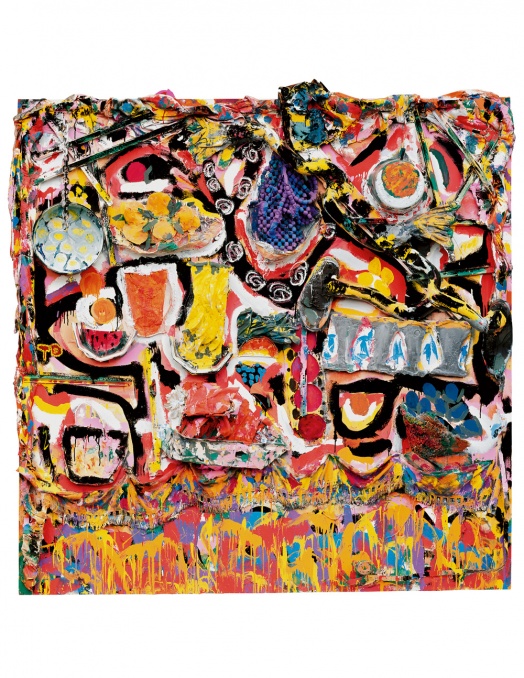
Thornton Dial
“Some kind of savior singing the blues/a derelict in your duct tape shoes/Your orphan clothes and your long dark hair/looking like you didn’t care/drunken angel” – Lucinda Williams
Featuring: Farrell Brickhouse, Karen Schwartz, Purvis Young, Thornton Dial
Curated by: Michael David
Drunken Angels
May 16 – June 22. 2014
Life on Mars Gallery
56 Bogart street
Brooklyn
lifeonmarsgallery.com
NY Arts: Has your approach to art always been associated with performance art?
Jacolby Satterwhite: No, I started with drawing and painting; however, the images I’ve been making since childhood have been performative and used the figure as a compositional pivot. Ten years into my painting practice, I became exhausted by painting’s history because it’s gender and racial politics were getting in the way of my ideas, so I pursued the alternative, which is performance and animation.
NYA: What artists were important to you during your development? Was there a particular artist or movement you were looking at in your formative years?
JS: Piero Della Francesca, Peter Paul Rubens, Goya, Carravaggio, Picasso, Madonna, Janet Jackson, Bjork, Neo Rauch, Lisa Yuskavage, Dana Schutz, Deee-Lite, Grace Jones, Marlene Dumas, Chris Ofili, Kara Walker, Joseph Beuys, Inez and Vinoodh, Antonio Biaggi, Paul Mcarthey, Andy Warhol, Bruce Nauman, Adriane Piper, Matthew Barney, Terence Koh, Nintendo 64, Sega Genesis, Dreamcast, Playstation, and music video directors like Mark Romanek, Chris Cunningham, and Michel Gondry—just to name a few out of a ton of influences.
NYA: Aside from performance, anything from photography, fibers, drawing, or computer-generated environments seem to make their way into your work. Is there a rhyme or reason as to the medium you decide to create a work with?
JS: The mediums I choose to work with are components of a more grand idea. Photographs and drawings are static, and give me the opportunity to make focused gestures in my work; those mediums are where I am most didactic. The CG animation and costuming is where the fun is. That is the territory where I am negotiating story, colors, textures, space, and composition.
NYA: The performative aspect seems to bleed through into a lot of what you do, whether in the form of actual performances, incorporation of these works into the realm of video, or stills taken from one or the other. How do you see your own body in relation to the work that you make? Is it just another tool or do all the creative ventures point back to it in some way?
JS: When talking about the work I usually use pronouns like “he”/ “him” to speak about the passive bodies that flow around in my animations. The way that I use my body in my work is similar to how I’d play with G.I. Joe dolls when I was a kid. The way I mediate my body between the animation and drawings gives it an unlimited terrain for what it can do and participate in. I have been outsourcing performances from others lately, and seeing what happens from there. I guess it’s like I’m getting 500 more G.I. Joes for my toy box.
NYA: Your work deals a lot with a personal or familial history. Can you tell us a little bit about what makes your background so important to the nature of your work?
JS: My background is important to my work, because I am the only person in the world with my background. You are the only person in history with your background, so by default it’s a great platform for original material. A lot of the content in the drawings are schematic documents of occurrences that happened around objects and the home. It’s my mother’s journal documented by short sentences and drawings of objects. The family photographs are separate performance documents that act as evidence that the objects in her drawings existed in her home, and people performed around them. So I usually mediate between the drawings and familial documents to influence a more surreal possibility for how those objects could function in the present animations.
NYA: How would you describe the relationship you have to your mother’s drawings?
JS: I watched my mother make her drawings since I was a child; she told me if I wanted to assist her in making them, I’d have to learn to be a better draftsman. So it technically is the genesis of my art practice. I also was the best at drawing Jesus in bible school. That was a minor influence on my ambition to pursuit art.
NYA: Her drawings seem always to have been translated to a new medium, either in being prints of the originals, or having been re-drawn into a 3D modeling environment. Do you see her need to create as flowing through your work in some way?
JS: The use of them is my system for restraining my creativity. They give me order and rules. It’s also a way to continue a creative lineage. The sheer volume of the drawings makes it necessary for me to use them to their full potential.
NYA: I hope you don’t mind me saying this—there is certainly an aspect of humor that comes through in many of your works. Can you share a little bit about the way this operates within your work?
JS: I think humor is a great subversion technique. It’s a great medium to deliver heavy content. I’m also a really goofy, nerdy, perverted guy … so it’s also a subconscious default.
NYA: You seem to have a very organic relationship to the technology you use, that is to say, you know exactly how you want it to operate and you are less concerned with a professionally polished look, and more interested in making the technology work for your project. Is this by necessity or design?
JS: I think it’s by necessity and design. My process is very analog because of tracing, rotoscoping, modeling, scanning, and performing. The design automatically results into a D.I.Y. aesthetic. I am satisfied with that, because it’s more human and porous. As I continue to learn and grow with the medium, things become more sophisticated.
NYA: Tell us about the inspiration behind the wild nature of the worlds you create, do the performances exist to be inserted into the worlds, or does the process usually happen the other way around?
JS: My live action performances are just as much of a world-building technique as my 3D animation videos; they co-exist. A lot of the footage from my live action performances informs the imagery in the animations. I compare it to an Ala Prima landscape painter like Milton Avery, Monet, or Edward Hopper going into the landscape with a sketchbook and easel, to return to their studio and make a refined project from it. I work from observation, and performance is the way that I observe the world.
NYA: Is there anything about your process or your oeuvre that you feel people overlook when encountering your work?
JS: Not in the current moment, which makes me desire to blur the lines a little more.
NYA: What upcoming exhibitions or projects do you have in the works that you are willing to share?
JS: I’m excited about a project I’m working on at Recess Art’s Sessions program. I’m outsourcing performance from the public. They’re invited to choose one of 500 drawings to re-inact on the green screen. It’s kind of like a performative Rorschach test. I’ve been working with the Kinect and 5D Camera to explore motion capturing too. Regarding upcoming shows, I am excited about Monya Rowe’s Inaugural Group Show for her new space on Orchard Street, Radical Presence Black Performance in Contemporary Art at the Grey Art Gallery and Studio Museum in Harlem this fall, my solo show at The Bindery Projects in Minneapolis, Minnesota, some upcoming solo projects in Oslo, Norway, and Mallorca, Spain at Mallorca Landings Gallery, and Untitled Art Fair in December. The 2014 stuff is tentative, but even more thrilled about that.
In January of 2013 a new online resource for artist residencies was born. I stumbled upon it at the tail end of that year and kept it to myself as though I had found buried treasure. I frequent it often and have continually wondered why more people don’t take advantage of it. There are plenty of websites designed to find opportunities in the arts, however, the search can be totally dreadful from deceptive “opportunities” that are sloppily listed or inefficiently advertised. Who doesn’t love a gimmicky invitation to pay a few thousand dollars for a residency?
So it’s time to stop being selfish and share this awesome resource.
Rate My Artist Residency was developed by visual artist and New York resident Katrina Neumann during her time in Germany last year. The website—ratemyartistresidency.com—runs as an organized, artist-supported platform for creatives who are looking for a residency that suits their preferences. Through a super-quick scroll you can know the location, cost, application fee, length of stay, benefits, deadline, etc. complemented by dreamy (or not-so-dreamy) photos of the residency itself. Everything is pleasantly straight-forward. There is also an option to search only fully-funded residencies, or those that offer fellowships and stipends—love that! The true brilliance of the site exists in the ability to rate and share experiences at the residencies—outstanding or abominable. As Ms. Nuemann explains, “The main impetus for beginning Rate My Artist Residency was to create clarity behind residency programs and allow artists to have a social platform to engage anonymously and exchange information about their experiences.”
Recently there has been a new development to the site—a crowd-funded grant on Indiegogo. The idea developed out of inspiration by grassroots efforts such as the once-was FEAST Brooklyn that funded artist project proposals through dinners where each patron would contribute by paying for a plate. This is Ms. Neumann’s first attempt using crowd-sourcing to build funding for artists, and as she professes, “It allows artists and patrons to become part of the grant-making process; subsequently making the grant process transparent as compared to most that are murky or built in an ivory tower.” I’m sure this will resonate in the minds of many. The grant, titled Artists Helping Artists (AHA), is currently for need-based artists within the U.S. who have been accepted in to a residency program. There are future dreams to expand to international applicants.
At the moment there are less than twenty days until the funding window closes. The goal is set quite humbly at $2,180. With each donation comes a sweet perk—whether that be good karma, recognition, a waived application fee ($10) for the grant, a piece of the winning artist’s work, or your name as a sponsor of the grant.
By donating, you can help an artist help you to help artists (or yourself).











