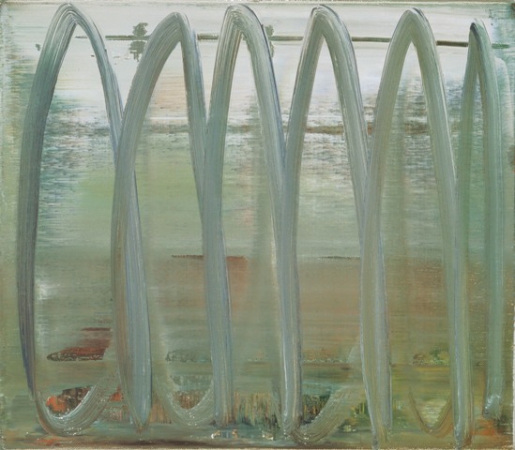
• An included work by Gerhard Richter.

    An included work by Gerhard Richter.

    Featuring: Joseph Beuys, Sigmar Polke, Gerhard Richter, Andreas Gursky, Bernard and Hilla Bechers, Rebecca Horn, Nam June Paik and more.

    The Paths of German Art from 1949 to the present
    April 23 – September 7, 2014
    Moscow Museum of Modern Art
    25 Petrovka
    Moscow
    Clare Rickman, spacegodlovers560, 2014. Image courtesy of artist and CCA.

    Clare Rickman, spacegodlovers560, 2014. Image courtesy of artist and CCA.


    2014 MFA Thesis Exhibition
    May 15-25, 2014
    CCA San Francisco Campus
    111 Eighth Street
    San Francisco
    cca.edu 

    Leah Oates: How did you become an artist and did you know early on that you would be in the arts or did you begin as something else? Were there other artists in your family?
    Kristine Marx: My earliest memories are of painting and drawing, so I always made art. My parents were very encouraging. I went to a liberal arts college to pursue many interests, but eventually returned to a studio practice.

    The only other artist in my family was my great aunt. I never met her, but one of her paintings of a swan on a lake hung over her sister’s fireplace. It was magical to me as a child.

    LO: What are the themes of your work and what inspires you?
    KM: The major themes in my work have to do with temporal and spatial experiences of the body that cross over into a psychological engagement. I am interested in how we construct past experiences in the present and perceptions of dislocation and connection.

    LO: Did you begin as a video artist? One sees painting, drawing, and photographic references when viewing your videos. Please tell us more.
    KM: I make videos, but I also paint and draw. I work on the videos as if they were paintings and the paintings as if they were videos, or a part of a longer narrative over time. The ideas in my work are the same regardless of medium, so I can freely move back and forth.

    LO: What is your working process? Each artist is so different in how they approach their work. How do you approach the creation of your work? Do you plan things out or play in the studio?
    KM: When I begin a new phase of making work, I experiment in the studio until some theme begins to reveal itself. I then focus on this theme until its internal logic builds into a body of work. I feel it’s akin to asking a question and then letting the answer take its time to unfold. I make art because I enjoy this process.

    LO: Why do you think art is important for the world and why is it important for you as an artist?
    KM: I am an artist because making things is the way I process and understand the world around me. It’s like thinking with my hands.

    Art is important because it performs the double task of reflecting culture while pointing beyond it. Art simultaneously embraces and critiques culture.

    LO: What advice would you give other artists who are emerging?
    KM: Do what you love. If you don’t love what you are doing, it’s not worth your time. And protect your solitude.

    LO: Please talk about upcoming bodies of work, shows etc. that you have coming up.
    KM: I just returned from a two and a half month research trip in Japan in preparation for a collaborative sound/video project with composer Akemi Naito. The project is based on Kobo Abe’s 1962 novel “The Woman in the Dunes”. The music is scored for percussion and the eighteen minute video is made up of stop-motion animation. Abe’s story is a post-war Sisyphean tale that I think still resonates today. The DVD is planned for release next year.

    Brazilian artist Duda Penteado is excited to announce the launch of his new book.

    Brazilian artist Duda Penteado is excited to announce the launch of his new book.

    “Art can not be empty, because the history of humanity repeats itself and is frightening. It is up to the artist to manifest himself through his work, and bequeath an interpretation of his time, a message.”

    Duda Penteado is a multimedia artist who has lived between the United States and Brazil for almost 20 years and works with performance, video, installations, murals, sculptures, paintings, and other visual practices. In recent years Duda has devoted much of his work on important issues of peace, globalization, diaspora, dual citizenship, and other geopolitical and social phenomena of the twenty-first century. This year, Duda returns to his hometown of São Paulo, for the launch of his new book on Wednesday, May 21 at 7p.m. at the Book Store Cultura.


    whitney_event

    Featuring: Bani Abidi, Ayreen Anastas and Rene Gabri, Amy Balkin,Bianco-Valente, Natalie Bookchin, Cybermohalla Ensemble, Klara Lidèn, Mary Mattingly, Hương Ngô and Hồng-Ân Trương, Sreshta Rit Premnat, Yorgos Sapountzis,Allan Sekula, and Knut Åsdam

    Whitney ISP: Common Spaces
    May 23- June 14, 2014
    The Kitchen Gallery
    512 West 19th Street
    New York City
    thekitchen.org

    Living in New York, you may not know the name Phil Elverum but there is a good chance you have heard music he has collaborated on, and for that matter, laid eyes on his art. He wouldn’t want us saying this, but he is kind of a big deal. Working as one of the pivotal members for a number of North Western bands including Old Time Relijun, D+, The Microphones, and now Mount Eerie. He is something of a musical oddity given his ability to play multiple instruments and has also been asked to help produce or engineer the work of other bands such as Little Wings and Beat Happening. Even given his success as a musician on multiple fronts, he is often driven to produce visual work for the love of the game. It just so happens that his visual aspirations sometimes line up to benefit his musical accomplishments. Phil often contributes to the musical compositions as much as he is responsible for the art that adorns the covers of the albums he has worked hard to make happen.

    As a kid, Elverum was fortunate enough to be born into a family that was appreciative of the visual arts. As he puts it only half jokingly, “Doesn’t every kid make visual art?…Childhood scribbling flowed seamlessly into my involvement in the DIY punk music world.  It’s all the same kind of revolutionary participatory world-making.”

    We’d have to agree. The unfortunate fact is that every artist also has to live. What this means is that in some ways we are always balancing the acts of free creation with the necessary pursuit of monetary gain.  The one thing these two have in common is that capitalism, at least in a more abstract sense, makes a case for the fact that each can be of equal value in today’s society. Culture can be seen to influence trends in commerce by introducing new perspectives on the popular aesthetic, and therefore alter the trajectory of the market–in some cases at least. Phil seems to be one of those rare cases where an individual feels comfortable disregarding the principle nature of the times, no matter what describes the artistic or commercial climate, in pursuit of what comes natural and as a direct result of organically occurring inspiration.

    Working in multiple mediums including collage, photo, and paint, Elverum always has work going in some studio, whether it be the one he uses for recording, or his space reserved for visual art.  When asked if there was an album cover he would be excited to asked to make given a choice of any band or album in the world, he did us one better,

    “I actually create album art for all the music that I put on my iPod.  In some rare cases I’ll keep the official album art if I find it fitting, but it’s much more fun to make my own quick jpeg.  Usually it’s just an image search for something that feels like my experience with the music, or sometimes an inside joke reference that only I will get. Months later I’ve forgotten and then I look at the tiny iPod screen and chuckle to myself. ”

    It’s good to keep a sense of humor sharp at all times, especially when you are your own audience. Phil keeps things light, even though he is clearly very serious about his music.

    As visual artists ourselves, we know how hard it can be to make a life for oneself doing the thing that we love. The only other creative profession that may present a harder uphill climb would be the work of a musician. For Phil, this paradigm may be the other way around. Involved in multiple successful bands simultaneously, Phil has a strong following and feels he receives the critical feedback he craves more readily in the world of music rather than visual art.  When asked whether there was a creative pursuit he put first he replied,

    “I think of them as the same project.  Each album or picture is obviously its own thing, but I aim for a sense of continuity and vastness among and in between all the various things.  It’s convenient that we’re accustomed to thinking of music as having ‘album art’.  I like the potential with the interplay.”

    Elverum is a great example of someone who follows his passion and makes things work for him no matter what creative pursuit he decides to sink his teeth into. We look forward to hearing more of his sonic experimentation while looking at the art he decided was fitting for the cover. It makes for a skillfully packaged multi-sensory experience that we can’t get enough of right now.

     

    Kara Walker's First public installation with Creative Time is a sweet success.

    Kara Walker’s First public installation with Creative Time is a sweet success.

    Kara Walker: A Subtelty or The Marvelous Sugar Baby
    May 10-July 06, 2014.

    Domino Sugar Factory
    316 Kent Street
    Brooklyn
    creativetime.org

    In the swirling mess we are left with following all the NYC art fairs and crazy secondary market auctions, there are a number of great looking MFA thesis shows going on. Here’s a compilation of some of our favorites. Go check them out, you never know who could be the next big star!


    Christian Meade, A Chair for Bucky, 2013. Augmented chair. Image courtesy of artist.

    Christian Meade, A Chair for Bucky, 2013. Augmented chair. Image courtesy of artist.

    SMFA Thesis Exhibition
    May 13–18, 2014
    Boston Center for the Arts
    539 Tremont St
    Boston
    smfa.edu


    Image courtesy of Matt Taber and Columbia University

    Image courtesy of Matt Taber and Columbia University

    Columbia University MFA Thesis Exhibition
    April 28 – May 19, 2014
    Fisher Landau Center For Art
    38-27 30th Street
    Long Island City
    arts.columbia.edu


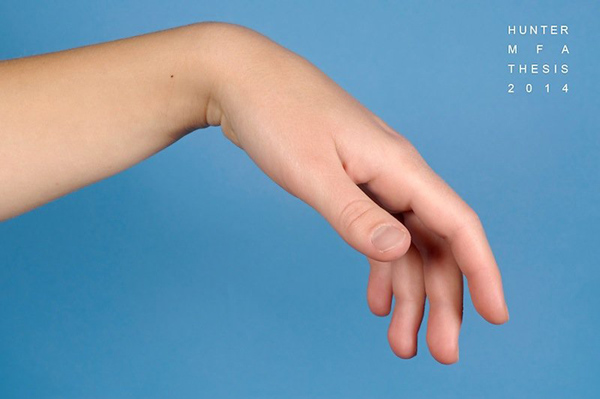
    Image courtesy of Hunter College

    Image courtesy of Hunter College

    Hunter MFA Thesis Exhibition
    April 24- May 22, 2014
    Hunter College
    205 Hudson Street
    New York City
    2014huntermfa.com


    Clare Rickman, spacegodlovers560, 2014. Image courtesy of artist and CCA.

    Clare Rickman, spacegodlovers560, 2014. Image courtesy of artist and CCA.

    Cal Arts MFA Thesis Exhibition
    May 15-25, 2014
    CCA San Francisco Campus
    111 Eighth Street
    San Francisco
    cca.edu 

    Image courtesy of Hunter College

    Image courtesy of Hunter College


    Hunter MFA 2014 MFA Thesis Exhibition
    April 24- May 22, 2014
    Hunter College
    205 Hudson Street
    New York City
    2014huntermfa.com

    NY Arts Magazine: Please tell us something about your work that often gets overlooked by the unfamiliar or untrained eye.
    Patrick Berran: I am often asked questions pertaining to the process; what type of materials, even step-by-step questions, also if they are completely print-based paintings. I enjoy the process very much, it is important. My paintings are created using various methods of painting, printing and transfer techniques. The patterning/graphic elements result from a disparate aspect of my studio. While traveling I work in small sketchbooks, creating only washes or stains of color. These books are handmade with very thin paper and the washes often transfer onto one another, creating a visual space that is very much ethereal. Something that looks like a simple pattern within the paintings is the result of hours of manipulation with collage and photocopy from these washes. I like the notion of having something happen both outside and inside the studio.  Whether it’s intense studio mode, or these hours away that create the source material for future paintings—I create a situation where I am noticing and seeing things around me more often than not.

    News | Exhibitions