
• unnamed

    Italian American Museum
    Presents
    Flora Interpretations An Exhibition
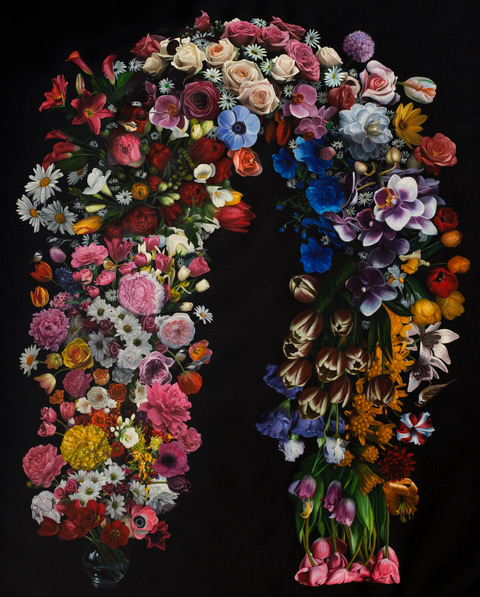
    Featuring Photo Impressionistic Murals and Abstract Studies on Canvas by Michael DeSiano

    Exhibition: January 28th – February 26th, 2017

    The artist presentation and discussion will be held on: Thursday, February 16th at 6:30 P.M.

    Italian American Museum
    Italian American Museum
    155 Mulberry Street
    New York, NY 10013

    Museum Hours of Operation:
    Friday, Saturday, Sunday, 12 NOON to 6:00 PM

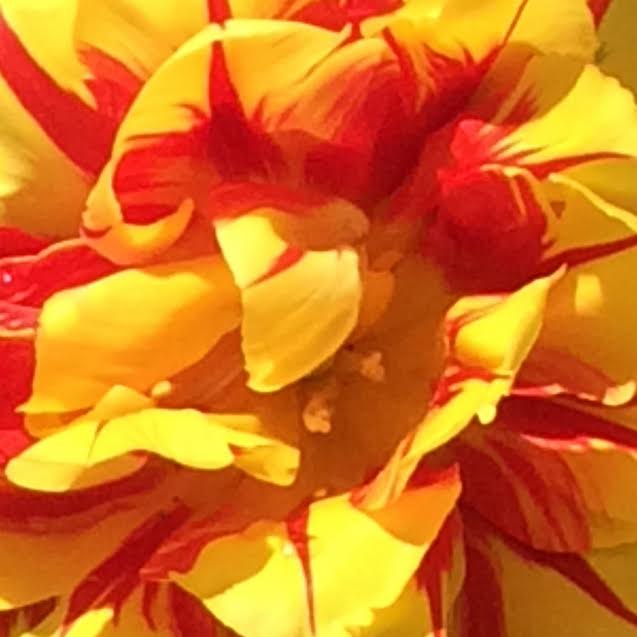
    The widely exhibited Artist, Michael DeSiano presents a solo exhibition that celebrates the beauty, color and essence of flora and flowers with impressionistic and abstract photographic works on canvas. With photographs taken in Italy and the United States he has created works which both please and absorb the viewer. The opening reception for this exhibit is scheduled for Friday, January 27th, 6:30 P.M. in the Italian American Museum at 155 Mulberry Street. A presentation by the artist and discussion of the works will be held in the Museum on Thursday, February 16th at 6:30 P.M. “Flora Interpretations” will be on exhibit from Saturday, January 28 through Sunday, February 26 in the Museum’s gallery. Regular museum hours are from noon to 6 PM on Fridays, Saturdays and Sundays. Suggested museum admission is $10.

    Biography:
    Michael DeSiano’s art concentrates on natural and cultivated flora while working with photography, mixed media and painting. He has shown in New York City, and galleries the United States. An advocate and writer on the visual arts, he has published in journals, lectured and presented workshops throughout the United States. He is the author of Principles and Elements of Art and Design and the forthcoming ACT: Art Creativity and Thinking.

    Michael posts his art works and publishes the Flora/Art Blog on social media, with accounts on Instagram, Facebook, Pinterest, G+, Behance, Flickr, Reddit, Tumblr, and Blogger. His portfolio is presented on the michaeldesiano.com website, and selected portfolios are posted on Deviant Art, 500px, FineArtsAmerica, SaatchiArt, Vango and Pictorem. On YouTube, the vignette videos objectively document his observations, experiences and encounters, mostly in NYC.

    Michael DeSiano was born in New York City and grew up in mythic Brooklyn, amid people of great diversity and backgrounds striving to move forward in America. Michael came late to his parents, Rose and Sal. An only child, and first born male into a traditional Italian American extended family, he received the kind of attention that supported his success. For his fifth birthday, his beloved Aunt Madeline gave him an Erector Set. His curiosity and imagination for three-dimensional design and sculpture became a lifetime interest.

    His father studied chemistry at NYU to aid his “second job” a small perfume business. Scents of exotic flowers filled the home and became a daily conversation. Michael won art and craft awards in grade school. He was encouraged to pursue art by his teachers. But he followed the more traditional route of mechanical engineering, because his parents, first generation Italian Americans and children of the depression, wanted to ensure he had a financially secure profession.

    He earned an engineering degree from Brooklyn Polytechnic University. However, during a backpacking trip in Italy he realized the need to pursue art. He attended the School for American Crafts at R.I.T. and the Brooklyn Museum Art School. Confident that art was the career to follow, he earned a Master’s degree from NYU. Enthralled by both the practice and theory of art making, he completed a Ph.D. in Creative Arts from N.Y.U. After marrying, he and his wife Pat bought a vacant candy store in Brooklyn. With their apartment, above, Michael began creating painted constructions and sculpture in his first-floor storefront studio. Their children, Salvatore and Rose followed their father’s interests, Sal an engineer for Google and Rose a Professor of digital photography.

    With the help of Pat, Michael supported himself through teaching art on the college and graduate level. He could not deny himself the satisfaction of teaching in some of the best art schools in the NYC, including Pratt Institute, New York University and Queens College. He taught a broad range of subjects: painting, sculpture, two and three-dimensional design, art history, and later specialized in the creative process and visual thinking.

    In the 1980’s, DeSiano began exhibiting consistently in commercial, university, public and cooperative galleries. His first one-person exhibit at the Just Above Midtown Gallery, New York, received excellent reviews. This exhibition was followed by the Hansen Gallery on 57th St. in NYC. He currently exhibits with the Brooklyn Waterfront Artist Coalition and other venues.

    In the 1990’s he took time out from art making to concentrate on art theory and practice through university teaching. Researching, teaching and lecturing on art processes, aesthetics and criticism, complemented by studio teaching, he began to follow a new path for art making. During this period, he also authored a book on the Principles and Elements of Art and Design, which is widely used and still in print.

    Michael DeSiano has led workshops, lectured and given presentations throughout the United States for professional artists and art educators. His popular online courses in art, creativity and visual thinking are the basis for the forth coming book, ACT – Art Creativity and Thinking, to be published this spring. This innovative e-book provides a systematic, neuropsychological-based approach to creative art making and thinking. The book makes use of quotes of master artists, illustrated with master art works and accompanied by exercises designed to stimulate, inspire, inform and advance.

    After almost a decade of art research, exploration and teaching DeSiano has returned to art making. During the years of concentrated academics and theory DeSiano wanted to take time away from art making to rejuvenate, rediscover and redirect my sources of inspiration and focus. Most of all he concluded that central goal in making art for inspiration and meditation could be better served with a change of media.

    Artist Statement:
    In the New Millennium, my art making is energized by several masters for inspiration, theory processes, and working style. The analytical eye of Monet provides an entry into art as more than verisimilitude, a first step in abstraction and color study. Monet’s late works set the stage for a concentration on flora, and local and constructed gardens for subject matter. Another master of great import is Matisse who was hindered by physical limitations later in life. He turned to easily constructed mural scale collage with exuberant color. Taking the lead given by Monet and Matisse, I adopted art photography and flora, especially flowers of brilliant color. I am also inspired by Picasso who offered not only an example of outstanding creativity in his later years, but a Spartan and regimented lifestyle for conserving energy and focusing on making art in several media.

    Always a photographer, my expertise resided in documentation and presentation of art for portfolio, lectures and teaching. In the new millennium, I employ a camera for expressive purposes rather than documentation and realism. Already having camera skills, I delight in combining a love for color and painting with photography.
    I explore and respond to experimentation while using traditional and new technologies. My work uses innovations and experimentation, it also harkens back to historic art traditions, including impressionism, expressionism and abstraction.

    I rely on an excellent understanding and deep appreciation for art history and aesthetics. My expressive and inspirational imagery builds on past masterworks while embracing traditional, modern and contemporary art making. I believe that modern art, particularly impressionism, expressionism and abstraction and advances in technology have created an entirely new mode of creating, made obtainable through photography.

    My techniques are highly illuminating and expressive. My original photos are reworked with great expression, to bring forward visual information and experiences beyond what the eye can normally see. The processes and techniques combine the craft of photography with the creativity of a painter.

    I believe my works could not have been seen before, they are created with knowledge and inspiration from the past and recent technology. I work in a realm where new technology and expressive modes are brought together for the first time.

    Michael DeSiano


    Italian American Museum
    Italian American Museum
    155 Mulberry Street
    New York, NY 10013
    Tel.: 212.965.9000
    Fax: 212.965.9004
    or email info@ItalianAmericanMuseum.org
    www.italianamericanmuseum.org


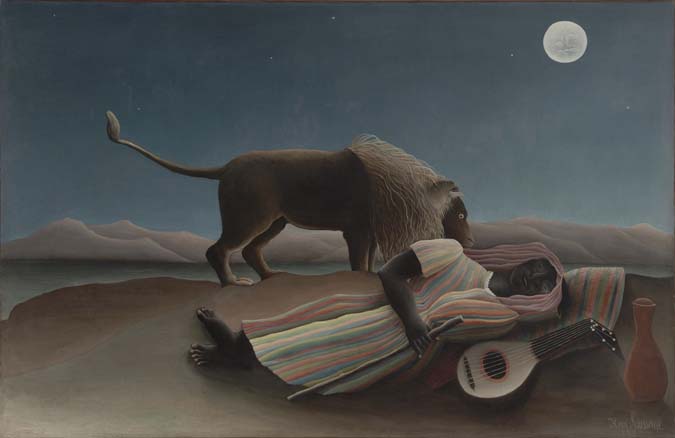
     Next to Henri Rousseau’s “The Sleeping Gypsy”, a painting by Zaha Hadid, the Iraqi-born British architect who died last year. The showcase of contemporary art from Iran, Iraq and Sudan, whose citizens are subject to the ban on view at MoMA.


     Henri Rousseau, The Sleeping Gypsy, 1897.  MoMA Collection. Oil on canvas, 51" x 6' 7" (129.5 x 200.7 cm). Credit: Gift of Mrs. Simon Guggenheim. MoMA Collection.

    Henri Rousseau, The Sleeping Gypsy, 1897.
    MoMA Collection. Oil on canvas, 51″ x 6′ 7″ (129.5 x 200.7 cm). Credit: Gift of Mrs. Simon Guggenheim. MoMA Collection.


    Read more:   “MoMA Takes a Stand: Art From Banned Countries Comes Center Stage”, NY Times

    Luisa Lambri, Untitled (The Met Breuer, #06), 2016, Pigment print, 31 7/16 x 35 3/8 inches (80 x 90 cm)

    Luisa Lambri, Untitled (The Met Breuer, #06), 2016, Pigment print, 31 7/16 x 35 3/8 inches (80 x 90 cm)

    Breuer Revisited: New Photographs by Luisa Lambri and Bas Princen
    The Met Breuer
    945 Madison Avenue, New York, NY, 10021

    February 1 – May 21, 2017

    Luhring Augustine congratulates Luisa Lambri on her forthcoming two-person exhibition at The Met Breuer, New York. On the occasion of the exhibition Lambri spoke to Artforum about her work: Link to article.

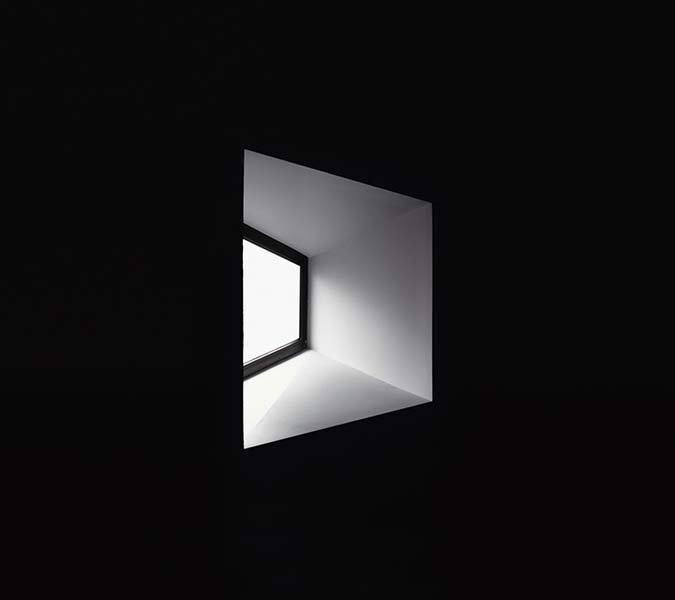
    The exhibition presents two series of commissioned photographs that reflect on the architecture of Marcel Breuer (Hungarian, 1902–1981). The images on view by the artist Luisa Lambri and the photographer Bas Princen use the Bauhaus architect and designer’s important public and municipal works to explore the relationship between the built environment and its inhabitants. Evoking minimalism and abstraction, Lambri creates images that examine the dialogue between interior and exterior and the interaction between surface and light. Princen investigates and reframes urban and rural spaces through documenting the concept of post-occupancy, or the evolution of a building and its enduring relevance.

    Lambri and Princen’s photographs offer two distinct views of how Breuer’s monumental modernist buildings, constructed in the 1950s and 1960s, exist today. Saint John’s Abbey Church in Collegeville, Minnesota, and the UNESCO headquarters in Paris have been selected for their scale and for their significance to his career. The IBM research center in La Gaude, France, served as the experimental site where sophisticated prefabricated systems for concrete constructions were developed. The fourth building, commissioned by the Whitney Museum of American Art, now The Met Breuer, was created as a museum for New York and epitomizes the architect’s principles. Lambri and Princen’s series give us an opportunity to contemplate the experience of architecture outside the typical framework of the architect’s working methods and ideas.

    For more information please visit the The Met Breuer’s website.

    Black Power!

    On view in the Main Exhibition Hall

    Curated by Dr. Sylviane A. Diouf

    The concept of Black Power was introduced by Stokely Carmichael and fellow Student Nonviolent Coordinating Committee (SNCC) worker Willie Ricks in June 1966. Like no other ideology before, the multiform and ideologically diverse movement shaped black consciousness and identity and left an immense legacy that continues to inform the contemporary American landscape.

    Perceived mostly as a violent, urban episode that followed the rural, non-violent Civil Rights Movement, the Black Power movement, which lasted only ten short years, had a more significant impact on issues of identity, politics, culture, art, and education than any prior movement. Reaching beyond America’s borders, it captured the imagination of anti­colonial and other freedom struggles and was also influenced by them. Similarly, Black Power aesthetics of natural hair and African­-inspired fashion, and the concept that black was beautiful, resonated worldwide.

    Following in the Black Power footsteps, American Indian, Asian, women, Latino, and LGBT groups challenged the status quo, and the politics of group identity entered mainstream academia and society at large. One of the most lasting legacies of the Black Power movement has been the enduring strength of the Black Arts Movement. The cultural transformations brought forth by the movement left indelible marks on black aesthetics and visual arts, as well as on hip-hop and spoken word artists.

    Thus, to understand 20th and 21st century African-American history, and ultimately American society today, it is imperative to understand the depth and breadth, and the achievements and failures of the Black Power movement.

    ORGANIZATIONS

    Black Power grew out of the political, economic, and racial reality of post-war America, when the possibilities of American democracy seemed unlimited. Black Power activists challenged American hegemony at home and abroad, demanded full citizenship, and vociferously criticized political reforms that at times substituted tokenism and style over substance. Some activists did this through a sometimes bellicose advocacy of racial separatism contoured by threats of civil unrest. Others sought equal access to predominantly white institutions, especially public schools, colleges, and universities, while many decided to build independent, black-led institutions designed to serve as new beacons for African-American intellectual achievement, political power, and cultural pride. Organized protests for Black Studies, efforts to incorporate the Black Arts Movement into independent and existing institutions, and the thrust to take control of major American cities through electoral strength exemplified these impulses.

    The movement’s multifaceted organizations, from SNCC to the National Welfare Rights Organization, triggered revolutions in knowledge, politics, consciousness, art, public policy, and foreign affairs along lines of race, class, gender, and sexuality. It forced a re-examination of race, war, human rights, and democracy and inspired millions of global citizens to reimagine a world free of poverty, racism, sexism, and economic exploitation.

    POLITICAL PRISONERS

    The Black Power movement was made and unmade through encounters with the criminal justice system, especially the prison. Prisons were especially central to activists’ efforts as they drew on their own experiences of confinement to indict a broader system of white supremacy. Many of the movement’s strategists, theoreticians, and foot soldiers spent time in jail or prison. For some, prison was the consequence of their organizing. For others, it was where they joined and contributed to the Black Power movement.

    The urban rebellions of 1963 to 1968 were often sparked by incidents of police brutality and saw thousands of people arrested. Activists resorted to study groups, escape attempts, newspapers, and legal appeals to challenge prison as both a metaphor for oppression and an example of it. But by the mid-1970s there was growing bipartisan support for increasing the severity and length of sentences. Thus began the rise of mass incarceration that would disproportionately impact the youth who had been the base of the Black Power movement. A half century later, the interrelationship between prisons, policing, and racism remains a central example of American inequality.

    COALITIONS

    The Black Power movement had a radical impact on grassroots organizing in poor communities of color and many white progressive circles. Grounded in the Black Panther Party’s core was its leadership in the international revolutionary proletariat struggle, a deep affinity for forming coalitions and alliances that transcended race and class, and a commitment to community service programs (survival pending revolution) as a fundamental element of human rights.

    These groups demonstrated by way of their bold confrontational methods the egregious contradictions of American democracy and a shared vision of a society that valued humanity over wealth. Such facts are highlighted by the various conventions and conferences organized during the Black Power movement, including the 1967 National Conference on Black Power in Newark, New Jersey; The United Front Against Fascism Conference that took place in 1969 in Oakland; The Revolutionary People’s Constitutional Convention in Philadelphia in 1970 and the National Black Political Convention of 1972 in Gary, Indiana.

    Delegates from an array of organizations gathered to write a new constitution that represented a united vision of a just and free society. These U.S. citizens not only called for a new nation but a new world that embraced solidarity, liberation, and tolerance for difference and diversity.

    EDUCATION

    A host of grassroots black educational struggles unfolded in the 60s and 70s. Schools and other sites of learning provided the critical terrain for battles over black studies, community control, and African-American identity. Insistence on black autonomy and internal development of African-American communities reshaped black educational outlooks. Many African-American educational struggles sought radical reform rather than incremental change, group progress rather than individual freedom, humanism rather than materialism, and political engagement rather than mere social mobility. They included cosmopolitan and internationalist perspectives, a reflection of revived interest in African cultural heritage and Third World movements.

    Student rebellions erupted on scores of high school campuses. Small, creative institutions played crucial roles in the intellectual and cultural development of people of color, especially as public programs in urban centers fell victim to cutbacks. Alternative models rooted curricula in the lives and experiences of black people while giving programmatic structure to Black Power ideals.

    THE LOOK

    In many respects, fashion was the most immediate and obvious marker of Black Power’s influence, while it simultaneously reflected the ideological diversity of the movement itself. Many younger African Americans, regardless of the degree to which they were politically active, donned Afros, African-inspired clothes, or sartorial inflections of militancy, often associated with organized black nationalist or revolutionary organizations.

    Fashion was a clear declaration of what some called the “new black mood,” which swept Black America. The fundamental thrust of Black Power was black self-determination, and a very clear affirmation of black people’s humanity. To that end, racial pride was inextricably tied to the cosmetics of blackness.

    By the waning years of the Black Power movement, the black press was no longer full of advertisements encouraging readers to get their skin as white as possible. Natural hair was not viewed as bizarre. Black pride remained elusive, but no moment had pushed black people closer to it than this era.

    POPULAR CULTURE

    Athletes joined artists and community organizers in linking Black Power to their everyday experiences. Muhammad Ali was one of the major figures to address how his athletics reflected his abilities as a black man to think independently of a white sports industrial complex. The Olympic Committee for Human
 Rights used the 1968 Olympics as a platform to support the agenda of the Black Power Conferences. Kareem Abdul-Jabbar refused to play on the Men’s Olympic Basketball Team to protest inequality and racism. Remembered through the iconic photo of their medal ceremony, Tommie Smith and John Carlos bowed their heads to pay respect to fallen warriors of the black liberation struggle, and held their gloved fists in the air to represent black power and unity.

    Martial arts schools served as critical sites for artistic production, resistance, and empowerment. Organizations such as the Congress of African People, US organization, the Nation of Islam, and the Black Panther Party practiced martial arts to teach body development and strengthening, self-defense, and creativity. Images of black martial artists also became popular on screen due to the genre called Blaxploitation, Hollywood’s version of black urban life.

    BLACK ARTS MOVEMENT

    If, as a number of scholars have commented over the years, The Black Arts Movement (BAM) was the cultural wing of Black Power, one might also say that Black Power was the political action wing of BAM. In truth, BAM and Black Power were not so much separate entities, but rather, as Larry Neal put it, “concepts” of, or ways of coming at, the black freedom movement. In that way of thinking, art was (or could be) political action just as those activities usually considered to be political were a sort of art.

    BAM changed how people felt that art should be circulated. The BAM imperatives of art for, by, of black people in the communities in which they lived as opposed to in elite museums, theaters, or concert halls in which they often felt unwelcome, opened up the cultural landscape for art and arts institutions supported by public money and other resources and aimed at grassroots communities. Not only did the BAM reach millions of people through its journals, presses, theaters, murals, festivals, and television shows during the 1960s and 1970s, but it left a lasting imprint on our sense of what art is, what it can do, and who it is for that remains with us to this day.

    SPREADING THE WORD

    Whether cultural, political, social, or academic, written texts by Black Power artists and activists was unprecedented. Periodicals, newspapers, books, publishing companies, and bookstores empowered the community by providing historical knowledge, political and revolutionary awareness, and cultural pride.

    To bring their message directly to the communities they served, organizations published their own newspapers. As expressions of the interconnectedness of Black Power and the Black Arts Movement, they were often literary and political, covering local and international issues and presenting poetry, short stories, and graphic arts. Small publishing companies offered an outlet to poets, novelists, educators, scholars, and activists.

    Black bookstores, such as The African National Memorial Bookstore and Liberation Bookstore in Harlem, did more than sell books. Drum and Spear bookstore in Washington, D.C. added a publishing company, Drum and Spear Press, and a Center for Black Education to its activities and opened an office in Dar es Salaam, Tanzania. These stores acted as cultural, political, educational, and social centers where the community could take classes, meet authors, militants, and visiting activists. They became sites of education, creativity, and resistance.

    BLACK POWER INTERNATIONAL

    Black Power activism erased national boundaries as its strategies and tactics proved adaptable in a variety of circumstances. Black Power became global, part of narratives of commerce, migration, imperialism, and cultural exchange. It was an international movement that, in voicing common elements within the experiences of African and African-descended diaspora peoples, provided a framework that helped define their grievances and goals. Additionally, it supplied a vocabulary, though spatially and culturally removed from the conditions of African diaspora life, and engaged in struggles with different objectives, found meaning in the interpretations conceived through Black Power’s set of values and practices. Black Power’s legacy is the ongoing history of the worldwide determination to contest all forms of domination and injustice.

    For exhibition-related inquiries, email schomburgexhibitions@nypl.org.

    Opening soon. February 16th, 2017. Schomburg Center for Research in Black Culture

    OPENING February 16, 2017 on display through October

    Black Power!
    The Schomburg Center for Research in Black Culture
    515 Malcolm X Boulevard at 135th Street

    FREE

    https://www.nypl.org/events/exhibitions/black-power


    Courtesy of The New York Public Library

    Joseph Fernand Henri Léger was born today on February 4, 1881, in Argentan, Orne, Lower Normandy, where his father raised cattle. Léger initially trained as an architect from 1897 to 1899, before moving in 1900 to Paris, and supported himself as an architectural draftsman. He was rejected at the École des Beaux-Arts, notwithstanding he attended classes there beginning in 1903 as a non-enrolled student and also studied at the Académie Julian.

    Joseph Fernand Henri Léger was a French painter, sculptor, and filmmaker. In his early works he created a personal form of cubism which he gradually modified into a more figurative, populist style. He was known for boldly simplified treatment of modern subject. Léger exhibited in 1911 at the Salon des Indépendants together with the painters identified as ‘Cubists’. Metzinger, Albert Gleizes, Le Fauconnier, Delaunay and Léger were responsible for revealing Cubism to the general public for the first time as an organized group.


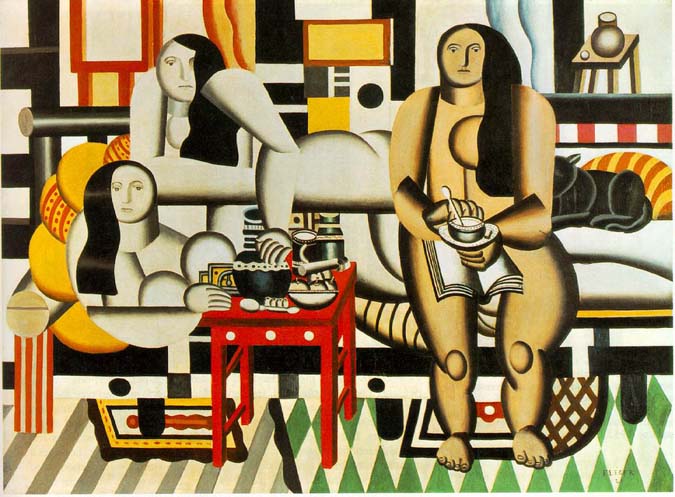
    Three Women, 1921 - Fernand Leger

    Fernand Léger, ‘Three Women’, 1921-22. Oil on canvas, 6′ 1/4″ x 8′ 3″ (183.5 x 251.5 cm). Mrs. Simon Guggenheim Fund. © 2017 Artists Rights Society (ARS), New York / ADAGP, Paris. MoMA


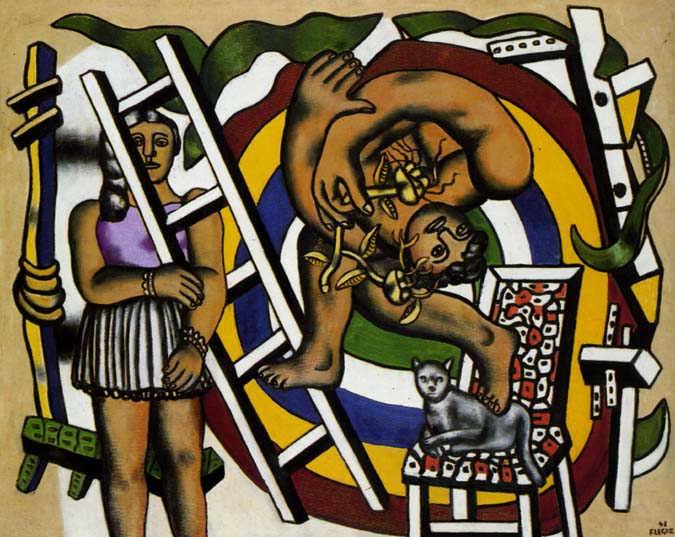
    © ADAGP, Paris and DACS, London 2016. TATE

    Fernand Leger, ‘The acrobat and his partner’ (L’acrobate et sa partenaire), 1948. © ADAGP, Paris and DACS, London 2016. Tate


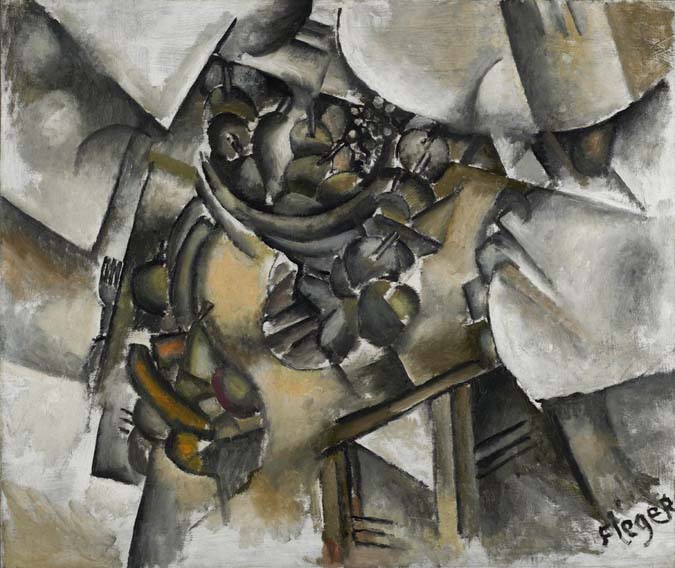
    Fernand Léger, Le compotier (Table and Fruit), 1910–11, oil on canvas, 82.2 x 97.8 cm, Minneapolis Institute of Arts. Reproduced in Du "Cubisme", 1912

    Le compotier (Table and Fruit), 1910–11, oil on canvas, 82.2 x 97.8 cm, Minneapolis Institute of Arts. Reproduced in Du “Cubisme”, 1912


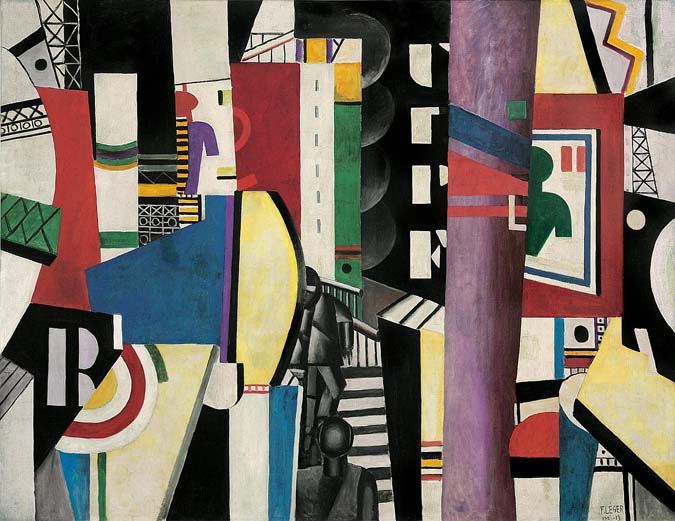
    Fernand_Léger, The City (La ville), 1919, oil on canvas, 231.1 x 298.4 cm, Philadelphia Museum of Art

    Fernand Léger, The City (La ville), 1919, oil on canvas, 231.1 x 298.4 cm, Philadelphia Museum of Art


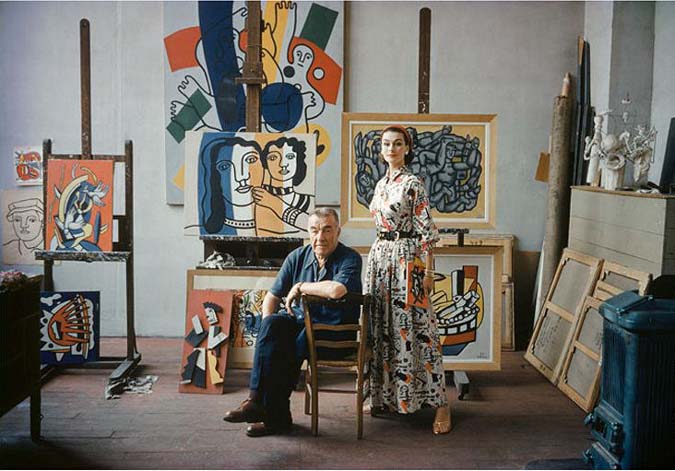
    Fernand Leger with Birtish model Anne Gunning in his Paris studio 1955 © 2007 Mark Shaw.

    Fernand Leger with Birtish model Anne Gunning in his Paris studio 1955 © 2007 Mark Shaw.


    J. Gora, NY Arts


    A Syrian artist whose work about the war in his country has captured the world’s imagination has vowed not to apply for a United States visa until President Donald Trump is out of power.

    Khaled Akil’s latest project is being exhibited from Tuesday at California’s Stanford University.

    Under Trump’s recent executive order, which suspends travel for Syrian refugees indefinitely, there is no way he would be able to attend his opening.

    “I understand they want to interview people and they have the right to know who is coming, but to give a racist order like this to prevent us is agonising,” Akil told Al Jazeera.

    Akil moved to Istanbul, Turkey, five years ago. Since 2012, he has applied twice to visit the US to attend exhibitions and was rejected on both occasions.

    He fears that in the US, because of the travel ban, there was now “justification for people to hate Syrians”.

    “With Trump, I will never apply for the visa, whether or not a ban is in place,” he said. “The politics worries me because it creates the tension that I saw in my own country which led to more violence. That’s why I can’t trust the system anymore, I won’t feel safe there.”87b52de86Artist Khaled Akil vows not to seek US visa under Trump4f640a4adebd0516dfc2b7e_18

    2 Feb – 1 Apr 2017, Hauser & Wirth New York, 69th Street

    Opening: Thursday 2 February 2017, 6 – 8 pm

    ‘Between the space of nothing and the action of something, everything is possible’ – Douglas Dreishpoon

    New York… Beginning 2 February 2017, Hauser & Wirth will present ‘Nothing and Everything: Seven Artists, 1947 – 1962,’ an exhibition dedicated to the synergistic relationship that existed between visual artists and composers during the years following World War II. Curated by Douglas Dreishpoon, Chief Curator Emeritus at the Albright-Knox Art Gallery, the exhibition features works by Louise Bourgeois, John Cage, Morton Feldman, Philip Guston, Franz Kline, Joan Mitchell, and David Smith – mavericks who pushed the boundaries of their respective mediums to new realms of abstraction. Paintings, sculptures, prints, and drawings will be contextualized by a selection of musical scores and ephemera.

    On view through 1 April, ‘Nothing and Everything’ is accompanied by a fully-illustrated catalogue featuring an essay by Dr Dreishpoon. The gallery will host additional public programs during the course of the exhibition (schedule to be announced).

    ‘Nothing and Everything’ examines a particularly fertile period in the history of American art through the work of seven artists who, magnetized by a shared ethos and the spirit of their times, socialized together, exhibited collaboratively, and supported one another’s ideas. The cultural context and synesthetic affinities that linked these seven individuals is the exhibition’s central premise.

    Upon entering the gallery, visitors first encounter a recording of the American avant-garde composer, music theorist, and philosopher John Cage reading his ‘Lecture on Nothing’ (in a rare recording from the 1980s). Delivered in Cage’s distinctive manner, the talk has no clear narrative; words and phrases are punctuated with moments of silence. Some of Cage’s first compositions in the 1930s were written for percussion. By the 1940s he was widely recognized for his groundbreaking use of the concepts of randomness. In 1952, he unveiled his seminal composition ‘4’33”’ – silent for its entirety, with musicians instructed to not play their instruments for the duration of the piece. For the uninitiated listeners then in attendance at the Maverick Concert Hall in Woodstock, New York, the silence drew their attention to the naturally occuring sounds of the environment. The exhibition also includes excerpts from ‘Radio Happening I’ (recorded live at the WBAI radio studio in New York on 9 July 1966), a work from the ‘Radio Happenings’ series of conversations between Cage and American composer Morton Feldman, recorded over a period of six months between July 1966 and January 1967. The pair discuss the role of the artist, what it means to be a composer, and the debates around abstraction.

    After a serendipitous encounter at Carnegie Hall in January 1950, Cage and Feldman became good friends. Through Cage, Feldman was introduced to a cadre of visual artists, who included Jackson Pollock, Philip Guston, Willem de Kooning, and Franz Kline – artists who would inspire him through their pursuit of a new abstraction. The exhibition’s title echoes the crux of a conversation shared between Feldman and Cage during a studio visit with Philip Guston. Together the three would exchange ideas about the concept of abstraction, in both art and life:

    ‘Cage and Feldman were in my studio, in 1951 or 1952,’ Guston recalled, ‘and I had done what were probably the sparest pictures of all… I think one painting just had a few colored spots on it, and lots of erasures. Cage was very ecstatic about it, and he said, ‘My God! Isn’t it marvelous that one can paint a picture about nothing!’ and Feldman turned to him and said, ‘But John, it’s about everything!’

    Here, Cage and Feldman pose the central question: Can ‘nothing’ be a material thing? Is it an existential condition? ‘Nothing,’ Feldman declared in an article on Guston, ‘is not a strange alternative in art. We are continually faced with it while working. In actual life, this experience hardly exists.’

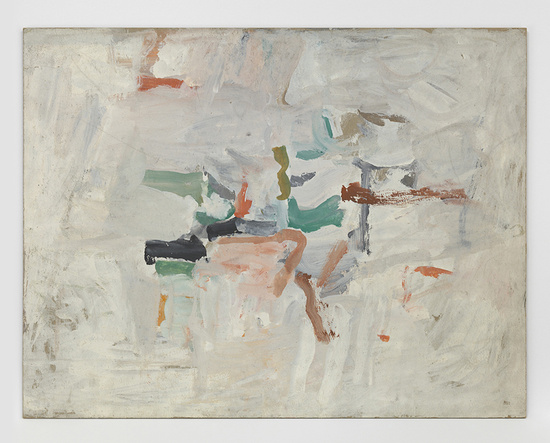
     Untitled — Philip Guston, circa 1951 Gouache on paper 44.5 x 57.8 / 17 1/2 x22 3/4 in © The Estate of Philip Guston Courtesy the Estate and Hauser & Wirth Photo: Genevieve Hanson


    Untitled — Philip Guston, circa 1951
    Gouache on paper
    44.5 x 57.8 / 17 1/2 x22 3/4 in
    © The Estate of Philip Guston
    Courtesy the Estate and Hauser & Wirth
    Photo: Genevieve Hanson

    Philip Guston started experimenting with abstraction in the late 1940s following a decade of figurative and personal allegories. By the 1950s, both he and Feldman were arriving at a philosophical turning point in their work. While Guston consciously began to pare down his painting compositions, Feldman adopted a highly experimental and minimalist approach to his soundscapes. Guston’s ‘White Painting I’ (1950) and ‘Untitled’ (ca. 1951) show the artist limiting his palette, using fewer colors and feather-like brushstrokes surrounded by ambiguous space.

    Feldman, who would have seen these works, was creating compositions of a similar nature, distinctively more reduced, quiet, and meditative. Feldman developed a graphic score for compositions with titles like ‘Projections’ and ‘Intersections’, which allowed performers to choose their own pitches and rhythms. The exhibition includes a specially designed listening room where the recordings of a selection of Cage and Feldman’s compositions from 1950 to 1962 can be heard on loop. This includes Cage’s ‘Aria’ (1958), ‘Music of Changes’ (1952), and Feldman’s ‘Intersection 4’ (1953), ‘Extension 4’ (1953), and ‘For Franz Kline’ (1962).

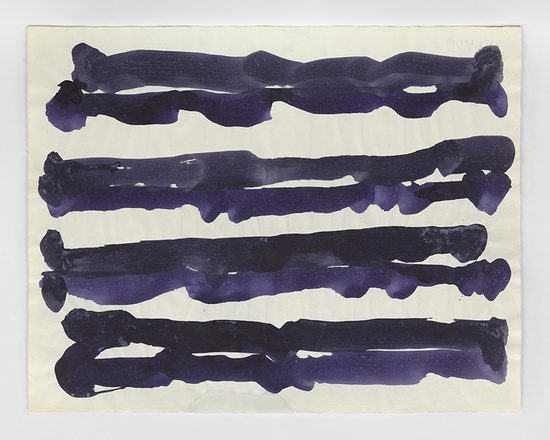
     Untitled — David Smith, 1955 Black egg ink (purple) on paper 44.5 x 57.2 cm / 17 1/2 x 22 1/2 in © The Estate of David Smith Courtesy the Estate and Hauser & Wirth Photo: Genevieve Hanson


    Untitled — David Smith, 1955
    Black egg ink (purple) on paper
    44.5 x 57.2 cm / 17 1/2 x 22 1/2 in
    © The Estate of David Smith
    Courtesy the Estate and Hauser & Wirth
    Photo: Genevieve Hanson

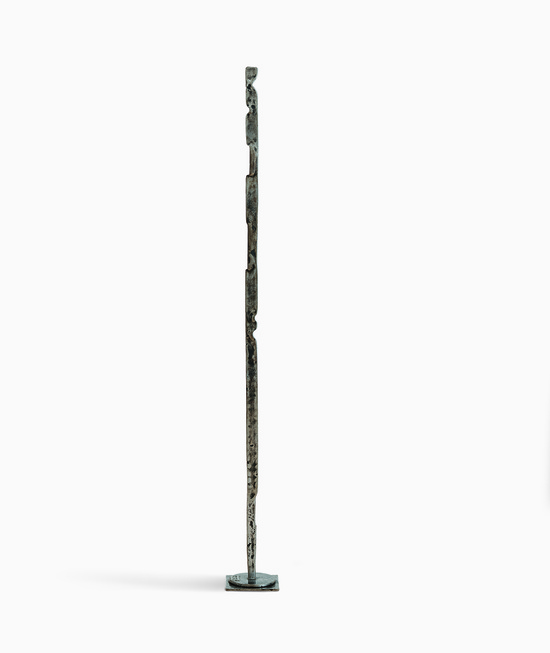
     Forging IX — David Smith, 1955 Varnished steel 184.2 x 19.4 x 19.4 cm / 72 1/2 x 7 5/8 x 7 5/8 in © The Estate of David Smith Courtesy the Estate and Hauser & Wirth Photo: Rob McKeever


    Forging IX — David Smith, 1955
    Varnished steel
    184.2 x 19.4 x 19.4 cm / 72 1/2 x 7 5/8 x 7 5/8 in
    © The Estate of David Smith
    Courtesy the Estate and Hauser & Wirth
    Photo: Rob McKeever

    ‘Forging IX’ (1955), part of a series comprising 10 sculptures by David Smith, is one of his most reductive works. Reaching tall but lacking in any substantial mass, the work is engulfed by space, transmitting a sense of vulnerability. In contrast, the artist’s series of egg ink paintings signal a more poetic gestural exploration.
    Horizontal streaks of ink glide across the paper dispersing fragments of space. These works by Smith seem to share effects with Cage’s spontaneous compositions, with their playfully random injections of gaps and silences.

    The spatial orientation of sculpture was also an important aspect for Louise Bourgeois. For her space was a parallel to silence. In 1983, the artist remarked, ‘Silence is a subject that interests me tremendously. The length of the silence, the depth of the silence, the irony of the silence, the timing of the silence. The hostility of the silence. The shininess and love of the silence.’ Bourgeois was no stranger to the palpability of silence with which she associated her own feelings of alienation and loneliness, experienced in the early years living in America. The lone column ‘Breasted Woman’ (1949 – 1950) highlights the white walls of the space it inhabits and the absence that surrounds it, intensifying its own isolation. ‘The Blind Leading the Blind’ (1947 – 1949) further shows how space can be divided but also united, how it can, in the words of curator Douglas Dreishpoon, ‘blind, but also enlighten.’ A selection of Bourgeois’s works on paper from the 1950s gestures toward an environment whose quiet unfamiliarity suggests a lack of human presence.

    During this period, Joan Mitchell and Franz Kline deployed as gestural, at times minimal aesthetic. Feldman became closely acquainted with both artists during evenings at such preferred destinations as New York venues The Club and the Cedar Tavern. Initially adopting a post-Cubist style, Mitchell’s paintings evolved into dynamic compositions as seen in ‘Rose Cottage’ (1953), and her ‘Untitled’ works from 1954 and 1958 – 1959. Here, she applies rigorous brushwork incorporating dabs and strokes, mixing warm and cool colors, and applying heavy, dry, and drips of paint that synthesize multiple forms: light and dark, space and density, gravity and lightness.

    The exhibition concludes with a selection of works by Franz Kline. A latecomer to Abstract Expressionism, Kline worked in a figural style into the late 1940s. He then began to create small abstract brush drawings by applyingthick, black strokes in ink or oil to pages from a telephone book. Encouraged by his close friend Willem de Kooning, Kline enlarged these drawings using a Bell-Opticon projector. Large-scale ideogrammes pinioned by painterly white and black counterthrusts resulted; the leap toward abstraction had been made.

    ‘Herald’ (1953 – 1954) is an early, defining example of Kline’s signature black-and-white paintings. An open rectangle, its explosive black contours, rendered by a housepainter’s brush, cut into a white field. Like a Japanese ensö, the rectangle’s composition is at once dynamic and arrested, playing with the tension between movement and the completion of movement. The form of the square or rectangle was extremely important to Kline. The artist pushes the form of the rectangle beyond pure geometry, imbuing it with an emotional valence that provokes a sort of seeking on the part of the viewer.

    The presentation of the work of these seven artists provides a literal and metaphorical commentary on the impending impact of abstraction through their explorations of silence and sound, space and the materiality of the absence of space – explorations that continue in art today.


    Courtesy of Hauser & Wirth New York.  Copyright © 2017 Hauser & Wirth.


    Rotterdam-Contemporary-Art-Fair-info-400x267

    Wednesday 8 – Sunday 12 of February 2017

    World Trade Center Rotterdam
    Beursplein 37
    3011 AA, Rotterdam
    The Netherlands


    The 6th edition of Rotterdam Contemporary art fair will take place at the World Trade Center in Rotterdam. The fair will be held during the Rotterdam Art Week together with Art Rotterdam and other venues, creating the biggest art fair week in The Netherlands from

    Wednesday 8th till Sunday 12th of February 2017.

    Over the past years Rotterdam Contemporary Art Fair took place at the Cruise Terminal, located at Kop van Zuid. In 2017, the fair will move to the World Trade Center. The new location offers the fair a possibility to expand from 72 to over 90 stand presentations and to internationalize itself further on.

    The expansion of the fair enables a wider presentation of contemporary art scene and offers an international platform for galleries and other exhibition spaces.


    Learn more


    U.S. PAVILION AT LA BIENNALE DI VENEZIA 57TH INTERNATIONAL ART EXHIBITION TO FEATURE TOMORROW IS ANOTHER DAY  WITH NEW WORK BY MARK BRADFORD

    PROJECT WILL INCLUDE MULTI-YEAR COLLABORATION BETWEEN BRADFORD AND VENICE SOCIAL COOPERATIVE, RIO TERÀ DEI PENSIERI


    BALTIMORE, MD, January 25, 2017
    – The Rose Art Museum at Brandeis University and The Baltimore Museum of Art (BMA), in cooperation with the U.S. Department of State’s Bureau of Education and Cultural Affairs, will present Mark Bradford as the representative for the United States at La Biennale di Venezia 57th International Art Exhibition, on view from May 13 to November 26, 2017. Los Angeles-based Bradford, a leading light in contemporary art, will create new works in a variety of media—presented alongside existing work—for Tomorrow Is Another Day, co-curated by Christopher Bedford, BMA Dorothy Wagner Wallis Director and commissioner for the project; and Katy Siegel, BMA Senior Programming and Research Curator.


    In conjunction with the U.S. Pavilion exhibition, Bradford will embark on a six-year collaboration with Venice social cooperative nonprofit Rio Terà dei Pensieri, which provides employment opportunities to men and women incarcerated in Venice to create artisanal goods and other products and supports their re-integration into society. Titled Process Collettivo, the Rio Terà dei Pensieri/Bradford collaboration aims to launch a sustainable longterm program that brings awareness to both the penal system and the success of the social cooperative model. A storefront, located in the heart of Venice, will be the initial manifestation of the collaboration, which will be open to the public in April 2017.


    Mark Bradford is known for abstract paintings and collage-based works that recapture mid-century American art’s capacity to conjure the sublime and evoke deep feeling, while incorporating layers of social and personal commentary. In parallel with his studio work, Bradford is deeply engaged with social issues, as co-founder of Los Angeles-based nonprofit organization Art + Practice, which encourages education and culture by supporting the needs of foster youth predominantly living in South Los Angeles, and providing access to free, museum-curated art exhibitions and moderated art lectures to the community of Leimert Park. The artist’s equivalent commitments to formal intervention and social activism anchor his contribution to culture at large, and embody his belief that contemporary artists can reinvent the world we share.


    The U.S. Pavilion exhibition Tomorrow Is Another Day will reflect Bradford’s interest in renewing traditions of abstract and materialist painting, as well as his longtime social and intellectual interests, most notably in marginalized populations. For the five galleries of the U.S. Pavilion, Bradford will create a multilayered narrative that progresses through the building’s spaces and reflects the artist’s belief in the capacity of art to expose contradictory histories and inspire action in the present day.


    PROCESS COLLETTIVO: Rio Terà dei Pensieri / Mark Bradford

    Bradford’s distinctive vision will also inform Process Collettivo, which will leverage the world stage of La Biennale di Venezia to foster a deeper understanding of the limitations of penal systems and support a social cooperative model that addresses some of those limitations by creating a bridge of opportunity for inmates and those recently released. Over a six-year period, a storefront space in the Frari district of Venice, developed and programmed by Rio Terà dei Pensieri and Bradford, will sell artisanal goods made by Venice prison inmates; provide opportunities for employment to formerly incarcerated individuals; and function as a resource center for former inmates to receive support services, including access to job training, housing, mental health services, and workshops that teach practical skills. All proceeds from merchandise sales will support Rio Terà dei Pensieri in expanding and sustaining the cooperative for years to come.Throughout Process Collettivo, Rio Terà dei Pensieri and Bradford will assess the project’s impact in improving the lives of former inmates and aim to reshape the negative perceptions surrounding the penal system and the formerly incarcerated.


    “Mark’s approach to the U.S. Pavilion project—encompassing both his exhibition and Process Collettivo—exemplifies his distinctly material approach to contending with social issues, particularly those impacting the margins of society,” said Bedford, BMA director and former director of the Rose Art Museum. “Just as Mark will actualize social change beyond the walls of the Pavilion, the BMA aims to bring contemporary art beyond our walls and into our local community. It is a privilege to work with Mark to advance these shared interests through the international platform of the Venice Biennale.”


    This will be the second time that BMA has served as a commissioner of the U.S. Pavilion. In 1960, the BMA was invited to organize the Pavilion by Porter A. McCray, chairman of the International Council of the Museum of Modern Art in New York. The exhibition was co-curated by BMA Director Adelyn Breeskin and Chief Curator Dr. Gertrude Rosenthal, featuring four New York School Abstract Expressionist artists: Hans Hofmann, Franz Kline, Philip Guston, and the sculptor Theodore Roszak.


    To learn more about Mark Bradford and the U.S. Pavilion, please visit www.markbradfordvenice2017.org.


    ABOUT MARK BRADFORD

    Mark Bradford was born in 1961 in Los Angeles, where he lives and works. He received a BFA (1995) and MFA (1997) from the California Institute of the Arts in Valencia. Best known for his large-scale abstract paintings that examine the class-, race-, and gender-based economies that structure urban society in the United States, Bradford’s richly layered and collaged canvases represent a connection to the social world through materials. Bradford uses fragments of found posters, billboards, newsprint, and custom-printed paper to simultaneously engage with and advance the formal traditions of abstract painting.


    Solo exhibitions include Scorched Earth at the Hammer Museum (2015), Sea Monsters at the Rose Art Museum (2014), Aspen Art Museum (2011), Maps and Manifests at Cincinnati Art Museum (2008), and Neither New Nor Correct at the Whitney Museum of American Art (2007). In 2009, Mark Bradford was the recipient of the MacArthur Foundation ‘Genius’ Award. In 2010, Mark Bradford, a large-scale survey of his work, was organized by Christopher Bedford and presented at the Wexner Center for the Arts, Columbus, before traveling to the Institute of Contemporary Art/Boston; Museum of Contemporary Art, Chicago; Dallas Museum of Art; and San Francisco Museum of Modern Art.


    His work has been widely exhibited and has been included in group shows at LACMA Los Angeles County Museum of Art (2014), Whitney Museum of American Art (2013), the 12th Istanbul Biennial (2011), Seoul Biennial (2010), the Carnegie International (2008), São Paulo Biennial (2006), and Whitney Biennial (2006).


    ABOUT THE COMMISSIONER/CURATORS


    Christopher Bedford assumed the role of Dorothy Wagner Wallis Director of The Baltimore Museum of Art (BMA) in August 2016 as the 10th director to lead the museum, which is renowned for its outstanding collections of 19th-century, modern, and contemporary art. Bedford is recognized as an innovative and dynamic leader, fostering community engagement with the visual arts and developing programs of national and international impact. Prior to joining the BMA, Bedford served as director of the Rose Art Museum at Brandeis University from 2012 to 2016, where he led the museum in strengthening its engagement with both the university community and the greater Boston area. During his tenure, he organized a number of major exhibitions that enhanced the national profile of the Rose, including Lisa Yuskavage: The Brood (2015); Mark Dion: The Undisciplined Collector (2015); Mark Bradford: Sea Monsters (2014); Mika Rottenberg: Bowls, Balls, Souls, Holes (2014); Chris Burden: The Master Building (2014); and Walead Beshty: Untitled (2013); and secured numerous significant gifts for the collection. Previously, Bedford served as chief curator and curator of exhibitions at the Wexner Center for the Arts at The Ohio State University (2008 – 2012), where he organized exhibitions featuring Nathalie Djurberg, Omer Fast, Paul Sietsema, and David Smith, as well as a nationally travelling exhibition of the work of Mark Bradford that toured to the Institute of Contemporary Art in Boston, the Museum of Contemporary Art in Chicago, the Dallas Museum of Art, and the San Francisco Museum of Modern Art. From 2006 to 2008, he served as assistant curator and curatorial assistant in the Department of Contemporary Art at the Los Angeles County Museum of Art and was consulting curator in the Department of Sculpture and Decorative Arts for the J. Paul Getty Museum.


    Katy Siegel joined The Baltimore Museum of Art (BMA) in 2016 as Senior Curator for Research and Programming, and was appointed the inaugural Eugene V. and Clare E. Thaw Endowed Chair in Modern American Art at Stony Brook University in 2015. Previously, she served as curator-at-large at the Rose Art Museum at Brandeis University from 2013 to 2016, where she curated numerous exhibitions including Light Years: Jack Whitten, 1971 – 1974, Rosalyn Drexler: Who Does She Think She Is?, and Painting Paintings (David Reed) 1975, co-curated with Christopher Wool. Siegel also co-curated Postwar: Art Between the Pacific and the Atlantic, 1945 – 1965, with Okwui Enwezor and Ulrich Wilmes, which is currently on view at the Haus der Kunst in Munich; and High Times Hard Times: New York Painting, 1967 – 75, which toured internationally to the United States, Mexico, Austria, and Germany. Her books include “The heroine Paint”: After Frankenthaler (Gagosian/Rizzoli, 2015); Since ’45: America and the Making of Contemporary Art (Reaktion Books, 2011); and Abstract Expressionism (Phaidon, 2011).


    THE ROSE ART MUSEUM AT BRANDEIS UNIVERSITY

    Founded in 1961, the Rose Art Museum at Brandeis University is an educational and cultural institution dedicated to collecting, preserving, and exhibiting the finest of modern and contemporary art. The programs of the Rose adhere to the overall mission of the university, embracing its values of academic excellence, social justice, and freedom of expression. The museum’s permanent collection of postwar and contemporary art is unequalled in New England and is among the best at any university art museum in the United States. For more information, visit www.brandeis.edu/rose.


    Founded in 1948, Brandeis University is named for the late Louis D. Brandeis, the distinguished associate justice of the United States Supreme Court, and reflects his ideals of academic excellence and social justice. The only nonsectarian Jewish-founded institution of higher learning in the United States, Brandeis is one of the world’s youngest private research universities. Located west of Boston, Brandeis’ distinguished faculty are dedicated to the education and support of 3,600 undergraduates and more than 2,000 graduate students. It has been ranked among the top 35 national universities by U.S. News & World Report every year since the rankings’ inception. For more information, visit www.brandeis.edu.


    THE BALTIMORE MUSEUM OF ART

    The Baltimore Museum of Art is home to an internationally renowned collection of 19th-century, modern, and contemporary art. Founded in 1914 with a single painting, the BMA today has 95,000 objects—including the largest public holding of works by Henri Matisse. Throughout the museum, visitors will find an outstanding selection of American and European painting, sculpture, and decorative arts; works by established and emerging contemporary artists; significant artworks from China; stunning Antioch mosaics; and an exceptional collection of art from Africa. The BMA’s galleries also showcase examples from one of the nation’s finest collections of prints, drawings, and photographs, and exquisite textiles from around the world. The 210,000-square-foot museum is distinguished by a grand historic building designed in the 1920s by renowned American architect John Russell Pope and two beautifully landscaped sculpture gardens. As a major cultural destination for the region, the BMA hosts a dynamic program of exhibitions, events, and educational programs throughout the year. General admission to the BMA is free so that everyone can enjoy the power of art. For more information, visit www.artbma.org.


    RIO TERÀ DEI PENSIERI

    Rio Terà dei Pensieri is a nonprofit social cooperative that provides opportunities for work placement and social reintegration to men and women within Venice’s prisons. Rio Terà dei Pensieri trains prisoners to produce cosmetics, design and manufacture PVC bags, as well as operate a silkscreen laboratory.All products are available to the public for purchase.

    Rio Terà dei Pensieri is part of a 13-member collective of social cooperatives working with incarcerated persons in the Italian prison system called FREEDHOME. This collective provides an extensive network of employment opportunities to current and formerly incarcerated persons. Participants are trained to make artisanal products, building vocational skills for future job opportunities outside of the collective network.

    For more information, visit www.rioteradeipensieri.org


    THE U.S. DEPARTMENT OF STATE’S BUREAU OF EDUCATIONAL AND CULTURAL AFFAIRS

    The Bureau of Educational and Cultural Affairs (ECA) promotes international mutual understanding through a wide range of academic, cultural, professional, and sports exchange programs. ECA exchanges engage youth, students, educators, artists, athletes, and emerging leaders in many fields in the United States and in more than 160 countries. Alumni of ECA exchanges comprise over one million people around the world, including more than 40 Nobel Laureates and more than 300 current or former heads of state and government around the world.

    For more information, visit: www.exchanges.state.gov/us


    Courtesy of The Baltimore Museum Art (BMA) and the Rose Art Museum at Brandeis University.


    INSTALLATION

    Artists Working in Various Media Inspired by Team Sports

    With work by Gennadi Barbush, Ryan Cronin, Chris Dimino, Don Doe, Cary Leibowitz (Candyass), D.Dominick Lombardi, Ray Materson, Tony Petracca, Tyson Reeder, Karen Shaw, Lewis Smith and Robert Yoder.

    On view till February 5th, 2017

    In Memory of the Players and the Staff of the Brazilian Club Chapecoense, the Sports Journalists and All Friends of the Sport who perished on their way to the 1st leg of the Copa Sudamericana Final in Columbia.

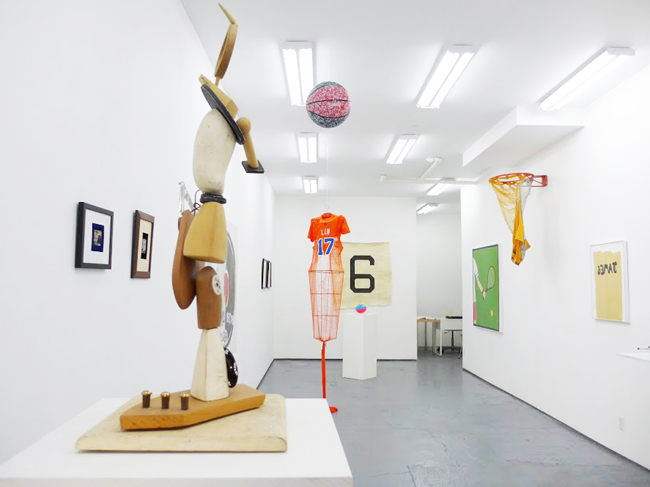
    Lichtundfire is happy to announce SPORTSVERGNÜGEN, a tightly weaved group show curated by D. Dominick Lombardi and Augustus Goertz, and comprised of works in various media inspired by team sports.


    By D. Dominick Lombardi:
    Visual art and sports rarely mix well. Most can mention any number of successful sports related films, songs, plays and books, yet, for the visual arts, there are few major works that measure up to the greatest sports related art such as Myron’s Discobolus (Discus Thrower) (450 B.C.E.), George Bellows iconic Dempsey and Firpo (1924), or, in more recent times, Catherine Opie’s poignant photographic portraits of High School, American Football players.

    When I googled in images “sports related fine art” the first thing that came up was a photograph of three old naked guys playing golf, followed by a bunch of Leroy Neiman paintings or art inspired by Leroy Neiman paintings, plus lots of very slick sports-action photographs – nothing for a contemporary art exhibition.

    After months of searching, Augustus Goertz and I have selected a number of compelling works that break the mold of the aforementioned lowest common denominator-type. With our selections of sculpture, painting, collages, needlework and objects, we hope to challenge the viewer to see past the over commercialized and commoditized sports world to find a more complex and expansive reality that lies beyond money and marketability. Few artists care to admit they have an interest in sports yet there are some that see a starting point like any other aspect of popular culture: a starting point to create.


    By Augustus Goertz:
    When I was a kid, I often would draw sports scenes for the entertainment of my friends. Later, I enjoyed playing sports with fellow art students. For most of my life I have taken pleasure in some form of sports or another, usually with painters or filmmakers, photographers and videographers etc. Even though the history of art is replete with iconic works associated with competitive activities, the art world has kept sports at arms length, bordering on disdain. Except in the case of their own promotional materials, the sports world, even though, athletes themselves are very obviously engaged in a self conscious effort to perfect their craft and art, seems to be very uncurious about what artists are up to.

    Out of years of musing about this came the idea for this show. I discussed it with D. Dominick Lombardi, a respected curator friend, and Priska Juschka, who is so open to unusual exhibition ideas, and here we are! I am grateful to Dominick for his generosity in sharing credit with a first time curator such as myself. I have learned a lot just seeing the volumes of correspondence involved! Game on!

    Lichtundfire:​ 175 Rivington Street, NY NY 10002
    Contact: Priska Juschka, info@lichtundfire.com, New Tel: 917-675-7835
    Gallery Hours: Wed- Sat. 12-6 PM, Sun 1-6 PM

    News | Exhibitions