“Jackie Sleper does not match the traditional profile of a Dutch artist. Unlike her historical counterparts, with their austere Calvinist roots and dour palette, Sleper’s work celebrates life with bursts of color and a quixotic co-mingling of sculptural embellishments. She draws inspiration from her world travels, and the wide-ranging cultures she seeks to embrace while there. Even after so many years, she remains a careful observer of the natural world and its inhabitants. She allows herself the luxury of childlike discovery. Her work is both reflective and instructive, as it seeks to embrace those common elements that link us as a universal family of humankind.” ~Tineke Reijnders, Art Historian and critic specializing in contemporary art.
In a highly unusual mixture of schooling, Utrecht-based artist Jackie Sleper, studied at both the College of Agriculture and Horticulture (now Wellantcollege), and the Utrecht Academy of Visual Arts. While art school honed her technical skills, it is the “farmer’s school,” as she likes to call it, which taught her about the fragility of life, the sanctity of nature, and the importance of working with others to get the job done. It also served to inform her work, as figures of animals, birds, insects, flowers, and plants, along with humankind of course, populate her paintings, photographs—and most prominently her clay, porcelain, resin, and wood sculptures. Many of Sleper’s one-of-a-kind sculptures, exhibited across Europe, as well as Mexico, are based on her travels, always with her family in tow, throughout China, Mexico, and India. Gathered together these highly theatrical, multi-themed exhibitions examine—often with an ironic, humorous, and surreal touch—the threads that connect people on a daily basis. Her artistic creations can also be read as narratives, where the solitary beauty of each intricately crafted work, reads like a full blown story of the artist’s life experiences, as well as that of humankind.
Sleper currently lives in Utrecht with her husband Janjacob, and two of their nine children, and a wild menagerie of animals. The following interview is based on a series of interviews conducted over a two-year period, at the artist’s Utrecht atelier, as well as over the phone, and by email.
Edward Rubin: One of the things that I find most intriguing about your trajectory is your 5 years of study, in lieu of attending a public high school, at the College of Agriculture and Horticulture. This is so unusual. Did you actually plan on becoming a farmer?
Jackie Sleper: No! I didn’t want to be a farmer. But I also didn’t want to go to a regular high school like everybody else. I wanted to be free, outdoors, and on my own. The college was some nine miles from my house. In good weather, I would get there by horse. In bad, I took my bike. When I first enrolled, there were 700 boys and me. I took all the courses offered in Land and Garden. I was thirsty for knowledge. I wanted to know and do everything. I still do. I milked cows, sheered sheep, delivered calves, planted and raised vegetables, plowed fields, rode tractors, and fixed engines. Oh yeah (she laughs), I also wrung the necks of chickens. This ‘farmer experience’ taught me much about life, the weather, the growth process, the cycle of life and death, and the behavior of all kinds of birds, animals, and insects. But the college wasn’t totally about farming. There was a full academic program. I had to take Latin, Spanish, French, English, mathematics, chemistry, biology … everything.
ER: You mentioned that at a very early age it was already obvious to you, as well as everybody around you, that you were born to be an artist. How did this manifest itself?
JS: Unlike my sister and brother, I was the rebellious one in my family. I wasn’t content to sit silently in my room playing with dolls. At age five I was already a wild child, always doing the unexpected. When the family was out of the house, I would rearrange all of the furniture so when they returned home nothing was the same. I also built a little cave-like house from tree branches in our backyard. To decorate it, I would collect things from the street, take small objects from the rooms of my parents, brother and sister, and from around the house, like forks, spoons, ribbons, and mirrors and hang them on strings from the house’s ceiling. I would then lie down on the ground, look up, and think about what I created. Even at this young age I was concerned with beauty. I have always been a dreamer of what could be.
ER: When did the idea of becoming an artist and actually making art enter into your life?
JS: My parents were not at all supportive of my being an artist. It was my grandmother, the wise one in the family, who knew that there was something special about me. She gave me a camera when I was eight years old and I went around documenting virtually everyone and everything. Around the same time my aunt—she must have sensed something too—gave me a book on Frida Kahlo. Reading about Kahlo and seeing how beautifully her work depicted the fullness of life around her affected me deeply. I related to Kahlo’s loneliness. I felt that we both shared a great love of humanity. A seed must have been planted then, as growing up I read every book about Frida that I could get my hands on. As an art student, years later, I was writing stories in my journal and making sketches and drawings about Mexico. Of course, I had no idea that I would eventually be going to Mexico, meeting friends and students of Frida and Diego Rivera, much less creating a traveling body of work based on the culture of the country.
ER: After graduating from ‘farming school,’ you waited seven years to go to art school. Why so long? Were you making art during those years?
JS: I wanted to go to art school, but it was very expensive and my father refused to help me financially so I went to work to save money. I had many jobs … selling books, and antique dishes, glasses, cups—you name it and I did it. All the while I was making art, both drawing and painting. Though I had no formal training at the time I was good enough to be commissioned by the city of Utrecht, as well as Dusseldorf, to create murals. That paid good money. During my five years of study at the Utrecht Academy of Visual Arts, I held three jobs at all times, slept very little, spent as much time as possible making art, and had my first child. I started out as a realist painter and by the end of the first year I was also making photographs. As far as working in three dimensions—a thought always on my mind—it wasn’t until I created Tenzin (2006), my tribute to the Dalai Lama for my China exhibition that I felt secure enough to start sculpting. Now, as you can see (she laughs) there is no stopping me.
ER: Much of your work is exhibited in large and extremely diverse exhibitions under mysteriously intriguing literary titles such as, Silent Whispers, Dulce y Amargo, Black Jack, Shadow of Life, and Soil: Under the Skin of India. How do you plan such large series? And what about your titles, how do you come to them?
JS: It’s a strange thing, and it’s hard to explain. I really don’t plan my exhibitions as such. I don’t even make sketches before I start working on an exhibition or an individual work. Ideas just come to me. Basically, I communicate with everything: the earth, nature, people, animals, objects, even the ‘higher being.’ More than thinking what I am going to do, I feel it. As a teller of stories, I see myself as an intermediary, a midwife. It’s as if there is some sort of channel that is opened, and it goes on and on and on. Sometimes an exhibition is triggered by an event like my mother’s death, which set me to thinking about the boundaries of pain and what is suffering. Out of this came Black Jack. As far as my titles, they are the crown on the head, the summing up of the main idea underlying each body of work. It was only after visiting Mexico and seeing the joy and hardships that the people face every day that the title of Dulce y Amargo, which translates to ‘bittersweet,’ popped into my mind. The same with China, Silent Whispers refers to the country’s censorship. As far as Shadow of Life, I felt that I had to do something with my shadow (she laughs) as it follows me all the time.
ER: You told me that you enjoy working with other people—assistants, curators, various craftspeople, and other artists. Can you talk about this further?
JS: I love working with all kinds of people, my family included, who sometimes act as models for my work. I learned first hand how to work closely with other people without fighting (she laughs) at farmer school. It’s a matter of respecting what they do, understanding how they fit into the overall picture, and minimizing your own ego. Right now I have two main assistants, a husband and wife team. Both are accomplished artists in their own right. Oscar Paanen is my left hand and Yvonne Piters my right. Both work with me on casting and making molds. They help me with the crating and shipping of my work to museums and international exhibitions. Yvonne also handles correspondence and manages my database. I also work with Petra Janssen of Studio Boot, a graphic arts company in Denbosch. Petra photographs my work and helps me to produce a small magazine that comes out approximately once a year. Another artisan that I work very closely with–the third in this triumvirate—is Enzo Forulesano, a professor of ceramics who teaches and works in Florence. As you see, I use ceramic flowers, birds, insects, butterflies, scorpions, rats, and sheep to adorn my sculptures. I design these myself. I make a mold, create various prototypes, and Enzo’s students use these examples to create as many as I need for my project. I also incorporate other objects into my work, manufactured and handmade, that I find in flea markets, jewelry shops, children’s stores, and factories, around the world. Wherever I go, I am always looking.
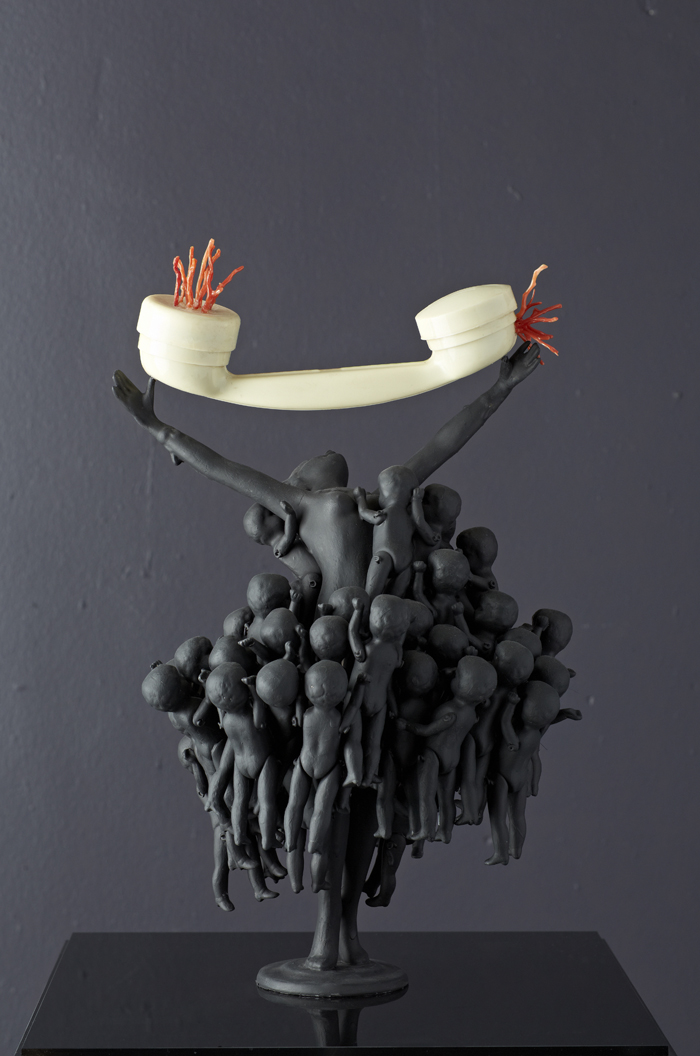
Jackie Sleper, Jizz, Black Jack series, 2012. Courtesy of the artist.
ER: Your three, so-called ‘Foreign Country Culture’ exhibitions, are based on your visits to China, Mexico, and India. How did this interest in other countries come about?
JS: I was always interested in other countries, how people live, and what they are doing with their lives. Like the title of Gauguin’s painting, Where do we came from? What are we? Where are we going? I’m always looking for my roots—where I came from, and who I am. Reading about Frida Kahlo gave me a great thirst to visit Mexico. Later on, in art school, part of the school’s program encouraged student exchanges, so I spent six months living and making art in Ireland. I also visited Spain with my father several times, took art classes in the Czech Republic for six months, and just before I entered art school I lived in Spain for a year. There, too, I was studying and creating art. You must remember that Netherlands may be a very small country but we have always been virulently global in our outlook.
ER: Why China, Mexico, and India? Did you deliberately choose to visit these particular countries?
JS: Yes, no, and yes! Each visit is its own story. I chose to go to China. The uniqueness of the culture intrigued me, as did the restrictions, as visitors were not allowed freedom of travel within the country. In 2004 when a ‘free zone’ for tourists was allowed, I went with my family to China for six weeks. Out of this visit came work about the country’s culture, history, politics, religion, and what it was like being an ‘everyday’ man and woman living in today’s world—subjects that I explore in all of my work. My trips to Mexico and India, took root at the Florence Biennale in 2005, where I first showed my China based work. Mexico was pure serendipity. Matty Roca, a prominent Mexico based curator, and one of the biennale’s jurors, was so impressed with how I presented life in China through my work that she invited me to do the same for Mexico. Two years later I returned to the Florence Biennale and won first prize in Sculpture and Installation for my Mexican-inspired work. Thanks to Matty, my exhibition Dulce y Amargo ended up travelling to eight museums throughout Mexico. As homage to Matty I created Rocatizada (2008). I used red, green, and yellow painted ceramic peppers, which I attached them to wheels. The peppers represent Matty’s fire and passion, while the wheels, which point every which way, symbolize her energy and ability to move quickly in every direction.
India is yet another story. Though I met New Delhi-based curator Sushma Bahl in 2005, it wasn’t until you put us both together in 2010, that my trips to India, and the possibility of exhibiting my work there, started to unfold. Right now, Sushma and I are in talks with several museums in India for a traveling exhibition of my India-inspired work. We have invited Jivya Soma Mashe, one of India’s most prominent artists—he is a master of Warli Painting—to participate in this exhibition.
ER: Because you are an outsider you can never have the exact same experiences, thoughts or ways of feeling and knowing as a person shaped by thousands of years of their country’s own history. How deep do you feel you plumb the minds of the people and their culture?
JS: That’s an interesting question. As a people we all share commonalities. We all want to be healthy, happy, and free. There is always that connection. As far as knowing what is in another person’s mind or for that matter what is on their mind, in addition to telling conversations, there are always all kinds of visual clues. More to the point, I find that keeping your ego in check, emptying your mind of all preconceived notions and biases, and just sitting next to a person in silence, doing and saying nothing, creates a bond which fosters a shared kind knowing, a oneness of spirit if you will. Trust also plays a large part. I rarely do any research before visiting a country. I want to be a blank tablet and write it all down when I get there, to experience everything first hand.
To give the reader a sampling of your thinking and working process let’s talk about Fertilidad (2008) and Devoción (2008) from your Mexico series, Follow Me (2009) from Shadow of Life, Jizz (2012) from Black Jack, and Black Eye Star (2010), Pithora (2010), and Red Fort (2012) from your India based series.
Fertilidad (2008) is dedicated to the fertility of the Mexican people. I deliberately chose to use clay so that the figure that I fashioned would look like a recently unearthed Mayan sculpture. As you see, the man is carrying a porcelain doll from the `20s. Sprouting out of the top of his head are hundreds of tiny colorful animals that I bought from a ceramist on my first visit to Mexico. The doll he is holding is standing on a spray of turquoise gems. On top of the doll’s head is a little amethyst on which a butterfly has alit. The butterfly is one of my symbols of life.
In Devoción (2008), I am taking a somewhat humorous look at the Catholic religion. Here I took a near-kitsch angel—the type sold in curio and tourist shops—in the midst of prayer. Around his head I placed many garnets. On the angel’s back, instead of wings, are some 20 pregnant flamingos about to take flight. The majority of Mexicans are Catholic, and being very devout, they also have a large family, which is why I put a baby in the stomach of each flamingo.
Follow Me (2009) is open to interpretation. Thinking of Mark’s said, “Religion is the opium of the people” it can be read as the power that religion has over people. It can also be seen as Madonna praying for their health. I found the Madonna statue, on which I painted a black face and hands, brown hair, and a golden crown, at a flea market in Maastricht. The sheep which represent the people were designed by me and fabricated in Florence. They are white sheep, not black sheep, because white sheep follow and the black sheep never follow. Too add a touch of the surreal, as well as a bit of reality, as people go every which way, I placed some of sheep upside down. The roses, along with the religious medallions, and the tin hands and legs protruding from her back—the same types that the people hoping for Madonna’s curative blessing place at her feet in churches—are from Mexico.
In Jizz (2012) I am addressing how modern day communication is increasingly reliant on electronic devices of all kinds. Everywhere you go, on the train, the bus, walking in the street, even in the classroom, movies and concerts, and airplanes, when all electronic devices are supposed to be silenced, you see people talking and texting on their mobile phones and IPods. In Jizz numerous children are seen crawling up to the phone that is held by a woman. From the phone sprouts coral, one of my symbols for life. It seems that young people, and us too, can hardly live without phones. Face to face communication is happening less and less. Nowadays, almost all contacts are handled by mobile, Facebook, or other so-called “social” media. If our phone has no connection we utterly panic. It kills creativity. Jizz is actually an indictment of the fact that, real or imagined, you are not allowed to be inaccessible.
Black Eye Star (2010), from my India series, also has many possible meanings, both obvious, and hidden. The boy’s head which I found in a flea market in Utrecht is made of white porcelain which I painted to resemble an Indian child. The garland of birds around his neck which I bought in a Christmas store in St-Malo symbolizes freedom. The dancing butterflies on his head also symbolize freedom, as well as the souls of his ancestors. I used a Black Star sapphire to highlight the intensity of the boy’s third eye. You never know what caste an Indian child belongs to. Maybe he is an untouchable. If he is an untouchable then he has no life as a child. Black Eye Star is saying that every child, whatever the caste, is free and protected by spirits.
Pithora (2010), my blue monkey sculpture, is the result of my visit to the ancient pilgrimage site of Galtaji Temple, which is just outside of Jaipur. It is known as the Monkey Temple, since tribes of rhesus monkeys, all seeking food from the tourists, live there. The monkeys are incredibly cheeky. They’ve been known to steal, pull your hair, or even worse, hit you. I saw one particular proud and beautiful male monkey and I thought that this is the metaphor of the Indian man, who unlike the woman of India, have the most freedom, hold the most power. To emphasize his duplicitous nature, I painted a batik design on my monkey’s head as a mask, to camouflage what he is doing. I added a codpiece of fresh water pearls to indicate the sacred status that he enjoys. The seven sculpted domes of Red Fort (2012)—I painted each a different color—represent different aspects of life in India. They are made from clay that I collected in India. It is my tribute to the actual seven-domed fort in Old Delhi which was built as a palace in the 17th Century for Mughal Emperor Shah Jajan.
ER: You recently returned from the island of Mallorca where you created a fountain titled Ode to Gaudi (2013). Other than murals that you painted in various cities, is this your first site-specific work?
JS: In a manner of speaking all of my work is site specific, as I always take the space around my sculptures into consideration. A few years ago I was commissioned to design a suite of rooms at the Casa Turquesa, an art hotel in Cancun, Mexico. However, this is my first work to appear in a permanent collection at a sculpture park. The fountain was commissioned by Ien Van Wierst, the founder of the Palmyra Sculpture Center Foundation. It is composed of two porcelain mosaic deer heads with real antlers. Water spouts out of their mouths. Surrounding the fountain are three benches which I decorated with birds, dogs, and butterflies. Gaudi is one of my heroes, so I titled the fountain Ode to Gaudi.
ER: Dutch art historian, Tineke Rejinders, talking about the “lavish decorations” that you use in composing your sculptures recently wrote that you do “not leave the superfluous out in order to get to the core, but as a hunter, you draw your cultural catch into your pieces…with grace and beauty.” She goes on to say that your work shows “an ostentatious lust for elegance.” I find that your use of diverse objects in composing your sculptures adds an alluring, if not exotic, aspect to my viewing experience. As I take in the various ornamental elements that you use to create what could be thought of as an assemblage, I find myself both deconstructing and reconstructing your work.
JS: I intentionally juxtapose handcrafted and manufactured objects with those found in nature in the composition of my work. I like to mix low art with high art, the old with the new. Each of my objects, as well as the completed sculpture itself, is telling a story which rattles both brain and eye. Such mixing of past and present histories encourages a lively conversation between my work and the viewer. This is what you are experiencing. Not coincidentally, this same poetic process is how we create our own day to day reality. And in a larger sense, it mirrors the integration of society. What I really want my work to do is to communicate the wild onrushing joy of being alive. If such an exchange occurs then I am very happy!

















