• Courtesy of the artist.

    Courtesy of the artist.

    I have always loved drawing directly from my subject, particularly figures in movement, portraits, and dramatic landscapes. I like wild, dramatic places and watching athletes and dancers at the peak of their fitness. I work with mixed media using torn paper, acrylics, and oil pastels, but love working purely in oils too. I love the way dancers inhabit their space, the moment before the jump, the split second of flying through the air. I have been fortunate and privileged to work with the beautiful Russian dancers in St. Petersburg at the Vaganova Ballet Academy and Marinsky Theatre.

    charlotteleadbeater.com

    Courtesy of the artist.

    Courtesy of the artist.

    I’m driven by color—it excites and inspires me. As I paint, I’m conscious of the energies that colors possess, especially as agents of healing that can transform us. Color can change how we feel. I work fast and I’m always in motion, like dancing, I need space. Sometimes I work with paintings on the ground so I can come in from any angle. I love a translucent surface with depth to see through the layers into time and space. I try to reveal our natural source and it’s all there in the color.

    ritakenyon.com


    Courtesy of the artist.

    Courtesy of the artist.

    Everything around us is wavelengths, from sound to color. I believe they play a big part in our emotions. Different wavelengths—color in this case—get a different answer from the viewer. I use recordings of music as something to inspire my emotions. I let the freedom of creation take the piece where it wills. Music and nature are ephemeral, but painting lasts. Art can be appreciated by the many and not in a single instant but in an infinite number of moments right now.

    gracemkw.com

    Courtesy of the artist.

    Courtesy of the artist.

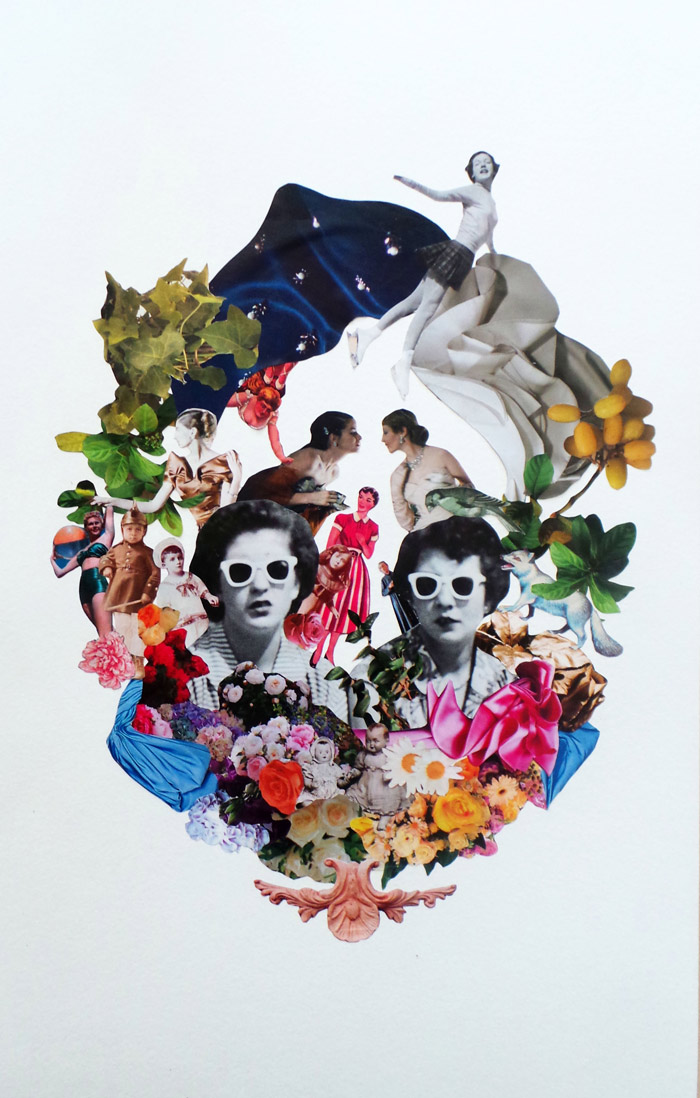
    My work covers all aspects of collage, as it allows me to use a wide range of techniques, giving me full freedom for experimentation. The textures, colors, and different materialities join in a process of collecting, sorting, and re-use, resulting in unexpected encounters between these various elements. In my work, the lack of a constant style due to the different images that I arrange in each composition is plain to see. I am interested in the aesthetics of magazines, objects, and daily things, because of the diversity of materials and meanings that they each possess. I can then take them out of context, scramble and rearrange them, creating new exaggerated atmospheres or distortions from reality. All these different elements provide new meanings and new stories which are left to the imagination of each viewer.

    franciscacorrea.wix.com/arte

    Courtesy of the artist.

    Courtesy of the artist.

    In my work, I use noble materials such as semi-precious stones that absorb, preserve, focus, and issue energy. I use stones such as amethyst, citrine, lapis lazuli, agate, quartz, onyx, jade, and hematite. I also use Swarovski Elements that serve as perfect and glamorous light enhancers, highlighting details with their extraordinary reflection. By means of the intentioned use of color, shape, and texture, I incorporate nature symbolically and figuratively, along with its rhythm and movements to create an experience of the magic in its perfect harmony. I am awakening the collective unconscious of the sensations that only nature is able to transmit: peace, tranquility, strength, harmony, and magic. In this way, I seek to provide the right energy to harmonize every space and the people who live there.

    jeannettecanale.cl

    To Do as One Would, Image Courtesy of David Zwirner Gallery

    To Do as One Would, Image Courtesy of David Zwirner Gallery

    Featuring: John Dante Bianchi, Nick Darmstaedter, Violet Dennison, Xavier Donnelly, Charles Harlan, Benjamin Horns, Ann Greene Kelly, Zak Kitnick, Eric Mack, Alex Perweiler, Harry Schleiff, Cal Siegel, Zachary Susskind, John Szlasa, Christopher Williams

    To Do as One Would
    June 26-July 25, 2014
    David Zwirner Gallery
    519 West 19th St.
    New York City
    davidzwirner.com

    Amy Lien, Enzo Camacho, Installation. Polyester foam padding, bamboo sticks, clear vinyl, papier-mâché. Courtesy of Mathew Gallery.

    Amy Lien, Enzo Camacho, Installation. Polyester foam padding, bamboo sticks, clear vinyl, papier-mâché. Courtesy of Mathew Gallery.

    Featuring: Amy Lien and Enzo Camacho

    Who Do You Love?
    May 2 – June 28, 2014
    Mathew Gallery
    12 Schaperstrasse
    Berlin
    mathew-gal.de


    Matthew Hassell: Surely you haven’t always painted quite the same way you do now. Could you tell me a little about where your work comes from and some of the experience that led you to make the work you are currently involved with creating?
    Tatiana Berg: I haven’t been painting for that long, relatively, but you always try on a lot of different hats along the way. It’s not easy airing the dirty laundry of your awkward, derivative beginnings, but I love it when artists do—that’s why I love how every time I’ve seen Dana Schutz give her artist talk she starts with a slide of an abstract, Robert Ryman-y all white little painting that you’d never think she’d ever make. It’s a lovely, generous thing to do, especially in front of students.

    Something I’ve been reminiscing about with some old friends was how we noticed, in retrospect, an implied expectation in school of having to digest and metabolize the entire arc of 20th century painting in four years of study. Students rise and die with Modernism in the classroom. They start you off with the observational stuff, and then you move on to maybe some expressionistic-but-still-representative things, and eventually you make it to abstraction, which then gets discarded in favor of conceptualism and the immaterial art object. I’m exaggerating, of course, and not everyone did that! But it was a common narrative, and funny to watch people sneer at whatever previous method they’d been using once they had “evolved” to the next step.

    All this to say is I’ve run the gamut. I took a stab at everything when I was starting out. As a young painter I’d sometimes try and figure out how to make the paintings of an artist I was obsessed with—it was like a fever, and the cure was understanding something about their process. Once I vaguely succeeded I’d lose interest, and be able to move on with my life. I’ve made knock-off Alan Shields, Alex Katzes, Manets! I’m not making the “kind” of work I thought I would be making at all. You metabolize your influences, and climb out of the maze.

    MH: Your mark-making has a decidedly casual feel to it, but many of your compositions end up being quite complex. I see a number of art historical connections that could be made, but who are some of you favorite sources of inspiration?
    TB: Composition is one of those things that I can’t rely on myself to reliably produce. I need some source material, food, or otherwise I’ll fall into the same three tricks over and over. Certainly other paintings are great sources. I lived in Paris during high school, so I spent a lot of time on the weekends at the big museums. The Raft of the Medusa is an old favorite. I try and visit that thing every time I go home. Caravaggios, too. Those have some crazy compositional gestures.

    I certainly owe some debt to the Supports/Surfaces artists, as well as 60-70s painterly painters that were collected in Katy Siegel’s excellent 2007 show, High Times Hard Times. I’m also consistently obsessed with Milton Avery, as everyone should be.

    MH: What other sources of inspiration do you find in the world around you?
    TB: I derive a lot of inspiration from pop culture and humor especially. I watch a lot of stand-up and also improv, which I particularly adore. So much of humor is derived from cadence and timing, just like paintings. There’s rehearsal, where you accumulate muscle memory, and then the act of painting is really rhythmic where you’re continuously responding in real time to external and internal stimuli. Knowing when to stop, knowing when to land the punchline, that’s all very tricky.

    I finally broke down and took an improv class at the UCB theater this summer. I was terrified—I am absolutely not a performer and don’t enjoy being onstage. But in the end, it was unreservedly the most fun I’ve had in ages. I hadn’t been around adults who were so unselfconsciously playful and collaborative. It made me realize how infrequently we actually play games in regular life, and it was just unbelievably helpful for painting. I learnt so much, and I’m still unpacking that experience.

    MH: I’d maybe describe you as an abstractionist for the most part, but a good deal of your work also flirts with representation. It’s clear no one has to feel pressure to land on one side or another these days, but it makes me curious whether or not the more sparse abstract works you create come from somewhere in the “real/lived” world somewhere.
    TB: Everything has a referent. Just as all representation is abstraction, all abstraction gets filtered through a mind that, through force of habit, reads language and representation into everything. It’s not just that you can’t have one without the other; they’re simultaneous.

    MH: Much of your work deals with an economy of expression when it comes to your handling of the paint. How do you know when to stop working on any given piece?
    TB: That’s the big hat trick, ultimately. I don’t know a single painter that doesn’t continue to struggle with that one. I mess this one up a lot on either end, by under-working or over-working. It feels like sexual edging: you have to stop yourself right at the cliff edge without going over. I have this feeling that the very best painting, regardless of speed, stops just short of being “done.” Where you’re able to imagine what could happen next. In that way it acts as an irritant and makes you complicit in its life.

    Of course this method runs the high risk of being undercooked and unsatisfying mush. That’s what makes it fun, and hard—when you succeed it’s transportative and experiential like nothing else.

    MH: In your Tent works, the structures you paint on are built in the round as multi-sided stretcher volumes draped in canvas and painted. I love this work. I had seen images, but first saw one in person at the show About Space at the ArtBridge Drawing Room. I like your decision to put them on casters, giving them an implied movement and transportability. Can you tell me a bit about how this side of your work came about?
    TB: When I was younger I think I felt typically torn between what I assumed were different postures, the abstract and the depictive. I’d think of some paintings as “concave” and “convex”—the concave being of the illusionistic variety, and the convex as the assertive “objecthood” objects. But what I came to understood is that in my work these two modes actually operate in the same way, at the same time.

    I strongly anthropomorphize my work. This is something we all do, involuntarily. To ignore that is to ignore a facet of human perception. Just as every concave painting is three-dimensional object in space, every convex one leads a double life as a legible, depictive symbol. It was my feeling that while the recent history of painting has roundly addressed this first principle, we have not yet had so much work addressing the second.

    Everything is a body. Everything is a cartoon. Everything has a dick, etc.

    Those are some of the things the tents are trying to address. They sprung out of a curiosity I had, wondering what a painting would look like broken up, exposed, and hanging out in our human space, while occupying a human amount of space. I’m untrained in any form of sculpture, so I’m amused in the way that they’re the product of an unskilled person working their way backwards, problem solving with the only skills available to them—in my case, painting skills, like stretcher building.

    I love the tents a lot, at this point they’re a familiar, friendly shape to me. They’re more mobile and assertive than even I as a person get to be, and they are wonderful vehicles for ideas.
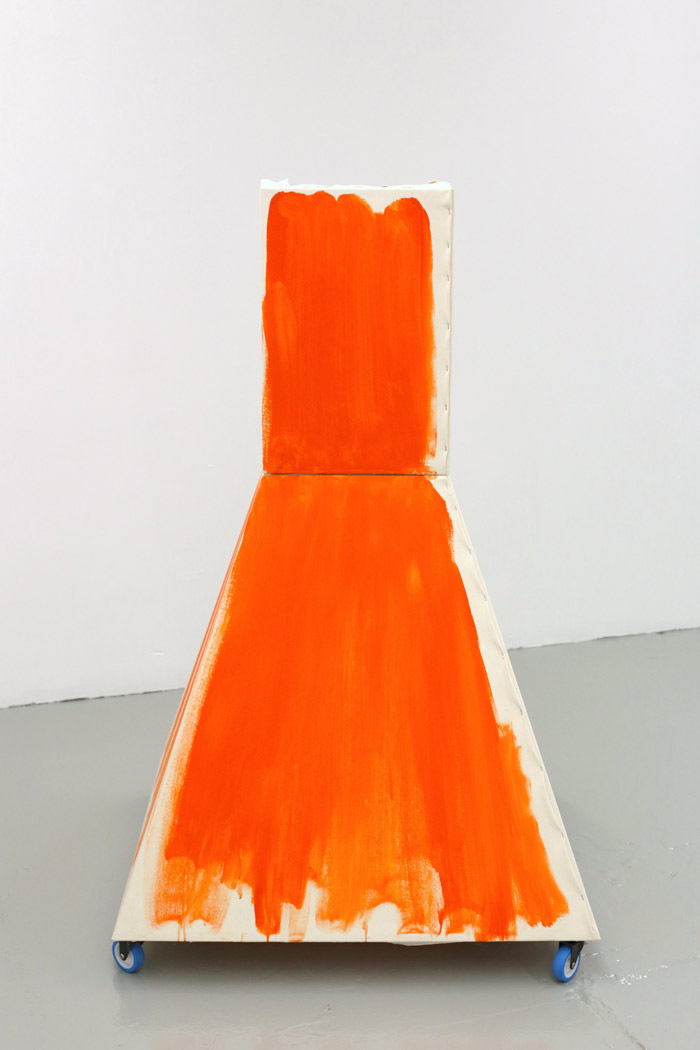
    Tatiana Berg, Joanna Tent, 2013. Acrylic on canvas, wood, casters. 60 x 38 x38 in. Image courtesy of Hansel and Gretel Picture Garden.

    Tatiana Berg, Joanna Tent, 2013. Acrylic on canvas, wood, casters. 60 x 38 x38 in. Image courtesy of Hansel and Gretel Picture Garden.

    MH: Is the fact that they are on wheels a playful invitation to the viewer, enticing them to walk around the work? Can I get your permission to push the next one I see around the gallery and really ruffle some feathers?
    TB: One of my favorite things is the way the tents suggest a possible function, while having none. They definitely feel like potential furniture, or containers for something, or possibly a very specific and weird tool.

    With the tents it seems like they want us to touch and move them and play with them. They’re saboteurs. They seem friendly but are deliverers of sneaky ideas, I hope.

    I’d love for people to be able to touch them all day long but it’s sadly impractical because some people aren’t so respectful! One of the funniest things I ever saw was someone using a smaller one as a little drink coaster at an opening. Just set your cup of wine down, and wheel it around with you while you circulate.

    MH: In a time where other art exploration is always seeming to invite viewer participation, this decision seems to be pointing an accusatory finger at the art world’s long standing position of frowning on the viewer’s ability to touch a painting.
    TB: I think about usefulness, and touch, a lot. I wonder what the use of a painting is. Ostensibly, once it’s “done” a painting just sits quietly on a wall, looked at but never touched. Maybe its greatest moment of “use” is the painter using it and touching it for their personal expressive purpose, and then that’s it. A painting is a one-use thing that’s almost discarded when it leaves the studio—which is a melodramatic idea I love.

    You know what else I just love? Mary Heilmann’s chairs. It’s such a goofy thing, to like sit on a “painting” while looking at paintings. I like work that does stuff that. It’s irreverent in a way that seems dumb but is actually aggressively smart.

    MH: Your marks seem so brusk and intuitive, made quite quickly—yet a lot of the structures you paint on in the Tent work seem like they took some time to build. Is there some amount of planning that goes in to how each tent piece will eventually look? Or once you have the surface ready do you just bang them out?
    TB: Two modes of thinking are necessary, in life and in painting: there’s the fast and performative, and the slow and designed. Oscillating between the two is healthy and I like that the tents embody both. They’re difficult and time-consuming to build, and then I don’t treat their surfaces differently than my “flat” works; I bring my best self to the party, respond to what’s in front of me, and let ‘em rip.

    I read this book over the summer, Daniel Kahneman’s Thinking Fast and Slow, which is like a treatise on the psychology and latest neuroscience of human behavior. I think it did a great job addressing these two modes of thinking; how our brains have two broad ways of working and what activities are best suited for them. I suspect I design in slow mode, and then paint in the fast mode—similar to athleticism and what we often call “intuition.” It’s an interesting read and seemed to confirm a lot of my suspicions and half-baked theories of how my own brain operates while I’m working.

    MH: I see a lot of your new work on assorted social media. (Yes I stalk you.) Do you tend to burn through materials? Did this factor into your recent move to works on paper? Or had you been working this way all along?
    TB: I burn through materials like a nymphomaniac on death’s row. Not really; but I do alternate through fallow periods of contemplation and relative laziness, to bursts of manic output. I have what I consider a high failure rate (for a painter, anyway). I live for high-risk painting—anything else bores me—and if going to fail, I want to really go down in flames.

    Anyway to answer your question, yes, I have sort of always worked this way, and finding the right kind of paper has been a godsend. It allowed me to really pick a speed that’s almost impossible to maintain with other media. Canvas and stretchers are just inherently costly, so I had to find other ways to allow failure; some of my earlier abstractions have many, many failed paintings hidden beneath the final product.

    MH: Each of the paper works seem to be painted on two pieces of paper placed together to make a single composition—is this move a practical way to work larger, or does it intentionally reference the painting tradition of the dyptich?
    TB: The move was definitely started by a practical need to work larger, at first, but it has become a deliberate part of the content now. It’s a push/pull, gap-thing that doesn’t operate in the same way when it’s a single sheet. It also has that effect, you know, when you cut up a giant pizza into little squares, you end up eating more? It’s like that.

    MH: Please clue us in on some new exhibitions or exciting projects to look forward to in 2014.
    TB: For the time being I’m looking forward to exhibiting my thesis work at the end of my Columbia MFA, but beyond that I don’t yet know of anything for certain!

    Mick Rampartha is an oddball experimental American poet. Most of his work is in haiku form and plays with the most banal and primitive attributes of life. A few weeks before he brought me to the Mother Cabrini Shrine and the Cloisters, Mick had his prostate removed. I was the first person to visit him at the hospital. Flash forward a couple weeks, and I met him again, outside the subway station, ready to explore the grounds of his favorite place to meditate. Mick made jokes about the Depend diaper he was wearing, snorted with laughter and explained, “I just keep dribbling…” as we walked toward the Mother Cabrini Shrine.

    I wondered why he was so bent on showing me a dead nun. I figured it’d be a weird and slightly off-color joke, like the kegel-exercise jokes he kept telling me now that his doctor had put him on a regimented plan to regain penile control. I felt a bit creeped out; I was about to gawk at a mummified nun put on display by a religion I found frightening. Knowing Mick the way I do, I imagine he took me because he is fascinated with religion, occult oddities, ancient art, and repulsed by the powerful, seemingly never-ceasing homophobia, sexism, racism, classicism and general disregard for people not participating within its’ power structure. Mick explained that a friend of his first took him on the same trek in the early 1980’s: the Mother Cabrini Shrine, the Cloisters, and then the Piper’s Kilt for beer and burgers. It’s nice to know some places have survived gentrification.

    The Cloisters opened in 1934, 17 years after Mother Cabrini’s death, which was the same year John D. Rockefeller, Jr. started the project. The more I look at this seemingly quiet corner of Manhattan, I believe both the Cloisters and the Mother Cabrini Shrine have significant allegiances to old European religious power—a coded, out-in-the-open symbol of allegiance to pre-democratic ideals—while also standing as symbols of American possibility.

    Once inside the Mother Cabrini sanctuary I found myself transfixed by her mummified corpse. I wondered: How does anyone worship God in this space? What is it like to take communion with a mummified corpse in the same room? Then I noticed the late afternoon light pouring through the stain glass representation of her on the back wall of the sanctuary. The light poured across the room with the full spectrum of color, it flooded the pews, and led my eye back to her remains. The experience suggested the room is a connected architectural choice. Wrapped around the curved wall behind her altar is a simple mural: images of Mother Cabrini with Sisters, Angels, Christ, and common folks. Mother Cabrini was known to be quite humble and simple—yet the display of her corpse is everything but… Before exiting we poked around the official Mother Cabrini gift shop. I bought her biography.

    Down the block, I felt overwhelmed. Mother Cabrini’s fate didn’t seem deserved. It seemed like a punishment, possibly, for being a radically helpful woman. She had little desire for personal possessions, yet in death she’s a caged memento of the empire she served. And as she remains there, forever part of the Church’s propaganda, the services she fought for and devoted her life toward have, for the most part, gone under-funded and closed down.

    Mother Cabrini, and 6 of her Sisters from the Institute they founded in Italy, arrived in New York City on March 31, 1889. They were immediately greeted by the city’s infamously rough side. Mother Cabrini wasn’t necessarily running around with winos getting blitzed on leftover wine sludge in Opium Dens, like those described by Luc Sante’s portrait of New York City, Low Life. But she did discover they were homeless—temporarily, anyway. Due to a miscommunication, the Archbishop didn’t expect them for several months, and suggested they had no need for the Sisters—they ought to return to Europe. But Mother Cabrini demanded the Archbishop provide housing and showed him a sealed letter from the Pope. He relented and found a boarding house for their first night. Upon settling in, they discovered their first bed infested with bedbugs. The legend goes, the Sisters shuddered at the crawling sheets and took turns sleeping in chairs as Mother Cabrini knelt in prayer and steadfastly chanted into the morning. She “discovered by experience that difficulties and discouragements at the outset showed that success was to follow.”

    Once the Sisterhood settled, Mother Cabrini met Mary Reid, wife of Count Palma di Cesnola, an exile from Risorgimento who was director at the Metropolitan Museum of Art. Mary bought the Sisterhood a house at 43 East 59th Street. Initially the Archbishop scorned the Sisterhood and demanded they not use the house as an orphanage. He suggested they start in Little Italy. At the time, Irish Clergy held power in New York. But the two women succeeded in convincing him to give them a chance, and founded the orphanage. Moving the Sisterhood from the Italian ghetto into a premiere neighborhood attracted notice and led to increased support for Mother Cabrini’s mission. Today, the orphanage is located in West Park, New York, and is known as the Saint Cabrini Home—the first of 67 institutions Cabrini would go on to found in New York, Chicago, Des Plaines, Seattle, New Orleans, Denver, Golden, Los Angeles, Philadelphia, and in countries throughout South America and Europe. Her institutions served the sick, the poor and trained additional Sisters to carry on the mission.

    I imagine Mother Cabrini consoling widows and newly orphaned children who’ve lost everything. Mother Cabrini was part of many efforts the Church made to bring Italian immigrants in America back to Catholicism. When she arrived in New York nearly 50 years before, Italian families had begun giving up on the Church, because of the unfamiliar Irish Catholic customs dominating the discourse. In Italy, attending Church was free, but in New York there was an enforced door fee of 10 cents—a large sum for immigrants, and a reminder they were to appease America’s god: Capitalism. I imagine Mother Cabrini’s country accent and matriarchal witticisms reminded those she touched of a simplicity they unknowingly left in Italy.

    Mother Cabrini died of complications from dysentery at 67, in Columbus Hospital, Chicago, on December 22, 1917, while preparing Christmas candy for local children. By then, she’d achieved regard for healing miracles, which she’s purported to have worked through obedience and relentless prayer. Since her death, people claim to have manifested miracles by praying to her. Because of this, she became a candidate for the canonization process. In 1931 her remains were exhumed and she was discovered to be a partially incorrupt corpse; and then officially declared a Saint. Since then the majority of her body has been held at the Mother Cabrini Shrine; her heart was sent to the site of the first Institute she founded in Codogno, Italy; a piece of her arm is in Chicago; and her head was sent to the Motherhouse, adjacent the Vatican.

    My friend Crystal grew up attending church at the Mother Cabrini Shrine during the 1990’s. Her Grandmother, a devout Catholic, made a promise to God that she’d always visit Mother Cabrini. Crystal’s Grandparents immigrated to Little Italy from the Dominican Republic in 1965. The family suspects she discovered Mother Cabrini in New York. But, it could’ve been as a child in the Dominican Republic. Crystal thinks her Grandmother has remained devoted because she is the Patron Saint of Immigrants. After arriving in Little Italy, her Grandparents moved to Bushwick and opened a Bodega. Throughout the 1960’s and 1970’s many friends and family members, immigrated and stayed at the apartment above the store. All the while, Crystals’ Grandmother kept a photograph of Mother Cabrini on the mantel and often made the trek to her favorite Saint.

    For Crystal, growing up with a mummified body was different. She comes from a large family, so funerals happen regularly; because many showcase open caskets, dead bodies become normalized. Seeing the body of some lady—and that’s all Mother Cabrini represented to her as a child—proved to be less shocking than a friend or relative’s. And because she’s on the altar wearing a habit, Crystal thought she was a statue. Around 10, Crystal mustered the gumption to go into the gift shop and ask the nun behind the register if Mother Cabrini was real. Crystal reasoned a nun wouldn’t lie. Her Grandfather teased her about the mummy, and she wanted to prove him wrong. But the nun verified Mother Cabrini’s body. She recalls feeling freaked out because she spent a lot of time at the altar with her Grandmother. She’d be there praying and Crystal would pretend to pray, but in actuality was transfixed by the mummy. Once Crystal understood it to be a real body, she went home and demanded her Mom remove all the Mother Cabrini memorabilia from her room. At the time she was obsessed with Michael Jackson’s HIStory album. Inside the album is a photo of a young girl with bandages over her eyes. Young Crystal’s imagination superimposed Mother Cabrini’s eyes over the bandages, and has since been terrified.

    Just before my deadline, I made a last trek to Mother Cabrini to take photos. I read Jose Munoz’s Disidentifications: Queers of Color and the Performance of Politics as I rode the subway uptown. A “closed” sign startled me when I arrived. I peaked through the window and pulled on a cigarette as a woman opened the door. She asked if I was there to see Mother Cabrini. “Yes,” I briefly explained the article. Her face lit up as she invited me inside. Immediately, she let me know how badly press was needed, that the sanctuary needed repairs and that interest in Mother Cabrini has drastically waned. She smiled as she pointed toward her. I asked if she knew anything about the origins of the mural. She shook her head. Then exclaimed, “But isn’t it beautiful!” I smiled and began fidgeting with my camera. There was a pause. Then she told me a story about a person who had written an unfavorable article about Mother Cabrini. Then darted from the room. I got the sense I was worrying her.

    I tried to snap a high quality photo; but realized there wasn’t a clear shot. The glass case displaying the body sits about 12 feet from a velvet rope placed to keep visitors out. I took a step back and tried to refocus the room, and hopefully find a way to capture its weirdness. Then it hit me—I had taken on an impossible project. Writing about a mummified nun for a small arts magazine focused on the intersections of art and the body was an absurd idea; sure to be the least read story ever. Simultaneously, I was dumbstruck by the magnitude of importance her devout followers placed upon her. The article seemed like it’d do little more than bore one group of readers, while outraging another.

    Moments later, she reappeared saying I shouldn’t use photos for a published article without first speaking to the Head Sister. If the Head Sister felt the article portrayed Mother Cabrini in an appropriate way, she’d happily allow as many photos as needed. I shot Mother Cabrini an eye roll. Paused. Then I started to stammer about my desire to speak positively about Mother Cabrini’s life and work but yes, I was aiming to … see her through a feminist gaze … Inevitably critical of the Church, which uses her death for its own profit. Sure, within the Catholic tradition the fate of Mother Cabrini’s corpse is considered a high honor. She’s been canonized, idolized, immortalized and mummified, but how does this parlay into her desire for simplicity and direct action? She lived a humble life, so why a grandiose, highly public, constant viewing of her mummified corpse? I imagine Mother Cabrini asking, “How do these excesses help serve the missions?” She gave me a long, confused look before I broke and agreed to meet the Head Sister. As the words came, I wondered what the fuck had happened to me. And then, just as quickly, I had this fantasy playing out in my head that talking to the Head Sister might actually prove an interesting, worthwhile venture. I’d come this far, I reckoned.

    But when I returned to meet her, the sanctuary was closed. It felt like I had been blessed.

    I decided to wander the grounds and snapped photos of trees, statues, and odd memorabilia. I realized I was experiencing a joy I hadn’t experienced. It took a moment to decipher that it came with the knowledge that she was inside the sanctuary, exactly the same as my other visits. And she was the same when Crystal knelt before her with her Grandmother. I had developed an appreciation for reverence; she was one of a handful of things that I could rely on. It felt silly, yet I stared at her bench placed against a brick wall near the parking lot adjacent to the sanctuary, and imagined her covered in orphans. Her belief in faith, simplicity, humility and obedience as the source of all spiritual power still doesn’t quite register with me. But I felt like I was beginning to grasp her desire for a reliable Sisterhood.

    Recently, Sister Megan Rice found herself caught while pursuing justice. The Sister, along with two anti-war activists, revealed security flaws at a nuclear facility outside Knoxville, Tennessee. They broke in using bolt cutters and a hammer. They caused no permanent harm to the facilities. The group claims they were demonstrating the ineptitude of the lackadaisical security system protecting the facility; they were acting as concerned global citizens. Despite evidence, Sister Rice faces 30 years in prison. All I could think was, “Wow, again—a Sister fights for a better, more sustainable world, only to end up caged by the powerful.”

    By Stephen Boyer

    Vince Contarino’s vivid abstractions make harmonious compositions out of seemingly disparate forms. Smoky swaths of brushwork melt in and out between elements of rigidly concise geometrical arrangements. Hear him tell NY Arts about one of his pivotal influences in this week’s release of our One Burning Question.

    News | Exhibitions