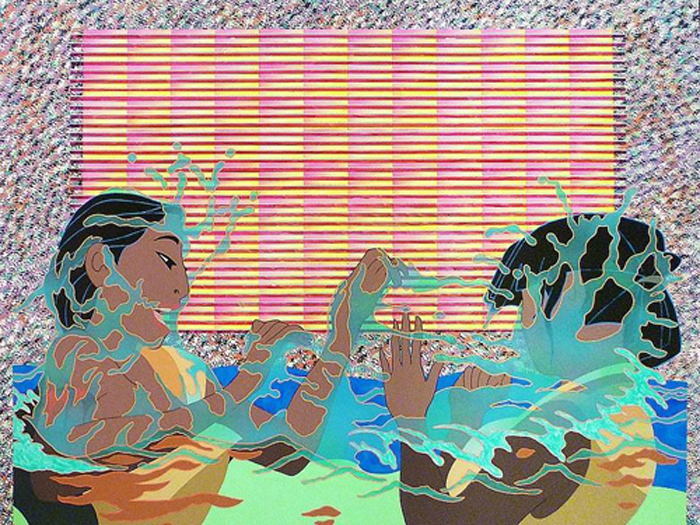
• Michael Dotson, New Spa World. Image courtesy of Graham.

    Michael Dotson, New Spa World. Image courtesy of Graham.

    Featuring: Seth Adelsberger, Trudy Benson, Michael Dotson, Henry Gunderson, Eric Shaw, Russell Tyler, Siebren Versteeg, Max Warsh

    Sunscreen
    July 10-August 28, 2014
    James Graham & Sons Gallery
    32 East 67th St.
    New York City
    graham1857.com

    Robert Larson, Bloom Discarded cigarette packaging on canvas 2013 42 x 75 inches

    Featuring: Andrew Schoultz, Erin M. Riley, Guy Yanai, Kristen Schiele, Michael Theodore, Robert Larson, Sam Friedman

    Summer Mixer
    July 17 to August 27, 2014

    Joshua Liner Gallery
    540 W 28th St
    New York City
    joshualinergallery.com

    Fridman Gallery

    Featuring: Ariana Papademetropoulos, Colter Jacobsen, Edgar Arceneaux, Lauren Fensterstock, Nick McPhail

    Curated by Luisa Aguilar Solis and Georgia Horn

    Recurrence
    July 17 – August 15

    Fridman Gallery
    287 Spring St.
    New York City
    fridmangallery.com

    Umbrellium, Marling, 2012. Photo Credit: Igor Vermeer, and Vermeer Fotografie. Courtesy of the artist.

    Umbrellium, Marling, 2012. Photo Credit: Igor Vermeer, and Vermeer Fotografie. Courtesy of the artist.

    Digital Revolution
    July 3-September 14, 2014

    Barbican Centre
    Silk St.
    London
    barbican.org.uk

    Ted Gahl’s paintings resist definition. Working mostly in abstraction, Gahl’s works often incorporate drawn elements and concise written phrases into their seemingly deep layers of gestural accumulation. Just as serious about abstraction as he is interested in cultural reference and the occasional joke, the artist unveils a longtime art crush in this week’s One Burning Question.

    ACME Brooklyn
    Adrian S. B, Alvaro Ugarte, Bill Abdale, Christian Calabro, Cleon Peterson, Dakota Sica, Enrique Santos, Federico SAENZ, Lotta Matila, Marina Silva, Monica Escutia, Pablo Davila, Rodrigo Imaz, Scotty Albrecht, Sebastian Vizcaino, Varenka Ruiz, Zazil Barba “This Event May Be Occurring In Another Context”

    Curated by Homero Fernandez Pedroza, Zazil Barba and Varenka Ruiz

    This Event May Be Occurring In Another Context
    July 17 – 21, 2014
    La Fabrica / ACME Brooklyn
    North 4th St #198
    Williamsburg, Brooklyn
    acmebrooklyn.org

    Hyongyon Park

    Drawing deeply from Korean Shamanism, also known as Mugyo, Hyongyon’s images are constructed of mysterious and otherworldly figures depicted as shaman. As a descendant of the Heavenly King, a shaman connects the physical world to the spiritual world seeking to help overcome people’s negative emotions and spiritual weaknesses. This healer, however, is often feared among skeptical people. Hyongyon believes that her unidentifiable creatures take the role of a shaman, and become incarnations of human suffering, desire, and hope.


    Jongwan Choo, Emergence, 2003. Acrylic, Charcoal, Color Pencil on canvas, 114.9 x 94.5 in. Collection of Shin Gallery.

    Jongwan Choo, Emergence, 2003. Acrylic, Charcoal, Color Pencil on canvas, 114.9 x 94.5 in. Collection of Shin Gallery.

    Jongwan Choo

    Jongwan’s photo-realistic monochrome figures that are indistinguishable from one another talk about the loss of personal identity and the lack of truth in our materialistic society. The hidden faces of the figures represent people hiding behind their façades and the predetermined social norms and principles that constrain an individual’s behavior. His works serve to shatter the façades people construct and break through the society where power and authority reconstruct who we are individually.


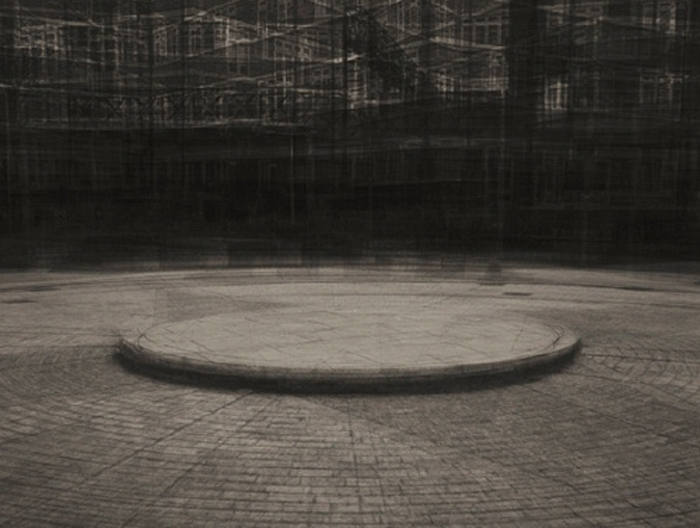
    Dongyoon Kim, Roundabout, 2009. Digital C type. Courtesy of the artist.

    Dongyoon Kim, Roundabout, 2009. Digital C type. Courtesy of the artist.

    Dongyoon Kim

    Dongyoon explores the fragility of our memories and experiences, both direct and indirect, by stacking multiple images into one photograph. At first glance, his photographs may look like one single image, however the subtle layers slowly unveil themselves, creating vibrant movement and confusion as the layers shift into one another. This challenge that the viewer faces represents the blurring or uncertainty of existence and the past over time, resulting in a shifting of one’s understanding of perception.


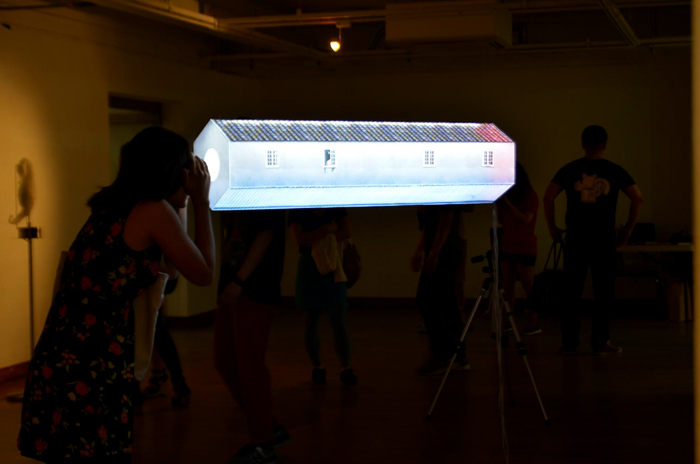
    Jinyoung Min, Between roof and roof, 2012. Acrylic, fabric, styrofoam and moving light, 43 x 11 x 9 in. Collection of OCI Museum.

    Jinyoung Min, Between roof and roof, 2012. Acrylic, fabric, styrofoam and moving light, 43 x 11 x 9 in. Collection of OCI Museum.

    Jinyoung Min

    Jinyoung takes her memories of childhood home and creates architectural installations. The viewer is invited to peek inside the houses, calling for the beholder’s own interpretation of the space. Jinyoung’s houses are not merely objects, or places to live, but they are about her own psychology and experience becoming spatialized. The process of experiencing these architectural installations becomes extremely private as each person gets a glimpse of his or her memories.

    Peter Saul, Raccoons Descending a Staircase, 2012. Acrylic, Colored pencil on paper, 50 x 35 in. Courtesy of Mary Boone Gallery.

    Peter Saul, Raccoons Descending a Staircase, 2012. Acrylic, Colored pencil on paper,
    50 x 35 in. Courtesy of Mary Boone Gallery.

    Keith Mayerson and Peter Saul
    July 8-August 8, 2014

    Robert Blumenthal Gallery
    1045 Madison Avenue, 3A
    New York City
    robertblumenthal.com

    Hein Koh, Rainbow Eye Claw, 2014. Mixed media, 27 x 25 x 29 in. Courtesy of the artist

    Hein Koh, Rainbow Eye Claw, 2014. Mixed media, 27 x 25 x 29 in. Courtesy of the artist


    Featuring: Amos Mac, Erik Foss, Hein Koh, Scooter LaForge

    Summer Exhibition 2014
    July 16 – August 10, 2014
    Opening: July 16, 7 – 9pm
    Munch Gallery
    245 Broome Street
    New York City
    munchgallery.com


    Leah Oates: How did you become an artist and what is your family background?
    Judy Blum Reddy: I wanted to be an artist since childhood. My parents fled Austria because of the war and I was born shortly after their arrival. As an only child, they were always very supportive of my whimsies. I went to Cooper Union after high school, then I told my parents I wanted to study etching at the Atelier 17 in Paris. They said OK but that I had to earn a little of my own money first. So I got a job at the pet department in Macy’s. I was fired shortly after being hired when I accidentally let all the parakeets out of their giant cage, which accelerated my departure for Europe. At the Atelier 17 I met Krishna Reddy, the Indian artist, who became my husband and we settled in New York in 1974.

    By the way, Macy’s doesn’t have a pet department anymore.

    LO: Your work is a series of lists and highlight bureaucracy, obsession and on the surface a need for control. Tell us more about the themes in your work.
    JBR: Well I lived in Paris for ten years and the French are the world champions of bureaucracy. They most likely inspired me.

    Extensive travel also inspired my interest in maps. Discovering foreign cities, the details of other cultures, is exciting, but also frustrating and harrowing; like a puzzle to decipher. Maps have an absurd quality. Behind a tiny dot are the lives of millions of people. How can you make any sense out of that?

    Also I guess I see life as an ineluctable struggle against disorder. That’s probably why I’m preoccupied with fathomless inventories and compilations.
    One of my works lists all the destinations of the Indian railroad and another has 298 panels naming all the streets in Venice, which took me three years to do. I think it’s important to decline and to organize things; it’s reassuring. Maybe I’ve transformed my angst into compulsion.

    LO: As a long time NYC resident how do you think the NYC art scene is compared to what is used to be? What are the pros and cons of the scene
    now and before in your opinion?

    JBR: As an outsider, I can’t really answer that question, but I suppose it partially echoes the evolution of other aspects of New York society: less whimsical, less fraternal, more individualistic, more elitist, more venal …

    LO: Why do you think art is important to people and to the world?
    JBR: For the usual reasons: art remains a humanizing and civilizing force in our society; it’s an ancient and universal language which permits all people to communicate and to record their history…

    LO: What advice would you give an artist who has just arrived in NYC and who is not sure where to begin?
    JBR: Get a job which will enable you to survive and to devote time to your work, then work; talk to people, try to enjoy life.

    LO: Who are you favorite artists and why?
    JBR: Nancy Spero, Paul Klee, David Schrigley … I can’t really explain why, but I suppose humor has something to do with it …

    News | Exhibitions