• It’s pretty difficult to miss two piers of art installations while walking down 12th Avenue. That means it’s time for that annual event known as The Armory Show that has been tantalizing New Yorkers since 1913.

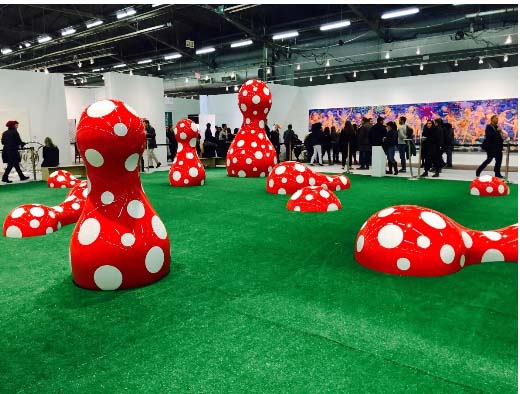
    Inspiration however is hard to find especially when you have to search for your favorite artists in over 250,000 square feet of exhibition space. Yet I persisted looking for my favorite artist Yayoi Kusama and was rewarded by seeing her characteristic polka dots in an installation called Guidepost To The New World. When I finally saw those red, funny shaped sculptures laid down on artificial grass, I felt at peace! Suddenly you fit into Kusama’s “Polka Dot” world! Kusama loves polka dots (who doesn’t?) and she goes beyond different with her artistic vision.

    Guidepost to the New World, 2016. Presented by Victoria Miro.

    Guidepost to the New World, 2016. Presented by Victoria Miro. Photo: VisionQuest Photography.

    All of this came from her hallucinations back in the day. When she first moved to New York in 1958 she wanted to become famous and gained notoriety for painting polka dots on naked people and succeeded for a while. Her works were exhibited next to Warhol, Oldenburg and Segal. Yet by the 70s, broke and destitute she placed herself in to a Tokyo Mental Hospital. After being rediscovered in the 1990s, she made a comeback and in 1996 her work was exhibited at Cooper.

    It’s ironic that her polka dots installation was exhibited the same week that archaeologists uncovered 16 limestone tablets left behind by prehistoric artists in the Abri Cellier, a cave site in France’s Vezere Valley. It’s dated to be 38,000 years old! Images of mammoths and other ancient animals were depicted on the stone by using – you guessed it – polka dots. Archeologists call this pointillism.

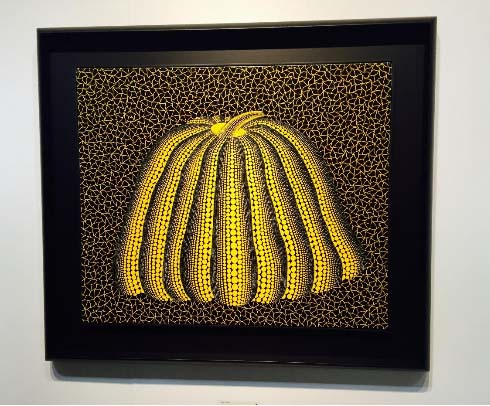
     Yayoi Kusama, Pumpkin, 1992. Acrylic on canvas 60.6 x 72.7 cm

    Yayoi Kusama, Pumpkin, 1992. Acrylic on canvas 60.6 x 72.7 cm. Photo: VisionQuest Photography.

    Kusama had an unusual take on painting pumpkins. When you look at it you get a feeling that the whole world moves around you. It’s almost like it helps us reach up to the universe. The pumpkin motif was very important in Kusama’s life as her storehouse was always full of them when she was growing up.

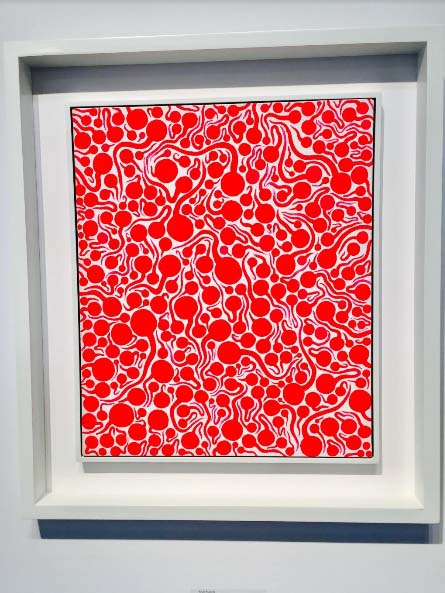
    Yayoi Kusama, Flame, 1990, Acrylic on canvas 45.5 x 38.0 cm

    Yayoi Kusama, Flame, 1990, Acrylic on canvas 45.5 x 38.0 cm. Photo: VisionQuest Photography.

    Welcome to Kusama’s world. This painting titled Flames looks like a hospital full of angry, bloody sperm. Yet, it does not bother you. You want to come into her world and see more, more of her insanity, which she beautifully exposes in art.
    All of these Yayoi Kusama art pieces presented at the Armory Show were great to see but I was surprised that they did not feature more of her better works that clearly would have stood out more. After all, in 2015, she was named one of the top 10 Living Artists. Overall the Armory Show is a marvelous annual celebration of art and creativity and should not be missed. I am looking forward to next year’s installations. There are always surprises.

    – Justyna Kostek, NY Arts


    unnamed


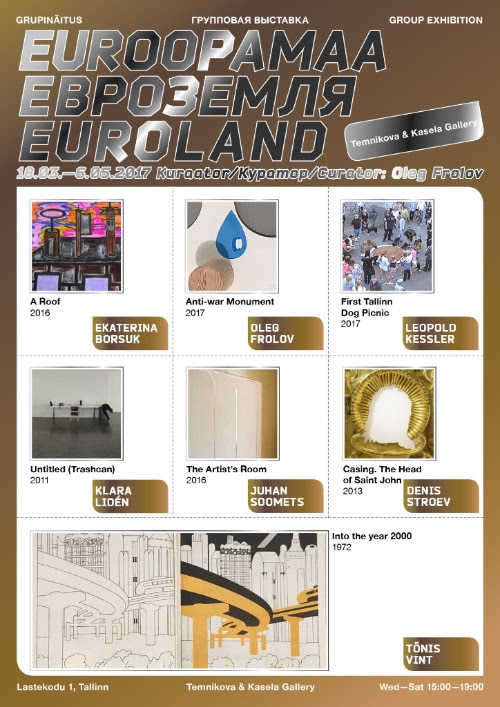
    We are glad to invite you to the opening of group exhibition “Euroland” on Saturday, 18 March at 5pm in Temnikova & Kasela Gallery, Lastekodu 1, Tallinn.

    Exhibition is on view till 6 May 2017

    “Euroland”, curated by Oleg Frolov

    Participating artists: Ekaterina Borsuk, Oleg Frolov, Leopold Kessler, Klara Lidén, Juhan Soomets, Denis Stroev, Tõnis Vint

    Graphic design by Viktor Gurov

    Anyone curious enough to look into the conditions of our present life and future possibilities will consider two equally significant questions. First, what exactly has allowed a peculiar configuration of well-functioning institutions, sustainable economic development and personal freedoms to appear in Europe in the first place and, at least rhetorically, to become a recognized standard of a good life? What are the forces that enabled the two-fold progressive leap of post-WWII democratic recovery and then, around 1989, the end of the Soviet Union’s totalitarian rule in many European states? Second, why is this desirable configuration threatened regularly and remains far from being established as a universally held goal? To address and answer these questions properly, a healthy culture of public debate assisted by social and political theorists is needed. An art exhibition may deservedly be part of such a debate because of the default and vital proximity of fine art to the process of building a society fit for life, and because art is dependent on less explicit values and conflicts and, certainly, the appearances and morphologies of its environment. Fine art’s bond with the successes and failures of building democracies in Europe is the starting position for this show.

    Art is embedded within the overall societal framework and for the last 200 plus years it has been growing as a hybrid sector, influenced by increasing popular participation in governance, better accountability of authorities, secularization of the imagination, and the introduction of methods of rational planning, but at the same time by the turmoil of city life, and more recently, the proliferation of the visual industries. The general propensity of art, as we know it today, towards critical discussion is easily understandable and goes back to the reforming and replacing of the old European monarchies with parliamentary nation states. The choice between democracy and authoritarian rule is still relevant, unfortunately, so theorizing on society and politics is still part of artistic activity. What is less clear though is how fine art’s participation, embeddedness and dependency are regarded by society at large; what roles if any are prescribed to artists; what exactly are European artists doing when they refer to societal issues and appearances. This show presents European art as a source of diverse proposals for a general discussion of democracy.

    “Euroland” is a group exhibition that features 7 European artists of different generations from Tallinn, Moscow, Berlin and Vienna, who are shown together for the first time; their works manifest profound interest in ambivalent connections, which exist between physical environment of post-WWII Europe, respective societies’ institutional frameworks and different ways of relating to and acting in it. The show creates common intellectual context to practices, which art historically may be considered to be quite apart, and also demonstrates how certain artistic methods and visual motives are shared or may complement each other.

    Presented in Estonia, a European state, which in its recent history has met several conflicting variants of development, this exhibition promotes a view of democracy as a fragile configuration of institutions, which requires an ongoing creative process of building a liveable environment and the rational and moral involvement of its citizens.


    Exhibition is supported by Cultural Endowment of Estonia.

    _____________________________________________________________
    Temnikova & Kasela
    Lastekodu 1, Tallinn, Estonia, +372 6405770, info@temnikova.ee.
    WednesdaySaturday 3-7 pm, or by appointment. Follow, like, Instagram.
    www.temnikova.ee

    Mar 17–June 11, 2017

    The formation of self and the individual’s place in a turbulent society are among the key themes reflected in the work of the artists selected for the 2017 Whitney Biennial. The exhibition includes sixty-three participants, ranging from emerging to well-established individuals and collectives working in painting, sculpture, drawing, installation, film and video, photography, activism, performance, music, and video game design.

    The Whitney Biennial is the longest running survey of contemporary art in the United States, with a history of exhibiting the most promising and influential artists and provoking lively debate. The 2017 Biennial is the Museum’s seventy-eighth in a continuous series of Annual and Biennial exhibitions initiated by Gertrude Vanderbilt Whitney in 1932. It is the first to be held in the Whitney’s downtown home at 99 Gansevoort Street, and the largest ever in terms of gallery space.

    The 2017 Whitney Biennial is co-curated by Christopher Y. Lew and Mia Locks.

    The film program is organized by Christopher Y. Lew, Mia Locks, and Aily Nash.

    Read more about the 2017 Biennial curators and advisors.


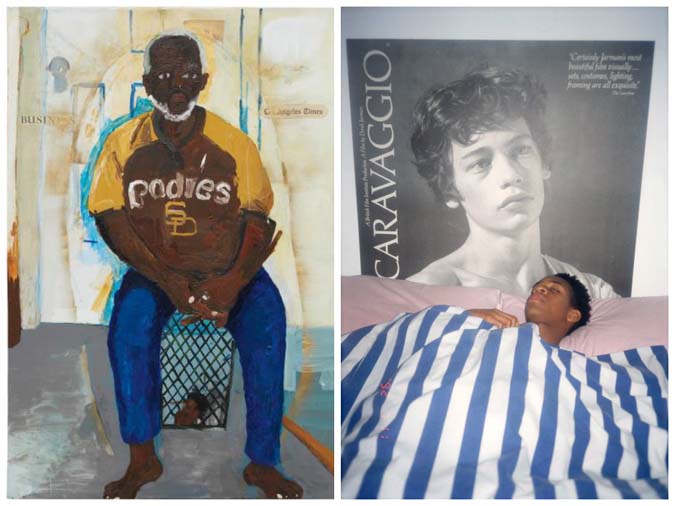
    Left, HENRY TAYLOR, “He’s Hear, and He’s Thair,” 2008 (acrylic and collage on canvas), sold for $60,000 this week at a Phillips New York auction. Among the most prominent artists participating in the biennial, Los Angeles-based Taylor’s work was on view at Blum & Poe earlier this month. At right, The work of multidisciplinary artist Lyle Ashton Harris intersects the personal and the political. A 2014 recipient of the David Driskell Prize from the High Museum of Art in Atlanta, he lives and works in New York. Shown, LYLE ASHTON HARRIS, “Lyle, London,” 1992, 2015 (Chromogenic print). | Collection of the artist; courtesy the artist.

    Left, HENRY TAYLOR, “He’s Hear, and He’s Thair,” 2008 (acrylic and collage on canvas), sold for $60,000 this week at a Phillips New York auction. Among the most prominent artists participating in the biennial, Los Angeles-based Taylor’s work was on view at Blum & Poe earlier this month. At right, The work of multidisciplinary artist Lyle Ashton Harris intersects the personal and the political. A 2014 recipient of the David Driskell Prize from the High Museum of Art in Atlanta, he lives and works in New York. Shown, LYLE ASHTON HARRIS, “Lyle, London,” 1992, 2015 (Chromogenic print). | Collection of the artist; courtesy the artist.

    2017 Biennial Artists


    The former lieutenant colonel in the Saudi Arabian army is known for his politically and socially engaged works that draw on his Muslim heritage

    The Saudi Arabian artist Abdulnasser Gharem will open his first US solo show at the Los Angeles County Museum of Art (Lacma) next month. The artist, who was until recently also a lieutenant colonel in the Saudi Arabian army, is known for his politically and socially engaged works that draw on his Muslim heritage. Abdulnasser Gharem: Pause (16 April-2 July) includes 11 works of sculpture, prints and film, all of which were created after a significant moment for the artist, when he says “the world stood still”—the 2001 attacks on the World Trade Center towers in New York, where two of the hijackers were former classmates.

    The exhibition also comes on the heels of President Trump’s revised immigration ban, which suspends entry visas to the US for citizens of six Muslim-majority countries—Iran, Somalia, Sudan, Yemen, Syria and Libya—for 90 days, with the promise of more “extreme vetting” of migrants in the future. “Some of the works reflect on what’s happening both in Saudi Arabia and in the US,”  Gharem says. “But I am not picking a side, I’m just trying to be a mirror to my society.”

    Read More

    Source: The Art Newspaper

    March 3–July 23, 2017
    Brooklyn Museum
    Morris A. and Meyer Schapiro Wing, 4th Floor

    Georgia O’Keeffe: Living Modern takes a new look at how the renowned modernist artist proclaimed her progressive, independent lifestyle through a self-crafted public persona—including her clothing and the way she posed for the camera. The exhibition expands our understanding of O’Keeffe by focusing on her wardrobe, shown for the first time alongside key paintings and photographs. It confirms and explores her determination to be in charge of how the world understood her identity and artistic values.

    In addition to selected paintings and items of clothing, the exhibition presents photographs of O’Keeffe and her homes by Alfred Stieglitz, Ansel Adams, Annie Leibovitz, Philippe Halsman, Yousuf Karsh, Cecil Beaton, Andy Warhol, Bruce Weber, Todd Webb, and others. It also includes works that entered the Brooklyn collection following O’Keeffe’s first-ever museum exhibition—held at the Brooklyn Museum in 1927.

    The exhibition is organized in sections that run from her early years, when O’Keeffe crafted a signature style of dress that dispensed with ornamentation; to her years in New York, in the 1920s and 1930s, when a black-and-white palette dominated much of her art and dress; and to her later years in New Mexico, where her art and clothing changed in response to the surrounding colors of the Southwestern landscape. The final section explores the enormous role photography played in the artist’s reinvention of herself in the Southwest, when a younger generation of photographers visited her, solidifying her status as a pioneer of modernism and as a contemporary style icon.

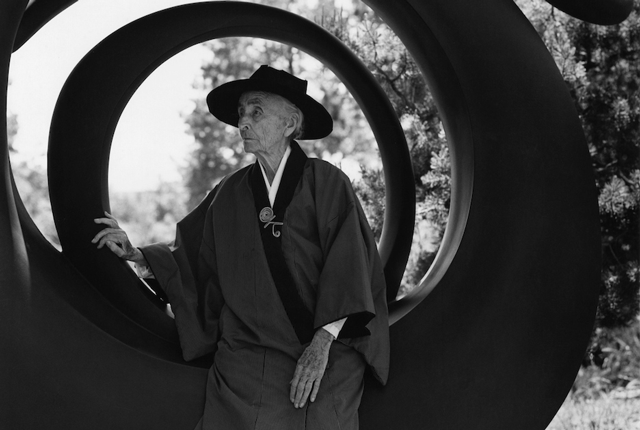
    1984 Georgia O’Keeffe portrait by Bruce Weber. Image credit: Bruce Weber and Nan Bush Collection, New York. Bruce Weber/Courtesy of the Brooklyn Museum.

    1984 Georgia O’Keeffe portrait by Bruce Weber. Image credit: Bruce Weber and Nan Bush Collection, New York. Bruce Weber/Courtesy of the Brooklyn Museum.

    Georgia O’Keeffe: Living Modern is organized by guest curator Wanda M. Corn, Robert and Ruth Halperin Professor Emerita in Art History, Stanford University, and coordinated by Lisa Small, Curator of European Painting and Sculpture, Brooklyn Museum.

    Lead sponsorship for this exhibition is provided by the Calvin Klein Family Foundation. Generous support is also provided by Anne Klein, Bank of America, the Helene Zucker Seeman Memorial Exhibition Fund, Christie’s, Almine Rech Gallery, and the Alturas Foundation. The accompanying book is supported by the Wyeth Foundation for American Art and the Carl & Marilynn Thoma Art Foundation and is published by the Brooklyn Museum in association with DelMonico Books • Prestel.

    We are grateful to the Georgia O’Keeffe Museum, whose collaborative participation made this exhibition possible.

    Georgia O’Keeffe: Living Modern is part of A Year of Yes: Reimagining Feminism at the Brooklyn Museum, a yearlong series of ten exhibitions celebrating the 10th anniversary of the Elizabeth A. Sackler Center for Feminist Art. Leadership support is provided by Elizabeth A. Sackler, the Ford Foundation, the Stavros Niarchos Foundation, Anne Klein, the Calvin Klein Family Foundation, the Institute of Museum and Library Services, Mary Jo and Ted Shen, and an anonymous donor. Generous support is also provided by Annette Blum, the Taylor Foundation, the Antonia and Vladimer Kulaev Cultural Heritage Fund, Beth Dozoretz, The Cowles Charitable Trust, and Almine Rech Gallery.

    Brooklyn Museum
    200 Eastern Parkway
    Brooklyn, New York 11238-6052


    Courtesy of the Brooklyn Museum – Press Release. Copyright ©2017 the Brooklyn Museum.

    By Xiaoyun Helen Zhang

    Art is only one of the multiple venerated idols in the grand Temple of Human Minds. We concern the power of art transcending borders of vital importance to the Ultimate Question: Can people understand art between cultures, over diversified barriers of faith, aesthetics, wealth and ideology? To be more precise, how could an ordinary American, born and live in a free and developed country, really understand the ideas of a contemporary Chinese artist who breathe post-totalitarian air and witnessed a fast social progress never seen in human history?

    Some would say “Yes!” and put Ai Weiwei up on the table. Why was it that Ai’s artistic creations were widely accepted in the Western Hemisphere while other Chinese artists struggled for entrance into international views? The answer was seemingly quite obvious: Ai Weiwei deals with international themes using international forms. The forms he adopted and themes he discussed are both easy-to-get: he employed performance, sculpture, among other popular expressive methods to deal with the universal theme of “oppression and anti-oppression”. In short, his creative fight is a common struggle, which just happened to happen in a Chinese context.

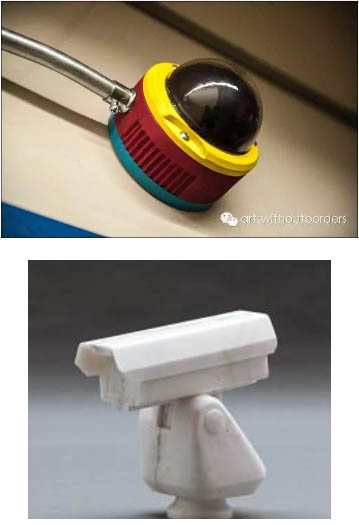
    My experience of starting with familiar themes happened in our first show SINAMERICA I, back in 2015, which attempted to introduce emerging Chinese Artists living in New York to U.S Audience. The enthusiasm of being noticed was high among this community consisting more than 300 young talents. We spend extra time to go through a huge number of submitted works before deciding which to be put on stage. The standard I had in mind was simple and clear: we must start with something that international viewers would love to see most. So Jin Yu’s fantastic fake monitors were presented on the final version of the show. The talented young Chinese female artist’s devices were placed on hidden-yet-still-obvious places around the gallery (especially including lady’s restroom) to remind people of the existence of a technocratic post-totalitarian surveillance, in a relatively nifty tune. This on-site sculpture art piece can be seen as a cute echo of Ai Weiwei’s white marble camera. This kind of art is naturally universal, speaking both mean and end. Jin Yu’s work of less seriousness and equal meaningfulness won quick comprehension among the general audience at the opening night.
     

    Untitled-2

    Skipping the Ai Weiwei style, more sophisticated and yet equally successful artists such as Zhang Xiaogang could present his opinions and feelings on China’s mix of pre-modernity and post-modernity in a more delicate way, which requires slightly more effort to be understood. Zhang Xiaogang’s Bloodline-Family series are, as critics described, about Chinese Face, Chinese Family and Chinese History during the last 70 years. Yet the themes Zhang Xiaogang treated could still generate enough universal consonance among the generation of the Cold War. Bloodline-Family series still very much concentrated on the personal experience in an oppressed society. His Tian’anmen series, however, are of less subtlety (though still much more delicate than Ai Weiwei’s treatment on the subject), which satiric nature requires minimum effort in interpretation.
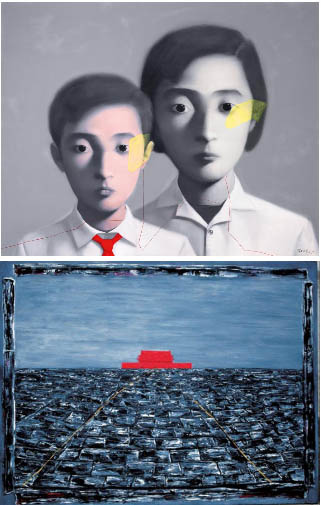
    Zhang Xiaogang’s subtle yet still obvious references

    Zhang Xiaogang’s subtle yet still obvious references

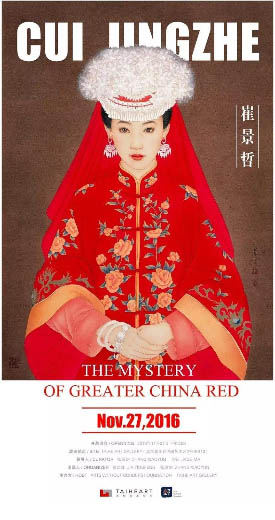
    Arts like this are easy to read, or say, naturally universal, especially when the theme and figure presented are concrete and stereotypical: landmarks, facial expressions, or simply pretty girls (laugh). All you need is to present it and let the Wow begin. In our most recent exhibition, the Mystery of Greater China Red, I introduced Cui Jinzhe’s resurrection of China’s classic lady painting. His works already have an established status in international market, especially Russia and Middle-East. His forwarding artistic intention has won him universal appreciation, by putting attractive Far-East femininity in iconic Chinese red bridals. And that’s all you need for introducing further the heritage skill of Gongbi he applied on these vivid eye candies, a fine brushwork style in Chinese Water-and-Ink painting, which requires unspeakable efforts on meticulous details.
    Untitled-1

    Things can be bit more complicated when it comes to less universal art skills presenting less universal themes, especially when Traditions became a more important player among all. It is almost impossible for young people of the West to widely appreciate manuscript drawings from Medieval Europe; how would you even expect to directly introduce Classical Chinese Art, which came down from the same time period, into their modern consumerist minds? In comparison to Ai Weiwei and Zhang Xiaogang, who both fall in the category of Contemporary Art, how could we make more peaceful and inward artworks of long inheritance? Such are the challenges facing international curators, whose re-interpretation process could be just as important as the original works. So, to my fellow curators and curators-to-be, I intend to list some helpful tips. So read carefully:

    A recent exemplary re-interpretation of mine would be: How to introduce Shanshui (Mountain-and-Water painting), a historic category of Chinese Art, to the general public in New York? Traditional Shanshui could prove difficult at keeping Viewer’s Attention for more than 5 seconds (the necessary human gazing time before fall in love with each other), so we the Art without Borders started by presenting a modern metamorphosis of it first, as the young second-generation artist Chen Baoyang digitalized his father’s famous Shanshui masterpieces and printed the recalculated version of them on 4×4 inch canvas, creating a rather eye-candy like attraction to mediocre eyes. Hence his father, Chen Xiangxun’s traditional works were better noticed as viewers approach to savor the difference. This present-past bridging attempt was done in our recent exhibition of X-ATRAMENTVM II, which achieved great acceptance among viewers from different culture backgrounds.
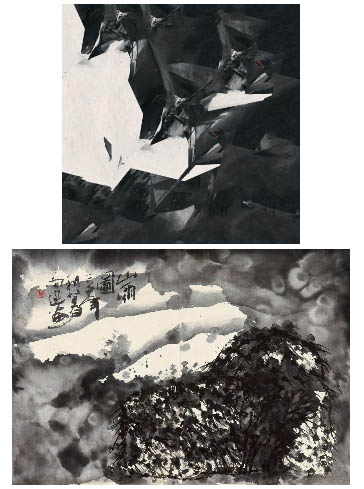
    Chen Baoyang’s digital reprint is the doorway into his father’s artistic legacy

    Chen Baoyang’s digital reprint is the doorway into his father’s artistic legacy

    Chen Baoyang’s creative methods were much like Xu Bing’s. Xu Bing’s signature, the retro-engineering of Chinese hieroglyphs mixed with Latin Letters, took the art of Chinese Calligraphy to a whole new level. As traditional Mountain-and-Water images were revived by state-of-the-art programming, Xu Bing reorganized English letters and words into traditional Chinese characters. Hence similarly, referencing Xu Bing’s imaginative characters could be an effective way to generate substantial interest while introducing the much more traditional art of calligraphy.
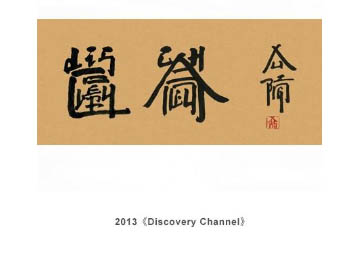
    Untitled-1

    Another exampling work done by Arts without Borders is in our Chinese Renaissance Series. While representing older forms of traditional painting skills, we intentionally selected Duan Gexin’s water-and-ink cartoon to introduce younger international crowd into appreciating the ancient skills of water-and-ink. The methodology is obvious: aim for recent contents done by good old skills. So here comes the first tip of transnational exchange in art: choose a bridging device between here and there, that is, to use intermediary art works when crossing culture barriers of Time.
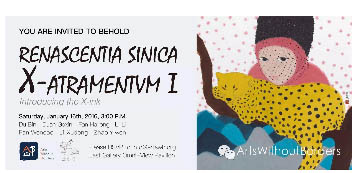
    Artist Duan Gexin, using traditional skills on cute comic figures

    Artist Duan Gexin, using traditional skills on cute comic figures

    However, when without the kind support of these culture hybrids as reference, some ancient artistic concepts could be confounding: such as the Jinling School, a major painting style discovered by a group of artists living in the city of Nanjing back in 17th Century. Art History is already a boring selective because of too many types, genres and methods, so why bother introducing them like a babbling professor? Here is the thought I had when I decided to name the serial shows presenting new masters of this prominent category using Latin, as the SCHOLA NANKINENSIS. Who understands it? No one, yet it draws much more attention than simply going with long subheading of “introductory expo about an important Chinese Traditional Art Genre”. SCHOLA NANKINENSIS. Yes, as if you were discovering the art as Matteo Ricci, 17th century missionary to China, a rather proper perspective I want for my western viewers to impersonate. Similar efforts were done in order to ensure consistency in Time and Ideas, while translating other terms implying ancient arts in our serial shows. So here is the second tip, when dealing with major leaps in Time with no good bridging artworks at hand, try to pair a sense of contemporariness in your translation efforts.
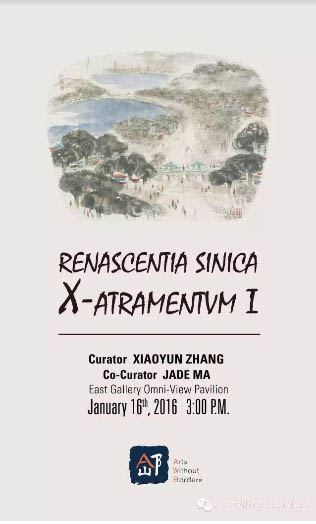
    Untitled-1

    A third tip I want to share with you is not a trick, but a feeling. As we were doing Shi-Cha, an opposite show of SINAMERICA I (Chinese Emerging Artists living in New York) dealing with Western Emerging Artists living in Beijing, I discover that the most cross-culture communicable experience comes from these young motivators of art, as they transform ordinary touches into inventive expressions. They actually share feelings of surprising similarity: foreignness because of distance and inadvertently a strong desire for homogeneity: A Chinese girl employed bed sheets as substitute for rice paper to write down her wildest dreams in calligraphy while a British painted his figurative diary on Chinese flowery table clothes. These are spontaneous artworks which provided a quasi-anthropological way of introspections. As we are relocated on Time Zones, we are also departed from our Culture Safe Zones. The only things we hang onto by instinct are the ordinary pieces in everyone’s life and ordinary emotions sharable by all. In a sense, common and basic feelings are the last and most important method all curators should be counting onto facing multicultural viewers: love, sadness, fantasies and a sense of loss.
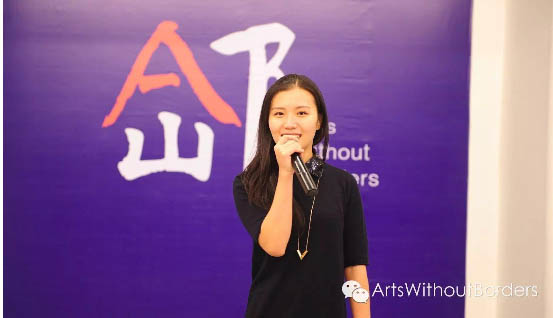
    Xiaoyun Helen Zhang, curator on site
    Xiaoyun Helen Zhang, curator on site

    Vik Muniz
    Epistemes
    February 23 – April 1, 2017

    Sikkema Jenkins & Co. is pleased to present Epistemes, a solo show of new work by Vik Muniz. The exhibition – which premieres the artist’s new series Handmade in the United States – will be on view at the gallery from February 23 through April 1, 2017.Best known for his re-creations of iconic images from visual culture made using nontraditional materials and recorded with a camera, Muniz here strips the work of representational imagery, in a direct exploration of the illusionist strategies and material processes that he has developed over the course of his career. As Muniz explains, “It’s like a menu of the ideas that I’ve drawn on, a compendium of strategies exposed in a very simple way.”

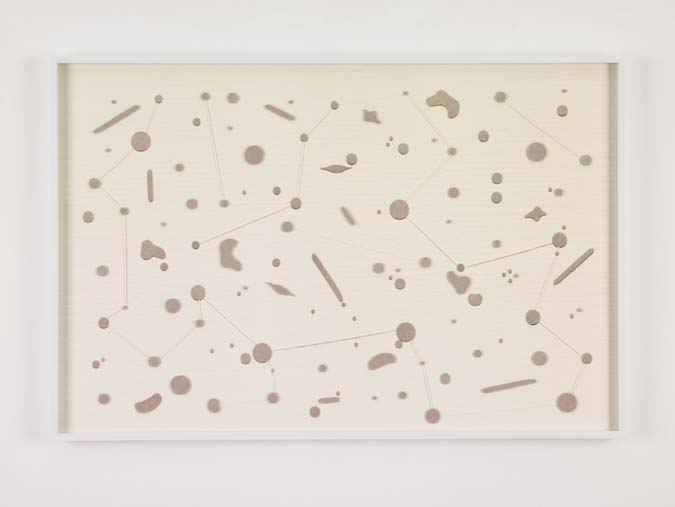
     Galaxy, Handmade, 2016 Mixed media 38.5 x 58 inches (97.8 x 147.3 cm), framed Unique


    Galaxy, Handmade, 2016
    Mixed media
    38.5 x 58 inches (97.8 x 147.3 cm), framed
    Unique

    These new works combine the material object and photographic trompe l’oeil into a unified abstract composition. Commenting on the confounding image-object relationship probed within these works, Muniz observes, “It always goes both ways. What you expect to be a photo isn’t, and what you expect to be an object is a photographic image.” Extending this idea more broadly, Muniz adds, “In a time when everything’s reproducible, the difference between the artwork and its image is all but nonexistent.”

    While not referencing specific artistic antecedents in Handmade, Muniz’s vocabulary draws connections to abstract art movements including concrete art, constructivism, and op art.
    The exhibition’s title is taken from the philosophical term épistème, which Michel Foucault introduced in his book The Order of Things and refers to the implicit structures that set the conditions for the production of scientific knowledge in a given time and place.
    Vik Muniz was born in 1961, in São Paulo, Brazil and he currently lives and works in New York and Rio de Janeiro. His work has been exhibited in prestigious institutions worldwide with recent solo exhibitions at the Eskenazi Museum of Art at Indiana University, Bloomington, Indiana; High Museum of Art, Atlanta; and Mauritshuis, The Hague, Netherlands (all 2016). His work is included in the collections of major international museums such as: Art Institute of Chicago, Chicago; Los Angeles Museum of Contemporary Art, Los Angeles; The J. Paul Getty Museum, Los Angeles; the Metropolitan Museum of Art, New York; Museum of Modern Art, New York; Museu de Arte Moderna de São Paulo, São Paulo; and the Victoria and Albert Museum, London; among many others.

    Muniz is involved in social projects that use art-making as a force for change. In 2010 his work with a group of catadores – pickers of recyclable materials – was the subject of the Academy Award nominated documentary film Waste Land. In recognition of his contributions to education and social development including his work with the catadores, he was named a UNESCO Goodwill Ambassador in 2011. More recently, he opened Escola Vidigal, offering preschool and afterschool programs in art, design and technology to children 4 to 8 years old at the favela Vidigal in Rio de Janeiro.


    Courtesy of Sikkema Jenkins & Co., New York