• PATRICK JACOBS
    Come Closer to Me
    16 Jan – 15 Feb
    Gallery 1 and 2
    Opening Reception:
    Friday, 16 January, 2015.  7-9pm
    Catalogue available

    Press Release

    We are pleased to present Patrick Jacobs’ third one-person exhibition at Pierogi, taking its title – “Come Closer to Me” – from Whitman’s Leaves of Grass, and featuring sculpture, printmaking, and a room-sized installation. Jacobs investigates space, scale, and perception of reality, while working across media. Drawing inspiration from nature, historical landscape painting, popular home and garden culture, and the supernatural, he sets up contexts with inherent internal contradictions.

    A conflicting atmosphere of bliss and discontentment reigns in the empire of weeds. “Behold these spiny stalks and toothy leaves,” declare the herbaceous brood in a post-emergent flamboyance, “Look on our caps and laurel crowns of seeds!” But the longing for love and happiness comingles with an unbearable anxiety and fear of loneliness. Fibrous tissues, cords and membranes swell with perverse desires while tendrils, felted pink with webbed mycelia ache for meaningful intimacy. All that remains is an impenetrable and melancholy silence.  –Jacobs, 2014

    Black and white prints of fungal rings found in grass lawns are displayed in the gallery’s front space. Employing the traditional copper plate etching process over the past year and a half, in collaboration with master printer, Dan Waller, Jacobs has carefully rendered some, while allowing others to evolve through chance or accident. Consisting of quivering lines and dots and subtle tonal variations, many evoke microbial structures or nebulous clouds of cosmic dust.

    In the main gallery, slime molds, dandelions, stinkhorns, and a pink forest count among the subjects observed through small circular windows of warped glass embedded in the gallery’s walls. Depicted in miniature dioramas, they are both a part of and at odds with their meticulously constructed surroundings.

    A stretched and compressed view of the artist’s Brooklyn apartment dominates the rear space of the gallery, morphing the real and the imaginary. Gallery walls are partially torn away to reveal multiple vantage points, fracturing the pictorial plane. A bay of windows provides a fictional bird’s eye-view of an idealized, although improbably foreshortened and attenuated, Gowanus Heights. Constructed from disparate materials including lichen, industrial expansion foam, paper maché, cardboard, glue, and paint, this installation works to expose the recesses of the subconscious mind, as well as the hopes and desires lying just beyond our grasp.

    Of this work, Gregory Volk writes, “…[c]onflating inside and outside space, nearness and distances, architecture and nature, a domestic setting and the vast world, contemporaneity and an immense scale of time, this is a risky, breathtaking work, and the apartment seems like a time-travelling capsule of sorts, visiting ‘remote pasts’ as Robert Smithson once wrote, and also, perhaps, ‘remote futures’ long after this current city has changed.”

    Patrick Jacobs’ work has been included in numerous exhibitions including “Journey Forth: Contemporary Landscape Between Technology and Tradition” (Museum of Art and History, Santa Cruz, CA); “American Dreamers: Facing or Escaping Reality in Contemporary Art” (Centro di Cultura Contemporanea Strozzina, Florence, Italy); and “Otherworldy: Optical Delusions and Small Realities” (Museum of Arts and Design, NY, NY). He has received awards and residencies from the Pollock-Krasner Foundation, Vermont Studio Center, New York Foundation for the Arts, and Bad Wiesse. He received an MFA from the Art Institute of Chicago and studied at the University of Klagenfurt, Austria.

    Pierogi

    Hours

    11am to 6pm, Tuesday through Sunday and by appointment

    Location

    177 North 9th Street Brooklyn, NY 11211

    Contact

    T: 718.599.2144
    E: info@pierogi2000.com

    Kristina Nazarevskaia

    More Articles by This Author

    New dates for Art Basel Hong Kong, 2015 sure to cause some galleries to choose their March art fair platform.

    This just in. The art fair organizers just announced that starting next year the newly hatched Hong Kong outlet of the global Art Basel brand is switching its run dates from mid June to mid March. The fair will now run almost concurrently to The Armory Show and the ADAA: The Art Show in New York City and since the two fairs share a substantial portion of top exhibitors this will surely cause headache to more than one gallerist. If the Armory Art week in New York generally runs the second weekend in March, ending some time around the 8th or 9th, and the Hong Kong fair launching on March 13th, this means that the New York – Hong Kong flights will suddenly become much more in demand with collectors, advisors, gallery staff, critics, media jetting off to make the next event.

    This may also be a deciding factor for many galleries when choosing which platform to participate in this very busy March art season. Besides the physical time required to get from one side of the globe to another there is also the massive logistical issues involved in attending both fairs so close together. Art has to be selected, curated, installation designed. Paintings, sculptures, installations have to be transported to the fair, cleared customs, delivered to the art fair itself, installed and the gallery staff in place to face the collectors.

    So international art galleries that participate in any of the New York March art fairs are going to have to either scramble and make both appearances, or pick and chose which one they want to be a part of. Doesn’t make much economic sense unless the organizers of the Art Basel Hong Kong fair are keen on keeping a very regional focus allowing Asian galleries first access to collectors.

    New dates are as follows:

    Preview (by invitation): Friday evening, March 13, and all day Saturday, March 14, 2015
    Public Show Dates: Sunday, March 15 to Tuesday, March 17, 2015

    “The second edition of Art Basel in Hong Kong, Lead Partner UBS, will take place from May 15 to 18, 2014 at the Hong Kong Convention and Exhibition Center. The show will present 245 of the leading galleries from Asia, Europe, the Americas and the rest of the world and more than 3,000 artists, ranging from young emerging artists to the Modern masters from both Asia and the West. 50 percent of galleries presented at the show have exhibition spaces in Asia and the Asia-Pacific region, showcasing a strong combination of high-quality works from the East and the West and underscoring Art Basel’s commitment to the region. The main sector, Galleries, presents premier established galleries from across the world, while Insights is dedicated to presenting precise contextual and thematic presentations by artists from across the art scenes in Asia and the Asia-Pacific. The Discoveries sector provides a platform for younger galleries and Encounters shows large-scale sculptural installations by leading artists from around the world. The show will include for the first time a Film sector, curated by Li Zhenhua, and hosted in collaboration with the Hong Kong Arts Centre. The show will be accompanied by strong public programming, including Art Basel’s popular talks programs, Conversations and Salon. Additionally, collaborations with local and international partners will ensure a diverse range of arts programming, with hundreds of cultural events hosted across the city throughout the week. ” – Art Basel Hong Kong.

    This article ©galleryIntell.

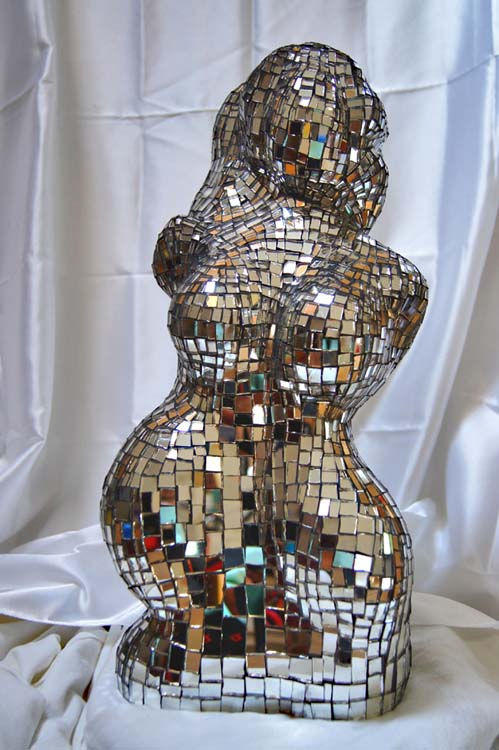
    Artist: Manuella Muerner Marioni Title: Courtesy of Jadelynn Medium: Mixed-Media Sculpture (Mirror Sculpture) Size: 20.5 x 8.65 x 12.5 inches (Height x Width x Depth) Year: 2013

    Manuella Muerner Marioni
    Courtesy of Jadelynn
    Mixed-Media Sculpture (Mirror Sculpture)
    20.5 x 8.65 x 12.5 inches (Height x Width x Depth), 2013

    Through my work I want to break out of the rigid social order, create tensions and to bring about a vivid confrontation with the  issues of “form, light and colors”. My fascination has always been the play of light in the crystals, in the water, and especially the
    light fraction of sunlight through the prism.

    From dead to life! Pure matter to bring to life through specific perceptual effects. For me as an artist, a great challenge. I want to raise not only my work in the center. The surroundings and
    environment of my beholders should become a part in my artwork. All these details have to give a contribution to the totality of the artwork. How can you represent that?

    With three-dimensional sculptures, covered with mirror pieces, which reflect a confrontation with the sculpture and surroundings. Each individual mirror fragment I cut by hand with a diamond cutter.

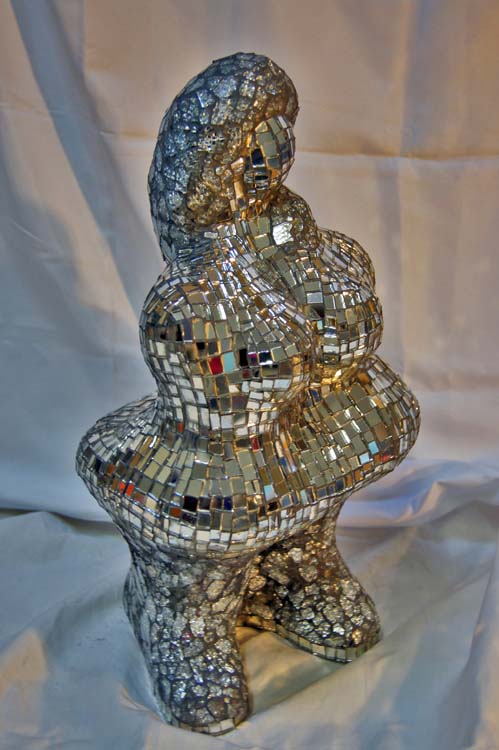
    Artist: Manuella Muerner Marioni Title: Alice Medium: Mixed-Media Sculpture (Mirror Sculpture) Size: 18.50 x 11.50 x 7.90 inches (Height x Width x Depth) Year: 2014

    Manuella Muerner Marioni
    Alice
    Mixed-Media Sculpture (Mirror Sculpture)
     18.50 x 11.50 x 7.90 inches (Height x Width x Depth), 2014

    The perceived image of my sculptures changes every time when I move to a new location or when I change my perspective. Even my clothes are scattered reflected back. My sculptures convey the mystery of a never-ending visual experience.

    – Manuella Muerner-Marioni April 2011

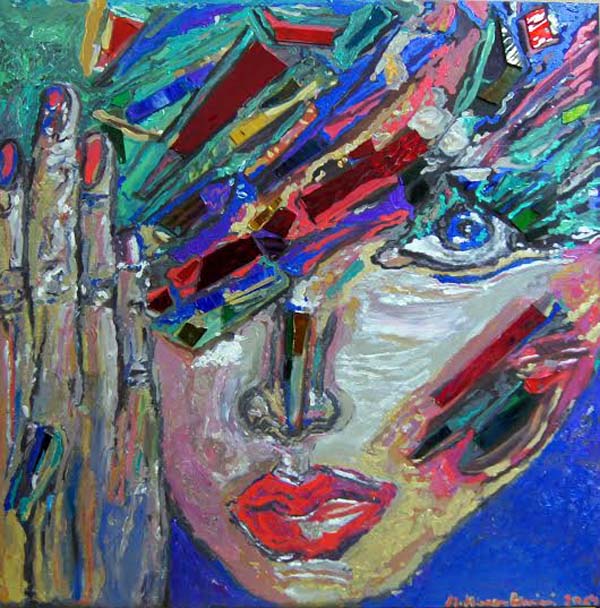
    Artist: Manuella Muerner Marioni Title: Spectrum Art Face Medium: Acrylic with Spectrum glass Fragments on Canvas Size: 35.45 x 35.45 x 2 inches (Height x Width x Depth) Year: 2014 This Painting disappeared at the Art Hamptons 2014, at Booth 414 !!!!!

    Artist: Manuella Muerner Marioni
    Title: Spectrum Art Face
    Medium: Acrylic with Spectrum glass Fragments on Canvas
    Size: 35.45 x 35.45 x 2 inches (Height x Width x Depth)
    Year: 2014
    This Painting disappeared at the Art Hamptons 2014, at Booth 414 !!!!!

    Manuella Muerner Marioni was born on March 23, 1964 in Thun, Switzerland. She studied Fine Arts and Fashion Design at the new Kunstschule Zurich/Switzerland. Travelling to cities and foreign countries such as Vienna, Lisbon or Paris, Spain,
    South America and the USA, she continuously widened her artistic horizon. Niki de St. Phalle was her personal teacher and friend who accompanied her artistically for a very long time. In the meanwhile, her style has been successfully recognized
    worldwide.
    Manuella Muerner Marioni ́s art tries to break out of rigid social structures and to create a tension in the viewers. The viewers are encouraged to emerge into a lively discussion with form and colour. Her paintings are to be understood as a supplement or even as an additional
    interpretation of her sculptures: Snippets of mirror are glued on her sculptures that reflect the environment and the light in a broken way. They are glued in such a manner so as to reflect also each other. Thus a kaleidoscope of colours and forms is created, an extract of reflected reality which is immediately distorted and which appears to say that all things are relative: A viewer can see himself as an extract of
    the world, but he cannot view himself completely and in the next snippet he looks different again. The relativity of human perception has become the subject matter of the work: What is reality, what is deception?
    In her paintings now, Manuella Muerner Marioni repeats these experiences on a two dimensional level. There, she hides fragments of social symbols and signs and lets them overlap with naturally round and cragged shapes on amorphous- abstract
    bodies. Her bodies imitate the character of glass and stand for the fragile, vulnerable in a human being, which feels exposed to the environment. Light and thought change the perception. Solid things seem to be transparent; some illusions and therefore transparent things become shapes through colour. Colours and contexts appear relative to the illuminations that shine from outside on the painting. This relativity is evoked also within the painting through the choice of the colour palette, which characterise the amorphous bodies and thus elevate them from the
    environment.
    Despite her concentration on colours, structures, light and the material, the thematic relationship between art and society is what matters to her a priori. All her artworks deal with socio critical topics and thus try to approach reality from a multi-perspective.

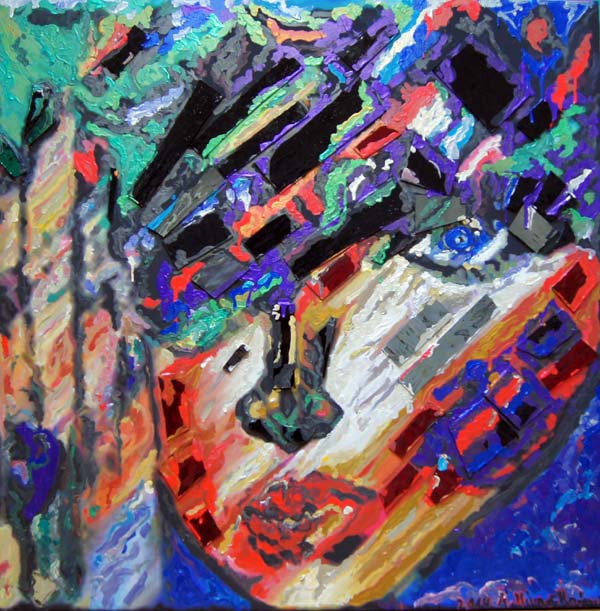
    Artist: Manuella Muerner Marioni Title: Spectrum Art Face Dark Medium: Acrylic with Spectrum glass Fragments on Canvas Size: 35.45 x 35.45 x 2 inches (Height x Width x Depth) Year: 2014 This Painting disappeared at the Art Hamptons 2014, at Booth 414 !!!!!

    Artist: Manuella Muerner Marioni
    Title: Spectrum Art Face Dark
    Medium: Acrylic with Spectrum glass Fragments on Canvas
    Size: 35.45 x 35.45 x 2 inches (Height x Width x Depth)
    Year: 2014
    This Painting disappeared at the Art Hamptons 2014, at Booth 414 !!!!!

    Manuella Muerner Marioni

    arte-manuella
    manuella muerner marioni
    hub 7
    CH-3203 muehleberg
    SWITZERLAND
     

    ARTE-MANUELLA

     
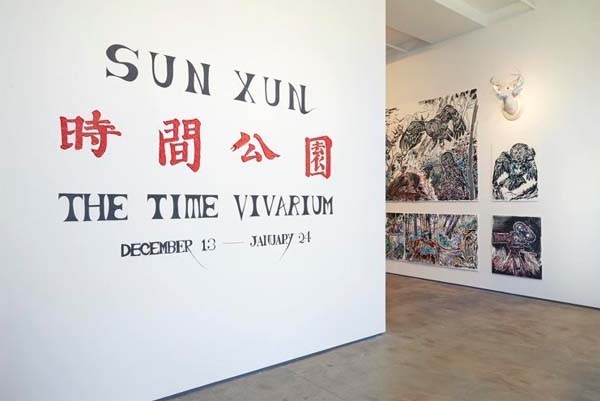
    SUN XUN, Installation view of The Time Vivarium at Sean Kelly, New York December 13, 2014 - January 24, 2015. Photography: Jason Wyche, New York. Courtesy: Sean Kelly, New York

    SUN XUN, Installation view of The Time Vivarium at Sean Kelly, New York December 13, 2014 – January 24, 2015. Photography: Jason Wyche, New York. Courtesy: Sean Kelly, New York


    Sun Xun, The Time Vivarium at Sean Kelly
    December 13, 2014 through January 24, 2015
    Press Release

    Sean Kelly is pleased to announce The Time Vivarium, an exhibition in two stages by Chinese artist Sun Xun. This will be the artist’s first exhibition at the gallery and his first solo exhibition in New York since 2009. An opening reception will take place on Friday, December 12th from 6 to 8 p.m. The artist will be present.

    In the first phase of the exhibition, Sun Xun will display a new series of richly colored, dynamic large-scale paintings, murals and a painted Chinese folding album. Throughout the month of December, the artist and his assistants will be in residence at the gallery creating new work — murals, drawings and paintings — that will transform and extend the initial exhibition. During this time, visitors will have a rare behind-the-scenes opportunity to experience the daily activities of the artist and his transplanted animation studio developing a new film work in progress. Questions and dialogue with the artist will be encouraged.

    Drawing on his father’s recollections of living through China’s Cultural Revolution, his own experiences as a modern Chinese citizen and his interactions with people during the show, Sun Xun hopes visitors to the exhibition will discover a different point of view regarding China’s complex history. The concept grew out of Sun Xun’s preoccupation with global history, culture and politics. He is especially interested in the way historical events are perceived and remembered by ordinary citizens versus how they are officially presented by public agencies and the media. Sun Xun’s work addresses these ideas in a symbolic and surrealist way, often choosing to use animals and insects as the main characters of the story instead of people.

    The title, The Time Vivarium, was inspired by a recent visit to the American Museum of Natural History’s exhibition halls. Sun Xun was struck by the idea that official Chinese accounts of the past have many parallels to the dioramas in the Natural History Museum. The exhibits, like state history, are designed with a socio-political agenda, heavily influencing notions of cultural identity. Unlike the dioramas in the museum, The Time Vivarium will by definition be “a place of life”.

    The work Sun Xun will make whilst in the gallery, combined with thousands of images produced in the six months prior, will be filmed sequentially — culminating in an expressionistic, stop-motion animated film, pulsating with creative energy. On completion of the film in early January, the second phase of the exhibition will begin with a complete reinstallation of the galleries transforming it into a theater space. The film will simultaneously be shown through four synchronized projectors onto the main gallery walls and will fill the space with an extraordinary sensorium of color, light, music and sound. The newly created artworks and the film will be on view through January 24.

    Sun Xun studied printmaking at the China Academy of Fine Arts, and founded Pi animation studio in 2006. In 2010 he was awarded the Best Young Artists award by the CCAA, the Young Art Award by Taiwan Contemporary Art Link and the Arts Fellowship by Citivella Ranieri Foundation (Italy).

    Sun Xun has held multiple solo exhibitions around the world, most notably at the Hammer Museum, Los Angeles; The Hayward Gallery, London; The Drawing Center, New York; the Kunsthaus Baselland, Basel; the A4 Contemporary Arts Centre, Chengdu; the Minsheng Art Museum, Shanghai; and the Louis Vuitton Taipei Maison, Taipei. He has most recently exhibited his work at the Metropolitan Museum of Art, New York; the Shanghai Biennale, Shanghai; and The Vancouver Art Gallery, Vancouver. His films have been screened at numerous festivals worldwide, including, the 25th Torino Film Festival, Torino; the 8th Seoul International Film Festival, Seoul; the 53rd International Short Film Festival, Oberhausen; and the MECAL International Short Film Festival, Barcelona.

    http://www.skny.com
    Gallery hours are Tuesday through Friday from 11am until 6pm and Saturday 10am until 6pm.

    Artists for Artists
    51st Anniversary Exhibition to Benefit the Foundation for Contemporary Arts

    December 13, 2014 – January 10, 2015
    Matthew Marks Gallery
    526 W 22 Street

    Press Release

    Matthew Marks is pleased to announce Artists for Artists: 51st Anniversary Exhibition to Benefit the Foundation for Contemporary Arts, the next exhibition in his gallery at 526 West 22nd Street. This will be the Foundation for Contemporary Arts’ fourteenth benefit exhibition. Organized by Brooke Alexander, Cecily Brown, Robert Gober, Anne Dias Griffin, Agnes Gund, Jasper Johns, Julian Lethbridge, Glenn Ligon, Kara Walker, and T. J. Wilcox, Artists for Artists will raise funds for the Foundation’s grants to artists.

    The Foundation for Contemporary Performance Arts was established in 1963 when John Cage (1912–92) and Jasper Johns joined together to organize a benefit exhibition in support of their friends and colleagues in the performance arts. Sixty-seven artists contributed to this landmark show; with proceeds from the exhibition, the Foundation began making grants to performing artists. Now known as the Foundation for Contemporary Arts, it remains fifty-one years later the only institution of its kind, created by artists to benefit artists.

    The exhibition is comprised of forty-three artworks by Ai Weiwei, Stephen Andrews, Cecily Brown, Lucinda Childs, Cynthia Daignault, Walton Ford, Mark Thomas Gibson, Liam Gillick, Robert Gober, Guyton\Walker, Rachel Harrison, Jasper Johns, Jennie C. Jones, Kim Jones, Ellsworth Kelly, Anselm Kiefer, Jeff Koons, Julian Lethbridge, Glenn Ligon, Julie Mehretu, Kate Millett, Meredith Monk, Sophy Naess, Ken Okiishi, Elizabeth Peyton, Seth Price, Steve Reich, Clifford Ross, Ed Ruscha, Amy Sillman, Lorna Simpson, Josh Smith, Rudolf Stingel, Emily Sundblad, Ena Swansea, Sarah Sze, Kara Walker, Pae White, and T. J. Wilcox. The artists have generously donated the artworks on view to benefit FCA’s grant programs.

    A fully illustrated catalogue accompanies the exhibition.

    Artists for Artists will be on view from December 13 to January 10, 2015, Tuesday through Saturday, 10:00 AM to 6:00 PM.

    About the Foundation for Contemporary Arts
    The Foundation’s mission is to encourage, sponsor, and promote innovative work in the arts created and presented by individuals, groups, and organizations. Its legacy continues today with unrestricted, by-nomination grants supporting pioneering work across the fields of dance, music/sound, performance art/theater, poetry, and the visual arts. In addition to vital financial assistance, grantees receive the inestimable encouragement that comes with recognition by their peers. A fund is also maintained to assist artists with emergencies and unexpected opportunities related to their work.

    www.matthewmarks.com

    By Jerry Saltz for Vulture, Dec. 12, 2014

    “Forever Now: Contemporary Painting in an Atemporal World” at the Museum of Modern Art arrives, curated by Laura Hoptman, at a moment when painting is in an astonishingly conflicted but promising abysm of wakefulness. A group show about this stirring medium, at this moment and in the very House of Modernism, sends shock waves through the art world — anointing artists, starting arguments, performing operatically contested desires and new standards. It’s the kind of thing that friends stop being friends over. Or that’s what shows like “Forever Now” used to be — when time moved slower, information wasn’t instantly accessible everywhere at once, museums were codifiers and curators defending their absolute power positively, or ridiculously. I’m not nostalgic for the dreaded age of curator-bullies, and now that galleries and biennials do most of the codifying, I love that museums have the luxury of time to sift through things rather than react to every twist of aesthetic fate (although too many museums are trying to be like galleries — more on that later). “Forever Now” is handsome, professional, well intentioned, and has moments that take the breath away. I’m a fan and was an early advocate of a third of its 17 artists. Yet, overall, “Forever Now” doesn’t capture enough of painting’s pangs, conflict, promise, or current astonishment at its position. Most of all, with a handful of exceptions, the show fails to make a case for the exceptional quality, or truly new character, of contemporary painting; For long stretches, it instead settles for showcasing its ubiquitous presence. If MoMA is the Ferrari of Modernist museums, “Forever Now” is driving it like a Prius: something made to have minimum impact on the environment while making people feel okay about something troubling.

    How did this happen? Hoptman is nobody’s fool. Highly admired, even loved in the art world, she is a lucid thinker and writer and has long been a remarkably perceptive curator, among the first proponents of early-1990s artists like John Currin, Luc Tuymans, Elizabeth Peyton, Gabriel Orozco, and Chris Ofili. I count myself lucky to call her a friend and to have known her for more than 25 years. The roster of artists she has chosen is revealing. Thirteen of the artists in “Forever Now” are American; all but one of the rest are from Germany. Age-wise, there’s a 30-year spread with Amy Sillman being almost 60 and Oscar Murillo nearly 30. This is not a show to define a generation, since the artists are not of a generation as that term has typically been used. Instead, they are all participants in a cultural moment, in which painting has come to reign supreme, defined by virtuosic newness, of course, but more and more by the basic stylistic sameness valued by the art market and the art fair in particular. To those in the art world, the list of included artists will seem familiar, almost a lineup of acceptable artists and market darlings, many of whom are represented by major spaces or megagalleries like David Zwirner, Hauser & Wirth, and Marian Goodman. (Although a few do not fall into this category.) Many have had museum retrospectives. It’s not the fault of the curator, but most of these artists already fetch enormous prices — some in the millions of dollars — for their work. Indeed, the show’s opening found dealers and art advisers parked in front of artist’s work taking sales orders, as if at an art fair.
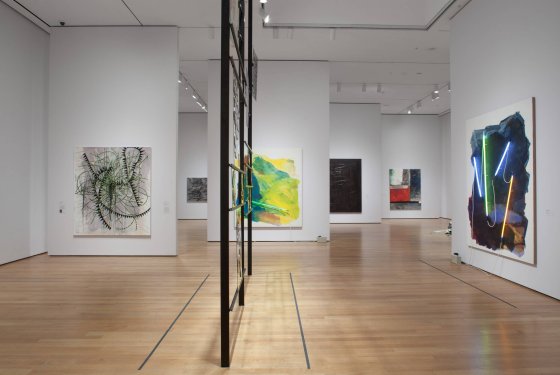
    "The Forever Now: Contemporary Painting in an Atemporal World." John Wronn/© 2014 MoMA, N.Y.

    “The Forever Now: Contemporary Painting in an Atemporal World.” John Wronn/© 2014 MoMA, N.Y.

    Hoptman writes in the catalogue that “the seventeen artists in this show are stalwart practitioners of painting qua painting.” For those not conversant in art-speak, “painting qua painting” means, technically, painting as painting. What it seems to mean to those in the art world is painting about painting. Or painting about the processes of making paintings; or about the history of making paintings; or maybe about painting’s modes, compositional approaches, color theories, materials, marks, and subject matters. Or something. Frankly, this is not all that different from what we used to simply call “abstract painting.” And in fact, it’s not hard to see the painting collected here, and the broader painting universe from which it’s drawn, partly as an expression of some nostalgia about earlier eras, when experiments with form seemed to offer something like truly radical content. (There are numerous gestural similarities to the painting of the Abstract Expressionists and the Neo-Expressionists.) Not to say these painters would necessarily acknowledge any of that; I suspect that each one of the included artists would emphatically say that his or her work is not “qua” painting but just painting.

    As for what the show says, its subtitle is “Contemporary Painting in an Atemporal World.” Atemporal refers to the conceit that all artistic styles — from cave painting to Pop Art back to Impressionism and Chinese ink drawings — are current, because we see them in the present, a present that collapses the sprawling palimpsest of history and geography into the flat screens of our smartphones. In this view, painterly styles, schools, and gestures all exist free from the limitations of time, history, and, perhaps especially, Modernism’s imperious dictate about always having to change style in order to be Modern, novel, and worthy. All art has always come from other art, and artists have always dug into, repurposed, and outright stolen from and made styles, tendencies, and approaches their own. But the conceit of “Forever Now” is, I think, that something is different now, that Modernism’s incessant ever-forward march seems so last century, so debunked, and with the combined knowledge of the known universe essentially in our pockets, more artists know about more art than ever before. This is probably true. And because of that, the title suggests, they are making art that, for once, isn’t about taking the next step forward in art history. I think.

    But let’s put aside the rhetoric and look at what the show itself tells us. As is often the case with MoMA these days, “Forever Now” is wedged into too little space. Paintings are hung salon-style, wedged in, given attenuated spaces and little bins, or installed near the top of tall walls meant only for showing the work of Richard Serra. It would have been better had Hoptman been allowed to do 17 one-month one-person shows of each one of these artists somewhere in MoMA to really drill down into their own ideas and make a real statement.

    Looking around at the statements made by what has been hung, Laura Owens, Nicole Eisenman, Michael Williams, Michaela Eichwald, Kerstin Bratsch, and Joe Bradley all impress. (Josh Smith does, too, although this may have to do with all of his work being jammed together on one wall and generating this massive graphic impact.) Bradley’s gigantic squiggles and doodles really have grandeur while simultaneously producing a shock of incredulity at how simple and unfinished looking art is, but how powerful of presence. Similarly, Bratsch’s giant paintings on paper encased in steel and glass frames leaned against the walls outside the show’s entrance look like grossly enlarged book end-papers adorned with crenellated turrets of iridescent paint and colorful aigrette crowns gone mad. I love them. Ditto Eichwald’s pliable brown and black Formica-like surfaces of stains, marks, shapes, and scrapes, which have the feel of having gone through excremental fire and survived.

    I relish the ropy sluicing surfaces of Mark Grotjahn, but his great paintings seem more excellently old-school than newly atemporal. Stalwarts like Amy Sillman, happy inclusion Mary Weatherford, and Charlene Von Heyl come off well. Von Heyl is, to my eye, the most influential artist in art schools today (almost every student loves to mix up different styles, spaces, and gestures in individual canvasses), but one who is falling into the predictable habit of making all the parts of her painting different. Sillman supplies brushy mid-century-like figurative-abstractions à la de Kooning, Diebenkorn, and Guston. It is a style that is easy to be bad at, and one I don’t often pay much attention to, but in Sillman’s accomplished hands looks strong and also original of color. There are the physically powerful, otherwise bland, almost-monochromes of Rashid Johnson. And some pulled-apart paintings by Dianna Molzan — certainly not a “market approved” artist, as I don’t think she even has a New York gallery — are placeholders for all the generic deconstructivist art (torn or otherwise attacked canvases, exposed stretcher bars, etc.) that’s all the rage. And endlessly boring. Matt Connors, whom I’m usually not a fan of and who is the show’s token Zombie Formalist, looks fantastic here with a gigantic, leaning three-panel painting that is Ellsworth Kelly and Brice Marden made by Richard Serra. It is painting as architectural fact. International art star and market phenom Oscar Murillo shows his impressive Schnabel-like touch and wonderful color in works that are warm and would look lovely in any living room. Beyond that, they are only elegant. Speaking of which, Julie Mehretu, whose handsome work strikes me as merely decorative, makes a welcome move here. Brava. The problem is that now she’s making sooty Cy Twomblys.
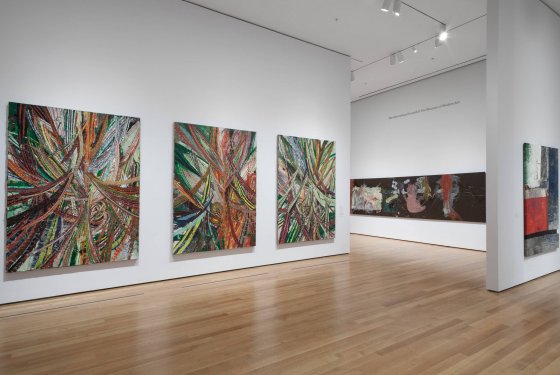
    "The Forever Now: Contemporary Painting in an Atemporal World." John Wronn/© 2014 MoMA, N.Y.

    “The Forever Now: Contemporary Painting in an Atemporal World.” John Wronn/© 2014 MoMA, N.Y.

    So: There is good painting in “Forever Now.” Very good. Some great. (The show’s last wall of Michael Williams finds an artist so adept at creating complex surfaces that it’s hard to even fix our focus on them.) But it is far too narrow in its focus, giving us only one known strain of contemporary painting that, while shadow-dancing with various methods of reproduction and processes, is all more or less handmade and mostly abstract. That’s it. What does all this abstract atemporality and gestural painting add up to? In the case of the artists I don’t like, I’d say that dipping into any and all styles of painting and abstraction is a way not to address the anxieties that now exist around painting in general and abstraction specifically. It’s become a kind of shelter and sanctuary where instead of making old ideas new (as many artists do now), these artists make old ideas palatable, unthreatening, un-conflicted. Or they make paintings that look like edgy hard-core abstraction, deploying fields of black or monochrome paint; Polke, Richter, or Oehlen–like effects; splashes; all-over composition; switching styles willy-nilly within works. These are all familiar signals that say to viewers and buyers, “I know I’m an abstract painting, but the fact that I know that means that I’m cool and you knowing that I know it makes you cool too. Plus, I’m not crass like Jeff Koons and Takashi Murakami. Like me.” It’s both too confident and too needy. I call this assertive negative content — art whose primary content is what it’s not. And it’s a startling statement that this negative content is so appealing to people (collectors especially) right now.

    But what is truly missing here is the sense of painterly anxiety. Not enough of “Forever Now” lets us in on the storms gathering in the medium, where there is an epic struggle going on, not in spite of the disappearance of modernism’s teleology but precisely because painters working today have had that universe of possibilities collapse on them. On the one hand, artists are ultra-aware of and therefore in an ironical position to painting’s processes, endless tropes, styles, ideas, and, therefore, their own work. Perhaps it’s been ever thus, but it’s more thus than ever. An artist using Day-Glo color today is also using Warhol; every brushstroke references a hundred other artists; painting on fabric might be Polke, Kippenberger, Salle, Oehlen. And so on — not absolutely, not every time, not intentionally, even, but it’s there. History and style are now extra-active content.

    If that were that, we’d be dealing only with self-conscious work. The complication is that while artists are in this ironical position to painting, to them their work is not ironic at all — in fact, it is completely, utterly sincere. Today, artists have an almost Romantic relationship to their own work — even if it is made in a time when they are as self-aware as almost never before. This is because the need to make art and the drive to be an artist still run as deep as ego and insecurity towers high. The tension that now exists between these two previously opposed, now concurrent states, is fusing in some new powerful emotion of being at once sincere and ironic. It is a new interior emotion and the tremendously productive chasm and chaos alive in painting and much art today. I’m thinking, for example, of the blasted-looking abstract paintings of Lucy Dodd; the scorching color and rash repeating orders of Katherine Bernhardt; the erratic organization and Eros of Keltie Ferris; the maybe-too-pretty but hobbled Modernism of Patricia Treib; the all-out discontentedness and retinal attack of Bjarne Melgaard; the insane glutted flat surfaces of Borna Sammak.

    While I like a lot of the artists in this show, the exhibition as a whole fails to deliver up the restless interiority, forming intellectual constructions, and exigencies that this split is producing. There are places beyond just using abstraction as a cruise ship or tasting menu. These places can be glimpsed in “Forever Now.” But the show doesn’t venture far enough into this charged, pathos-filled, maybe magisterial arsenal of internal and historical anxiety, insatiable introspection, and outward amplitude. If art really has broken free of time and history — more of the art in “Forever Now” would not cling to or look like so many of its known safe lifelines. More of this art would not look like what more and more art looks like. That’s why I love the artists I love in this show, and even more why I love all of the artists I love who are not in this show. I almost don’t know what to call what they’re making now or how to see it — except with my nerves.

    Source:  www.vulture.com/2014/12/momas-market-moment.html



    ar55[1]

    Art Rotterdam 2015

    February 5 – 8, 2015

    Van Nellefabriek
    Van Nelleweg 1
    3044BC Rotterdam

    www.artrotterdam.com

    london

    The 27th edition of London Art Fair takes place from 21-25 January 2015.

    Annually launching the art world year, the Fair provides a supportive environment for collectors of all levels.

    Museum quality Modern British art is presented alongside contemporary work from today’s leading artists, covering the period from the early 20th century to the present day.

    In addition to the main Fair you’ll also find two curated sections focusing on younger galleries, new work and contemporary photography; Art Projects and Photo50, as well as a unique exhibition from our 2015 museum partner Pallant House Gallery.

    http://www.londonartfair.co.uk/visiting

    Untitled-1 copy

    STUART NETSKY
    SIRENS
    On view: December 2, 2014 – January 30, 2015
     Bridgette Mayer Gallery presents:

    Sirens  
    a solo show by Stuart Netsky 
      December 2, 2014 – January 30, 2015
    Opening Reception Thursday, December 11, 6 – 8 p.m.

     For more information click here
    For a preview of available works, please contact:

    Gallery hours are Tuesday – Saturday 10:00 a.m. – 6:00 p.m.
    & by appointment.  For pricing, images or additional exhibition information please contact t: 215 413 8893 e: bmayer@bridgettemayergallery.com 
    News | Exhibitions