• Eugene Rodriguez, Trumpet, Oil and wax on linen on panels, 40” x 60” x1.5, 2012

    Eugene Rodriguez, Trumpet, Oil and wax on linen on panels, 40” x 60” x1.5, 2012

    Held up to juggernauts like Basel, the fairs produced by artMRKT Productions, now in New York, Miami, Houston, Seattle, and San Francisco, feel like playful, hip alternatives (see: Williamsburg food trucks shipped out to the Hamptons). But this year, running parallel to artMRKT San Francisco’s fifth outing, a new local effort makes its own outsider debut: the stARTup Art Fair, a showcase for independent artists, which runs from May 1 to 3 at the Hotel del Sol. By allowing artists to represent themselves — and thereby keep 100 percent of their profits — the fair seeks to give a boost to local talent, especially given the current state of the city’s art scene.

    San Francisco’s rampant tech gentrification has been at the forefront of the city’s news in the past years, as has its adverse effect on the livelihood of local artists. “As rents go up — driven by the growth of new tech companies looking for space in SF — a number of galleries and artists have been displaced, making it difficult for them to do their own business in the Bay Area,” Ray Beldner, a local artist and one of the fair’s co-founders, explained to us in an e-mail. “As galleries have closed, they have left artists without representatives to bring their work to the art fairs that have become — for better or worse — the main source of art sales and economic support for artists in the last decade. A fair for independent artists, where they interface and reach art fair crowds directly, seemed like the next simple and logical step for artists to regain some control over their economic futures.”

    Read More..


    By Geoff Edgers | Source: The Washington Post

    NEW YORK — The golden Saddam Hussein statues hadn’t arrived, but Wafaa Bilal decided it was time to come up with a price tag. The 2015 edition of the Armory Show fair would open Thursday to the public.

    “I’m thinking $80,000 to $100,000,” Bilal said casually to the director of his Dubai-based gallery, as if he were discussing which toppings to put on a pizza.

    “It’s got to be that,” said William Lawrie, settling the issue.

    Bilal, 48, was born in Iraq, where he says he couldn’t study art because of Hussein’s oppressive regime. After time in a refu­gee camp, he arrived in the United States in 1993 and today is a professor at New York University. He’s also one of 27 artists in the Armory’s special “Focus” section, featuring a group of 15 galleries representing artists from Egypt, Lebanon, the United Arab Emirates and other areas of the Middle East, North Africa and the Mediterranean.

    “Focus: MENAM,” as it’s officially called, serves dual purposes. For some of the selected artists, it’s hard to connect with buyers, network for institutional support and get attention from museums and galleries. The Armory Show, a fair and market spread across 200,000 square feet in the Pier 94 and 92 buildings on the Hudson River, provides access to it all — to art authorities and the public — over a four-day art market in one of the world’s great art centers. For the Armory Show, a business not a charity, the program has other benefits. By creating the Middle Eastern focus, it is connecting with a region where oil-rich collectors have been spending hundreds of millions of dollars on art and recruiting U.S. museums to open satellite institutions.

    Artist and gallery owner Daniel Templon chats with The Armory Show director Noah Horowitz amidst preparations at Pier 94 in Manhattan. (Yana Paskova/For The Washington Post)

    Artist and gallery owner Daniel Templon chats with The Armory Show director Noah Horowitz amidst preparations at Pier 94 in Manhattan. (Yana Paskova/For The Washington Post)

    The 2015 Armory Show marks the first partnership between Art Jameel, an organization funded by the Saudi-based distributor of Toyota and Lexus, and Edge of Arabia, a nonprofit group partially based in London that connects the art scenes of the Middle East and the West.

    “We didn’t do this because of funding, but we’ve been able to meet some very important people,” said Noah Horowitz, the Armory’s executive director. “We’re also trying to work with artists and galleries that don’t already have mega visibility.”

    That description fits Aleya Hamza, who runs the Gypsum Gallery in Cairo. She couldn’t afford to fly her artists, Doa Aly and Mona Marzouk, to New York. What mattered is that their work made the trip.

    “Generally, I don’t like having them bracketed as the artists from the Middle East,” Hamza said. “Right now, there’s hype about them in New York, but when the hype is over, what happens to them?”

    Being pigeonholed is a small price to pay, she conceded, to promote artists from a place where the market is minuscule, museums don’t collect contemporary art and there is almost no foundation support.

    “The Armory Show is an equal playing field, and in the next few days, we’re going to see whether these artists can prove to be as interesting as American artists,” said Heba Elkayal, an Egyptian-born art history student at Columbia University who is helping Hamza. “This is a great opportunity to show off how complex the art being produced in the Middle East can be.”

    Horowitz said there was discussion about whether to group the Focus artists together. Ultimately, he decided it made sense. With more than 2,000 artists in the Armory Show, he wanted to make it easier for people to see galleries participating in the program.

    And for Stephen Stapleton, a co-founder of Edge of Arabia, one of the sponsors of the initiative, which includes a symposium, it’s Horowitz who has made much of the difference. At 35, the Armory’s leader has a PhD in art history from the Courtauld Institute of Art in London and isn’t afraid to call out the shortcomings of the glitzier side of the art market.

    “It’s always been curious to me,” Stapleton said. “Art fairs are the least creative fairs of all industry fairs. You go to a boat fair or a car fair, and they’re much more creative. You go to an art fair, it’s like everybody is scared to stand out. Noah knows it actually should be a place where new things happen. We had crazy ideas. We’re bringing a modified RV to the fair and doing these trips through New York. Noah understands you have to think outside the box.”

    Lawrence Abu Hamdan, selected as the Armory’s commissioned artist for the show, has taken that to heart. Hamdan, a sound artist born in Jordan and living in Beirut, is doing two projects. In the Focus section, he’s displaying an older piece, “The Freedom of Speech Itself,” which is meant to make a political statement about the way people are monitored through voice prints. As the commissioned artist, he has created a series of works.

    One is a conceptual piece that he unveiled this week by slicing open a cardboard box. Reaching, he grabbed a bag of potato chips and smiled. A closer look at the crinkly packaging revealed a small label offering a warning:

    YOU HAVE THE RIGHT TO REMAIN SILENT, ANYTHING YOU DO SAY IN THE VICINITY OF THIS OBJECT MAY BE RECORDED FOR TRAINING AND MONITORING PURPOSES.

    The idea came to Hamdan after learning that Massachusetts Institute of Technology researchers had found a way to extract sound from everyday objects, including tissues, a glass of water and a plant.

    “These,” he said, holding up one of the 5,000 bags of chips being distributed for free throughout the Armory Show, “will be a new kind of vinyl records. It’s both sinister and beautiful. The leaves from a plant or a potato chip bag or a tissue, each have their own sonic color. That’s the beautiful side. The sinister side is that everything we see around has the potential to record our every word.”

    A few booths down from Hamdan, Bilal looked over at smaller, concrete busts of Hussein being stacked on a shelf. These were not the $80,000 editions. Bilal has strong feelings about war in the Middle East. His brother died during a U.S. missile strike in Iraq. A past project found the artist confined to a room for 30 days where people could fire a paintball gun at him. He is unwilling to compromise if it detracts from his point.

    The Hussein busts are an example. These candle holders, bookends and paper weights would be sold for $3,000 to $5,000. The cost of making them? Bilal said he has been paying American veterans $6 an hour. That’s less than minimum wage, he said proudly.

    Many veterans, Bilal explained, don’t have proper health care or jobs when they get home. Did he feel bad that they were being paid so little for their work? Of course not.

    “That’s what exploitation is all about,” he said.

    —————————————————–

    Resources:

    The Washington Post

    Gypsum Gallery



    Architectural Digest Design Show
    March 19-22, 2015
    Booth #131
    Piers 92 and 94,
    55th Street, NYC, NY

    Le Petit Musee @ The Emporium
    InDeArts, Great Barringtons, MA, Sept. 2015

     Follow the Bliss 40"x30", oil on canvas, 2015

    Follow the Bliss
    40″x30″, oil on canvas, 2015


    Amy Cohen Banker – American artist  born in NYC, NY.
    She is one of the most energetic practitioners of New York School aesthetics, whose expressionistic paintings transcend boundaries of colors and poetic impression.  She studied with Knox Martin and has developed an idiom which recalls the vigor and hue of the Abstract Expressionist masters. She has been featured in group shows at museums, galleries and cultural centers in Europe and the US, including Cornell University – Artist in Residence; Isabel O’Neill School and Foundation; Chelsea Art Museum, NYC; Hermitage Museum, St. Petersburg, Russia; and many others. She was also featured artist in a group exhibition at Christie’s Auctions and Miami Basel Art Fairs.
    “She will be a leading force in the 21st Century Art World. She has earned admiration and respect as a distinguished American artist.”

    www.amycohenbanker.com

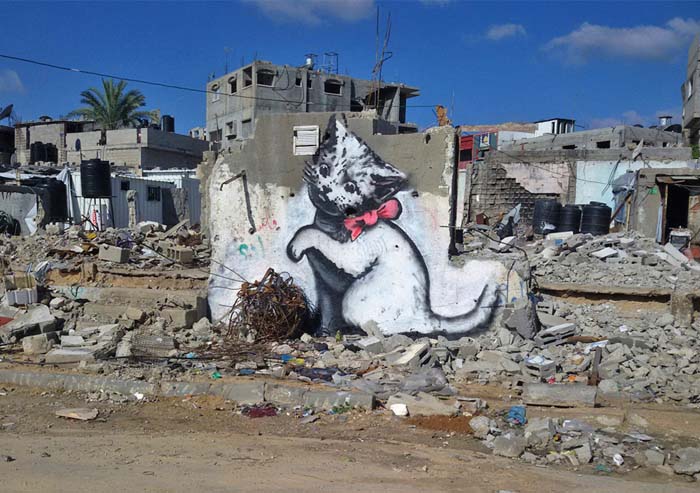
    When Time magazine selected the British artist Banksy—graffiti master, painter, activist, filmmaker and all-purpose provocateur—for its list of the world’s 100 most influential people in 2010, he found himself in the company of Barack Obama, Steve Jobs and Lady Gaga. He supplied a picture of himself with a paper bag (recyclable, naturally) over his head. Most of his fans don’t really want to know who he is (and have loudly protested Fleet Street attempts to unmask him). But they do want to follow his upward tra­jectory from the outlaw spraying—or, as the argot has it, “bombing”—walls in Bristol, England, during the 1990s to the artist whose work commands hundreds of thousands of dollars in the auction houses of Britain and America. Today, he has bombed cities from Vienna to San Francisco, Barcelona to Paris and Detroit. And he has moved from graffiti on gritty urban walls to paint on canvas, conceptual sculpture and even film, with the guileful documentary Exit Through the Gift Shop, which was nominated for an Academy Award.

    Pest Control, the tongue-in-cheek-titled organization set up by the artist to authenticate the real Banksy artwork, also protects him from prying outsiders. Hiding behind a paper bag, or, more commonly, e-mail, Banksy relentlessly controls his own narrative. His last face-to-face interview took place in 2003.

    While he may shelter behind a concealed identity, he advocates a direct connection between an artist and his constituency. “There’s a whole new audience out there, and it’s never been easier to sell [one’s art],” Banksy has maintained. “You don’t have to go to college, drag ’round a portfolio, mail off transparencies to snooty galleries or sleep with someone powerful, all you need now is a few ideas and a broadband connection. This is the first time the essentially bourgeois world of art has belonged to the people. We need to make it count.”

    ***

    The Barton Hill district of Bristol in the 1980s was a scary part of town. Very white—probably no more than three black families had somehow ended up there—working-class, run-down and unwelcoming to strangers. So when Banksy, who came from a much leafier part of town, decided to go make his first foray there, he was nervous. “My dad was badly beaten up there as a kid,” he told fellow graffiti artist and author Felix Braun. He was trying out names at the time, sometimes signing himself Robin Banx, although this soon evolved into Banksy. The shortened moniker may have demonstrated less of the gangsters’ “robbing banks” cachet, but it was more memorable—and easier to write on a wall.

    Around this time, he also settled on his distinctive stencil approach to graffiti. When he was 18, he once wrote, he was painting a train with a gang of mates when the British Transport Police showed up and everyone ran. “The rest of my mates made it to the car,” Banksy recalled, “and disappeared so I spent over an hour hidden under a dumper truck with engine oil leaking all over me. As I lay there listening to the cops on the tracks, I realized I had to cut my painting time in half or give it up altogether. I was staring straight up at the stenciled plate on the bottom of the fuel tank when I realized I could just copy that style and make each letter three feet high.” But he also told his friend, author Tristan Manco: “As soon as I cut my first stencil I could feel the power there. I also like the political edge. All graffiti is low-level dissent, but stencils have an extra history. They’ve been used to start revolutions and to stop wars.”

    The people—and the apes and rats—he drew in these early days have a strange, primitive feel to them. My favorite is a piece that greets you when you enter the Pierced Up tattoo parlor in Bristol. The wall painting depicts giant wasps (with television sets strapped on as additional weapons) divebombing a tempting bunch of flowers in a vase. Parlor manager Maryanne Kemp recalls Banksy’s marathon painting session: “It was an all-nighter.”

    By 1999, he was headed to London. He was also beginning to retreat into anonymity. Evading the authorities was one explanation—Banksy “has issues with the cops.” But he also discovered that anonymity created its own invaluable buzz. As his street art appeared in cities across Britain, comparisons to Jean-Michel Basquiat and Keith Haring began circulating.

    Banksy’s first London exhibition, so to speak, took place in Rivington Street in 2001, when he and fellow street artists convened in a tunnel near a pub. “We hung up some decorators’ signs nicked off a building site,” he later wrote, “and painted the walls white wearing overalls. We got the artwork up in 25 minutes and held an opening party later that week with beers and some hip-hop pumping out of the back of a Transit van. About 500 people turned up to an opening which had cost almost nothing to set up.”

    In July 2003, Banksy mounted “Turf War,” his breakthrough exhibition. Staged in a former warehouse in Hackney, the show dazzled the London art scene with its carnival-atmosphere display, which featured a live heifer, its hide embellished with a portrait of Andy Warhol, as well as Queen Elizabeth II in the guise of a chimpanzee.

    Late that year, a tall, bearded figure in a dark overcoat, scarf and floppy hat strolled into Tate Britain clutching a large paper bag. He made his way to Room 7 on the second level. He then dug out his own picture, an unsigned oil painting of a rural scene he had found in a London street market. Across the canvas, which he had titled Crimewatch UK Has Ruined the Countryside for All of Us, he had stenciled blue-and-white police crime-scene tape.

    During the next 17 months, always in disguise, Banksy brought his own brand of prankster performance art to major museums, including the Louvre. There, he succeeded in installing an image of the Mona Lisa plastered with a smiley-face sticker. In New York City, he surreptitiously attached a small portrait of a woman (which he had found and modified to depict the subject wearing a gas mask) to a wall in the Metropolitan Museum of Art. The museum took it in stride: “I think it’s fair to say,” spokeswoman Elyse Topalian told the New York Times, “it would take more than a piece of Scotch tape to get a work of art into the Met.”

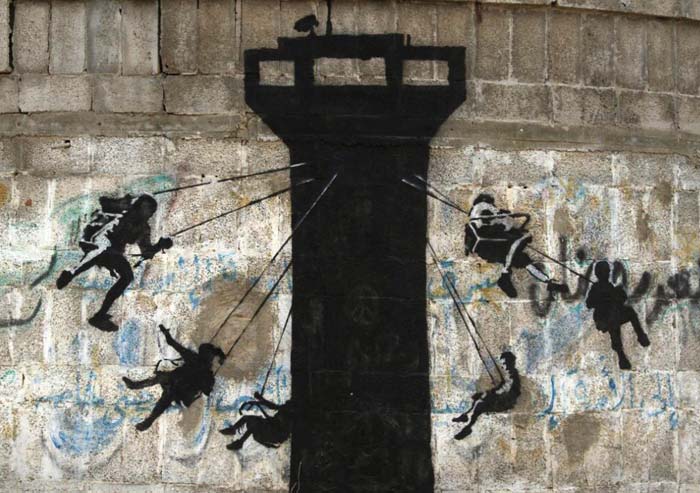
    Banksy became an international star in 2005. In August, he arrived in Israel, where he painted a series of images on the West Bank’s concrete wall, part of the barrier built to try to stop suicide bombers. Images of a girl clutching balloons as she is transported to the top of a wall; two stenciled children with bucket and spade dreaming of a beach; and a boy with a ladder propped against the wall were poignant meditations on the theme of escape.

    Two months after returning from Israel, Banksy’s London exhibition “Crude Oils” took the art of the subversive mash-up to new heights—Claude Monet’s Water Lilies reworked to include trash and shopping carts floating among lily pads; a street hooligan smashing the window depicted in a reimagining of Edward Hopper’s Night Hawks. A signature Banksy touch included 164 rats—live rats—skittering around the gallery and testing critics’ mettle.

    There was an inevitability to Banksy’s incursion into Los Angeles with the show “Barely Legal” in September 2006. “Hollywood,” he once said, “is a town where they honor their heroes by writing their names on the pavement to be walked on by fat people and peed on by dogs. It seemed like a great place to come and be ambitious.” Crowds of 30,000 or so, among them Brad Pitt, were in attendance. “[Banksy] does all this and he stays anonymous,” Pitt told the LA Times, almost wistfully. “I think that’s great.”

    The exhibition centerpiece was an 8,000-pound live elephant, slathered in red paint and overlaid with a fleur-de-lis pattern. L.A.’s outspoken animal-rights advocates were incensed; the authorities ordered the paint to be washed off. Fliers distributed to the glittering crowd made the point that “There’s an elephant in the room…20 billion people live below the poverty line.”

    In February 2008, seven months before the collapse of Lehman Brothers, New York’s rich and famous gathered at Sotheby’s for a night of serious spending. The event, organized by Bono, artist Damien Hirst, Sotheby’s and the Gagosian Gallery, turned out to be the biggest charity art auction ever, raising $42.5 million to support AIDS programs in Africa.

    Banksy’s Ruined Landscape, a pastoral scene with the slogan “This is not a photo opportunity” pasted across it, sold for $385,000. A Vandalized Phone Box, an actual British phone booth bent nearly 90 degrees and bleeding red paint where a pick­ax had pierced it, commanded $605,000. Three years later the buyer was revealed to be Mark Getty, grandson of J. Paul Getty.

    Banksy took on the medium of film in Exit Through the Gift Shop, an antic, sideways 2010 documentary on the creation and marketing of street art. The New York Times described it as paralleling Banksy’s best work: “a trompe l’oeil: a film that looks like a documentary but feels like a monumental con.” It was short-listed for an Oscar in the 2010 documentary category.

    When the Museum of Contemporary Art, Los Angeles put on its comprehensive survey of street art and graffiti in 2011, Banksy was well represented in the field of 50 artists. The show was a high-profile demonstration of the phenomenon that has come to be known as the “Banksy effect”—the artist’s astounding success in bringing urban, outsider art into the cultural, and increasingly profitable, mainstream.

    It could be said that Banksy’s subversiveness diminishes as his prices rise. He may well have reached the tipping point where his success makes it impossible for him to remain rooted in the subculture he emerged from.

    The riots in the Stokes Croft area of Bristol in spring 2011 offer a cautionary tale. The episode began after police raided protesters, who were opposed to the opening of a Tesco Metro supermarket and living as squatters in a nearby apartment. The authorities later said that they took action after receiving information that the group was making petrol bombs. Banksy’s response was to produce a £5 “commemorative souvenir poster” of a “Tesco Value Petrol Bomb,” its fuse alight. The proceeds, he stated on his website, were to go to the People’s Republic of Stokes Croft, a neighborhood-revival organization. Banksy’s generosity was not universally welcomed. Critics denounced the artist as a “Champagne Socialist.”

    He has countered this kind of charge repeatedly, for instance, telling the New Yorker by e-mail: “I give away thousands of paintings for free. I don’t think it’s possible to make art about world poverty and trouser all the cash.”

    The irony, he added, that his anti-establishment art commands huge prices isn’t lost on him. “I love the way capitalism finds a place—even for its enemies. It’s definitely boom time in the discontent industry. I mean how many cakes does Michael Moore get through?”

    While the value of his pieces soars, a poignancy attends some of Banksy’s creative output. A number of his works exist only in memory, or photographs. When I recently wandered in London, searching for 52 previously documented examples of Banksy’s street art, 40 works had disappeared altogether, whitewashed over or destroyed.

    Fittingly, the latest chapter in the enigmatic Banksy’s saga involves an unsolved mystery. This summer, during the London Games, he posted two images of Olympic-themed pieces online—a javelin thrower lobbing a missile, and a pole vaulter soaring over a barbed-wire fence. Naturally, a Banksyan twist occurs: The locations of this street art remain undisclosed. Somewhere in London, a pair of new Banksys await discovery.

    By Will Ellsworth-Jones – Smithsonian Magazine
    ———————————————————-
        Courtesy: http://banksy.co.uk/

    Courtesy: http://banksy.co.uk/

        Courtesy: http://banksy.co.uk/

    Courtesy: http://banksy.co.uk/

    ————————–
    Resources:
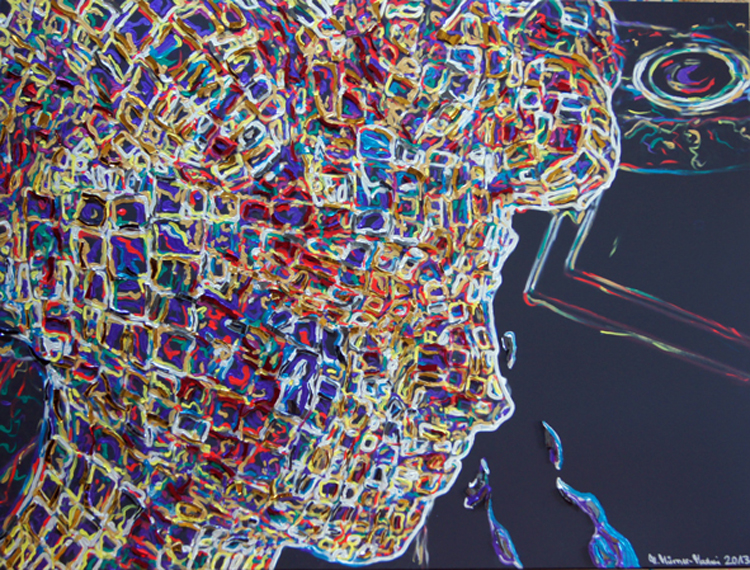
    Title: Lacrime Artist: Manuella Muerner Marioni Medium: Acrylic with Spectrum glass fragments on Canvas Size: 120 x 90 x 5 cm / 47.25 x 35.5 x 2 inches (Width x Height x Depth)

    Title: Lacrime Artist: Manuella Muerner Marioni Medium: Acrylic with Spectrum glass fragments on Canvas Size: 120 x 90 x 5 cm / 47.25 x 35.5 x 2 inches (Width x Height x Depth)

    Aesthetics of becoming playful and self-analysis between reflections and Human research

    In the artistic philosophy of Manuella Muerner Marioni Life and the Being plays an absolutely important role, both conceptually and visually. We could say that both are part of a single fascinating idea that existence blends utopia and reality in a game of shapes, space, color.

    The artist’s aim is to break the order of use of conventional society and the world, showing him through a reflection ephemeral, changing, mutation always new.

    In mirror or glass tiles is reflected or absorbed the real space, turning into light and color, allowing the viewer to become part of the creative process of the artist through his image, becoming an integral part.

    The sculptures of Manuella Muerner Marioni break the visual schemes of classicism, when in the shape and space come together in a close dialogue in search of a new identity.

    This may be, from time to time, the viewer reflex, daylight or darkness of the night, the chromaticism of nature or urban environment …

    In short, the artist leaves to the world, to the reality, to us to interact, to form a new image of art.

    The bright colors of acrylic emphasize, in the paintings steps and symbolic elements, to define almost mystical and spiritual worlds left to the discovery of the users, while running the surface with the eye may lose and find himself in labyrinths of signs and flashes of color and tonal.

    They are as far alphabets, hieroglyphics to interpret and read with the look, but also with the spirit, creating an iconography antique flavor, but with contemporary aesthetics.

    In the pictorial art of Manuella Muerner Marioni, the field is rich of gestures and materials, where we can find space elements and small found objects, such as transistors and cards of computers, which create characters and human portraits from the essence technological to the existence of today, we have become accustomed.

    The metamorphosis of Human is ongoing in this third millennium, the author captures the expressive and conceptual synthesis, putting the art to the service of society, as reflected in a visual document to leave to posterity.

    The mosaic technique, the ancient stained glass windows, a craft that is rooted in tradition and history resurfaces with personal originality in the works of the artist, to testify to a careful and rigorous academic training that is completed, every day, with experimental and multidisciplinary creative processes.

    Painting, sculpture, installations interact with the senses of observers in a process of self-analysis playful and intimate formal and mental, an art reflected and reflective, a life in the mirror of aesthetics and beauty of becoming immortal.

    An art criticism by Dr. Guido Folco, ITALIA ARTE

    For more information contact:

    Manuella Muerner Marioni
    www.arte-manuella
    manuella muerner marioni
    hub 7
    CH-3203 muehleberg
    SWITZERLAND
    E-Mail: fine@arte-manuella.ch
    NEWS BLOG


    Judith Scott, Untitled, 2004, fiber and found objects, 28 × 15 × 27".

    Judith Scott, Untitled, 2004, fiber and found objects, 28 × 15 × 27″.

    “Judith Scott: Bound and Unbound”
    BROOKLYN MUSEUM
    NEW YORK
    Through March 29
    Curated by Catherine J. Morris and Matthew Higgs

    What’s called “outsider art” has informed modern art for over a century; Judith Scott’s story shows that its example remains powerful. Born with Down syndrome and then left deaf by a childhood illness, Scott spent most of her first forty years in institutions until she was rescued from them by her twin sister, Joyce, in 1986. Within a couple of years, Scott began to make art—works often taking the form of irregular multicolored bundles and poles, intricately constructed of yarn and found mixed materials and with surfaces recalling the wrapping techniques of artists such as Harmony Hammond and Salvatore Scarpitta. Scott’s work is both nourishing and strange, and this exhibition, of some sixty pieces made between 1987 and the artist’s death in 2005, is her first American survey show—our first chance to see her art in depth.
    — David Frankel

    Björk

    March 8–June 7, 2015

    The Museum of Modern Art presents a retrospective of the multifaceted work of composer, musician, and singer Björk. The exhibition draws from more than 20 years of the artist’s daring and innovative projects and her eight full-length albums to chronicle her career through sound, film, visuals, instruments, objects, and costumes. In the Museum lobby, instruments used on Biophilia (2011)—a gameleste, pipe organ, gravity harp, and Tesla coil—play songs from the album at different points throughout the day. On the second floor, in the Marron Atrium, two spaces have been constructed: one is dedicated to a new sound and video installation, commissioned by The Museum of Modern Art, for “Black Lake,” a song from Björk’s new album Vulnicura (2015); and the second is a cinema room that screens a retrospective in music videos, from Debut (1993) to Biophilia. On the third floor, Songlines presents an interactive, location-based audio experience through Björk’s albums, with a biographical narrative that is both personal and poetic, written by the acclaimed Icelandic writer Sjón, along with many visuals, objects, and costumes, including the robots designed by Chris Cunningham for the “All Is Full of Love” music video, Marjan Pejowski’s Swan Dress (2001), and Iris van Herpen’s Biophilia tour dress (2013), among many others.

    Entry to the Björk exhibition is included with general Museum admission. Timed tickets are required for the Songlines portion of the exhibition, and are available same-day and on-site only, at no additional charge, on a first-come, first-served basis, beginning at 10:30 a.m. daily.

    MoMA members may reserve same-day tickets for Songlines on-site only, at no additional charge, on a first-come, first-served basis, beginning at 8:30 a.m. daily. Exclusive Member Early Hours will be held daily between 8:30 and 10:30 a.m. Space is limited.


    Organized by Klaus Biesenbach, Chief Curator at Large, The Museum of Modern Art, and Director, MoMA PS1.

    MoMA
    11 West 53 Street
    New York, NY 10019|(212) 708-940
    www.moma.org


    Laura Splan, Collaboration With The Sun #03

    Laura Splan, Collaboration With The Sun #03

    (re)create Residency Award Exhibition At Whitebox Art Center on
    February 17, 2015

    Reception from 2-7pm with moderated discussion at 6pm
    New York, NY — January 25, 2015 — (re)-create, a new, non-profit arts
    organization, is pleased to announce an exhibit of work by the recipients of its
    first artist’s residency, Laura Splan (www.laurasplan.com) and Ève K. Tremblay
    (www.evektremblay.com). (re)create’s mission is to support work that
    synthesizes “art, sustainability, cultural & personal renewal” and those who make
    it. Thrown into the Idaho wilderness on the shores of Hayden Lake in Kootenai
    County, the artists spent two weeks in a rustic camp setting with no requirement
    other than to leave a “trace” of their experiences, a selection of which will be on
    view at Whitebox Art Center (329 Broome St., New York, NY) this February!

    Splan’s works on paper and video present a retooling of Surrealist automatic
    drawings. During her residency, she constructed drawing instruments using
    found charcoal, twigs, and string attached to solar-powered motors. Pieces of
    charcoal salvaged from the campfire were moved across paper by the motor
    vibrations. The clumsy, iterative movements created abstract marks easily
    mistaken for those of a human hand. The chalky compositions materialize the
    ephemeral forces of nature. “Collaboration” within the project emerges where
    chance, idiosyncrasies, and arbitrary parameters collide. Timing and placement
    became the marks of the artist, while technical glitches and fluctuations in
    sunlight became the unique gestural marks of the instruments.

    Tremblay takes a more personal approach. Based on an invented family magic
    bird mythology, pyrometric cones normally used inside her father’s ceramic kilns
    to monitor temperature are staged in a series of mini ephemeral land art
    installations entitled Suite cone pyrometriques. Unfired the cones are straight and
    colored, once fired they melt in different shapes and turn white. Photographed
    they find evocative shapes and new roles as sculptural objects, forming scenes
    of a larger project Tremblay calls Madeleines minerales, a Proustian body of
    work including fired and unfired ceramic pieces and photographs.

    (re)create happily invites you to this double journey through imaginary Idahoan
    landscapes, guided by an artist talk at 6pm, February 17, 2015.


    unnamed
    Exhibition from February 7th to March 28th 2015

    Galerie Paris-Beijing | Paris
    62, rue de Turbigo – 75003 Paris, France\

    One year after the exhibition Day is done in Brussels, Galerie Paris-Beijing is pleased to greet Ghost of a dream in Paris and to present their new project: Gone the Sun.
    The two shows titles bring up the lyrics of the American military tune Taps (“Day is done, gone the sun… God is nigh”) and announce the irony and the caustic humour of this New Yorker artists duo, comprised of sculptor Lauren Was and painter Adam Eckstrom.

    Ghost of a Dream documents and critically explores the futile hopes and dreams of contemporary materialist society that is constantly on the search for a newer, better life. Lauren and Adam mine popular culture for real people’s discarded dreams, such as old lottery tickets, romance novels, baseball cards, trophies, art postcards or so-called “nudie cards”. These escapist objects form the material from which the artists re-create the faded hopes and dreams into large-scale immersive installations, sculptures, collages, videos or text-based work. Some of their works evolve into get-rich-quick promises and fruitless investments in the unpredictable system of gambling; others remind with irony and a little cynicism the ephemeral dimension of perfect romances, so often destined for delusive ends.

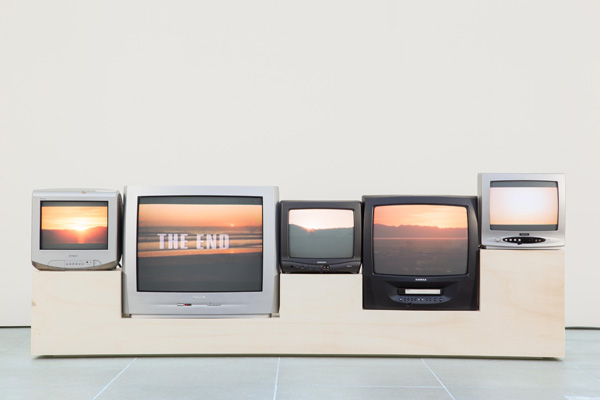
    For the video installations Day is done (2013) Lauren and Adam scoured through numerous hollywood films to amass a digital archive of sunsets that play on loop on countless television sets. Sunsets represent the moment of perfect, lasting romance, yet rarely live up to what the promise… Critically exploring the role of the media in creating and fostering such fantasies in society, they confront us with our own habits of seeking comfort and hope for perfect love in movies. Their immersive work hauntingly reminds us that many of our fantasies and dreams, creating a bright future that will never exist, make us lose much more than we will ever gain.

    Their title work for the show, Ghost of a Dream’s newest video Gone the Sun (2014), is playing with expectations and actualities. “THE END”, which fades in and out of this 60 layer video work of sunsets, has dual associations: the apocolyptical and the “happily ever after”. The tension they achieve between the idea of a “happy ending” and the “end of days” relies heavily on the discordant audio, which combines epic melodies intentionally composed to pull on our heartstrings and elicit emotional compliance into a confusing and agitating cacophony. The piece captures the anxiety of our times: overstimulation, relativism and the flattening of meaning.

    Lauren Was and Adam Eckstrom were both born in the USA and met while attending the Rhode Island School of Design. Eckstrom received a MFA Painting (Honors) in 2005 and Was a MFA Sculpture (Honors) in 2004. Their collaboration began in 2006 when they became intrigued by the question of what people dream about when they buy a lottery ticket. They founded the collaborative Ghost of a Dream in 2007 and a year later made their first piece in the Easy Money series, The Dream Car.
    Their work has been exhibited in Europe, China and int the USA and also has been featured in The Guardian, The Independent, Time Out and ArtForum.com among other publications. Ghost of a Dream have had various residencies in Germany, Switzerland, USA and France. The collaborative has been the recipient of the 2013 Pollock-Krasner Foundation Grant and the Jerome Foundation grant and received the first annual Young Masters Art Prize in London in 2009. They have had solo exhibitions notably at the Hunterdon Art Museum, New Jersey (2012) and were featured in group shows at the Courtauld Institute of Art (2009).

    Galerie Paris-Beijing
    Paris: 62, rue de Turbigo – 75003 Paris, France ( M° Arts et Métiers )
    Tel: +33 (0) 1 42 74 32 36
    Brussels: Hôtel Winssinger, Rue Hôtel des Monnaies 66 – 1060 Brussels, Belgium
    Tel: +32 (0) 28 51 04 13
    Beijing: #3 Qianyongkang Alley 5, Beixinqiao Santiao, Dongcheng District, 100007 Beijing, China
    Tel: +86 (0) 10 64 01 87 82 www.galerieparisbeijing.com

    On view till April 13, 2015

    Over the past two decades, some national and international governments have garnered attention for imposing draconian laws that restrict the rights of citizens under the guise of improving quality of life. Rio de Janeiro has “cleaned up” slums by imposing a militarized police force and Istanbul has put pressure on minority communities by gentrifying the neighborhoods in which they reside. In Russia, the arrest of two members of the art band Pussy Riot for speaking against President Vladimir Putin, along with the passage of anti-gay legislation, has generated international ire. Such restrictive policies have marked everyday life in major cities around the world.

    Through their work, artists such as Halil Altindere (Turkish, b. 1971) and Amal Kenawy (Egyptian, 1974-2012) address the freedom of expression and the role of the artist within society. Altindere’s Wonderland (2013) explores the anger and frustration of a group of youths from the Sulukule neighborhood of Istanbul, a historic area home to Romani communities since the Byzantine Empire that has been increasingly demolished since 2006 as part of an “urban renewal” development project. Kenawy’s The Silence of Sheep documents a short performance the artist orchestrated in downtown Cairo on December 14, 2009 and is, in part, a commentary on people’s submissiveness to local living conditions and cultural norms.

    Named for the 1990s policy under which New York City took a tough stance against vice and crime, Zero Tolerance brings together works by artists from across the globe that address tensions between freedom and control. Many of the works combine elements of political demonstration and celebratory parades to create art of a charged and ambivalent nature, responding to concerns specific in place and time.

    Artists in Zero Tolerance:

    ACT UP New York, Halil Altindere, Francis Alÿs, Ahmed Basiony, Joseph Beuys, Mircea Cantor, Chim↑pom, Song Dong, Oyvind Fahlstrom, Harun Farocki and Andrei Ujică, Igor Grubić, Sharon Hayes, Deborah Kelly, Amal Kenawy, Lorraine O’Grady, Pussy Riot, The Radek Community, Rirkrit Tiravanija, Christoph Schlingensief, Voina, Yoko Ono, Zhao Zhao, Artur Zmijewski.


    Zero Tolerance is organized by Klaus Biesenbach, Director, MoMA PS1 and Margaret Aldredge, Curatorial Assistant, MoMA PS1.

    The exhibition is made possible by the MoMA PS1 Annual Exhibition Fund.

    © 2015 MoMA PS1

    Address: 22-25 Jackson Avenue, Long Island City, NY | (718) 784-2084
    Hours: Thurs–Mon, Noon–6:00 PM

    News | Exhibitions