• Giuseppe Penone, Installation view

    Giuseppe Penone, Installation view

    Press Release

    Marian Goodman Gallery | New York

    24 West 57th Street  / +12129777160 / mariangoodman.com
    Mon – Sat 10am to 6pm

    Marian Goodman Gallery specializes in contemporary art. Please contact the gallery for more information.

    Giuseppe Penone Indistinti Confini

    Mar 18 – Apr 25, 2015

    Opening reception: Wednesday, March 18th , 6-8 pm

    Marian Goodman Gallery is pleased to announce an exhibition of new work by Giuseppe Penone, curated by Dieter Schwarz which will open on Wednesday, March 18th and be on view through Saturday, April 25th.

    The exhibition assembles some of the core ideas of the artist which have guided him from his beginnings. In the North gallery it is the form of sculpture created by the touch of one material on another, by the forces of growing, by the hand of the artist, or by human breath, the trace of pure existence. In the South gallery, it is the form derived from the artist’s approach to reality, i.e. from touching and seeing – the becoming of a form following the propagation of the eye’s look onto the world or the mere imprint of the fingers on a surface. And in the Third Floor gallery it is the grasp of the hand which tries to capture what is escaping, the paradox of trying to give a fixed form to the flow of reality. Penone creates poetic metaphors for these experiences, and in the exhibition these metaphors correspond with each other as they grow out of the classical and ephemeral sculptural material he utilizes: glass, marble and bronze, as well as live trees and dead leaves.

    A selection of key early works from 1970 to 1997 will be shown in conjunction with a series of new sculptures in bronze and marble which reflect the show’s title, Indistinti confini/ Indistinct Boundaries. The early works include Soffio di foglie / Breath of leaves, a floor sculpture of myrtle leaves from 1979-2015, which will be accompanied by a more recent and related work on canvas, as well as the major object Gli anni dell’albero più uno / The years of the tree plus one, 1969-2013. Early photographic works include the black and white photograph, Rovesciare i propri occhi/ To reverse one’s eyes, 1970, and Guanti / Gloves, a pair of two color photographs from 1972. Propagazione dello sguardo/Propagation of sight, 1997, a group of seven trees in pots with a glass element will also be shown. The exhibition will be accompanied by a brochure with an essay by Dieter Schwarz. A full exhibition catalogue will follow this June.

    The new works in marble and bronze, Indistinti confini/ Indistinct Boundaries, 2012 embody Penone’s perception of the binary nature of material form, revealing the distinction between the inner growth and external forces of the life of a tree, as represented in pure white marble and contrasting bronze. Penone writes, “The indistinct nature of the marble encloses infinite millennial existences compressed by the relentless weight of gravity, existences supported by the pure white calcium that has structured its form. The whiteness of the calcium envelops our thoughts, appears in our smiles, articulates our movements. The marble belongs to us, nurtures and sustains and attests to our existence. A tree trunk of marble, of calcium, encloses in our thought, the carbon, the plant, and the plant the mimicry of the color of the bronze, the green of the foliage and the trees, the flow of matter ….where courses the subterranean life of the world. ”

    Soffio di foglie/ Breath of Leaves, 1979-2015 records the impression of breath and the artist’s body on a pile of myrtle leaves on the gallery floor. Breath, the element representing life and the body, is used here as the constitutive tool of sculpture, just as breath and the imprint of the body are made manifest in much of the artist’s work since the 1970s, reiterating the relationship between man and nature, nature and sculpture. A new work in acrylic on paper titled Breath of Leaves accompany this signature work from 1979.

    Propagazione delle suardo/ Propagation of Sight, 1997, presents a series of trees in pots supporting a glass tree which itself becomes an image for the propagation of sight. In this gallery, Penone creates a forest of natural forms punctuated by the small group of Terra su terra- Volto/ Earth on Earth – Face, 2014, bronze trees with individual terracotta forms holding the impression of the touch—of face and hands–resting within.

    In the Third Floor gallery, a new work Avvolgere la terra/ Rising earth/ To enfold the earth-Rising earth, 2014, in wood, leather, terracotta and a related wall work by the same title illustrates the principle of touch which as Dieter Schwarz writes, “is [Penone’s] main device for accessing the world around him because touch is not only a physical process, it is also a fundamental principle of cognition and forming. Touch also determines the first moments in sculpture: taking hold, setting to grasping, pressing, the desire to retain a shape, the urge to permanently fix a form. ´

    Pelle di grafite-palebra / Skin of graphite- eyelid, 2012, a large graphite triptych on black canvas refers again to landscape, this time of the body as revealed through its patterned matrix of the skin depicted in a surface imprint of a closed eyelid. Penone refers to the closed eyelid as a “curtain, screen, projection of the glance”; it defines “the limits and space of thought or the fullness of sculpture as opposed to the emptiness of seeing”.

    Rovesciare i propri occhi/ To reverse one’s eyes, 1970, is a performative work preserved as a black and white photograph. A close-up of his face reveals his eyes covered with mirrored contact lenses, reflecting the surrounding landscape. With the eye no longer the window of the soul but a convex screen for an image that we can see while the artist’s own view is blocked, Penone states the “ability to see future images collected by the past is entrusted to the uncertain outcome of a photographic recording. ”

    Penone recently received the prestigious Praemium Imperiale International Arts Award for Sculpture in 2014. Giuseppe Penone’s recent solo exhibitions include Giuseppe Penone – Breath Is A Sculpture, at the Beirut Art Center, Lebanon (2014); Giuseppe Penone, at the Musée de Grenoble, France (2014); Penone Versailles, at the Château de Versailles, France (2013); Giuseppe Penone, at Kunstmuseum Winterthur (2013); Giuseppe Penone: Ideas of Stone, at Madison Square Park, New York (2013) and Giuseppe Penone: Spazio di Luce at Whitechapel Gallery, London (2013).

    Recent group exhibitions featuring Penone’s work have been held at the Franҫois Pinault Foundation, in Punta della Dogana, Venice, Italy (2014), as well as the Fondation Cartier pour l’Art Contemporain, Paris, France (2014).

    Giuseppe Penone has exhibited at Documenta V (1972), VII (1982), VIII (1987) and XIII (2012) and at the Venice Biennale in 2007, 1995, 1986, 1980, and 1978.

    Please join us at the opening reception for the artist on Wednesday, March 18th from 6-8 pm.

    For further information, please contact the gallery at 212 977 7160.

    NEWS

    By

    You can love or hate Kehinde Wiley’s bright, brash, history-laden, kitsch-tinged portraits of confident, even imperious young black men and women. But it is hard to ignore them, especially right now, with scores of them bristling forth from “Kehinde Wiley: A New Republic,” the artist’s mind-teasing, eye-catching survey at the Brooklyn Museum.

    Since 2001, Mr. Wiley has been inserting black individuals into the generally lily-white history of Western portraiture, casting them in poses — including on rearing steeds — derived from Renaissance and old master paintings of saints, kings, emperors, prophets, military leaders, dandies and burghers. Usually these works have titles identical or similar to their sources, among them “Napoleon Leading the Army Over the Alps,” and “Colonel Platoff on his Charger,” creating the delicious sense that Mr. Wiley’s updates are perfectly normal, which in a way they are. Still, they are conceptually provocative and should startle just about anyone, regardless of race, creed or color, even if his often thin, indifferently worked surfaces can leave something to be desired as paintings.

    In a way that few other living artists match, Mr. Wiley’s art is overtly, legibly full of the present. His paintings reflect some of the problems and pleasures of being alive right now, in times fraught with corrosive bigotry and inequality; flooded with images, goods and sounds; and enriched by the incessant, even ecstatic interplay of cultures — whether high, low or sub — around the globe.

    In the 44 paintings here, Mr. Wiley’s subjects wear hip-hop fashion or designer gowns, and in addition to posing as kings and saints, they mimic aristocratic ladies in well-known paintings from the Louvre or masterworks of African sculpture. Very occasionally, we see someone famous and in costume, as in “Equestrian Portrait of King Philip II (Michael Jackson)” based on a painting by Peter Paul Rubens. In Mr. Wiley’s reprise, produced in 2009, the face of the tragic pop star, who died that year, is overwhelmed by the ostentatious royal armor and hovering cherubs.

    Often, Mr. Wiley’s subjects are seen against decorative patterns based on textiles from various cultures — rich brocades, British Arts & Crafts designs, Africa-inspired Dutch wax-resist fabrics. Mostly floral designs, they curl across the figures, confusing foreground and background. Anointed with carved black or gold frames that look a little too fake, these paintings keep company with other borrowings from art history: among them six imposing full-length portraits in stained glass that are too photographic, and four bronze portrait busts that muster a terrific hauteur but otherwise are generically academic. In nearly every instance, the figures are larger than life; some paintings are nearly as big as billboards.

    But there are also small-scale portraits of young black men, some on gold leaf, like Byzantine icons, and others ensconced in sturdy wood frames equipped with doors. Resembling portable altarpieces, and based on the austere portraits from the 1400s by Hans Memling, they bring to mind the quiet perfection of Northern Renaissance works amped up with a contemporary sense of seductiveness.

    When it comes to art history, Mr. Wiley has not only scores to settle but also possibilities to explore. He sees this terrain as ripe with potential, a revisionist approach that he shares with artists as diverse as Nicole Eisenman, Dana Schutz, Carroll Dunham, John Currin and especially Mickalene Thomas, who also inserts black women into art history (and with a degree of painterly innovation that exceeds Mr. Wiley’s).

    Mr. Wiley also belongs to a tradition of Pop Art-infused figuration that includes Mel Ramos, Wayne Thiebaud and Barkley L. Hendricks. And he owes something to the flamboyance and painting-consciousness of artists from the 1980s, especially the slyly layered images of David Salle and the sampled patterns of Philip Taaffe.

    But as an artist and a persona, Mr. Wiley may best be described as a combination of Andy Warhol, Norman Rockwell and Jeff Koons. Like Warhol, he makes striking images of his contemporaries. Like Rockwell, he elevates everyday Americans with somewhat corny portrayals that are more interesting as images than as art objects. Like Mr. Koons especially, Mr. Wiley’s is largely an accessible public art that also raises issues about the role of the artist’s hand and the use of workshop production. Like all these artists, Mr. Wiley has a carefully cultivated public persona, and is, along with his art, the subject of considerable art-world argument, which matters little. Mr. Wiley’s work is part of the larger culture, and so is he.

    Mr. Wiley was born in Los Angeles in 1977 and grew up looking at old master paintings and sculpture at the Huntington Library in San Marino, Calif. He earned his B.F.A. from the San Francisco Art Institute in 1999 and his M.F.A. from Yale in 2001, followed immediately by a residency at the Studio Museum in Harlem. One day, on a street near the museum, he picked up a piece of paper featuring the image of a young black man; it was a confidential police mug shot of a suspect. Looking at the image in the catalog, or the painting from 2006 based on it, one can see why the innocence and nobility of this young face became, as Eugenie Tsai writes, “a catalyst for his subsequent work.”

    Covering just 13 years of activity, this exhibition was organized by Ms. Tsai, the museum’s curator of contemporary art, and offers an early midcareer report on Mr. Wiley’s progress. It presents the scope of his ambition and his carefully constructed artistic and social project, which has improved as he has gone global, finding subjects in Africa, Brazil, Jamaica and Haiti. It shows his willingness to risk and fail. The primary flaw is his seeming indifference to the physicality of painting, as he more or less said in a recent article, but that may be changing.

    However, Mr. Wiley is, as all artists should be, aspirational. In the first gallery, “Conspicuous Fraud series #1 (Eminence)” portrays a young man in a business suit whose black hair swirls around him like a large, powerful serpent. It is so cursorily painted as to seem unfinished.

    His later paintings adhere to a formula of repeating elements: figure, pose, garments, props, background, as do most portraits. The problem is that in many of his efforts, the elements battle one another. The figures, which are painted by Mr. Wiley, convey a certain intensity, but the backgrounds, painted by assistants, often seem skimpy, filled in, not quite up to the task. The imbalance can be even worse in canvases that replicate the actual setting of the borrowed work, as in “Gossiping Women” and “Santos Dumont: The Father of Aviation II,” in which marvelously solid subjects (two women and two men respectively) are set in landscapes that resemble sloppy stage sets or images painted by numbers.

    The patterned backgrounds are especially overdone in the first paintings Mr. Wiley made of young black women, a 2011 series titled “An Economy of Grace.” For this he went all out, outfitting the women in Givenchy gowns, with piled-up hair and elaborate makeup. It doesn’t help that they also seem ill-at-ease, having been removed from the comfort zone of their own clothing in a way that their male counterparts are not. The fashion photographs that Mr. Wiley orchestrated for a recent issue of New York magazine, using some of the same models, are better. And so are his latest paintings of women in everyday dress: especially “The Sisters Zénaïde and Charlotte Bonaparte,” after another Jacques-Louis David, where two young women, seated, reading a letter before what may be the artist’s simplest background pattern, based on a William Morris design.

    A general complaint here is that the labels cite the paintings’ high-art sources intermittently. The origins of the backgrounds are almost never mentioned. Full disclosure for each would strengthen the show.

    But aspiration pays off. Like the artist’s most recent paintings of women, his three small and highly detailed portraits based on Hans Memling in the show’s final galleries end the exhibition on a high note, especially the muscular, slightly androgynous Rasta-braided subject of “After Memling’s Portrait of a Man in a Red Hat.” This is perhaps the only work in the show that you can imagine seeing anywhere near its Flemish original. The smooth pore-less surfaces and intimacy of Mr. Wiley’s effort have a rare physical and emotional concentration. Now that he has our attention, he may find his true métier working small, in oil on wood panel, in the manner of Northern Europe’s self-effacing early portraitists. At least for a while.

    Correction: February 21, 2015
    An art review on Friday about “Kehinde Wiley: A New Republic,” at the Brooklyn Museum, misidentified the artist who made the painting on which Mr. Wiley’s “Equestrian Portrait of King Philip II (Michael Jackson)” is based. He was Peter Paul Rubens — not Jacques-Louis David, whose paintings of Napoleon crossing the Alps inspired another work by Mr. Wiley.


    ———————————————

    Resource:

    NY Times | Art & Design

    Review: ‘Kehinde Wiley: A New Republic’ at the Brooklyn Museum

    By ROBERTA SMITH, FEB. 19, 2015

    NEWS

    By JOYCE LAU for NY Times

    HONG KONG — Collectors and museum directors from around the world had the chance on Friday to deal discreetly with the 223 galleries participating in the third Art Basel in Hong Kong fair.

    The private viewing was the quiet before the storm on Saturday night, when the event kicks off officially with a Champagne-soaked vernissage that has become Hong Kong’s art party of the year. An estimated 65,000 visitors will descend on the fair before it closes on Tuesday.

    The popularity of the annual Art Basel in Hong Kong is testament to how rapidly this city’s art market has grown, and how far it still has to go.

    One of the fair’s big draws — the Encounters section, with large-scale installations by international artists — is a hit with the public precisely because Hong Kong still does not have a world-class contemporary art museum. The proposed M+ museum, in the state-funded West Kowloon Cultural District, will not open until 2018.

    Hong Kong’s annual art fair rose from the ashes of the 2008 financial crisis, when local entrepreneurs opened ART HK. That fledgling show, which drew on the strengths of the booming Chinese and Southeast Asian markets, quickly caught the attention of overseas buyers. MCH Group, the Swiss art giant that runs the Art Basel fairs in Switzerland and Miami Beach, bought a majority stake in ART HK in 2011 and renamed it in 2013, bringing it under the Art Basel umbrella.

    Magnus Renfrew, a co-founder of ART HK who is considered a pivotal figure in developing Hong Kong’s art market, oversaw the fair from 2008 to 2014. After a half-year search for his successor, and with just two months to go before this year’s fair, MCH announced on Dec. 30 that the job would go to Adeline Ooi, an Art Basel executive specializing in the Southeast Asian market.

    Hong Kong’s local art scene is less established than Tokyo’s, and less vibrant than Beijing’s. But as a tax-free, English-speaking commercial center with few government restrictions, it is an ideal place to buy and sell art. In terms of sales, it is the third-largest art market in the world after New York and London.

    One important aspect is Hong Kong’s lack of censorship. “In Southeast Asia, religion is an issue when it comes to images dealing with nudity or sexuality,” Ms. Ooi said by telephone from Sydney, Australia, one of many stops on a promotional trip across the Asia-Pacific region. At the Singapore Biennale art fair in 2011, she said, certain works were taken down.

    “In Hong Kong, we have liberties we would not have in China,” she said.

    One example is M+. The museum-in-progress has made its mark with a collection that includes works by the Chinese artist Ai Weiwei, as well as photographs from the deadly June 4, 1989, crackdown in Beijing — images that would not likely be shown at a similar state-funded museum in mainland China.

    “Hong Kong is a city that’s not afraid of foreigners or foreign ideas,” Ms. Ooi said. “It’s not afraid of anything.”

    A change in schedule this year to March from May, to avoid clashes with other international art events, has brought more high-profile Western galleries to Art Basel in Hong Kong.

    But what is noteworthy is the ascent of Asian galleries. Leo Xu Projects of Shanghai, which opened in 2011, spent two years in the Discoveries sector, which is for emerging, smaller galleries. This year, it is in the Galleries sector, next to big names from New York, London and Paris.

    According to Chi-Won Yoon, chief executive of UBS Asia-Pacific, 40 percent of the company’s art acquisition budget is now dedicated to the Asia-Pacific region. UBS is the main corporate sponsor of Art Basel in Hong Kong, which Mr. Yoon described as having “a certain energy that is different from the other fairs.”

    The focus is on encouraging young Asian collectors. Art Basel in Hong Kong is expanding its Junior Art Hub, developing a mobile app called Planet Art and holding educational seminars at the University of Hong Kong.

    Thanks to the annual fair, mid-March has now turned into Hong Kong Art Week. There will be 150 events around town, including free screenings of 40 films at the Hong Kong Arts Centre.

    The old posse from ART HK has announced a rival art fair called Art Central, which will run at the same time as Art Basel in Hong Kong. In its inaugural year, Art Central will host 70 galleries at a newly commissioned space on the downtown waterfront, plus talks and seminars at The Asia Society.

    Most Hong Kong galleries now time their big openings for March. Pearl Lam, an eccentric, cutting-edge gallerist, opened a second Hong Kong space this month at SoHo 189 with a solo show by the Chinese artist Ren Ri. SoHo 189, a building in the quickly gentrifying Soho area, also acts as the home for Gallery Huit and Leo Gallery.

    Patrick Foret, Art Basel’s head of sponsorship, said that Hong Kong’s fair could aspire to be like Miami’s, which draws together “creative industries, fashion and art.”

    Para Site, one of the city’s most established alternative art institutions, just opened a larger new space in Quarry Bay, in Eastern Hong Kong.

    Also in Eastern Hong Kong is Chai Wan Mei, a loose series of parties and open houses in the artsy industrial neighborhood of Chai Wan, where many artists live and have studios. The Chai Wan Nights party has become the hot, sweaty alternative to Art Basel’s air-conditioned cocktail receptions.

    “Chai Wan is a real eye-opener,” Ms. Ooi said. “Visitors don’t expect art in warehouse spaces in Hong Kong.”

    Wilson Shieh, who has been an artist in Hong Kong for 20 years, has watched the local art scene develop from basically nothing.

    “When we graduated from art school, we didn’t even think of becoming full-time artists,” he said. “When I started, I couldn’t have imagined that we would have an art scene like this. In the ‘90s, Hong Kong was just a stopping-off point for collectors heading to Beijing.”

    Mr. Shieh considers the city’s annual art fair to be a major boon to local artists. “It’s been eight years now that we’ve had a platform, an opportunity, to show ourselves to the world,” he said.

    “Visitors are curious — some even come to my studio in Fotan,” he said, referring to another art community in the outlying New Territories. “I think Hong Kong’s golden era is yet to come.”

    cologne2

    April 16-19, 2014

    ART COLOGNE has always been a number one address for viewing, enjoying and buying top-of-the-range artworks.
    In today’s fair, approximately two hundred leading international galleries will showcase a carefully selected and curated
    range of top-quality 20th and 21st century artworks. Art lovers and collectors will encounter a broad range of modern and contemporary art from many diverse movements, in all price brackets, shape and size.

    The fair is composed of several sectors. GALLERIES sites established galleries. NEW CONTEMPORARIES represents galleries founded in the 21st century. NEW POSITIONS offers solo-presentations of outstanding young artists. ART COLOGNE has joined forces with the New Art Dealers Alliance (NADA) to launch a new section titled ‘COLLABORATIONS’. Galleries participating in COLLABORATIONS will showcase a program based on a jointly planned project.

    Meanwhile, a supporting program of exhibition openings and events in nearby museums and institutions around the Rhineland make ART COLOGNE one of Germany’s must-see events of the year.

    http://www.artcologne.com/en/artcologne/home/

    dubai

    Wolrd Art Dubai 2015

    • 8 April      16:00 – 21:00
    • 9 April      16:00 – 21:00
    • 10 April    12:00 – 22:00
    • 11 April    12:00 – 22:00

    A new accessible art fair created to bring regional and global artists and galleries together with Dubai’s international community.

    A unique fusion of art, education and entertainment, the debut of World Art Dubai reflects the city’s growing prominence as a leading culture and arts hub, and you are invited to be part of the launch event at DWTC.

    The inaugural World Art Dubai will house an collection of several hundred modern, contemporary and fine artworks comprising paintings and prints, photography, sculpture, installations, performances, mixed media, new media and more– presented by international and local artists and galleries from across four continents. World Art Dubai offers the Middle East’s only art fair to cater for all art lovers, buyers and collectors.

    http://www.worldartdubai.com/

    hongkong2

    Hong Kong
    March 15–17, 2015

    Welcome to the newest Art Basel show. With half of the participating galleries coming from Asia and Asia-Pacific, Art Basel in Hong Kong assumes a significant role in the international artworld, providing a portal to the region’s artists. The new show gives galleries from around the world a platform in Asia to demonstrate the way they work with artists, and bring their highest quality work to Hong Kong.

    Known as the gateway between the East and West, Hong Kong ranks among the world’s most dynamic international capitals. A 21st century metropolis, it is a port city with a vast skyline rising above its bustling Victoria Harbour. In addition to the many museums, concert halls, and performance spaces, a vibrant melting pot of cultures makes Hong Kong a place of endless exploration.

    https://www.artbasel.com/en/Hong-Kong

    March 13, 2015

    From: Fredrik Redan
    Subject: Text to journal, letter via Hans
    Date: March 13, 2015 at 4:17:19 AM EDT

    Read about Hans Andre and came to think of his early years when he worked together with Staffan Hallström.

    Staffan who were older and well-established artist, he later received the title of professor, began his collaboration with Hans already in 1970.

    Together they had two years project grants from the Swedish Royal Academy of Fine Arts to develop graphic and photographic art.

    In addition to lithographs and the like, they also made a 16 mm film, a very different one, about Paris Metro.

    Which also resulted in an exhibition at Gallery Prisma in Stockholm for the imposing Leif Nielsen.

    Leif came originally from Denmark and it was needed, apparently, a Danish to revive the provincial Swedish art world.

    Below is a collage, made around -70, and the whole picture is imaginary, assembled from various parts, noting among other things that it is the same house that’s used.

    And this was 45 years ago!

    They were ahead of their time.

    ————————————————————-

    From: Hans Andre
    Subject: Dear Abraham
    Date: March 4, 2015 at 6:03:39 AM EST
    To: David Abrams
    Reply-To: Hans Andre
    I do not know if the text was what you expected.
    Now to something completely different:
    From one thing to another, I understand that the economic climate makes it maybe difficult to start up a blog, but perhaps a beginning is to have something like “Letters to the Editor”?
    Anyway, a short story, when I think of You  I will always think of Leif Nielsen. Leif was a Dane who came to Stockholm in the sixties and realized that it needed a force to collect and display of modern Swedish art. He gathered what came to be known as the “angry” artists. Many of whom went on to become prominent. I was around 20 when I together with Staffan Hallström, very famous painter and later a professor at the Academy, had my first exhibition at Leif. Later, I had over the years other exhibitions with him. He died a few years ago, more than eighty years old. But, and this was where I wanted to come, he was a unique driver who saw the potential of artists. Although the galleries not always made some money, sometimes he was forced to work as a waiter …., but he never gave up. The driving force was to showcase the new, exciting and different.
    When I now look back, I’ll be 65 this year,  I see that there are very few left with the same drive.
    Perhaps this is a generational issue, notwithstanding which, such as Leif and You are unique.
    Collage 1970

    Collage 1970

    All the best
    Hans Andre

    ——————————————————–

    MARCH 11, 2015

    Subject: Re: Перешли мне это обратно.
    To: Abraham Lubelski

    Im the artists  but  I do not like this  Name , they call themselves special but i think more important for the society is cook , taxi driver or cleaning lady

    ,,Artists’’  think  they  are  very important  for  society that’s  maybe a true  but  the thing is  they have to be useful and they  have to  work  for  society

    Abraham  Lubelski  did  a good  job for   the artist ;;;  why  you ask… i tell you .. for 2000 $ you can be visible in the center of  art World .. Soho NY

    Than if you get this possibility take care for your self  call  curators , journalist and let them now,, invite for an exhibitions ,, they can see your Art in real ..and can judge ,, if is good or  so so art
    in my opinion exposure is one thing and sales is something different

    Lots  of  ,,artists ‘’ think they are very special but if you look at their works ,,,is  not so special the ,, artists ‘’ think 😉

    Yaro

    ——————————–

    March 9, 2015

    What do critics of art have to do with the making of art? Are you impacted in the making of your art by what other people say?
    The art work I most prefer to make must speaks for itself. Most of the time I fail but must keep trying.

    Please reply and submit an image of your own work for publication at publisher473@gmail.com

    Performance Series, Venice Biennale. Abraham Lubelski

    Performance Series, Venice Biennale. Abraham Lubelski

    —————————————————-

    March 03, 2015

    I do not really like to talk about my painting.
    However, just to paint because it is beautiful or aesthetically, I do not find it meaningful.
    I’m always looking for different layers in my paintings, ie. different ways for the viewer to see them on.
    Ideally is if the viewer over time can see the other layers and levels of my paintings than what they saw first.
    There must be an idea’ and thought that in turn can create other thoughts and ideas.
    At a time when there is always the question of  a “quick fix” ,it´s needs images which can be viewed over a longer time perspective as well as content.
    As a fellow human beings, it is our responsibility to take care of our daily lives.

    Hans Andre
    www.hansandre.com

    Please write me a short “journal” about your work that I may edit and place on the web site.
    Stay strong and healthy.Spring is always a fresh beginning.

    All the best,
    Abraham

    On Mar 3, 2015, at 6:51 AM, Hans Andre wrote:

    >     Dear Abraham,
    >     I hope all is well.
    >     Up here in Stockholm, spring has finally started to come, and thus also the light.
    >     Which makes life a little easier.
    >
    >     Enclosed please find my latest painting:
    >     Reminiscence
    >
    >     All the best
    >
    >     Hans Andre
    >     www.hansandre.com

    Hans Andre, Reminiscence

    Hans Andre, Reminiscence

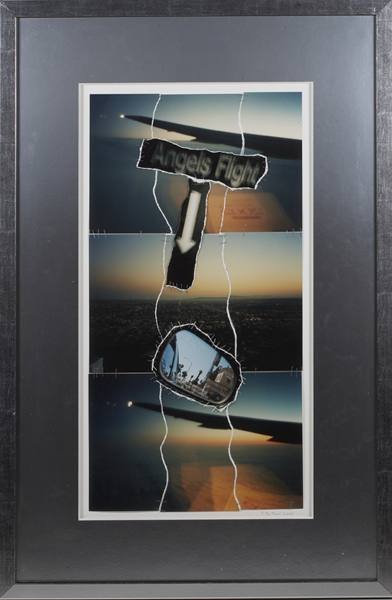
    Tina De Biasi, "City of Dreams". Photo collage and staples.

    Tina De Biasi, “City of Dreams”. Photo collage and staples.

    Fiorentina De Biasi
    “City of Dreams”
    Photo collage and staples
    March 7th , 2015, 7pm – 10pm

    Leonardo Rossi Studio
    200 West 21st , NYC
    212 727 9777

    Fiorentina De Biasi was born in Castellammare di Stabia (Naples, Italy). She studied at
    DAMS (Department of Art Music and Entertaining) at Bologna University. She graduated in
    1999. After experimenting with painting, she is now performing photo collage. Each image
    that emerges seems to recount continuous journey between urban scenarios and contemporary  mitography where the distance and detachment of any photographic souvenir have been broken in pieces and liberally and uninterruptedly recomposed and rearranged. The observer’s sight and the photographic reproduction become vision, a fractured and oblique vision, so deep as to reveal possible senses and ulterior meanings. As a result, when looking at these frames, it is not uncommon to experience the same astonished feeling the Kublai Khan had when receiving Marco Polo and his descriptions of the fantastic and invisible cities.

    Tina De Biasi, "City of Dreams 1". Photo collage and staples.

    Tina De Biasi, “City of Dreams 1″. Photo collage and staples.

    Tina De Biasi, "City of Dreams 2". Photo collage and staples.

    Tina De Biasi, “City of Dreams 2″. Photo collage and staples.


    http://www.projeqt.com/fiorentina


    March 6, 2015 • By | NYMAG

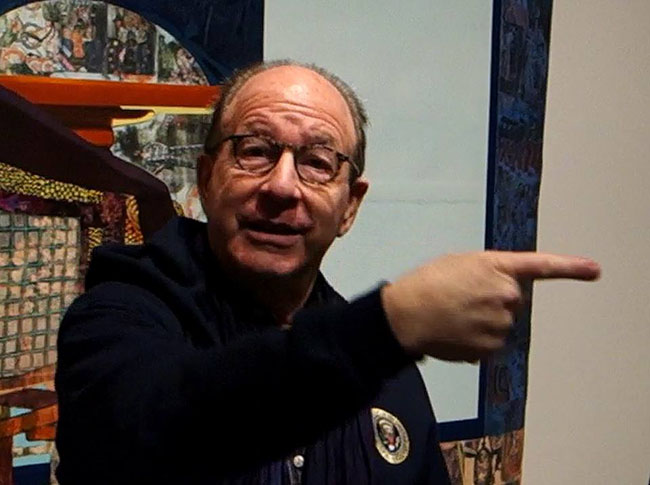
    On Tuesday morning, I tried to log into Facebook via my iPhone. It didn’t work. I didn’t think anything of it, as I often don’t remember my passwords. When I tried again on my laptop, however, I wasn’t able to log in either, and instead got some sort of note saying that owing to complaints regarding particular posts, that I’d violated “community standards” and was banned from Facebook. I don’t know how to do screen-grabs so I clicked “I agree,” it disappeared, and I was able to see my Facebook but was no longer able to participate in any way on it. That was that.

    My first thought: Here we go again. Last December, Instagram had shut down my account during Art Basel Miami Beach when I posted (from New York) a picture of Charles Ray’s great MoMA-owned sculptural masterpiece of four nude figures holding hands, American Romance. Instagram reinstated me within three hours, claiming an errant algorithm had made a mistake.

    This time, I didn’t run afoul of any Facebook algorithms scanning for nude photographs, pornography, genitalia, hate speech, civil-rights violations, etc., however. Instead, it was my “friends” who’d driven me out of town. Apparently, over the last bunch of months, I’d run afoul of art-world conservatism and moralism and been demonized by artists, whose names I recognize from social media — people policing my borders. In particular, Facebook had repeated complaints from my “friends” and followers objecting to my numerous posts of ancient Roman and Greek art and medieval illuminated manuscripts. (Not to any nude photos or the like.) At a certain point, after posing art questions almost every day for five or six years, I began to get interested in a lot of art-historical material that was coming to light online as a result of high-definition digital photography. Art from one of my favorite periods in all of history; what we roughly call the Dark Ages and medieval art. I loved the idea of communicating in pictures — with idiotic jokes often attached. But I wanted people to see these lost images. Over the course of the last year or two, these pictures that reflect a kind of internal consciousness and external condition that feels relevant again in this time of ending American empire, have sort of taken over my life on social media — though not in a way I had planned, exactly. Scads of people took these pictures in more ill-intended, sick, and literally wayas than I could ever have imaged.

    These pictures are powerful. Many were made in the tumultuous period in the West between the collapse of the Roman Empire and the hegemony of Christianity. Most of these images are hard to take. They contain body parts, defecation, plague, death, boils, brutality, emaciation, torture, severe tooth decay, horrific attempts at surgical remedies. Most of all, these pictures portray demons. Thousands of them besetting humanity at every turn in every color, plumage, and guise, snakes, birds, pigs, dragons, frogs, flowers, roots, devils. I love them, the color, scale, subject matter, mythos, and pain. These were people trying to live by Christ’s “Love thy neighbor as thyself.” The pictures from these stormy centuries over a thousand years before Freud remind us that one core human state is self-hate.

    I’d gotten on Facebook in 2008 when a student created a page for me. I had no idea how it worked or what I’d do with it. After a few months of writing about the weather and what I was wearing, apropos a show I’d just seen, I wrote a few lines saying why I didn’t like the paintings of Marlene Dumas. It was like a bomb went off. Out of nowhere, scores, then hundreds of people flooded onto my page to tell me in no uncertain terms why I was wrong. (I still think I’m right.) Other than a little bit of “ouch,” in an instant in my underwear I had a digital epiphany: Facebook might make it possible to invert a model of art criticism. Rather than the critic speaking from on high, alone, unassailable, from the top of the pyramid to the many, Facebook might make possible for the many to speak to one-another, coherently. I tried. It worked. Like wildfire. And I kept doing it. Trying everything I could think of, following my fancy.

    Social media seemed to imply a giant meta step forward in art criticism to me, a way to get through a period when print is waning and we’re finding our ways on blogs and the like. And there’s no money to it, so there’s nothing to lose and everything to gain. It felt like the Wild West to me, borderless. I really thought I was experimenting with art criticism, but the truth is that I was not really in control of the experiment; it was in control of me. And had only very little to do with art or criticism, and much more to do with communication and self-expression.

    On Facebook, the boundaries between high and low seemed finally to slip away. Doing criticism in public, in real time, live, was thrilling, satisfied my need to try new things, reach a much, much wider audience, be a ham, alleviate the long terrible hours of aloneness that all writers and artists know well, all the while exercising my own demons and dancing naked in public. Facebook, then Twitter, then Instagram, changed the way I see criticism and the art world. Social media makes all this much bigger, more participatory, and even possibly more horizontal. It makes me think hierarchies can be flattened, that there were many ways to form communities, even for those of us who don’t only want to speak art world to art world, who write for glossy general-interest magazines, have no degrees, only leave our house to do our jobs. The housebound could have voice. And have fun at the same time. And take micro-breaks between writing paragraphs to mix it up about art with real artists in real time. I loved that criticism could be practiced in public and not mainly in specialist journals or in classrooms. I’d like to think that on these platforms a sort of accidental criticism happened. And is happening still. And will again.

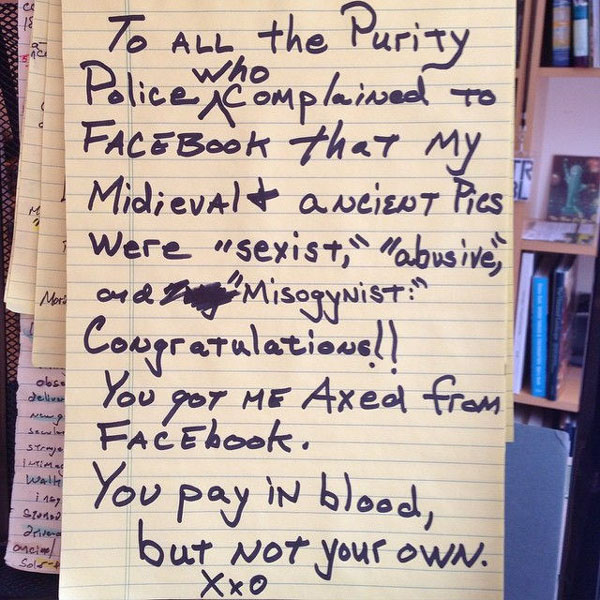
    But what happened this past week made those possibilities seem foreclosed (even if I was relieved, for a bit, to be relieved of my account). Letters to Facebook objected to these images (made by artists) being “abusive to women,” “sexist,” and “misogynist.” Letters branched out from there, accusing me of being all these things too. Soon I was being called “a confirmed sexist.” This from people who subscribe, navigate to, seek out, and read my Facebook page voluntarily, people who then use their energy to criticize how I’m trying to use mine. This seems perverse to me. Especially when we remember that a click away from my page are numerous others devoted to white-supremacy groups, guns for children, sex trafficking, the Westboro Baptist Church, and much more. ISIL has Twitter pages! Facebook complainers objecting to medieval illuminated manuscripts clearly have too much time on their hands and some misplaced feelings about authority, not to mention critics.

    My impression from Facebook is that the large majority of these complaints come from people of my generation, people between the ages 48 and 68 — and that the objections are not to photographs or contemporary works of art. Even on my Facebook, I regularly find people telling me not to post such “sexy” images, or to post only about art issues. In the past, I’ve been blasted on Facebook, called a disaster for art, a sell-out, a fraud, someone “promulgating a massive deception.” After I tried to be on a reality-TV game show, artist William Powhida opined that for him to be on my “top ten list” was like “an anchor around my ankle.” I read these criticisms and think, They could be right. And anyway, I love that the art world is always getting its panties in a wad about the collapse of cultural values and the like. I didn’t mind being “the like.” But that’s gotten darker.

    But, if my banning tells me anything, it’s that my sense has been right that this criticism has mutated of late. I hope that all of these finger-pointing little Napoleons get a grip and go elsewhere. I know that I’m going to probably keep loving these old images as they come to light, post them, even with my idiot jokes about them depicting me, Klaus, Marina, and others having sex, or whatever. In the meantime what does it tell us that pictures made by artists and posted by an aging male art critic now bear witness to Facebook being more open and permissive than many in the art world? I’d only ask people who hate the pictures and captions I post not to visit my page anymore, please unfollow me, block me, forget about me. Please quit me.


    —————————————————————————————————————————————–

    Image retrieved from Facebook – Facebook.com/jerry.saltz

    Image retrieved from Facebook – Facebook.com/jerry.saltz


    Image retrieved from Instagram @jerrysaltz-6

    Image retrieved from Instagram @jerrysaltz-6


    By | Vulture

    Without quite meaning to, I seem to have prereviewed the Museum of Modern Art’s current Björk show. I greeted its June announcement with dismay, writing, “Today the Museum of Modern Art crawled deeper into cravenness, announcing the upcoming ‘full-scale retrospective’ of Björk. Don’t get me wrong: I love Björk and her fabulous amaranth persona, her videos, and her music.” I wrote then that all belong in a museum, but added, “MoMA [is] destroying its credibility … in its self-suicidal slide into a box-office-driven carnival … Tilda Swinton sleeping in a glass vitrine, Queen Marina staring at smitten viewers in the atrium, the trashy Tim Burton show, last season’s gee-whiz Rain Room, and of course the wrecking ball Diller Scofidio + Renfro is about to swing.” What made me know back then that the Björk show would likely be another embarrassing pop-programming nadir in a string of embarrassing pop-programming nadirs was the way MoMA — more than any major museum in the world — has gravitated to spectacle almost for its own sake. At the same time, the museum is unable to even commit to going all the way with a show like this by giving it a whole floor, or PS1, or multiple galleries in MoMA itself. By now all of these shows feel like the museum trying to boost its numbers, pandering, and at sea. One other thing raised a big red flag: Its curator being Biesenbach, I reasoned that his fan heart was sure to get in the way of this being done in an erudite, historically-contexualizing way, placing the art and the artist in her own time. Back in June I grumbled about Biesenbach being “predictable” and a “showman,” then whined about MoMA being unable to think of any other living or dead artist for such a show.

    I wanted to be surprised and proven wrong about the Björk show. Alas, I haven’t been. Housed in the museum’s atrium in a two-story, black-painted wooden-pavilion thing, you wind through lines (very, very long lines), reading handwritten lyrics in books encased in vitrines, hearing snippets of music, and then donning a headset that leads you through a 40-minute tour of the second floor, album by album. It’s a discombobulated mess. The spoken narrative, written by Icelandic poet Sjón and read by actor Margrét Vilhjálmsdóttir, is a pretty silly fable about a “young girl” who ventures into “kingdoms.” As you walk, signals tell the headset that you’ve moved on, and it begins playing the next chapter of the tale. All the while, video clips play here and there, and we look into alcoves containing some of the fantastic costumes and paraphernalia used in some of the music videos, including those wooly yak-creatures. The halls, where you will spend the vast bulk of your time, are lined with pictures from the albums. There is one pillow-laden theater that screens Björk’s music videos. In another, a ten-minute work commissioned by MoMA is displayed. Unfortunately, this work is not yet up to museum or gallery standards. Biesenbach is no idiot, but the show is “sound and fury, signifying nothing.” Even, I venture, for fans.

    I don’t think I’m just being a geezer. As I said, museums and pop culture are fine together. And old hat by now. (In May Biesenbach will do a Yoko Ono show.) But this bacchanal is not yet even open to the public, and critics half my age have already blasted it. The Guardian’s excellent Jason Farago rightly called it “unambitious,” saying that it had “definitely, definitely, definitely no logic” and is a combination of Madame Tussaud’s meets the Rock and Roll Hall of Fame. ArtNews critic Ben Davis, who’s usually quite measured when unpacking why he doesn’t like exhibitions, unloaded, “the show is bad, really bad … MoMA has laid a colossal egg.” ArtNews’ Michael Miller opined that the show was “a waste of time,” and called an interview between MoMA Director Glen Lowry and Biesenbach “a Laurel and Hardy routine,” and finished writing something that many say when speaking about MoMA: “I felt sad and embarrassed leaving the museum.”

    That sadness has mushroomed into dejection of late. Since 2004, when it reopened in its bland new Taniguchi building, many art-world conversations about New York museums circle back to and then plunge into people’s pain, anger, sadness, and frustration about the Museum of Modern Art. On the one hand, the museum has the greatest collection of modern art on Earth. It always will. Yet not only is most of this collection permanently held captive in storage, what little of it is on view is seen in perhaps the most unpleasant viewing conditions in any major museum in the world — in far too few galleries that are far too small and poorly designed. Then there’s the museum’s twisted bid to transform itself into something like a multiplex mall, specializing in whiz-bang pop-cultural events. Now comes a Diller Scofidio + Renfro expansion plan meant to fix the problems it created in 2004, which looks much more likely to exacerbate them.

    And notwithstanding some truly excellent revolving exhibitions, the museum is now mainly defined by Lowry and Biesenbach’s funhouse exhibitions and events, which admittedly pack the rafters with paid ticket-holders. If there’s a silver lining to the Björk show, it’s that the two-story pavilion construction points directly at another way (other than transforming the entire adjacent and contiguous education building into gallery space) to gain space for the permanent collection: permanently build out the atrium into five floors of gallery space for the collection. But MoMA would rather crazily raise money, build, and think about art and consequences later.

    The Björk show is another self-inflicted wound in the most important institution to Modernism on Earth. Longtime MoMA watchers find it mysterious that Lowry, dedicated, energetic, and well-intentioned as he is, has not been let go by the trustees. He oversaw one failed expansion. Why allow even a chance at another?  The damage done so far and being done again with this show is extensive enough that even with its regular great temporary historical shows, MoMA’s credibility is listing. Badly. As for Biesenbach, I admire his passion and he sees many more shows than most curators in positions like his. But consider the power implied in the dual title bestowed on him by Lowry: director of MoMA PS1 and chief curator at large at MoMA. He runs both ships. Whatever else the board has in mind to fix this mess, perhaps it’s time to make Biesenbach just the director of MoMA PS1. I bet he could have done a great Björk show there.

    News | Exhibitions