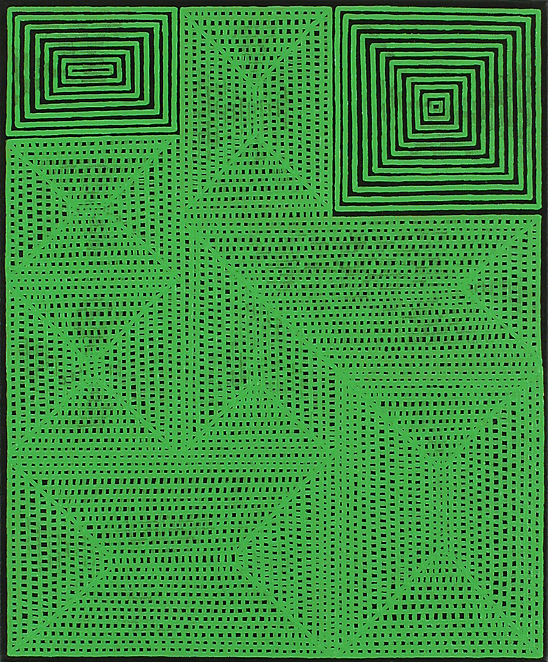
• Pay Attention, 2015, acrylic on linen, 18 x 15 inches

    Pay Attention, 2015, acrylic on linen, 18 x 15 inches

    MEL BERNSTINE

    March 27 – May 3, 2015
    Opening reception: Friday, March 27, 6 to 8 p.m.
    McKenzie Fine Art, Inc.
    55 Orchard Street
    New York, NY 10002

    Bernstine has been making paintings, drawings, and sculpture since 1980, while living in the East Village of New York. Self-taught as an artist, he moved downtown after completing a master’s degree in International Affairs at Columbia University. In the East Village he was part of the music, art and literary scene and published the underground magazine Newave. Bernstine left New York for Los Angeles in 1984, then on to Paris in 1988. Since then, he has been based in France, also spending time in London, Marrakesh, and Berlin. While continuing to make art, he worked a variety of day jobs, finally devoting himself full-time to art-making in 2007.

    Bernstine’s small-scaled abstract paintings and drawings explore his interest in the concept of emergence, the appearance of patterns and complexity from a multiplicity of relatively simple interactions. He creates his work intuitively, beginning with discreet motifs and allowing the composition to emerge organically. As he notes: “While working I focus on the different parts of the whole and try to not get directly involved in the process of composing. I try to set up a situation where a composition will emerge, making itself known after at least 75% of the work is done…. It has to do with generating something that is unpredictable. I am happy when the finished work is alive and many-faceted, but without loose ends… The hope is to find unexpected results and complexity emerging from simplicity.”

    The artist repeatedly explores a variety of visual motifs: gossamer webs and grids of fine lines with undulant movement; concentric geometric patterns; accumulations of discreet grid zones and rectangular shapes; accretions of tiny rectangles resembling tile work or aerial views of imaginary topographies; and energetic and colorful bursts and vortices. In black-and-white checkerboards, Bernstine twists and torques the patterns and fills in the background with parallel stripes. This lends the work a distinctive optical vibrancy as well as visual richness within a limited palette. In other examples, a central checkerboard is executed in two colors and set against a striped ground creating a distinctive spatial push and pull. One large-scale work on paper is included in the exhibition, a diaristic creation combining a variety of motifs in a single work. Because of space constraints in his home/studio, it was created piecemeal without a clear overview, allowing chance to dominate the decision making.

    In all of the work, the evidence of the hand is primary, despite the overall density and attention to detail. Surfaces are taut but the flat plane never dominates. Rhythms of music as well as patterns and pulsations of the urban environment can be felt throughout. Bernstine notes that, “I would like my thoughts (ideas, ruminations, memories, observations, imaginary internal debates and dialogues, analyses and other stream-of-consciousness raw synaptic chatter) to find their way into the work. I trust that they do, though in a way that is mostly indirect.”

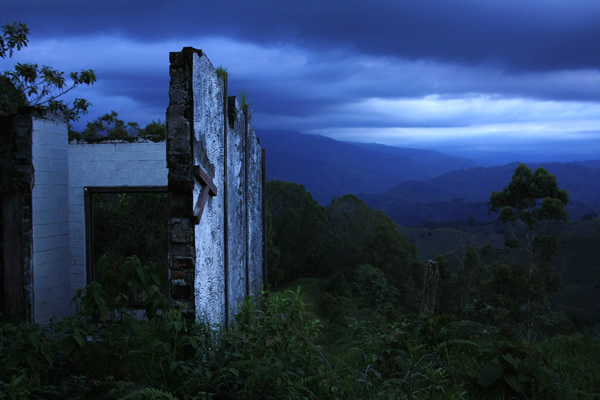
    "Arquitecturas de la memoria – Landazuri", 2013, photographie. © Marcos Avila Forero

    “Arquitecturas de la memoria – Landazuri”, 2013, photographie. © Marcos Avila Forero

    Marcos Avila Forero
    ESTENOPEICA
    Conflictos rurales
    Samedi 4 avril > dimanche 7 juin

    Le printemps s’ouvre au Château des Adhémar avec une exposition consacrée au jeune artiste d’ origine franco-colombienne Marcos Avila Forero.
    Issu de l’Ecole Nationale Supérieure des Beaux-Arts de Paris, Lauréat du Prix Loop 2014 à Barcelone, du Prix des Amis du Palais de Tokyo en 2012, d’une résidence à la Fondation Hermès en 2010, c’est un jeune créateur fasciné par les déplacements des peuples, des idées et des cultures. Ainsi, à une époque de migrations et de flux, Marcos explore les territoires, le contexte politique et social, les récits des individus – véritable matrice de son travail – pour révéler l’imaginaire du voyage et de la mémoire.
    Utilisant des matériaux locaux, pauvres, symboliques, très importants pour le commerce et la survie des populations (toile de jute, palettes, barques, etc.), il s’exprime dans des fresques murales, vidéos, travaux collectifs et mises à l’épreuve, toutes étant chargées de l’histoire des hommes et des traditions et révélatrices de l’identité plurielle qui est la sienne.
    « Chacun de mes travaux commence toujours d’abord par une rencontre, celle d’un lieu, d’un contexte, d’une personne, d’un document, d’une histoire… et c’est à partir de là que le travail commence. Je m’intéresse aux témoignages, aux documents, à l’histoire quand elle est officielle, à l’histoire quand elle est officieuse, au vécu qu’ont gardé certains objets ou certaines matières premières… Tous ces éléments deviennent les outils dont je me sert pour échafauder chacune de mes pièces. L’être humain est le personnage principal. » M. Avila Forero
    Vivant et travaillant à l’année à Paris et à Bogota, Marcos développe dans sa démarche ce mouvement riche d’échanges et de savoirs-faire qu’il matérialise ensuite dans une réactivation des us et coutumes de la Colombie, au sens littéral comme figuré.
    De ce fait, il nous fait basculer dans son histoire questionnant simultanément la tradition et la transmission orale et visuelle.

    Au château des Adhémar, Marcos Avila Forero déploie un panel d’œuvres contextuelles, récentes, en lien  avec l’histoire du « mythe de la caverne », de l’archéologie, de la trace.
    Que ce soit dans la scénographie pensée comme telle ou dans le choix des pièces, l’exposition créé un scénario qui nous fait pérégriner dans un univers aux facettes politiques et aussi poétiques.
    Avec une pratique protéiforme qui englobe la création de fresques murales, de vidéos souvent pensées en installation, de travaux collectifs qui mettent en exergue l’identité plurielle qui est la sienne, Marcos nous offre dans cette exposition une vision riche et multi sensoriel de son microcosme, abordant tant des questionnements sociétaux, qu’identitaires, et plastiques.

    Collaborations
    Galerie Dohyang Lee, Paris ; Galerie GDM, Paris, Galerie ADN, Barcelone.

    L’artiste
    Marcos Avila Forero est né en 1983 à Paris en France.
    Après un cursus à l’école supérieure des Beaux-Arts de Rueil-Malmaison, il intègre l’École nationale supérieure des beaux-arts de Paris (Ensba) dont il sort diplômé en 2010.
    En 2012, il reçoit le Prix Découverte des Amis du Palais De Tokyo, ce qui lui permet de bénéficier l’année suivante d’une exposition personnelle dans l’un des espaces du Palais de Tokyo (Paris). Il voyage en Colombie et travaille avec des populations déplacées par le conflit armé dans un bidonville nommé Zuratoque et réalise une oeuvre et une exposition éponyme.
    En 2013, parrainé par Giuseppe Penone dont il a fréquenté l’atelier à l’Ensba, l’artiste est accueilli en résidence à la Maroquinerie de Nontron en Dordogne (France), dans le cadre de la quatrième édition des résidences d’artistes de la Fondation d’entreprise Hermès. En utilisant les matériaux et les savoir-faire locaux, l’artiste réalise un ensemble de tambours de la culture Palenque, communauté issue des territoires rebelles bâtis en Amérique Latine par des fugitifs noirs à l’époque coloniale. Cette résidence donne lieu à une seconde exposition de son travail au Palais De Tokyo.
    Dernièrement, Marcos Avila Forero a obtenu le Loop Award 2014 lors de la foire internationale d’art contemporain barcelonaise Loop Art Fair (Espagne) pour son film À Tarapoto, Un Manati. Cette oeuvre, engagée dans des questions documentaires et sociales, aborde les mythes du manati, un animal sacré, dans la communauté Cocama en Amazonie. Une vidéo pour laquelle l’artiste s’était déjà vu décerné le Prix Multimédia Des Fondations De Beaux–Arts en 2011.
    En 2015, le Centre d’art contemporain du château des Adhémar consacre à Marcos Avila Forero une exposition intitulée ESTENOPEICA Conflictos rurales. Au cours de cette année, son travail sera montré dans plusieurs expositions personnelles, à l’ADN galeria à Barcelone (Espagne), au CAIRN, Centre d’art de Dignes-les-Bains (France) et à la Galerie Dohyang Lee à Paris.
    Les oeuvres de Marcos Avila Forero sont présentes dans plusieurs collections privées et publiques comme celle de la Fondation d’entreprise Hermès (France), d’Isabelle et Jean-Conrad Lemaître (France) ou le Fonds Régional d’Art Contemporain Aquitaine (France).

    Marcos Avila Forero est représenté par la Galerie Dohyang Lee, Paris et ADN galeria, Barcelone.

    Les rendez-vous autour de l’exposition

    Vernissage le samedi 4 avril ~ 12h. Rencontre avec l’artiste ~ 11h. Entrée libre

    Visites commentées de l’exposition
    Les mercredis et les dimanches à 11h et 15h (sauf les mercredis 15 et 22 avril à 15h)

    Rencontre enseignants
    Mardi 7 avril à partir de 17h30. En présence de l’équipe du CAC, de la professeur-relais 2nd degré et du conseiller pédagogique 1er degré.

    Conférence « Facettes de l’art contemporain : questionnements, société et transmission. »
    Lundi 4 mai ~ 18h30. Avec Béatrix Burlet, historienne de l’art. Avec l’Université populaire de Montélimar. Entrée libre. Réservation : 04 75 52 31 45.

    Nuit européenne des musées
    Samedi 16 mai ~ 19h à 23h. Nocturne et événementiel

    # Aparté
    Samedi 20 juin 2015 ~ 15h
    Rencontre avec l’artiste et Jacques Léopold Brochier, préhistorien au Centre d’Archéologie Préhistorique du Rhône aux Alpes, Valence.
    Entrée libre

    Vacances au château
    Les p’tites histoires

    Mercredis 15 avril et 22 avril ~ 15h.
    Écoute une œuvre te parle ! Plongez dans l’imaginaire du château avec la lecture d’une histoire reliée à l’univers des artistes exposés. Activité accompagnée de jeux et suivie d’un goûter. 6 – 10 ans / 5 € par enfant

    L’art en partage
    Les jeudis 16 et 23 avril ~ 15h
    Enfants, grands-parents, parents : nous vous convions à une visite toute en dialogues et en expérimentations, à laquelle tout le monde peut se joindre et se rejoindre ! adulte 6 – 4 €  / enfant 5 €.
    Réservation : 04 75 00 62 30

    ——————————————————————

    Château des Adhémar – Centre d’art contemporain
    24 rue du château
    26 200 Montélimar
    courriel : chateau-adhemar@ladrome.fr
    Tél. : 04 75 00 62 30 / 04 75 00 62 31
    http://chateaux.ladrome.fr

    Dates et horaires d’ouverture
    Exposition du 4 avril au 7 juin 2015
    Ouverture tous les jours
    10h – 12h30 et 14h – 18h

    Accès
    Située entre Valence et Orange, dans la Vallée du Rhône, la ville de Montélimar se situe à 150 km au sud de Lyon, 50 km au sud de Valence et 80 km au nord d’Avignon.
    Le château des Adhémar se trouve sur les hauteurs du centre ville, à proximité de la chapelle des Carmes. Vous pouvez y accéder en voiture ou à pied (10 minutes depuis la gare, l’espace Saint-Martin et l’office de tourisme).

    Par la route
    En venant du sud :
    Autoroute A7, Sortie 18 Montélimar Sud puis suivre direction Montélimar centre.
    En venant du nord :
    Autoroute A7, Sortie 17 Montélimar Nord puis suivre direction Montélimar centre.
    Suivre indications « cimetière » vers le « château des Adhémar ».

    Coordonnées GPS : N : 44.56 E : 4.755
    Lien Google maps

    Tarifs
    Plein tarif 4 €
    Tarif réduit 3 €
    Gratuité pour les – de 18 ans

    Tarifs scolaires
    Visite : 30 € forfait par classe
    Visite-atelier : 40 forfait par classe
    Pass expo : 40 € forfait annuel par classe
    Sésame : gratuité pour les écoles primaires de la Communauté d’Agglomération de Montélimar

    Le château départemental des Adhémar – centre d’art contemporain bénéficie du soutient du Ministère de la Culture et de la Communication (DRAC Rhône-Alpes) et de la région Rhône-Alpes.

     

    Take a look at the entire series here: vimeo.com/channels/makingart

    Making Art New York, Alyssa Monks, Brooklyn, New York

    “We need to feel like we belong to this experience, we need to know our place, we need to know where we fit. We need to feel that we’re accepted for who we are. So the goal you may think is to, get a show, get press or to make money or to have fame. But it’s not, the thing we all really want is to feel connected.”

    You can find out more about Alyssa here: alyssamonks.com

    Music courtesy of Lerin Herzer, Andrew Joslyn and Podington Bear (podingtonbear.com/)

    For more information about Brass Brothers Films go to brassbrothersfilms.com.

    Connection from Jesse Brass on Vimeo.


    Smith Smith - Light my Fire

    Smith Smith – Light my Fire

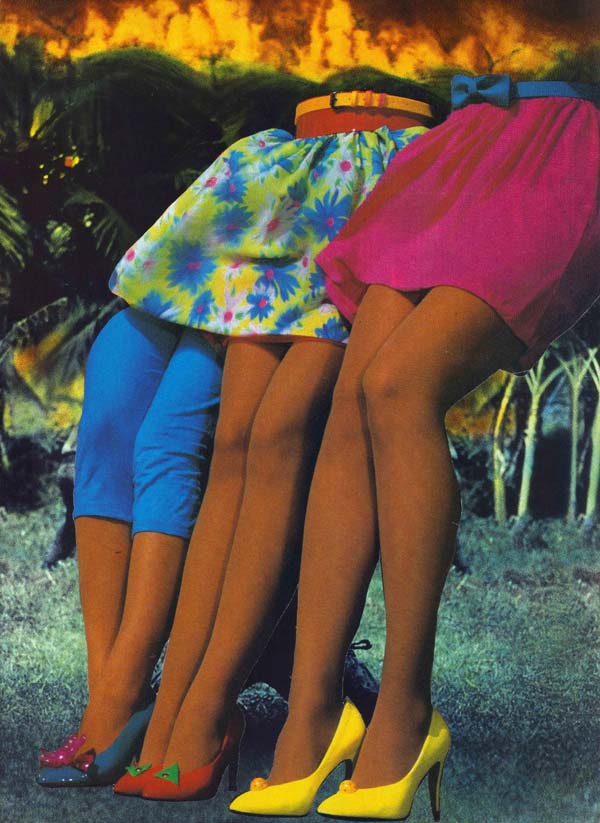
    The first bits of paper that I have collected and glued together were pictures of my idols, Kurt Cobain, Jim Morrison, Jimi Hendrix. I was 14 and I absolutely did not want to lose those pictures of them so I started to assemble them religiously…
    20 years later I continue! It became a means of expression in itself, a playground for my life.
    I love the beauty of the absurd, humor, surrealism and provocation. I love working in the construction as well as the deconstruction of an image… When I approach the creation of a collage I have no specific technique, sometimes I know what I want, sometimes I listen to what the images tell, sometimes I cut hundreds of bits of paper and other times of the sets. But at the end of the story, I wish one thing, I want the both form and content…
    Collage = Freedom of Thought

    To find all my collages : Smith Smith Tumblr
    To understand who I am : Smith Smith Official Website

    Monet’s painting confirmed genuine by using SPECIM’s hyperspectral camera.

    23 March, 2015. The 1891 work ‘A Haystack in the Evening Sun’ was found to be a genuine piece of Claude Monet’s work by researchers at the University of Jyväskylä in the Department of Mathematical Information Technology. The research team revealed a layer of paint over Monet’s signature, and year of the oil painting by using a hyperspectral camera developed and produced by SPECIM.

    The painting has been owned by the the Gösta Serlachius Fine Arts Foundation since the 1950’s but it has not been authenticated so far because the signature is covered by paint.

    The work was examined at the University in the Recenart – Research Center for Art multidisciplinary project in Mänttä. The study used the hyperspectral camera with an XRF device, which tells of the work’s elemental composition.

    “The hyperspectral camera took an image of 256 different wavelengths simultaneously in the near-infrared region. This wavelength region is not visible to the human eye. Many of the painting’s pigments which have been used and are still used today are there in the wavelength range which is partially and even completely transparent. In this case, the light reflection can be measured from the surface layer and deeper” says researcher Ilkka Pölönen.

    “The camera is principally operating as a scanner, which scans one line at a time. The optics includes a prism structure which diffuses the light’s wavelength order, a custom-made sensor is used capable of recording infrared radiation. When the camera is moved using the scanner an image of the whole picture can be obtained.”

    The camera produces one table with the large number of spectral data. Monet’s signature was applied to the data spectrum separation methods, which have been studied in the international research. “Spectral imaging and its many applications has been a favourite area of research. Two dissertations have already been published on this subject and have dealt with, among other things, medical and environmental science applications”, says dean Pekka Neittaanmäki.

    The news story was published in Keskisuomalainen.


    I first became interested in sound art well before I became interested, or even knew anything about, curating.  However I was heavily influenced from a relatively young age by considerations that are essentially curatorial. I’ll have to give you a bit of background. In the late ‘80s I spent the school holidays in Kuwait. The Western movies, toys and games on sale there were generally bootlegged copies. All the movies we would hire from the local video store were pirated in blank sleeves and all you had to choose from were the titles. Everything was otherwise identical. When you eventually watched the films themselves they were often heavy edited to remove sex, nudity, or scenes that might be politically sensitive. These edits were made regardless of how they would affect the narrative of the story; there would suddenly be a chunk missing. Characters in films would mention events that had been excised by the censor and so these mentions could take on a bizarre significance.

    Likewise videogames also seemed to exist in an alternate universe with names of the Atari 2600 cartridges were often misspelled with surreal effects. Superman became Suppermen; Spider Fighter became Spider Fitter; and they would have completely unconnected images stuck onto the cartridges. It all felt experimental and interesting. I believe this had an immense influence on how I would start to perceive cultural artifacts. Nothing was sacred or could be considered complete, and sometimes that incompleteness could be more meaningful or profound. Everything was fair game. So I started to make my own edit tapes of audiotapes: bits of pop songs, cut in with bits from radio plays, messing about with recording techniques. When the first gulf war broke out I forgot about it for a bit but I eventually came back to this a few years later while I was studying for my degree in Fine Art.

    I started making tapes again but pushed the experiments further and incorporated more of my own ambient recordings into them. I thought I was being quite radical. It was only when I was introduced to William Burroughs’ tape experiments from the ‘60s and ‘70s that I realized how much of this ground had been covered. His arrangements of audio material kicked off my interest in this work as a curatorial process.

    I still occasionally make things now, but usually only for specific purposes or as a collaborative activity. My practice developed along lines that are seen as consistent with the kind of things a curator might do, so I prefer to see these activities as curatorial. When making things it’s easier to have a frame that makes more sense to more people.  Most of what I currently do would be classified as coming under the job description of the curator, so even when I make something that might be art I prefer to not call myself an artist. It makes explanations more convoluted than they need to be.

    The majority of spaces in which I work are spaces that favour visual art forms. The demand for maximized flat wall spaces in art galleries is not particularly kind to the way sound bounces about. Also the relationship sound art has with technology cannot be overlooked. The aestheticisation of technology; speakers, amps, wires, etc; versus some kind of pure acousmatic, spiritualist manifestation of sound … I am often surprised about how the presence or absence of things in space can end up becoming decisions made by curators or by budgets. I’m not sure this is the best way to go about it.

    Obviously sound is less easily contained than images and more difficult for visitors to ignore. This and the time-based nature of sound is part of the problem with participation. It can inherently distance the visitor from any sense of interactivity with regards to the way they may choose to navigate sound work. In your average painting show the visitor has much more freedom to navigate their way around the material. In comparison, sound can become quite authoritarian. This is something I try to avoid as much as possible, often at the risk of appearing abstruse or illogical in how the exhibitions I work on might hang together or where individual works begin and end.

    One of the main threats to authorial intention in sound is the problem of exhibiting multiple works, particularly in art galleries. These are spaces created to be able to see things well whether they were purpose-built gallery spaces or converted warehouses, shops or power stations. This makes curating sound works for group exhibitions an ecological exercise, things must become part of a broader composition. There are some works that are, of course, able to do this better than others. Navigating these issues is frequently about how much of the work’s autonomy the artist might be willing to let go of. Sometimes this can be to the point at which the work is reduced to being only a hint of what it could be alone, but this is not necessarily a bad thing. It is good for art to talk to each other, even if this ends up becoming messy. Who wants to be alone?

    Headphones are a common retreat to retain some kind of autonomy, but they are alienating devices. Artists who make work specifically for headphones, such as Janet Cardiff or Christina Kubisch, demonstrate how crucial it is for sound artists to be aware of the impact the technology has on the environment of the exhibition. John Cage’s famous silent composition 4’33” reminds us of how the often subliminal noises of the audience are part of the experience. What is the purpose of being in a sound art exhibition if the space around us and the people and objects we share it with are ignored? Works like Cardiff and George Büres-Miller’s The Muriel Lake Incident from 1999 are significant in this respect. The Muriel Lake Incident not only plays the soundtrack of the film the one is watching but also chucks in some exceedingly disconcerting audience noises. Experiencing that work was a really important thing for my understanding of curating sound. I remember someone laughing behind me and turning around with one of those spontaneous smiles that appear in awkward social situations only to find that there was no one there and it was all on the tape. I might just as well have ignored that laugh or made a mental note that I was sharing the gallery with idiots. These different responses to an imagined threat had a huge impact on my thoughts about the use of sound art in a gallery.

    I’m also very interested in audio archives and how they are reshaping the kinds of things we might put in art galleries as artistic propositions. I’ve mentioned Burroughs, and have curated a number of exhibitions involving his tape experiments, but I’ve always wanted to do an exhibition that would have, at its center, tape recordings by Andy Warhol. I went to a lecture by the art historian Jean Wainwright, who is an expert on Warhol’s tapes, but when I contacted her afterwards she told me that there’s an embargo on them for at least another 20 years or so. Warhol is a specific case, but there is an interesting apprehension in such things being made public. Time-based materials made in such quantities are expensive for estates to vet. Yet re-evaluating such things now that there is more of an awareness of the potentials of sound as art is a really interesting place to be.

    Of course sound art is still regarded as a niche art form and a little bit mischievous. I still regularly come across the preconception that sound artists are ill-disciplined iconoclasts making a noise in a space for quiet contemplation. Also the way people are used to engaging with things in art galleries seems to come more from a visual approach to meaning-making. Art galleries are not just spaces for displaying art, they serve a whole load of other functions for visitors and sound art can get in the way of this. It’s harder to socialize and to teach, for example, when you have to also just listen. To speak about a piece of sound art you often have to turn it off or, as it’s time-based, interrupt a moment that your companion might never get back. But these are not necessarily limits.  It might be more valuable for visitors to an art gallery to be aware of just how complex the experience they are having can be. Sound art seems to be a very good way of exploring this.

    Having said that I’m more interested in inter-media projects than projects that are only about sound. Many years ago I spent a lot of time recording the sounds around famous paintings, and they revealed to me things that the visual record alone couldn’t. People make very distinct noises around specific types of visual work. How the visual, the aural, and the tactile work together is more interesting to me than prioritizing only one of these things.

    The Internet seems to be an integral battleground in how contemporary artists are articulating their relationship to sound and the relationship of sound to other arts practices. I’m working on an exhibition at IMT Gallery in London with a young Danish sound artist called Lotte Rose Kjær Skau. She comes from both a musical and a sound art background, yet what’s exciting about her work is how visual it is and yet how it still feels fundamentally to be about sound art. I like the fact that it doesn’t necessarily matter. Sound art is a comparatively recent articulation of something people have been doing for a long, long time; it seems a shame to be purifying it into a separate discipline now. Artists like Kjær Skau are beyond that.

    By Mark Jackson

    unnamed

    IEVGEN PETROV
    BREAKWATER

    Exhibition “PIER” by IEVGEN PETROV, 2013-15
    Hyperrealistic series of watercolors and sculpture.

    Галерея сучасного мистецтва ЦЕХ

    Київ, вул. Фрунзе 69
    +38 044 591 13 69
    www.tsekh.com.ua

    Any crisis, a chronic one in particular, provokes a reaction. An
    artist is not an exception to this. For Petrov, this reaction is
    embodied in the project “Pier” which he started back in 2013.
    Under these extremely difficult circumstances there was no
    surprise in the choice of the topic.
    Petrov believes that as long as the language of description of
    Maidan and the war is not established and is only expanding its
    vocabulary, the artist’s reaction to these topics is secondary and
    cannot be more relevant that the events themselves; moreover,
    it resembles illustrations to a cheap magazine which does nothing
    to contribute to emergence of this language. Petrov prefers to
    abstract. And the pier is a perfect place for that.
    Over a long period of time of working on the project Yevgen
    noticed that increasingly more people appeared on the pier. The
    pier, in fact as before, remained the main free attraction and the
    scene of beach performance; now it has replaced a confessional
    and mediation mat for people, and Petrov himself replaced the
    usual story component focusing on an inanimate object for the
    first time.

    People are considered in the same ontological plane with seagulls,
    waves, tires, and ice blocks. In the “Pier” Petrov builds an orbit
    with many different equal actors where the pier is central. And
    while we are watching interactions of real object behind the
    curtains slightly opened by Petrov, we start to perceive this rough
    piece of concrete burnt on canvas with watercolors as a sensual
    object.

    Geller Sasha

    Finding exciting emerging artists online can be quite the daunting feat, as nearly any person can put their work online, only to have it drift away into the obscurity that is the millions of sites that exist to show artwork. NY Arts wants to bring some of those sites back from the deep recesses of cyberspace, pulling them together into a useful directory where art resources are pooled, becoming more easily accessible.

    We will update the page regularly, adding fresh sites each week. Check back soon to see an exciting new crop of artist websites.

    http://www.adamgallery.com/
    http://www.alancristea.com/
    http://www.alisonjacquesgallery.com/
    http://www.annelyjudafineart.co.uk/
    http://www.anthonyreynolds.com/
    http://www.artangel.org.uk/
    http://www.artfirst.co.uk/
    http://www.beauxartslondon.co.uk/
    http://www.broadbentgallery.com/
    http://www.browseanddarby.co.uk/
    http://www.byardart.co.uk/
    http://www.carlfreedman.com/
    http://www.corvi-mora.com/
    http://www.doffay.com/
    http://www.emmahilleagle.com/
    http://www.flowersgallery.com/
    http://www.fosterart.net/
    http://www.gasworks.org.uk/
    http://www.generalhotel.org/
    http://www.gimpelfils.com/
    http://www.greengrassi.com/
    http://www.halesgallery.com/
    http://www.hartgallery.co.uk/
    http://www.hauserwirth.com/
    http://www.ica.org.uk/
    http://www.jacobsongallery.com/
    http://www.jerwoodspace.co.uk/
    http://www.jillgeorgegallery.co.uk/main_pages/frameset.htm
    http://www.lemonstreetgallery.co.uk/
    http://www.lissongallery.com/
    http://www.marlboroughfineart.com/
    http://www.maureenpaley.com/
    http://www.maxwigram.com/
    http://www.messums.com/
    http://www.mummeryschnelle.com/
    http://www.purdyhicks.com/
    http://www.sadiecoles.com/
    http://www.sarahmyerscough.com/
    http://www.sorchadallas.com/
    http://www.southlondongallery.org/
    http://www.spruethmagerslee.com/home
    http://www.stephenfriedman.com/
    http://www.stuartshavemodernart.com/
    http://www.theapproach.co.uk/
    http://www.thefineartpartnership.co.uk/
    http://www.themoderninstitute.com/
    http://www.thomasdane.com/
    http://www.timothytaylorgallery.com/
    http://www.victoria-miro.com/

    The Roving Eye
    By Tony Zaza

    BE NOT INHOSPITABLE TO STRANGERS LEST THEY BE ANGELS IN DISGUISE.

    The Better Angels, Terrence Malick’s silent black and white movie restores the
    promise of cinema as a medium that can invade conscience.  Once viewed psychic
    apathy is impossible. Poetically bleak and somber, the coonskin voiceover narrative
    conveys a kind of hillbilly incantation of loss.  It’s not a film to toy with your
    passions or your sense of storytelling.  You must bring imagination and take the
    warning, we are no longer pioneers, just consumers.
    Profiling of Lincoln’s boyhood in 1817 Indiana, The Better Angels seeks a more lofty
    goal, invoking condolences  for our romantic notions of freedom and democracy.  It’s
    the first movie with a heart since 1999.

    Malick was the one of a trio of aspiring filmmakers born of  prehistorical USC  that
    includes Speilberg and Lucas.  His gift  unlike the others was solemnity of spirit and
    its brought to full fruition here.  He’s fashioned a lament not just for the loss of the
    simple life, but for the demise of civility.

    Thursday, March 19, 2015

    6:30–8pm
    ICI Curatorial Hub
    401 Broadway, Suite 1620
    FREE and open to the public

    Dread scott headshot.  Malik Cumbo photographer Aug 2011

    Last October, between the non-indictments for the killers of Michael Brown and Eric Garner, artist Dread Scott performed “On the Impossibility of Freedom in a Country Founded on Slavery and Genocide,” a reenactment of iconic Civil Rights movement images of protesters pummeled by fire hoses (1). The performance took on a new resonance, an open-ended meditation on how to resist state brutality towards black lives. A few months later, in the midst of the #blacklivesmatter movement, millions of dollars changed hands at Art Basel Miami, a celebration of arts commerce largely indifferent to that historical reckoning.

    The timing of these events rendered visible a vast gap in contemporary approaches to arts and culture. Scott’s goal, to “make revolutionary art to propel history forward,” offers an alternative to the market-driven, sanitized work of the global art circuit. In a presentation and conversation around Scott’s work, he and curator Ryan Wong will discuss the imperatives of art-making in revealing the roots of radicalized violence, and the role of protest images in moving history forward.

    (1) This performance was produced by More Art and took place on October 7, 2014 underneath the Manhattan Bridge Archway in DUMBO.

    This event is free and open to the public. To attend, please RSVP to rsvp@curatorsintl.org with DREAD in the subject line.

    News | Exhibitions