Ubiquitous Object, Ambiguous Things –
Resisting Disappearance
Julie Shiels
April 2 – May 2, 2015
Opening Reception: Thursday, April 2 from 6-8 pm
547 W. 27th Street, #210 / acinstitute.org
Wed – Sat 1pm to 5pm
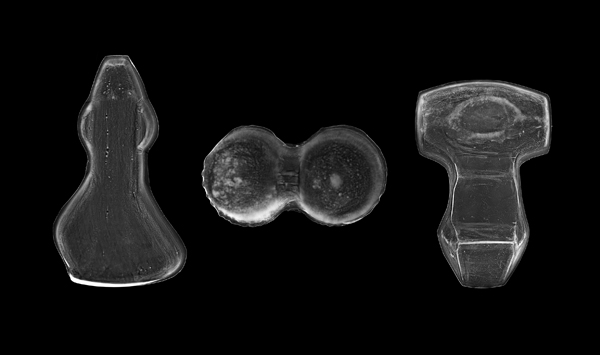
Ubiquitous object, Ambiguous Things – Resisting Disappearance is derived from the empty space found in clearplastic packaging. The transparent form of the empty vacuum package is both an object in itself and an echo of the commodity it once encased. In this exhibition, Julie Shiels attempts to reproduce the empty space left behind by consumption.
The voids in these ready-made molds have been amplified and transposed using two ephemeral materials: light and dried plaster. Shiels uses a combination of photograms and loose caste objects to visualize a trash item in a way that can be perceived beyond its status as commodity. The project seeks to reflect on the temporality, the materiality and the mutability of waste.
Biography
Julie Shiels has a Masters of Art from RMIT University (2006) and is currently completing a PhD at the Victorian College of the Arts in Melbourne, Australia. Julie has exhibited nationally in Australia and internationally. She has undertaken funded residencies at Red Gate Gallery in Beijing, China (2010 Toyota Travel Prize), and Hanoi, Vietnam (1997, Australia Council).
Her work has been acquired by public collections including National Gallery of Australia, State Library of New South Wales, State Library of Victoria, Baillieu Library (University of Melbourne), Australian Embassy, Hanoi, Vietnam, City of Banyule and Port Phillip Art Collections and many private collections.
There are a lot of thrills in “Diego Rivera and Frida Kahlo in Detroit,” a tightly focused exhibition exploring the 11 months that the married couple spent working here in 1932-33.
But what’s most exhilarating about the show, which opens Sunday at the Detroit Institute of Arts, transcends the numerous knock-out works by both artists. And it goes beyond the deeper understanding that emerges of their relationship to each other, their shared Mexican roots and the impact that Detroit had on their lives and art.
As the first major exhibition since Detroit exited bankruptcy, the show carries a celebratory aura that’s hard to describe but will feel palpable to anyone who rode the roller-coaster of emotions with the DIA saga during the bankruptcy. It’s a victory lap for a museum — and a city — that spent most of the last two years in an existential crisis, fighting to protect its irreplaceable treasures from liquidation.
Walking through the galleries reminds you just how close Detroit came to losing a cornerstone of its cultural soul — especially because the creation of the DIA’s signature work, Rivera’s magnificent “Detroit Industry” murals, is one of the central narratives of the show. The political parallels and divergencies between then and now are unavoidable.
Of course, the timing is serendipitous. The Rivera-Kahlo show has been in the works for years, long before anyone knew how or when the cliff-hanger might end. Had the winds blown differently, the exhibition might instead seem more like a last meal before the march to the scaffold.
When Rivera and Kahlo arrived in Detroit at the height of the Great Depression, the city-owned museum was struggling to stay open, although a close read of evidence shows no serious talk of selling the art. Visionary director William Valentiner invited Rivera to Detroit and Edsel Ford put up the artist’s eye-popping fee of $20,000 ($350,000 in today’s dollars).Rivera and Ford — the communist and the capitalist — looked like an odd couple, but they shared common ground, mutual respect and convergent agendas. Both believed industry was a key to human progress, both believed in the power of art to change lives. Ford, a cultured man and enlightened industrialist, also may have seen the commission as a peace-making gesture with labor at a time when Ford security guards and Dearborn police shot and killed five unarmed workers and injured dozens of others in a hunger protest. Rivera believed his revolutionary art could reform capitalism from inside the belly of the beast.
Frida Kahlo, “Frieda and Diego Rivera” (1931), oil on canvas, 39 3/8 x 31 in, San Francisco Museum of Modern Art, Albert M. Bender Collection, Gift of Albert M. Bender (all images courtesy Detroit Institute of Arts unless otherwise noted)
But never forget how brave and farsighted Valentiner and Ford were in turning a mid-career contemporary artist and self-described Marxist loose on the DIA’s central courtyard to depict Detroit history. The DIA had only moved into its Paul Cret-designed Beaux Arts home on Woodward Avenue five years earlier in 1927. Would any leadership at any American museum today take such a risk?
Organized by DIA adjunct curator of contemporary art Mark Rosenthal, “Diego Rivera and Frida Kahlo in Detroit” includes about 65 paintings, drawings and prints. Brief summaries of the artists’ trajectories before and after their time in Detroit frame a hefty central chapter on work created in the city.
There are regrettable omissions — no example of Rivera’s trenchant early abstract cubist works, no mention of other relevant art history currents like surrealism, no reflection of Kahlo’s posthumous rise to feminist sainthood or pop culture status. Still, Rosenthal’s selection of work and detailed interpretive arguments in his sharp catalog essay are illuminating. The bonus of remarkable historical film footage, including Rivera at work at the DIA, adds to the time-capsule vibe.
The artists were at separate points in their lives and careers in 1932. Rivera, 45, was at the peak of his international fame and powers as a muralist; Kahlo, 24, was just beginning to establish her artistic identity. For most of the exhibition they work in separate cocoons: Rivera on the public stage, Kahlo looking inward, translating her private emotional and physical pain into intimate pictures of shattering emotion.Rivera plots an incredibly sophisticated program for the 27-panel fresco cycle he will paint across the four walls of the courtyard. It’s so damn exciting to see his ideas coalesce in the rarely seen and breathtaking life-size preparatory drawings for the murals. These charcoal-and-pigment works reinforce Rivera’s intelligence, ambition and masterful draftsmanship — look at the expressive confidence of his lines and weight of his curvacious forms.
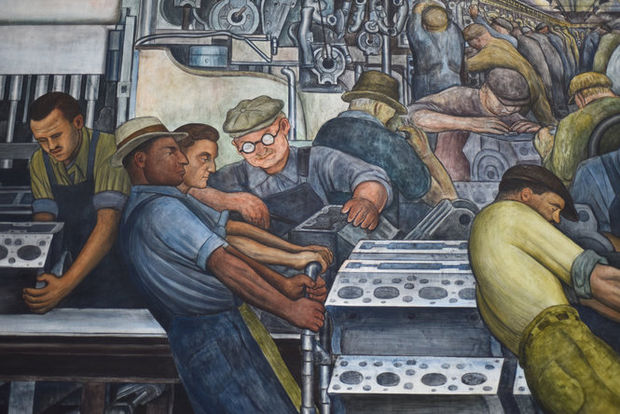
Diego Rivera, detail of ‘Detroit Industry’ north wall (1932)
The murals depict the heroism of the Ford assembly line workers, a subject close to Rivera’s proletarian heart. But he also integrates science, medicine, biology, industry into a utopian synthesis of North American industrial might and Mexican spiritualism. Dualities percolate: Poisonous gas bombs and life-saving vaccines, the soulless mechanization of labor and the promise that mass production of products like cars will elevate lives of common folk.
Rivera’s worldview was complicated and contradictory, but the fundamental optimism that shines through “Detroit Industry” is striking. After Rivera left Detroit for New York, where his Rockefeller Center mural was destroyed for its inclusion of the Soviet leader Lenin, Rivera’s outlook darkens. In the revealing watercolor “Mechanized Motherhood,” Rivera inserts a cubist-like machine into a mother’s womb to symbolize capitalist exploitation.
Kahlo made five paintings in Detroit, and the DIA has gathered three of them, as well as numerous other drawing and paintings. The gender-bending “Exquisite Corpse” pencil drawings she made in 1932 suggest an artist on the brink of something. But what?
Rivera implored his wife to paint her life. Kahlo suffered a miscarriage in July and the painting she soon made, “Henry Ford Hospital,” remains definitive: a beautiful nightmare in which she lies naked on a bed in a pool of blood, six umbilical cords connected to hovering symbols, including a fetus. The images of Detroit factories manifest Kahlo’s own radical politics, connecting the dots between her tragedy and the evils of capitalism.
Kahlo’s formal command sharpened after Detroit. The famous “Self-Portrait with Cropped Hair” and hallucinatory “Suicide of Dorothy Hale” gain power from a concentrated authority and seductive marriage of the confessional and the impervious. It’s the same attitude of countless modern celebrities, among them Madonna (a Kahlo collector). No wonder Kahlo has been embraced by pop culture.
But Rivera still remains the bigger star in Detroit. When “Detroit Industry” opened to the public, religious leaders called the murals blasphemous and obscene and many upper-crusters objected to the artist’s lefty politics. Newspapers called for the murals to be whitewashed. But Ford spoke in defense of art, and working men vowed to form a protective shield around Rivera’s masterpiece.
Eighty years later, the community again rallied to the defense of art, as foundations, civic leaders and state politicians forged a grand bargain of $816 million to protect the DIA from municipal creditors. The DIA, especially the murals, is indivisible with the identity of Detroit as a tough, hard-working city that can take a punch.
Galerie Lelong is pleased to announce its first solo exhibition by the Lebanese-born artist and writer Etel Adnan. Adnan’s vibrant, expressive paintings, works on paper, and tapestries demonstrate her commitment to communication beyond the confines of the written or spoken word, and her use of color, shape, gesture, and perception help to create the landscapes for which she is well known in a variety of media. For the first time in New York, a film by the artist will also be on view in the exhibition. Galerie Lelong will host an opening reception on Thursday, April 2, from 6pm to 8pm.
Color and light are the two dynamics that inform Adnan’s ongoing series of landscape paintings of Mount Tamalpais (Marin County, California). Adnan has said that “light is everything for me,” and the sunlight expressed in her paintings and other works is often symbolized by a red rectangle or square. Having left home at an early age, Adnan’s interest in and exploration of physical and emotional diaspora is evident throughout her work, with the concept of returning to a place strengthened through memory. As one of the most important voices in Arab and Arab-American literature, Adnan’s accordion-fold books (leporellos) fuse her visual and linguistic prowess, which Galerie Lelong will present along with one of the artist’s tapestries. Translating the rich colors and delicate sensory shifts of her paintings and works on paper to wool, Adnan’s tapestries recall the vibrant Persian rugs of her childhood.
Equally an artist, social observer, and commentator, Adnan was born in Lebanon in 1925 to an Arab father from Damascus and Greek mother from Smyrna. After being educated in Beirut, at the Sorbonne, the University of California, Berkeley, and Harvard University, Adnan returned to Lebanon in the early 1970s. Six years later, after the first year of the Lebanese Civil War, Adnan moved to Paris where she currently lives and works.
Adnan’s work has been exhibited widely. Last year, The Mathaf: Arab Museum of Modern Art in Doha, Qatar, presented the largest exhibition of her work to date with the retrospective Etel Adnan in All Her Dimensions, curated by Hans-Ulrich Obrist. According to Obrist, Adnan is “one of the great poets of her time and also a wonderful visual artist: so she bridges these two things. . . . What is so key about Etel is also how many artists of the younger generation she inspires. . . . She is an artist’s artist.” Adnan’s inclusion in the 2014 Whitney Biennial garnered significant critical praise, and in 2012, Adnan presented in Documenta (13), where she was also a Documenta resident artist and writer. Adnan authored a volume of Documenta’s notebook series, 100 Notes – 100 Thoughts, and in 2014, Nightboat Books released a two- volume edition of Adnan’s collected writings. Galerie Lelong will present a solo exhibition of Etel Adnan’s work in Paris from February 12 to March 28, 2015. A catalogue will be produced in connection with the exhibition, featuring texts by Hans-Ulrich Obrist, Jean Fremon, and Cole Swensen. Galerie Lelong will organize a solo presentation of Etel Adnan’s work at the ADAA Art Show at the Park Avenue Armory from March 4-8, 2015. Adnan’s work is currently on view at the Museum der Moderne, Salzburg, through March 8, 2015. The gallery will also host a reading of Adnan’s poetry in conjunction with her exhibition in April.
Galerie Lelong
528 West 26th Street
New York, NY 10001
T 1 212 315 0470
Founded in 1986 by a group of artists, Momenta Art is an artist-run not-for-profit organization that provides a space for presentation and dialogue to inspire challenging ideas about how we envision the world. Momenta Art has remained focused on alternative programming by utilizing visual presentation as a platform for public dialog through panel discussions, performances, screenings and workshops. By often presenting projects that ask difficult questions, we seek to act as a catalyst to promote the positive transformation of our society.
Momenta Art
GALLERY HOURS:
THURSDAY – SUNDAY 12-6PM
56 BOGART STREET
BROOKLYN, NY 11206
718-218-8058
info@momentaart.org
Robert Murray, Double Diamond, 2013 painted aluminum and wood, 13″ x 21 x 10″
ROBERT MURRAY
TORONTO
20 MARCH to 18 APRIL 2015
OPENING RECEPTION 20 MARCH, 6pm to 9pm
ARTIST REMARKS 7pm
Barbara Edwards Contemporary, Toronto is pleased to present a solo exhibition of works by Senior Canadian sculptor, Robert Murray. Murray is known for his iconic steel sculptures that form a significant contribution to the postwar debates on abstraction, industrial fabrication and public art. This exhibition will feature a selection of small scale sculptures and works on paper.
Robert Murray, considered one of the most significant sculptors of his generation, was born in Vancouver in 1936. He studied at the University of Saskatchewan’s Regina College of Art and was an active participant in the Emma Lake workshops led by critic Clement Greenberg, Jack Shadbolt, Will Barnet, John Ferren and his longtime friend Barnett Newman. Newman encouraged Murray to move to New York in 1960. He currently resides in West Grove, Pennsylvania.
Murray’s work is included in major museum and private collections throughout Canada and the U.S. including: the Whitney Museum; National Gallery of Canada; Art Gallery of Ontario; Montreal Museum of Fine Art and the Metropolitan Museum of Art, to name only a few. Murray was honoured with a major retrospective by the National Gallery of Canada in 1999 and received the Order of Canada in 2000.
Cara Perlman’s finger-paint portraits spotlight a moment in the early 1980s when Times Square took its place alongside the Lower East Side and the South Bronx as a New York neighborhood important to artists. Many of the portraits are of Perlman’s friends in Collaborative Projects Inc. (COLAB), an artist group that in the summer of 1980 organized the now-famous Times Square Show in which Perlman participated. Others are of Times Square locals who frequented Tin Pan Alley, a basement bar located near the TSS show, which became popular with artists, and where Perlman worked as a bartender.
Perlman’s goal to make a vital art connected to real life was shared by other young artists working in the late 1970s and early 1980s. Her portraits present some of the key players of this new generation and remind us of the important role played by Tin Pan Alley, a bar that rose to maturity in the wake of the Times Square Show and extended the creative discourse that began there. Painted directly from life these finger paint portraits can be admired for their expressive vitality and virtuosity. This online exhibition includes portraits of Tin Pan Alley founder Maggie Smith, bartender Nan Goldin, cookKiki Smith and other artists connected to the bar.
Momenta Art’s Spring Benefit 2015 will take place on Thursday, April 23rd at Momenta Art at the renowned 56 Bogart Building, the location of the burgeoning Bushwick art scene.
The Spring Benefit raises essential operating support for all of Momenta’s programs, supporting Momenta Art’s mission to provide an engaging forum for public dialog and participation through critically-engaged art projects by emerging and underrepresented artists.
The Benefit features a two-week exhibition of over 150 artists’ work that will be raffled at the final event, by the performer Breyer P-Orridge, and an online Paddle 8 auction of 25 established artists. The raffle exhibition takes place from April 3rd until the raffle auction on April 23rd, and the online auction takes place from April 16th through April 30th. Tickets are available for $225 until the benefit exhibition opens on April 3rd, and $275 thereafter until all tickets are sold. There is also a special “Buy It Now” ticket for $950 to purchase an artwork outright during the preview exhibition.
Featured Paddle 8 artists (25 in total) include: Andrea Belag, James Biederman, Lauren Ewing, Tamara Gonzales, Margrit Lewczuk, Thomas Nozkowski, Ann Pibal, Joanna Pousette-Dart, Greg Sholette, Michael Scoggins, and Stephen Westfall
Featured raffle artists (150 in total) include: Lovett Codagnone, Oasa Duverney, Chitra Ganesh, Eric Heist, Chelsea Knight, Shaun Leonardo, Leah Oates, Martha Rosler, Mira Schor, Peter Scott
On Kawara – Silence at the Guggenheim Museum in New York City was always going to be one of the most significant exhibitions of On Kawara’s career.
After all, it is the first fully representative survey of five decades of the artist’s practice, which focuses on exploring time and our different perceptions of its scale. The Japanese-born artist, based in New York City since 1965, worked closely with the Guggenheim on this exhibition and his presence is clear throughout its narrative.
However, the death of Kawara in July last year, only seven months before the exhibition opened, now changes the context of that story: On Kawara – Silence is no longer an exploration of an artist’s ongoing practice, but an elegy that maps an artist forever absent and a life now complete.
Kawara is perhaps best known for his series of Date Paintings, which form the longitudinal body of work titled Today. Each canvas in this extensive series carries nothing but a line of white text on a dark coloured background conveying the date it was created.
The Date Paintings begin on January 4, 1966, the year after Kawara moved from Japan to New York. In the book that accompanies the exhibition, Maria Gough notes that, “There are no published photographs of On Kawara after 1965”. It is as though this date marks the rebirth of Kawara as a data-generating entity, which ceaselessly maps and traces itself through space and time.
Daniel Buren says in his essay for the book:
On Kawara was not born on such and such day and such and such year like everyone else. Rather, as he would have it, he indicates on August 31, 2002, he was aged 25,453 days.
We rarely count time in thousands of days, instead using smaller numbers of years, which we conceive as a cycle rather than a succession of days. It’s an uncommon approach to time that disrupts how we usually conceive and contain time.
On Kawara, MAY 20, 1981. “Wednesday.” New York. From Today, 1966–2013. Acrylic on canvas, 18×24 inches (45.7x61cm). Pictured with artist-made cardboard storage boxes, 24 5/8 x 18 5/8 x 2 inches (62.5×47.3x5cm). Private collection. Photo: Courtesy David Zwirner, New York/London. Guggenheim
The Date Paintings form the backbone of On Kawara – Silence, beginning with the January 4, 1966 canvas, and continuing up the Guggenheim’s spiralled ramp. The Guggenheim is a notoriously difficult exhibition space. Unlike most “white cube” style galleries, which guide the audience from room to room, the Guggenheim has a continuously sloping ramp that corkscrews from the ground to the top of the building.
Many Guggenheim shows are organised from the top down (take the elevator up and walk down), but On Kawara – Silence climbs up the spiral, with its side rooms creating intervals that group together works into sections, such as Kawara’s Paris-New York Drawings, his Codes works, which use private ciphers to create coded messages and his Journals, a detailed inventory of his Today series since 1965.
As the audience climbs the ramp, they pass three months of Date Paintings from 1970 (January 1 to March 31). In reproductions, Kawara’s Date Paintings often seem sterile, aesthetically dry and – let’s be frank – dull. This is the curse of much conceptual art work, where the focus is the idea, not the art object or the way it looks. But in the flesh, these works are unexpectedly beautiful in their execution.
As Jeffrey Weiss notes in the catalogue, “the paintings are slowly crafted in multiple layers”. The hand-painted lines that render the text are delicate and accurate; the canvases are flawlessly constructed. Although, as Weiss says, “these cannot be identified as conventional objects of aesthetic contemplation”, there is a conceptual aesthetic at play – there is a beauty to the complexity and sheer obsessive scale of his mapping.
Each canvas is accompanied by its storage box, in a display cabinet in front of the paintings. Each box is lined with a section of a daily newspaper from wherever Kawara happened to be at on that day.
The box for January 4, 1970 is lined with a New York Times picture of the groovy Princess Margaret and Lord Snowdon, with children, in their 1960s convertible. The box for January 9, 1970 is lined with another Times story, about the Apollo lunar mission conference. January 15 is lined with the Times’ death notices.
With these snippets of newspapers, the seemingly sterile Date Paintings open onto a whole world of the times and places into which they were created. The dates are given a human scale and a social dimension. This is expanded further in Kawara’s I Read works, further up the ramp, in which the artist shows us everything he read during the years 1968-1979.
Kawara’s Self Observation works, I Got Up, I Went and I Met, likewise map the temporal, location and social dimensions of Kawara’s days. I Met is a day-by-day typewritten catalogue, arranged in bound volumes, recording everyone Kawara met on any given date. On some days he met 20 people, on others only one.
I Got Up consists of 11 years of daily postcards, beginning in 1968, sent to friends and associates. The addressed side of the cards read in rubber-stamped text “I got up” followed by a time, which is usually around 10:00-11:00am. Displayed in large double-sided frames, from one side we see only the text with the varying times of Kawara’s rising; from the other side the postcards read as a mass of cheaply printed picture postcards of New York, Mexico City and other places where Kawara visited.
On Kawara, I Went, 1968–79. Clothbound loose-leaf binders with plastic sleeves and inserted printed matter. Twenty-four volumes, 11 ½ x 11 13/4 x 3 inches (29.2×29.8×7.6cm) each. Sleeve size: 11 1/16 x 8 5/8 inches (28.1×21.9cm). Inserts: Ink on photocopy, 11×8 inches (27.9×20.3cm) each. Collection of the artist. Guggenheim
Similarly mapping Kawara’s geographical coordinates, his I Went work traces in red line on a map everywhere Kawara went in the location he was in at the time. One of the pages on display mapped Kawara’s movements around his hometown in Japan, Kariya – the date is the day after my own birth. At this point, the relational social dimensions of Kawara’s work became clear.
Our own times overlap with Kawara’s, and we inevitably map our own days and locations to those of Kawara. These may just be calendar dates, but each one has billions of possible permutations, and we too are among them.
In 1969, Kawara began sending telegrams declaring “I am not going to commit suicide don’t worry”. These mutated into the more positive message of “I am still alive” on January 20 1970 and continued in telegrams to friends, art collectors, curators and other artists, such as Sol Lewitt, irregularly until 2000.
On Kawara, Telegram to Sol LeWitt, February 5, 1970. From I Am Still Alive, 1970–2000. Telegram, 5 ¾ x 8 inches (14.6×20.3cm). LeWitt Collection, Chester, Connecticut Guggenheim
The gesture echoes that of Marcel Duchamp, who in August 1913 took a vacation in a seaside town on the estuary of the Thames, and wrote a postcard to fellow artist, Max Bergmann saying, “I am not dead; I am in Herne Bay”. In both cases, the artists’ affirmation of being alive is inevitably overshadowed by the inevitability of their death.
The restating of “I am still alive” cannot help but be a memento mori, a reminder of death.
On July 15 2014, The New York Times reported the death of On Kawara, stating that his family “declined to provide the date of death or the names of survivors”. Perhaps this is ironic, given the amount of detailed information that Kawara gave us about his life since the mid-1960s.
But then, maybe it’s not. Kawara’s work tells us so much of the metadata of Kawara’s life, but nothing of Kawara. We might know he was in New York on 1 April 1969 and got up at 8:15am, but most of us still don’t even know what the artist looked like.
On Kawara, April 1, 1969. From I Got Up, 1968–79. Stamped ink on postcard, 6×9 inches (15.2×23 cm). MTM Collection, Japan. Guggenheim
In some ways, Kawara’s extraordinary 1960s conceptualist project, of documenting every detail of one’s life regardless of its banality, has drifted over the years towards the norm. In particular, Kawara’s work seems to presage a world of social media, in which we’re compelled to tweet, check-in, update and photograph our meals, to leave a trace of the most banal daily metadata of our existence. Kawara’s obsessive self observation has become automated and the norm.
The book for On Kawara – Silence gives a clear sense of the exhibition having been severely disrupted by Kawara’s death during its final planning stages. Daniel Buren’s essay ends with him saying that he has just learned about Kawara’s death:
He can neither say that he is dead, nor can he say that he is no longer alive. The interruption here is all the more brutal.
Jeffrey Weiss likewise says that the exhibition “now inevitably serves to mark his loss”
Yet, On Kawara – Silence, spiralling towards the inevitable apex of the Guggenheim’s ramp, feels less like a life interrupted than a life now complete. Perhaps it reminds us in an unexpectedly poetic way that with life and death, interruption and completion are the same thing.
On Kawara – Silence is on display at the Guggenheim Museum in New York City until May 3.





 +493020613870 /