• ABRAHAM LUBELSKI WILL DO A SERIES OF ONE HOUR INTERNET INTERVIEWS ON LOVE, PEACE AND ART

    NY Arts Magazine presents the interactive performance installation, A Summer of Love and Peace: 300,000 Works on Paper.


    Abraham Lubelski and NY Arts Magazine are pleased to announce the summer event, which incorporates not only work by Lubelski, but also that of hundreds of other artists. The installation, A Summer of Love and Peace: 300,000 Works on Paper will be a tribute to the infamous 1969 Bed In by John Lennon and Yoko Ono in Amsterdam. In the performance the pajama-clad newlyweds spoke out about world peace to the world from their bedroom. It was the honeymoon as performance art, interlaced with a protest against the Vietnam War. In this re-appropriation of the performance Lubelski, who will be joined by his family, will also be within a bedroom environment in his own attempt to establish similar relationships of communication and harmony. Surrounded by his own ongoing sculptural installation 300,000 Works on Paper Lubelski will create an open forum that develops Lennon’s original ideas into an interactive Web performance.

    Beginning May, 2015, and continuing for the rest of the summer Lubelski and his family will give interviews, answer questions, and have frank and open conversations with the public to spread their words of peace and creativity to a global audience. Lubelski, who realizes that performance art engages the public through its immediacy will make slight but significant changes in order to alter the original work, propelling it toward new territory. By translating cultural symbols into political actions—utilizing primitive modes of communication and creativity (the drawings on paper), alongside contemporary methods (interactive phone-lines and Web sites)—Lubelski creates new meanings for them.

    The viewer is invited to participate—playing a pivotal role in the piece, by calling a special phone line to ask or say anything they wish. The interactive, all encompassing environment will be transmitted via the Internet on several Web sites (including www.nyartsmagazine.com), creating a fully immersive, interactive environment that traces the invisible presences of the audience. Viewers’ questions will be recorded in an open sequence of conversations between international participants. Discussing everything from drawing and writing to Darfur and the state of the Web, Lubelski aims to explore the relation between a concept and its instantiation. Appropriating the original in performance in order to make it relevant to contemporary society, A Summer of Love and Peace: 300,000 Works on Paper could be seen as an art installation, activism, debate or even therapy.

    Lubelski has long held an interest in art projects for which the Internet is both a sufficient and necessary condition of viewing/expressing/participating—this exciting event opens up the concept of live performance to an international audience whereby remote participants are enabled to work together in real time through the medium of the Internet. The work will make utilize many aspects of Internet communication—including online social environments such as virtual networks (e.g, facebook), text chat, voice chat, and video directories (e.g., You Tube). A multi-sensory assemblage of existence, collaboration, and communication, the installation becomes a Duchampain metaphor for the contemporary art world.

    Abraham Lubelski
    The photo series “Milk of Magnesia”

    The photo series “Milk of Magnesia”

    I grew up in a very spiritual and political family. I very much wanted to change the world. I wanted to be the next Martin Luther King Jr. or Mother Theressa, but through my art. I remember being four and thinking I would surely be killed if I pursued my dream of activism and art. My father was an artist (musician and painter) and my mother was in politics – diversity training. We traveled often when my mother went into international development and it really shaped my outlook on life. I had experiences that changed my life and my concept of self. Living with my grandmother, for a few years, in Ethiopia was also life-changing. I had been very badly bullied throughout the seventh grade before being sent away to my grandmother’s for school and to recuperate. I think my mother wanted me to gain perspective, experience and greater understanding. I learned another side of privilege, entitlement and the dysfunction of the Western ideology. When I got back to North America, not only was I severely depressed, but I developed a rather serious eating disorder. I never felt like I fit in. I had never felt like I would fit in. It didn’t bother me consciously, but emotionally, I felt very out of step with my peers, once again. My art changed from deeply introspective, from my childhood, to introspective, angered and very pain-motivated. I started to encounter my body as it’s own entity. My body and physical appearance as metaphor for my life-experiences of being an outcast in North America. As I started to paint, draw, photograph and even film my body I also started to dabble in manipulation. Instead of encountering exactly my ‘self’, I started to encounter my self-concept through my art. My inspiration is moments of real stillness, being awake to life around me, my childhood and ridiculous amounts of nostalgia.

    On the pieces: Ultimately, the photo series “Milk of Magnesia” is a retrospect on life, love and loneliness. It began as a look at my body, my relationships and my “self”. When I was five years old I had my very first, memorable, existential breakdown. Twenty years later, I had my second most significant series of questioning. As a result of years of negative self-talk and no real sense of self-love, I began unwinding my ideas through manipulated photographs. “Two Girl Act Play” is a reflection of the multi-leveled or even the duality of my “self” reflection.


    Joan Jonas

    They Come to Us without a Word

    For the five galleries of the U.S. Pavilion, Joan Jonas will conceive a new complex of works, creating a multilayered ambiance, incorporating video, drawings, objects, and sound. Literature has always been an inspiration and source for Jonas, and the project for Venice will extend her investigation into the work of Halldór Laxness and his writing on the spiritual aspects of nature, but will focus on other literary sources.

    Joan Jonas: They Come to Us without a Word

    Joan Jonas: They Come to Us without a Word


    More information: http://joanjonasvenice2015.com/

    unnamed
    Daisy Youngblood 
    Ten Years 2006-2015
    April 2 – May 30, 2015
    40-page catalogue with 25 color illustrations available
    McKee Gallery
    745 Fifth Ave
    New York, New York 10151

    Untitled-1

    You still have time to JOIN our 7th annual Free HK: ArtiST Festival weekend May 15-17!!  Show Art, Perform, Submit/Publish free via our Int’l Arts & Culture Mag. now!  Want to do a set or a whole show-even film- at 3 nights of fantastic play/networking parties?  Any entertainers may use free code “GratisArt”. Sign up is still only $25 to exhibit art-sell if you choose- for weeks in venues we shall provide.  Do any & ALL;  to register on: ArtistsintheKitchen.org.

    Interview with Ann Lewis
    By Stephanie Stepan
    Originally published on Friday Best: www.fridaybestmag.com

    Somewhere on a wall in NYC, a little owl with the words ‘Love Life’ next to it marks the spot of Ann Lewis’s first stencil. It wasn’t a smooth operation: In her hurry to not get caught she forgot to take the safety off the spray. All the while her friend looked on wondering if they were about to go to jail. Nerves aside, Ann couldn’t wait to do it again.
    Ann is now a street artist that goes by the name of Gilf! and an activist living in New York City. If you’d asked Ann in high school what she wanted to be, she probably would have said an engineer. The reason? Her dad worked in a car dealership and she thought it would be quite cool to design cars. It turned out that maths wasn’t Ann’s thing and she felt more like herself when she wasn’t coming up with the same answers as everyone else.
    This is Ann’s story about what not to do when you’re putting up your first stencil, finding your strength in being different and why she fights for the rights of others.

    You seem to me like the kind of person who doesn’t hesitate to speak up for what you believe in. What kind of a reaction would you like in response to the work you’re creating?
    I think it’s important to be able to create a dialogue. That’s a big reason why I do what I do. I’m very interested in people talking about issues and not just glazing over things. So really the reaction I’m seeking is public discussions that can help them recontextualise what’s happening.
    What has been the best reaction you’ve received to your work so far?
    The best reaction? I got an email from this girl and she was like, ‘You know, what you do speaks to me on a level that I’ve never connected with anyone on. I’ve started making art because of what I’ve seen you do. I’m empowered as a woman to watch another woman do this.’ I couldn’t have asked for anything more than that. It was so touching.
    I can imagine. It’s interesting now that you’re going into more participatory styles of art where you are meeting people face to face. How is that going?  I know you recently got into an orange jumpsuit to protest against mass incarceration in Times Square.
    I think that was the most exciting work that I’ve done for myself thus far because I was able to interact with people and because I was able to create that dialogue instantly.
    With a painting on a wall people kind of take it or leave it but when you’re standing in an orange jumpsuit in the middle of Times Square people are like, ‘What are you doing?’ and you’re able to say, ‘Did you know that this is happening? And how do you feel about it? What are your ideas?’
    Some people weren’t interested and other people were excited about it. I can teach people something and there were experiences where I actually learnt a lot from the people that I interacted with.
    What kind of stuff did you learn?
    One of the most interesting moments happened when I was walking through a park. I was wearing a jumpsuit that didn’t have any markings on it yet. There was a bunch of guys, older guys, and they said, ‘What are you doing wearing my uniform? That’s what they put me in when I go upstate.’
    To them I looked like this white woman co-opting this jumpsuit likes it’s something cool and they were kind of angry about it.

    My phone was dead so I couldn’t show them pictures and so I sat down with them and said, ‘Listen, this is what I’m doing: I’m trying to raise awareness about these situations and I’m actually on my way to a protest right now.You guys should come with me.’
    We were talking about how long they’d been upstate, and they said, ‘We can’t go to the protest.’ And I said, ‘Why not?’ They said, ‘We’d be the first people they’d arrest.’
    So what was crazy about it was that they’re the biggest victims of this system and they can’t actually fight for themselves.
    What were they like once you’d explained what you wanted to do?
    By the end we were joking and chatting. It was interesting to watch them totally turn and be like, ‘Oh you’re fighting for something that you have never experienced.’
    I think that was at first what they were kind of giving me the stink eye for. They said, ‘You don’t have any idea what you’re talking about because you’ve never been there.’
    I said, ‘I know, but it’s a human rights issue in my opinion. If I’m human and I see somebody fighting for their rights for something that I take for granted, I think it’s also my responsibility to fight alongside them.
    After I got that through to them they were like, ‘Right on, cool, well good luck at the protest. And don’t get arrested cos it sucks!’ [Laughs]
    Do you consider yourself to be an optimist then?
    Yes, absolutely. I feel like the reason I work so hard to bring up these conversations is because I feel it can change things and I know we have the capacity to be better. I know this country can be so much better than it is. We have the resources; we just have to work for it. I see we can have a bright future.
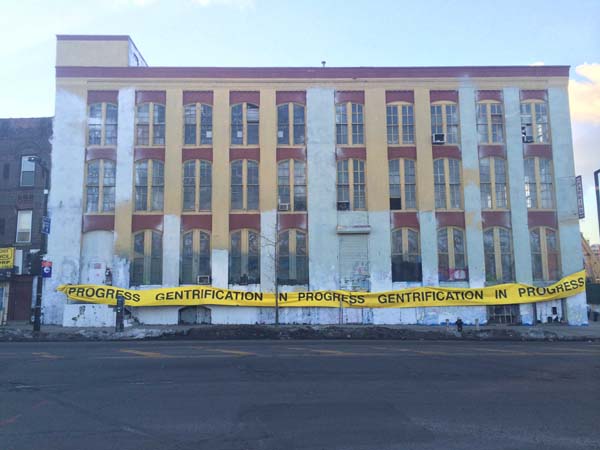
    A collaboration between Ann and BAMN at the Long Island City graffiti mecca 5Pointz

    A collaboration between Ann and BAMN at the Long Island City graffiti mecca 5Pointz

    If we back track to when you were first starting out, what kind of support did you get from other people? Did you feel like you could hold your own in what can be quite a male-dominated environment?
    Well, when I first started I didn’t know anybody. I didn’t know how to stencil and I was just kind of out there in the middle of the night and freaking out. And you’re right, there are more men than women but it’s changing a bit now. The female street art scene is getting stronger. I think as a woman I felt supported by the people that I spent time with but there was definitely some backlash. I definitely got some guys going, ’What are you doing with spray paint?’
    But, you know, those people exist.
    How did it feel putting up your first stencil and not knowing how to do it?
    Horrifying! There was a safety on the can that I didn’t realise was there so I’m shaking like a leaf and I’m taping this stencil up and my girlfriend is looking out for me and saying, ‘What are you doing? This is crazy, we’re both going to go to jail!’ And I get the stencil up and I’m trying to spray the paint and obviously there’s no paint coming out so I’m all flustered. But it was a great learning experience. So then we walked out onto the street and I took the cap off and the stopper fell out and I was like, ‘Oh! Now I know how to use spray paint! Let’s do that again. [Laughs]
    That’s hilarious! What was the stencil of?
    It was a little owl and it said ‘Love life.’ I still have it. I have it next to my bed.
    You’ve obviously found your strength in making art for other people. What qualities do you maybe wish you had that you don’t have?
    I think it would be really nice to stay focused [laughs]. I am notorious for coming up with a million ideas and trying to do all of them. It would be good to stick with something.
    So who do you turn to if you need to feel a bit more grounded? Where is the advice most likely to come from?
    My older sister, Molly, she’s actually spending some time in New York right now so we’ve been able to get close again. She’s usually the voice of reason and she’s the voice that I typically don’t want to hear. Which is great because I always need someone to say, ‘Well have you thought about this? Or this?’ And then I’m like, ‘Oh right.’
    And sisters can say stuff to you that no one else will, I think.
    Yes, exactly! It’s great because I’ve gotten to a point now where I know I can’t take it super personally.
    What’s the toughest bit of advice that your sister has given you?
    She is in the ad world, or she used to be, and so she is always trying to get me to think more about myself as a brand. I had a hard time with that for a while. I thought, I’m not a brand, I’m an artist. She’s like, ‘Yeah, but you’re an artist in 2015. You have to think about your public persona and curate it well.’
    Somebody said that street artists are just graffiti artists with publicists and that’s not what I want. So that’s where the push back came from. I didn’t feel like I was allowed to be myself.
    So what’s been the conclusion for you since that conversation with your sister?
    I’ve now taken a step back and said, ‘I can do things for me. I can do work that doesn’t have to go out to the public.’ I think so many artists for hundreds of years have worked like that and I’m just now sort of realising that I don’t have to share everything!
    What do you feel like is the biggest misconception about you?
    I think the Gilf! name really confused a lot of people. Gilf was actually a word I came up with with two of my dear friends who are still friends to the day. We were little kids, like six or seven, and two of us were going through difficult things at home.
    One had very challenging parents that were expecting a lot of her even as a little kid and my parents were going through a divorce. So we kind of created this wonderful world where we could be completely free and super creative. For me the word Gilf was our placeholder, it was part of our secret language. It was a very special and dear example to me of what true creativity is and the special and safe place which you can make where you’re free to create. That’s what it really means to me. And, of course, then the Milf word happened.
    I can’t believe it’s been taken out of context like that. It’s such a beautiful meaning behind it.
    Yeah, I know, but when I started doing street art I wasn’t thinking that it was going to end up being my career. I just thought, Fuck it, it’s Gilf! Of course, now I’ve got to deal with this branding issue. But it’s something that I stand behind. I will still do Gilf! work any time I do stuff outside.
    So look at your life and hopes for the future, what are you most afraid of?
    That I won’t get enough done while I’m here [laughs]. I feel like there is so much to be done, so many things to change. My biggest fear is that that won’t happen.
    I wanted to skip back about what you were saying about Gilf! and the influence your childhood had on what you do now. Were there other things you feel like were formative to who you are now?
    I think my parent’s divorce had a very big impact on me. We had a tumultuous few years. It created this bond with my sister and I but it was also very divisive. My childhood was very much just parents yelling back and forth at one another and using us as pawns and it was challenging. That’s part of the reason why I fight so hard for things. I didn’t have anyone fighting for me when I was little. That’s just where those sorts of things come from.
    Where did art fit into your life as a kid?
    I was actually very much into music, and I never really liked visual art classes. I thought they were kind of dumb! [Laughs]
    I later went to college as an engineer. I really wanted to design cars because my father owned a car dealership [laughs] so I thought that would be cool. It turns out I hate maths and I’m really bad at it.
    I dropped a class and at the last minute I picked up an art class. What I found so amazing about it was that I wasn’t supposed to get the same answer as everybody else. We were drawing a model and the teacher would make us stand up and walk around and look at everybody’s stuff. He would say, You’re never going to have the same perspective; you’ll never have the same eye, or anything. Just allow yourself to be you.’
    How wonderful!
    Yeah, instead of convergent thinking, it was divergent thinking. It was the quintessential, Yes, finally I can be myself moment. I don’t have to be something I’m not.
    You eventually left a desk job as a project manager at an interior design firm to stencil and support yourself by bartending. Were people supportive of you when you said, ‘I can’t sit at my desk anymore’?
    Ummm..no! Everybody said, ‘Get a job. Keep a job. Why are you going back to bartending?’ I mean, I didn’t tell my family right away that I was running around at night hoping to not get arrested. My mother still thinks that everything I do is legal and not because I haven’t tried to tell her. She says, ‘Oh well, you get permission, right?’ Well, not all the time! So, you know, you kind of have to keep some things secret for a bit.
    The jobs my parents had were all jobs that they were told to take. My mother’s a nutritionist because my grandfather told her she had to be. And my dad worked in the car business because that’s what the family did. So when I found something that really spoke to me they were both really excited. They’ve always been supportive of my decisions: my good decisions and my bad decisions.
    What advice would you give your younger self going into engineering? What did she need to hear?

    It’s ok to fail. Learning what you want is sometimes a process of learning what you don’t want through a process of elimination. Your biggest fear of being different is actually your greatest strength.
    Any final words of wisdom from Ann Lewis?
    Use your energy, your talents, your privilege or power to make the world better for others. To serve oneself is not nearly as fun or rewarding.

    See more of Ann’s work at http://gilfnyc.com/

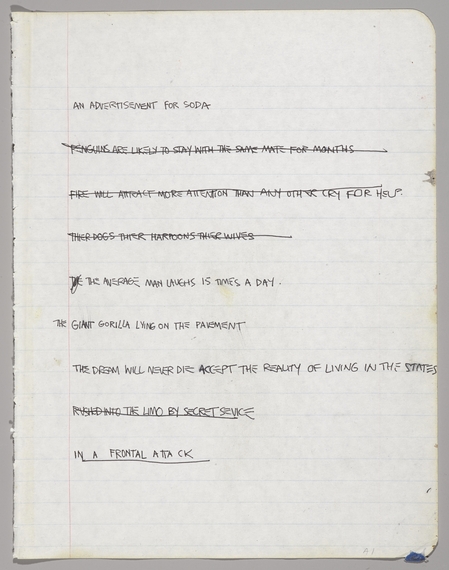
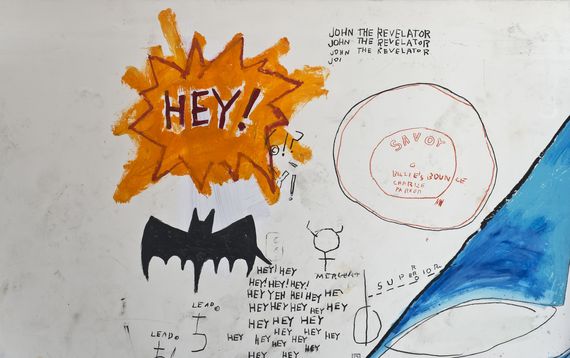
    Jean-Michel Basquiat passed at the tender age of 27 years young, yet his body of works — particularly to be paid special attention at his upcoming exhibit at the Brooklyn Museum titled Basquiat: The Unknown Notebooks, isn’t just someone’s brilliant idea to fabricate the young artist’s thoughtful ‘scribbles’ into some artistic sense of expression. Curated by Basquiat scholar, Dieter Buchhart and Tricia Laughlin Bloom, former Brooklyn Museum Associate Curator of Exhibitions, The Unknown Notebooks is the first time Basquiat’s 8 notebooks of 160 pages created between 1980 and about 1987 have ever been exhibited and shown to the public. Parts of the exhibit display a chronological succession of every right-sided page Basquiat drew on from these notebooks, meticulously laid out purposefully omitting the blank left-sided page with proper spacing for the viewer’s ease. Now attempt to decipher Basquiat’s thoughts drawn from advertisements, famous black athletes, pop art, Aztec, Native American, Caribbean, African, Greek and Roman culture, jazz music, girls’ phone numbers and everything in between. And to the artist — an avid reader, draftsman and critical thinker, this was also art itself, literally. Indeed, there is a pictorial element to his texts. Whether it’s his love of using the word “teeth” by twisting the ‘e’ into three parallel line-strokes, or spitefully crossing out phrases to bring emphasis to that very phrase, Basquiat’s warning is, to not approach these pages of texts too differently to his elaborate canvas paintings or drawings that you’d only consider as, art.

    2015-04-02-1428009327-4306045-EL135.01.02-thumb

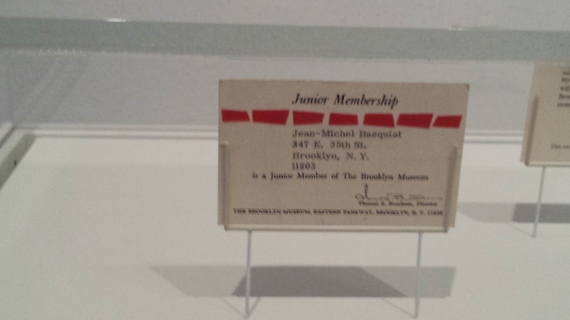
    After all, Basquiat did once say that he used words like brushstrokes. He also used language poetically, attuned to the rhythm and the musical qualities of words by emphasizing repetition and experimentation, testing letters and words like jazz notes, for both their sounds and their constellations of meaning. So you’ll be excused if you’re at times confused because this cat was too cool, so cool. No wonder he worked to the jazzy sounds of Charlie “Bird” Parker late at night, when he wasn’t partying of course. Besides the swooping wooden and canvas structures of Basquiat’s art alongside his many excerpts of texts from unbound notebook pages, et al for the eyes to delight over in this exhibit, looped-film in somewhat private rooms of documentaries on him and outtakes from Downtown 81 show live footage of the man in the flesh as a street artist, back then a familiar part of the NYC downtown art scene and culture of lower Manhattan in the late 1970’s. Also finding itself in the exhibit is Basquiat’s cute “Junior Membership” card on display, proof that even at younger age, way before he became an artist, he was a Junior Member of Brooklyn Museum.

    2015-04-02-1428010086-3037443-Basquiat3-thumb

    110 West 80 St-4R, NY, NY 10024 212 874 3879

    Basquiat: The Unknown Notebooks is on view and opens to the public at the Brooklyn Museum, April 3 – August 23, 2015.

    All photos used by permission from the author and Brooklyn Museum.

    ———————————————————————————-

    The review was published by  for Huffington Post


    Poren Huang Generation to Generation 45×17×30cm Bronze 2005

    Poren Huang Generation to Generation 45×17×30cm Bronze 2005

    Venue: Powen Gallery
    March 1 – April 5 ,2015

    What does Poren Huang mean when he says “people of the 21st century can’t compare with dogs”?

    Even when unfed or abused by its moody owners, a dog will wholeheartedly protect them, eagerly greet them when they return, and dutifully stick to its post until the day it falls to sickness. By stark contrast, people may go so far as to break family ties over financial issues and never see each another once again. As they are lost in a 21st century world of economic abundance, people are actually worse than dogs and can certainly learn from them for their sincerity, loyalty and enthusiasm.

    Huang, a Dog in the Chinese zodiac, once cared for more than 20 dogs and sometimes had to deliver his own puppies, making him indeed a dog expert. In fact, since his grandfather’s time Huang’s family has always enjoyed the company of man’s best friends. “The Dog’s Notes,” a series launched in 2005, is Huang’s response to the predicament of contemporary people facing various tests of morality as they prosper. With sculptures of human-like dogs, the series is an artist’s creative endeavor of viewing dogs as a role model for, and inspiration to, their human companions.

    Huang’s sculptures are brimming with courage and confidence, often portraying an upright and vigorous dog. Later works from “The Dog’s Notes” appear with a higher degree of personification, conveying Huang’s belief in mutual learning between humans and dogs, especially in today’s society. As they live in an affluent environment, people become even more vulnerable to stress and thus suffer from mood swings or depression at a first sign of trouble. Dogs, by comparison, are always cheerful companions to their owners; even when humans are too upset to pay attention to them, dogs will always wait with sincerity for their human best friends to feel better, with no grudges held.

    In some later pieces from “The Dog’s Notes,” a dog is found accompanied by a panda, provoking discussion and sometimes even controversies. Viewers are entitled to interpret the interaction between the two animals in their own way, be it cooperative or competitive. Although the dog looks tiny next to the panda, its extraordinary vigor makes it even more eye-catching. People tend to respond to this series with a knowing smile together with a desire to touch and connect with the works, which are often considered therapeutic and highly enriching. This positivity affects people who interact with the sculptures, as they always want to take one more look at the amusing and exaggerated gestures.

    The thought-provoking artworks from “The Dog’s Notes” stimulate discussion easily. Unlike what the title may suggest, it is not really the dogs that Huang emphasizes; rather, what Huang is trying to address through these sculptures is issues such as the meaning and value of life and what attitude one should adopt reflecting upon life’s impermanent nature. As material conditions have improved, people in the modern world have fewer opportunities for self-exploration or pondering over the meaning of life. Thus, under the glamour lies always an unknown heart of scarcity that panics.

    “The Dog’s Notes” is a spiritually nourishing series – especially to those who constantly communicate with the works. After spending some time with the sculptures, collectors will not only perceive the sheer materiality but find infinite possibilities for conversation and exploration in the artist’s creations. This positive, pleasant experience can be gained as long as one ceases to view the art pieces as ornaments, and the reward is a spiritual richness that the material world cannot otherwise provide.

    Huang has been making art for more than two decades. He has held numerous exhibitions with works collected by several museums.

    http://www.powengallery.com/index.php/en/artists/12-powen/artists/29-huang#!1.Im_Not_Happy_Now_2005

    Powen Gallery

    www.powengallery.com

    No.11, Ln. 164, Songjiang Rd., Zhongshan Dist., Taipei City 10459, Taiwan

    Tel:+886-2-25236009

    Fax:+886-2-25235018

    Opening hours: Tuesday – Sunday 10:00 – 19:00

    Bincode

    Bincode

    A Small Business City – The Place To Be
    Bincode.com was established in 1998. Since 2012 we expended and evolved into a new dynamic directions as Small Business International Directory, Marketing, Promotion and Business Community Networking platform. Our mission is to provide opportunity for small business owners to reach global audience in North and South America, European Union, Asia, Africa and beyond. A multi-language translation platform with dynamic worldwide business networking functionality, where business owners can exchange, sale and promote their services and products to everyone and anywhere in the world without language or geographical limitation.

    We will put you and your small business on the map!

    www.bincode.com
    Bincode Inc.

    “Sketch in the Air”, Jorge Palacios,

    “Sketch in the Air”, Jorge Palacios,

    A “Sketch in the Air” softens Trump SoHo with sound echoes in Tribeca

    Jorge Palacios, one of the most poignant figures of Spanish contemporary sculpture now presides the entrance of Trump SoHo with a rotund “Sketch in the Air”, which he erected while opening his solo show in partnership with Fridman Gallery, Steven Harris Architects, and Rees Roberts + Partners space in Tribeca.

    The cobblestone streets of SoHo run slightly off the grid plan of Manhattan with their iron-cast buildings, of no more than 12 stories, and their 19th century English and French facades: until one point. Trump SoHo is a colossal ensemble of glass and concrete 454 feet tall, a powerful disruptor of this neighborhood’s identity. It broke ground in 2006 not without loud opposition from different community groups involving protests, mail campaigns, and even law suits. This time the spirit of Robert Moses won again and the building was completed in 2010. However the dissonance hasn´t been as strident as expected. Five years after completion it doesn´t seem it was a Trojan horse any more, since we haven´t seen such developments proliferate in the area. The chosen materials were rich, but don’t scream as they do in other Trump sites (the mirror facade definitely helps), and the public areas were designed by David Rockwell. And let’s face it; the hotel means business for the surrounding stores. Today Trump SoHo displays one more soothing ointment for the discombobulated pedestrian.

    Jorge Palacios’ work is consistent, powerful from its very coherence. His first sculpture, now in exhibition for the first time at Rees Roberts + Partners space in Tribeca, reveals the expressive traits that he has developed throughout his career with increasing subtlety and serenity.  Palacios’ work has been exhibited at the highest places, such as the Thyssen-Bornemisza Museum of Madrid, or the Exhibition Center of the Principality of Monaco in Monte-Carlo.

    Jorge Palacios

    After jumping several snow ditches I found a yellow cab that left me at the main entrance of the Trump SoHo, and there it is: the two meters tall bulbous giant displaying a big round teak belly. It is a typical Palacios figure; its generous curves transmit an unequivocal sense of rotundity. However we soon appreciate that volume is far from been the same as mass or even weight, when realizing that all that rotundity rests in a thin steel mast. Similar contrast to lightness vs. heaviness, takes place between the elemental beams of the sculpture with their warm rectangular solidity versus the overall shape of the sculpture that evokes lightness and viscosity. Palacios shows interest for combining the warmth of the woods with the freshness of different fluid forms. That’s precisely the case with the “Drop”.

    Convergences

    Convergences

    The story of the first “Drop” is well known. Palacios worked on a large format sculpture for months, experimenting with molten glass and countless scale models pursuing the perfect water drop form into a massive wooden body. The piece was widely recognized and praised, particularly for the vivid rings of the wood. Palacios realized that the expressivity of his form was underscored by the material. His own wood, the dearest material that gives him such a rich pallet had betrayed him. And so he ignited the “Drop”. Therefore the “Drop” exhibiting today in New York after visiting Monte-Carlo is not the original one but a second generation of those ashes.

    “Sketch in the Air” at the Trump SoHo (246 Spring St.) and “Convergences” at Rees Roberts & Partners (120 Chambers St.) are on view through May 1st

    Alejandro Pardo

    News | Exhibitions