• The Frieze Projects program at Frieze New York will feature six new artworks, both inside the fair and around Randall’s Island Park, Manhattan. Curated by Cecilia Alemani, Frieze Projects is the non-profit program of artist commissions realized at Frieze New York. This year, the program includes sculptural environments and performative spaces involving intricate mazes, intimate hideouts and room-size installations. Frieze New York takes place May 14–17, 2015 and has been sponsored by Deutsche Bank since its launch in 2012.

    The artists participating in the Frieze Projects program at Frieze New York this year are: Korakrit Arunanondchai, Pia Camil, Samara Golden, Aki Sasamoto and Allyson Vieira. The program will also feature a special tribute to the Flux-Labyrinth, an installation conceived in Berlin in 1976 by George Maciunas, in collaboration with other Fluxus artists.

    The six projects will be scattered both inside and outside the fair – built among booths, in common areas, or hidden within the fair’s layout. The artists choosing to create clandestine rooms that host participatory spaces include Aki Sasamoto, who will construct a personality test in the form of a three-dimensional maze. Another hidden space will be realized by Samara Golden who plans to build an underground sculptural environment that reveals the subterranean features of the fair. Other projects will interrupt the fabric of the fair itself, with Korakrit Arunanondchai installing a number of massage chairs throughout the fair, upholstered in his signature material of bleached denim, which will be free for visitors to use. Pia Camil will make a similarly conspicuous intervention by freely distributing a series of wearable fabrics to fair visitors to employ as items of clothing. Outside the fair, Allyson Vieira will install a colossal broken column made of recycled bales of plastic.

    As in the previous editions of Frieze New York, Frieze Projects features a tribute to an alternative space or an artist-run project that has radically transformed the way we experience contemporary art. Following homages to the underground space Fashion Moda (2012), the artists’ restaurant FOOD (2013) and the artist project Al’s Grand Hotel (2014), this year the Frieze tribute will be devoted to the Flux-Labyrinth. For this homage at Frieze New York 2015, a group of contemporary artists have been invited to create new environments, sculptures and situations that will be installed in a labyrinth of narrow corridors and rooms where obstructions and hurdles turn the experience of traversing the space into a joyful and surreal exercise.

    Curator Cecilia Alemani said: ‘For the fourth edition of Frieze Projects in New York, I have invited a group of international artists to create new spaces, both physical and fictional, places to relax, play and explore. All together, this year’s Frieze Projects will feature temporary architectures and intimate spaces dispersed throughout the fabric of the fair’.

    To keep up to date on all the latest news from Frieze, sign up to our newsletter at Frieze.com, follow @FriezeNewYork on Twitter, @FriezeArtFair on Instagram and become a fan on Facebook.

    Darryl Lauster, University of Texas Arlington

    The latest front in the battle over public art is taking place in Queens, New York, where Councilman Jimmy Van Bramer, responding to angry constituents, has drafted a bill to allow more public input on commissions funded through the city’s “Percent for Art” initiative.

    The outcry was directed at Ohad Meromi’s “Sunbather,” an abstract figuration embellished in bright pink that has been selected for installation in Long Island City.

    As always, some of the dissent is fueled by the cost of the project, approximated at $515,000. But while money is an easy and frequently misunderstood target for such complaints, the sculpture’s color in this instance seems to attract the most critics.

    “Pink poop,” some have groused. “Looks like someone’s used bubblegum!” read an online comment.

    In her essay “Looking Around: Where We Are, Where We Could Be” the renowned scholar Lucy Lippard defined public art as an “accessible work of any kind that cares about, challenges, involves, and consults the audience for or with whom it was made, respecting community and environment.”

    Encoded into her definition is the very dichotomy that has created tension between artists and the public for millennia. How does one simultaneously consult and challenge? In a democracy, public space is the terrain reserved for the open exchange and dissection of political ideas. And it can be argued that one’s politics drives one’s aesthetics. So is it possible to present a work to a narrow-minded public that reacts with gut-level outcry to any departure from previously formed sensibilities?

    Is it time for a new definition of what public art should be?

    To be fair, both Councilman Van Bramer and sculptor Ohad Meromi have handled the issue with respect. In fact, one could argue that attempting to empower the public’s voice on the aesthetics of their immediate environment is laudable.

    But while Van Bramer has noble intentions, in situations such as this, the problem often lies not in simply requesting public input. Rather, it lies in the unwillingness to compel the public to enter the dialogue in a professional and thoughtful manner (as Meromi has). All too frequently insults are lobbed from afar, landing anonymously in op-ed columns or social media platforms, having no efficacy or interest in problem solving.

    It’s important to recognize that this sort of averse reaction is not new nor particularly unique.

    • After the Washington Monument’s dedication, the magazine American Architect and Building News published a review stating “It is to be regretted that ages are likely to elapse before the monument will fall down.”
    • In France, writer Andre Dumas signed a protest calling the Eiffel tower “…the dishonor of Paris.”

    Luis Jimenez’s Blue Mustang
    Lori Greig/flickr, CC BY-NC-ND

    • Maya Lin’s Vietnam War Memorial, now one of our country’s most beloved landmarks, was once called “nihilistic” by Senator James Webb. Vietnam veteran and Pentagon lawyer Tom Carhart referred to it as “a black gash of shame” in a New York Times op-ed.
    • Critics have dubbed the late Luis Jimenez’s Blue Mustang, installed at the Denver International Airport, a “demon horse” due to its wild eyes and aggressive posturing.
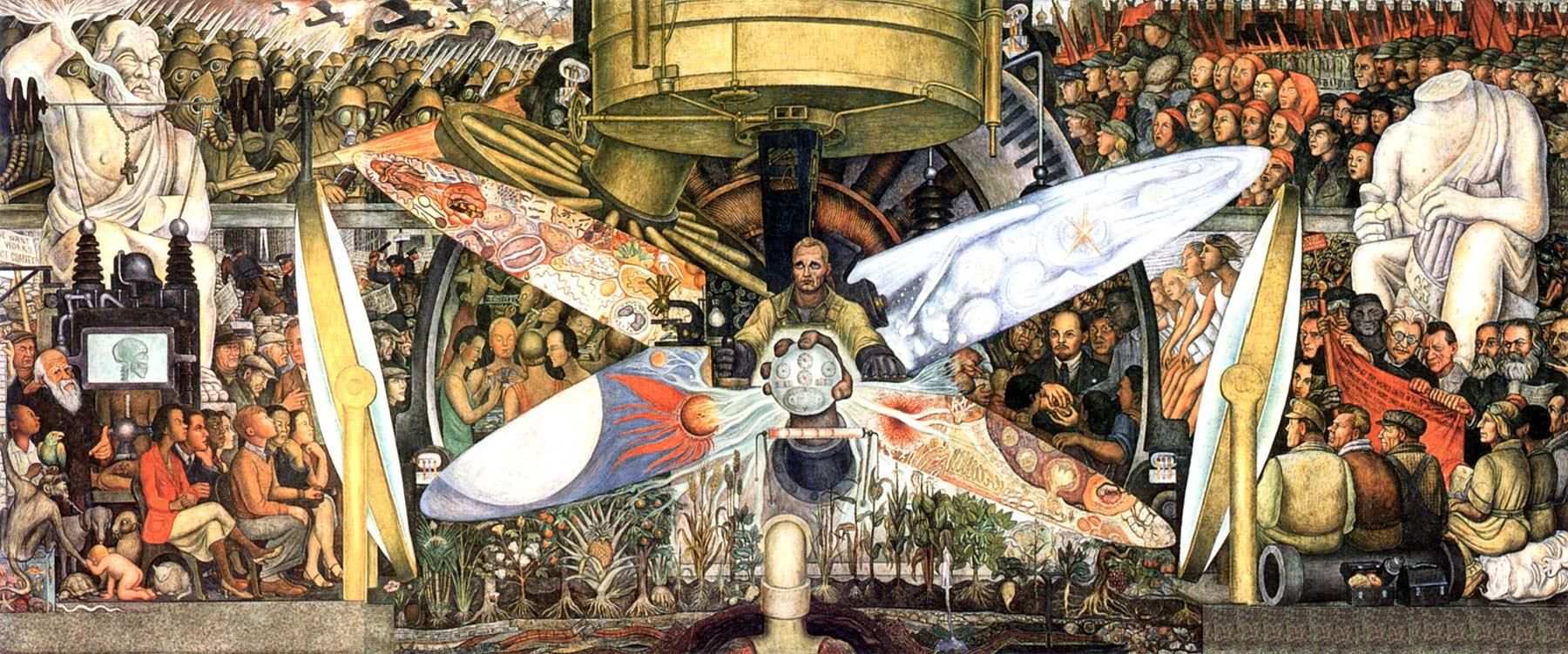
    • And in a famous example, Diego Rivera’s mural Man at the Crossroads was chiseled off the lobby wall of New York City’s RCA building in 1934 because it contained an image of Lenin.

    In a country where freedom of speech is a constitutional right, is the image of a Communist revolutionary so dangerous that we cannot bear its depiction?
    Gumr51/Wikimedia Commons, CC BY-SA

    Why do we react so reflexively to the unfamiliar?

    On one hand, it may be a symptom of an era where we increasingly demand instant gratification. Politicians ask us to declare ourselves for or against issues the second we hear of them. Our televised media presents us news in four-minute segments. Twitter limits itself to 140 characters. Overworked already, we seek simple, immediate answers.

    Through his sculpture, Meromi actually seeks to reject the very sort of rapid reaction that has become so prevalent.

    The sculpture is “at rest,” he noted, “and for me that gesture of rest, of stopping, is some kind of revolt against speed.”

    In a world where haste trumps diligence, does he even stand a chance?

    But this idea merely scratches the surface. As is often the case, the truth is more complex and more elusive.

    Great artists seek to begin conversations by dissecting the world around us. Great art presents itself to the world as a polite intruder, sneaking into our public space and calling for attention. Once constructed, it demands one meets it on its level. And as viewers, we are called to encounter it forsaking ethnocentrism, our biases and our baggage. Doing so is the only way to offer it the respect it deserves, just as we would for a human being.

    It’s a relationship that takes time. And over time, we forget how much we might change.

    There’s no need for a new definition of public art. Rather, it’s time for the public to re-affirm the way art challenges us – how it asks us to see our communities and ourselves in new ways.

    Meromi’s figure can certainly go a long way towards that goal.

    The Conversation

    This article was originally published on The Conversation.
    Read the original article.

    Southern Stream, Embajada de Chile en Washington

    Sin titulo C, Oleo sobre tela, 40x40

    Sin titulo C, Oleo sobre tela, 40×40


    Sin titulo F, Oleo sobre tela, 40x40

    Sin titulo F, Oleo sobre tela, 40×40

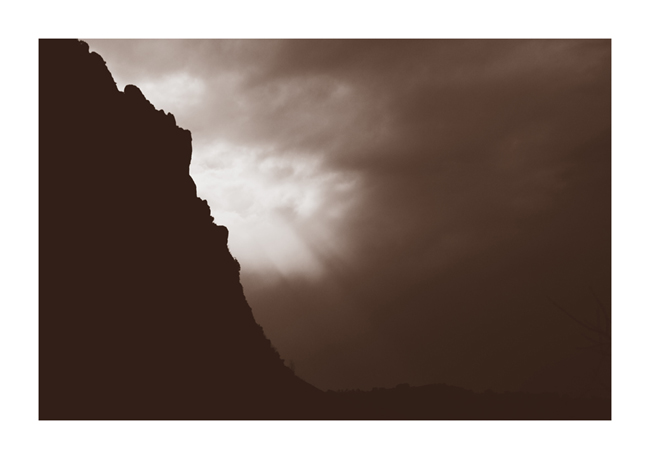
    Photo by Aitor Frías & Cecilia Jiménez

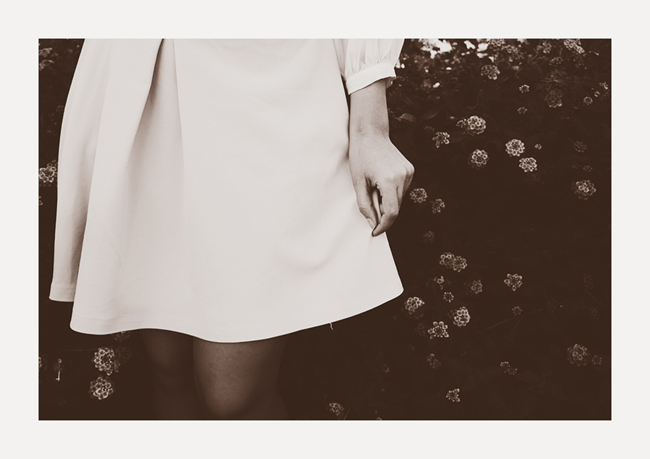
    Photo by Aitor Frías & Cecilia Jiménez

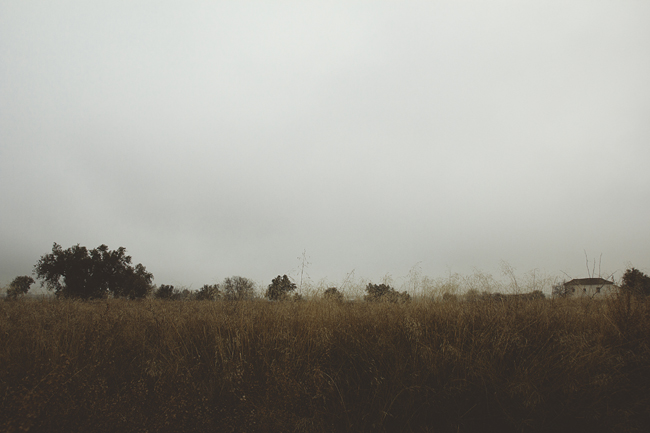
    Photo by Aitor Frías & Cecilia Jiménez

    Photo by Aitor Frías & Cecilia Jiménez


    PAINTING WITH LIGHT

    For us, Photography is the Art of Painting with Light. Therefore, the stories we capture with our camera base their lighting schemes in those Masters of Painting who had in the Light its main ally (Velázquez, Degas, Dürer, William Turner, etc)

    What fascinates us about Photography is its capacity for catching wonderful scenes that we all normally let go, and projecting them in our minds as new, vibrant and personal fictions.

    Somewhere in time, Aitor Frías & Cecilia Jiménez

    Somewhere in time, Aitor Frías & Cecilia Jiménez

    More information at: http://aitorfrasceciliajimenez.portfoliobox.me

    “DENISE” by Michele Gabriele @ TILE

    Since March 17, TILE project space is hosting DENISE, a solo show by Michele Gabriele. DENISE is a flow in which the environment is pressing and tightens. She is an unlimited permanence but divided in correspondence with the unwinding of purposeful phenomena. The substance is in excess, in surplus towards the walls dry and bright. The sections of which it is formed appear like mnestic traces, engrams, the physical elements of the memory still in action.
DENISE is an identity which turns but does not change shape, she is suspended between two distinct temporalities but unable to define her. She hides in her inner leaving her flavor on things. Disturbed by what surrounds her, DENISEfreezes any information in their original form that causes anxiety. Balances are broken and the substance is expanded in a not functional way. 
DENISE wanders around the house looking for memories of her lost love, but she finds traces only 
on herself.

    MICHELE GABRIELE “Whity-Trashy” transparent silicone, plastic granulate, polistyrene, cat food, hair gel, liquid soap, feathers, beach umbrella pole support, foam-rubber, papier-mache 2015

    MICHELE GABRIELE
    “Whity-Trashy”
    transparent silicone, plastic granulate, polistyrene, cat food, hair gel, liquid soap, feathers, beach umbrella pole support, foam-rubber, papier-mache
    2015

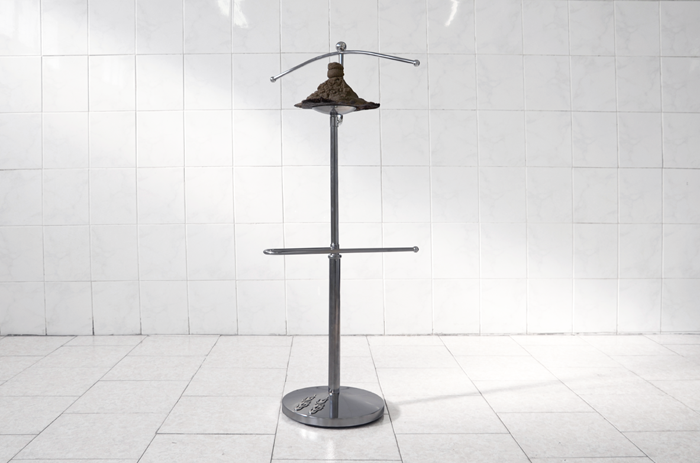
     MICHELE GABRIELE “Holdythang” Clothe-hanger, sand, soil, chrome stickers 2015

    MICHELE GABRIELE
    “Holdythang”
    Clothe-hanger, sand, soil, chrome stickers
    2015

    MICHELE GABRIELE “Whity-Trashy” transparent silicone, plastic granulate, polistyrene, cat food, hair gel, liquid soap, feathers, beach umbrella pole support, foam-rubber, papier-mache 2015

    MICHELE GABRIELE
    “Whity-Trashy”
    transparent silicone, plastic granulate, polistyrene, cat food, hair gel, liquid soap, feathers, beach umbrella pole support, foam-rubber, papier-mache
    2015


    http://www.ofluxo.net/denise-by-michele-gabriele-tile/
    http://tileprojectspace.tumblr.com/tagged/michele-gabriele
    Courtesy of the artist and TileProjectSpace

    Lizzani e Bozzacchi

    Lizzani e Bozzacchi

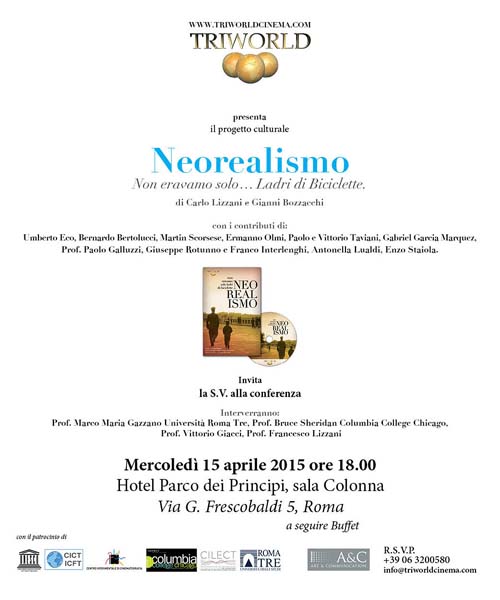
    The event will be held at Hotel Parco dei Principi – Sala Colonna – address: Via G. Frescobaldi 5, in Rome on wednesday 15th April 2015 at 18.00.

    “We were not just… Bicycles Thieves. Neorealism”
    The book is written by Carlo Lizzani, the last witness of Neorealism, and Gianni Bozzacchi.

    With contributions by: Umberto Eco, Bernardo Bertolucci, Martin Scorsese, Ermanno Olmi, Paolo e Vittorio Taviani, Gabriel Garcia Marquez, Paolo Galluzzi, Giuseppe Rotunno, Franco Interlenghi, Antonella Lualdi e Enzo Staiola.

    This suggestive cultural journey rediscovers Neorealism as the founding moment of modern cinema, that inspired several directors.

    “This book contains an in-depth and documented account of an artistic period in Italy that left and indelible mark on world cinema, changing that art forever. Neorealism lasted

    little more than a decade. But anyone who wants to understand contemporary cinema still needs to start from there.

    The book traces that creative path in words and images put together by Carlo Lizzani (the last surviving director from that period) and producer-director Gianni Bozzacchi.

    The two cineastes co-wrote, directed and produced the documentary film on which the book is based – “We’re not onlyBicycle Thieves” – in which they document the origins of

    the movement, highlighting how it revolutionized the relationship between audience and film, using the camera to create a new vision of the world. At the same time, they dispel many of the rumors and clichès that were spawned in the shadow of neorealism’s global success, while reminding us (in both the film and book) how much of the innovative content of Neorealism was made possible by the new cinema technologies created in that period. The book includes the film’s full screenplay, along with many images, both famous and less well-known, from the filmography of the  period. The images are not simply iconographic decoration,but are used to illustrate key concepts in neorealism which, as Lizzani explains, revolutionized the “grammar and syntax of cinema”. The text is accompanied by full transcripts of interviews made with the leading figures from culture and cinema who appear in the film, in the following order: Professor Paolo Galluzzi, Bernardo Bertolucci, Franco

    Interlenghi, Enzo Staiola, Paolo and Vittorio Taviani, Martin Scorsese, Umberto Eco, Ermanno Olmi, Giuseppe  Rotunno, Antonella Lualdi. Biographies and a full list of

    works by all artists cited in the book are included in order to offer readers as complete a documentation as possible of  the neorealist movement.”

    The book presentation wants to create a synergy among different realities, for its cultural and educational value it will be addressed

    to students as well, in fact there are three versions of the book, one is an essay more affordable for young people.

    Conference speakers:

    Prof. Marco Maria Gazzano, Università Roma Tre
    Prof. Bruce Sheridan, Columbia College Chicago
    Prof. Vittorio Giacci
    Prof. Francesco Lizzani

    Info video:  https://www.youtube.com/watch?v=sXnVMyin7jo

    The event will be held at Hotel Parco dei Principi – Sala Colonna – address: Via G. Frescobaldi 5, in Rome on wednesday 15th April 2015 at 18.00.

    invito_Il_Neorealismo_OK

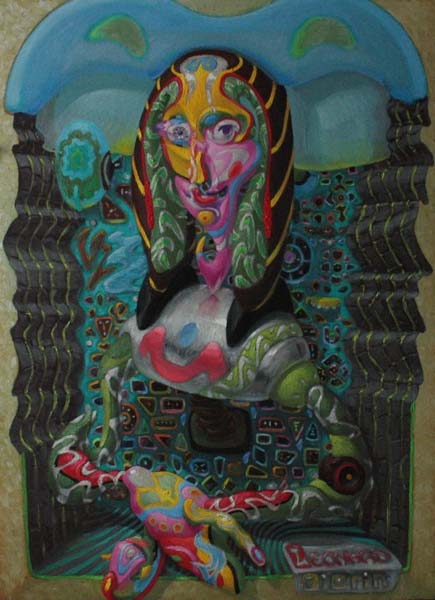
    Golden Mona Lisa

    Golden Mona Lisa

    Tuscany Mona Lisa

    Tuscany Mona Lisa

    Silver Mona Lisa

    Silver Mona Lisa

    http://www.ericfiorin.com/


    Bill Jensen: Transgressions

    Bill Jensen: Transgressions

    Bill Jensen: Transgressions
    April 9 – May 9, 2015


    Cheim & Read is pleased to announce an exhibition of recent paintings by Bill Jensen. Jensen, who turns 70 this year, has been represented by the gallery since 2007.


    Bill Jensen’s paintings are the result of experimental, unpredictable, and sometimes years-long journeys. Striving for an ego-less, unpretentious practice devoid of preconceived outcomes, Jensen surrenders to the painting process, allowing it to determine the path and destination of his work. His intensive layering and re-working of the canvas results in highly tactile and seductive surfaces: paint is plastered on, scraped off, seeped, dredged, brushed and smoothed until a certain “presence” is achieved. Ultimately, he attempts to create paintings which, like self-contained beings, affect the world around them—a characteristic Jensen refers to as “emotional density.” His new paintings explore these longstanding concerns, as well as others initiated with the body of work presented at Cheim & Read in 2011–12.


     

    Jensen draws inspiration from art history, Chinese philosophy, the natural world, African tribal art, and film: in his studio, Andrei Tarkovsky’s Andrei Rublev (1966) is often playing in the background, the Russian actors’ voices filling the room. As with the works in his last show, Jensen introduces and repeats “imagery” appropriated and abstracted from these various sources. For his new paintings, this includes Andrei Rublev’s icon painting, The Holy Trinity (1410), from which three seated angels are isolated as an abstract form in Jensen’s Thoughts Never Twisty (2013–14). The title is from a statement by Confucius regarding the clarity and wisdom of early Chinese poetry. In his fresco-like Transgressions paintings, Jensen uses a detailed scene of the struggle between good and evil from Michelangelo’s The Last Judgment (Sistine Chapel, 1536–41), which he has transformed into thick, calligraphic lines against a light-filled ground. In a series titled Stillness, the sculpted drapery from Buddhist statuary becomes thickly layered folds of paint; red and magenta pigment streaks the canvas, marking, like stigmata, where a hand or foot would have been. Jensen also finds inspiration in his own heavily-worked etchings, which are flipped, reversed and reconfigured into a series of compositions. One of these paintings, Double Sorrow + 1 (Grey Scale), is a large black-and-white triptych with hundreds of grays, overall cool in temperament; in contrast, The Book of Ch’u is a juxtaposition of warm and saturated colors, appropriate for its reference to an anthology of ancient poetry from Southern China. In a separate series, titled Dark Dragon Pool, an iridescent, deep purple hue suffuses the canvases. The title is taken from a 16th Century field guide for the names of every rock, tree, peak and pool in China’s Huangshan or Yellow Mountains; the paintings visually echo the philosophy of Classical Chinese poetry, in which the seemingly simplest prose is often the most profound.


    Several of the works are triptychs or diptychs, which allow for multiple configurations. They displace the viewer’s reading of spatial progression by punctuating the picture plane with distinct, physical edges; this discontinuity is reinforced by the slightly different sizes of each panel. A small but very intentional space between paired canvases causes an abrupt break which further fractures the sense of time. This disruption is magnified by the contrast between compositions, which are often light or dark, calm or tumultuous. For Jensen, these contradictory forces are a sustained source of tension and ambiguity, reverberating with ancient Chinese concepts of “emptiness” and “fullness.” In his work, Jensen searches for a resolution between the conceptual and the concrete—between a painting’s aura and its physical manifestation. His many references simultaneously tether his paintings to the weight and flow of history, while also, in their various expressions, releasing them from contemporary ideology, providing them with ethereal timelessness.

    Cheim & Read
    547 West 25th Street
    New York, NY 10001
    http://www.cheimread.com

    E1a62zn-m2Jj0g0eFXG0Mg

    VARENYE ORGANISM is a collaboration of artists, designers, dreamers, robots and mutants, which was born in Moscow around 4 years ago.

    We do interactive art, huge social toys and fashion, promote new abstract lifestyle and drink a lot of tea. Our mission is to help human species to evolve and reach new borders of consciousness through games and weird behaviour.

    http://varenye.com

    Amour Paternel 31 x 63 x 12

    Amour Paternel 31 x 63 x 12

    Sculptures forged in steel or stainless steel, brushed and painted. These sculptures represent “oxydovégétalisations”. I invented this term to convey the notion that time oxidises our lives, at its own pace, eroding all material, everything on Earth and even the universe. Dust to dust, ashes to ashes. We are the result and the victims of these oxydovégétalisations.
    La Naissance de L'Amour 84 x 24 x 10cm

    La Naissance de L’Amour 84 x 24 x 10cm

    I didn’t choose metal as the basic material for my sculptures, but, rather, it chose me, through a process of listening to my friends, including Jacques Bouget and Alain Joriot, themselves passionate artists.
    My creations are, for the most part, free or abstract expressions. I see creation as a way of escaping into a new universe, parallel to our own reality.
    As a child, I created my own robots using the tools available to me. As a teenager, I used materials from the dump and gave them a second life. Today, I try to recycle as much as possible from industrial scrap.
    The world of plants and the sea has always fascinated me and the discovery of photographs by Karl Blossfeldt was a revelation to me and marked a change toward free expression.
    Calder, Picasso, Gonzales, and Brancusi, but also Magritte, Dali, Gaudi, Ingre, John Flaxman or Annette Messager…their work resonates in my mind and proves that creation and the imaginary have no limits in a perpetually changing world; always creating and placing an imaginary world in touch with the real world.
    News | Exhibitions