• VENICE — At 10:20am this morning, two boatloads of artists and activists occupied the dock landing of the Peggy Guggenheim Collection (PGC) in Venice. It marks the first joint action between GULF (Gulf Ultra Luxury Faction) and Gulf Labor, which is an official participant in the 2015 Venice Biennale, and two Italian organizations, Sale Docks in Venice and Macao from Milan — an independent art space which started organizing art workers in 2012. The crowd of roughly 40 people are hoisting banners and flags that read, “Meet Workers’ Demands” and other labor-related messages. The museum occupation is the latest effort to highlight labor issues impacting migrant workers at Saadiyat Island, where Guggenheim Abu Dhabi, Louvre Abu Dhabi, and other luxury culture brands are building outposts.

    “We organized the AbStrike [abstract strike] event in Venice and Milan and we’ve been involved with Gulf Labor for over a year,” Emanuele Braga of Macao told Hyperallergic. “AbStrike is exploring the possibilities for strikes for cultural workers. We gathered various projects that explore the issue of artist workers and debt, among other issues. We did joint events in Venice and Milan, which is hosting Expo [that is having labor issues], to also see how these models that are both pushing forward this model of labor precarity and build up a different type of consciousness in the workers and raise awareness in the communities and the media.”

    The event is the first “official” event of Gulf Labor’s Biennale participation, according to New York University professor Andrew Ross, who made headlines in March when he was banned from visiting the United Arab Emirates.

    Originally Published by Hyperallergic Media, Inc.

    Read More – Hyperallergic Media >

    Mock occupation by activists in military uniforms mimics Russia’s military incursion into east Ukraine

    Mimicking the Russian military involvement in east Ukraine, a group of Ukrainian artists and activists have staged a mock-occupation of the Russian pavilion at the Venice Biennale, descending on the venue in camouflage fatigues.

    The artists then urged visiting tourists to take selfies wearing military uniforms they handed out.

    The uniforms had the words “On Vacation” printed on them, a reference to the now-infamous remarks during Russia’s 2014 invasion of eastern Ukraine, when the separatist leader Alexander Zakharchenko said the Russian soldiers were enjoying a “vacation … among brothers who are fighting for their freedom”.

    On their website, the activists are asking visitors to the Venice Bienniale art show to find an #onvacation representative, as they call themselves, put on a uniform and then take a selfie in “an occupying power of your choice” and post it to Instagram or Twitter with the hashtag #onvacation.

    “#onvacation challenges the viewer to actualise their opinions and beliefs about their understanding and experience of occupation,” said a statement on the website.

    It added: “The project offers an entirely genuine engagement in a well-known structure – the free vacation sweepstakes, but it also positions this engagement in a conflict that is constantly denied by the occupying power.”

    Originally Published by Guradian News.

    Read more – Guardian News >

    Nikolaus Hirsch, Julieta Aranda, Brian Kuan Wood, Anton Vidokle

    “Architecture as Intangible Infrastructure,” Issue One

    Architecture remains the most tangible way of constructing the social. Yet, the system we call “architecture” is not reducible to the physical, the tactile, the obvious. In the history of avant-garde architecture, immateriality and intangibility carried a promise of liberation, of escape from the heaviness of building, from completion, from gravity or reality. A new contemporary architecture would be built out of pure knowledge—drafted on paper as an idea to be shared, never bogged down by the technicalities of constructing in dimensional space, or even any spatial paradigm altogether. The history of the avant-garde can’t—as Beatriz Colomina has pointed out—be separated from its engagement with media and communication. Building would move at the speed of thought and spirit, superseding calculation, regulation, codes, and existing infrastructure.

    Architects today do not conceptualize their work in such radical terms. Is it because they are too busy stalking clients in China and the Gulf? Maybe. But at the same time, architects today also have to contend with the fact that other immaterial, intangible forces have subordinated much of the spatial thinking that historically situated architecture in relation to the building and planning of spaces and cities. As Keller Easterling has written in a previous essay, “it is as if architecture, as customarily defined, cannot access some of the most important levers of explicit, measurable spatial change, leaving control of them largely to the financial industries.”

    But what are these levers? Or for that matter, how has architecture always given form to the immaterial or intangible spatial effects in communication pathways, or war, rubble, memory, tourism, and cultural capital? Hasn’t architecture always provided a way of reading ethical transgressions in reverse, of giving them form, for better or for worse? How has physical architecture always been a symptom of ideology? How has it always been a communications infrastructure?

    How, then, can we contextualize more recent advances in registering and distributing space, in order to place them back into the history of architecture? Just look at how something like Airbnb abstracts and dissolves, even fiscalizes, core notions such as what constitutes a home. And it presents this as data before an economy of sharing and selling that takes place above and beyond architectural intervention. In the cities where Airbnb is being used most heavily, it is planning urban space, but without urban planners. Except maybe someone like Molly Turner, Airbnb’s new director of public policy, who is an urban planner, and describes Airbnb as part of a “third wave of tech … taking all of the connectivity and transactions that are occurring online and bringing them back offline into the real world.”

    Airbnb can be part of a new integrated meta-architecture that involves the pooling and marketing of space in a way where, in a broad sense, architectural interventions on the level of building tend to serve as decorative afterthoughts to the capture and recording of not only space, but also of practices, representations, expressions, knowledge, and skills. This is the aim of UNESCO’s initiative over the past decade to update the concept of cultural heritage to include immaterial and intangible cultural products. UNESCO’s Intangible cultural heritage (ICH) becomes a device for making another layer of global culture visible and searchable across long distances, and an amplifying mechanism for heritage that can allow it to be converted from culture into a knowledge database, and back into culture again. Is this something we can compare to what Lebanese architect Bernard Khoury imagined as a building that would record memories of a place as data, but also demolish its physical matter with each kilobyte or megabyte it records?

    Edited together with Nikolaus Hirsch, this first part of a special double issue of e-flux journal focusing on architecture invites a number of the field’s most audacious and adventurous thinkers to consider how these invisible and intangible forces are rebuilding cities and reformatting space over and above the role that architecture once served. They are not only reducible to data streams and technocratic information pathways, but also convert ethical questions of whose hands do the actual work of building into material expressions of labor markets, economic flows, and colonial memory. They include the passage from the formal domain of building to an informal domain of knowledge in research-based university departments as well as in slums, black markets, shadow networks, and courtrooms alike. How are practicing architects already working to adapt the radical propositions of architecture to build and think in a way that takes this often contradictory information into consideration?

    The second issue of “Architecture as Intangible Infrastructure” will be released in September 2015 with essays and contributions from Beatriz Colomina, Bernard Khoury, Hu Fang, Ingo Niermann and Rem Koolhaas, Hans Ulrich Obrist in conversation with Hans Hollein, and others.

    © 2015 e-flux and the author

    Tom Scicluna, Ton Capacity, 2015

    Tom Scicluna, Ton Capacity, 2015

    Tonight:
    Sounds Like-Nicholas des Cognets, Mike Calway-Fagen, Janelle Iglesias,
    Tom Scicluna

    May 8 – July 20, 2015
    Reception, Friday, May 8, 7 – 11 pm

    Dimensions Variable presents Sounds Like, a group exhibition including the work of Mike Calway-Fagen, Nicholas des Cognets, Janelle Iglesias and Tom Scicluna. The exhibition will run from May 8 – July, 20, 2015. Please join us for the reception on Friday, May, 8, 7 – 11 pm.

    There is value in not knowing, in being unsure.

    When you can’t name something, can you still know what it looks like, what it smells like, feels like, sounds like?

    With this question in mind the exhibition’s four artists deploy objects, videos, and discrete noises that act as mediums of experience outside the structure of language but beyond the bounds of the merely visual. Their varied interests lie not in things that have soundtracks; that work as an accompaniment to a purely visual experience, but situations where sound is integral to the structure and composition of the piece. These things could not exist without sound and can’t help but make some auditory discharge. The sound element of this work resists quick categorization and allows things to remain mysterious a few moments longer.

    There is value in not knowing and it’s ok to not be certain just what that value is.

    Read more>

    image002

    ARTIST BEN MOON COLLABORATES WITH THE BUILDING ART CURATORIAL PROGRAM ON “THE EVOLUTION OF IDEAS”

    Lobby Exhibit at 366 Fifth Avenue Launched on Monday, May 4, 2015

    NEW YORK, NY – May 7, 2015 – Artist Ben Moon has been selected as the featured artist in the lobby of 366 Fifth Avenue, which is located across from the Empire State building. Several of Moon’s mixed media paintings will be featured in the exhibit, as well as three art panels entitled “Horizon Triptych” that are mounted in the doors along the back wall of the lobby. The exhibition is tied to the commencement of Market Week, which begins on May 4th and will run for six months.  

    The exhibition was curated and coordinated by Cindy Farkas Glanzrock, the President of the Building Art Curatorial Program (BACP), whose aim is to match commercial building owners, collectors, and tenants with established arts organizations and emerging and mid-career artists.

    “New York City is a convergence of energies from across the globe that collide and simmer in a primordial soup of culture, commerce, and creativity, evolving into the trends of tomorrow,” says Glanzrock. “The inspiration stems from ideas throughout history that culminate in a “Nexus,” a convergence of connections that bind together ideas and trends from the past and the future. I chose Ben for this specific lobby project with the aesthetics of the accessory companies that fill the building in mind, and it’s a melding of real estate, art, and the fashion business.”

    With a string of exhibitions all over the world, Moon has spent his artistic life following these diverse paths, wherever they have led. The fragments of collage and found objects used in his work are discoveries made during these explorations. The Black & White matrix of symbolic drawings, as well as the “mosaic” painting style represent Moon’s attempt to weave together various “memory samples” into a tapestry of beliefs which determines the way we each experience reality.

    “It’s been the experience of a lifetime working with Cindy Glanzrock, who has worked so tirelessly to curate this project and help me realize my vision for the Lobby of 366 Fifth Avenue. This building symbolizes the merging of many diverse ideas and technologies into the ideas of tomorrow. The inspiration for “Nexus” is to create a series of images which not only represent this dynamic process pictorially, but to use the placement of each image in sequence, to lead the viewer through the space, revealing the story gradually,” states Moon.

    The “Nexus” works, and other art by Ben Moon, will be for sale from Monday, May 4th through summer 2015 at 366 Fifth Avenue. For information about the art for sale and other works, please contact Cindy Glanzrock Glanzrock.bacp@gmail.com.

    BEN MOON As an avid musician and “fine arts” major at Tulane University, Moon immersed himself in the diverse artistic culture of New Orleans. Even at this early stage, he became fascinated by the ways in which his love of creating both sonic and visual

    elements could be combined to create a heightened emotional effect. After graduating and returning to New York, Moon’s work has been featured in a string of successful exhibitions throughout the world, including New York, London, New Orleans, Beijing, as well as several appearances at Miami’s prestigious Art Basel. For more information, visit his website, www.WorldOfBenMoon.com.  

    Cindy Glanzrock is the President of Building Art Curatorial Program and can be contacted by email at cindy@glanzrockrealty.com or through www.RealArtMuse.com.

    By Boris Groys

    On Art Activism

    Current discussions about art are very much centered on the question of art activism—that is, on the ability of art to function as an arena and medium for political protest and social activism. The phenomenon of art activism is central to our time because it is a new phenomenon—quite different from the phenomenon of critical art that became familiar to us during recent decades. Art activists do not want to merely criticize the art system or the general political and social conditions under which this system functions. Rather, they want to change these conditions by means of art—not so much inside the art system but outside it, in reality itself. Art activists try to change living conditions in economically underdeveloped areas, raise ecological concerns, offer access to culture and education for the populations of poor countries and regions, attract attention to the plight of illegal immigrants, improve the conditions of people working in art institutions, and so forth. In other words, art activists react to the increasing collapse of the modern social state and try to replace the social state and the NGOs that for different reasons cannot or will not fulfill their role. Art activists do want to be useful, to change the world, to make the world a better place—but at the same time, they do not want to cease being artists. And this is the point where theoretical, political, and even purely practical problems arise.


    Michael Rakowitz, Joe Heywood’s paraSITE shelter, 2000. Battery Park City, Manhattan. Plastic bags, polyethylene tubing, hooks, tape. Courtesy of the artist and Lombard Freid Gallery, NY

    Art activism’s attempts to combine art and social action come under attack from both of these opposite perspectives—traditionally artistic and traditionally activist ones. Traditional artistic criticism operates according to the notion of artistic quality. From this point of view, art activism seems to be artistically not good enough: many critics say that the morally good intentions of art activism substitute for artistic quality. This kind of criticism is, actually, easy to reject. In the twentieth century, all criteria of quality and taste were abolished by different artistic avant-gardes—so, today, it makes no sense to appeal to them again. However, criticism from the other side is much more serious and demands an elaborate critical answer. This criticism mainly operates according to notions of “aestheticization” and “spectacularity.” A certain intellectual tradition rooted in the writings of Walter Benjamin and Guy Debord states that the aestheticization and spectacularization of politics, including political protest, are bad things because they divert attention away from the practical goals of political protest and towards its aesthetic form. And this means that art cannot be used as a medium of a genuine political protest—because the use of art for political action necessarily aestheticizes this action, turns this action into a spectacle and, thus, neutralizes the practical effect of this action. As an example, it is enough to remember the recent Berlin Biennale curated by Artur Żmijewski and the criticism it provoked—described as it was by different ideological sides as a zoo for art activists.

    In other words, the art component of art activism is often seen as the main reason why this activism fails on the pragmatic, practical level—on the level of its immediate social and political impact. In our society, art is traditionally seen as useless. So it seems that this quasi-ontological uselessness infects art activism and dooms it to failure. At the same time, art is seen as ultimately celebrating and aestheticizing the status quo—and thus undermining our will to change it. So the way out of this situation is seen mostly in the abandoning of art altogether—as if social and political activism never fails as long as it is not infected by art viruses.

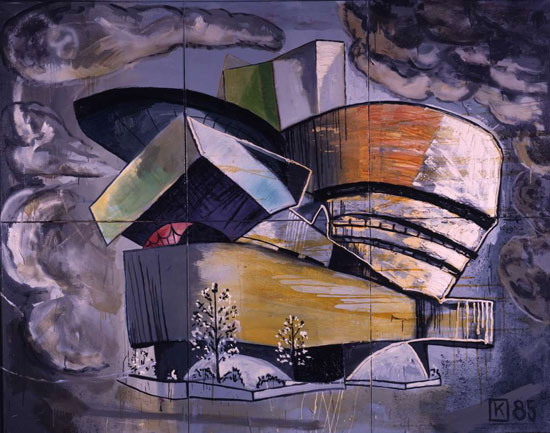
    Martin Kippenberger, The Modern House of Believing or Not, 1985. Oil on canvas.

    Martin Kippenberger, The Modern House of Believing or Not, 1985. Oil on canvas.

    The critique of art as useless and therefore morally and politically bad is not a new one. In the past, this critique compelled many artists to abandon art altogether—and to start to practice something more useful, something morally and politically correct. However, contemporary art activism does not rush to abandon art but, rather, tries to make art itself useful. This is a historically new position. Its newness is often relativized by a reference to the phenomenon of the Russian avant-garde, which famously wanted to change the world by artistic means. It seems to me that this reference is incorrect. The Russian avant-garde artists of the 1920s believed in their ability to change the world because at the time their artistic practice was supported by Soviet authorities. They knew that power was on their side. And they hoped that this support would not decrease with time. Contemporary art activism has, on the contrary, no reason to believe in external political support. Art activism acts on its own—relying only on its own networks and on weak and uncertain financial support from progressively minded art institutions. This is, as I said, a new situation—and it calls for new theoretical reflection.

    The central goal of this theoretical reflection is this: to analyze the precise meaning and political function of the word “aestheticization.” I believe that such an analysis allows us to clarify the discussions around art activism and the place where it stands and acts. I would argue that today, the word “aestheticization” is mostly used in a confused and confusing way. When one speaks about “aestheticization,” one often refers to different and even opposing theoretical and political operations. The reason for this state of confusion is the division of contemporary art practice itself into two different domains: art in the proper sense of the word, and design. In these two domains, aestheticization means two different things. Let us analyze this difference.

    Read more >

    unnamed
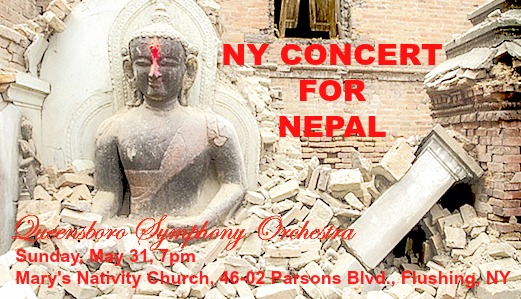
    “NY CONCERT FOR NEPAL” BY QUEENSBORO SYMPHONY ORCHESTRA 5/31
    The “NY Concert for Nepal” will be performed by the Queensboro Symphony Orchestra in their season finale on Sunday, May 31st 7pm at Mary’s Nativity Church in Flushing, NY with proceeds from the free-will offering benefitting the people of Nepal affected by the earthquake. Led by acclaimed maestro Dong-hyun Kim, classics to be performed are Tchaikovsky’s monumental 5th symphony, Mozart’s Horn Concerto #3 (featuring Peter DelGrosso) and the Nepali national anthem arranged by Paul Joseph.
    Date & Time:
    Sunday, May 31st at 7pm
     
    Place:
    Mary’s Nativity Church, 46-02 Parsons Blvd. (at Holly Ave.), Flushing, NY 11355, (718) 359-5996, 7 train, Q27,
    Q65 stops 2 blocks away (near Hospital)
    Driving: Take LIE to Exit 24, head north on Kissena Blvd., right onto Rose Ave., left onto Parsons Blvd, church on left. Parking lot on Jasmine Ave. Handicapped entrance on Holly Ave.
    Admission:
    Free-will offering
     
    Website:
     
    Information:

    In this exhibition Sapir continues his ongoing project “Research for the Full Crypto-Taxidermical Index,” a coming into being lexicon of objects. The term “crypto-taxidermy” alludes to the embalming of animals that are not part of the official zoological index. Sapir’s cataloguing system undermines familiar systems of classification and distorts coherency and differentiated meaning. The objects in Sapir’s lexicon are mutations suspended between the organic and the artificial, the seductive and the threatening. One cannot always know which object was gathered from nature, which is an outcome of toiling work in the studio and which was transformed and disrupted.


    “The viewer transpires in a suspended present, between a catastrophe that may have already occurred”

    Tomer Sapir, Untitled, 2012. Mixed media, 174 x 50 x 44 cm, Terra
    Incognita, Solo exhibition at Chelouche Gallery, Tel Aviv. Photo Credit: Elad Sarig

    Tomer Sapir / Terra Incognita
    By Avi Lubin
    In his exhibition “Terra Incognita” in Chelouche Gallery for contemporary art in Tel-Aviv, Tomer Sapir features quasi-organic configurations which constantly evolve, blurring the boundaries between the bustling present and the prehistorical past. Relics and fossils of creatures from an invented prehistoric era awaken into an implausible present. Despite the fossils’ static quality, something bubbles under the surface. While some of the “findings” looks as if were taken from a prehistoric time, it seems that others contain organic values from the present such as mould.The viewer transpires in a suspended present, between a catastrophe that may have already occurred (the skeleton of an upside-down carcass, traces of an epidemic, a natural catastrophe or a manmade disaster) and an imminent danger (seductive traps, a venomous sting, cocoons about to hatch at any minute, a bulb taking shape within the upturned skeleton, possibly a toxin possibly a parasite).In this exhibition Sapir continues his ongoing project “Research for the Full Crypto-Taxidermical Index,” a coming into being lexicon of objects. The term “crypto-taxidermy” alludes to the embalming of animals that are not part of the official zoological index. Sapir’s cataloguing system undermines familiar systems of classification and distorts coherency and differentiated meaning. The objects in Sapir’s lexicon are mutations suspended between the organic and the artificial, the seductive and the threatening. One cannot always know which object was gathered from nature, which is an outcome of toiling work in the studio and which was transformed and disrupted.That project was set in motion in the exhibition “Shelf life” in Haifa Museum of Art (curators: Tami Katz-Freiman and Rotem Ruff). It was an interim summing up after three years of sculpturing work in his studio/lab, elaborating his engagement with cryptids, animals for which there is no scientific proof and which are not identified in the official zoological index. Sapir carefully arranged the objects in a system of vitrines composed of shelves, drawers and cabinets. That display was reminiscent of natural history, pre-history or archeology museum displays, yet without any classificatory principle, what undermined any attempt at coherence or order. By organizing the fictional organic configurations he examined the overlapping of biological and synthetic elements and attempted to come up with the chemical formula for combining them.

    The second significant beat of that project was shown in the exhibition “The End of History” in Künstlerhaus Speckstraße and Kutscherhäuser, Hamburg. In it Sapir turned objects from his coming into being lexicon into two-dimensional images through a slide projection. That projection did not only function as a means of documentation, but also created a distance between the viewer and the objects and intensified the illusion of a didactic work which is based on research and knowledge.

    Terra incognita is in fact the third significant beat of this ongoing project. Terra incognita (unknown land) is a Latin term used by cartographers to demarcate areas of land yet unmapped or undocumented. These territories were marked in medieval maps of the world by painterly depictions of mythological beasts, at times with the added inscription: “HC SVNT DRACONES” (Here be Dragons).

    In this exhibition Sapir decided to return to intimate individual sculptures. He waived the use of vitrines and presented his cryptids focusing on a critical and compressed moment in a manner which challenges the ability to differentiate between a journey into a fictive arena, a visit to a natural history museum, and a visit to an art gallery. The world introduced by Sapir is underlain by a duality between the use or imitation of nature (the findings of a researcher, gathered leftovers or findings, traces of what once was) and what is quintessentially man-made (sculptural works, use of synthetic materials). It is precisely this dichotomy, however, which makes for a space and time where Sapir’s sculptures/creatures may exist, a gray area which sustains a tension between history, mythology, and fiction.

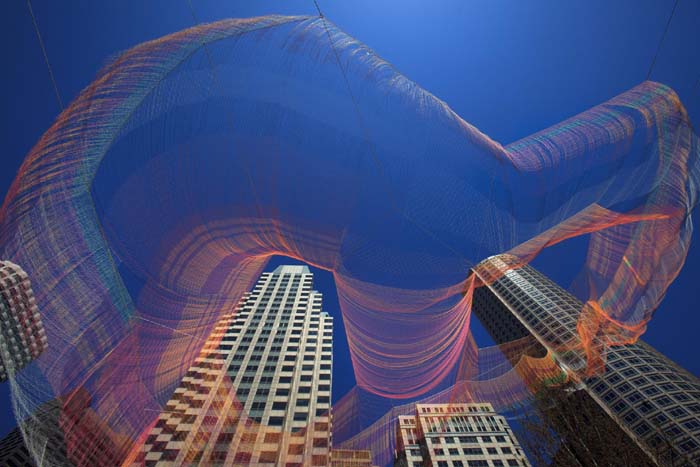
    Floating sculpture rises over the Greenway

    Half-acre net tethered between buildings to waft overhead until Oct.

    Is it a giant jellyfish? A spaceship? An outsized butterfly net?

    Whatever it is, Brookline artist Janet Echelman’s light-as-air sculpture, which turned heads as it soared over the Rose Fitzgerald Kennedy Greenway on Sunday morning, took a village to raise.

    Arriving in the wee hours of the morning, crews closed roads to make way for the project’s six cranes. With roughly 50 workers on site, the sculpture — a vast net of rusty orange, magenta, and green hues that will float above the Greenway until October — emerged from an impossibly small wooden crate, hoisted, inch by inch and crane by crane, to span roughly half an acre in the air.

    It was a colossal choreography of man and machine, as cranes lifted one portion of the net, then another, only to hand them off to workers who hand-winched them to buildings around the Greenway, fastening them tight.

    But if hoisting the sculpture resembled what organizers called a “crane ballet,” its planning and design were equally intricate — a creative collaboration between Echelman, structural engineers, software developers, lighting specialists, building contractors, political officials, the Rose Fitzgerald Kennedy Greenway Conservancy, owners of nearby property, and more.

    “It’s a bit of a coming-out party for public art on the Greenway,” said Conservancy executive director Jesse Brackenbury.

    It is also a work of collective imagination. “I ask what is possible, and then the engineers tell me this is possible, and within that I start to design,” said Echelman, 49, who has constructed similar aerial sculptures around the world.

    In Boston, Echelman is exploring a contrast between the ephemeral and the permanent: “I started thinking about the way Boston ambitiously reshaped its environment,” she explained. The sculpture’s three voids are meant to evoke three hills that once dominated Boston’s landscape but were razed to create landfill. Similarly, its colored bands are intended to recall the elevated highway that defined the Greenway space before the Big Dig banished it below ground.

    The Greenway commission, the Brookline artist’s first in Boston, is her most complex project to date, incorporating a structural net to support the floating form.

    “It’s basically a spider web — a stiff spider web that’s cast between supporting buildings, and it’s the spider web that is holding her sculptural net,” said Patrick McCafferty, a structural engineer at Arup, the engineering firm Echelman works with to design her creations.

    The sculpture emerged from an impossibly small wooden crate, hoisted, inch by inch and crane by crane, to span roughly half an acre in the air. Dina Rudick/Globe Staff

    The sculpture emerged from an impossibly small wooden crate, hoisted, inch by inch and crane by crane, to span roughly half an acre in the air. Dina Rudick/Globe Staff

    Constructed of high-tech rope that is eight times stronger than steel, the web takes a shape that is largely determined by the surrounding built environment, including which buildings have excess load-bearing strength.

    “We’re tapping into the unbridled potential energy of the site,” said McCafferty, noting that the kinematic sculpture demanded structural and engineering analyses more complex than most buildings. “You usually see buildings as static, staid things, but they’re extremely dynamic, and that’s manifested through the sculpture’s form.”

    Arriving mid-morning sporting a hard hat, Echelman marveled at her first sighting of the Greenway sculpture, weighing roughly 1 ton and ascending 365 feet at its highest point. Floating between anchor points at One International Place, 125 High Street, and the InterContinental Hotel, the sculpture boasts more than a half-million knots and more than 100 miles of rope.

    The work, which Echelman has yet to title (“I wanted to meet it first”), may appear gossamer light, exquisitely sensitive to the subtlest environmental shift as it shimmers and pulses in the breeze. By another measure, however, it is a giant sail: a 2,000-pound kinetic mass that will exert wildly variable forces on the buildings that support it.

    “We happen to be standing in one of the most windy corridors of downtown Boston,” said McCafferty, adding that the sculpture is designed to withstand wind speeds of 105 miles per hour. “We’re talking about anywhere between 50 and 70,000 pounds of force the net is putting on any one of these buildings under a wind event, so it’s not for kids.”

    Neither is its installation.

    The sculpture emerged from an impossibly small wooden crate, hoisted, inch by inch and crane by crane, to span roughly half an acre in the air. Dina Rudick/Globe Staff

    The sculpture emerged from an impossibly small wooden crate, hoisted, inch by inch and crane by crane, to span roughly half an acre in the air. Dina Rudick/Globe Staff

    “It can feel as complicated or more so as building a high-rise,” said Micah O’Neil, a senior project manager at Shawmut Design and Construction, which coordinated the installation.

    The sculpture is a study in contrasts, not only between its own strength and flexibility, but also between the rigidity of the built environment and what Echelman deems its “monumental softness.” And while it employs state-of-the-art engineering, a team of craftsmen in Washington state also used age-old nautical techniques to hand-splice and knot the nets.

    “This is very much about handcraft and ancient traditions as well as about the newest technology,” said Echelman, adding that she uses bespoke Autodesk software to design her sculptures.

    The work, whose cost the Conservancy estimates at $1.25 million, is part of the nonprofit’s push to use art to lure visitors to the park, temporarily transforming it with contemporary exhibits.

    “It changes perceptions of what the public thinks of their space,” said Lucas Cowan, the Greenway’s curator for public art. “We knew this was going to challenge a lot of people in regards to what they were viewing and what the notion of public art was. It’s not just a bronze or a static object.”

    Cowan is now designing programming to complement the sculpture, which joins Shinique Smith’s mural in Dewey Square Park and a planned sculptural installation this June at the Chinatown gate.

    Over the next week, Echelman will fine-tune the sculpture’s lighting, which will shift with the wind at night.

    Ultimately, she said, the work is about the viewer’s experience. “If you come and lie down in the grass underneath and look up and notice the changing patterns of wind, I feel that you have experienced the work,” she said, “creating your own meaning, finding your own observations about nature and the city.”

    The sculpture emerged from an impossibly small wooden crate, hoisted, inch by inch and crane by crane, to span roughly half an acre in the air.

    Malcolm Gay can be reached at malcolm.gay@globe.com. Follow him on Twitter at @malcolmgay

    ———————————————————-

    Originally published by Malcolm Gay for The Boston Globe

    PAVILION OF THE UNITED STATES
    56TH INTERNATIONAL ART EXHIBITION – LA BIENNALE DI VENEZIA
    JOAN JONAS’S THEY COME TO US WITHOUT A WORD
    Presented by the MIT List Visual Arts Center
    Commissioner and Co-Curator: Paul C. Ha, Director of the MIT List Visual Arts Center
    Co-Curator: Ute Meta Bauer, Director of the NTU Centre for Contemporary Art Singapore, Nanyang Technological University


    ON VIEW:
    United States Pavilion, Giardini della Biennale, Venice, Italy
    MAY 9 – NOVEMBER 22, 2015
    10:00 – 18:00 (closed Mondays)
    Vaporetto Stops: Giardini 1, 2, 8, 4.1, 4.2, 5.1, 5.2, 6.1, 6.2


    VERNISSAGE
    MAY 6 – 8, 2015, 10:00 – 19:00
    United States Pavilion, Giardini della Biennale


    PRESS CONFERENCE
    THURSDAY, MAY 7, 2015, 11:30
    United States Pavilion, Giardini della Biennale
    PERFORMANCE
    THEY COME TO US WITHOUT A WORD II
    JULY 20 – 22, 2015, 21:00
    Teatro Piccolo Arsenale


    Venice, Italy, May 6, 2015 – Joan Jonas’s They Come to Us without a Word is presented by the MIT List Visual Arts Center in cooperation with the U.S. Department of State at the 56th International Art Exhibition – la Biennale di Venezia. Jonas, a pioneering figure in video and performance art, is occupying the entirety of the Pavilion’s five galleries with a new video installation involving drawings and sculptural elements. A new performance by the artist will take place in July at the Teatro Piccolo Arsenale in Venice, with new music by Jonas’s long-time sound collaborator, American jazz pianist and composer Jason Moran.

    Co-curated by Paul C. Ha, Director of the MIT List Visual Arts Center and Ute Meta Bauer, Director of the NTU Centre for Contemporary Art Singapore, Nanyang Technological University, They Come to Us without a Word evolved out of an earlier work, Reanimation, first presented as a performance in 2010 at MIT, where Jonas has taught for 15 years. Reanimation was partly inspired by the writings of Icelandic author Halldór Laxness and his poetic portrayal of the natural world. They Come to Us without a Word evokes the fragility of nature in a rapidly changing situation, with each room of the Pavilion depicting a specific subject, such as bees or fish. Fragments of ghost stories sourced from an oral tradition in Cape Breton, Nova Scotia, form a nonlinear narrative linking one room to the next. “Ghosts are very much alive there, as in all parts of the world,” Jonas states. “We are haunted, the rooms are haunted.”

    In each of the four rooms of the Pavilion there are two video projections—one presenting the main motif of the room and the other the ghost narrative, a continuous thread running through the exhibition spaces.
    Free-standing rippled mirrors, conceived by Jonas and handcrafted in Murano specifically for this project, are placed in each room alongside Jonas’s highly distinctive drawings and kites, as well as a selection of objects that were used as props in her videos. This arrangement creates the sense of a stage set. Similar mirrors cover the panels of the Pavilion’s rotunda, where old Venetian crystal beads hang on a chandelier-like structure suspended from the middle of the ceiling. The ambience reflects the viewer and the exterior of the Giardini intersected by video images. An outdoor piece in the courtyard, consisting of tree trunks from the nearby Certosa Island held tightly together by copper wire, echoes the themes of the exhibition.


    Jonas developed the videos in New York in winter 2015, during a series of workshops with children ranging in age from five to 16 performing against video backdrops of landscapes shot by Jonas mostly in Nova Scotia, Canada, and Brooklyn, New York. Sources also include several early videos by Jonas. They Come to Us without a Word is animated by a soundtrack designed by Jonas, using excerpts of music by Jason Moran and songs by the Norwegian Sami singer Ánde Somby. The customized lighting is conceived by designer Jan Kroeze.


    The video footage shown in the Pavilion is being reedited for the performance They Come to Us without a Word II, as Jonas further explores the themes of the Pavilion. Jason Moran will develop the music for the project and play live in the performances. Details are available at www.JoanJonasVenice2015.com.
    _44A8276 CAP
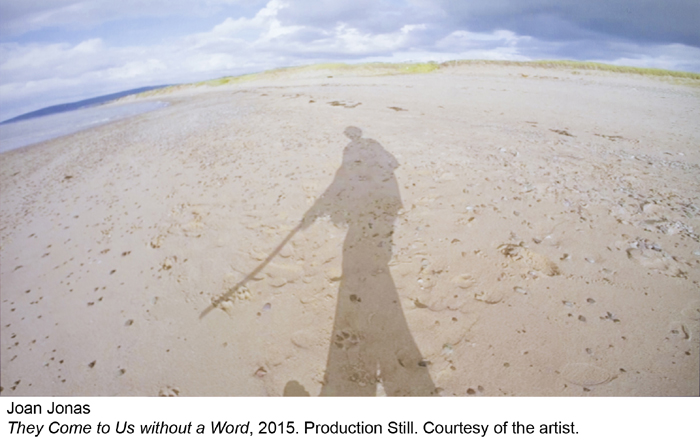
    “Although the idea of my work involves the question of how the world is so rapidly and radically changing, I do not address the subject directly or didactically,” said Jonas. “Rather, the ideas are implied poetically through sound, lighting, and the juxtaposition of images of children, animals, and landscape.”
    Jonas has been a tenured visual arts professor at MIT for the past 15 years, and is currently Professor Emerita in the MIT Program in Art, Culture, and Technology (ACT) in MIT’s School of Architecture + Planning, making the artist’s installation for the U.S. Pavilion an exceptional moment in her long-standing relationship with MIT. The List is renowned for presenting groundbreaking contemporary artwork and has always served as a creative laboratory where artists are free to experiment—a leadership position that has been affirmed by the List’s selection as the commissioning institution for the U.S. Pavilion for the third time in the past 15 years, having organized the pavilions by Fred Wilson in 2003 and Ann Hamilton in 1999.


    “Joan’s voice and vision have been powerful forces in contemporary art for five decades, and I am thrilled to present They Come to Us without a Word in Venice, one of the most iconic forums for the presentation of cutting-edge artwork,” said Paul C. Ha, Director of the MIT List Visual Arts Center. “Joan’s selection is not only an acknowledgement of her outstanding contributions to the art world thus far, but also an investment in the innovative promise of her future work.”


    “As I know from working with Joan as both a curator and educator, one does not only see her work, one experiences it. Her multimedia installations make a lasting impression, and her ability to work with spaces in a sensual way turns a visit to the U.S. Pavilion in Venice into a profound encounter,” said Ute Meta Bauer, Director of the NTU Centre for Contemporary Art Singapore, Nanyang Technological University.
    Jonas’s work developed out of her art-historical studies and sculptural practice, and expanded to performance and film in the 1960s through her involvement with the New York avant-garde. Jonas has employed an interdisciplinary approach throughout her career, being one of the first artists to explore the potential of the video camera as a tool for image-making and the TV monitor as a sculptural object. At the same time, she has experimented in developing her own visual language in relation to the figure and physical space. Her installations, video works, and performances bring these components together with drawings, props, objects, and language, reflecting her research into how the image is altered through the mediums of mirror, distance, video, and narrative. In Venice, she pursues this research in relation to figure and ground, working with new themes, like ghost stories, while integrating all the diverse aspects of her practice.


    “We are especially proud to be presenting an MIT professor as the representative artist for the United States at the Venice Biennale,” said Philip S. Khoury, Ford International Professor of History and Associate Provost, who oversees the arts at MIT. “Joan’s fearlessly experimental work is emblematic of MIT and the List’s mission to foster the creation of intellectually investigative, challenging artwork, and we have no doubt that her installation for the U.S. Pavilion will push new boundaries and captivate audiences in ways that were previously unimaginable.”

    A fully illustrated catalogue, published by Gregory R. Miller & Co., will be released in June in conjunction with the exhibition They Come to Us without a Word. Edited by Jane Farver, the publication will feature essays by Ann Reynolds, Ingrid Schaffner, and Marina Warner.


    ABOUT THE ARTIST Joan Jonas (b. 1936, New York, New York, U.S.A.) is a pioneer of video and performance art, and an acclaimed multimedia artist whose work typically encompasses video, performance, installation, sound, text, and drawing. Trained in art history and sculpture, Jonas was a central figure in the video and performance art movement of the late 1960s, and her experiments and productions in the late 1960s and early 1970s continue to be crucial to the development of many contemporary art genres, from performance and video to conceptual art and theater. Since 1968, her practice has explored ways of seeing, the rhythms of ritual, and the authority of objects and gestures.

    The recipient of numerous honors and awards, Jonas’s most recent solo exhibitions include those at HangarBicocca, Milan (2014); Centre for Contemporary Art, Kitakyushu Project Gallery, Japan (2014); Kulturhuset Stadsteatern Stockholm (2013); Proyecto Paralelo, Mexico (2013); Contemporary Art Museum, Houston (2013); Bergen Kunsthall, Norway (2011); Museum of Modern Art, New York (2010); and MACBA, Barcelona (2007 – 08). She has been represented in documenta in Kassel, Germany six times since 1972, and has had major retrospectives at the Stedelijk Museum, Amsterdam; Galerie der Stadt Stuttgart, Germany; and the Queens Museum of Art, New York. Joan Jonas is a New York native and she continues to live and work in New York City. She received a B.A. in Art History from Mount Holyoke College in 1958, studied sculpture at the School of the Museum of Fine Arts, Boston, and received an M.F.A. in Sculpture from Columbia University in 1965. Jonas has taught at MIT since 1998, and is currently Professor Emerita in the MIT Program in Art, Culture, and Technology. In June 2015, Gregory R. Miller & Co. will publish the first comprehensive monograph of Jonas’s work, edited by Joan Simon, titled In the Shadow of a Shadow: The Work of Joan Jonas.

    ABOUT THE COMMISSIONER/CURATORS
    Paul C. Ha is the Director of the MIT List Visual Arts Center, and has more than 25 years of professional experience in art and museum administration, fundraising, curating, and teaching. Since joining the List in 2011, Ha has founded the exhibition program List Projects, which commissions emerging artists to create site-specific installations at the museum. As the inaugural Director of the Contemporary Art Museum St. Louis from 2002 to 2011, he developed new programming that expanded the Museum’s audiences both locally and internationally, raised more than $40 million for the institution, and established a $5-million endowment—the Museum’s first, and positioned CAM as a leader in the contemporary art field. Ha has curated and worked with over 100 artists in solo and group exhibitions, and many artists received their first major museum exhibitions under his leadership at the List Center and the Contemporary Art Museum St. Louis, as well as when he was Director at White Columns gallery in New York, and Deputy Director of Programs and External Affairs at Yale University Art Gallery.

    Ute Meta Bauer is a veteran curator of exhibitions and presentations on contemporary art, film, video, and sound, with a focus on transdisciplinary formats. She is the Founding Director of the NTU Centre for Contemporary Art Singapore at the Nanyang Technological University (NTU), where she is also a professor in the School of Art, Media, and Design. She curated Theatrical Fields, commissioned by Bildmuseet Umeå, Sweden (2013 – 14), which includes various works by Joan Jonas and was shown summer 2014 at the NTU CCA in Singapore. Bauer is a former MIT professor, having served as the Founding Director of the Program in Art, Culture, and Technology at MIT’s School of Architecture and Planning, and as Director of the MIT Visual Arts Program. She was Co-Director of the World Biennial Forum No. 1 with Hou Hanru, Gwangju, Korea (2012); Artistic Director of the 3rd Berlin Biennale for
    Contemporary Art (2004); and Co-Curator of Documenta11 (2001 – 02) on the team of Okwui Enwezor. Most recently she curated Yang Fudong: Incidental Scripts (2014) with Khim Ong and Simryn Gill: Hugging the Shore (2015) with Anca Rujoiu at the NTU CCA Singapore.


    ABOUT LA BIENNALE DI VENEZIA
    The Venice Biennale dates to 1895, when the first International Art Exhibition was organized. It is one of the most important international biennials and cultural institutions in the world, introducing hundreds of thousands of visitors to exciting new art every two years. The 56th International Art Exhibition of La Biennale di Venezia (May 9 – November 22, 2015) is directed by Okwui Enwezor, a curator, art critic, and writer, and the Director of the Haus der Kunst, Munich.


    ABOUT THE MIT LIST VISUAL ARTS CENTER
    Located in Cambridge, Massachusetts, the List Visual Arts Center is a creative laboratory that provides artists with a space to freely experiment and push existing boundaries. As the contemporary art museum at MIT, the List presents a dynamic program of six to nine special exhibitions in its galleries annually, a program of evolving site-specific work by emerging artists known as the List Projects, as well as a broad range of educational programs, events, and scholarly publications. Beyond the full slate of special exhibitions and projects it presents each year, the List also maintains and adds to MIT’s permanent collection; commissions new works through the MIT Percent-for-Art program, a collection of more than 50 site-specific artworks throughout the campus; and oversees the Student Loan Art Program, which lends more than 500 works of art annually to MIT undergraduate and graduate students.

    Originally named the Hayden Gallery, MIT established this center for the visual arts in 1950 to provide a dedicated structure upon which to build the university’s existing relationship to the arts. It was renamed the List Visual Arts Center in 1985 in recognition of a gift from Vera and Albert List, and relocated to its current, expanded location in the Wiesner Building on the campus of the Massachusetts Institute of Technology, which was designed by MIT alumnus I. M. Pei (B.S. Architecture, 1940) and Partners Architects.
    For more information, visit: http://listart.mit.edu


    ABOUT THE ARTS AT MIT
    Nearly 80 percent of incoming freshmen have prior training in the arts and nearly 50 percent of all MIT undergraduates enroll in arts courses each year. The arts at MIT connect creative minds across disciplines and encourage a lifetime of exploration and self-discovery. As an example, MIT’s visiting artists program enables contemporary artists to engage with MIT’s unparalleled environment of pioneering research, unbounded risk-taking, and imaginative problem solving, and has previously hosted artists such as Olafur Eliasson, Trevor Paglen, Tomás Saraceno, Vik Muniz, Mel Chin, and Rick Lowe.
    The arts strengthen MIT’s commitment to the aesthetic, human, and social dimensions of research and innovation. Artistic knowledge and creation exemplify MIT’s motto, mens et manus—mind and hand. The arts are essential to MIT’s mission to build a better society and meet the challenges of the 21st century.
    For more information, visit: http://arts.mit.edu


    ABOUT THE U.S. DEPARTMENT OF STATE’S BUREAU OF EDUCATIONAL AND CULTURAL AFFAIRS
    The U.S. Department of State’s Bureau of Educational and Cultural Affairs (ECA) builds relations between people of the United States and the people of other countries through academic, cultural, sports, and professional exchange programs, as well as public-private partnerships and mentoring programs. These exchange programs improve foreign relations and strengthen the national security of the United States, support U.S. international leadership, and provide a broad range of domestic benefits by helping break down barriers that often divide us, like religion, politics, language and ethnicity, and geography. ECA programs build connections that engage and empower people, and motivate them to become leaders and thinkers; to develop new skills; and to find connections that will create positive change in their communities. Alumni of ECA exchange programs comprise over one million people around the world,
    including more than 40 Nobel Laureates and more than 300 current or former heads of state and government.


    For more information, visit: http://www.exchanges.state.gov/us
    The Bureau of Educational and Cultural Affairs supports and manages official U.S. participation at the 56th International Art Exhibition – la Biennale di Venezia. The selection of Joan Jonas’s They Come to Us without a Word for the U.S. Pavilion in 2015 resulted from an open competition and the recommendations of the Federal Advisory Committee on International Exhibitions, convened by the National Endowment for the Arts.

    ABOUT THE SPONSORS
    Joan Jonas’s They Come to Us without a Word, the official U.S. presentation at the 56th International Art Exhibition – la Biennale di Venezia, is organized by the MIT List Visual Arts Center and is presented by the Bureau of Educational and Cultural Affairs of the U.S. Department of State. The exhibition is produced with the collaboration of the Peggy Guggenheim Collection, Venice (Solomon R. Guggenheim Foundation, New York). Lead foundation support has been provided by the Helen Frankenthaler Foundation; lead individual support has been provided by Cynthia and John Reed. Additional funding has come from The Council for the Arts at MIT, Toby Devan Lewis, clé de peau BEAUTÉ – Shiseido, VIA Art Fund, Artnet, Agnes Gund, Lambent Foundation, Karen and Gregory Arenson, Barbara and Julian Cherubini, Alison and John Ferring, Charlotte Feng Ford, Carolyn Fine Friedman and Jerry Friedman, Pamela and Richard Kramlich, Barbara Lee Family Foundation, Lore Harp McGovern, Gregory R. Miller and Michael Wiener, Jane and Neil Pappalardo, Office of the Associate Provost of MIT, Office of the Dean of the School of Architecture and Planning of MIT, Office of the President of MIT, Office of the Provost of MIT, Elizabeth A. Sackler, Francis H. Williams, Anonymous, and numerous other individuals.


    Media Contact:
    Leah Talatinian | Arts at MIT | +1.617.253.5351 | venicepress2015@mit.edu
    Mark Linga | MIT List Visual Arts Center | +1.617.452.3586 | venicepress2015@mit.edu
    Hanna Gisel | Resnicow + Associates | +1.212.671.5162 | venicepress2015@mit.edu
    Chelsea Bruck | Resnicow + Associates | +1.212.671.5164 | venicepress2015@mit.edu
    Megan Ardery | Resnicow + Associates | +1.212.671.5178 | venicepress2015@mit.edu


    Additional information and images available at JoanJonasVenice2015.com


    Follow the MIT List Visual Arts Center on Twitter: @MITListCenter, Instagram: @mitlistarts, or Facebook: MIT List Visual Arts Center, for updates from Venice and look for #JoanJonasVenice.

    News | Exhibitions