• At the heart of the Lower East Side blooms the Orchard Street art district with colorful vivacity. More galleries are moving into and the street breathes with fresh vegetation and renewed creativity. It’s now an area where healthy pedestrians outnumber road traffic, street art abounds, and storefronts in primary colors invite to observe the action inside.

    Art galleries and late dinner was our after work choice last Wednesday so we showed up at Artifact Gallery opening reception of the latest Manuella Muerner Marioni’s solo exhibition in the city. She had just arrived from an exhibition at the Museo Dell’Energia in Milan, where she had to fly immediately after participating in ART Expo New York. The art market can be a demanding partner.

    The Swiss artist had on display some of her neo-expressionist paintings and two voluptuous sculptures of a modernist overtone. The paintings portray the sculptures, but they are markedly different. Her seemingly wild brushwork of strident colors is slightly figurative but profoundly abstract and charged with controversy and angst. Paintings such as Brainstorming (2011) are rough and violently emotional. The use, however, of saturated colors and figurative simplifications reminds of quieter neo-expressionist masters like Norris Embry or Peter Robert Keil; and reflects a tendency towards a kind of Fauvism that is wild and balanced at a time.  Muerner Maroni reinterprets her own sculptural creations in two dimensions by negating them. Black edges and vertices become white, the surroundings fall into a dark negative black that contradicts the invariably white gallery spaces, and the simplicity of the sculptural forms gives way to chaotic bursts of abstract expressionism. “Art is the creation of opposites” declares the author, and those contradictions can be found in the paintings themselves. There is a clear interest in expressing volume and perspective on the female figures while faces are painted flat like the CDs that record those conceptual efforts that Muerner Maroni rejects in favor of the naked expression.

    Brainstorming, acrylic, mixed media on canvas, 23.5″x31.5″, 2011.

    Brainstorming, acrylic, mixed media on canvas, 23.5″x31.5″, 2011.

    The artist mingled around and granted a few words to most of the attendees dressed with one of her own creations, while a poet declaimed around the room between laughs and toasts. The most interesting pieces were actually among the attendees: two feminine figures meticulously covered by mirror glass mosaics.

    sculpture1

    Manuella Muerner Marioni, Torso Gold, 2010. Mixed media sculpture, 20 x 8 x 12 in.

    To understand the genesis of these sculptures one must go back to the formative period of Marioni’s career, in particular those seven years she spent collaborating with her friend and mentor Niki de Saint Phalle. Most famous for her public sculptures, Saint Phalle had become captivated by the Barcelona of Antoni Gaudí since the late 50s. The irregularity of the individual forms that preserve larger symmetries, the explosive colors and the whimsical organic ornamentations. Saint Phalle passed her sense of Gaudí to Marioni, however, the single feature that Saint Phalle didn’t adopt from Gaudi’s sculpture has become the one that Marioni puts at the center of her creation: the mosaic.

    2-DSC02517

    Sphynx, mixed media mirror, 11.5″x13″x6.7″, 2011.

    These modern Paleolithic Venuses, in their essential fertility give back a fragmented image of yourself for you to realize and instinctively reconstruct. They are generous in not standing alone as the sole center of attention but giving prominence to environment and beholder as well. They change while you move and the lights go down progressively in the late afternoon at Orchard Street.

    – Manuel Pardo


    Wilson_Biville_small_504

    From The Ruins…
    Curated by Jane Ursula Harris
    May 8 – September 19, 2015
    Opening reception: Friday, May 8, 6-9pm
    Upcoming M Lamar: Thursday, May 21. Reception & extended viewing hours 6-7pm with 7pm performance.

    Michael Ashkin
    Abigail DeVille
    William Eggleston
    LaToya Ruby Frazier
    Christian Holstad
    Jennifer & Kevin McCoy
    Luther Price
    Julie Schenkelberg
    Jane & Louise Wilson

    Reflecting a world that seems perpetually on the brink of disaster, where threats of global warming and over-population play out as if in slow motion, From the Ruins… gathers artists who mine this limbo state in works that abstract, document, alchemize, or otherwise re-imagine remnants of the built world.

    What appears to be ad hoc, casual, and precarious, is often deceptively calculated, or painstakingly crafted. In this sense, From The Ruins… reframes recent discussions of zombie formalism, long confined to painting, so that aspects of the “tentative, unfinished or self-canceling” (Raphael Rubinstein, Art in America, May 2009) take on new meaning.

    Even more so, the ongoing phenomena of ruin porn is critically engaged here, as many of the artists reveal in the latter’s fetish for decay, a collective sublimation of fear: the need to envision a romantic end, rather than face an uncertain present. The objects and images in From the Ruins… therefore oscillate between states of destruction and construction, peril and becoming, hope and despair, evoking the equivocality of “a world that no longer believes in the power of the end” (Teresa Heffernan, Post-Apocalyptic Culture, 2008).

    Read more >

    “SHE” by VALYA:

    VISUAL REFLECTIONS ABOUT FEMININITY

    During wartime, when so many Ukrainians, including artists, are moving off the country, only the most persuasive artworks and exhibition projects are able to overcome a negative tendency of intellectual migration in order to help the developing and struggling community on the very eastern edge of Europe to find out its cultural roots for effective living.

    ***

    VALYA is American artist of Ukrainian origin. Her cultural and genetic roots were explored fundamentally in time of her previous TSEKH gallery’ exhibition projects: Everything But Memory, 2011, and Cell Memory, 2008. Accordingly, VALYA’s oeuvre could be analyzed in terms of contemporary Ukrainians’ visual researcher. By her own words, her current felt red installation not only about Ukraine, it is Ukraine, SHE.

    SHE_02

    Furthermore, VALYA’s femininity has a very deep look onto the roots, because in her archaic Life Tree history, modernity, and future are closely integrated. So, ornaments, used by VALYA, are going from the ancient Ukrainian wipers, embroideries, Easter eggs etcetera.

    To conclude with, TSEKH gallery, Kyiv, presents an upcoming exhibition project SHE by VALYA, May 26 – June 29. This is huge, complicated, and fantastically creative installation, with its main part as 6.2×6.5 meters, and it is made from industrial red felt and linen thread, with addition of hundred of small sculptures as archaic female goddesses, that were spread from Ukraine worldwide aforetime… .

    ***

    Being born and living in bloodshed, Ukrainian nation needs to fix its sacral and ornamental tradition, which, for VALYA, gives power to defend itself. Small ceramic sculptures make an emphasis on archaic femininity, which gives birth. Opposite two sides of installation are equal, connected between themselves like DNA’ spiral, so traditional Ukrainian ornaments is a cultural code here, code, that integrates and gives life to the whole developing and struggling community.

    VALYA. “ВОНА”: ВІЗУАЛЬНІ РОЗДУМИ ПРО ЖІНКУ

    Протягом війни, коли так багато українців, включаючи митців, виїжджає з країни, тільки найбільш переконливі витвори мистецтва та виставкові проекти долають негативну тенденцію інтелектуальної міграції, щоб допомогти спільноті, що розвивається та бореться на східному кордоні Європи, віднайти та осягнути власне культурне надбання для побудови ефективної моделі існування.  

    ***

    VALYA – американська мисткиня українського походження. Культурні та генетичні корені було фундаментально досліджено у попередніх виставкових проектах мисткині в галереї ЦЕХ: Everything But Memory, 2011, Клітинна пам’ять, 2008. Відповідно, творчий доробок VALYA можна представити як візуальну аналітику сучасної української спільноти. За її власним висловом, її нинішня інсталяція з червоної повсті не тільки про Україну, це і є Україна, ВОНА.

    Якщо вести далі, феміністична проблематика VALYA має глибинний зв’язок із традицією, саме тому архаїчне Дерево Життя поєднує історію, сучасність, та майбутнє, що є нерозривно поєднані. Так, наприклад, орнаменти, які використовує VALYA, походять від давніх українських рушників, вишиванок, писанок тощо.

    Насамкінець, галерея ЦЕХ представляє майбутній виставковий проект “ВОНА”, 26 травня – 29 червня. Це є велична, складна, та надзвичайно вигадлива інсталяція, її головна частина 6.2х6.5 м. завдовжки, зроблена з промислової червоної повсті та лляної мотузки, до того ж сотня маленьких скульптур архаїчних жіночих богинь, які колись поширились із України світом на світанку історії… .

    ***

    Народжена в борні, українська нація має зафіксувати власну сакральну та орнаментальну традицію, що, на думку VALYA, дасть їй наснагу для захисту. Маленькі керамічні скульптури акцентують увагу на архаїчній фемінності, що народжує. Два протилежні боки інсталяції є однаковими, вони з’єднані між собою як спіралі ДНК, тому традиційна українська орнаментика є культурним кодом, це є код, який об’єднує та дає життя усій спільноті.

    The Tsekh Gallery (Kiev, Ukraine)

    On its 60th birthday, the Ringturm is attracting the attention of the international art scene. For the eighth time, Wiener Städtische Versicherungsverein will wrap the Ringturm – this year with the work “Sommerfreuden“ (“Summer Pleasures”) by Croatian artist Tanja Deman.

    (Vienna, 11 May 2015) Today, work is set to start on the façade of the Ringturm. This summer, the building will once again make its mark on the city’s appearance with a supersized art installation. Wrapping the Ringturm has already become a tradition, and this year, as an expression of the cross-border intercultural dialogue of Wiener Städtische Versicherungsverein, the wrapping of the tower will build a strong connection with Croatia. Austria and Croatia are bound by many years of shared history, and Croatia’s accession to the EU has made this close relationship even more intense. “This year, with Tanja Deman, the Croatian artist who is transforming the Ringturm building with her work ‘Sommerfreuden’ (‘Summer Pleasures’), we are giving Vienna an installation reflecting a kind of nostalgia. This work represents the essential human yearning for sunshine and joie de vivre. The motif acts as a kind of window – one glance is enough to open up a new perspective on urban living”, according to Dr Günter Geyer, Chairman of the Managing Board of the Wiener Städtische Versicherungsverein.

    “Sommerfreuden“ (“Summer Pleasures”)  

    In “Sommerfreuden”, Tanja Deman opens up the Viennese urban landscape and presents a utopia of summer refreshment and relaxation. “Fascinated and simultaneously inspired by the diverse waterscapes of Vienna, ‘Sommerfreuden’ creates a fluent and smooth passage between two worlds, constructed landscape and natural”, says Deman of her work. The picture is an amalgam of very different puzzle pieces carefully combined to create a balanced composition. Water and air – two elements humans could not live without – dominate the work. The first glance plunges the spectator into the refreshing water of a swimming pool teeming with other people. The second glance brings forth film sequences, like our own personal memories of a summer’s day, which gradually assemble to form a consistent ensemble.

    At the same time, the work meets the demand for a new perspective, for distance from the protagonists – both in terms of space and time – because Deman’s piece is directly linked to the real world around it and ‘folds’ space and time to form a unique image-space. The artist focuses on nature as shaped by humans, and the Ringturm itself becomes part of this artificial landscape. “’Sommerfreuden’ illustrates the city dwellers’ longing for relaxation, rest and pleasure. An artificial nature created by humans acts as a frame, combined with unspoilt nature in the distance”, Deman explains. For example, the ‘bathing landscape’ in the foreground of the image is directly connected to the work’s own urban context, the Donaukanal (Danube Canal). Tanja Deman turns the Donaukanal – a popular summertime meeting point for the locals, as well as for tourists – into a common perspective: instead of the Ringturm building we can see the sea, horizon and some offshore islands. Even the sky in the image indicates that the work portrays an artificial reality; the lines across the blue sky give it the air of an old photocopy. Appearances are deceptive, however, because the image does not show a real scene; the way it unfolds makes it clear that the portrayed scene has never taken place this way.

    In 2015, Tanja Deman’s work marks a turning point in the artistic wrapping of the Ringturm: in the past, only paintings were used. This year’s “Sommerfreuden” marks a shift towards new media. Work on the Ringturm façade will continue until mid-June, until a total of 30 printed pieces of fabric, each about three metres wide and up to 63 metres long, are installed. The 4,000 sqm art piece will be on display from mid-June until September.

    The artist

    Visual artist Tanja Deman was born in the Croatian seaport of Split in 1982; today she lives and works in Zagreb. She holds Master’s and Bachelor’s degrees in Fine Arts (BFA, MFA) from the Academy of Fine Arts in Zagreb. The 33-year-old artist has participated in many international artistic programmes and has exhibited her work on numerous homeland and international art exhibitions. In Austria, for example, she was artist-in-residence programme at KulturKontakt cultural centre in Vienna and is currently artist-in-residence at the Atelierhaus Salzamt in Linz. Deman works in photography and film. Reflecting on modern architectural history and the landscape, she addresses the sociology of space and studies the socio-political dynamics of the human made environment. Numerous prizes and awards underscore her success. Deman’s works are to be found in several public collections and many private collections worldwide.

    Architecture in the Ringturm

    To mark this year’s wrapping of the Ringturm, the exhibition “Croatian Islands – Construction Culture over the Centuries” is on display between 22 June and 23 October at the Vienna Ringturm. Croatia’s unique island world, with around 1,200 islands (only 66 of which are inhabited), and its rich architectural heritage are in the focus of Adolph Stiller’s and Lukas Skanski’s exhibition. The Dalmatian islands and their remarkable hotel buildings are portrayed in the exhibition, as well as the great historic structures built by the Romans and Venetians which define the coastline.

    The Ringturm at 60

    In 2015, the Ringturm celebrates its 60th anniversary: on 14 June 1955, the Ringturm, Vienna’s first office block, was ceremonially inaugurated. At that time, it was a symbol of freedom, modernity and the reconstruction of Austria; today, the Ringturm has become a space for exchange, communication and the cross-border intercultural dialogue of Wiener Städtische Versicherungsverein. Since 2006, the Ringturm itself has become an artwork; a ‘wrapped’ tower. After four successful works by Austrian artists, since 2012, artists from Austria’s neighbouring countries have also been invited to design the Ringturm’s wrapping.

    Wiener Städtische Versicherungsverein is the principal shareholder of Vienna Insurance Group (VIG) and provides assistance to VIG in cultural and social matters. Great importance is placed on cross-border cultural exchanges, thus creating open spaces for cultural development. Through co-operation and initiatives, Wiener Städtische Versicherungsverein provides specifically targeted support for socially active organisations, especially in countries in Central and Eastern Europe where VIG has a presence. Furthermore, as the principal shareholder, Wiener Städtische Versicherungsverein also deals with strategic policy issues of the Group.

    At 8:20 p.m., the body artist Chris Burden entered a large gallery of the Museum of Contemporary Art, did not look at his audience of 400 or more, set a clock for midnight, and lay down on the floor beneath a large sheet of plate glass that was angled against the wall.

    So began on April 11 a deceptively simple piece of conceptual art that would eventually involve the imaginations of thousands of Chicagoans who had never heard of Burden, would cause the museum to fear for Burden’s life, and would end at a time and in a way that Burden did not remotely anticipate.

    The piece began, in a sense, a month earlier, when I was interviewing Burden at the Arts Club of Chicago in the company of Ira Licht, the museum’s curator. At that time Burden had just completed a piece in a New York art gallery that involved his living for three weeks on a triangular platform set so high against one of the gallery’s walls that no one could see for sure if he was really up there. He took no nourishment except celery juice.

    The piece had been spooky, mystical, Burden was saying. There had been something infuriating, for some of the visitors to the gallery, in the notion that a human presence was up there in the shadows under the ceiling, not speaking, not doing anything, just waiting.

    Some of the visitors tried to take running jumps up the wall in an attempt to see Burden, or a hand, or a shoe, or a couple of eyeballs in the darkness. Others took it on trust that he was there. Burden heard one young man telling his friend that the feeling in the gallery was almost spiritual: “He can hear us, and he doesn’t answer, but he can’t help listening…it’s like God.”

    Burden had been invited to Chicago to participate in an exhibition of “conceptual art” at the museum. Earlier that morning, he’d visited the gallery where he’d be performing, and now at lunch he said he wasn’t sure yet what he would do, but he had a few ideas.

    Would it be fair, Ira Licht asked, to ask for some rough estimate of how long the piece might last?

    No, Burden said, it wouldn’t. A piece lasting 45 seconds might be richer than one lasting two hours.

    Licht said there might be a problem if some of the museum’s members arrived a few minutes late and the piece was already over. Well, Burden sighed, he couldn’t please all of the people all of the time. And it was at that moment that the idea for his April 11 performance came to him…

    The talk at the luncheon moved on to some of Burden’s earlier pieces, and inevitably to the performance by which he earned his master’s thesis at the University of California at Irvine: He had himself locked into a locker measuring 2-by-3-by-3 feet for five days; there was a five-galloon jug of water in the locker above him and, with admirable logic, an empty five-gallon container in the locker below him. Word of the piece had spread all over the campus, and hundreds of students had come to talk to him through the locker’s grillwork. One of the beauties of the piece, Burden said, was that, of course, he had to listen: “I was a box with ears and a voice.”

    On another occasion, Burden had himself manacled with brass rings to a concrete floor, flanked by two buckets of water with live electric wires in them. The audience was admitted, and trusted not to knock over a bucket and electrocute the artist. “I had absolute faith that they wouldn’t,” Burden said. “After all…I’m not suicidal.”

    For other works Burden had himself nailed to the roof of a Volkswagen, and shot in the arm with a rifle (“It was supposed to be a graze wound, but the marksman missed”). These more violent pieces tended to attract more attention, he said, but some of his quieter pieces were perhaps more interesting. The idea in conceptual art is that the artist causes experiences to happen to himself, and then ruminates on the interaction between the self and the experience; an audience may be permitted to observe, but is not essential.

    When he returned to Chicago in April, Burden told the museum he would require the large industrial-style clock, the sheet of plate glass, and nothing else. The clock was fastened to the wall and the sheet glass was leaning against it at a 45-degree angle when the museum’s doors were opened at 8 p.m.

    An unusually large crowd filed in, attracted perhaps by publicity about Burden’s previous performances. There was a slight carnival atmosphere. The tone was muted somewhat because of a large number of spectators who were seriously interested in body art, but all the same a definite feeling existed in the room that some people had come to see blood.

    At 8:20, Burden entered the gallery, set the clock for midnight and laid down under the glass. He was wearing a Navy blue sweater and pants, and jogging shoes. He let his hands rest easily at his sides and looked up at the ceiling, blinking occasionally. He could not see the clock.

    The audience perhaps expected more. There was a pregnant period of silence, about 10 minutes, and when at the end of it nothing else had happened, there were a few loud whistles and sporadic outbursts of clapping. Burden did not react. At various times during the next two hours, audience members tried to approach Burden with advice, greetings, exhortations, and a red carnation. They were politely but firmly kept away by the museum attendants. A girl threw her brassiere at the glass; it was taken away by a smiling guard.

    At 10:30 p.m., when I left, the crowd had dwindled down to perhaps 100. I came back to the Sun-Times to write a mildly quizzical article, and then called Alene Valkanas, the museum’s publicist, to ask if Burden was still on the floor.

    “Yes, he is,” she said. “It’s a really strange scene here right now. There are about 40 people left, and they’re all very quiet. Burden doesn’t move. It was more like a circus before; but now it’s more like a shrine…very mysterious and beautiful.”

    I filed the story with a pre-written editor’s note: “At (fill in the time and day), Chris Burden ended his self-imposed vigil.” The editor’s note was never to run.

    I left to meet friends for a drink, and we talked about Burden and what he was up to. There was the suggestion that this was another of his danger pieces, that eventually someone would become impatient enough to throw something at the plate glass and break it, that Burden’s immobility was an impudent invitation of violence toward himself. Nobody had a better idea.

    The room was crowded and happy and noisy, but I felt my thoughts being pulled back to that vast, empty gallery with the sheet glass leaning against one wall. At 1:15 a.m., I went to the pay telephone and called Alene. She said Burden was still on the floor. I said the hell with it and drove back downtown to the museum. Burden had not moved.

    Two of the museum guards still remained (one of them, Herman Peoples, would become so involved in the piece that he would voluntarily share the vigil with Burden, vowing not to leave until it was over). There was a television reporter, Rich Samuels of WMAQ, sitting on a mat of foam rubber, and a young couple who left soon after I arrived. Two banks of spotlights illuminated Burden against the wall, and the other lights had been turned out; a zaftig nude by Gaston Lachaise lounged in the shadows.

    “He doesn’t move except for what look like isometric flexings,” Alene Valkanas said “He flexes his fingers sometimes, and once in a while you can see his toes flexing.”

    Burden seemed removed to a great distance. He was not asleep. There was no way to tell if he was in a meditative trance, or had hypnotized himself, or was fully aware of his surroundings. After an hour, I left very quietly, as if from a church. The next day I’d planned to drive down to Urbana, but before I left I called the museum. It was noon; Burden had still not moved, the museum said. Fifteen hours and 40 minutes.

    During the drive downstate, my thoughts kept returning to him, and I wondered what he was thinking and how he felt, and if he were thirsty, and if he had to piss. The radio stations had picked up on the piece by now, and were inserting progress reports on their newscast. Disc jockeys were finding the whole thing hilarious.

    On Sunday, driving back to Chicago, I stopped at the Standard Oil truck stop in Gilman to call the museum. Burden had not moved. The time was 2:30 p.m. Forty-two hours and ten minutes. I came into the office, where I learned that Ira Licht and other museum authorities were consulting specialists to determine whether Burden’s life was in danger. A urologist said no one could go more than perhaps 48 hours without urinating and not risk uremic poisoning. Burden hadn’t had anything to drink, but that was not a problem at the moment, apparently; since he was not exercising he would not dehydrate dangerously in only two days.

    Alene Valkanas called at a little before 6 p.m.

    “The piece ended at 5:20,” she said. Forty-five hours. “We felt a moral obligation not to interfere with Burden’s intentions, but we felt we couldn’t stand by and allow him to do serious physical harm to himself. There was a possibility he was in such a deep trance that he didn’t have control over his will. We decided to place a pitcher of water next to his head and see if he would drink from it. The moment we put the water down, Chris got up, walked into the next room, returned with a hammer and an envelope, and smashed the clock, stopping it.”

    The envelope, sealed, contained Burden’s explanation of the piece. It consisted, he had written, of three elements: The clock, the glass, and himself. The piece would continue, he said, until the museum staff acted on one of the three elements. By providing the pitcher of water, they had done so.

    “I was prepared to lie in this position indefinitely,” he continued. “The responsibility for ending the piece rested with the museum staff but they were always unaware of this crucial aspect.” The piece had been titled “Doomed.”

    The idea for the piece, Burden explained later, had come during our lunch with Licht: “I thought, if he’s concerned about how long the piece will be, I’ll do a piece in which he has complete control over the length.”

    “My God,” Alene Valkanas said. “All we had to do was end it ourselves, and we thought the rules of the piece required us to do nothing.”

    During the 45 hours, Burden had been in psychological danger, perhaps, but not in physical danger; he had urinated, but the museum staff had not noted the signs on his navy-blue dungarees. He had been thirsty and hungry, Burden said, and he had been completely conscious at all times except for some fleeting periods of sleep. He had not used a self-imposed trance, or yoga, or anything else except self-discipline to keep himself lying there.

    “I thought perhaps the piece would last several hours,” Burden said. “I thought maybe they’d come up and say, okay, Chris, it’s 2 a.m. and everybody’s gone home and the guards are on overtime and we have to close up. That would have ended the piece, and I would have broken the clock, recording the elapsed time.

    “On the first night, when I realized they weren’t going to stop the piece, I was pleased and impressed that they had placed the integrity of the piece ahead of the institutional requirements of the museum.

    “On the second night, I thought, my God, don’t they care anything at all about me? Are they going to leave me here to die?”


    Source: Roger Ebert, May, 1975

    Chris Burden Documented Projects 71 – 74

    manuella
    May 13- 31, 2015 / Opening Reception: Wednesday May 13, 2015 at 6 p.m.

    You and your friends are cordially invited !!!
    The artist will be present at the Opening Reception – Looking forward to see you :-))
    Adress Gallery: ARTIFACT, 84 Orchard Street, New York 10002, NY
    Opening Times: Wednesday – Sunday 12 p.m. – 6 p.m.
    More information about artist:

    Manuella Muerner Marioni
    www.arte-manuella
    manuella muerner marioni
    hub 7
    CH-3203 muehleberg
    SWITZERLAND
    E-Mail: fine@arte-manuella.ch
    NEWS BLOG

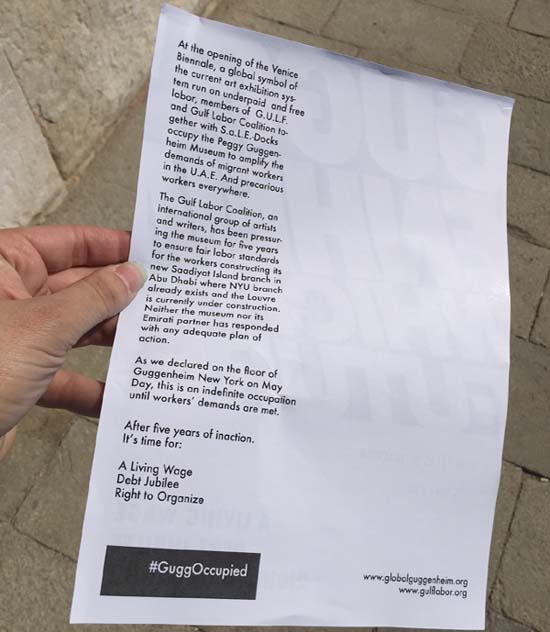
    Gulf Labor is an active participant in the 2015 Venice Biennale’s central exhibition, All the World’s Futures, which is curated by Okwui Enwezor. They are a coalition of artists, writers, architects, curators, and political cultural advocates. The group staged a series of protests dedicated to its investigations of labor conditions in the Persian Gulf:

    10405619_10152922393682099_2102250573579533779_n

    Facebook Image: Noah Fisher, May 8, 2015, Venice. Ivor Stodolsky, Gregory Sholette, Amin Husain, Natasha and Joulia Strauss.

    May 8, 2015, VENICE — At 10:20am this morning, two boatloads of artists and activists occupied the dock landing of the Peggy Guggenheim Collection (PGC) in Venice.

    11223490_10152922393802099_7054497235805719484_n

    Facebook Image: Noah Fisher, May 8, 2015, Venice.

    The message:

    ‘This morning we shut down the Venice Guggenheim by way of boats, for the same reason we recently shut it down in NYC: to crank up pressure on the museum to meet the worker’s demands in Abu Dhabi for dignified rather than debt-bonded labor conditions. Now is the time: main construction starts in the next few months .

    Even since I was invited to participate in the Venice Biennale with Gulf Labor, it was always clear that this was a new possible stage for the campaign, and also that we should avoid export/import politics so frequently seen in high-flying art exhibitions. Following months of setting up relationships and plans through skype, this time we were joined by more than 30 people from occupied art spaces in Venice & Milan: Seasoned activists who provided us with all kinds of support and quickly became friends.

    After a day of meetings and a night of banner painting, we rode through the grand canal on five boats and scrambled up on the Guggenheim to occupy its canal-facing facade with a banner carefully lettered by Joulia, waving colorful flags and bearing signs, then a group shut down the entrance on the other side. After a few hours the museum agreed to meet a small delegation of us, and after a couple more hours Richard Armstrong called from NYC, they had acceded to our demand to meet with the board of directors. The campaign is far from over but it was a big win today in Venice!

    – from Facebook wall, Noah Fisher 

    Facebook Image: Noah Fisher.

    Facebook Image: Noah Fisher.

    venice-gugg-protest-flyer-02

    The flyer. Image for Hyperallergic.

    Facebook Image by Amin Husain

    Facebook Image: Amin Husain

    11100501_10152922394922099_6919786480717207735_n

    Facebook Image: Noah Fisher, May 8, 2015, Venice.

    11018101_10153718715163973_2291936040122126931_n

    Facebook Image: Joulia Strauss.

    Facebook Image: Snapshot by Joulia Strauss.

    Facebook Image: Joulia Strauss.

    Facebook Image: Amin Husain wall

    Facebook Image: Amin Husain

    – Images and text coordinated by J.G. Wita


    Techno museum to open in Frankfurt

    “Music is the key to technology,” Brian Eno once said. And true to this maxim, Frankfurt is set to become the home of Germany’s first museum for electronic music. But a stereotypical museum this most certainly is not.

    Symbolbild Techno Mayday. Copyright: Thomas Frey/dpa/bildfunk

    Germany’s biggest indoor electronic rave ‘Mayday,’ which annually welcomes 20,000 to 25,000 visitors. Deutsche Welle

    The MOMEM – or Museum of Modern Electronic Music – is scheduled to open in 2017 in the heart of the techno metropolis of Frankfurt, reaffirming German’s place as the spiritual home of electronic music.

    In the spirit of the innovative musical form, the museum will shrug off traditional museum exhibition traits and instead offer a space which invites visitors into the sensory world of electronic music, exploring many aspects of the musical form. Thematically it will tell the story of the history and cultural relevance of the form.

    Andreas Tomalla – aka Talla 2XLC – is the driving force behind the museum. Widely credited for inventing the word “techno,” Tomalla pioneered the form with his “Techno Party” events in the 1980s. He remains active as a trance DJ and producer, and is the first honorary chairman of the Friends of MOMEM.

    According to organizers, the museum will include exhibitions as well as interactive elements for visitors. Also, DJ workshops will be held regularly and, channeling the soul of the club, there will be regular live events. The city of Frankfurt has leased the space to the MOMEM free of charge – on the premises of the city’s Children’s Museum – however the museum will be self-funded, with no financial support from the city.

    City of sound

    The announcement took place this week amidst raucous riffing and rambling of the Musikmesse Frankfurt – the world’s leading musical instrument and technology trade fair, which runs until April 18. From the traditional to the technical, the Musikmesse showcases the latest developments from all aspects of the industry.

    Over 2,250 exhibitors from 57 countries are represented at this year’s fair – which also includes the parallel Prolight + Sound event – covering the full gamut of music industry needs, including instruments, lighting installations, sound systems, sheet music, production and more.

    “The industry is innovation driven,” explains Michael Biber, the head of Prolight + Sound. “Motion image resolution is always improving. Videos on YouTube are getting more professional and you can compose music on the iPad, without even playing an instrument.”

    Change in tempo

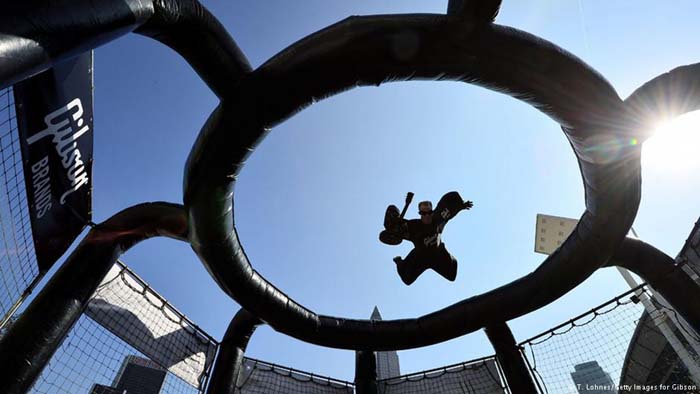
    Gibson's AirDrome, which propelled daring guitarists at Musikmesse into the air with high-speed wind

    Gibson’s AirDrome, which propelled daring guitarists at Musikmesse into the air with high-speed wind.  Deutsche Welle

    With the breakneck technological changes in the industry, Musikmesse director Wolfgang Lücke says, “It is more convenient to press a button and fool around [with technology] than do the hard practice to learn to play an instrument.” As such, traditional instruments such as pianos, accordions and harmonicas are suffering with sluggish sales in the German market – however guitar, electric piano and synthesizer sales remain strong.

    German manufacturers still lead the charge when it comes to the crafting of pianos, brass and woodwind instruments, while the production of electric guitars is still firmly in US hands. As the home of the legendary Stradivarius, Italy still dominates the premium violin market, however China has emerged as a strong player across the board – especially in the production of instrument parts.

    The bling is never too far away when it comes to the music business, and it is on full display in Frankfurt with Gibson’s one off “Eden of Corone” guitar – constructed using 1.6 kilograms of gold and 400 carets of diamonds. Valued at $2 million (1.9 million euro), according to the “Guinness Book of Records” it’s the most expensive guitar in the world – albeit not so suitable for shredding, unless you are Tony Iommi from Black Sabbath that is, who is on hand to give the bejeweled axe a daily work out.

    With the annual Musikmesse and now with the planned Museum of Modern Electronic Music, Frankfurt is establishing itself as much more than a financial hub. After all, even bankers like to get their groove on after a hard day’s work.

    Originally published for Deutsche Welle


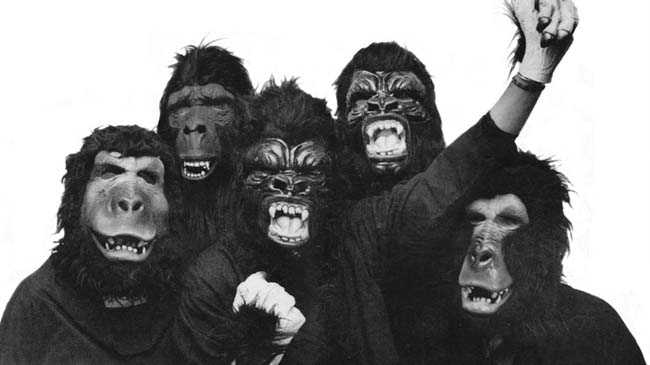
    Guerrilla Girls members

    Guerrilla Girls members

    Artist-activists target art world’s hypocrisy and corruption while rubbing elbows at events

    by By Jennifer Smith for WSJ

    Last weekend, the art-activist group the Guerrilla Girls engaged in a typically bumptious gesture: projecting images from their latest campaign on the side of the Whitney Museum of American Art’s building in lower Manhattan as a block party to fete the new location wound to a close.

    “Dear Art Collector,” read the message, traced in bright light from a mobile projector run by another New York City activist group, The Illuminator Art Collective.

    “art is sooo expensive!

    even for billionaires

    we totally get why

    you can’t pay all your employees a living wage”

    It has been three decades since the Guerrilla Girls first began plastering New York’s art districts with funny, statistic-filled posters decrying the dearth of female artists on museum and gallery walls. Now the group—along with a new generation of artist-activists—continues to skewer what they see as the art world’s hypocrisy and corruption.

    Never mind that the Whitney, which declined to comment on the “Dear Art Collector” projection, now owns more than 90 works by Guerrilla Girls. Or that some of the group’s members—clad in their trademark gorilla suits, to preserve anonymity—mingled with curators at a recent artist reception at the new building. An exhibit of their posters, stickers and billboards opened this month at Abrons Arts Center downtown, and the Guerrilla Girls have embarked on a new campaign.

    Targets include everything from the art establishment’s lack of diversity—an issue that by some measures has made only marginal progress since 1985—to labor issues and soaring prices paid by wealthy collectors in today’s turbocharged art market.

    “We are the agitated outsiders, the creative complainers, and we like it that way,” a Guerrilla Girl who identified herself as Käthe Kollwitz said in a recent interview. (Members assume the names of dead female artists.)

    Recently, the group has teamed up with newer groups of activist artists. They include the Illuminator, as well as Occupy Museums and the Gulf Labor artist coalition, which on Friday shut down the Solomon R. Guggenheim Museum with a protest over labor practices at Saadiyat Island in Abu Dhabi, where the museum is planning to build a new branch.

    Another Guerrilla Girl, Frida Kahlo, said she was heartened to see a new crop of artists engaging in political art, many of them in collectives that operate outside the traditional art market.

    “They are veering away from the idea of the lone individualistic genius,” Ms. Kahlo said. “They don’t want to participate in the art system.”

    Take Noah Fischer, a Brooklyn artist and activist involved in the action at the Guggenheim organized by Gulf Labor, a group that has staged multiple protests over what it sees as exploitative conditions for the largely migrant workforce on Saadiyat Island.

    Trained as a sculptor, Mr. Fischer, 38 years old, said he quit showing his work in traditional galleries amid the financial downturn, having concluded that the same economic system that led to the crisis was also fueling the art market: “I thought, I want to be challenging that system, not trying my hardest to be supported by those people.”

    In 2011 he joined the Occupy Wall Street movement in Zuccotti Park and wrote a manifesto that catalyzed the Occupy Museums movement. Occupy Museums mounted a protest in September at the Metropolitan Museum of Art over the new plaza endowed by billionaire David H. Koch and recently helped stage an action outside the Whitney over an adjacent natural-gas pipeline.

    Read more >


    Venice Biennale represents rebalancing in the art world

    VENICE (AP) — A Nigerian art critic and museum director is the first African to curate the Biennale contemporary art fair that opens Saturday for its seven-month run, while female artists are representing more countries than ever in national pavilions — trends seen as an informal rebalancing in the art world.

    Russian artist Irina Nakhova poses next to a futuristic sculpture of a head of a pilot inside her installation 'The Green Pavilion' on display at the Russian pavilion at the 2015 Biennale of Arts in Venice, Italy, Wednesday, May 6, 2015. Photo: Domenico Stinellis, AP

    Russian artist Irina Nakhova poses next to a futuristic sculpture of a head of a pilot inside her installation ‘The Green Pavilion’ on display at the Russian pavilion at the 2015 Biennale of Arts in Venice, Italy, Wednesday, May 6, 2015. Photo: Domenico Stinellis, AP

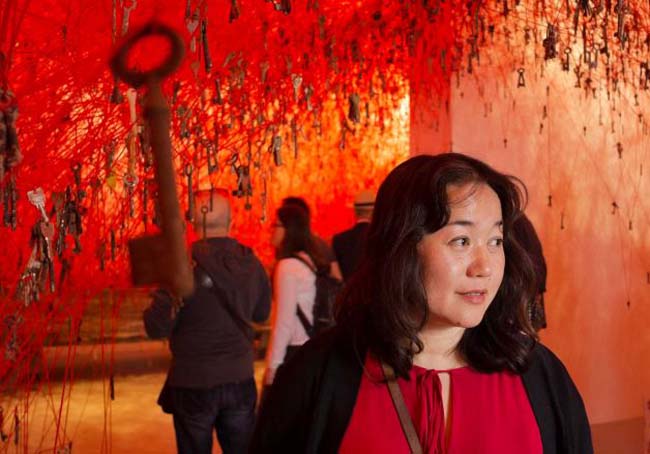
    There’s Joan Jonas for the United States, Fiona Hall for Australia, Irina Nakhova for Russia, Sarah Lucas for Great Britain, Chiharu Shiota for Japan, Pamela Rosenkranz for Switzerland and Camille Norment for Norway. And those women are all from the more established Biennale participants in the Giardini, around one-third of the 89 national pavilions.

    British artist Sarah Lucas poses next to her sculpture 'Gold Cup Maradona' part of her installation 'I Scream Daddio' at the British pavilion at the 2015 Biennale of Arts in Venice, Italy, Wednesday, May 6, 2015. Photo: Domenico Stinellis, AP

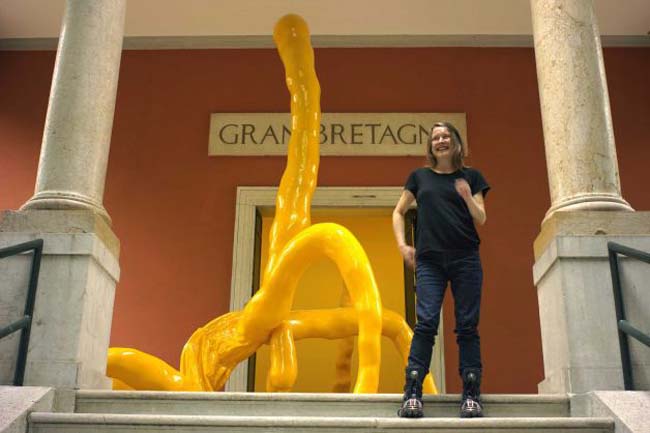
    British artist Sarah Lucas poses next to her sculpture ‘Gold Cup Maradona’ part of her installation ‘I Scream Daddio’ at the British pavilion at the 2015 Biennale of Arts in Venice, Italy, Wednesday, May 6, 2015. Photo: Domenico Stinellis, AP

    The prominence of women in the national pavilions — which along with the main show curated by Okwui Enwezor comprise the 56th International Art Exhibition — may be coincidence. Still, the force of the female numbers is gaining notice as somehow tapping into a zeitgeist and challenging the notion of the art world as being male dominated.

    “I think it is wonderful so many women are representing countries this year. I think it is great,” Jonas said, sitting outside the U.S. pavilion — where she had just been approached by a woman who thanked her for giving hope to female artists.

    JoanJonasatMITPhotobyLBarryHetherington2014_CP

    Jonas started her artistic career as a sculptor in the 1960s before moving into performance art and becoming an early adapter to video in the 1970s. She said that her participation in the Biennale would bring “a lot more attention to my work” — while adding that she always felt supported.

    “I am an artist’s artist. From the very beginning, I had an audience. From the very beginning, I felt appreciated,” she said. “I couldn’t continue to work like this if I didn’t have the support of my fellow artists, and then many curators, over the years.”

    News | Exhibitions