• [Photo via Electric Zoo’s Facebook]

    [Photo via Electric Zoo’s Facebook]

    From September 4-6, Electric Zoo returns to New York City’s Randall’s Island Park with a new “Transformed” theme in tow. Before the Labor Day Weekender arrives, festivalgoers can plan ahead with its newly released day-by-day schedule.

    Headliners Above & Beyond, the Chemical Brothers and Alesso will each close out the main stage on separate nights, with support spread over the three days from Zeds Dead, Borgore, Adventure Club, Nervo, Deorro, DVBBS, Oliver Heldens and more. Elsewhere, themed stages include two days of Awakenings’ stateside debut, featuring Adam Beyer, Get Real, The Martinez Brothers, Henrik Schwarz and Kølsch; followed by an All Gone Pete Tong takeover starring the radio icon himself and new album collaborator Hot Since 82.

    Over at the Riverside stage, Madeon and Cashmere Cat kick off the festival’s first day with Alison Wonderland, Destructo and Mija; who lead into a trance-swaying Day Two with Markus Schulz and Ferry Corsten. On Sunday, things get tropical with Thomas Jack, whose curated stage brings out summery house from Robin Schulz, Claptone, Le Youth and more. Meanwhile, bass abounds at the Hilltop Arena with Gramatik, Keys N Krates, Excision and The Glitch Mob; with some melodic interludes from RAC, Galantis, and Goldroom.

    View the daily rundown for Electric Zoo NY 2015 below. Single-day tickets go on sale starting June 18, and you can pre-register for those on the Electric Zoo website.

    EZTransformed_lineup_byDay_v06c

    ————————————————-

    Shea Kopp for beatport

    “I’m told I am a nomadic artist,” artist Francesco Clemente once dryly noted. In Encampment — a multi-part 30,000 square foot installation occupying MASS MoCA’s largest gallery — Clemente’s transitory experience of changing geographies, diverse cultural climates, and indeed consciousness itself infuses his imagery and art with a particularly rich range of references and meaning. For the past three decades Clemente has traveled often, dividing his work and primary residences between Varanasi, India, and New York. Informed by the logistical realities and production opportunities of making art in wildly disparate locations, his aesthetic investigation of states of flux delves into the nature of passage itself. “I believe in this movement of generating and dissolving, and regenerating and dissolving again — this is a technique for the mind to become and remain awake,” Clemente explains. Passages between bodily pleasure and changing spiritual states, between acts of destruction and creation, and between the seen and unseen are all at the heart of Encampment, opening at MASS MoCA in North Adams on June 13, 2015, and remaining on view through early January 2016.

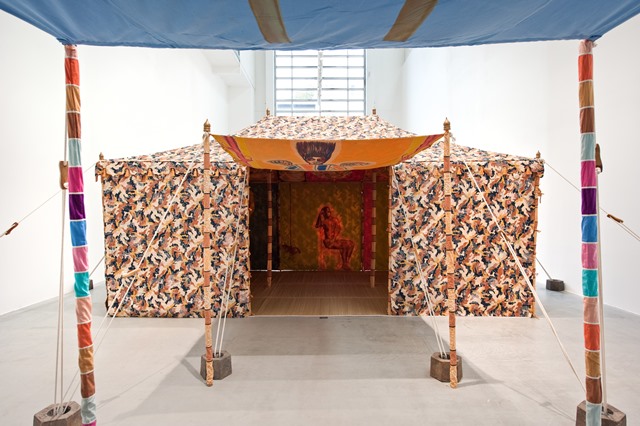
    Francesco Clemente, Standing With Truth Tent (2013) (exterior view), tempera on cotton and mixed media.

    Encampment Installation View, 2015. Pepper Tent, 2014 (exterior view) Tempera on cotton, embroidery, hand stitching, bamboo poles, wood finials, ropes, iron weights 600 x 400 x 300cm Collection of the artist, New York, U.S.A.

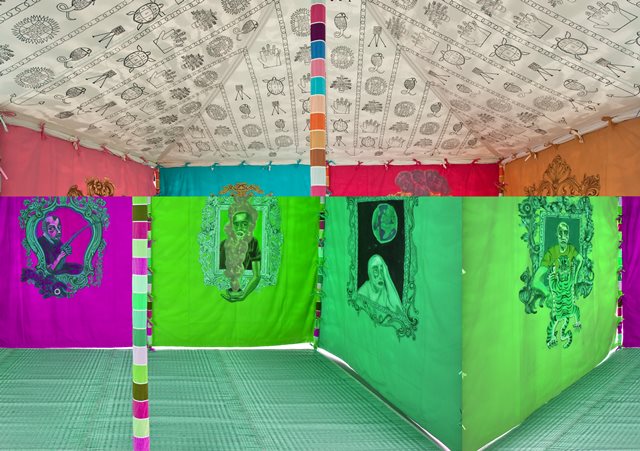
    The show’s centerpiece — gathered at MASS MoCA for the first time as a complete ensemble — is a suite of six painted canvas tents, which, as Clemente noted, “were generated by reflection on my own life, and my own needs; it was as if I didn’t have a home, but wanted one.” Created over the course of three years from 2012 through 2014, in collaboration with a community of artisans in Rajasthan, India, the large 2-pole structures (each measuring some 10’ x 18’ x 12’ high) transform MASS MoCA’s signature Building 5 gallery into a kind of tent village, inhabited by painted human figures both supine and in motion, and emblematic symbols and signs both obvious and arcane. Secured in place by ropes and special cast-iron weights, the exteriors of the large bamboo and fabric tents are richly decorated with hand-printed woodblock designs, carved after drawings by Clemente. The patterns recall the camouflaging on the uniforms and gear of the Indian Army in Rajasthan — the visual resonance of which is heightened by the region’s complex social, political, and military relationship with Pakistan, whose border it shares. Closer inspection of the camouflage patterns reveals esoteric texts, embedded icons, human silhouettes, and other subtle signs, all intricately outlined with hand-embroidered gold-colored thread. Inside the tents, walls, ceilings, and entryways are awash in richly toned jewel-like paintings. Depictions of love and carnal desire are juxtaposed with trompe l’oeil paintings of framed portraits of Clemente, for example, in which the artist’s arm and hand reach through the frame, grasping towards viewers. Implicating our very presence in the museum, Clemente draws visual parallels between erotic voyeurism and the spectatorial enjoyment of art.

    Francesco Clemente, Museum Tent (2013) (interior view), tempera on cotton and mixed media. Photo: Courtesy of the artist and Blain/Southern Gallery, Berlin.

    Francesco Clemente, Museum Tent (2013) (interior view), tempera on cotton and mixed media. Photo: Courtesy of the artist and Blain/Southern Gallery, Berlin.

    As an installation, the tents combine to create a beautiful world of color and strangely alluring hospitality. Passing by and through the tents, the viewer is led to a darkened, theatrically lit space, where Clemente presents four large-scale sculptures. Resembling altars or guideposts that at first appear to be fabricated of wood and other organic materials, the vertical sculptures are, in fact, built and cast from aluminum. The four works — Earth, Moon, Sun, and Hunger — incorporate both traditional forms and references to contemporary life: in Moon, for example, a bronze-colored stereo sits atop a metal work box balanced precariously atop a base made from silvery branches. Taken together, the works suggest both a maker and viewer in states of transitory suspension, caught, perhaps, between a life lived directly, without mediation, and reality experienced one step removed, as an observer, or as a consumer of culture. Quoting Guy Debord’s seminal text, The Society of the Spectacle, the flag that hangs from the top of Hunger is embroidered with the words “the spectator feels at home nowhere because the spectacle is everywhere.”

    In a third mezzanine gallery overlooking the tent encampment, the exhibition includes a stunning new suite of 19 erotically charged paintings, rendered in bright washes of watercolor and exquisitely detailed brushwork in solid body ink. Drawing on the tradition and craft of Mughal miniature painting, the watercolors combine decorative motifs with dreamy imagery that shifts between abstraction and figure painting. Sharply juxtaposing abstract interludes with scenes of love and intense desire, the paintings layer textures and color forms in ways that appear almost collage-like in their spatial complexity. The finely detailed, hand-painted miniature patterns in gouache an unusual visual register to the transparent watercolors, layering silhouetted bodies in sinewy vines and other organic shapes, and confusing traditional distinctions between figure and ground. In India, Clemente “found a place that was utterly contemporary and with the same vitality and drive that I knew of in the West, but in completely alternative terms.” In this new series of paintings, he draws on Indian and Western European traditions to create a hybrid visual language with which to relate intimate tales of sensual and spiritual encounter.

    Francesco Clemente was born in Italy, and lives and works in Varanasi, India, and New York, New York. Recent solo exhibitions include the Rubin Museum of Art, New York; Schirn Kunsthalle, Frankfurt; Uffizi Gallery, Florence; Reykjavik Art Museum, Reykjavik; Solomon R. Guggenheim Museum, New York; Musée National d’Art Moderne, Centre Georges Pompidou, Paris; SFMoMA, San Francisco; Dia Art Foundation, New York; The Museum of Modern Art, New York; Nationalgalerie, Berlin; and Stedelijk Museum, Amsterdam. Clemente is a member of the American Academy of Arts and Letters.

    This exhibition is supported by the Horace W. Goldsmith Foundation, the Massachusetts Cultural Council, and Blain|Southern Gallery.

    Courtesy of:  MASSACHUSETTS MUSEUM OF CONTEMPORARY ART

    MResIMG_0349-e1434088602906-1080x380

    A new play written and performed by Winsome Brown
    Directed by Brad Rouse

    The epic story of a mother’s life. In this beautiful one-woman show, Obie-award winner Winsome Brown channels her wickedly funny Irish mother, her Alaskan frontiersman father, and her engaging family to tell the story of a simple life. With deft humor and a light touch, she reveals Mary’s struggles with aging and alcoholism, her war-stories of a 45-year marriage with children, and the sad grace of her death. A deeply touching story of family, thrilling and generous in its love, honesty, and humor.

    In the beautiful one-woman show, This Is Mary Brown, Obie-award winner Winsome Brown channels her wickedly funny Irish mother, her Alaskan frontiersman father, and her engaging family to tell the story of a simple life.

    More information >

    angelina jolie cigarette face My style hinges on long limbs, jagged joints, and exaggerated facial features. I give my characters a whimsical, light sense even when the theme or emotion may be darker. The juxtapose urging the viewer to look beyond their first reaction. My mediums of choice are pen, watercolor, and pencil. I’m highly diverse and tailer my style accordingly to the client and outlet. – Cait Chock

    “After Year Zero” investigates geographies of collaboration and the politics of universality after 1945, during the period of decolonization. The Museum of Modern Art in Warsaw hosts the second presentation of the exhibition, which was initially produced and presented at the Haus der Kulturen der Welt (HKW) Berlin in 2013. Museum of Modern Art together with HKW also announces the publication of an accompanying book of the same title.

    “After Year Zero” presents works by selected artists, films, documents and archival material 
exploring relations between two distinct political and historical “frames” of the emergent postwar order: the bipolar confrontation dominating the northern hemisphere as it was being divided 
by the Iron Curtain, and the rise of the Third World against the backdrop of what the author Richard Wright, in his book-length report from the Bandung Conference in 1955, termed the “Color Curtain.” The exhibition considers how we can contrast continuities and discontinuities, both in the case of Europe and the West after 1945 and in that of former colonies that asserted their independence in the decades following the defeat of facism.

    The exhibition developed out of a series of workshops and nomadic discussions held in Algiers, Dakar, Johannesburg, Paris, and Brussels under the title “Matters of Collaboration”. In the 
workshops, dedicated to critically engaging historical and contemporary relations between 
Europe and Africa, two radically different aspects of “collaboration” have been explored: 
collaboration with an enemy or adversary, and collaboration as the creation of common ground and the making of political imaginaries, as “working together” (in the original sense from Latin, co – laborare). The double-edged term “collaboration” consistently puts into question colonial modernity’s identitarian and “Manichean” logic (Frantz Fanon) and its long afterlives in the present day. The term directs attention instead to a grey zone, characterized by the in-between and by radical asymmetries of power at the same time. “Collaboration” also draws attention to relations between individuals, and to frameworks and systemic parameters that they undermine or transform. The concept, as a way of interrogating the global order of colonial modernity in transformation before and after the Second World War, highlights the degree to which 
“modernity” has been “from the start a North-South collaboration” (J.L. & J. Comaroff).

    The Otolith Group, “In the Year of the Quite Sun”, 2013. Courtesy of the artists

    The Otolith Group, “In the Year of the Quite Sun”, 2013. Courtesy of the artists

    An interrogation into the narrative ordering of history reveals battles around the concept 
of “universality” as milestones in forging political imaginaries of global order. Anticolonial 
movements have long rejected universalist claims of the colonial “civilizing mission.” The “collapse of civilization” in Europe has led not only to the foundation of the United Nations and newly 
inclusive universalist vocabularies on both sides of the Iron Curtain, but also to a reinvigorated critique and re-formulation of the universal from within the space of racial exclusions.
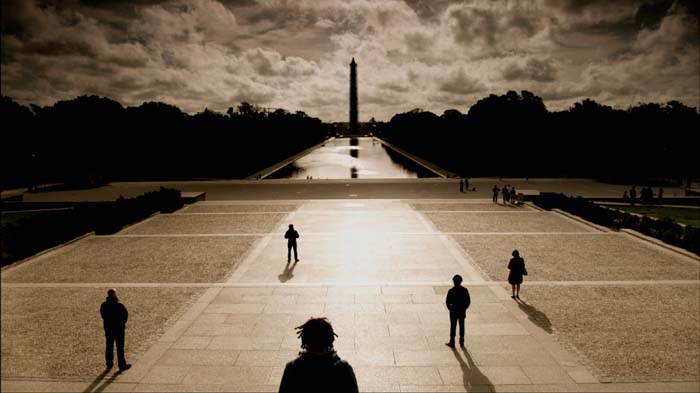
    John Akomfrah, "Transfigured Night", 2013 (still), double channel HD video installation, colour, sound, 30 min.

    John Akomfrah, “Transfigured Night”, 2013 (still), double channel HD video installation, colour, sound, 30 min.

    In “After Year Zero”, the post-1945 struggles are the starting points for an exploration of breaks, new starts, and continuities that – both openly and in concealed fashions – have determined framework conditions of the New World Order and the architecture of contemporary global 
relations and institutions. In the exhibition, these developments are documented in archival-display vitrines and contrasted to the history of Pan-African Congresses organized since 1900 in the lead-up toward independence efforts, and to political alliances including organizations 
of Afro-Asian solidarity and the Non-Aligned Movement.
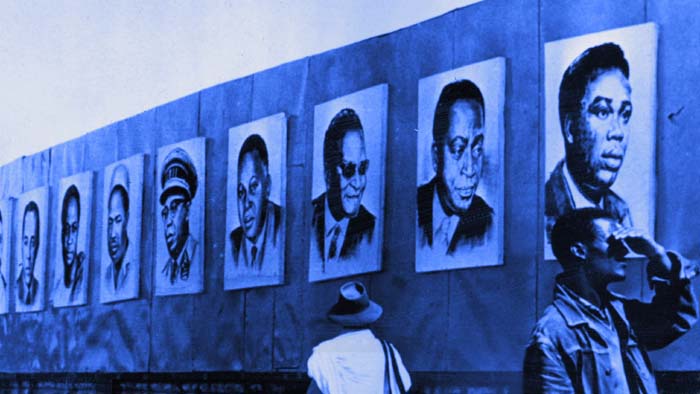
    John Akomfrah, "Transfigured Night", 2013 (still), double channel HD video installation, colour, sound, 30 min.

    John Akomfrah, “Transfigured Night”, 2013 (still), double channel HD video installation, colour, sound, 30 min.

    Among the exhibition’s artworks, John Akomfrah’s 2-channel installation “Transfigured Night” is a visual and auditive montage speculating on the “narcoleptic” relation of the post colony to its 
citizens, departing allegorically from the mystical love poem by German romanticist Richard Dehmel that inspired Arnold Schönberg’s eponymous string sextet at the turn of the 20th 
century. Yervant Gianikian and Angela Ricci Lucchi present their work with archival film materials from Fascist Italy’s 1935 invasion of Ethiopia, which has led to their film “Pays Barbare” (2013). The Otolith Group presents a work on postage stamps produced in Ghana between 1957 and 1966, assembling them into a “political calendar” of Pan-Africanist imagery. Kader Attia traces Afro-American and African genealogies of blues music.

    After Year Zero begins with a short film by Jihan El-Tahri, “Flag Moments”, that depicts 
independence celebrations across various states in Africa. The film includes a discussion with former ANC spokesperson Jesse Duarte recalling quarrels around seating order for a state 
dinner in 1994 – an official event commemorating the end of apartheid. It may seem that African anticolonial aspirations had finally been fulfilled throughout the continent, coming full circle from the first Pan-African Congress, in 1900. Yet the state dinner also symbolizes how an exit from one frame is not necessarily a step into fresh, blank territory.
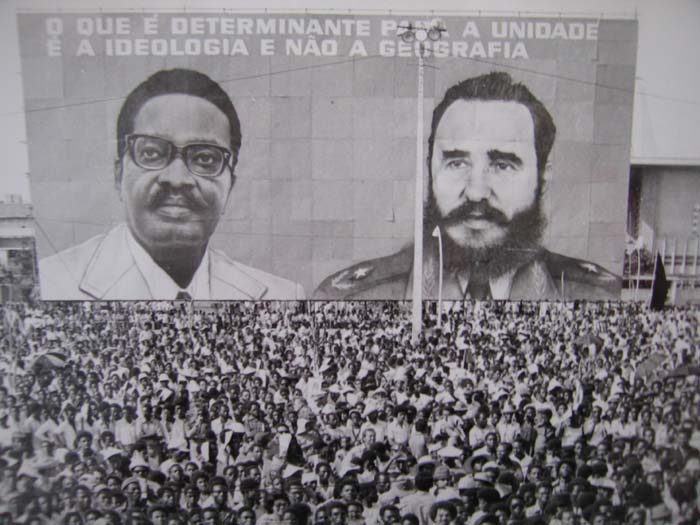
    Jihan El Tahri, "Cuba, An African Oddyssey", 2008. Courtesy of the artist

    Jihan El Tahri, “Cuba, An African Oddyssey”, 2008. Courtesy of the artist

    The exhibition is enlarged at the Museum of Modern Art in Warsaw from the Berlin edition of “
After Year Zero”, which had been co-curated by the artists and was based largely 
on commissioned film installations. The diversity of artistic media range from painting, with two works by Daniel Kojo-Schrade from his Afronauts series, and photography including Kiluanji Kia Henda’s triptych “Redefining the Power”, which plays with the power of representation 
in appropriating monumental leftovers of the colonial past. The works of these two artists can be seen as two line of flights out of memophilia toward a future that must be invented, rather than awaited.

    “After Year Zero” is a production of Haus der Kulturen der Welt and Museum of Modern Art in Warsaw. The project is based on a series of workshops held under the title Matters of Collaboration in 2012 in Algiers, Dakar, Paris, and Johannesburg in cooperation with the Goethe-Institut in Brussels and with funding from the Excellence Initiative of the Goethe-Institut.

    Exhibition participants include: John Akomfrah, Kader Attia, Balufu Bakupa-Kanyinda, Kudzanai Chiurai, Jihan El-Tahri, Theo Eshetu, Yervant Gianikian and Angela Ricci Lucchi, Ruy Guerra, 
Walter Heynowski and Gerhard Scheumann, Kiluanji Kia Henda, Małgorzata Mazurek, Sana na N’Hada, Daniel Kojo Schrade, Yann Le Masson and Olga Poliakoff, Łukasz Stanek, Michał Sutowski (Institute for Advanced Study), Kidlat Tahimik, Adamu Tesfaw, The Otolith Group, Travelling Communiqué, Visionary Archive.

    Courtesy of the Museum of Modern Art, Warsaw, Poland
    www.artmuseum.pl

    tumblr_npi0j8wYZ41uutp7uo1_1280

    The Nepal Earthquake left Butterfly Home’s children homeless; OFF Chelsea.com hosts a 6/25 Art Party to help.

    OFF CHELSEA, an artists’ collective, is holding a fundraiser for Nepal’s Early Childhood Development Center and Butterfly Home, on June 25th.  Art-loving New Yorkers will get a chance to help children on the other side of the world.

    In Nepal, when a parent goes to prison, if there is no local guardian, the child must go too.  Pushpa Basnet, a social worker in one of the poorest countries on Earth, founded Early Childhood Development Center and its Butterfly Home to provide these children with an alternative life, away from prison.

    But the massive April 25th Gorkha Earthquake and its May 12th aftershock have left Pushpa’s children effectively homeless.  The quake registered 7.8 on the Richter Scale, and devastated Nepal’s already fragile economy.  Both Butterfly Home’s rental house residential facility, and the new structure Pushpa was building with prize money she earned as CNN’s 2012 Hero of the Year, have been seriously damaged.  All the children are sleeping outside, under plastic sheeting.  The Center administration is worried about providing water and food.  It’s cold.  In this desperately poor country, this is a real emergency.

    A group of New York artists and musicians has gathered to help in a joyful way.

    On Thursday, June 25th, OFF CHELSEA.com will host a Group Show and Party Fundraiser at Scene Space.

    • 351 West 36th Street.
    •  17 artists; 3 bands; 1 DJ.
    • 5:00 PM to 12:00 AM.
    • Food, Drink, Dancing
    • Suggested donation is $10 at the door, but no one will be turned away.  Participating artists will donate a percentage from the sales of their artwork; likewise, a portion of tips at the bar will go to Butterfly Home.
    • All services are donated.
    • Have a great time, while helping a really good cause.

    If you have any questions about this event, you can reach me at this email, or visit WWW.OFFCHELSEA.com, and click on “Events”.  You can also visit www.ecdcnepal.org.

    FACEBOOK INVITE: https://www.facebook.com/events/1646780555588073/

    Performance and Visual Artists:

    Lorenza Astengo
    Rosanna Boraso
    Ron Burman
    Christian Calabro’
    Elaine I. Carl
    Stefania Comandatore
    Marco Dianese
    Cacho Falcon
    Alexis Greene
    Nitzan Krimsky
    Riccardo Mazzei
    Ian Pai
    Johanna Schwarzbeck
    Vanessa Solomon
    Jayne Wexler
    Egon Zippel
    Yoshe Sky

    Music:
    Cultfever
    New Casino
    Moon Casual
    DJ Beppe Savoni

    Draftsmen Draft


    DRAFTSMEN    DRAFT
    Works  on   paper

    LUISE ROSS  GALLERY

    Summer Hours:
    Monday–Friday, 10:00   –5:00
    547  WEST 27 STREET #504
    NEW YORK NY 10001-­‐5669
    www.luiserossgallery.com

    Juguetería/Toys Warehouse — Interactive Exhibit by Studio Sweet Home — to Open at Exit Room NY for

    Interviews

    The Studio Street Home duo — Colombian native Yeimi Salazar and Puerto Rican native Melvin Sanchez – began collaborating six years ago, soon after they met in NYC. Their first solo exhibit will open tomorrow and Saturday at Exit Room NY during Bushwick Open Studios. While visiting Exit Room last week, we had the opportunity to speak to its art director Daniela Zoe.

    It’s great to see Exit Room NY so alive again! What a wonderful home for Studio Sweet Home‘s first solo exhibit!

    Yes! To coincide with Bushwick Open Studios, I wanted to feature artists with a unique multidisciplinary approach. And I’m delighted to host Studio Sweet Home here at Exit Room NY, as Juguetería/Toys Warehouse is a great opportunity for the artists, our space and the public.

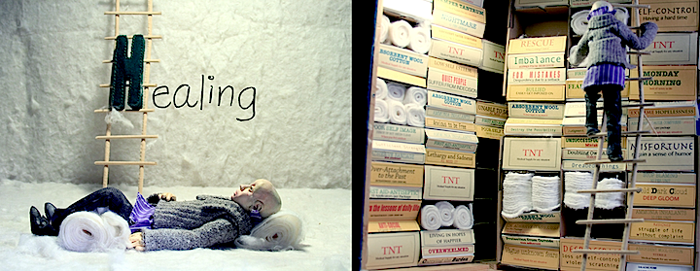
    Studio Sweet Home Healing. Street Art NYC.

    Studio Sweet Home Healing. Street Art NYC.

    Can you tell us something about this upcoming show? What will Juguetería/Toys Warehouse feature?

    There will be paintings, installations, sculptures, video projects, and performances. There will be something for everyone – as Juguetería/Toys Warehouse is not just an art exhibit, but an interactive experience.  A participatory performance will be held at 7pm on both opening days.

    studio-sweet-home

    Studio Sweet Home Healing. Street Art NYC.

    Have you worked with Studio Sweet Home artists Yeimi Salazar and Melvin Sanchez in the past?

    Yes, they have participated in group shows before here at Exit Room NY.

    Studio-Sweet-Home-art-installation

    What was it about Yeimi Salazar and Melvin Sanchez that initially drew you to them?

    Their mastery of their craft, their talents and their versatility.  And I love the way their works attract participants.

    – Read more at: http://streetartnyc.org/blog/category/interviews/#sthash.Yj13QIBT.dpuf

      Marcel Dzama, “Neptune.” (2004-2005) Ink and watercolor on paper. 48-part work: Overall: 56 x 132 inches (142.2 x 335.3 cm). Each: 14 x 11 inches (35.6 x 27.9 cm).

    Marcel Dzama, “Neptune.” (2004-2005) Ink and watercolor on paper. 48-part work: Overall: 56 x 132 inches (142.2 x 335.3 cm). Each: 14 x 11 inches (35.6 x 27.9 cm).

    New Interview Magazine Lines & Marks launches the first of its “Conversations about Drawing” with Marcel Dzama, followed by Anders Nilsen, Julie Mehretu, Charles Cohen, & Ben Klock.

    Lines & Marks is the only interview magazine dedicated to nothing less than the foundation of human achievement in both the arts and sciences — Drawing.

    Via candid conversations and beautiful, interactive artwork presentations, Lines & Marks examines the act of mark-making as a quintessentially human compulsion and the foundation of visual thinking, writing, art, mathematics, and science.

    But interviews are only half the picture. The other half are the pictures. Lines & Marks’ trademark is beautiful, interactive artwork presentations. After all, without the drawings, there’s nothing to talk about.

    Lines & Marks launches June 1 with a candid conversation with Marcel Dzama (David Zwirner Gallery, NYC) on drawing, Duchamp, Maurice Sendak, Spike Jonze & Arcade Fire, with a never before seen interactive artwork presentation. (Marcel Dzama Interview)

    Next Interviews:

    •  Anders Nilsen: Xeric & Ignatz Award-winning graphic novelist. (Drawn & Quarterly)
    • Julie Mehretu: MacArthur Fellow and US State Department Medal of Art recipient. (Marian Goodman Gallery, NYC)
    • Ben Klock: Berghain resident. (Klockworks. Berlin)
    • Charles Cohen:  Photographer/Video Artist (Bonni Benrubi Gallery, NYC)

    Lines & Marks (linesandmarks.com) is a labor of love and presented ad-free.
    Share your love of drawing.

    Read Marcel Dzama Interview

    11351537_10153327786061838_94703990_n 11349953_10153327786046838_843465528_n

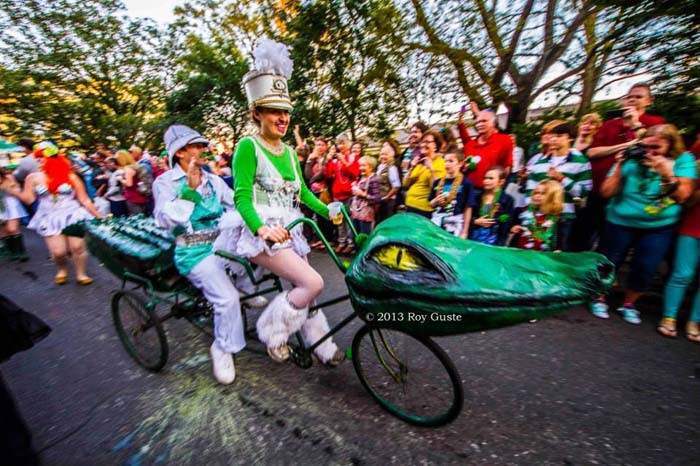
    Environmental bicycle sculptures by  Katrina Brees
    News | Exhibitions