Javaka Steptoe (left) and Claudia Rahadjanoto (right) at Story Time: Tales on Sugar Hill Photo Credit: Lauren Kelley
Saturday, October 3,2015
The new Sugar Hill Children’s Museum of Art & Storytelling provides children and families with a space to grow and learn about Sugar Hill and the world at large, through interactions with accomplished artists and storytellers, access to well-equipped art-making facilities, and firsthand experiences with historically significant and important contemporary works of art.
Developed by Broadway Housing Communities and designed by internationally acclaimed architects Adjaye Associates, SHCM is a cultural oasis where transformational experiences in art and storytelling create lasting change in the lives of young children.
Inaugural exhibitions include:
People, Places, and Things: Selections from The Studio Museum
Organized by Lauren Haynes, from The Studio Museum in Harlem, this exhibition explores artworks created from the 1930s to 1980s and features everything from portraits to landscapes by a group of renowned artists who have depicted everyday life in communities throughout the U.S., including Harlem.
Txt: art, language, media
This exhibition investigates new forms of literacy and its visual impact of this on everyday life, from the literature of “ABCs” to spoken word poetry to text messaging. Presented in partnership with El Museo del Barrio, and co-curated by Rocio Aranda-Alvarado, El Museo del Barrio and Lauren Kelley, Sugar Hill Children’s Museum of Art & Storytelling.
The Pollen Catchers’ Color Mixing Machine: Saya Woolfalk in collaboration with daughter Aya Mitchell
Filling the six walls of the Museum’s 3,000 square foot Main Gallery, Saya Woolfalk’s brilliant mural – created specifically for the Museum’s opening – is a wondrous dreamscape for all to explore. Curated by Lauren Kelley, Sugar Hill Children’s Museum of Art & Storytelling and produced with the support of members of Cre8tive YouTH*ink’s Art School Without Walls.
The 2015/2016 Artist in Residence, David Shrobe
A fourth generation Harlem resident, current Joan Mitchell Teaching Fellow and Hunter College MFA graduate, David Shrobe’s paintings, wall collages, and objects are an intimate rendering of the community as an evolving landscape. Selected in partnership with The Laundromat Project, David’s inaugural open studio will be a reflection of work produced at the start of his residency.
Featured Speakers, Artists and Guests:
– Ellen Baxter, President, Founder and Executive Director, Broadway Housing Communities
– Susan R. Delvalle, Director, Sugar Hill Children’s Museum of Art & Storytelling
– David Adjaye, Adjaye Associates
– Alessandra Carnielli, Executive Director, Pierre and Tana Matisse Foundation (pending confirmation)
– Thelma Golden, Director and Chief Curator, The Studio Museum in Harlem (pending confirmation)
– Jorge Daniel Veneciano, Executive Director, El Museo del Barrio
– Lauren Kelley, Associate Director, Curatorial and Public Programs, Sugar Hill Children’s Museum of Art & Storytelling
– Jennifer Ifil-Ryan, Associate Director, Education and Community Engagement, Sugar Hill Children’s Museum
– Lauren Haynes, Associate Curator, Permanent Collection, The Studio Museum in Harlem
– Exhibition Artists: Andrew Demirjian, Iviva Olenick, Antonia Perez, David Shrobe and Saya Woolfalk
It’s not easy being a superstar anti-establishment art celebrity. Back in the late 1990s I was one of a group of art students who, for a time, became mildly famous as art pranksters. Within the group we could never be sure – and this despite our most earnest efforts – that our work really was the stuff of revolution. But we were in the papers. We were on the Turner Prize programme. We were even offered a book deal. Nonetheless it’s hard to maintain revolutionary kudos once you’ve been interviewed by Timmy Mallett.
And so I feel for Banksy. In Bristol, his street-pieces are still powerful landmarks even if we know, and he knows, what a dichotomy he represents, caught somewhere between art and artifice; an anarchist in capitalist giftwrap.
This being so, I was not expecting much from his latest hyped-up creation, Dismaland. I assumed it would be trying too hard to recapture that lost edginess; that old sold-out soul. An art Dumbo, painting its face like a clown; an elephantine joke that isn’t funny.
And yet. And yet.
Weston-super-Mare has become a byword for every cliche ever mouthed about the British seaside. Fish-paste sandwiches. Miserable donkeys. Rain. More rain. Somewhere along the seafront, a life-size dummy of the Queen stares out from a hotel window.
The remains of a former landscape are still visible, with golden sand and spectacular sunsets that bleed all over the west-facing coast. But the town itself is challenged. It’s one of the many seaside towns run down by low employment and little investment.
And while towns such as Margate may have been substantially regenerated by an influx of middle-class urban artists, let’s be clear: nothing would doom Dismaland faster than to see it beswamped by hordes of post-ironic urbanites.
Swamped. Yui Mok/PA
I can only hope that doesn’t happen, because my experience of Dismaland was pure magic.
It came from the children. Among rubble, crumbling brickwork and exposed cabling, children played. They were joyous on the merry-go-round, despite the decorative horse strung up by a cleaver-wielding butcher. With utmost seriousness, children steered miniature boats crammed with miniature migrants towards miniature cliffs of Dover, avoiding the miniature corpses. Somewhere a Shetland pony hung suspended in formaldehyde, a golden narwhal tusk glued to its forehead. The children stared. “Look,” said a mother, almost concealing her anxiety. “A unicorn.”
The magic never stops… Yui Mok/PA
The pinnacle of it all was the fairy tale palace, modelled dismally on Disney’s core branding. In the absolute gloom, children’s voices were shrill. “I don’t like it.” “I’m scared.” “Look! The princess is really dead. Mum. Have you seen the animals? Look. She is really dead.” And so on.
The princess is really dead, mummy. Yui Mok/PA
Fairytale of Weston-super-Mare
Disney, of course, has colonised the fairy tale as a medium for extreme capitalism. Banksy, in turn, has re-appropriated it as a vehicle for “entry-level anarchy”. But fairy tales themselves are intricately bound up with class relations and social power, frequently hinging on rags-to-riches and marrying “up” as the very model of success.
In 1697, Charles Perrault wrote the first collection of fairy tales for children. In 17th-century France, fairy tales had become a highly stylised literary form created for aristocratic adults; highly wrought and finely tuned for the monied classes. But Perrault’s tales were written under the guise of an old peasant woman: Mother Goose. Aping the style of the oral folk tale, his collection included what would come to be Disney staples such as Cinderella and Sleeping Beauty.
While folk tales were often morally ambiguous or downright ambivalent, stylised fairy tales were frequently intended to mould social behaviour according to the mores of the rich. Perrault himself was clear about his pedagogical intentions. Such stories were useful since they could be made to contain hidden instructions for children.
It’s no surprise, then, that Disney’s tales have played such a key role in its hyper-capitalist dominion.
But even despite landfills of princess merchandise, Disney too has dabbled in the vaguely horrifying. The death of Bambi’s mother scarred generations of children, as did the Technicolor perversities of Pinocchio’s Pleasure Island. Dumbo’s Pink Elephants are in a class of their own. Watching the children play at Dismaland I was reminded of all these things; and reminded too that there is a value, surely, in allowing children to come face-to-face with their own fears and realities; their unexpressed anxieties, dreams and nightmares; danger and loss.
Folk heroics. Yui Mok/PA
There is no moral to this particular story. Except to say that, perhaps, Dismaland’s re-imagining of the Disney fairy tale is truer to its folk roots than was intended. While a fairy tale is pinned down and fixed, like a glue-tusked pony in formaldehyde, the folk tale is a living organism that changes with every telling; becoming something different depending on the who, the where and the how. Four weeks from now, perhaps Dismaland itself will be a pickled pony. But on Saturday, it was magic.
INTERNATIONAL ART EXHIBITION AT THE KANELLOPOULOS ART CENTRE IN ELEUSIS In flux
1 September – 9 Οctober 2015
Eleusis21 European Capital of Culture – Candidate City and Aeschylia Festival organise the exhibition “In Flux” curated by Shoair Mavlian at Kanelopoulos Arts Centre in Eleusis, Greece.
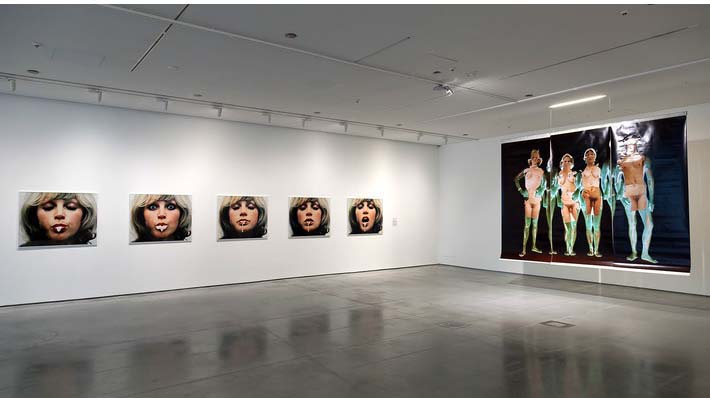
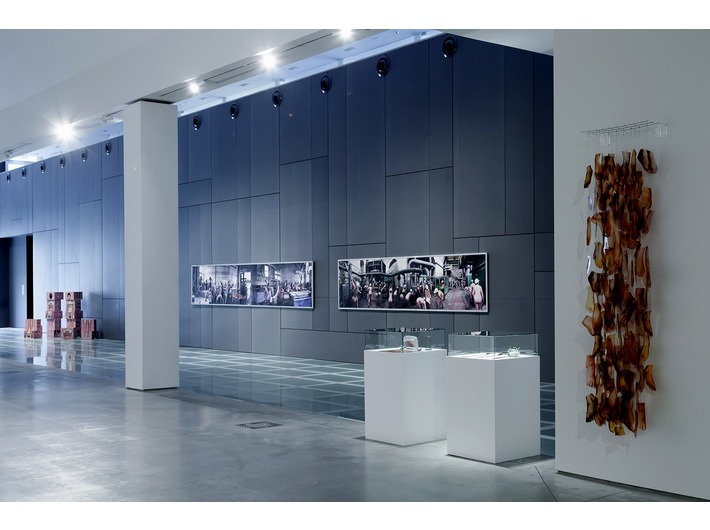
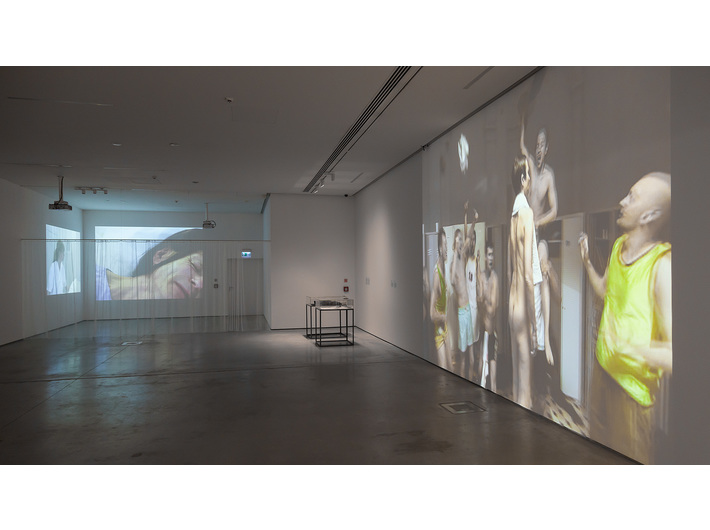
The exhibition In Flux brings to the forefront the idea that we are currently in a state of flux, acknowledging that we are in a period of transition. The exhibition highlights how artists are engaging with this change. In Flux focuses primarily on Europe and its neighbouring countries that for some time have been engaged in European dialogues and looks at four themes which artists have engaged with in recent years, these being; the complex relationship between east and west, migration and the refugee crisis, moments of protest and resistance and the construction of national identities. Works by Bouillon Group and Ahmet Öğüt explore the complex relationship between east and west in relation to European Union member and non member states. Thomas Mailaender and Henk Wildshchok’s work looks at migration and the refugee crisis documenting how these issues materialise in visual terms across the European landscape. Emine Gozde Sevim, Émeric Lhuisset and Sergiy Lebedynskyy and Vlad Krasnoshchok’s works all engage with and document moments of protest and resistance which have erupted across major cities in recent years. Aikaterini Gegisian’s work explores the construction of national identities and the merging of past and present in times of transition.
The exhibition seeks to expose the fragility of what seemed like embedded indestructible institutional systems, how quickly they can be dismantled and the often immediate arrival of change. For most, since the end of the Second World War Europe has been a symbol of democracy and prosperity however this seems like a far cry from our current state as the ongoing aftershocks of the 2008 crisis continue to redefine the institutional structures which bind the continent as a union. These institutional structures are simultaneously expanding and contracting and change has emerged across all realms of our society and materialises in both subtle and drastic ways in our political, economic and social spheres. The exhibition is both a chance to reflect on recent events and to pose questions to consider for the future as each artist offers different observations and perspectives on our current state of flux.
The artists selected for the exhibition hale from across Europe and its neighbouring countries and all regularly exhibit internationally and many have represented their respective countries in recent Venice Biennials. The list of artists is; Bouillon Group (Georgia), Aikaterini Gegisian (b. 1976, Greece), Emine Gozde Sevim (b. 1985 Turkey), Sergiy Lebedynskyyand Vlad Krasnoshchok (b.1982, Ukraine and b.1980, Ukraine), Émeric Lhuisset (b. 1983, France), Thomas Mailaender (b.1979, France), Ahmet Öğüt (b. 1981 Turkey), Henk Wildschut (b.1967, Netherlands). The exhibition will be accompanied by an essay and small publication.
In Flux is curated by Shoair Mavlian. Shoair Mavlian is a curator at Tate Modern, London, focusing primarily on photography, working on the research and delivery of exhibitions and displays across Tate Modern and acquisitions for the international collection. She co-curated the major exhibition Conflict, Time, Photography (Tate Modern, London, 2014) and the collaborative exhibition Project Space: A Chronicle of Interventions (Tate Modern, London and TEOR/éTica, Costa Rica, 2014). She has also worked on many of the photography displays of the permanent collection across Tate Modern including New Documentary Forms (2011), Harry Callahan (2013) and Close Up: Identity and the Photographic Portrait (2015).
Kanelopoulos Arts Centre
37 Dragoumi st, 19200 Eleusis
Greece
Opening hours: Tuesday-Sunday from 10:00 to 13:00 and 18:00 to 21:30
Free admission
NY Arts Staff – Courtesy of the Eleusis21 European Capital of Culture, Greece: Press Release
Opening Reception, September 12, 6–9PM
MOCA, North Miami
770 NE 125TH ST.
NORTH MIAMI, FL 33161
The collections assembled in this exhibition are chromosomes of the process of synthesis; a necessary step in a practice of art Peter Wayne Lewis calls “analytic”. To understand, he says, is always “to unbind, to de-compose, to sequence and in a way to destroy the figurative, to densify, to give thickness to the sensible”.
Time space NY – 1/2/3/ , July 2001. Collage from photography (taken on September 2001). 9 pieces, each 45x30cm. Edition of 3. Photography/Dibond Acryl, each 222×150 cm.
Gender in Art exhibition, Museum of Contemporary Art in Krakow (MOCAK)
Genderissocially constructed sex. Gender studies examine the way history and culture determine sex. Who a man or a woman is in a given world largely depends on the one who manipulates these images. For centuries the conception of gender has remained in the hands of religions, which have imposed ʻproperʼsocial roleson the representatives of different sexes. This has been going for so long that it has come to be seen by many as the law of nature. A vast majority of religions have reduced woman to the role of the weaker, more stupid and subordinate sex. To many people this still seems to be ʻnaturalʼ. Currently we are trying to understand the mechanisms behind this manipulation and lead to a situation in which full dignity and equal rights of all genders would be secured. We endeavour to arrive at a point where gender would cease to be anideological constructand become man’s individual decision that is closest to their sense of identity. The exhibition at MOCAK fits in with the field of these reflections, studies and claims.
Gender in Art exhibition, Museum of Contemporary Art in Krakow (MOCAK)
Gender in Artis another project in MOCAK’s series that confronts significant civilisational themes with artist’s interpretation. Theinternational exhibitionwill feature works of aboutforty artists.The accompanyingpublication, beside documenting the exhibition, will be a collection of essays which will present the issue from different perspectives.
Gender in Art exhibition, Museum of Contemporary Art in Krakow (MOCAK)
ISTANBUL — Following the bloody breakdown between the Turkish government and Kurdistan Workers’ Party (PKK), a few participants in the Istanbul Biennial proposed that artists brieflysuspendtheir work in the citywide exhibition that opens to the public on September 5. On Wednesday, curator Carolyn Christov-Bakargiev, who was copied on the emailed proposal to the artists in “Saltwater: A Theory of Thought Forms,” appeared unruffled by the action.
“I believe there is a very strong agency in those individual gestures and acts. Whether I think that it will have a true impact on what is going on and the Machiavellian deals that are being made behind the scenes is another question,” she said at the press conference held at the Italian High School on Istanbul’s Bogazkesen Street. “I am a skeptic in human affairs.”
It was a diplomatic enough answer to an arts press corps bracing themselves for a follow-up to her fouled DocumentaQ&Asession in 2012. Christov-Bakargiev then paused, looked up into the shady canopy in the courtyard, and serenely added: “That is why I am interested in the oak trees.”
For the 14th Istanbul Biennial, Christov-Bakargiev has “drafted” (the choice term she insists on rather than “curated” or “selected”) an exhibition that at times feels like an embrace of occult spiritualist revivalism. Or, from the perspective of a journalist on a stopover, a crunchy, return-to-nature overnight camp. (Even the show’s catalogue has the chunky heft of a Gideon Bible, a kind of “Gospel According to CCB.”) It also happens to be a brilliant curatorial conceit, suggesting the retreated position of intellectuals today.
After a few more questions, she welcomed three artists to the stage for a surreal art-world “Kumbaya” moment. Theaster Gates first sang in a rich baritone, then Adrian Villar Rojas strummed his guitar, crooning a love ballad in a falsetto. Meanwhile, Liam Gillick stared at a drum set (he seemed only to be manipulating a synthesizer). Christov-Bakargiev swayed to the weird trio in her seat, wearing a feather-tufted sleeveless cassock like a high priestess.
Like all dutiful initiates, patrons accepted a common mark during the biennial’s opening days: temporary tattoos designed by Lawrence Weiner, reading “ON THE VERGE.” Trips to the Büyükada Island in the Sea of Marmara — the island where Leon Trotsky was exiled for four years prior to going to Mexico via France — felt like pilgrimages. Theaster Gates lead boat trips on the Bosphorous at 6:30 in the morning. Pierre Huyghe built a concrete stage at the bottom of the Marmara sea, off Sivriada, for jellyfish and other sea creatures. Go to the coordinates and you will stare only at the waves. Of the biennial’s 36 locations in and around Istanbul, three are fictional.
Then there is of course the talk of saltwater (the title of the biennial) and its healing powers. As many of the works in the show are in remote and isolated venues across city and sea, one can regress into thinking that the only saltwater that the curator had drawn forth was the sweat on your back. Many works are in hotels (William Kentridge), basements (Janet Cardiff and George Bures Miller), abandoned houses (Ed Atkins, Susan Philipsz), or in an Old City Turkish bath (Wael Shawky).
Abstract, stubborn, and hard to access: what might fail a travel bureau is a boon to this biennial. “It occurred to me that the agora of today may not be in the public square, or park, but possibly in the freer retreat of an anonymous house on Buyukada, or in a hotel room, camping or waiting for what is to come, if properly wired and connected to others,” Christov-Bakargiev writes in her catalogue.
Some artists have eschewed physicality altogether: Haig Aivazian’s Holy Trinity Armenian Church chorus, the symbols and mallets of Andrew Yang’s attic, the clicking of Cevdet Erek’s sound installation in a garage destined for demolition, the disembodied voices spoken in the pitch black room by Irena Haiduk.
In Francis Alÿs’s film staged at the 1920s tobacco warehouse DEPO, dozens of children with birdcall whistles tweet and sing across the ruins of an old city between Turkey and Armenia. They are calling back the birds to the ghostly plot of land, the film says.
On Friday, outside of the exhibition space, the lanky, gentle-looking artist Alÿs sat pretzel-legged on a sunny ledge. He was found writing and sketching on a postcard: alone, and intent on his work.
The 14th Istanbul Biennial opens to the public on September 5 and runs through November.
The human-made disaster in New Orleans before, during and after Hurricane Katrina was the first time I was forced to really grapple with race and class inequality.
And it’s what motivated me and three fellow volunteers to try to preserve the history of one neighborhood – New Orleans’ Lower Ninth Ward – before its story was forgotten.
In 2005 I was a college student, paying little attention when Katrina happened. Nine months later, I got on an airplane as part of an alternative summer break, where I expected to do the same volunteer work I’d done since I was a kid. Then I’d head off for Bourbon Street and the French Quarter (which was all I knew of the city).
Instead, I discovered that the Lower Ninth Ward – a neighborhood that, before Katrina, had one of the highest rates of black homeownership in the nation – remained an open wound, one that left a lasting scar.
For while New Orleans has largely recovered from Hurricane Katrina, it’s clear that the Lower Ninth Ward neighborhood has not.
Nonetheless, the story of the neighborhood’s destruction and the story of the ensuing efforts to rebuild it – which includes the creation of a museum – is a remarkable tale of cultural survival.
The Lower Ninth Ward – with one of the highest rates of black home ownership in the country – was hit especially hard by flooding. Jessica Rinaldi/Reuters
I remember sitting down at a tool lending depot with a man struggling to rebuild his home in the Lower Ninth Ward. He’d stayed through the storm, and his trauma was palpable.
Other residents remembered the chaos of the disaster. There was Brandon Fontenelle, who recalled that it was “hard for some of us that wasn’t making the money to get out of here.”
Ward “Mack” McClendon noted that the hurricane itself caused the neighborhood only wind damage. But “when the levees broke after Katrina had passed, that’s what created all of our problems.” Karen Frank remembered hearing “a boom, and when I heard the boom, I heard everybody outside saying ‘ooh.’”
“All I had was one emotion: survival,” Milton Crawford III would later say.
‘I think they forgot about us’
Despite the magnitude of the flooding, a number of houses remained structurally sound and could be renovated. But the houses needed to be emptied of all their contents, the walls taken down to the studs.
The work was demanding. At the same time, it was incredibly moving to sort through the remnants of someone’s life – some of whom had passed away in the flooding or in the aftermath. It seemed as though if we could just gut, renovate and rebuild enough houses, the community could return.
Before being rebuilt, houses needed to be gutted. Author provided
However, the Lower Ninth Ward was treated differently from other parts of New Orleans.
As resident Minor Moe recalled, “St Bernard coming up. Uptown coming up. Canal Street coming up. Every part of town coming up but the Ninth Ward, and I think they forgot about us.”
The return of Lower Ninth Ward residents was obstructed by prolonged denial of access to property (worsening mold and termite damage and theft), prolonged absence of water and electrical service, and concern over adequate levee repairs.
But “risk reduction” measures – including proposals to “right size” the city by redeveloping their neighborhood as green space and rainwater storage – have been perceived as attempts to hinder the return of displaced black residents. This was further exacerbated by the threat of government seizure of “nuisance properties” under eminent domain if homes were not gutted or lawns grew above 18 inches.
The premature demolition of homes by the Federal Emergency Management Agency (FEMA) without proper inspection and notification (and then without compensation) – along with the presence of disaster capitalists seeking to buy up properties before residents recovered – further hindered the community’s rebuilding efforts.
“Everybody could come back home to New Orleans but us,” a resident named Ester Smith remembered.
Under military curfew enforced by the National Guard, residents of the neighborhood were given only restricted access to their property for months after the flooding, well after it had been lifted for other parts of the city.
“Matter of fact, they created what they called a ‘look and leave’ policy,” Ward “Mack” McClendon explained. “After so many months, you could get on a bus in the Upper Ninth, and you could look at your house and leave.”
A culture and history forever lost?
Ten years later, most pre-Katrina residents remain displaced or have died, while the economic and physical infrastructure remains gutted. Nearly half of the housing units are vacant.
“How long it’s been?” resident Deborah Hawkins wondered. “A long damn time, and we still look the same.”
What many people don’t know about the Lower Ninth Ward is that it is a distinct community, with a rich cultural history going back to the late 1700s, when it was a cypress swamp that housed runaway slaves. It was later ground zero for school desegregation in the Deep South, and home to over 200 renowned musicians, including Fats Domino.
The neighborhood possesses “a unique bundle of characteristics that, when taken together, constitute a sense of place that cannot be found or replicated elsewhere.”
With most of their people unable to return home and the spread of gentrification, many original residents expressed the same concerns: they feared their culture, their history, their stories – all of it would be submerged forever.
“The people that’s coming here now, they really don’t know the heritage of the Lower Ninth Ward,” resident Jason Freeman said. “And I’m just afraid that it’s going to get lost.”
“It’s history. It’s the place where I grew up,” Percy Robinson said. “It’s a community that I knew really, really well, and I don’t know it anymore. It’s gone. The community I grew up in is gone.”
Building on an existing subculture of house museums in New Orleans (such as the House of Dance and Feathers and the Backstreet Cultural Museum), we cofounded the museum to combat the erasure of residents’ voices.
Situated in half of a double-shotgun house on the corner of Deslonde Street and Urquhart Street, the museum is nestled on a quiet residential block between the main drags of St Claude Avenue and North Claiborne Avenue.
Built in 1940, the building was originally owned and inhabited by several families before becoming a rental property. While the house was renovated after Katrina, the owner stopped renting it because he relocated to Baton Rouge and no longer wished to make the commute.
Wanting to put down roots in New Orleans, we purchased the property in 2011 with the museum in mind. After knocking on neighbors’ doors in the surrounding area and receiving their approval, we began work.
Today, the well-marked purple facade and blue porch are hard to miss.
The Living Museum – which officially opened its doors in August of 2013 – celebrates the neighborhood’s vibrant history and culture through exhibits and oral histories, excerpts of which are included in this article. It has also become a hub for children’s programs and community events. Admission is always free.
I’m indebted to the people here for teaching me how the world works on the back of their trauma, for their kindness and generosity. “Roots run deep here,” and the Lower Ninth Ward Living Museum will continue to work in solidarity with the community and carry their stories forward.
Resident Jon Chenau probably put it best: “The soul of the people here, you’re not going to find that nowhere else.
Visitor messages in the Rebirth and Remembrance Room. To date, the museum has welcomed 4,278 visitors from 42 states, 22 countries and six continents. Author provided
You can find more information about the Lower Ninth Ward Living Museum here and here.
Merike Estna’s solo show “Corporate Jungle” and Temnikova & Kasela gallery’s 5th birthday
Temnikova & Kasela is pleased to invite you to the opening of Merike Estna’s solo show “Corporate Jungle” on Friday the 4th of September 2015 at 8pm when the gallery will also celebrate its 5th birthday.
Taking its name from the title of a sticker series from an online messenger service Sticker Store, the exhibition sets out to juxtapose what has become a familiar mode of digital image-based communication with the artist’s ongoing exploration of painting as a practice. On view will be a new painting series “Slip Off” and an installation entitled “I’m a bit out of sync but next time I’ll do better, I promise” originally conceived for Cesis Art Festival in Latvia.
The latter consists of a painting as a stage covering much of the gallery’s floor surface, accompanied by a sound piece and posters distributed across gallery walls and the city. Employing the brush stroke technique developed in her past few shows — as if to locate the bottom line of painter-as-colour-mixologist, an almost domestic act of repetitive work linking painting to craft — Estna’s floor-as-painting is a testament to skills acquired through both home work like mopping and artistic work of a painter.
Meanwhile, the posters express the thoughts occupying the artist during these activities. She ponders the idea of a surface as a means of communication; the physical surfaces of clothing, interior design, technology or liquids; music as a surface that can be ordered or mixed.
The paintings placed amidst the installation are a mix of ready-made digital imagery designed to encapsulate the complexity and, simultaneously, the standardised nature of language into non-verbal signs. Transferring this idea into the realm of art, Estna’s paintings pull between the abstract and the overly representational; In a way, leading the exhibition to close in the loop, bouncing between the various surfaces on show.
Merike Estna is an artist working in London. Her upcoming projects include a solo exhibitions, installations and performances in various galleries including Palermo Galerie, Stuttgart, Germany; Poetry and Pattern, X Marks the Bokship, Matt’s Gallery, London, UK; House of Saint Barnabas, London, UK; and a group show at Blyth Gallery, Imperial College, London.
The exhibition will remain open untill Saturday, 31st of October 2015.