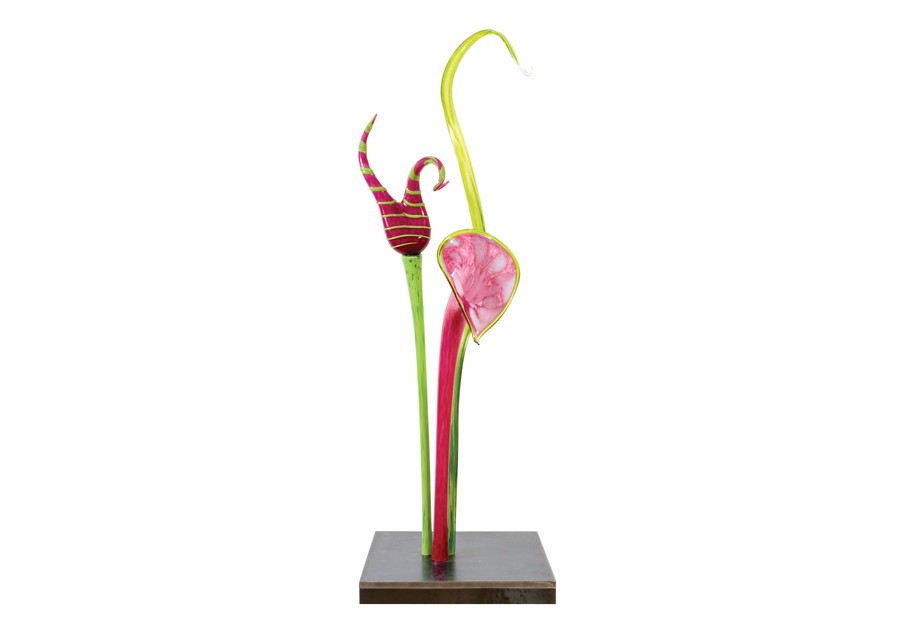
image: Untitled, 2004, glass, 86 x 22 x 32 inches, 218.4 x 55.9 x 81.3 cm
Dale Chihuly: A Selection at Marlborough Gallery Holiday Window at Barneys New York December 2, 2015
Dale Chihuly
NEW YORK, NEW YORK: The Directors of Marlborough Gallery are pleased to announce an exhibition of artwork by Dale Chihuly, presented concurrently with a holiday window installation at Barneys New York at 660 Madison Avenue. For Barneys, Chihuly designed a signature window display initiated by the theme “Chillin’ Out.” Titled Winter Brilliance, the 700 hand-blown glass elements of the sculpture are representative of frigid winters, and appear as grand crystalline designs composed of individual hand-blown glass icicles. Christie THREE SIXTY was engaged to choreograph special lighting effects onto the artwork. The visual experience is further enhanced with audio selections from “La Mer” by Claude Debussy, one of Chihuly’s favorite composers. The artist says of the show stopping window installation, “I want people to be overwhelmed with light and color in some way that they’ve never experienced.”
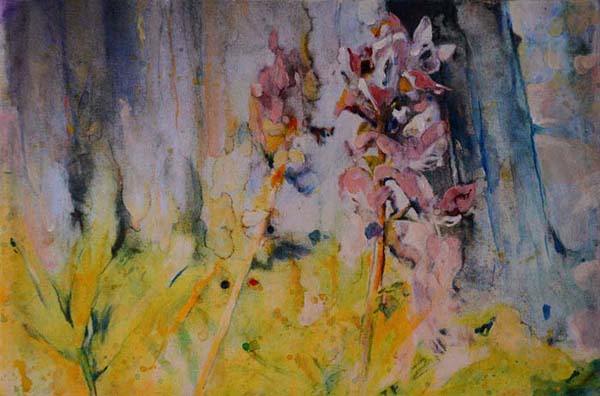
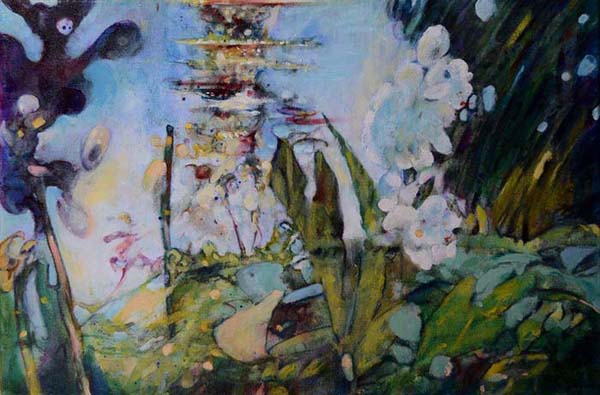
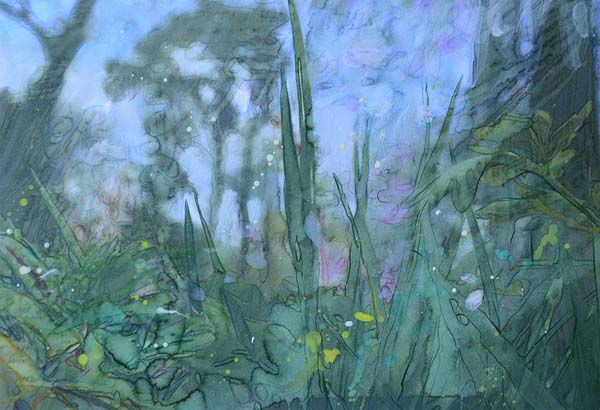
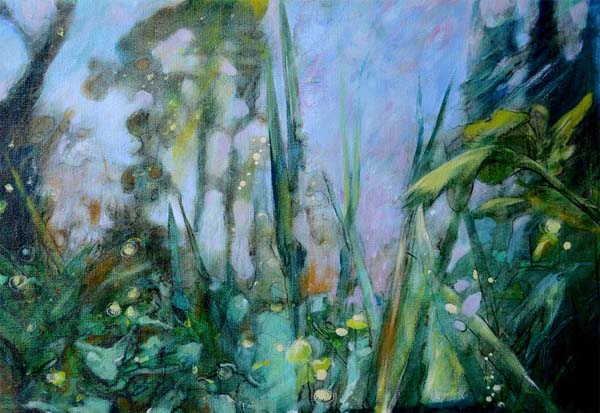
Beauty has always been the first importance subject in my paintings, the marvelous, natural, diverse subject of flowers appears repeatedly in my personal expression. These painted flowers, however, often serve more purpose than a decorative exhibit. Flowers can be exceptionally symbolic of various concepts and attribute different meanings to each painting depending on a variety of influences. There’s more to a flower, it seems, than just its color!
I often choose flowers as a subject to represent the peace, beauty and simplicity of the natural world. My flowery expression at times symbolize fertility, death, loss, innocence, childhood, love, luck, prosperity, lust, happiness, sorrow and life itself.
insignificance night
Magic forest – rabbit dream
Grass grass grass, 2015
Andromeda pollen, 2015
Personal Narrative: A moment in an ongoing day..
We do not notice the beauty of nature that surrounds us ,,, Flowers are beautiful and they are with us from start to finish … but in flowers is another enchanted world that lives its own life ,, Notice that elemental connection here is very clear ,,, fish in the aquarium is same flower whether the flower is fish. Yesterday, I was at the SoHo in Apple store and I saw a beautiful golden fish that exists only in the world of technology … Have such beautiful colors and they move so beautifully and even water as you touch it with your finger creates these small circular waves… beautiful and great technology,, but I stared a different point of view on wildflowers that grow themselves no one cares for only B.G. and I saw them space and wept over every broken leaves of the trees over every blade of grass.. a spiritual …. how beautiful the world would be without our human intervention … You know everything is very dangerous in these our present days, but I think what we’re doing with nature is the end of our civilization and beginning, and Hawking think so too and it surely is a very bright man.. Therefore, when you look at the flowers look in their beauty and symbiotic whole similarity and the magic of nanotechnology and enjoy what we got on so well so simply out of charity..
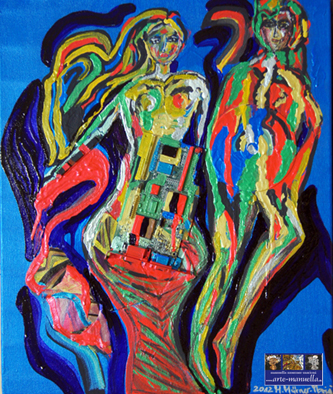
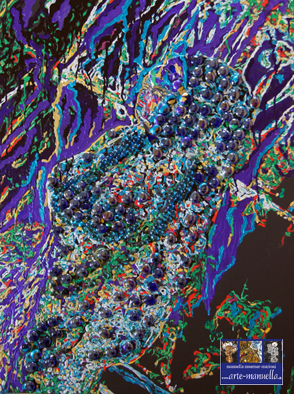
The figures she portrays through the folds of paint are filled with dynamism and movement, as they twist and twirl across the canvas. The end result of
Ms. Marioni’s complex creative process is a stunning work of pure beauty and magic. Her expertise of the medium is clearly exhibited in the way that the
With modern communications, you can be anywhere – you have the world at your fingertips. This is also the everyday reality of the upcoming generation of artists in the Czech Republic. This is also a connecting element for the group exhibition “(Re)construction of The Presence”. All participating artists were born in 1988 (Jozef Mrva), in 1989 (Michal Drozen) and 1990 (Filip Dvořák, Max Dvořák, Iva Polanecká, Štěpánka Sigmundová, Adéla Waldhauserová), grew up in a fully democratic society after the fall of the Eastern Bloc. Therefore it is no surprise that their present artistic practice is on the same level as the rest of the current international art world. One can observe a return to traditional media such as painting and drawing, but also work with photography, video and audio. Their use of various action forms like performance or stepping out from the classical gallery situation is common for the young generation. The openness of contemporary society can be seen in their approach. One of the basic elements is the creation of “bridges” between galleries and other spaces (real or fictional) and time. Thanks to these “transfers” in their works we meet with criticism of a depersonalized society in the information age, but we can also rediscover principles stemming from art history and subject them to new questions corresponding to the current view of the world. There will be seven young artists presented at the exhibition, who were selected by the curator for their innovative ideas and a great prospect of further growth in the future, not only in the Czech Republic, but primarily in the context of the whole world.
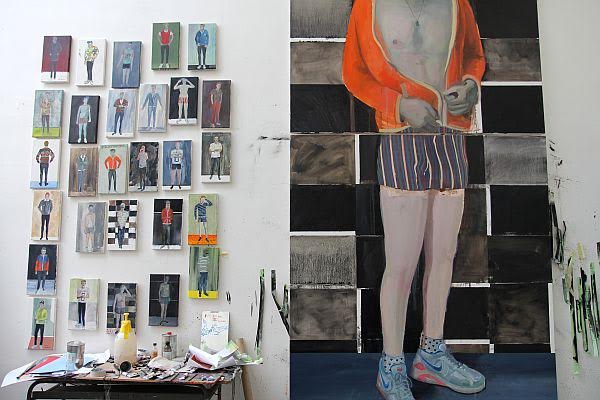
Michal Drozen, Indie hero, 2015, work in progress
Artist Štěpánka Sigmundová proves the fact that personal memories of individuals can become part of the collective consciousness of the work. Her records of everyday life consisting of photographs (more than 20,000 photos) and also collection of souvenirs become her “external memory”. Her works are characterized by long-term observations and classification. This archive with strong visual aspects makes the individual parts become placeholders of sites and situations, in which they can reflect memories for each of us. The work of Michal Drozen uses another approach, not capturing the whole world, but mainly himself, using painted auto-portraits and figurative paintings. The author solves the theme of constant exploration of being with painting. The classic theme, however, is all the more topical in the context of current everyday life of changing who you are and how are you viewed in a social network environments. Filip Dvořák also explores painting as a medium, sometimes he moves from surface dimensions to 3D and also to video performance, where he puts himself in different roles. He is fascinated with the historical legacy of art, especially from Romanticism. He adapts his interest and translates it into contemporary art language. One can observe great themes such as truth, sensuality, sincerity, beauty, refinement – themes, which are missing in fine art today, perhaps because we cannot see it in our daily life. Jozef Mrva, like Filip Dvořák, cites art history in his work, but he examines, deconstructs and reconstructs modernist processes of work, with new points of view. His “raw“ style has roots in philosophy, music and underground culture. Mrva is not scared of grand gestures and political opinions. He also works with the world of computers, seeing it as a theme and material of the 21th century. Another artist, Adéla Waldhauserová, works with photography, not only with the immediate capturing of an image, but she also works with photographs as a physical material – as objects. She is interested in landscape and human environments. She recycles her own as well as found photographs and books, and by creating small changes she destroys the narrative style of reading the images and puts new meaning to them, for example social themes, such as the most current one concerning migration. Iva Polanecká also has a strong relationship with nature and the environment. She works on displaying the invisible and the imperceptible. Polanecká uses multimedia installations, video, but the main body of her work is connected with sound. She tries to rouse interest in the viewer about things, which are overlooked in everyday life. Her specialty is making situations for visitors not only in gallery space, but in non-gallery spaces and outdoor. These events are usually arranged as walks with audio guides recorded by the artist, which are given out to participating visitors. One can observe her endeavor to find balance, meditation and the spiritual essence of being.Conceptual video maker and visual artist Max Dvořák has a different way of working. His impersonal maybe even cold moving images and “proof materials” reveal the background of scientific experiments. Stories on the border of fiction and reality force one to think about his or her position as an individual in a society.
Iva Polanecká, Prefigured of landscape, 2013, sound installation, 6 chanels sound records, speakers, aluminium object, 200 x 15 x 15 cm
Participating artists: Michal Drozen, Filip Dvořák, Max Dvořák, Jozef Mrva, Iva Polanecká, Štěpánka Sigmundová, Adéla Waldhauserová
curator: Jan Vítek (born 1989)
Jan Vítek is Czech young independent curator. Since 2014 he is also the co-curator of gallery Bunka, which is a site specific space for young art. He attempts to find new opportunities of presentation for young contemporary artists. He gathers experience across various cultural institutions: “(Re)constrution of the Presence” in Boccanera Gallery is his first exhibition outside of the Czech Republic.
She vanishes – Sara Bonaventura at Anthology Film Archives, December 2nd, 2015
She vanishes, a video by the experimental videomaker Sara Bonaventura, will be screened in New York, at the Anthology Film Archives, New Filmmakers NY section, during ORIENTING curated by Lili White, at 6 pm.
The video has already been shown in diverse locations before: in Italy and abroad (Belgrade, Moscow).
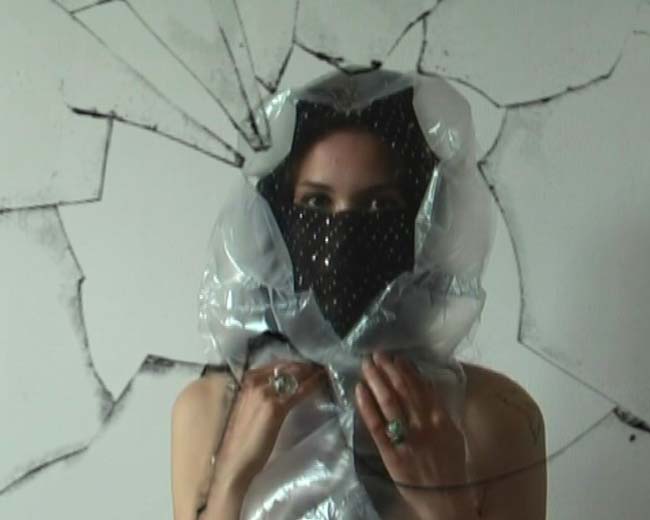
Would the modern Ariadne, who always knew her limits, hang herself today experiencing a state of abandon? Or has she always been un-finished? Swinging above the void, weaving her web on her own? She would love to disappear, while appearing. Refusing the linear logic of control/ property. Break means potential. No one knows
how the hang(wo)man game will end up. The last capture end is within a bubble, a vanitas. The logical thread is not enough. It was an umbilical cord, but it has been used to hang and constrain.
“Sarah offers what she does not have since she owns it no more”. Derrida, The gift of death.
Abstract
“For if Ariadne has fled from the labyrinth of old, the only guiding thread for all of us now is a
tightrope stretched above the void”. Rosi Braidotti
“The world is understood only as an extension of the body which is there in the process of
speaking… to the extent that it does not know repression, femininity is the downfall of
interpretation… Only meaning drives you mad/No madness without meaning”. Michele Montrelay
“The concept of sexual difference functions as the vanishing point”. Jacqueline Rose
“Meaning indicates the direction in which it fails”. Jacques Lacan
“Nothing to be seen as having nothing”. Luce Irigaray
When I though of the script and filmed this short I was writing my thesis, reading a
lot about aesthetics, visual culture, feminist film theory and gender studies. The
incipit french quotation is by Luce Irigaray, from her essay Speculum, and it is a
tribute to the so called écriture féminine. It is a french wordplay (rien à voir équivaut
à n’avoir rien) hard to be translated, but simplifying: having nothing to see equals
posessing nothing. It is a hint to feminist studies on the gaze, post-structuralist
studies in opposition to lacanian phallocentrism, which kept considering feminine
privates as penis’ sobstitutes; ironically declaring that if there is nothing, that
nothing could not be a substitute.
This short is my anti-manifesto.
A mise en scene of an impossibility -a virtual presence-, in front of and beyond the
camera. An “impossible body” displays loss, distance.
There is a tension without resolution, but also without a hierarchy. This unbalanced
tension is an in between, a terrain vague, a contra-diction. Same as the gesture of
typewriting she vanishes, a contradictory gesture which symbolizes the sense of
the short.
When the mind collapses, with its masks, grids and rational schemes, the body
reacts. this collapse could be a liberation. Words are not enough, there is not just
meaning but sense. The paradox is that I am writing it, bit it has to be experienced.
The body is the most dense political space, metaphor and matter, form and content,
identity and difference. It is the chiasm between the private and the public. The
feminine body is never neutral, never natural; it is always marked out, claimed, and
figured with language, always inscribed in a system of difference. The body is
written, but can speak also. HIstory is written but it can be reinterpreted. We are
always interpreting something that was interpreted.
She vanishes 6′ 48”, 2010, HD, color
I often play with quotes or idioms, trying to disclose a new sense, implying also nosense.
We can fill in some gaps, some silences, some vanishing points, live in left
out parenthesis; nowhere now here (at the beginning of the video) means in this hic
et nunc, which is always ineffable. Towards the end of the video an inter-text says
peek a boo-merang, referring to past and future space-time dimensions in an ironic
way. It was meant to finish like a hang-woman game. But the game is left open. To
give no answers, but multiple possibilities to you, the other, the observed observer.
And the inter-text the end is in a big bubble, a vanitas vanitatae; whose ambivalent
meaning was in fact to remind us that life is death, but also that death is life.
ORIENTING Programme:
Sara Bonaventura – SHE VANISHES (6 min, video, Italy)
Rebecca Arndt – DORIAN (20 min video, USA)
Tabita Rezaire – COMBTHROUGH (4 min, video. Mozambique)
Kristin Reeves – THREADBARE (6 min 16 mm, USA)
Leslie Wilson – TO MY LOVE (4 min, video, USA)
Linda Fenstermaker – ABANDONED GENERATIONS (10 min, video, USA)
Art Basel Miami Beach 2015 | Booth L05 |3.12.–6.12.2015
with Katharina Grosse, Jeppe Hein, Camille Henrot, Nathan Hylden, Annette Kelm, Kiki Kogelnik, Alicja Kwade, Justin Matherly, Michael Sailstorfer, Tatiana Trouvé, Daniel Turner, Jorinde Voigt, Matthias Weischer, Johannes Wohnseifer