• Kaws in 1998 was already playing hide and seek with galleries, media, fashion, design industry. surreptitiously interspersing his own iconic images onto public display ads. Like Donald Trump he know how how the media functions. NY Arts Magazine and its editor Abraham Lubelski found. Kaws walking the Soho streets of New York with a master key to access advertising panels on bus stop display cases showing Calvin Klein.  At home he would merge his own iconic signature graffiti then return the original posters  to the street advertising display cases. Kaws was invited by artist and founder of NY Arts Magazine Abraham Lubelski. to prepare a cover design. and presented another illusion and subversion of art, media, and commerce. Kaws was asked to modify a sample version using an existing edition of Interview.  Kaws’ work is surreptitious, mixing art media, design, pop culture in public surroundings.


    KAWS and his army of cartoon giants land in the UK

    KAWS is on at Yorkshire Sculpture Park from February 6 – June 12, 2016

    Wakefield, England (CNN)Even if you don’t know the name KAWS, you’ve probably seen his work.

    Remember the warped Calvin Klein ads that merged graffiti and fashion? The limited-edition Kanye West “808s & Heartbreak” album cover? The cartoon-esque bottle he created for Girl, Pharrell Williams’ fragrance with Comme des Garcons?

    Or maybe it’s his toy-like sculptures — and actual toys — which look like Mickey Mouse dolls with self-esteem issues, and sell for hundreds of thousands of dollars at auction, that have slipped into your psyche?

    Born Brian Donnelly, the Brooklyn-based artist began his career in the early 90s, graffiting ads plastered over what he considered to be public places — his work became so popular, advertising agencies started to hire him.

    Since then, his work has been displayed at the Museum of Modern Art, in New York; he has collaborated with renowned Japanese artist Takashi Murakami; and sold toys at hip Parisian boutique Colette, all while subverting some of pop’s most familiar faces, from The Smurfs to The Simpsons.

    And now he’s brought his brand of street-inspired pop art to the Yorkshire Sculpture Park (YSP), a multi-acre outdoor gallery in the north of England.

    Read more

    Published by Roberta Smith for The New York Times

    The objects in Cameron Rowland’s remarkable show at Artists Space offer a history lesson and an aesthetic experience, intricately fused. Accompanied by terse explanatory captions, they expose some of the troubling inequities in American society, especially concerning its prisons and their use of compulsory inmate labor. The process of grasping the meaning of this work equally involves looking, reading and feeling but its subject is one of the most urgent of our time.

    Mr. Rowland, who was born in Philadelphia in 1988 and earned a B.A. in studio art from Wesleyan University, has been exhibiting for less than five years but has become known for his carefully chosen, sometimes arcane use of existing objects. “Bait, Inc.,” his 2014 solo show at Essex Street Gallery on the Lower East Side, included scavenged materials like copper and car parts that can generate underground economies. An underlying theme was the way investors and government profit from the new workfare programs begun in 1996.

    Read more

    By Annie Jacobson, PhD Candidate, Ohio State History of Art Department

    On an unseasonably mild December evening, I walked across the Oval to Hopkins Hall to attend the opening BioPresence, an exhibition representing the culmination of months of planning, organizing, learning, and, of course, artistic exploration. Its theme represented the ongoing work of numerous people and entities across campus. Artists (both student and professional), were asked to create works about noticing and sensing all the living things on campus and in the local urban environment, documenting the “unique urban ecosystem” in which we all live and work. Invited to write about the show by one of the coordinators, professor Ken Rinaldo, I arrived at the opening celebration with little foreknowledge, wanting to let the exhibition speak to me on its own terms. What I found was a truly multifaceted show displaying an array of technological interventions into nature that allowed visitors unique perspectives on all types of life at Ohio State. From smorgasbords for squirrels and repurposed flea market paintings to slime mold dances and horse vision, the works in the exhibition ranged from clever and humorous to darkly striking and thought provoking.
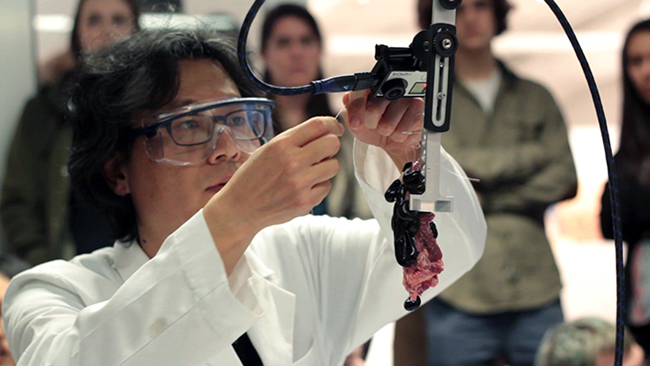
     The Inaugural Performance of Doo-Sung Yoo's Leech Project at the Opening Reception of the 'BioPresence' Exhibition Hopkins Hall Gallery, Columbus, Ohio December 9th 2015

    The Inaugural Performance of Doo-Sung Yoo’s Leech Project at the Opening Reception of the ‘BioPresence’ Exhibition Hopkins Hall Gallery, Columbus, Ohio December 9th 2015

    The exhibition, open for just one short week, filled the gallery and first floor in Hopkins Hall as well as parts of the upper floors, impressive considering that not all the works submitted to the show were selected for viewing. The arrangement of the works was carefully done, providing visitors a path to follow that also told the story of the ongoing BioPresence project—no small feat considering the number of works in the show. At the opening on December 8, Hopkins was filled with people weaving in and among the works, interacting with pieces that included a helmet that measures brainwaves designed and created with a 3D printer by student Jer Viny, a geodesic sensory deprivation apparatus, and a computer card game featuring the oft-underappreciated bacterium. Linked with many of the artworks was documentation of the process the artist used to arrive at his or her completed piece, an addition to the show which helped the viewers more completely understand how that work fit into the show’s theme. While giving me a tour of the exhibition opening night, Rinaldo, head of the Art and Technology program in the Department of Art, suggested to me that technologies such as robotics, animation software, and video and sound recording provide contemporary artists with the most current and relevant opportunities for creativity and exploration in our time, and even with the theme to focus the works, the variety was impressive.

    Among the most mesmerizing was first_contact by Axel Cuevas Santamaría, a video and sound work documenting the lowly slim mold Physarum polycephalum, which was rejected by scientists from the Animalia, Plantae, and Fungi kingdoms. These molds are single-celled beings, but they aggregate together to form reproductive structures and roll, glide, and slither around as they search for items on which to grow. Santamaría filmed in extreme close-up the molds moving gracefully across petri dishes. Then, in a small, darkened room, the recordings, featuring an array of colors from gold to green, were projected onto circular screens on the floor. The molds danced and sparkled to music electronically derived from their own movements, and the longer I watched them, the more they seemed to simultaneously resemble the surfaces of distant alien planets, the flowing forms of the lowly molds turning into powerful rivers or enormous storms. The round projection screens seemed to float in the dark, orbiting around one another, and as I stood in the black intermediary of the room, the varying levels of magnitude from the tiniest of organisms to the unfathomable vastness of space seemed to press in on me. Even the title itself alludes to cutting edge of discovery by scientists, be they pointing their microscopes to the smallest of life on Earth or aiming telescopes into the endless depths of the universe. Easily one of the strongest pieces in the show, first_contact captures how the marriage of nature and technology can produce both aesthetic and philosophical beauty, enticing viewers to think beyond their environment in both large and small ways.
    The Inaugural Performance of Doo-Sung Yoo's Leech Project at the Opening Reception of the 'BioPresence' Exhibition Hopkins Hall Gallery, Columbus, Ohio December 9th 2015

    The Inaugural Performance of Doo-Sung Yoo’s Leech Project at the Opening Reception of the ‘BioPresence’ Exhibition Hopkins Hall Gallery, Columbus, Ohio December 9th 2015

    Another highlight was the presentation of the Bioacoustic Urbanscapes, a  compilation of audio artworks featuring animal sounds, organized in part by TradeMark Gunderson, himself an audio artist. Earlier in the year, a call went out to artists from around the world for submissions that creatively used recordings of animals sounds from the urban environment. Artists had access to over 40,000 recordings from Ohio State’s own Borror Laboratory of Bioacoustics, another partner in the BioPresence project, as well as more recent recordings from wetlands near Ohio State’s campus taken this past spring and summer. The winning works were selected by members of the art department faculty and Angelika Nelson, the curator of the Museum of Biological Diversity at the Borror Lab, and presented in an upstairs classroom with an enveloping sound system. From experimental pieces to melodic songs, the creative array of audio works was impressive, and the compilation provided a fascinating addition to the visual works in the exhibition, although its out-of-the-way location prevented a wider audience from experiencing it.

    Amy Youngs’s Strike, displayed on the windows of the second floor facing the interior courtyard of Hopkins Hall, was a provocative and prominent addition to the show. From a distance, it spelled out the word “strike” in large letters. The ominous word hung above the visitors heads as they viewed some of the more whimsical pieces below. Upon closer inspection, the letters were fashioned with the bodies of birds. Although I could not identify many of the bird species, it was clear that a wide range of birds were included. I imagined the birds in their live state: flying joyously through clean blue skies, searching for bits of fluff or sticks to create nests or newly-surfaced worms for a morning meal. Their dead bodies seemed deflated and sad, reinforcing the impact of the large word seen from a distance. Youngs explained that the birds themselves had died when they struck large windows, an increasingly common occurrence as more and more contemporary buildings feature wide expanses of reflective glass. Created to call attention to this phenomenon, the birds were donated to the project from the Ohio State Museum of Biological Diversity, who document where and when the birds perish and preserve them for future study. This is an issue that is being addressed around the country, as the University of San Diego recently partnered with the University of Minnesota to test a special window coating to help deflect birds from windows.
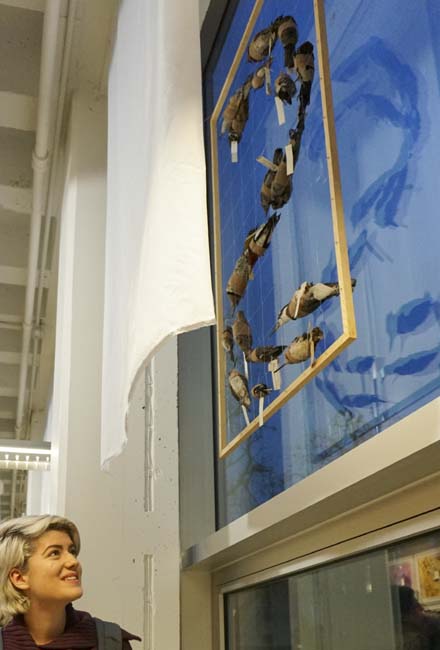
    STRIKE detail of bird installation by Amy Youngs, 'BioPresence' Exhibition, Hopkins Hall Gallery, Columbus, Ohio December 9th 2015

    STRIKE detail of bird installation by Amy Youngs, ‘BioPresence’ Exhibition, Hopkins Hall Gallery, Columbus, Ohio December 9th 2015

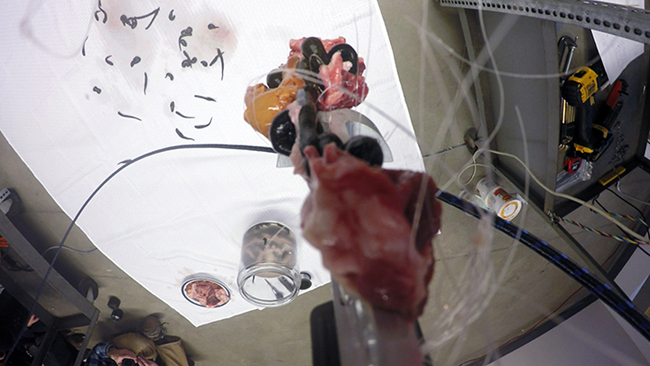
    One of the highlights of the opening was Doo-sung Yoo’s untitled performance piece staged near the entrance to the gallery space. Yoo himself was integral to the planning of the exhibition and a well established artist in video production and performance. Much of his work deals with how humans and animals are interconnected and interdependent, and these themes were clearly in mind for his live piece. It was hard not to have a visceral reaction to the work—there was literally a plate of viscera sitting on a table laid out as through at a restaurant, alongside a glass of wine and a loaf of bread. The table was positioned next to an elaborate contraption consisting of two metal drawer units rigged with upright posts which held between them by means of fishing wire a GoPro camera with approximately 6 inch metal post attached to it. The fishing wire was threaded through two robotic gears that moved the camera up and down and side to side. In the grand tradition of performance art, gallery-goers were confused and intrigued by this set up. As it was his first time executing this performance, Yoo at first seemed to scramble to get the set up exactly right. When I walked up, he was down on his knees, busy transferring about 3 dozen leeches from a bucket to three glass containers of various sizes. I’m not generally a squeamish person, but, seeing the plate of viscera, I had some idea of where the performance was going, and although my stomach objected, I couldn’t tear myself away.

    Others visitors to the exhibition drifted around, impatient for the performance to start. When each element in the elaborate set-up was ready, Yoo carefully donned button down shirt and tie, sat down at the table, and began pouring himself wine. Sitting in front of the wine, bread, and large plate of raw organs, Yoo began cutting the bloody mass into smaller pieces. The plate could barely hold its contents, and some of the liquid spilled over the edge to stain the pristine white tablecloth. He transferred the pieces to a smaller plate, and after taking several drinks from the wine, stood up to move over to the robotic contraption and the leeches. Carefully placing the plate of leech delicacies on the floor, Yoo strung up the raw innards on fishing wire and began to transfer pieces of intestine, heart, and other unidentifiable organs into the glass containers, beginning the leech feast. I was both mesmerized and repulsed to see the little creatures latch on to the meats and swell as the ate their fill. Then, with the leeches clinging to the viscera, Yoo carefully pulled them from their glass jar and tied them to the camera apparatus. Some of the leeches fell onto the white cloth beneath with a soft splat, eliciting groans and squeals from the crowd. When Yoo sent the leeches flying up and down between the supports, some of them were flung dangerously close to the audience; I even had to jump back to avoid one of the little guys landing on my shoe. I had expected to see art works elucidating the relationships between human and animal, but not to have my own personal encounter with one! As the leeches flew around with the little GoPro camera (also equipped with a magnifying lens), the live feed was projected on the wall behind the machine, a large image revealing the event from the perspective of the leeches themselves. Although I was unclear on the deeper meaning Yoo intended for the performance, it was certainly entrancing. I hope that I get to see the next iteration (although I’ll go to that one on an empty stomach).

    The BioPresense exhibition was part of a larger initiative that has been ongoing through the fall 2015 semester and connects artists, designers, scientists, and philosophers from all around campus. Representatives from the department of Civil, Environmental and Geodetic Engineering and the School of Environment and Natural Resources mingled with faculty from Classics, Comparative Studies, and of course, the Department of Art. The idea for the project began with conversations between the organizers about the ways animals worlds influence the fields of the arts, sciences, and humanities—and the lack of animals studies around campus. As sustainability becomes a more and more pressing issue locally and globally, this group of faculty wanted to specifically call attention to how we co-exist with the animals and plants on the Ohio State campus.

    Spearheaded by Department of Art professor Amy Youngs, the group applied for a university Framework Grant from the Office of Academic Affairs. The grant is specifically for faculty who will improve the Ohio State community through “creative and collaborative place-based projects.” The goal of the project was to make the animals and their ecosystems in and around campus more visible and to get people talking about sustainability. With the money they received from their winning application, Youngs and Rinaldo were able to purchase new equipment and software for the more than 200 students that were enrolled in the fall’s Art and Tech curriculum, including such courses as 3D animation, internet art, holography, and video art. The abundance of resources showed in the great array of projects in the BioPresence exhibition, and as Professor Youngs told me, it is especially helpful for the young artists in the program to focus their final projects of the semester around a specific theme, as this is how a majority of professional art exhibitions are organized.

    The theme of the project is a worthy one: as our planet faces great changes as a result of global climate change, we must consider how our actions on Earth affect not only ourselves, but the nearly endless multitude of other life that calls this little rock home. Artists in the exhibition spent months thinking about our urban landscape (so often only thought of as a space for human inhabitants) from the perspectives of numerous other creatures, and their works allowed viewers a chance not only to similarly delve into these other viewpoints, but also to see how artistic exploration explored through technology often results in works particularly of our early 21st century moment.


    – Annie Jacobson, NY Arts

     

    unnamed

    Griffin Gallery and CHARLIE SMITH LONDOND are delighted to announce their continuedcollaboration with the presentation of ‘Young Gods’. Curated by Zavier Ellis, the exhibition is anannual selection of London art school graduates and post–graduates. 

    CHARLIE SMITH LONDON
    EXHIBITION DATES Wednesday January 14th – Saturday February 14th 2015
    GALLERY HOURS Wednesday-Saturday 11am-6pm or by appointment
    ADDRESS 336 Old Street, London EC1V 9DR
    CONTACT +44 (0)20 7739 4055 | direct@charliesmithlondon.com | www.charliesmithlondon.com

    Griffin Gallery and CHARLIE SMITH LON
    Presented simultaneously at both galleries, the 2016 edition will feature eight artists working in painting,photography, sculpture, assemblage, video, performance and installation.   
    Comprising artists from Chelsea, City & Guilds, Goldsmiths, Royal College and St Martins, the exhibition will continue to illustrate the breadth of world class education throughout London art schools. ‘Young Gods’ has a proven track record of discovering vital new artists and introducing them to the international market, with previous selections going on to considerable success with galleries, museums and collectors.
    As Ellis states: “I’m excited to present once again my selection of London’s graduating artists at Griffin and CHARLIE SMITH LONDON. It’s always a fascinating process from visiting the schools; learning about the artists; and opening the shows eight months after the process has begun. I never cease to be intrigued, amused and enlightened by London’s art school output. Historically we have experienced considerable success with the Young Gods programme and it is rewarding to be able to offer some support alongside Becca Pelly–Fry and Griffin Gallery to artists at such an early stage in their careers.”  
    The private view will take place at Griffin Gallery Wednesday 13 January 2016 6:30–8:30pm and there will be performance by Chris Gray and J Price at CHARLIE SMITH LONDON Thursday 4 February 2016 6:30–8:30pm.

    Please contact Griffin Gallery or CHARLIE SMITH LONDON for images and further information |info@griffingallery.co.uk | direct@charliesmithlondon.com


    Is gallery space still worth paying rent for or will Instagram replace it all? Art Basel director Marc Spiegler gives us the answers

    Source: MARC SPIEGLER  for 

    Thinking about galleries—individually and as an art-world sector—is a constant inside Art Basel. The organisation was founded by a handful of Basel-based dealers and remains very much driven by gallerists. Those who sit on our selection committees play a pivotal role for the fairs. We also strive to stay in close contact with the 500-plus galleries around the world that do our shows, hoping to serve them by gauging their present challenges and working towards their futures.

    I gave a lecture at the Talking Galleries Conference in Barcelona at the end of last year, at a starkly transitional moment within the art world, and posed ten questions that every gallerist should be considering seriously because the answers they find will define their future.

    1. Are connoisseur collectors a dying breed?

    Gallerists frequently complain that the people visiting their booths and galleries know much less about art than before. What happened? In part, it seems simply a symptom of how fast the art world has grown; by definition, that means a lot of new collectors. Most do not come from families with a legacy of art collecting. Just as importantly, even the most experienced and engaged collectors today tend to have far less time for art than their predecessors. As the author Chrystia Freeland wrote in her brilliant 2011 article The Rise of the New Global Elite, in the Atlantic: “In 1916, the richest 1% of Americans received only one-fifth of their income from paid work; in 2004, that figure had risen threefold to 60%.”

    The super-wealthy no longer represent the leisure class, at least not as the American economist and sociologist Thorstein Veblen defined it. The newer art buyers at our fairs are often actively running hedge funds or start-ups; they may be super-wealthy, but they also are super-busy. However much they may be interested in art, they are rarely able to devote their Saturdays to visiting galleries. Instead, many use intermediaries to do their research; that’s why the ranks of art advisers are swelling so fast. Many of them also buy heavily at auction; it’s a quicker process and it feels more transparent to them, even if insiders know better. This deep demographic shift in wealth also explains why art fairs have grown to such importance: because they so efficiently offer the time-stressed collector an overview of an ever more global market.

    All this means that gallerists will need to rethink what happens when a potential collector actually sets foot in the gallery. To be a successful gallerist 20 years from now, you must throw out the old ways of playing upon social hierarchies. Having people at the front desk who don’t smile is not going to work; nor is telling people that their collection is not good enough for your artists. They will find another way, and your artists will suffer in the process.

    Read more

     
    unnamed
    Semiotic Guerrilla Warfare (Part 3)
     
    SemioticGuerrilla Warfare marks a new collaboration between CHARLIE SMITH LONDON and PAPER Manchester. The exhibition brings together artists with connections to both galleries creating a network spanning artistic practice between Manchester and London. This is part 3 of the exhibition; part 1 was shown at PAPER in Manchester and part 2 at Art Projects at London Art Fair 2016.
     
    30 January – 24 April 2016
    The Link Gallery
    Dean Clough, Halifax, HX3 5AX
    Open Daily 9am – 5pm 
     
    Phill Hopkins has a voracious appetite for world news and the situations that we as human beings find ourselves subject to. He is interested in how we process global images of conflict that we receive into the domestic. Hopkins uses very ordinary materials, often found or bought at the hardware shop. In Wrapped in Foil (Syria), he has added-in other found materials from the floor of his studio.
     
    image: Wrapped in Foil (Syria) 2015
    Blackboard paint, sticky-backed foil, emulsion paint, gloss paint, spray paint, varnish,
    used paintbrush handles, pin and Risperidone tablets on Fabriano 100/100 cotton paper.


    Untitled-1 copy

    SohoPhoto Gallery is proud to present six solo shows including touching work by Miana Jun and Rebecca Pine on the aftereffects of breast cancer.

    Exhibition Dates: February 3, 2016 – February 27, 2016
    Opening Reception: Tuesday, February 2, 2016, from 6pm to 8pm. Everyone is welcome.


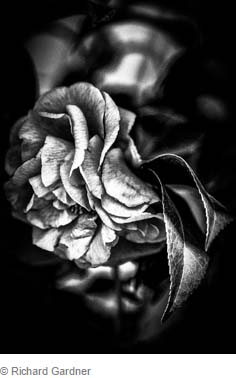
    A Note for Juliet
    Richard Gardner

    001
    “The collection of atmospheric blossoms has been created as tribute to the memory Juliet Man Ray, wife of great surrealist artist Man Ray. The selection is named for a Haiku I wrote many years ago for my dear friend, Juliet, shortly after her passing.”


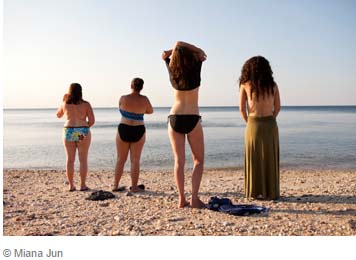
    The Breast and the Sea
    Miana Jun and Rebecca Pine

    002
    The Breast and the Sea (www.thebreastandthesea.com) is a written and photographic project capturing the strength and beauty of breast cancer survivors. Photographer, Miana Jun, and author/survivor, Rebecca Pine, share stories and photographs of participants, with scars bared in the sea. “It has been healing because I was able to expose my scars without judgment and without fear . . . knowing that the photos of me will help someone else to heal.” –Lauren, participant


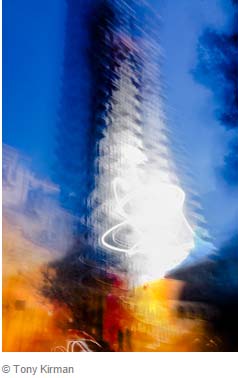
    Gestures
    Tony Kirman

    003


    Light tells us what time it is, and then time tells us something else. A camera gesture, with an exposure of half a second or longer, causes light rays focused by the lens to be distributed in a spontaneous way across the sensor–Intentional Camera Movement. The evidential nature of the photographic image is replaced by a celebration of the fluid and complex nature of reality.


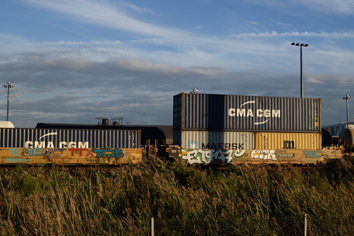
    Color Contained
    Joan Lemler

    LEMLER_Joan_ColorContained


    “I have photographed alongside the New Jersey Turnpike for many years but recently decided to focus on the shipping containers near Elizabeth and Harrison. I am drawn to their geometric blocks of color. I seek places where these symbols of industry are juxtaposed against marshland, open skies and diesel trains, or stacked like a mosaic. To me this creates an interesting, layered composition. And, when I have the right light, these mundane industrial scenes become beautiful.”


    Remembrance of Buildings Past
    Michael Sackler

    005


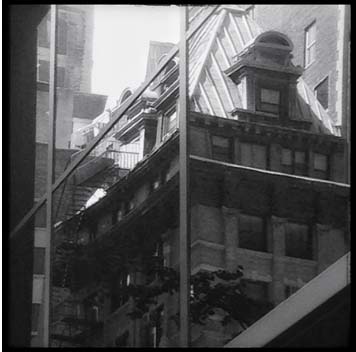
    “As an architect working in the neighborhood of the 9/11 Memorial, I have become acutely aware of the fall and the rise of buildings. This project explores the collage effect within cities of older buildings reflected within the facades of newer buildings. Memories of a prior urban and historical fabric, now obscured by inexorable change, are found embedded within the rigorous logic of the present.”


    Always–At the Seashore
    Paul Stetzer

    006


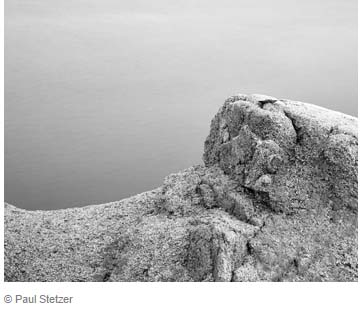
    “The borders of land and sea reward my patient waiting and watching with beauty, calm, inspiration, solitude, insight as the constant kissing of the shore by the waves coalesces into a sense of always.”

    SohoPhoto Gallery
    15 White Street
    New York, NY 10013

    Gallery hours:
    Wednesday to Sunday
    1:00pm – 6:00pm
    (and by appointment)

    212.226.8571
    SohoPhoto

    Maxwell Stevens "Summer Table 3" Oil on linen, 20 x 20 in/51 x 51 cm, 2013. Image copyright © 2016 Maxwell Stevens, all rights reserved.

    Maxwell Stevens “Summer Table 3″ Oil on linen, 20 x 20 in/51 x 51 cm, 2013. Image copyright © 2016 Maxwell Stevens, all rights reserved.

    MAXWELL STEVENS SUMMER TABLE PAINTINGS

    January 17 – February 7, 2016
    Opening Reception: Friday, January 22, 6 – 8 pm
    Gallery Hours: Tuesday – Saturday 12 – 7 pm, Sunday 12 – 5 pm, and by appointment

    NEW YORK – onetwentyeight is pleased to present MAXWELL STEVENS, SUMMER TABLE PAINTINGS, a new solo exhibition testing the boundaries of painterly abstraction and photorealism within the context of contemporary portraiture and delicately painted modern interiors.

    “I’m interested in the domestic arena as the primary site for our psychological and emotional experiences, and in how we exist differently, historically, within each passing moment. I try to use abstraction and the fragmentation of representational imagery to evoke this.”

    In this selection of oil paintings spanning several years, the viewer encounters an array of intricacy & detailed brushwork executed in the individually rendered scenes underlying each picture. These intimate, miniaturized portrayals are subsequently overpainted in thick impasto, fragmenting and disrupting the initially calm scenery. This interplay arrives at a newly hybridized pictorial space, one that makes allusions to both the Dutch Golden Age and to Abstract Expressionism, yet clearly would not exist in any other era than our own.

    Please join us for this special exhibition of paintings as we inaugurate an exciting 2016 season at onetwentyeight. For inquiries please contact us at summertablepaintings@gmail.com or +1.212.674.0244, +1.646.341.0175.


    footer-1onetwentyeight
    128 Rivington Street, New York, NY 10002
    galleryonetwentyeight.org +1.212.674.0244

    There is a perceptible, unidentifiable energy that permeates the Picasso Sculpture exhibition on the fourth floor of New York’s Museum of Modern Art. Phones snap pictures; viewers speak in enthusiastic whispers. And amongst the excited crowd: an invaluable collection of sculptures that catalogues 62 years of an artist’s life. The layout of the exhibit guides the viewer through time to 1964 from 1902, relaying Pablo Picasso’s artistic progression from bronze and wood cubist sculptures of his early years to twisting sheet metal structures that cap his career.

    In the middle of this story is a rupture in the narrative: Gallery 7, The War Years, 1939-1945. It is a moment of pause from the abstract, celebratory autobiography of modern art’s golden child. The pieces displayed within The War Years gallery reflect the harsh realities of Europe in the 1940s and of Picasso’s specific experience as an artist in German-occupied France during the Second World War. The spatial organization, individual displays, and overall tone of the gallery reflect the curators’ desire to portray the morbidity of Picasso’s War Year pieces in a concise, minimalistic manner.

    Upon entering Gallery 7, a shift in lighting signals a change in mood from the past three decades of Picasso creations. The previous room—Gallery 6, The Boisgeloup Sculpture Studio, 1933-1937— displays under bright lighting a set of colorful interpretations of the human form and the natural world. The room succeeding the War Years—Gallery 9, Vallauris Ceramics and Assemblages, 1945-1953—echoes the sculpture of Picasso’s Boisgelup Studio years in both tone and form: vases painted with controlled, energetic brush strokes; blooming plaster flowers in terracotta jugs; a miniature figure of a woman reading in a suggestive position.

    But Gallery 7 is dark. The lighting is precise to the point of ascetic; each work receives only the careful stream of a pointed spotlight. As patrons depart Gallery 6 their voices drop as they succumb to the visual cue of a dimness that whispers suggestions of silence. Entering Gallery 7, the respectful, but audible, excitement that pervaded the last six rooms melts away, replaced by a hushed reverence for The War Years.


    The sculptures of the War Years represent Picasso’s struggles as an artist under Nazi rule. They represent the somber social mood of a France infested with foreign soldiers. But more than anything, they represent Picasso’s attempts to push back against the social climate through visual commentary. The very medium through which Picasso relays his message is a rebellion; he casted some of his sculptures in bronze, an important commodity that the Germans reserved only for producing ammunition. Picasso also subverted German authority by refusing to conform to the accepted standards of art. In an audio guide provided by the museum, an exhibit curator explains that Picasso was deemed a “degenerate artist” by the Germans, meaning he was banned from exhibiting or publishing his work.

    Picasso comments on his environment of moral ugliness by reproducing it in his work rather than attempting to cover it with shades of false beauty. Death’s Head, a 1941 work in bronze, symbolizes Picasso’s quiet defiance and his desire to acknowledge his day’s darkness. The sculpture portrays a lifeless and misshapen human head. Two bloated sockets lay where the eyes should rest. A gaping hole lies where the nose should protrude. Gashes from a carving instrument mar the forehead. These disfigurations are not products of the piece’s decay over time, but rather, they are purposeful imperfections inflicted by Picasso to embody the atmosphere within which he worked.

    Gallery 7’s display of Death’s Head highlights Picasso’s masterful explication of the grotesque. The piece rests on a black block, and the dark head coupled with its dark background mutes a sharp spotlight. The head appears stoic without an accompanying body—a morbid, yet noble reminder of the evils of humanity. The curators craft a chillingly tranquil scene, and it is as if Picasso meant for Death’s Head to be rendered to the world as such: a decapitated entrée of despair served upon the dinner platter of a museum’s squeaky-clean podium.

    Adjacent to Death’s Head rests Head of a Woman, the first work of The War Years visible upon entry from Gallery 6. The piece rests on a podium, roughly four feet in height, against a wall that stands alone in the middle of the gallery. The curator’s decision to display Head of a Woman as the introduction to The War Years fits the room’s chronological organizational scheme; the work was finished in 1941, the first of Picasso’s years in his new studio. However, the work also serves as a thematic segue from the playful cubism of the Boisgeloup Studio sculptures to the serious subject matter of The War Years. Less offensively grotesque than Death’s Head, the Woman and her enlarged, disproportionate features still manage to convey Picasso’s abstract aesthetic language that pushes against the accepted artistic style of his time. No clear political meaning or social commentary can be derived from the work, but it serves as an effective transition piece, echoing the thematic framework of Gallery 6 more closely than the other two sculptures from 1941: the first, Death’s Head and the second, Cat, a warped representation of a cat in bronze.

    The layout of Gallery 7 connotes a purposeful geometry. Whereas the other galleries of the exhibit scatter their pieces about open floor plans in a seemingly unordered manner, the pieces of this gallery are situated in equidistant length from a central standalone wall. Other galleries of the exhibit boast nearly twenty pieces while Gallery 7 holds only ten. Three of these ten sculptures comprise a triptych in the back corner of the room, leaving a sculpture on both sides of the central wall and five sculptures positioned throughout the room. The lean offering of The War Years’ gallery allows each work to breathe its own story into life. Death’s Head is so evocative partly because the piece is visually isolated from the nearest sculpture by a few yards. Furthermore, the sparse layout of the room reflects the feelings of emptiness that Picasso himself must have felt while creating his works in German-occupied Paris.

    Aside from spacing and lighting, the curators tell Picasso’s story by utilizing the walls—or more accurately, by not utilizing the walls. Traditional galleries display their work against white walls with descriptive text beside the piece. Instead, The War Years room has gray-painted walls, and the wall text is replaced with a monochromatic, minimalistic pamphlet that gives basic information on each sculpture. These two unique curatorial decisions reinforce the somber tone of the gallery, emphasizing the lack of bright color in Picasso’s War Year pieces. The choice to forgo wall text mitigates visual distractions and allows the viewers’ attention to rest solely on the gallery’s pieces; the room’s energy bounces from sculpture to sculpture and is not cheapened by unsightly, cluttered chunks of text.

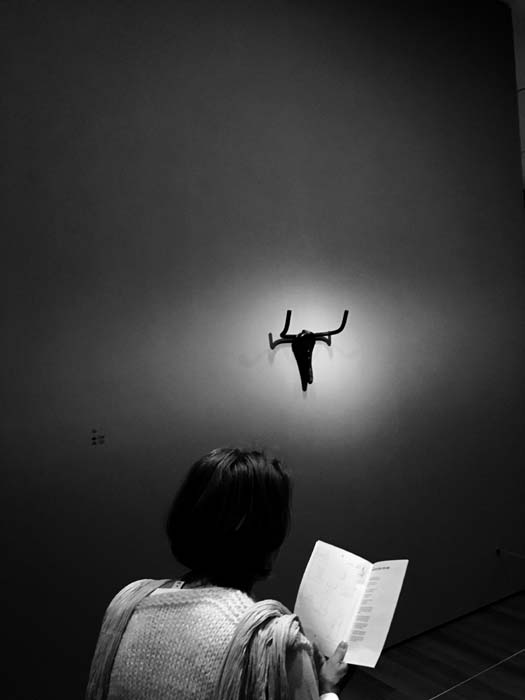
    The curators do indeed use two of the gallery’s six walls to showcase the sculptures that necessitate mounting. The three sculptures in the far right corner of the room from the primary entrance (Head of a Dog, Death’s Head, and Goat, 1943) seem to be afterthoughts by the curators. The unassuming two-dimensionality of the triptych’s paper form relegates the trio to the back of the room. However, the curators display Bull’s Head, a sculpture no larger than a tennis racket, alone in a prominent position on the backside of the central wall. Bull’s Head is decidedly random in the context of The War Years—it is a simple assemblage made from a bicycle’s handlebars and seat. However, its placement on the central wall provides a moment of levity amongst the heavy subject matter in the room, and it embodies the powerful spirit of creativity amidst a time of turmoil.

    Pablo Picasso, 1942, Tête de taureau (Bull's Head), bicycle seat and handlebars, 33.5 x 43.5 x 19 cm, Musée Picasso, Paris

    Pablo Picasso, 1942, Tête de taureau (Bull’s Head), bicycle seat and handlebars, 33.5 x 43.5 x 19 cm, Musée Picasso, Paris


    More generally, Bull’s Head emphasizes the simplicity, universality, and accessibility of art; one of the most renowned creators of all-time harnessed a childlike imagination to craft a work of art from old handlebars and a bike seat. The curators echo Picasso’s universal appeal in their desire to present the show to a wide-ranging audience. The printed informational pamphlet appeals to an older, more traditional audience, while the audio guide can be accessed on a smart phone by more technologically savvy museumgoers. There is even an audio guide made specifically for kids.

    Pablo Picasso lived and worked through one of the great calamities of humankind, and the curator’s display of his War Years sculptures exemplifies the artist’s perseverance, resistance, and will to break from the bonds of tragedy to chronicle history through emotionally captivating art. Holistically, the show conveys the complete spectrum of human emotion—from the bouncy, haphazard assemblage of Picasso’s 1929 Woman in a Garden to the hulking and haunting metal, clay, and bronze Man with a Lamb of the War Years. The curators display each piece of the exhibit with the same attention to detail, but Gallery 7 is especially powerful in its unbridled depiction of humanity’s most passionate emotions: anger, despair, and sorrow.

    – Yowana Wamala, NY Arts

    Throughout my career as an art critic, the choice of medium artists make has always been a central issue. In the 1970s photography was questioned. Was it an artistic medium or only a craft? Then came performance and installation art followed by video art. Luckily it seems that these days anything can be considered an artistic medium. So it didn’t surprise me much when Robert Kananaj put up a show in his gallery for short-filmmaker, Randall Okita, involving three pieces: two of them installation art and one video.

    At first I thought that this was another TIFF event spreading out across Toronto and filling every art venue. It is, but it is much more — a breathtaking exhibition that could stand proudly in any Kunsthalle in the world.

    All the pieces are metaphorical but if I wanted to be literal I would say Portrait as a Random Act of Violence feels like swearing, Things I Can’t Tell You is a poem and Be Here Now is a prayer.

    Portrait as a Random Act of Violence (2012) is the installation that we encounter when entering the gallery. Originally it was built for the short film Portrait as a Random Act of Violence. As the gallery’s introduction says, “Okita often employs complicated and intricately built artworks as key characters in his films, exposing their construction as a metaphor for the complexity of how conflict and struggles build within us.” The installation in the exhibition is the final scene of the film, when both the vandalized building and the glass sculpture are present at the same time, showing both the violence and its possible aftermath. This exhibition is meant to be a departure from performance art by removing the installation and sculpture from their original video screens and putting them in the gallery so they can stand by themselves, for themselves. And indeed Portrait as a Random Act of Violence is an outstanding installation in its own right, with a deep and intricate meaning that has many possible layers of understanding.

    Entering, I step into a dark, gloomy place, facing a seemingly abandoned building that might have been a greenhouse but it is so badly vandalized that I take two steps back right away, not sure if I want to continue or if I even want to know more. All the windows are broken and the sizes and edges of the holes suggest that the damage was done with a large axe or stone block. It is definitely a dangerous place where violence took place. It is truly scary. When brave enough to walk around the building, I look inside – and see a miracle. A man made of the fallen, broken glass pieces stands in the middle. It is more than broken pieces of glass put together – it seems like crystallized humanity. It shines in the dark. It is in the void created by the violence but instead of falling into the abyss, it fills it with light. While the vandalized building stands as a metaphor for violence and the darkness within us, the figure brings in hope.

    I understood this work better after watching the short film with the same title. The film is very fast and very loud at the beginning: a man stands in front of a building then smashes it ruthlessly, effectively, quickly. The destruction is drastic and dramatic. Then the same man steps into the building, hangs the cinder block he used to destroy it on a hook that starts a machine that pulls up the glass shards and gradually builds the figure. Could the perpetrator and the victim be the same person? Could it be different sides of the same character? Being made of glass suggests a fragile structure but this figure is more like crystal, strong and sharp. It is ambiguous in appearance, a disturbing mixture of vulnerability and strength. The posture — hands in front of the face, head turned away — is also ambiguous; is it trying to protect itself from another attack or is it in a martial arts pose, ready to fight fearlessly this time. The longer I looked at it the more I became enchanted by its inner light. Can violence be turned around and create something ethereal like this sculpture? I just hope that the cruelty of this building will not imprison it, that the humanity represented by it is uncontainable and that a resurrection will follow.

    Things I Can’t Tell You (2011), a 25 minute video loop, is a visual poem of fire. Two figures wearing special clothes and lit on fire are engaged in a choreographed air ballet. Okita is one of them. The human shapes — that are not recognizable, but abstract — swim in the air towards each other. They start as little flames on opposite sides of the screen and begin their journey toward the centre. The intensity of the flames changes as well as the shape of the figures. Sometimes we can grasp a human form — a head, a body part, arms stroking in swimming motions, legs kicking — always surrounded and swallowed by fire. As they burn they feed your imagination with images. They look like calligraphy created by bleeding brushstrokes, dancing dragons breathing fire, shapes that might be associated with known forms and ones that can’t be recognized or even guessed. The shapes are like words that are better understood unspoken or impossible to say. The two figures move towards each other and appear to be going to meet. They get very close, almost there, when at the sound of a drum and after a moment’s hesitation, they turn away, or are pulled away, from each other. Then the distance between them widens, the fire weakens, and dies. Darkness takes over for a short time until two little flames reappear, getting stronger as they move towards each other again in their burning desire to meet, to touch – forever unfulfilled.

    Randall Okita with Be Here Now, 2015, multi-media installation, detail. Photo Dustin Rabin

    Randall Okita with Be Here Now, 2015, multi-media installation, detail. Photo Dustin Rabin


    The flames fly like veils and remind me of the white draperies in Okita’s earlier film, Fish in the Barrel. Red or white, they both represent danger, and create high tension. They are disturbing. Strangely enough, fire feels less scary — Things I Can’t Tell You is more melancholy than dramatic. The dancing flames are so beautiful and mesmerizing that we forget to worry about the two people on fire. It feels that they are no longer people, and, through the metamorphosis of fire, their bodies have become spirits.

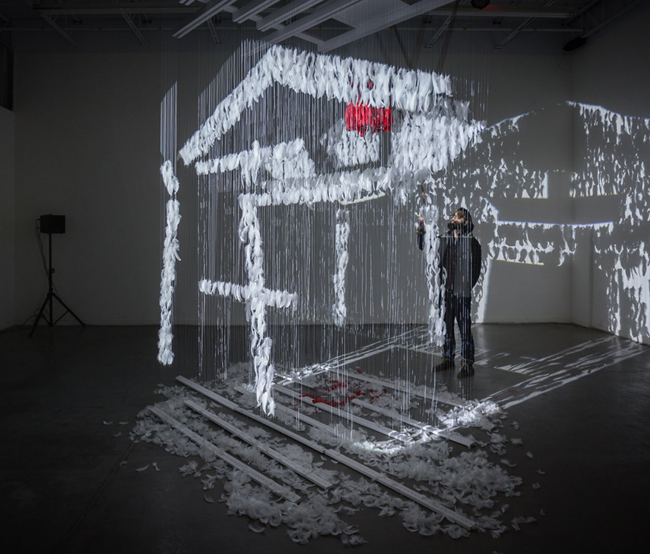
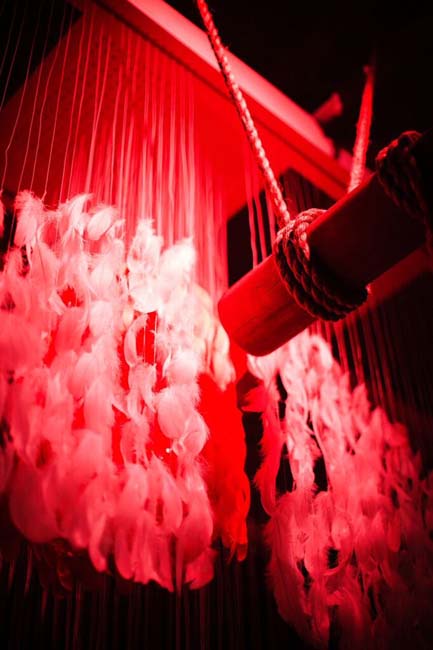
    Through a spirit gate we walk into the next room into a realm of spirits and prayer. Be Here Now (2015)  is like a Shinto temple or a cloud pavilion. At first the “building” seems to stand solidly on the ground, a large letter character painted by a wide brush, all lines. At a gong’s sound the color changes into imperial yellow, then as the clear outlines blurr, the “temple” seems to move slightly, like breathing in and out. After another sound it turns into burning red, like the rising sun, and I can no longer see what is what but get lost in this mirage that feels highly spiritual.

    Randall Okita, Be Here Now, 2015, multi-media installation, detail. Photo Dustin Rabin

    Shinto temples are final only in their form but not in their material. They are usually built of wood but that doesn’t last for long, so people have to rebuild them again and again, using the same design. In this installation, I stand in a temple created out of thousands and thousands of feathers. The feathers move, like the little paper prayer strips the Japanese put up around windows. It also reminds me of old shamans’ clothes and religions that worship tribal animals, birds among them. There is also an owl here somewhere up close to the ceiling. You can associate the moving feathers and the shadows they cast on the gallery’s walls with mythical animals, shape-shifters and other floating spirits. The projection of the different coloured lights alternates the outline and atmosphere of the temple and doesn’t really give you time to analyze its real nature. Finally, when alone in the room and the projection stops, I can walk around and see the hanging mallet. Each strike of the bell triggers a transformation: changing the light and sound, altering the disposition of the space and the viewers’ experience – making it all unique. Some say it is all illusion, just an optical trick. But what is illusion and what is spiritual vision and where is the borderline between them? It is up to the viewer to decide.

    Okita said in one of his interviews that he aims to find a balance between reality and the internal metaphors that he wants to represent. As the works in this exhibition prove, that balance is hard to find and very sensitive. The visual concept in which Okita creates his characters and their environment is striking. As his friend, the writer Brendan McLeod wrote, Okita’s works are “hyper imaginative, dramatically potent, and visually arresting.”

    * Exhibition information: November 7, 2015 – January 23, 2016, Robert Kananaj Gallery, 172 St Helens Avenue, Toronto.


    – Emese Krunák-Hajagos, NY Arts


    News | Exhibitions