•  


    “This ‘live ballet’ brings a continuous element of chaos..”

    “This ‘live ballet’ brings a continuous element of chaos, surprise and joy, like a floating bubble, or a shimmering shrine, to one of the busiest avenues in New York City.”

    Courtesy of the artist and the Lab Gallery.

    LAB Gallery

    The Lab (for installation + performance art) is pleased to present Paris based artist Anne Ferrer in her first exhibition in New York City. Rooted in her experience of foreignness and the absence of an inherent sense of home, Anne’s nomadic and sensorial sculpture is an organically inspired installation that is transportable in a suitcase. Ed Rubin, the curator of Billowing Beauty, describes it as a “lush and sensuous, sensitive and bold, mysteriously animated, Parisian soufflé.” Comprised of five exuberantly colored, giant, hand-sewn modules; the installation, breathes, grows, and evolves in slow motion, to the ‘lighter than air’ music of Los Angeles based composer Carol Worthey. This ‘live ballet’ brings a continuous element of chaos, surprise and joy, like a floating bubble, or a shimmering shrine, to one of the busiest avenues of New York City.

    Anne Ferrer, who lives and works in Paris, comes from a Catalan family and has grown up in small rural town in South France. She has studied in the US, receiving her BFA from Oklahoma University and her MFA from Yale (1988). Ferrer has shown at the Musée d’Art Moderne de la Ville de Paris (2002), the Centre Pompidou (2005), France, the Blue Star, San Antonio Texas (2009), the School of Art Institute of Chicago (1996), the Ho Ham Museum in Seoul, la Casa de Americas in Madrid, the French Institute in Rome and Naples, etc, and has recently built a monumental installation for the Dumbo Art Festival in Brooklyn. She has collaborated with Perfumers (International Flavors and Fragrances) as well as pastry chef Jean Paul Hevin, for her multi-sensorial sculpters. Ferrer is currently busy preparing a show for this summer at Chateau d’Avignon, France. www.anneferrer.com

    Anne Ferrer collaborated with Composer Carol Worthey for her recent exhibit at The Lab. Worthey combines elements of classical, jazz and world music music into an expressive, playful mix that soars and breathes with life and color. Billowing Beauty was curated by writer, curator, and artist, Edward Rubin. His writings on art, culture, and entertainment, appear regularly in such publications as ArtNExus, ArtUS, D’art International, Flash Art, Hispanic Outlook, NYArts and Sculpture Magazines, as well as online as Artes Magazine, Huma3, and NY Theatre Wire.

    Billowing Beauty an Installation by Anne Ferrer with Carol Worthey, Curated by Edward Rubin is on view from May 13 – June 3, 2011. For further information, images or to schedule an interview with the artist, contact Danika Druttman on (212) 339-2092 or email rogersmitharts@rogersmith.com. The Lab Gallery. The Roger Smith Hotel, 501 Lexington Avenue, New York, NY 10017.

    Marta Czok

    Each one of her paintings conveys a compelling story

    “Each one of her paintings conveys a compelling story that highlights singular moments of perception in a visually stunning fashion.”

    Marta Czok, Tank, 2010. Acrylic, graphite, India ink on canvas, 100cm x 200cm. Courtesy of the artist

    Marta Czok, Tank, 2010. Acrylic, graphite, India ink on canvas, 100cm x 200cm. Courtesy of the artist


    Jill Smith

    Timelessness can be translated as the quality of being eternal, ageless, immortal, or not affected by time. This sense of perpetual time is evident in the insightful work of Marta Czok. In Czok’s paintings there is a sense of profound mystery as figures are bracketed and framed by adjacent solid color canvases. These adjoining canvases create a cinematic quality that distills time and evokes a feeling of suspension. This suspended void, as it were, allows for a stage or platform in which figures act out a plethora of human expressions. Marta Czok’s work invokes a world full of wondrous insights into the many facets of humanity. The way she illustrates towers, machines, mannequins, and the human figure is evocative and compelling. Each painting reconstructs a narrative that has specificity but also universal appeal. With irony, wit, satire, and warmth she creates work that touches on personal and political sentiments with great poignancy.

    Czok was born in Beirut, Lebanon in 1947 and has a multicultural background being British/Italian of Polish origins. Her early life involved moving around quite frequently. Her Polish parents were in the Middle East after having managed to escape the USSR where they had been prisoners of the Soviets. While Czok was an infant, her family moved to the UK where she received her formal education. Interestingly enough, it was later in life that she found her voice as a painter. She states, “I turned to painting after I finished my studies at Central St. Martins College of Art and Design in London where I did a BA Course in Fashion and Textiles. In fact, on arrival in Italy in 1974, I worked for some time as a dress designer for various fashion houses and it was only when my daughter was born and I saw the world for the first time as it really was and not as I hoped it might be, that I finally dropped designing work altogether and concentrated full time on painting.” This turning point is incredibly telling in terms of her thought process. Czok’s work has a direct relationship to her immediate world. When her formal propositions are posited against one another, they form a visual compendium of thoughts and reflections of a particular moment in time. Take for instance her work entitled Tank. In the center of this medium sized canvas lies a beautifully rendered yet enormously threatening tank. On both sides of the canvas are adjacent canvasses that have been butted up against the central canvas. On the left hand side are two flat colored canvases, both a deep crimson red and on the other side a pale blue. Underneath the tank is a long horizontal band of light gray. In the center of this gray expanse lies a small photographically rendered portrait of a young girl on a vintage bicycle. An arrow connects the image of the girl and the tank in a dialectical manner. By connecting these five panels and disparate images in this fashion, Czok implores us to read this painting synchronically and diachronically. The red panels seem to be symbolic of the residue of war, namely blood and death. The opposite panel being a pale blue inspires a bit of hope, it hints at the potential for peace. The images in the center highlight two modes of transportation, two manned machines. One machine, the tank, is made for destruction and war the other, a bicycle, for joyriding and transit. Czok’s tank in all of its gruesome detail is a baroque manifestation of power. She has also rendered the image in such intricacy, drawing the viewer inside into its mechanical engineering. A cacophony of gears, spindles, pistons, and guns, serve as a viscous reminder of its potential. In contrast, the young girl on the bike is a symbolic representation of what war destroys, specifically innocence and freedom. When paralleled, the subtlest image, that being the girl, is actually the most powerful. Czok’s painting also shows us how Western cultural priorities are out of order. Countries spend trillions of dollars updating and expanding their military advantage, yet often at the expense of their most valuable asset, humanity. When considering this painting I couldn’t help but be reminded of the aftermath of the Holocaust. Czok has addressed this tragedy in a recent body of work. For about three years she devoted a series of paintings to children in the war and the holocaust. The resulting exhibition has already been on show in Rome and Padua and is slated for Ferrara some time in 2012. In the aftermath of the Holocaust, many of the survivors sought shelter in displaced persons camps provided by the Allied powers. The girl pictured in this painting could be one such displaced person, one of the countless individuals who have been victims of atrocity. With incredible tension, Czok’s moving work embodies the displacement that occurs through unnecessary aggression, reminding us that displacement is not only physical but also psychological.

     Marta Czok, Historians, Acrylic, graphite and Indian Ink on canvas  50x50 cm, 18 x 24cm, Courtesy of the artist.

    Marta Czok, Historians, Acrylic, graphite and Indian Ink on canvas 50×50 cm, 18 x 24cm, Courtesy of the artist.

    One conclusion that we can draw from this work and others is that Czok is a realist. She states, “My chief aim was, if not to save the world, then at least to tell all and sundry what, precisely, I thought of it – and what better way if not through painting?” And it would seem that painting is a medium that suits her well. In another work, entitled Historians, Czok creates a witty commentary on history and our insatiable need to canonize, record, and document it. Based on Peter Bruegel the Elder’s painting entitled The Blind Leading the Blind, (1568); Czok uses a grayed palette in this work and incorporates two panels that form a table or shallow stage. Five men wearing dunce caps form a humorous party. In a line, they pull one another towards the edge of the platform. From the far edge of the canvas, the party seems to disappear into the softened, grey background. As the band moves closer to us their contours become more defined and linear. At the very edge of the stage stands the party leader happily assuming a position to leap into the void below. He smiles as an arrow points down into nothingness, it reads “hello again.” Here, history is literally about to repeat itself, as this grouping seems to be the blind leading the blind. Careless, lost, and almost jolly, the figures are archetypal stand-ins for all of humanity. In their capes and formal attire they also seem to have a certain pride, yet their dunce caps belie their false confidence. Again, Czok creates a stunning tableau replete with exquisitely rendered figures. Her use of a muted palette highlights the narratives she creates; it allows us to focus on her point of view in a very direct manner. So often history is written by those in power and skewed to fit ideological rhetoric. Czok displays these characters, as they really are, self-appointed individuals without any concept of where they’ve been and where they are going. With this piece, I couldn’t help but reflect on the idea that Western civilization often continues to advance technologically at the expense of our current environment. We are typically too far into the muck of a situation before we stop to consider its trajectory and the affect of our so-called advances. The philosopher and cultural critic Jean Baudrillard claims that Western society in particular has effectively dropped out of the grand narratives of history. He contends that we are no longer active participants in shaping society towards a larger end goal. Yet, he also feels that we are incredibly aware of this fact. Due to globalization, our enlarged understanding of humanity means that we will continue to play out an illusory ending in a hyper-teleological way — acting out the end of the end of the end, ad infinitum. In Czok’s painting this tragic-comic stage is a metaphor for our propensity to play out endings and beginnings without a sense of ultimate direction.

    Czok’s most personal and perhaps most intimate painting is entitled Sleeping Beauty. This painting is split into two sections, one a deep gray, the other a pale, whitish gray. In the lower half of this work, a male figure rests peacefully. The delicacy with which this painting is rendered is quite something. The white folds of the bed have a beautiful translucent quality rendered in a deft, painterly manner with sweeping brushstrokes. From an aerial perspective, we view this intimate setting from a higher vantage point. In this work the viewer can almost locate the time of night, it appears to be before 4 a.m., when dawn usually begins to slowly turn its head. There is an incredible sense of familiarity that Czok has with her subject evidenced by the delicate paint application and close proximity. The title is also an indicator of the sentiment she places in relation to the sleeper. In this wonderfully sensitive work, Czok relays a poignant message of closeness, warmth, and affection. One is reminded of Egon Schiele’s languid sleeping lovers or solitary nudes. Yet in contrast, Czok’s work does not have an erotic overtone. Rather, this portrait is a devotional piece that conveys a sense of profound affection. As I viewed this painting, Walt Whitman’s “Sometimes With One I Love” came to mind. Therein he states

    Sometimes with one I love I fill myself with rage for fear I effuse
    unreturned love,
    But now I think there is no unreturned love, the pay is certain one
    way or another,
    (I loved a certain person ardently and my love was not returned,
    Yet out of that I have written these songs.)

    Love fulfilled or unrequited, the payoff is in having loved and the beauty shared therein. In this work it is clear that Czok is a realist yet romantic. She wants her works to have certain qualities about them that provoke thought and reflection. When we pay attention, certain messages resonate on profound levels. She states, “I want my work to have an aesthetic quality, a work of art must have meaning, a work of art must ‘speak.’ Finally— and most importantly—a work of art must inspire the viewer to walk taller, be nicer, have more mercy, not to lose hope.” This painting by Czok conveys a strong message of the bond that two people create and inspires us to love more fully.

    Marta Czok has created a spectacular oeuvre of paintings using soft, muted colors that create interesting juxtapositions in conjunction with her detailed graphite work. Her use of several panels and negative space encourages the viewer to see her paintings as cinematic narratives. Czok’s work is comprised of thought-provoking expressions of political and personal import. Each one of her paintings conveys a compelling story that highlights singular moments of perception in a visually stunning fashion.

     Marta Czok, Sleeping beauty, 2010. Acrylic, charcoal, gesso and modelling paste on canvas, cm 120x90. Courtesy of the artist.

    Marta Czok, Sleeping beauty, 2010. Acrylic, charcoal, gesso and modelling paste on canvas, cm 120×90. Courtesy of the artist.

    Sukhi Barber

    the human form is a catalyst for exploring such themes as immateriality, metamorphosis, and transcendence.

    “In many of her enthralling pieces the human form is a catalyst for exploring such themes as immateriality, metamorphosis, and transcendence.”

    Crystal Clear, Sukhi Barber

    Sukhi Barber, Crystal Clear, 2009. Bronze and crystal, 15.5″ x 9″ x 9.5″ Courtesy of the artist.

    Author: Jill Smith

    Modernist sculptor Henry Moore once stated, “All art should have a certain mystery and should make demands on the spectator. Giving a sculpture or a drawing too explicit a title takes away part of that mystery so that the spectator moves on to the next object, making no effort to ponder the meaning of what he has just seen. Everyone thinks that he or she looks but they don’t really, you know.” With the new, exciting sculptures of Sukhi Barber we must not only stop and look but also take the time to contemplate. In her works there is a sense of intangible nothingness captured in supreme elegance. Using the traditional technique of stone carving and lost-wax bronze casting, Barber has spent over a decade creating works that are philosophically palpable and formally brilliant. With beautiful simplicity, her work highlights the intersection between Eastern spirituality and Western materiality. She also references the history of modernism, sharing an affinity with Moore and Giacometti. In her many enthralling pieces, the human form is a catalyst for exploring such themes as immateriality, metamorphosis, and transcendence.

    After graduation from City and Guilds of London Art School, Barber traveled to India and was entranced by the timeless quality of peace and balance that she found in the art of Asia. Ancient devotional artwork can be found in the architecture, jewelry, and even the clothing of the people. Settling in Kathmandu, Nepal, she spent the next twelve years studying Buddhist philosophy. Buddhist thought has a rich cultural heritage and Barber creates work that reflects this ancient practice. The Buddha lived and taught in the northeastern Indian subcontinent some time between the 6th and 4th centuries BCE. As an enlightened spiritual leader he shared his insights to help sentient beings end suffering, achieve nirvana, and escape the constant cycle of suffering and rebirth. Achieving this higher plane of awareness is the goal of all sentient beings. In her sculpture entitled Excell, a beautiful bronze man sits in the lotus position, meditating. Expanding from his heart are rotating hollowed out triangular forms, creating negative spaces within the torso. This hollowed out human form pulls the viewer in towards its center. At the very center of the heart is an empty hole. This man is an archetypal signifier that represents all of humanity. His heart is unattached in all respects, divine and pure. In essence, we are reminded that human existence is transitory and that we are made up of the same chemical compounds as everything around us: the universe is both around us and in us. In his essay on Nothingness, Ueda Shizuteru writes, “Absolute nothingness is concerned with the coincidence of ceaseless negation and straightforward affirmation, such that the coincidence as such is neither negation nor affirmation. In the history of Buddhism, it has been Zen that has given this coincidence a fresh, existential concreteness to cut through the layers of speculation surrounding it. Zen is achieved through the interpenetration of the concepts of absolute nothingness and the self. In a word, we are presented with a nothingness-self—or, one might say, a nothingness viewed as someone rather than as something.” This is precisely the case with this sculpture; nothingness is someone and simultaneously everyone.

    Sukhi Barber, Excell, 2010. Bronze, 12

    Sukhi Barber, Excell, 2010. Bronze, 12″ x 9.5″ x 6.5″. Courtesy of the artist.

    By intuition, Sukhi Barber renders the human form in a way that embodies formal and philosophical ideas. In this way she says she seeks to “explore themes of hidden potentials, and the transcendence of our limiting view of a solid reality. My work often represents the negative space as being as important as the material itself, implying the dance of form and spirit, a constant state of transformation.” This brings us to the central theme in the work of Barber: metamorphosis. Metamorphosis is a biological process by which an animal physically develops after birth or hatching, involving a marked and relatively abrupt change in the animal’s body structure through cell growth and differentiation. When a sentient being undergoes metamorphosis, it is usually accompanied by a change of habitat or behavior. This is the latent content of Barber’s sculptures: that by way of the symbolic metamorphosis of the human body she demonstrates how we effectively change our behaviors, patterns, and the world around us. These sculptures call upon each of us to take a qualitative leap in our individual existences. Such is the case with the sculpture Synthesis. Here, Barber creates another man in the lotus position who sits, meditating, with eyes closed. This work features swirling lines that traverse the torso of the man. As these lines reach the precipice of the head, they create cuts in the form and unravel like a lotus flower. This dramatic display of impossibility is miraculous. As the head expands like a flower, it reveals a hollow center.

    Synthesis has a profound beauty and rich history that is incredibly compelling. From ancient times the lotus has been a divine symbol in Asian traditions representing the virtues of purity and non-attachment. Hindus and Buddhists alike revere it in their religious iconography. Both Vishnu and Lakshmi are often portrayed on a pink lotus flower. Its unfolding petals suggest the expansion of the soul. The growth of the flower into pure beauty from the mud of its origin bespeaks a spiritual aspiration and promise. Likewise, in Buddhist symbolism, the lotus represents purity of the body, speech, and mind, as if floating above the muddy waters of attachment and desire. In the base materiality of human existence we find the potential for spiritual ideals. Barber’s sculpture suggests that this limitless potential lies within each of our material existences. This is exactly where Barber’s work forms a conjunction between Western materialism and Eastern thought. Western culture has been enticed with physical materialism, a notion we inherited from the Enlightenment. The earth in its entire splendor is a rich resource providing us with the food, shelter, and clothing we need to survive. The same soil that we cultivate is the same soil that all of creation thrives on. We are nothing if not the by-product of millions of years of evolutionary cycles. Yet with all of our technology and intellect we are still completely dependent on our material environment. These two aforementioned sculptures share an affinity with the way Giacometti conceived his work. Giacometti was initially a member of the Surrealist Movement, but his work resists such easy categorization. While expressionistic and formal, his work’s intention was something else entirely. His finished work was typically an expression of his emotional response to his subject. He once said that he was sculpting not the human figure but “the shadow that is cast.” In a sense, his figures were a form of self-portraiture, imaging himself as archetype of all of humankind, as a residual remnant of the flood of existence. Scholar William Barrett in “Irrational Man: A Study in Existential Philosophy” (1962), argues that the attenuated and gaunt appearance of Giacometti’s figures embody the outlook of 20th century modernism and existentialism, specifically that modern life is increasingly empty and without meaning. He stated, “All the sculptures of today, like those of the past, will end one day in pieces… So it is important to fashion ones work carefully in its smallest recess and charge every particle of matter with life.”

    In another seminal work entitled Crystal Clear, Barber has created a stunning, bejeweled bodhisattva. Here the bust of a man, eyes closed, is presented in a gleaming bronze. Sections of the head have been recessed and removed to expose a large crystal diamond shape. Diamonds have a wide color bandgap of 5.5 eV corresponding to the deep ultraviolet wavelength of 225 nanometers. This means that pure diamonds should transmit visible light and appear as a clear colorless crystal. The reason we see colors in diamonds is due to defects and impurities from the lattice. Here, Sukhi’s diamond appears as a crowning jewel of wisdom, occupying the space where the brain should reside. When the mind is clear and open it has limitless possibility for change, evolution, and growth. Barber’s diamond-mind is a clear one, emptied of the cacophony of banal existence. Too, this “mind” reflects and refracts that which enters its pictorial field. It does not absorb that which is negative or impure. The outside world that it reflects is thus merely a visual projection and not the essential reality. Crystal Clear’s unique quality is that it requires that we move around it as an object in space to truly understand its significance. As we circle the sculpture, it dazzles us with its refracting light, bouncing around the room in the daytime as a beacon of hope, peace, and wisdom. As we move around it, we also realize that everything that is reflected is a visual projection. This has a relationship to the concept of Maya. Maya in Indian religions has multiple meanings, all centered on the concept of illusion. Maya is the main deity that manifests, perpetuates and governs the illusion and dream of duality in the phenomenal Universe. Each person, each physical object, from the perspective of eternity, could be likened to a brief, disturbed drop of water on a boundless ocean. The way this sculpture reveals itself is like peeling an orange; here the man’s epidermis is merely a skin or mask. As we peel away the external layers we realize the fruits inside, and that the peel is merely covering it up. Barber’s work makes a quite poignant statement, namely that beyond the particular narratives of individual existence is a universal plane of awareness. This same concept is in the Diamond Sutra. Interestingly, a copy of the “Diamond Sutra” was found among the Dunhuang manuscripts in the early 20th century. According to the British Library it is, “the earliest complete survival of a dated printed book.” Therein we find the quote:

    “All conditioned phenomena
    Are like dreams, illusions, bubbles, or shadows;
    Like drops of dew, or flashes of lightning;
    Thusly should they be contemplated…”

    Barber’s work, like the Sutra, is poetic and thoughtful. Essentially, Barber’s sculptures ask us to contemplate that which is beyond material existence. Each of her works is a metaphysical proposition that embody a form to illustrate philosophical and spiritual points of view. By creating miraculous, fantastic events she creates images of the potential latent in humanity. Her sculptures point towards an idealistic pathway and encourage the viewer to embark on that journey.

    . Sukhi Barber, Synthesis, 2010. Bronze. 13

    Sukhi Barber, Synthesis, 2010. Bronze. 13″ x 9.5″ x 6.5″. Courtesy of the artist.



    “Abstracted, these forces and structures develop a psychological dimension, evoking subjective experiences of the mind’s textures, intensities, and silences…”

    Leslie Shows

    “Abstracted, these forces and structures develop a psychological dimension, evoking subjective experiences of the mind’s textures, intensities, and silences…”

     Leslie Shows

    Leslie Shows, Nitrogen Cycle/10 Reds, 2010. Mixed media on panel, 75 x 120 inches. Courtesy of the Jack Hanley Gallery.

    Author: Jack Hanley Gallery

    These large-scale works are an investigation into landscape painting and abstract diagrams. By tying earth processes to social and psychological systems, a view emerges of landscape as neither separate nor a cipher, but the indivisible fabric of reality, and a field of discovery with its own agency.

    In varying degrees of abstraction and photorealism, Shows uses ink, poured paint, snapshots, and manipulated found images to diagram the invisible in the landscape-time, forces, processes, and connections. The materials shift between illustrative, metaphorical, and isomorphic representations of the subject matter: ink drips depict stalactites, rain and lava, and multiple registers of time are suggested by a rapid paint trawl, or a “core sample” of printed material from different eras. Collaged scraps accumulate on massive brushstrokes, and language colonizes abstract forms.

    Abstracted, these forces and structures develop a psychological dimension, evoking subjective experiences of the mind’s textures, intensities, and silences, and recalling Robert Smithson’s quote that “…ideas decompose into stones of unknowing, and conceptual crystallizations break apart into deposits of gritty reason…This slow flowage makes one conscious of the turbidity of thinking.”

    Aligned with the “intelligent materialism” associated with findings on self-organizing matter, these paintings map complex feedback systems of natural phenomena in which culture and language take their places in a continuum of material flow. Connections are drawn between caves, crystal structures, and architecture; volitional violence and impersonal intensities; or the fragmentation and stratification of matter and thought. As the artist experiments with the materials’ physical and linguistic properties, painting itself becomes part of this feedback loop.

    The result is a kind of synthetic documentary painting that includes multiple scales of time and space. The material histories of painting, the earth, civilization, and the micro-histories of an individual work are nested and collapsed into two dimensions.


    “With my embroidery, I invent other possible evolutionary dimensions for the people pictured. I re-invent them and enmesh them into new forms of visual kinship.”

    Maurizio Anzeri

    “With my embroidery, I invent other possible evolutionary dimensions for the people pictured. I re-invent them and enmesh them into new forms of visual kinship.”


     Maurizio Anzeri

     Maurizio Anzeri, Nadia, 2010. Embroidery on photo, 25.5 x 30 cm. Private Collection. Courtesy of the artist.

    Author: Maurizio Anzeri

    I see portraits as landscapes. I explore them in order to layer them with my own maps of orientation. I have always been fascinated by Darwin’s ideas of evolution. With my embroidery, I invent other possible evolutionary dimensions for the people pictured. I re-invent them and enmesh them into new forms of visual kinship. This is referenced in the parallel use of hair—another way to capture reality.

    I have always used embroidery, sewing, and hair. I use all forms of thread as a way to capture images. It is my way of recording experiences. Writers do it by using written lines of words. They create stories, characters, and situations. I do the same with thread. I “write” my own possible worlds, with their characters and scenarios. Thread, embroidery, and hair is my current way of mark making, of visualizing stories.


    “The question of playing both muse and artist is prevalent in these images, and seems to constantly swing from un-empowered and possibly ravaged, to downright brazen and ribald.”

    Jeanine Woollard, Native, 2009. Digital C-print, 60 x 90 cm. Courtesy of the artist.

    “The question of playing both muse and artist is prevalent in these images, and seems to constantly swing from un-empowered and possibly ravaged, to downright brazen and ribald.”

    Jeanine Woollard

    Based upon my fantastical ventures into the wilderness of the studio setting, the studio portraits series utilizes cheap velour blankets to create portals into imaginary worlds. With bric-a-brac props and the vital delusion of grandeur, the images Whoa, On The Rocks, Volare, and Native suggest any encounter is possible. On one hand there’s an obvious nod to the low-fi industrial scene, on the other, formal art historical and filmic tropes start to take shape through the body of the artist-muse. Each photograph is made up of many contradictory elements that are seemingly hashed together to form a narrative that floats in and out of humor, literary and mythical pastiche.

    These works began when I spotted a horse print blanket on a market stall near to my studio. The image of a black stallion, which would later become Whoa (2008), galloping through water, albeit it pixilated and offset, stood out as a brilliant departure from my static sculptural work into a much more performative relationship with objects. As I was already using assembled, found materials in sculptures, my working methods made an easy introduction for an image in this particularly domestic format.

    Having the weight of drapery and scale of a traditional backdrop, the surrounding props merely guide the viewer around a very basic set of collaged shapes. In Volare (2008) for example, the water maiden swimming alongside dolphins has her hair tied to the ceiling by a thread to give the appearance of movement, and yet when glanced at “awry” this comical detail is almost believable. It is this slippage in and out of reality; from acknowledgement that what one is seeing is a heap of miscellaneous items to glimpsing an entire scene, that materials play a crucial role. And it is through this careful selection, a kind of odd economy of objects—new, old, specific, or purely utilitarian—that the beauty of the work is to be found.

    Similarly in On The Rocks (2009) the Planet Of The Apes style femme fatale is literally strewn across bin bags and piles of old clothes, yet this is no bag lady. The question of playing both muse and artist is prevalent in these images, and seems to constantly swing from un-empowered and possibly ravaged to downright brazen and ribald. *


     Set up as another sleek little boutique, a passerby may just have continued on down the street had it not been for the line outside and full capacity crowd huddled inside the Michael Mut Gallery the night of April 28th. Onlookers shuffled nervously, trying to get a read on how things were going inside and waiting their turn to try a product they weren’t all too sure that they wanted.


    Image courtesy of the artist.

    Image courtesy of the artist.


    Author: Matthew Hassell

    Set up as another sleek little boutique, a passerby may just have continued on down the street had it not been for the line outside and full capacity crowd huddled inside the Michael Mut Gallery the night of April 28th. Onlookers shuffled nervously, trying to get a read on how things were going inside and waiting their turn to try a product they weren’t all too sure that they wanted.

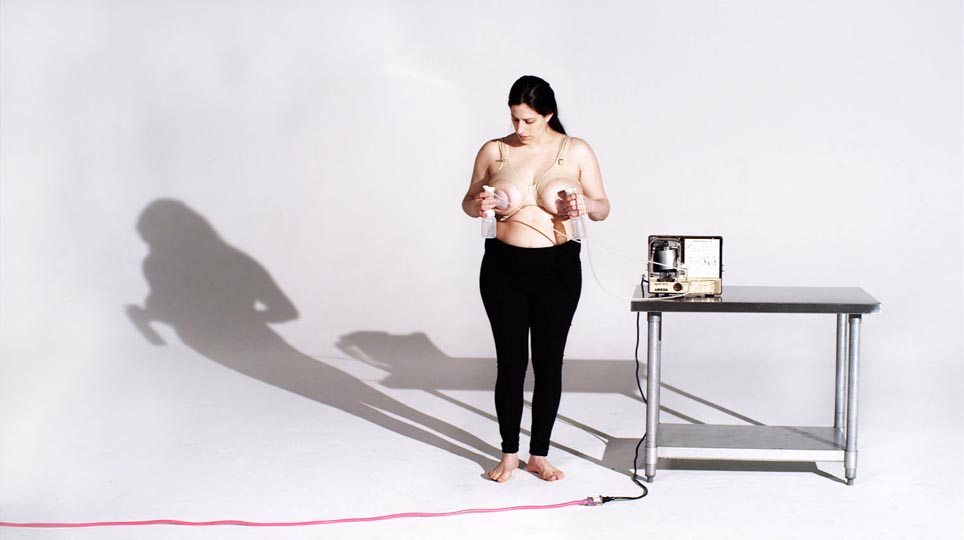
    As advertised by the A-frame sign out front, this was The Lady Cheese Shop. Part of an ongoing project for artist Miriam Simun, this work offered the participant exactly as advertised; three different cheeses made in part from the milk of three separate women. The main draw of the work was to the tasting display directly across from the entrance. There were three distinctly different cheese presentations composed by chef Sarah Hymanson. Each was accompanied by a card describing a brief bio of both the woman providing the milk and her similarly contributing animal of close geographical proximity. The backroom contained a video installation showing a woman in the process of obtaining milk with the help of a breast pump. This was followed by footage of the artist carefully combining and processing the ingredients to make the cheese product. Both scenes were shot on a stark, clinically clean white backdrop, which was dry almost to the point of snarkiness.

    Posed as an incestuous form of alternative food production, this work was centrally about the human science debate and stirring up the conversation pot. It presented a polarizing situation, which was posed as an awakening to the dangers of integrating technology into everything we do more than alluding to any better way forward. Ms. Simun seems to be asking for us to put on the brakes and have a look around before we send ourselves blindly hurtling toward a cyborg disaster world. The concept stood as an interesting sticking point and a literal call to dinner for a society so willingly immersed in experiencing technology. The cheese, if you were wondering, was delicious.


    “By using the urban surroundings as the exhibition space, this intervention becomes not only an immersive experience, but also a journey of discovery.”

    “By using the urban surroundings as the exhibition space, this intervention becomes not only an immersive experience, but also a journey of discovery.”


    New York Photo Festival

    Robert Holden’s new series, The Treehouse, will be exhibited during the New York Photo Festival 2011. An unprecedented photographic installation made of monumental prints displayed on buildings’ facades. Designed and sited as an urban intervention by VAMOS Architects, the work will appear in the complex and picturesque spaces of the festival’s DUMBO neighborhood. The images will be printed in very large scale thanks to the visionary wallpaper company Flavor Paper.

    The New York Photo Festival is proud to present the first individual exhibit in the United States by Paris- based photographer Robert Holden. The work exhibited throughout multiple public walls in the DUMBO neighborhood – where the NYPH is located – is Holden’s latest series The Treehouse. The Treehouse embodies an alternative way of life; “a way that can be possible”, in Holden ‘s words. These images reflect the artist’s belief in hope, friendship, the search for the other and the need to be one with the natural world.

    The locations and the individuals portrayed in the The Treehouse remain undisclosed as the artist wishes to present his body of work as a window open to an alternative world and not as a peephole on someone’s life. Robert Holden works on reality, which he reports through a style that mixes documentary photography and fictional narrative.

    The installation of extremely large prints wall-papered onto building walls creates the perfect contrast between the content of The Treehouse with its underlying values, and Dumbo’s urban fabric with its quintessential New York cityscape. Through this installation the author and his partners wish to elicit a provocative reflection on life choices.

    By using the urban surroundings as the exhibition space, this intervention becomes not only an immersive experience, but also a journey of discovery.

    Over the years Holden’s photographic work has developed into a confident subjective vision related to travel, synonymous with the belief that life is a voyage, as is each individual encounter. *

    Kristina Sretkova

    “Kristina Sretkova’s illuminated works stake a claim for the romantic impulse”

    “With the same intensity and burning passion, Kristina Sretkova’s illuminated works stake a claim for the romantic impulse in an impressive manner.”

    Kristina Sretkova, Ammos, 2011. Oil on canvas, 80 x 80 cm. Courtesy of the artist.


    Kristina Sretkova, Faithfulness, 2011. Oil on canvas, 100 x 100 cm. Courtesy of the artist.

    The ability to control fire was a dramatic change in the habits of early humans. An invention of epic proportions, fire allowed early humans to generate heat, light, make food, move to cooler climates, and the list goes on. Amidst a hyper virtual culture in the 21st century, fire continues to conjure up elemental and physical associations. In many ways, fire remains a signifier of ritual, fear, and passion. With the same intensity and burning passion, Kristina Sretkova’s illuminated works stake a claim for the romantic impulse in an impressive manner. Oil paint, in all its thick viscosity, is presented as a visual feast for the eyes. Sretkova piles it on thickly, with grand sweeping gestures that are both sensual and delicate. In the center of her new works one notices a refulgent, glowing light that grows with intensity as we approach the center. It is evidence of a rich interior world, drawing us into the subjectivity of the artist and simultaneously the canvas. It is an interior light that finds its antecedents in such artists like James Whistler and the contemporary artists like Natvar Bhavsar and Helmut Federle. This is fitting, as Sretkova has a multi-cultural background. Sretkova continues this legacy with her own exciting, new approaches.

    The first thing one notices about Kristina Sretkova’s new paintings is that they are largely nocturnes—nocturnes in the sense that they have a brooding, melancholy aspect. Yet her work is not without its fair share of sensuality and sweetness. The nocturne is a musical composition that is inspired by, or evocative of, the night. Historically, these compositions were coordinated with religious Offices and, since the Middle Ages, to divisions in the canonical hours of Vespers and Matins. Thus a contemporary literal interpretation of the word might be a devotion to the night, one of near spiritual significance. In later music history, nocturnes resurfaced as calm, often expressive and sometimes rather gloomy, as in the works of Chopin. The term Nocturne was later used by James Abbott McNeill Whistler in the title of a number of his paintings. Whistler’s famous painting Nocturne: Blue and Gold — Old Battersea Bridge (1872-77) has all of the trappings of late 19th century romanticism. As the West became increasingly industrialized, the landscape became a setting for expressive and deeply felt emotional states. If Whistler was concerned with the landscape as a site of emotional transference, Sretkova is concerned with how nature can mirror an inner landscape, a landscape of the heart. In her painting Illuminating Light (2011), a glowing blue orb emanates from the center and fades into the dark blue-black corners. Flecks of red underneath the blue seem to hint that Sretkova has begun to hone her technique, which has evolved into a highly refined, layered abstraction. At 5 by 4 feet, it grasps our visual field and our peripheral vision as we enter the picture plane. The artist’s early paintings referred to a landscape with an implied horizon, but Illuminating Light is entirely optical and frontal, imaging a head, oval, or sun-like shape. From our vantage point on earth we see the sun as varying shades of yellows and orange-reds. If we detached from our bodies and flew around in the atmosphere we would notice that as we got to close to the sun the colors would begin to change to yellows, indigos, and blues. In Sretkova’s effervescent, stunning abstraction we feel the heat and movement of all of these exploding “sunspots” bubbling forth towards the viewer. This work could just as well be a flower in bloom under the cover of darkness. I personally had the opportunity to visit the arid desert of Arizona and was enthralled to find a plant there called the Queen of The Night. It blooms once a year at night after the temperature reaches a certain level for their pollinators to come out. Named the Queen of The Night for its dramatic, white, waxy flowers, the plant is largely invisible throughout the rest of the year. Sretkova’s painting, like this desert flower, is composed of luminous, elegant white petals and stamen-like strokes.

    Kristina Sretkova, Illuminating Light, 2011. Oil on canvas, 160 x120 cm. Courtesy of the artist.

    Another enigmatic and moving work of Kristina Sretkova’s is entitled Mystical. This work presents itself as a window into another world. Using a palette similar to that of Illuminating Light, this painting is framed by a slightly off center hexagonal shape. It fades from a deep-blue black to a lighter phthalo blue center. As we move closer to the center, the painting winds us down a narrowing hole, yet resists becoming an entirely deep void. The hole is rather only implied with a shallow depth. Additionally, our perspective is slightly skewed each time we are sucked down the traverse. This beautiful and bending blue vortex is both romantic and existential. Sweeping, feathered paint marks invite us into the expanse, as we are lulled into a trance-like state of mediation. The flecks of white that glisten the pathway serve as arrows to the exit. The use of shapes to imply an inner world is fertile ground for Sretkova and she makes good use of it in this work. In like manner, the Swiss painter Helmut Federle has established himself as the great mentor of younger abstract painters. He too notes “Often my work was misunderstood in a formal sense. I’m absolutely no formalist. I am a deep spiritual searcher in the romantic tradition. Even the geometric work, you will be more correct to read it in a more romantic or spiritual way.” These words might easily as well apply to Sretkova’s work. Sretkova and Federle clearly share a kinship of form and thought.

    These exciting new approaches in abstraction posit Sretkova well at the fore of contemporary European painting. Attesting to the fact that her career is taking off are her recently won awards for the paintings My Heart at ARTWEEK in Berlin this past February and for the paintings Fairy Tale and Power at the Bulgarian Artweek in April. Sretkova’s success comes from many sources. She states:

    “I was very lucky with my parents who gave me love, trust, and the support to study at one of the best boarding schools in Germany: Schloss Torgelow and at the University of Applied Sciences in Cologne. I lived with my family in foreign countries and visited many cities and places around the world, meeting interesting people and cultures. Living and painting in Cologne and Berlin, two cities with a long history and special spirit, I believe gave me local inspiration, which affects the quality of my works. In Cologne I got the chance to know personally the great artist Sigmar Polke. He was very keen on humor and philosophy and liked music and singing. Once his gallerist asked, ‘what does one see in this abstract painting? His answer was, ‘I don’t know. Everybody sees something different, someone may sees his aunt, and another person may just see a bead or blotch.’”


    Sretkova’s success is also due to her bold, daring, emotive imagery. The romantic impulse has a long legacy stretching far back into the 19th century. Artists such as J.M.W. Turner and more contemporary artists like Natvar Bhavsar come to mind as corollaries for Sretkova. Natvar Bhavsar is a famous contemporary abstract Indian artist based in New York. Bhavsar says that he works in Rang. In Sanskrit, Rang has to do with physical color and the emotive engagement of one’s whole person. Using pure pigment and only his hands, he has created a vast oeuvre of luminous color field paintings. One can also feel the aura of Sretkova’s more recent paintings. Her latest work Faithfulness has a lovely, dreamy glow to it. It emanates a light from within and reflects light off the surface. The parapsychological and spiritual aura is a field of subtle, luminous radiation surrounding a person or object. To depict such an aura often connotes a person or thing of particular power or holiness: think Jan Van Eyck and Pisanello paintings in the 15th century. Some people maintain that all living things and all objects possess such an aura. Sretkova’s impressive painting, Ammos, seems infused with a kind of auratic presence. Yet this work is not an illustration of a holy person to be venerated; rather it points to itself as being a sacred form. Here she uses a more familiar scale and format: this work is a perfect square measuring just around 31 x 31. Utilizing a white shard, a shell-like shape to bisect the center of the canvas at a diagonal, this work is predominantly composed of pale blues, off whites, and occasional hints of color. Careening off the edges of this shell-like shape are brown umbers and cerulean blues that emphasize the centrality of the white form. To create this work Srtekova used sand from the beach in Cyprus. It is a work that provokes a feeling of profound transcendence. Sretkova paints regularly in Cyprus, where she has very good cooperation with the Kypriaki Gonia Gallery and likens her experiences and artistic imagery on that Island: “When strolling on the beach I felt as if I became one with the sun, sand, salty water, wind, calmness, yellow, green, blue, music, and simply light.” Like a seashell fragment washing ashore, this painting is in the process of revealing and concealing itself. Too, all of humanity is involved in this same quiet process of metamorphosis. The poet Stanley Kunitz described these changes in his poem “The Layers:”


    “Live in the layers,
    not on the litter.”
    Though I lack the art
    to decipher it,
    no doubt the next chapter
    in my book of transformations
    is already written.
    I am not done with my changes.”


    Mystical, Kristina Sretkova

    Kristina Sretkova, Mystical, 2011. Oil on canvas, 100 x 100 cm. Courtesy of the artist.

    The layers are a poetic and visual metaphor for life processes and our individual evolution. Between the phenomenal differences in our individual existences are the grand narratives of death and rebirth, loss and redemption, love and longing. Ammos captures that essence, that in-between-ness of things that is so difficult to articulate, yet universally felt. In her new, exceptional paintings, Sretkova captures that often inexplicable sense of transcendence. Their power lies in their ability to move us beyond the particulars and into the universal. They are both a mirror into which Sretkova seems to be looking and a gateway into which the viewer can enter. To view more of Kristina’s work please go online at www.kristina-sretkova.com


    Linda Ledet

    “these works pay homage to the immaterial presence of the spiritual realm”

    “Her new works espouse uninhibited freedom and joy in their creation. Glowing and sensuous, these works pay homage to the immaterial presence of the spiritual realm.”

    Linda Ledet, Gulf Coast Magic II, 2010. Oil on canvas, 24″ x 30. Courtesy of the artist.


    Linda Ledet, A Place for Us, 2010. Oil on linen, 48″ x 48. Courtesy of the artist.

    In most religions, Heaven is a realm, either physical or transcendental, in which people who have died continue to exist in an afterlife. Artists such as Dante have tried to depict and analyze its structure; others have attempted to capture the light that emanates from it, such as Monet. Coming down the historical pipeline, Linda Ledet offers a new voice to this transcendent realm. With rapturous and masterful brushwork her work ranges from the intensely colorful to the muted and quiet. Glancing through her portfolio, one notices how golden washes, crimson drips, and delicate marks create soft, creamy fields of lush pigment. Using nature as a springboard, her work creates a sense of interconnectedness between the physical and the spiritual. Collectively, her wild, contemporary works are vivid, expressionist paintings that communicate profound feelings of joy, love, hope, and compassion.

    Dante described Heaven as concentric rings with varying levels of significance. He remarks “round us bent a glowing girdle, living, conquering, that more than all it showed could sweetly sing, making itself a circling crown, and we its centre….down from Mid-Heaven, through all its splendors, came separate intense, a tiny orb of flame, that when it reached her, ringed her round complete, a crown of light, pulsating.” This sense of splendor and heavenly majesty is evident in works such as Gulf Coast Magic II. A sun-baked field of gold, ochre, and reds contain partially hidden small boats. Taking a cue from Claude Monet’s masterpiece Impression, Sunrise (1872), this work veers close to a total abstraction as the boats fade into obscurity. Initially, the bright colors of Impressionist canvases were shocking for eyes accustomed to the more sober colors of Academic painting. Monet was the central figure in the Impressionist movement that transformed French painting in the second half of the nineteenth century. With a vast oeuvre, he depicted the rich landscape and leisure activities of Paris and its inhabitants. Similarly, Ledet paints her natural surroundings and the immediacy of her everyday life. In the upper right hand corner of this work, the sun and its reflection burns with a dynamic light. Dripping in upward fashion are ochre and yellows, set against orangey-red stains. Speckled yellowish-white daubs create intense highlights. The impressive characteristic of Impressionist paintings is that visual reality loses its corporality and thus becomes only an appearance, an impression. Eventually, the process of perception becomes intertwined with the image created and is no longer an accurate representation of what is observed. In this work Ledet is using another medium altogether: light made visible. Ledet has an intense career developing. She studied under master painters including Wolf Kahn, Kevin MacPherson, Carolyn Anderson, John Cosby, Dan Gerhartz, Robert Johnson, Kim English, Tom Browning and Ken Backhaus. The legacy of plein air painting has given her an overwhelming appreciation for nature and likewise her creator. Ledet relates, “My life, spirit and art are intertwined. For me, art is all about connection – to God, myself, others and creation. Painting is much more a response to Divine Love and Grace rather than a mere rendition of a subject onto a canvas. The artwork begins to beat with its own heart.” This pulse that beats within her artwork is contagious. Works like A Place For Us creates a sense of ecstatic joy and heartfelt longing. Nestled into an orange-magenta shallow hillside rests a small purple, yellow, and black home. The field it overlooks disintegrates into stains and flutters of orange, yellow, and blue. These marks rest in the center of the canvas and criss-cross like a flock of birds. In complex patterns of separation, alignment, and cohesion flocks of birds remain tightly knit together. This work suggests a sense of quiet unity evidenced by the isolated house, amidst a raucous display of cacophony evidenced by the swirling brushstrokes surrounding it.

    Linda Ledet, Gulf Coast Magic I, 2010. Oil on Canvas, 24″ x 30. Courtesy of the artist.

    Perhaps her most significant work to date, Gulf Coast Magic I, is the synthesis of her varying impulses. This work was painted after the BP oil spill in the Gulf of Mexico and is dedicated to the beauty and wonder of the coast and spirit of the American people despite trying circumstances. In this glowing abstraction, a purple-blue band that narrows into drips horizontally bisects a yellow-orange sweeping expanse. It causes a powerful rupture in the picture plane, abstracting the work completely. Without a reference to a landscape or seascape, as in her other works, this painting becomes a formal balancing act of color, shape, and composition. With its passageways of varying hues it reads as peaks, valleys, or the edge of a coastline. Upon closer inspection, I noticed two opposing perspectives in this work. On the one hand, this work could very well be an aerial view of Gulf Coast Magic II. Yet, in this case we are floating above the earth’s surface as a sort of ascended being, peering down into the depths of material existence. Conversely, we could picture ourselves as ascended beings flying closer to the sun. As we arrive nearer, as an Icarus-like figure, we sense the heat and all consuming brightness of the sun, blocking out anything else, we are bathed in golden light. In either case, it is compelling.


    Linda Ledet’s work oscillates between landscape and abstract, creating a unique style of painting all her own. Her new works espouse uninhibited freedom and joy in their creation. Glowing and sensuous, these works pay homage to the immaterial presence of the spiritual realm.

    News | Exhibitions








