• Narcissus gazes at his own image in the water and adores it. In his reflection, the man sees both a god and a marble representation of that god. Both worshipper and idol, Narcissus remains forever kneeling at the side of the pool as a figure for our need to see ourselves in our objects of worship.

    Gabriel Cohen and Jolie Signorile. Idol #4, 2010. Found doll’s head, nylon, peacock neck feathers. Dimensions variable. Courtesy of Fredericks & Mae.


    IDOL

    Kate Meng Brassel

    Narcissus gazes at his own image in the water and adores it. In his reflection, the man sees both a god and a marble representation of that god. Both worshipper and idol, Narcissus remains forever kneeling at the side of the pool as a figure for our need to see ourselves in our objects of worship.

    Small figurines, female and fertile, irrevocably decontextualized. The so-called “Venus statues,” unearthed at sites from Europe to Oceania, have a prehistoric provenance that definitively blocks our access to these early artists’ intention. Intuitively, we feel that we know that these objects were created for worship. This very intuition—whether correct or not—is a crucial one. It recognizes our need to venerate something plastic and like ourselves; it recognizes our impulse to recreate ourselves in an enduring, non-mortal form. The idol provides a locus for the projection and exploration of our own attributes. We examine it, magnify it, leave and return to find it unchanged and unaffected, so unlike our own bodies.

    “And God said, Let us make man in our image, after our likeness… So God created man in his own image, in the image of God created he him.” (Genesis 1: 26-27) The Hebrews constructs a god who makes man in his own image to worship him, a construction that validates men’s own existence. Walking images of god multiply by the thousands to reflect and venerate their creator. Other idols are forbidden in this closed system of mirrors.

    American culture reiterates the worship of the self-image. This worship is reinvented through the intense importance of the individual in our society. The self-made individual, a man who has pulled himself up by his bootstraps has been our ideal since Lincoln emerged from his log cabin. The pioneer, the cowboy, the entrepreneur, the maverick ego that makes its mark without a map, Steve Jobs, Jay-Z: these have been the American ideals. The history of the American idol has been the increasing democratization of the capacity for individual exceptionalism in the popular imagination.

    David J. Merritt, Modern Idol, 2010. Unfired clay and bronze spray paint, 10 x 12 x 8 in. Courtesy of the artist/


    With the liberation of women into the public sphere, femininity, too, makes its self-made mark. The 1990s brought us the Divas, the Divine Women, who are significantly soloists singing their ballads, belting their interiority for mass audiences. The public responded by immediately recognizing its position in this worshipful configuration.

    The last ten years have been the decade of American Idol, a program with unprecedented viewership and pervasive resonance through television, music, and the cult of personality. American Idol capitalizes on three essential paradoxes: The performer strives to excel the mass, with the goal of being accepted by the mass and absorbed into mass culture. The audience watches the self-making of the exceptional individual while engaging in a homogenizing cultural phenomenon. The resultant Carrie Underwood myth purports to be a point of identification for viewers who never were farm girls and never will be pop stars. As Judge Simon has observed, “Fortunately or unfortunately, everyone is genuine, and they believe they can be the next American Idol.”

    An idol provides a self-resembling site for the projection of ideology. The artist accesses and reinvents systems of idolatry in ways that reveal the evolution and relevance of worship. At this moment, how does the artist in New York respond to the idea of the idol? In this informal investigation, two sometimes divergent, sometimes entwined currents emerge. We witness the impulse to secede from the mass-cultural idol industry: to both discover and construct a space that is epistemologically prior to our everyday, a space that is pre-language, pre-gender, pre-religion. We witness also the mastery and reinvention of contemporary idolatry: the harnessing of the force of mass iconography to show its own abstraction and parallel existence.

    Nick Paparone’s sculptures and video give us a structure and development for contemporary idolatry, in real time. Ian Warren’s performance pieces enact an abstraction of worship and masculinity; the artist both exposes and engages in the human instinct to be divine, from Babel to the U.S. of A. The structure and history of theater performance—since the origins of tragedy in ritual contexts—provides a locus for the rediscovery of communal worship in a post-religious culture. Lindsay Abromaitis-Smith’s performance of Epyllion integrated the audience, who responded both instinctively and formally to the ritual that was unfolding before them in dance, dirt, bread, chalk, and water. Puppets made from husks and clay materialized as objects of worship, focusing the audience-participants’ attention towards the elemental, supernatural, and pre-human. Sam Clagnaz shows us how to construct and also to become an idol enshrined in the stuff of our own experiences. Patricia Anne Mandel’s bronzes are loaded with the painful consequences of Hollywood-worship. David J. Merritt turns the idea of the bronze idol on its head, providing us with an ironic yet personal view of the mutability of our objects of worship. And, finally, Fredericks & Mae creates idols for your personal use that are ahistorically archaic and futuristic. You will imagine that you stumbled upon these transporting pieces in your alternate reality.


    The 6th Momentum Biennial.
    June 18 – Oct 2, 2011

    www.momentum.no/


    Art Santa Fe.

    New Mexico, July 7-10, 2011

    www.artsantafe.com

     Sol Lewitt


    Sol LeWitt: Structures, 1965–2006
    www.artforum.com/museums  

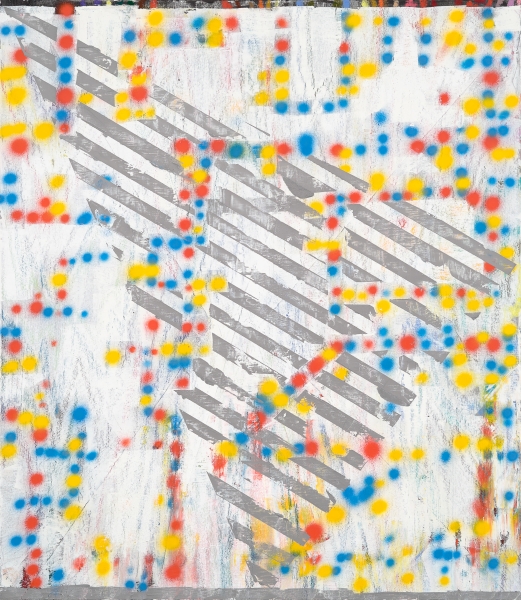
    “I think of each layer of paint as concealing– but only partially– an entire world behind it.”

    Keltie Ferris, Courtesy of Horton Gallery

    Keltie Ferris, Courtesy of Horton Gallery

    Jason Stopa: These are clearly mixed media pieces. But I’m curious; does the term ‘mixed media’ even mean anything anymore? How do you see them?

    Keltie Ferris: Actually, I don’ t ever use the term mixed media, because it’s just too vague for me. My paintings are a progression from gesso, to a colorful layer acrylic paint, to oil pastel, to oil paint. My work looks more multi-media because I use a variety of different tools, palette knife, a spray gun and brushes. To me each layer is really separate and succinct, and none of them completely cover the canvas, so you can always see the history of the painting’s making.

    JS: The term multimedia seems relevant for our time too. I feel as though some of these works seem to be exploding from within it’s as if you’ve created holes within the work….points of access. Can you talk about this?

    KF: Sure. I think of each layer of paint as concealing– but only partially– an entire world behind it. Each layer of paint is an insufficient mask or veil to an incredibly dynamic world of vectors and radiations. Often there is an entirely different color-world behind each layer. My paintings are very frontal and forceful, but you have the feeling that you never really entirely see all of them. They’re like most things in life — you can’t see everything all at once.

    JS: I like that. Werner Herzog once said, “no one can live in an entirely illuminated room.” Which is another way of saying that we can’t know or see everything from every angle, even ourselves. How do you arrive at color and scale in the work?

    KF: Since I’m 5’5″, The height of most of my larger works are 80″, which is the tallest work I can do without going up and down a stool or ladder for hours and hours. I’ve made many 80″ x 80″ square pieces, since the square has proven to be a fruitful problem for me. The smaller works, I’ve arrived at comfortable sizes, through trial and error, trying to find scales that match the tools and marks I make.

    JS: These seem to be as much about the surface as they are about the physicality of the image. Can you discuss this?

    KF: To me, painting is most exciting when it has some notion of touch and texture. It’s the human element of abstract work. But paintings that are just devoted to the touch of the artist— well it can lead to some sentimental places that I’m not interested in. By contrast spray paint is about a complete lack of touch. I’m painting with a machine on top of my more hand-made marks, creating the tension you’re alluding to.

    JS: I sense an affinity with outer space or the way that early video games portrayed vastness, is that a correct reading? Does your work have any relationship to digital images?

    KF: I’m clumsy with digital media, and was one of the last people I knew to get e-mail, to get a cell-phone, to join facebook, etc. On all accounts, I gave in, because there’s a deluge out there of digital images. I’m sure I’m very much affected by all sorts of them. Growing up, I didn’t have much access to early video games– no atari or nintendo in the house, and no quarters for the arcade. But I did want to play them. I was very interested in Astronomy as a kid and had a telescope and read Carl Sagan and Stephen Hawking, and I slept under the stars by Lake Ontario every summer. And yes, I was particularly interested in the vastness and emptiness of space more so then the stars themselves. The scale shifts are mind-boggling, to say the very least. These things seep into my paintings subconsciously, for sure, though they are far from the most pressing concerns when I am making them.

    Cory Arcangel (born 1978) is a digital artist, musician and performer based in Brooklyn. His work spans mediums such as video, photography, and sculpture, and concerns itself with the relationship between technology and culture, making use of media in many cases. Arcangel is best known for his video game hacks. His work has been featured in solo exhibitions at the Migros Museum in Zurich, the Barbican Center in London, and the Museum of Contemporary Art in Chicago.

    Anatole Ashraf

    Cory Arcangel: Pro Tools Review

    Anatole Ashraf

    Cory Arcangel, Various Self Playing Bowling Games (aka Beat the Champ), 2011. Hacked video game controllers, game consoles, cartridges, disks, and video, dimensions variable. Collection of the artist. Courtesy of Whitney Museum .

    Cory Arcangel (born 1978) is a digital artist, musician and performer based in Brooklyn. His work spans mediums such as video, photography, and sculpture, and concerns itself with the relationship between technology and culture, making use of media in many cases. Arcangel is best known for his video game hacks. His work has been featured in solo exhibitions at the Migros Museum in Zurich, the Barbican Center in London, and the Museum of Contemporary Art in Chicago.

    “Cory Arcangel: Pro Tools” is the artist’s current exhibition now on view through September 11 at the Whitney Museum of American Art, located at 945 Madison Ave at 75th St. The exhibition–named after the popular audio software–aims to emphasize “the combination of professional and amateur technologies as well as the vernaculars these technologies encourage within the culture at large.” The collection of new works spans various mediums, including video games, single channel video, kinetic sculpture, prints and pen plotter drawings. The viewer is invited to a barrage of information and a multitude of lights, sounds, colors and visuals, and as a result, there is something for almost every interest. Research in Motion (Kinetic Sculpture #4) (2011), for example, is a set of silver tables modified with custom electronics and locked in a dance of technology that makes the inanimate come alive. At the same time, Since U Been Gone (2011), a set of fourteen screenprints and metallic foil, and the video There’s Always One at Every Party (2010) compel fans of Kelly Clarkson and Seinfeld, respectively, to re-examine the cultural implications of these celebrities’ works. The main attraction, however, is Various Self Playing Bowling Games (aka Beat the Champ) (2011), a haunting statement on the nature of obsolescence. As each digital player throws an increasingly dramatic gutter ball from game system to game system, Arcangel reminds us of our own complicated relationship to technology. Eventually it starts to dawn on the viewer that the obsolescence being alluded to may also be humanity’s own.

    The Norton Museum of Art has announced a $1.5 million grant from The Leonard and Sophie Davis Fund/MLDauray Arts Initiative for a six-year project called RAW (Recognition of Art by Women). RAW’s mission is to discover, highlight, showcase, and promote living women artists, a group the grantors believe has been substantially underrepresented, and that the Museum wishes to champion.

    Jenny Saville, Atonement Studies (Panel 2), 2005-2006. Oil on paper, 252 x 185 cm.

    “RAW’s mission is to discover, highlight, showcase, and promote living women artists, a group the grantors believe has been substantially underrepresented, and that the Museum wishes to champion.”

    Jimmy Saville, Atonement Studies

    Jenny Saville, Atonement Studies (Panel 2), 2005-2006. Oil on paper, 252 x 185 cm.

    RAW: Recognition of Art by Women at the Norton Museum

    Norton Museum of Art

    The Norton Museum of Art has announced a $1.5 million grant from The Leonard and Sophie Davis Fund/MLDauray Arts Initiative for a six-year project called RAW (Recognition of Art by Women). RAW’s mission is to discover, highlight, showcase, and promote living women artists, a group the grantors believe has been substantially underrepresented, and that the Museum wishes to champion.

    With this grant, the Museum will organize six special exhibitions, one in each of the next six years (2011-2016). The inaugural exhibition will premier this fall and feature the rarely-exhibited paintings and drawings of British artist Jenny Saville. It is being organized by the Norton’s Curator of Contemporary Art, Cheryl Brutvan. The grant encompasses exhibition, publication, research, and education programming, and includes the funding of the first Sophie Davis Curatorial Fellow, which the museum is now recruiting, and will allow the Museum to expand its research and exhibition development.

    Museum Executive Director Hope Alswang said, “This grant not only represents an incredible opportunity for the Museum to continue a relationship with the Davis family — a family that has been an important part of its history and development over the past two decades — but it is also completely transformative to our contemporary collection. It gives us a dynamic new platform from which to engage our many audiences, and affords our curators the opportunity to speak and publish on important topics. In short, it allows the Museum to influence the way art is being discussed today.”

    Alan Davis, son of Leonard and Sophie Davis, who directs the fund, said, “My wife (Mary Lou Dauray) and I discussed opportunities to make a statement about the gender discrimination that still exists today, and the lack of representation of women artists in many museums. We came up with a program that made sense for both the Norton and for us.”

    The late Leonard and Sophie Davis were part-time New York City residents and among Palm Beach’s most prominent philanthropists. Sophie Davis also served on the Norton Museum’s board, and the couple’s contributions included $2.5 million toward the Museum’s expansion, and a gift of Chinese art.

    Garth Weiser, Casey Kaplan Gallery, May 6 – June 25

    Garth Weiser
     
    Garth Weiser
    Casey Kaplan
    525 West 21st Street
    May 6–June 25

    “Uncovering” LAB Gallery, NYC June 10-24

    “Uncovering” Lab Gallery
    A Performance Installation by
    LEIMAY: Ximena Garnica and Shige Moriya
    June 10-24, 2011
    Part 1: June 10,11,13,14,15,16 4-7:15pm
    Part 2: June 19,20,21,22,23,24 2-8pm

    The LAB (for installation + performance art) is pleased to present Uncovering, a performance installation by LEIMAY, led by the creative duo Ximena Garnica and Shige Moriya. Uncovering is an exploration into the paradox between fear and ambition; how it affects the individual and helps define society. This two part piece will take place over the course of a two week run on the corner of 47th and Lex.


    “Art is the reflection of the society where it develops.”


     Sergio Beraldi

    Courtesy of the artist.

    Sergio Beraldi

    www.sergioberaldi.com

    Walking with Art: Art is the reflection of the society where it develops. Artists’ reflect their feelings onto the canvas from the depths of their being and make society critically aware. Sender and receiver do not have to share the same message; it is enough if the piece of art has allowed the artist to express their reaction and the viewer to receive a message that thrills him. Forms, or not forms, smooth or full of material textures, low and limited palettes, or nuances of saturated colors are used to express a discourse on the canvas.

    News | Exhibitions