• unnamed

    Gallery Shchukin, New York, is pleased to present “Insight Out”, a new exhibition by Matthias Alfen. Matthias Alfen’s work often plays with the human understanding of time as space. The time of our life—is like the space of a path, each moment a step… the entire life: a journey. We use many of the same words to show position as both spacial and temporal.  In the time/space of our imaginations, the past is behind us; it is filled with memories; the present is a good spot to be in, and arena for choices, a vantage point to look back and foreward;  the future waits in front of us, a positive potential, an expanse of possibility. And yet, time is not like concrete space.  While  you may know a space, like your house or a soccer field, because you can move confidently through it, the only evidence we have of either past events or future potentials, are constructs in the now, our active perception of the present. Time is not space but imagination. And anything—like a sculpture or a painting—in our present experience that seems strange, distorted, unusual, or arresting is telling us something about our memories, our preconceptions, and our expectations.

    Opening reception of “Insight Out” solo show will be held on Thursday, March 10, from 6:30 – 8:30 PM.

    Address: 144 5th Avenue, 2nd floor
    New York, NY 10011

    unnamed

    David Musgrave, Stick figure (night), 2015, Titanium, 11 3/4 x 5 1/2 x 2 1/2 inches (30 x 14 x 7.5 cm), from an edition of 3 and 2 APs

    Park Avenue Armory
    643 Park Avenue, New York, NY
    March 2–6, 2016
    Gala Preview to benefit Henry Street Settlement Tuesday, March 1
    Luhring Augustine is pleased to present new work by David Musgrave at the 2016 ADAA Art Show. Musgrave’s practice, which encompasses drawing, sculpture, painting, writing and animation, mines the uncertainties of representation, expression and process. His solo presentation at The Art Show includes a drawing of a torn up sheet of paper ‘healed’ through the process of representation, and another of a figure evoked by a fragile conjunction of illusory paper scraps and tears; a small but virtually indestructible stick figure apparently lifting itself from the ground; a trompe l’oeil panel depicting a peeling layer of grey-green paint; and an enlarged replica of a wall-crawling toy octopus, rendered transparent and frozen in its descent. They elaborate Musgrave’s ongoing project to condense the mythical, the technical, the material and the conceptual into precariously unified forms. For more information about The Art Show, please visit the ADAA website.

    In addition, Musgrave will present an animation and live reading from his novel Unit at Printed Matter on Thursday, March 3, 6–8pm. The event is free and open to the public. Printed Matter is located at 231 Eleventh Avenue, New York, NY 10001. For more information about this event, please visit Printed Matter’s website.

    David Musgrave lives and works in London and has recently had solo exhibitions at greengrassi, London; Marc Foxx, Los Angeles; and Luhring Augustine, New York. His work has been featured in a number of exhibitions at institutions throughout Europe and the Americas including Kunstverein Freiburg; Tate Britain, London; CAPC musée d’art contemporain de Bordeaux; and Contemporary Art Museum St. Louis, MO.  Musgrave’s work is included in the collections of the Museum of Modern Art, New York; Metropolitan Museum of Art, New York; Hammer Museum, Los Angeles; Dallas Museum of Art; Rhode Island School of Design, Providence; and Tate, London.
    Bushwick Armory Week
    Glenn Ligon: We Need To Wake Up Cause That’s What Time It Is will be on view at Luhring Augustine Bushwick for extended hours: Tuesday – Sunday, 11am – 6pm and 11am – 9pm on Saturday, March 5 for Bushwick Late Night.

    Opening Reception Sat. March 5, 2016
    Cross Contemporary Art
    81 Partition St. Saugerties, New York 12477
    on view thru March 27, 2016

     “Trio: Augustus Goertz, Marianne van Lent and Brian Wood” is an exhibit of three artists’ abstract meditations of life and its many manifestations. From Brian Wood’s figural/vegetal forms to van Lent’s gestural landscapes and Goertz’ intense textural universes, there is an ambiguity of scale that slides from the cellular to the immense. Each artist contributes to a unique understanding of existence as an eternal shifting of energy from great to small, distant to intimate, fleeting and permanent. This seesawing back and forth in scale allows the viewer the distinct experience of multi-dimensional travel and the compression of simultaneous time. 

    “Trio: Augustus Goertz, Marianne van Lent and Brian Wood” is co-curated by Ford Crull and Jen Dragon. 

    About the Artists: 

    Augustus Goertz: 
       Augustus Goertz’s paintings involve a building of texture and pigment creating a hybrid sculptural surface.  This construction allows the nuances of changing light to participate in the experience of the artwork. The scale of his canvases shifts from aerial to terrestrial, from the vast sweep of a landscape to the miniaturization of a child’s toy. These paradoxical references give the viewer a distinct sensation of swinging from one reality to the next through an environment at once infinitely large and minute. More about the artist: http://bit.ly/ccagoertz

    Marianne van Lent:
    Marianne van Lent captures the transcendence between the spiritual and material worlds. There may be suggestions of scale in her paintings with the inclusion of landscape references or biomorphic elements however she bypasses that reality by allowing indeterminate and mystical elements to float through, as if they were thoughts in the mind’s eye, intimate psychological states or the elusive space between worlds. More about the artist: http://bit.ly/ccamvlent

    Brian Wood:
    The paintings and drawings of Brian Wood create a powerful experience of organic forms in ambiguous scale. Colorful, biological shapes create their own luminosity in the darkness of the canvas or carve a precise, figurative contour from the whiteness of paper. It is not clear if we are encountering massive planetary movements, minute atomic reactions or intimate bodily sensations, nor is it meant to be. Mr. Wood, a Guggenheim Fellow, is in the permanent collections of the Museum of Modern Art in New York, the Brooklyn Museum, and the Metropolitan Museum among many other distinguished public and private collections. More about the artist: http://bit.ly/ccawood

    About Cross Contemporary Art: Cross Contemporary Art is a gallery dedicated to showing mid-career and established artists who have a connection to New York City, Hudson Valley and Catskills region. Open Thurs through Mon 12-6, Tues and Wed by appointment or chance. 81 Partition st Saugerties, NY 12477 Phone Gallery Director Jen Dragon 845.399.9751 for more information.
    "Last Call" ©Augustus Goetz 1997 mixed media on board 12'"x12".

    “Last Call” ©Augustus Goetz 1997 mixed media on board 12′”x12″.

    "Neverland" ©Marianne van Lent oil on canvas

    “Neverland” ©Marianne van Lent oil on canva

     “Volute” © Brian Wood 2012 14 x 11 inches oil on wood

    “Volute” © Brian Wood 2012
    14 x 11 inches oil on wood


    unnamed
    Back in the Bronx featuring Jerome Charyn
    Saturday, March 5, 12:00pm to 1:30pm


    Join us during our Back in the Bronx series when author Jerome Charyn will read from his anthology Bitter Bronx, sharing personal anecdotes as well as signing copies of the book. Read more >

    Lunch by David Greco’s Arthur Avenue Caterers is included.

    Free admission for Bronx Museum members; $10 for non-members

    If you are a Bronx Museum member, or would like to become a member, please email membership@bronxmuseum.org to reserve your ticket.

    ———-

    About the author

    Jerome Charyn, master of lyrical farce and literary ventriloquism, published his first novel in 1964. He’s the author of Johnny One-Eye, The Secret Life of Emily Dickinson, I Am Abraham, and dozens of other acclaimed novels as well as nonfiction works. His short stories have appeared in The Atlantic, Paris Review, American Scholar, Epoch, Narrative and Ellery Queen.

    In Bitter Bronx: Thirteen Stories, Bronx-born Charyn brings to life the pre- and post-Robert Moses world of New York’s northernmost borough in thirteen bittersweet stories.

    Charyn lives in New York and Paris.

    Galleria Raffaella Cortese
    March 10, 2016 – May 11, 2016

    Galleria Raffaella Cortese is pleased to announce a second solo show of Cuban artist Ana Mendieta.

    Firmly anchored in reality – and at the same time tormented by an inner life deeply marked by tragic events – in only thirteen years of career Mendieta experimented with various media, from performance to video, from photography to drawing and sculpture.

    The artistic practice of Ana Mendieta always investigated the close relationship between Art and Nature that is very intense in her work and sometimes pushed to its limit, especially in the use of the artist’s own body. In many performances, in fact, the body becomes the means by which the artist blends with Nature, in a kind of spiritual and visceral ritual that assumes a symbolic value of rebirth. As the artist repeatedly declared, ‘culture is the memory of history’ and it is in this sense that the body is not just a witness, but also the vehicle of our collective memory.

    Awarded the Prix de Rome for sculpture, in 1983 Mendieta moved from New York to Rome, a city that had a special place in her heart due to its connection with History. During the residency at the American Academy in Rome, Mendieta had the chance to develop her sculptural technique, using materials such as soil and wood; furthermore she intensely dedicated herself to drawing.

    The exhibition focuses on the production of the Roman period, in particular on a corpus of selected ink, watercolour and pencil drawings that subsequently led to the creation of the sculptural works. The exhibition also features the book of lithographs Duetto Pietre Foglie, realized as well during her Roman residency, and a precious notebook from 1981 with some preparatory studies.


    Among the main solo exhibitions by Ana Mendieta (Havana, 1948-1985): Covered in Time and History, the films of Ana Mendieta, NSU Art Museum Fort Lauderdale; Katherine E. Nash Gallery, Minneapolis (2015-2016); She got Love, Castello di Rivoli, Turin (2013); Ana Mendieta: Earth Body, Sculpture and Performance 1972-1985, Whitney Museum of American Art, New York; Hirshhorn Museum and Sculpture Garden, Smithsonian Institution, Washington D.C.; Des Moines Art Center, Des Moines and Miami Art Museum, Miami (2004); Ana Mendieta (1948-1985) – Body Tracks, Neues Museum Luzern, Lucerne and Fries Museum, Leeuwarden (2002).

    Ana Mendieta | via a.stradella 1
    Galleria Raffaella Cortese
    20129, Milano – Italy
    www.galleriaraffaellacortese.com
    tue – sat 10-13 | 15-19.30


    Courtesy of Galleria Raffaella Cortese


    Untitled-1 copy

    Simply Exhibition and Events
    Exhibition: February 26, 2016 – March 26, 2016
    Public Artist Talk: March 4, 5:00 – 6:00 pm
    Public Reception: March 4, 6:00 – 9:00 pm

    Simply 2016 Photography Exhibition | With Juror David J. Carol at The Center for Fine Art Photography Runs Through March 26th, 2016 | Simply 2016 is an exhibition highlighting artists’ ability to capture the everyday in an extraordinary way. Artists from around the world are being showcased in this exhibition, juried by David J. Carol. This photography exhibition offers the chance to slow down and appreciate the beauty in simplicity. Artist Pamela Joye captured striking reflected light in a particularly atmospheric manner in Mirror Fountain. Her cheerful, energetic subjects continue with their lives unbeknownst of the beauty in the details of their play. Phillippa Stannard uses composition and perspective to bring the viewer into the shot. Others artists use heavy color saturation to stop the viewer in their tracks such as Andrew Miller’s piece, Park Fountain. Shaking the life into the commonplace, the artists have taken mundane visuals and elevated them to entice and inspire. Join us in exploring this spectacular expression of ordinary turned extraordinary in the Main Gallery until March 26th, 2016. Always free, public welcome.

    Featured Artists: Meredith Abenaim, Manuel Armenis, Mark Astrom, David Bennett, Steven Bollman, Melissa Breyer, Marie Bush, Michael Carlebach, Patrick Cobb, Gregory Costanzo, Sally Davies, Debra Davis, Emma Dobbs, Holly Donovan, Philip Drucker,  Dorothy Glenn, Marcia Glover, James Graves, Suzy Halpin, Matthew Johnson, Pamela Joye, Chip Kahn, Susan Keiser, John Kobeck, Robert Larson, Marcia Mahoney, Michael McAllister, Angie McMonigal, Andrew Miller, Shin Noguchi,  Jeff Phillips, Robert Renfrow, Eric Rennie, Lisa Rigazio, Debora Schwedhelm, Joseph Stanek, Phillipa Stannard, Michael Sullivan, Preston Utley, Sandra Chen Weinstein, Lauren Welles, Terry Wild, and Casie Zalud.

    + Exhibitions and Receptions at C4FAP are always free and open to the public.
    + Mingle with featured artists & art lovers at our reception on Friday,         March 4, 6 – 9 pm.
    + Please join us on our website at c4fap.org for updates and events.

    About C4FAP

    Since 2004, The Center for Fine Art Photography has been a preeminent supporter of photography. As a nonprofit, 501(c)(3) organization, C4FAP is supported globally with donations, grants, and memberships. Based in Fort Collins, CO, the Center for Fine Art Photography offers three public galleries with 20+ exhibitions yearly, classes, and online exhibitions that give photographers and photography enthusiasts from all over the world an opportunity to engage with the Center and it’s community. For more information about C4FAP, including information on workshops, membership, becoming a donor and exhibitions, please visit the website at c4fap.org.

    Gallery Location
    400 North College Ave.
    Fort Collins, CO 80524
    Online at C4FAP.ORG

    I felt very excited when I heard that the Musée d’art contemporain de Montréal was planning a retrospective of David Altmejd’s work in the summer of 2015. I couldn’t wait to see it. Altmejd is an international artist whose work has been included in important Biennials (Istanbul, 2003; Whitney, 2004; Venice, 2007 where he represented Canada) and large exhibitions in New York, Paris, Montreal, and in Humlebæk (Denmark, 2016)) among others. He was born in Montreal in 1974 and, like many other successful artists, he moved to New York, where now he lives and works.
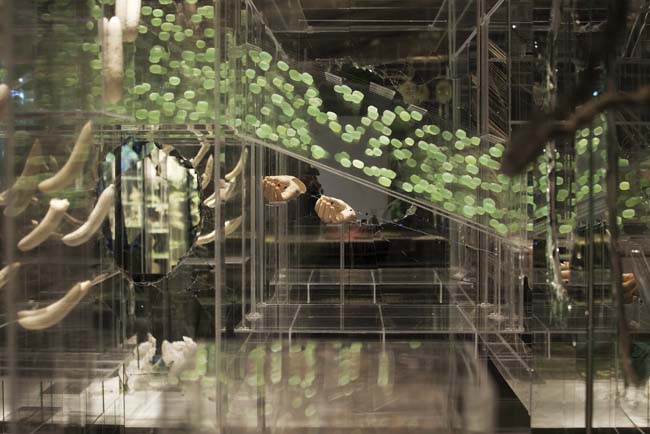
    David Altmejd, The Flux and The Puddle, 2014, detail Photo,Poul Buchard Brondum and Co. Courtesy of Louisiana Museum of Modern Art,Denmark (2). The Flux and the Puddle, 2014  Plexiglas, quartz, polystyrene, expandable foam, epoxy clay, epoxy gel, resin, synthetic hair, clothing, leather shoes, thread, mirror, plaster, acrylic paint, latex paint, metal wire, glass eyes, sequin, ceramic, synthetic flowers, synthetic branches, glue, gold, feathers, steel, coconuts, aqua resin, burlap, lighting system including fluorescent lights, Sharpie ink, wood, coffee grounds, polyurethane foam  129 H x 252 W x 281 D inches, 327.7 x 640.1 x 713.7cm.

    David Altmejd, The Flux and The Puddle, 2014, detail Photo, Poul Buchard Brondum and Co. Courtesy of Louisiana Museum of Modern Art,Denmark (2). The Flux and the Puddle, 2014 Plexiglas, quartz, polystyrene, expandable foam, epoxy clay, epoxy gel, resin, synthetic hair, clothing, leather shoes, thread, mirror, plaster, acrylic paint, latex paint, metal wire, glass eyes, sequin, ceramic, synthetic flowers, synthetic branches, glue, gold, feathers, steel, coconuts, aqua resin, burlap, lighting system including fluorescent lights, Sharpie ink, wood, coffee grounds, polyurethane foam 129 H x 252 W x 281 D inches, 327.7 x 640.1 x 713.7cm.

    The Montreal exhibition fulfilled expectations as it displayed several important works from Altmejd’s career so viewers could get an overall picture of his oeuvre. The piece that opened the show was the portrait of his sister Sarah Altmejd. As he has said, this work is tremendously important in his oeuvre, since  he wanted it to be the best sculpture ever, a very powerful, intense work. He shocked viewers with this sculptural approach as instead of Sarah’s face, there is a black hole, framed by crystals and jewels, but Altmejd explained that he sees the hole as a metaphor for nothingness, a representation of the universe before the Big Bang. This is a nothingness that hides everything in its darkness.
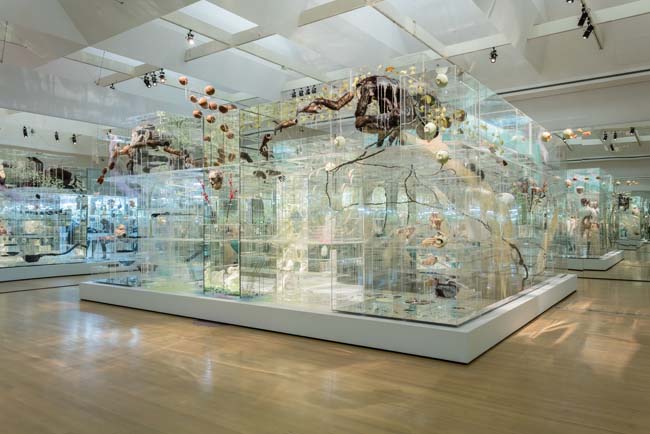
    David Altmejd, The Flux and The Puddle, 2014, view, Photo, Richard Max Tremblay, 2015, Courtesy of  of Musée d’art contemporain de Montréal

    David Altmejd, The Flux and The Puddle, 2014, view, Photo, Richard Max Tremblay, 2015, Courtesy of of Musée d’art contemporain de Montréal

    Altmejd’s sculpture The Werewolf immediately caught the attention of critics. They tried to label him as gothic, or as someone interested in the supernatural – but the artist disagreed with those terms. He doesn’t like speculations of possible narratives of his work either – yet he invented a powerful tale about how his werewolf came into existence. “If a man transforms into a werewolf, it constitutes the most intense transformation experience that one can have on both a physical and a mental plane. In a matter of seconds, one goes from one state of mental and physical identity to a totally opposite one. Right after the transformation is over the monster’s head would be chopped off and placed on the table. The head would be so filled with energy that it would be crystallized immediately, instead of rotting.”1 This is a very painful transformation and both beings pay with their lives for this double identity since the decapitated head is both man and wolf. The werewolf heads are often ornamented with chains, jewels and beads, making them very decorative but still threatening, with their open mouths showing canine teeth. This grotesque, cruel beauty that others might see as horrible, seems to excite Altmejd.

    Le spectre at la main (2012), a very seductive piece, is also a transformation of an animal but less dramatic. In a large Plexiglas container a zebra runs, really fast, so we see the movement similar to the way photographs try to capture a racehorse’s motion but all that shows is a blurry outline of the animal and speed lines in the air. In this work the miracle happens in front of our eyes, as we almost see this beautiful animal dissolving into the air. Its elongated body is going through a physical change, creating a tension and energy that kicks the surrounding coconuts into floating. The whole body becomes a vision of movement as the zebra is shimmering and almost disappearing. However, by some magic, it remains recognizable. This piece, like most of Altmejd’s work, is realistic and abstract at the same time. It is also playful as the intricate vision of the movement and the beautiful pattern of the zebra amuse us.
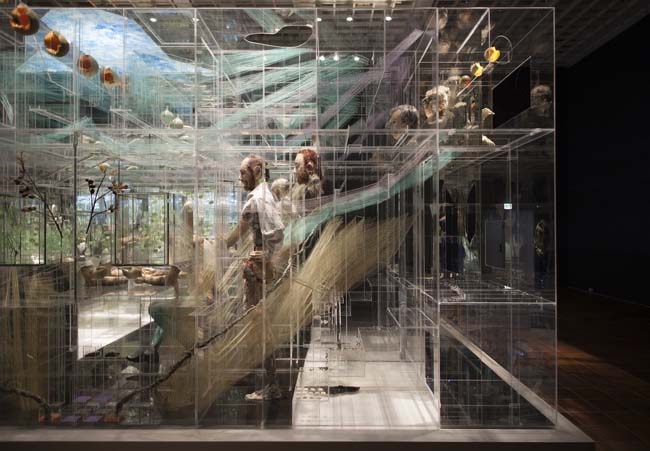
    David Altmejd, The Flux and The Puddle, 2014, Photo,Poul Buchard Brondum and Co. Courtesy of Louisiana Museum of Modern Art,Denmark (4)

    David Altmejd, The Flux and The Puddle, 2014, Photo,Poul Buchard Brondum and Co. Courtesy of Louisiana Museum of Modern Art,Denmark (4)

    I let out a loud ‘Wow’ when I first saw The Flux and the Puddle (2012). It reminds me of a museum of curiosities showing a temporary exhibition on nightmares. The large, room-sized Plexiglas container is filled with hundreds and hundreds of objects that seem to be floating in midair. It challenges the viewer’s patience but it is also entrancing with its many small, vivid details. It is overwhelming and mesmerizing.

    Even being familiar with Altmejd’s work, this is something different, something more – a very ambitious project just by its size. The Flux and the Puddle is the sum of everything Altmejd has done until now, a synthesis of the artist’s last 15 years, involving the most important elements of his oeuvre in one monumental artwork. Altmejd creates his own universe inside the box, from inside the box. He used it as a studio, literally moving into it and building his objects in it, creating a unique environment and ecosystem where everything is connected. As he said, “For me every object is an element and the whole thing is one sculpture.” 2

    The process of making the piece and the energy put into its creation is as important to Altmejd as the final product. “I really understand myself as a process artist.” he has explained, “I like it when the piece suddenly starts to make choices itself.”3  He considers himself an initiator, a collaborator, perhaps, who carries out the decisions his art dictates – and loves it when it surprises him. “I seek to inject energy and create tensions in a work because in my mind, tensions create energy….I am much more interested in the objects being alive and … able to develop its own intelligence and generate its [own] meaning.”4 Through this method this piece becomes an independent entity with its own life force, meaning and intelligence – no longer controlled by the artist.
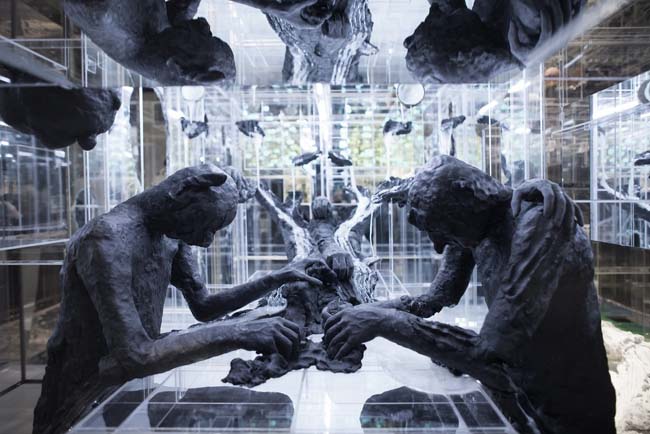
    David Altmejd, The Flux and The Puddle, 2014, detail, Photo,Poul Buchard Brondum and Co. Courtesy of Louisiana Museum of Modern Art,Denmark

    David Altmejd, The Flux and The Puddle, 2014, detail, Photo,Poul Buchard Brondum and Co. Courtesy of Louisiana Museum of Modern Art,Denmark

    The Flux and the Puddle fills an entire room and the walls of the room are covered with mirrors. It is hard to know what is real and what is only a reflection, since everything duplicates – creating a labyrinth that’s confusing but also amazing. Altmejd, in the video accompanying his exhibition at the Louisiana Museum of Modern Art, mentioned that, as always, he started this piece at a microscopic level, accumulating details until the small parts combined in order to build complexity. Everything builds from the inside out, creating itself and its own history. Making the sculpture also means experimenting since he never plans or knows what it will look like when finished. For example, he makes an object, places it, puts threads through it and start moving, fixing the threads with Plexiglas pieces here and there and at a certain point an idea will present itself for another object and another direction. All the ideas germinate from the inside.

    Nature is an important element in Altmejd’s work. All plants come from seeds, represented by gems here, blue seeds coming from blue flowers that are also jewels. The diva’s dress is made of the same blue stones. Branches grow and reach out, produce fruit, and then juices pour from the fruit, like dripping pineapple slices. They are tempting with their sweetness that also refreshes and regenerates the body. The werewolf’s arms break and multiply as they reach out to the point where he is able to grab the grapes and he eats them, crouching over them happily. All the juices find their way to the puddle.

    Altmejd explained that The Flux and the Puddle is like a human body, built around a heart, and the heart is the werewolf’s decapitated head. Everything is connected to it by thousands of threads that the artist coloured himself, creating a special nervous system so energy can circulate. In this way the life force of the werewolf travels through the threads connecting hybrid bodies and other objects. There are holes on the walls of the container, giving the illusion that it is actually breathing, connecting the inside with the outside. It is an artificial world that seems organic with organic pieces that mimic the artificial. On one side melons are bursting out of the container, ears appearing on some of them, hinting of conversion into a head.  Their hair is transplanted from the werewolf’s head.  Everything is fragmented, the objects are constantly broken, rebuilt so they become more solid, then broken and reconstructed again. Two large crudely shaped humanoid figures with cat-like heads and long tails are making heads while remaking themselves as well. Their hands are multiplied. There are so many of them, copying the artist’s hands, very sensitive, beautiful hands. They are similar to the hands seen in Altmejd’s The Architect, Watchers and Bodybuilders where they rebuild themselves by grabbing flesh from one part of their own bodies in order to build another part. Nothing is final here. Everything is in a constant state of transformation. Life size humans with bloody organs or crystals in their open chests wearing white coats bring laboratories into the space; a hint at biological experimenting that can produce genetically modified beings. Animals and humans are no longer separate in this piece but lovingly united creating a mythology that is old and futuristic at the same time. We live in an age when this kind of new reality, however surprising, is no longer shocking but almost expected. Heads – maybe the artist’s – appear in a few spots, seemingly thinking, looking amazed or unsure of this bizarre world he’s brought into existence.

    Altmejd said that with The Flux and the Puddle he wanted to create “some big drama about wars and sex” and describes his intentions for this piece as “operatic” in scope. He was also obsessed with infinity and exploring the possibilities of infinite multiplication and details. He wanted the objects to have the potential for transformation — to evolve and grow. The brilliance of this piece is how Altmejd incorporated all the elements and connected them in an open-ended structure that is gruesome and charming, repulsive and seductive, all at the same time.

    David Altmejd’s Universe
    Louisiana One Work: The Flux and the Puddle
    November 12, 2015 – January 31, 2016
    Louisiana Museum of Modern Art, Humlebæk, Denmark
    Musée d’art contemporain de Montréal, FLUX
    June 20 – September 13, 2015


    Footnotes:

    1 Quoted in Christopher Glazek: “Taking Control of the Nightmare: David Altmejd’s Dream Work,” David Altmejd, Bologna: Damiani, 2014: 106
    2 Robert Enright: “Learning from Objects: An Interview with David Altmejd,” Border Crossings vol. 23, no. 4 (November 2004): 24
    3 Robert Enright: “Learning from Objects: An Interview with David Altmejd,” Border Crossings vol. 23, no. 4 (November 2004): 72
    4 Michael Amy, Sculpture as a Living Organism: A Conversation with David Altmejd, Sculpture vol. 26, no.10 (December 2007): 25

    – Emese Krunak-Hajagos for NY Arts

    Review by Paul Black

    Acclaimed NY artist Michael Joo is currently presenting the largest solo show in London to date. Radiohalo; is a major solo exhibition of new works by the conceptual artist at Blain|Southern London, presenting works across a variety of media and substances incorporating themes of energy, nature, and technology, creating a complex and rich body of work exploring identity and the body, often by its absence or processes.

    Radiohalo Installation view detail, Blain|Southern, London. Photo: P A Black © 2016.

    Radiohalo Installation view detail, Blain|Southern, London. Photo: P A Black © 2016.

    Here Joo presents his new series of ‘caloric paintings’, and in doing so forms a conceptual dialectic with his earlier works, such as The Saltiness of Greatness (1992), in which the artist meticulously calculated the amount of energy that historical figures consumed during a lifetime. With this new body of work Joo gauges the number of calories individuals would expend performing various actions. Juxtaposing form, substance, and action to create his version of painting, in a way that only Michael Joo can.

    The artist combines the principles of painting, photography, print-making and sculpture, ‘seeding’ canvases with silver nitrate solution, creating works that are temporal in nature as the silver nitrate transforms over time, with caloric values being transferred to the canvases. The artist’s recurring methodologies investigate the meaning and value of the body and identity, and the viewer’s perception of the material used. Joo also adds a performative element to the works, the canvases serve as the result of an action mirroring the concern with caloric usage by the body in performing a process.

    The artist has a non-linear approach to his practice, juxtaposing aspects of science with art to create works that are often a documentation of a process. Joo’s work continues to evolve in a way that includes his physical presence in much the same way as the shamanistic German artist Joseph Beuys. Beuys’ sculptures were in fact the artefacts of an action performed by the artist. In this sense the works defy a traditional category. Joo’s current works are simultaneously signifiers of a concept and the very artefacts of an action predicated by that concept.

    Prologue (Montclair Danby Vein Cut) (2014-2015), Blain|Southern, London. Photo: P A Black © 2016.

    Prologue (Montclair Danby Vein Cut) (2014-2015), Blain|Southern, London. Photo: P A Black © 2016.

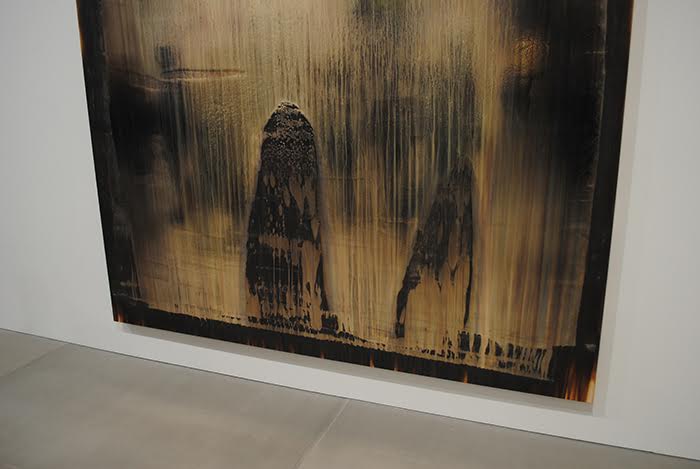
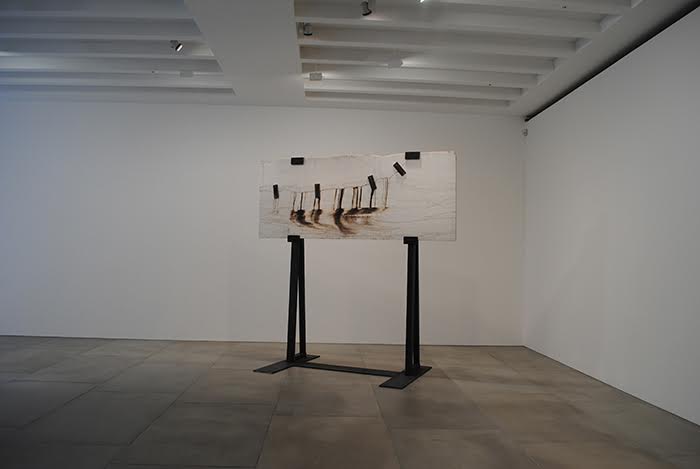
    Prologue (Montclair Danby Vein Cut) (2014-2015), is the largest sculptural work in the exhibition. The work continues joo’s fascination with Cameron’s Line, a tectonic boundary in the US defined by a subterranean belt of marble. The sculpture stands at 3 metres, consisting of a broken slab of marble elevated in a steel frame much like a billboard, and clamped back together, and treated with silver nitrate on one side. The piece is a signifier of the process of geological time as opposed to the fragile viewer who might stand beneath it, while the temporal journey of the material is reflected in the strata of the marble.

    Joo’s works emulate a closed system within a system, operating metaphysically and alchemically, speaking of temporality and the nature of human agency, explored through the artist’s series of endangered crane’s legs, performative sculptures created from graphite, with which Joo marked the walls of the lower gallery at Blain|Southern. The act and resulting forms suggest the fleeting physical existence of the endangered bird, again the temporal and performative are present in the work – the temporary body, the graphite suggesting the carbon of carbon-based life – and the influence of human beings’ socially constructed boundaries.

    The artist’s latest series of works feel like a departure for the artist, heading ever-more into the relationship between the performative and the artefact. Joo transforms the nature of the canvas blurring definitions, and confounding traditional expectations. The artist’s sophisticated practice continues to operate metaphysically, alchemically, poetically, and conceptually (not to mention, synthetically and politically), exploring the boundaries between human identity and given form and potential meaning via process time and action. Joo’s work remains a fascinating journey for the viewer.

    Paul Black. Photos courtesy of P A Black.
    Michael Joo: Radiohalo – Blain|Southern, London – until 9 April 2016.

    – Paul Black for NY Arts

    The Devil in the Details: Kenneth Anger, the Inventor of a Celluloid Avant-Garde, Nears 90

    Source: © 2016 ARTnews
    By

    With his films moving from fringe theaters to MoMA, the director grants a rare interview at his old Hollywood haunts

    Last December, my car left the apartment complex on North Hayworth Avenue where, in 1940, F. Scott Fitzgerald suffered a heart attack and died. My driver took me up past Sunset Boulevard to Hollywood Boulevard, heading east, traversing the same road that, when it was just dirt, hosted horseback races between Douglas Fairbanks and Charlie Chaplin. The loser would pick up the tab at the Musso & Frank Grill, where I was headed. When I arrived, I asked the man at the front desk about a reservation for Kenneth Anger and his face went white.

    Anger walked in 20 minutes later, and the waiters swiveled to see him—the whole room did. He was scowling, eyes glaring, and wearing a track jacket emblazoned on the back with the word “LUCIFER.” A host led him to a booth. Musso & Frank is the oldest restaurant in Hollywood, but only a few years older than Anger, America’s first avant-garde filmmaker.“I went to Beverly Hills High School, and there used to be a red car, a streetcar—it doesn’t exist anymore—but I used to take that from Beverly Hills to Hollywood, and come to Musso & Frank,” Anger told me.Anger is 88. He ordered a glass of red wine. The darkly handsome, mischievous face of his youth—Brando with a touch of evil—was still there, buried under slackened skin. He spoke slowly at the start, then sped up. He would look right at me, then look down at the table, in the direction of my phone, which was recording us. He kept caressing the cracks on the phone’s broken screen.“So,” he said. “I’ve been coming here since I was a teenager.”Slouching in the red vinyl booth, he looked around the restaurant, and talked about his childhood.“My grandmother took me to see Al Jolson in The Singing Fool,” Anger went on. “Mostly it was silent with titles, then, suddenly, Al Jolson comes on and says, ‘You ain’t heard nothin’ yet!’ And this electrified the audience at the time.”I asked him what he felt when he saw The Singing Fool.“I wanted to be an individual artist making film,” Anger said.


    Read more


    Art Dubai 2016

    Art Dubai 2016

    Art Dubai is the leading inter­national art fair in the Middle East, Africa and South Asia. The tenth edition of the fair takes place March 16-19, 2016 in Dubai, United Arab Emirates.


    Art Dubai is held under the Patronage of HH Sheikh Mohammed bin Rashid Al Maktoum, Vice-President and Prime Minister of the UAE, Ruler of Dubai

    Art Dubai Ladies Preview is held under the patronage of HH Sheikha Manal bint Mohammed bin Rashid Al Maktoum, President of Dubai Women Establishment, Wife of HH Sheikh Mansour bin Zayed Al Nahyan, Deputy Prime Minister and Minister of Presidential Affairs UAE

    Taking place each year in March, Art Dubai presents a select yet diverse line-up of around 90 galleries from the UAE and around the world, across three programmes: Contemporary; Modern, devoted to masters from the Middle East, Africa and South Asia; and Marker, a curated section of artspaces that focuses each year on a particular theme or geography.

    Alongside the gallery halls, Art Dubai’s extensive not-for-profit programme includes a dynamic roster of commissioned projects, film and radio programmes; artists’ and curators’ residencies; educational initiatives for children through to professionals, including the year-round art school Campus Art Dubai; an annual exhibition of works by winners of The Abraaj Group Art Prize; and the critically-acclaimed Global Art Forum.

    Over the last nine years, Art Dubai has become a cornerstone of the region’s fast-growing contemporary arts community. Recognised as one of the most globalised meeting points in the art world today, Art Dubai places an emphasis on maintaining its intimate, human scale while foregrounding quality and diversity.

    Art Dubai is held in partnership with The Abraaj Group and is sponsored by Julius Baer and Piaget. Madinat Jumeirah is home to the event. The Dubai Culture and Arts Authority is a strategic partner of Art Dubai and, along with Dubai Design District (d3), supports the fair’s year-round education programme.

    Learn more

    News | Exhibitions