• Image courtesy of the artist.

    Image courtesy of the artist.

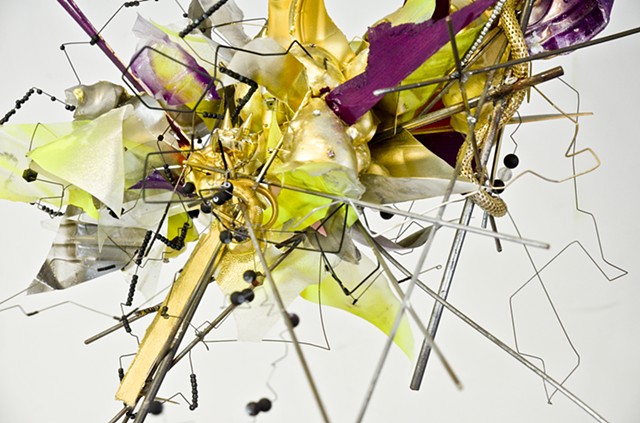
    In an age of rapidly growing technology, war, and natural disasters our environment has begun to change before our eyes. I am interested in the sublime moment when things start to fall apart and structure and chaos dance. Influenced by the relationship between sound and abstraction, the sounds of explosions, natural disasters, and car crashes are used as a starting point for the work.

    My work incorporates synthetic materials as a symbol of American culture and my childhood in Las Vegas. As a child I became fascinated with casinos and the absurd worlds they create. I am obsessed with the paradox of beauty and the grotesqueness that casinos construct. I use a combination of materials such as fashion magazines, enamel, glass beads, crushed crystals, shredded tires, sand, mica, glitter and spray paint to create vividly colored worlds that are falling apart through their own facade.

    I am inspired by fractals, systems, and other chaotic systems. Looking at the structure within chaos influenced the way the collages were made. Inspired by systems, networks, and hybrid forms, my collages have been a continued exploration into the relationship between abstraction and the virtual age.

    www.nataliecollettewood.com


    “Recently, he was awarded a residency fellowship at Sculpture Space in Utica, New York.”


    Courtesy of the artist.

    Michael Clyde Johnson
    www.michaelclydejohnson.com

    Michael Clyde Johnson (b. 1981, western Nebraska) currently lives and works in Brooklyn, New York. In 2009, he received his MFA from Hunter College, New York. His work has been exhibited widely, at venues including Socrates Sculpture Park, the Bronx Museum of the Arts, and the Newhouse Center for Contemporary Art, all in New York City. He has also had a two-person exhibition at the CAS Arts Center in Livingston Manor, New York. In 2010, he participated in the Artist in the Marketplace program at the Bronx Museum and was shortlisted for the Public Art Fund’s In the Public Realm competition. Recently, he was awarded a residency fellowship at Sculpture Space in Utica, New York.

    “My earliest exhibitions were based on poetry by A.S. Pushkin and F. Pessoa.”

    Courtesy of the artist.

    Marja Blomster
    www.blomster.fi

    I studied at Free Art School in Helsinki (1981-1984). My art consists of experimental forms of art such as installation and conceptual art; I create these by drawing, painting and photography. My earliest exhibitions were based on poetry by A.S. Pushkin and F. Pessoa. The themes of my recent exhibitions have been “DNA” (1999), “Pain” (2002), “Nature–no nature” (2005) and “Great Urban Expectations” (2009). I have participated in many group exhibitions in Finland and abroad. My artworks are in the collections of several museums as well as in private collections.

    Courtesy of the artist.

    Marc Pietri
    www.marc-pietri.com

    Starting from a drawing made with Word Art, it was one of my first attempts to modify the original drawing and the colors.


    “The garden is not intended to reflect a real space; the perspective is deliberately flattened and the color, which is vibrant and richly patterned, reflects a dream-like quality.”


    Courtesy of the artist.

    Jean Hall
    www.jeanhallpainting.wordpress.com

    This is a depiction of a fantasy garden. The garden is not intended to reflect a real space; the perspective is deliberately flattened and the color, which is vibrant and richly patterned, reflects a dream-like quality. The figures are suspended in a meditative state within this environment – the intention is to create a calm and restful sensation despite the lively color. Drawing on the traditions of Japanese prints, the composition is simplified – negating real space – and creating a cohesive design at once restful and visually arresting.


    “Beauty, I never try to play with it. I respect it infinitely, and I always try to let nature speak for itself.”


    Courtesy of the artist.


    Courtesy of the artist.

    Jacqueline Politis-Jobin
    www.jpolitis-jobin.com


    The produce of nature: they are to be respected; one must bow with humility to their beauty. In my eyes, the simplest onion is a jewel.

    The artist has the upper hand here, because all they need to do is position one’s work in the eye of the spectator. He or she will notice the beauty of a fruit that wouldn’t warrant a second glance in real life. But, if truth be told, we can never hope to match natural beauty.

    Beauty, I never try to play with it. I respect it infinitely, and I always try to let nature speak for itself.


    Courtesy of the artist.


    “If I do not enjoy the whole process, painting has no sense for me.”


    Courtesy of the artist.

    Ivy Coradini

    www.ivycoradini.com.ar

    I´ve been painting for years mainly for my own personal enjoyment. Years ago I started selling my pictures because some people insisted on that, not because I wanted to do it…

    I miss my pictures when they are not with me anymore. I´ve never taken any kind of art courses and to be honest I feel that I can´t be a true artist without attending Art School. Anyway, I know I won´t do it and -as many other autodidacts do- I¨ll keep self-teaching and spending time in libraries. If I do not enjoy the whole process, painting has no sense for me. I live and work in Buenos Aires, Argentina.


    “Black and white contrasts were produced using matrices and using a traditional painting brush.”

    Courtesy of the artist.

    Goran Grofelnik
    www.goran-grofelnik.com

    The works “Spirals, Rollers, Pegs” (# 0007) and “Space Rip” (# 0013) were made using a combined technique: acrylic and spray on canvas. They were created simultaneously in the year 2004, and are of same dimensions.

    The basic idea in both works was the same: to paint with shadows, and by this means, to achieve a simple visual communication with the viewer.

    Black and white contrasts were produced using matrices and using a traditional painting brush. By this means, I want to provoke the viewer’s curiosity, and that layering my work induces an associative analytical contemplation.

    Each artwork has an immediately inspired title.

    Maria Walker: Would you describe your studio space for us?

    Cordy Ryman: My studio is in Sunset Park, Brooklyn. It’s a huge, one-story garage building with a few dividing walls, 16-foot ceilings, no natural light, good artificial lighting. I’ve been there about five years. My block is all industrial and commercial. I’m flanked by a Polish-Russian shoe factory and a commercial bakery. I’ve divided my space into two parts: one part is messy, for working; the other part I try to keep cleaner so I can see things and show works.

    “The works evolve like a spiral with branches moving outward … going forward but constantly looping back to revisit things.”

    Cordy Ryman, (Front) Coil, 2008. Acrylic, enamel, and metal on wood,48 x 48 x 4 in. Courtesy of the artist.

    In Conversation: Maria Walker Interviews Cordy Ryman

    Maria Walker: Would you describe your studio space for us?

    Cordy Ryman: My studio is in Sunset Park, Brooklyn. It’s a huge, one-story garage building with a few dividing walls, 16-foot ceilings, no natural light, good artificial lighting. I’ve been there about five years. My block is all industrial and commercial. I’m flanked by a Polish-Russian shoe factory and a commercial bakery. I’ve divided my space into two parts: one part is messy, for working; the other part I try to keep cleaner so I can see things and show works.

    I almost always work on multiple things at once in multiple modes. One piece often leads to another, then a third might start that is totally different, almost like an antidote to the other two. Eventually, I have four or five pieces going, all at various stages, and I bounce between them based on whichever grabs my interest that day.

    MW: In the photo of your workspace, there is an explosion of materials on the floor, which become contained or arranged within the artworks on the walls. Can you speak to the sense of ordering in your work? Are there rules or systems that you follow?

    CR: Sometime there are general parameters that I follow, but the rules are loose. Probably 80% of the time I’ll change or break them part way through, but a sense of order and structure remains. Other times I’ll start more intuitively and see what happens. Then I might go back and apply some containing structure or riff on what happened previously.

    I also work with multiple themes. I get seduced by certain colors, shapes, or materials, which will crop up repeatedly in my work for a period of time. Then I get sick of it, fall out of love, and fall in love with some new “theme” that has crept in. Once I’ve dropped a theme, I usually avoid it for months or years, but often they crop up again and again on their own. Eventually the works evolve, but not linearly. More like a spiral with branches moving outward … going forward but constantly looping back to revisit things.

    MW: That makes me think of the piece Coil from your studio. The spiral turns inwards and outward, and the brown supports jump from one part to the next, the way you might loop back to an idea after a few weeks or a year. The green isn’t directly visible, like some elusive event parallel to the more obvious drawing. That light between the object and the wall makes me think about the space between painting and sculpture. How much do you think about the language of painting versus sculpture? What about that space between the two resonates with you?

    CR: I like your spiral metaphor! I think that’s true, and I don’t think anyone else has picked up on that. The spiral or coil has been one of those things that has been popping up a lot over the last few years, and maybe even more so this year. I feel very connected to it right now!

    I think more about painting and the issues of paintings, but I don’t really differentiate that much. I grew up around a lot of painting, and I like to look at paintings most, but I need to make things, and making a traditional painting on canvas has always felt too much like a prop. I like the space between the two, but I don’t worry about the definition. Some people see me as one or the other; either or both is fine with me.

    MW: What shows that are up are excited about these days? At the Met, do you have favorite artists that you regularly visit? Were there artworks you saw as a child that you think about still?

    CR: Of my own volition, I rarely go to look at art. That said, when I go to museums and galleries I do love it, get a lot from it, and vow to start going more. I can’t pinpoint any one work that particularly inspires me … I’m more inspired by the whole of it and a way of thinking that the whole impressed upon me. I grew up around a lot of art. My parents are both painters; all their friends were artists; even the babysitters were artists. My mother in particular used to take my brother and me to openings, galleries, and museums constantly. I thought it was boring at the time, though looking back I see I got a lot from it … Today I do like to look at art—I love it—but the impulse to go out looking is broken … so I need prodding.


    We all know what Rosie the Riveter looked like, and what she stood for. Ford-era production line labor—and the rise of powerful unions—left us indelible portraits of work in mid 20th century America.

    Before that, Dickens created searing portraits of labor in the proto-industrial era, as Millet and his followers recorded a vivid picture of agrarian labor in mid 19th century Europe.


    “But what does work look like today in a global economy marked by outsourcing, rapid migration, disruptive economies, and a state of labor that seems fractured, precarious, and almost invisible?”

    Adrian Paci, Centro di Permanenza temporanea, 2007. 5.30 min, color, sound. Courtesy the artist and Galerie Peter Kilchmann, Zurich, Galleria Kaufmann Repetto, Milan and Peter Blum Gallery, New York.

    The Workers
    MASS MoCA

    We all know what Rosie the Riveter looked like, and what she stood for. Ford-era production line labor—and the rise of powerful unions—left us indelible portraits of work in mid 20th century America.

    Before that, Dickens created searing portraits of labor in the proto-industrial era, as Millet and his followers recorded a vivid picture of agrarian labor in mid 19th century Europe.

    But what does work look like today in a global economy marked by outsourcing, rapid migration, disruptive economies, and a state of labor that seems fractured, precarious, and almost invisible? With video, sculpture, photography, and performance art from 25 artists, this exhibition examines the way labor is represented today (and how some contemporary workers choose to represent themselves).

    The timing, and the place, could not be more fitting: Once the site of a bustling factory itself—whose closure in the face of intense international competition left nearly a third of it’s community out of work—MASS MoCA is perhaps uniquely positioned to present this timely show. The history of North Adams’ workers mirrors that of many in the United States and abroad today who have lost a way of life to the perennial hunt for cheaper labor, even while the low-wage workers who replaced them have just begun to organize for more rights and better working conditions.

    The exhibition will include nearly 40 works by 25 emerging and established international artists including Claire Beckett, Osman Bozkurt, Camel Collective, Mircea Cantor, Almudena Carracedo and Robert Bahar, Susan Collis, Vicky Funari and Sergio De La Torre, Jason Dodge, Sam Durant, Harun Farocki, Yevgeniy Fiks, Anthony Hernandez, Oded Hirsch, Hugo Hopping, Emily Jacir, Laboratorio 060 with York Chang, Mary Lum, Yoshua Okon, Adrian Paci, Jaume Pitarch, Oliver Ressler, Stephanie Rothenberg, Tyler Rowland, Allan Sekula, and Santiago Sierra.

    Camel Collective, Laboratorio 060, Mary Lum, and Santiago Sierra are all creating new work for the exhibition. North Adams-based Lum will present an installation made with fragments from the bottom of ordinary paper bags will travel across the wall of the gallery like workers exiting or entering a factory. Camel Collective’s new work draws on imagery from archival photographs of the 1970 strike at Sprague Electric Company and ruminates on the worker as an image subjected to a historical process of abstraction as well as an image-maker. Laboratorio 060 will also engage MASS MoCA’s past and the experiences of former local union members (including several who currently work at the museum) to consider both past failures and future possibilities for organized labor. Sierra, long known for his provocative work on the subject of labor and economic and power relations, will stage a performance featuring a U.S. soldier, perhaps the most invisible of at-risk workers.

    In conjunction with “The Workers” MASS MoCA curator Susan Cross has invited Bureau for Open Culture—a nomadic contemporary arts program directed by curator and art historian James Voorhies—to inhabit one of the museum’s buildings for the first four months of the exhibition. Set within a previously unused industrial building on the grounds of MASS MoCA, Bureau for Open Culture presents “I Am Searching for Field Character”, an exhibition series of public conversations, performances, installations, and workshops with a slew of visiting artists, writers, designers, and thinkers, a well as a beer garden which operates every Thursday and Friday night between May 26 and September 30.

    MASS MoCA will publish a catalog in conjunction with the exhibition featuring a central essay by Andrew Ross, Professor of Social and Cultural Analysis at NYU and author of Nice Work if You Can Get It: Life and Labor in Precarious Times, in addition to texts by the co-curators of the exhibition, MASS MoCA curator Susan Cross and artist Carla Herrera-Prats, as well as artists and activists Vicky Funari and Sergio De La Torre; filmmaker and Williams College Professor of Art, Liza Johnson; labor historian and MCLA Professor of Sociology, Maynard Seider; and curator and Director of Bureau for Open Culture, James Voorhies. “The Workers” is on view from May 29, 2011–Mar 15, 2012.

    News | Exhibitions