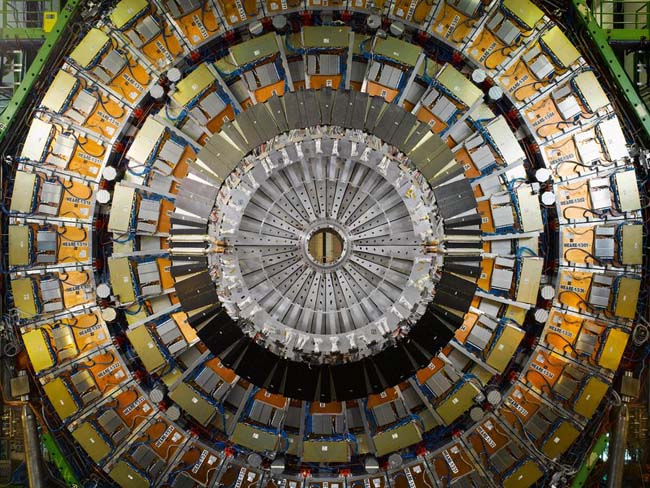
• Large Hadron Collider, Geneva, Switzerland (James Brittain/Corbis) Read more: http://www.smithsonianmag.com/smart-news/cern-seeks-international-artists-full-time-residency-180958448/#t17EPUeXPoFX8iXG.99 Give the gift of Smithsonian magazine for only $12! http://bit.ly/1cGUiGv Follow us: @SmithsonianMag on Twitter

    Large Hadron Collider, Geneva, Switzerland (James Brittain/Corbis)

    The European Center for Nuclear Research is calling for art submissions for its annual award

    smithsonian.com

    For any artist out there wanting to get up close and personal with the world’s largest and most powerful particle collider, this might be your chance: the European Center for Nuclear Research (CERN) is seeking submissions for its COLLIDE International Award. The lucky winner will get the opportunity to work with a CERN scientist on a project designed to bring art and science together.

    “Our desire is to connect the worlds of leading scientists with international artists through ‘creative collisions’, encouraging both fields to inspire and challenge each other, and pushing the boundaries of their traditional roles and methodologies,” Arts@CERN’s director, Monica Bello, said in a statement.

    Famously home to the Large Hadron Collider, CERN has offered the award to artists with an interest in the sciences for several years. This is the first year, however, it will be collaborating with the Liverpool-based Foundation for Art and Creative Technology (FACT). The winner of the COLLIDE International Award will win a three-month-long, fully funded residency split between the two institutions as well as a $15,000 cash prize, Sarah Cascone reports for artnet News.

    “Encouraging curiosity is central to our agenda, and introducing the public to experimental and open-minded artists is an amazing way to inspire creativity both within science and arts,” FACT director Mike Stubbs said in a statement.


    Read more

    art-basel-hong-kong
    Samson Young’s multi -media walk ‘So You Are Old by the Time You Reach the Island’ to premiere at Art Basel’s show in Hong Kong.


    Art Basel and BMW are pleased to announce that Samson Young, Hong Kong sound artist and winner of the first BMW Art Journey, will present a new public artwork during Art Basel’s Hong Kong show this year. Titled ‘So You Are Old by the Time You Reach the Island’, the piece will take the form of a multi – media walk that will lead participants on a journey through the streets of the Admiralty and Wan Chai districts in Hong Kong. Offering a time and site – specific experience, the work weaves together institutional histories of place with fictional


    and personal narratives, all through films, audio tracks, on-site FM radio broadcasts, live actions, and installation elements dispersed along the route.


    The multi-media walk adds a new chapter to ‘For Whom the Bell Tolls’, an ongoing project the artist developed on his BMW Art Journey in 2015. The artist’s journey centered on bells, both as sonorous objects and as ideological, political, and religious emblems of their respective communities. On a sixty-day trip around the globe, Samson Young researched and recorded numerous bells, compiling an extensive archive of bell recordings and a series of bell sound sketches on paper. The recordings and interviews collected over the journey will be a major aspect of the multi-media walk.


    ‘During my 2015 BMW Art Journey, I traveled to eleven countries on five continents,frequently alone,’said the artist.‘ So now it is all the more exciting to add this new dimension to the journey, in the city I call my home, surrounded by friends, artistic collaborators, and visitors. In the past year, I have developed a deeper appreciation for the cultural and psychological meanings of travel, and I hope that though this experience, participants in the sound walk will share this understanding.’


    By enabling the winning artist to go on their own journey of creative discovery, the BMW Art Journey functions as a mobile studio that can take artists almost anywhere in the world–to develop new ideas, discover new themes, and envision new creative projects.


    Additional information about ‘So You Are Old by the Time You Reach the Island’, Samson Young, and his BMW Art Journey can be found at bmw-art-journey.com


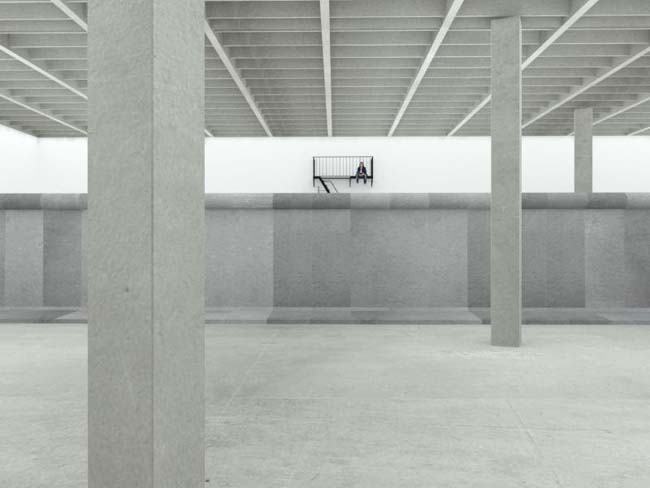
        For as Long as It Lasts, 2016, courtesy the artists, artists' rendering     The Future, 2014, courtesy Galleri Nicolai Wallner, Copenhagen, photo:      Anders Sune Berg

    For as Long as It Lasts, 2016, courtesy the artists, artists’ rendering
    The Future, 2014, courtesy Galleri Nicolai Wallner, Copenhagen, photo:
    Anders Sune Berg

    TEL AVIV MUSEUM OF ART 
    ANNOUNCES THE EXHIBITION 
    POWERLESS STRUCTURES
    BY ELMGREEN & DRAGSET, 

    OPENING MARCH 31, 2016 

    The acclaimed artist duo to show a monumental installation and several sculptural works in
    Israel’s leading contemporary art museum.
    Tel Aviv Museum of Art, Israel’s leading institution of contemporary art, is pleased to announce Powerless Structures, an exhibition by the artist duo Elmgreen & Dragset, taking place in several of the museum’s exhibition spaces and galleries, opening March 31. 
    Powerless Structures is the centerpiece of Tel Aviv Museum of Art’s 2016 international exhibition program, and is adapted specifically for the museum’s layout. The exhibition is titled after a well-known series of the artists’ works that investigates how structures-whether political, social, financial, cultural or physical-have the potential to be altered or interchanged, since these structures depend solely on our acceptance of their power. The exhibition’s fragmented trajectory features eight works positioned throughout the museum’s various galleries and its sculpture garden.
    Upon entering the Herta & Paul Amir Wing at the Tel Aviv Museum of Art, viewers will witness
    Donation Box (2006), a transparent glass box on a plinth filled with unexpected objects such as a worn sneaker, a car key, a flight ticket, a package of condoms, and a “Do Not Disturb” sign, among plenty of other items, rather than only coins and notes. The box remains sealed off from additional donations.
    Nestled in the heart of the museum, viewers will encounter Modern Moses (2006), a wax figure of a baby in a carrycot lying on the ground beneath a cash machine. This installation presents a contemporary interpretation of the biblical story of the abandoned Moses in the neo-liberal economic system.
    In the museum’s lower level is Other Landscapes (2016), a new
    installation appearing as the partially-applied wall signage for a (fictional) exhibition by Matisse that has yet to open, alongside scaffolding and tools that seem to have been left behind by the museum’s technical crew.
    Inside the Lilly & Yoel Moshe Epstein Multi-Purpose Gallery, the largest space in the museum, hangs The Future (2014), an installation of a lonely and pensive teenage boy sitting atop a fire escape. The Future is positioned together with a new installation, For as Long as It Lasts (2016), a full-size replica of a section of the iconic Berlin wall, which bifurcates the vast hall. The wall serves as a blank surface for projection that can change according to each individual spectator, and also references Elmgreen & Dragset’s shared history in Berlin, where the artists, like many others, moved in 1997 as a direct result of the fall of the Berlin wall. In front of the wall stands Zimmerstrasse (2016), a Berlin street sign indicating a central street that hosted many art galleries in the beginning of the millennium, near the historically significant crossing point Checkpoint Charlie.
    In the museum’s Main Building, viewers will discern Portraits of the Artist (2014) among the European Art of the 16th-19th Centuries, in the Ruth and Bruce Rappaport Gallery. Here, two faded rectangles imply the absence of a pair of portraits, which are no longer hanging on the wall. The title refers to Elmgreen & Dragset as a single entity, and the faint traces underscore the idea that eventually, all of our portraits will be taken down at some point: history will be re-written or our personal hard drives will crash, Instagram or Facebook will no longer be relevant, and the images that served as profiles of our identities might vanish and exist only as distant memories.
    Wishing Well/Powerless Structures, Fig. 166 (2016), the final work of the exhibition, is situated in the museum’s sculpture garden, and depicts a sealed, round, pool-like well dug into the ground. The coins inside the well seem familiar, but when seen up close, it becomes apparent they are blank, with no denominations.
    Each of Elmgreen & Dragset’s works in Powerless Structures evokes a feeling of something that has been left behind, forgotten, forsaken or is waiting for an action to happen. The artists subvert the power of various structures throughout the exhibition, disrupting our original associations and expectations, and creating a resounding sense of unease, with space for reflection and hope.
    This is the first time the work of the acclaimed artist duo has been shown in Israel. The artists will give a talk on April 1, 2016, the day after the exhibition opening. 
     Tel Aviv Museum of Art  www.tamuseum.org.il

    By Ruth Direktor

    The image most characterizing the first exhibition in Israel by artist duo Elmgreen & Dragset is that of a structure that has collapsed and scattered to pieces. Instead of a complete, coherent exhibition located in one gallery, offering the visitor a total experience, several works are scattered throughout the Museum, chancing upon the viewer unexpectedly, in different locations and in different guises of not-art.

    At the entrance to the Herta and Paul Amir Building, a Donation Box (2006) is placed, of the kind found at the entrance to various establishments. It seems to have always been there. Like those boxes, it too is transparent, not just by its material quality, but by its very defiantly demanding nature, aiming directly at the pocket of those chancing upon it, causing them to turn their gaze elsewhere. Yet, it is precisely the gaze of the alert viewer, which is essential in order to provide Donation Box with a meaning of an art work and to read it, as well as the other works in the exhibition. A ready gaze will notice several coins in the box, but they are swallowed among a medley of objects that seem like the emptied contents of a pocket or a bag or a trashcan: an old trainer, a squashed cigarette box, a comb, a Do Not Disturb sign, a pacifier, an empty packet of pills, a train ticket, a car key and various crumpled or squashed papers. The opening of the box is blocked.
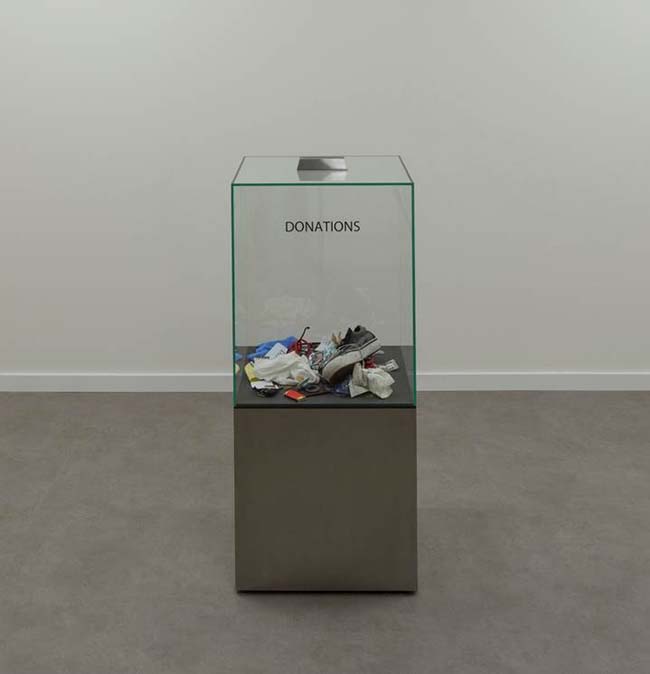
    Donation Box, 2006 Courtesy Private Collection, Paris Photo: Anders Sune Berg

    Donation Box, 2006
    Courtesy Private Collection, Paris
    Photo: Anders Sune Berg

    The donation box illustrates well Elmgreen & Dragset’s tendency to use materials that comprise the world of art, combine them into a passive-aggressive relationship with the viewer, and present the economic situation as existential. If Donation Box conjures up the Poubelles (trash bins) of Arman—the French New Realism artist who collected the contents of trash cans in Plexiglas boxes—then these works of him from the 1960s immediately elucidate the difference. Alongside criticism of the consumerist society that emerged post-World War II, the object works of Arman and his contemporaries also expressed enthusiasm for this society, and the conviction that a person’s chattel, as well as the remnants he or she leave behind, reflect his or her personal essence. In contrast, Elmgreen & Dragset’s Donation Box is realistic and delusion-free about Capitalism and its implications for individuals and museums alike. Its contents are not the personal portrait of someone, but rather a cynical and depressing mirroring of museum economy in the capitalistic era. Furthermore, the box explicates, already at the entrance, that Elmgreen & Dragset’s conduct on the art arena is fully aware of its processes, its characteristics and the forces which motivate it; they play the game with amusement, while viewing it from aside and tearing it to pieces as much as they can.
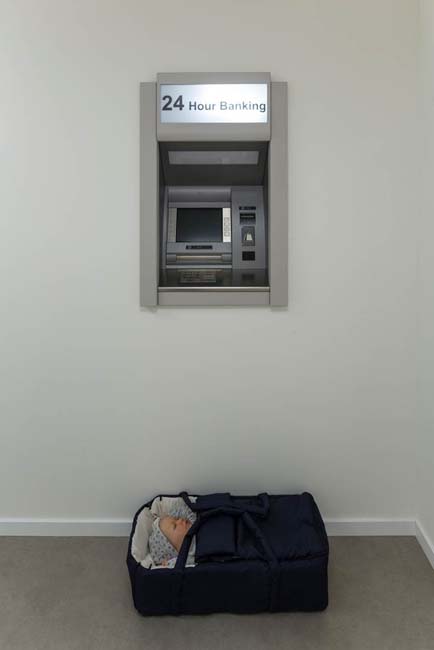
    Modern Moses, 2006  Courtesy Sammlung Goetz, München Photo: Anders Sune Berg

    Modern Moses, 2006
    Courtesy Sammlung Goetz, München
    Photo: Anders Sune Berg

    Further on, sunk in a passageway wall, stands an ATM. On the floor below is a baby carrycot with a wax baby. This is Modern Moses (2006), a horrifying contemporary version of the Biblical tale and a blunt, direct representation of abandonment and orphanhood in the shadow of Capitalist economy. The marble floor is cold, the ATM is inoperative and visitors to the Museum keep passing over Moses on their way to the galleries and halls, between exhibitions and concerts.

    The exhibition’s unmarked route continues to the building’s lower level. Here it seems we have chanced upon an exhibition in progress: painters’ scaffoldings, a ladder, a bucket of paint, paper cups and, on the wall, a large title whose letters have not all been peeled off yet: “Matisse: Other Landscapes.” The heart misses a beat. A Matisse exhibition! Without a label or an elucidating text on behalf of the Museum, there is no way to understand this is an installation-that-is-an-artwork rather than preparations for an exhibition. As in many other works by Elmgreen & Dragset, the artists use the common artistic-institutional syntax (label, exhibition heading, invitation and terminology such as “biography” or “self-portrait”) and then deconstruct it. The world of art is exposed as an arena whose rules are obvious, therefore transparent, thus so tempting to play with, disrupt, unsettle.

    An “exhibition” also becomes such a construction which is so obvious, that a dramatic action such as a deliberately misleading announcement about a fictive exhibition is needed in order to draw attention to it. Instead of other landscapes by Matisse (imagine them: pink and orange, with soft black contours…), a concrete replication of the Berlin Wall cuts across the Lily and Yoel Moshe Elstein Multi-Purpose Gallery. It is 3.60 meters high (like the original Wall) and 30 meters wide  (the Berlin Wall spread along 155 kilometers). On the wall behind the Wall hangs an fire escape construction, on which a youth in jeans and a hoodie is seated, looking down, contemplating, self-absorbed, and at the same time curious, attentive, colored in the whole range of hues between the optimism and pessimism deriving from the title attached to him: The Future. Not far from him, a street sign bearing the word “Zimmerstasse” stands, the name of the street that belongs in Berlin’s collective memory with Checkpoint Charlie, one of Berlin Wall’s best-known symbols. The youth’s future is unknown, the future of Zimmerstrasse is already here: fashionable, touristy, representative of the Wall’s commercialization. In any case, it seems that the future is a dubious option of the global era: freedom under the auspices of neo-liberalism.

    Elmgreen & Dragset arrived in Berlin in 1997, eight years after the fall of the Wall, when Berlin had already remodeled itself as the capital of the World’s young people, and the Wall itself was already a myth. They have lived and worked in the city since then. This is where they built their studio. The evocation of the Wall twenty-seven years after its fall relates to what it still symbolizes: an arbitrary border, a cruel separation, an artificial creation of others and otherhood. The illusion that all these have collapsed with the fall of the Wall is nurtured through the bubble of freedom and openness that Berlin has created, but other walls, real and metaphorical, still exist and are still being built, and the unreasonable act of building a wall within a gallery contains and remembers them all.
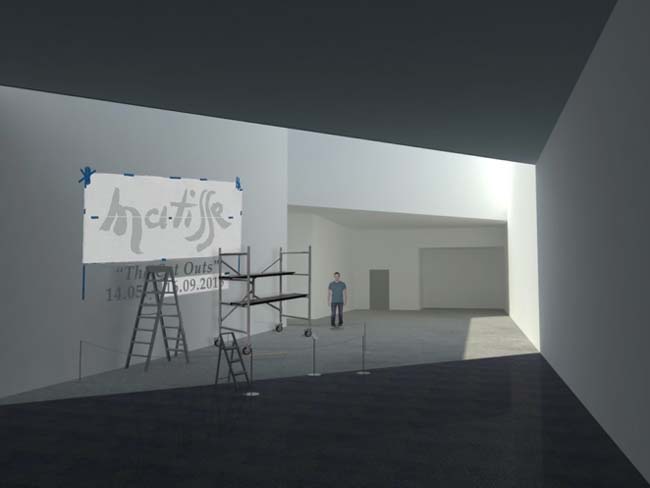
    Other Landscapes, 2016 Courtesy the artists, artists' rendering

    Other Landscapes, 2016
    Courtesy the artists, artists’ rendering

    Far from the Berlin Wall, in the Museum’s Sculpture Garden, stands Wishing Well (1998/2016), another takeoff of something familiar (this time something familiar and pleasant: a town square, families and children, tourists on holiday). Only close inspection reveals the shift that appropriates it from the thing itself and makes it into a meaningless structure, for a thick pane of glass blocks the well, and the coins in the water bear no mark. These are coins in their primal existence, metal disks of varying sizes, before their symbolical value has been imprinted on them, rendering them tradable. True, it is possible to guess from their size and metal type whether these are 1 or 5 or 10 NIS coins, yet once their identity has been robbed, even coins can evoke compassion. Like Donation Box, Wishing Well is also blocked. Viewers cannot throw a coin and make a wish, they are prevented from the customary active participation, and even the concept of Participatory Art—which makes viewers active participants in art that is often carnivalesque—is here under critical scrutiny. The participation required of the viewers here is of a different,  more delicate and demanding nature: a gaze, attention, reading and deciphering signs.

    The artists themselves confirm that for them, an exhibition is experienced as a movie set, where a plot can be directed, in which the viewers participate without knowing the script. This is translated into a seductive reading suggestion. Although the scattered structure of the exhibition at the Tel Aviv Museum of Art makes the reading of the whole difficult, the physical process throughout the Museum, along the exhibition’s stations, enhances the analogy to an ongoing, albeit non-linear, narrative structure. In the Museum’s Main Building, quite afar from the other works, stands another of Elmgreen & Dragset’s works, seemingly their most personal: Portraits of the Artist (2014). The portraits are located among the European Art of the 16th-19th Centuries, in the Ruth and Bruce Rappaport Gallery, alongside paintings representative of the portrait-painting tradition most identified with the bourgeoisie, paintings depicting a figure or a group of figures in their fineries, according to conventions well known to the painter and to those being painted. In contrast, Portraits of the Artist—wherever it is exhibited—is comprised of two oblongs painted directly onto the wall, assimilated into it and differing from it in color, which is one shade paler than that of the wall (red in this case). The label is the only way to notice them and give them meaning, whereas the title reminds us that the duo, Elmgreen & Dragset, is an artistic unit whose combined identity has become a brand name. Whereas the portraits hanging on the surrounding walls seek to emphasize the individual essence of the depicted figures as well as the painter’s fingerprint, the two oblongs representing the artist’s, (actually the artists’) portraits—whose hue, as mentioned, is one shade paler than that of the wall—are an anonymous pale abstract devoid of identity. In contrast with all the other works in the exhibition, scattered throughout the Museum’s (new) Herta and Paul Amir Building, the portraits are placed in the (old) Main Building. Separating this work from the others emphasizes the bi-structural entity of the Tel Aviv Museum of Art, making it a metaphor for an artist of two portraits, a duo of artists who are a double-headed creature of sorts.

    It is only once the viewers have completed the fragmented walk along the exhibition’s stations, that they can articulate for themselves a narrative that is subtly formulated between the abandoned baby below the ATM machine, the pitiful youth behind the Wall and the portrait(s) of the artist(s) diluted into the Museum wall; or another narrative, formulated between the Donation Box and the Wishing Well and the ATM machine, all blocked (Massimiliano Gioni refers to blocking as unrequited yearning. The viewers observing the works yearn for something beyond their reach, something physically and metaphorically remote); or another narrative whose main chapters are the fictitious imminent Matisse exhibition and the no-longer-existent Berlin Wall. All the possible narratives involve a blurred sense of missed opportunity, prevention, frustration and anxiety about the future, accompanied by a wink that turns the tables and invites further, other, unexpected readings.

    The works’ state is somewhere between the before and the finally after, between the not-quite-baked and the leftovers. They are reminiscent of things that have been forgotten, forsaken or discarded, things drained of meaning and of a past power they may have held. Soon, someone will gather up the baby abandoned below the ATM (to a better future? Probably not), soon the Matisse exhibition will be opened (somewhere, not here), soon the Berlin Wall will fall (we already know this).  The coins in the Wishing Well will remain in their crude pre-meaning state without having their monetary value imprinted on them, in the Donation Box the used objects, post-meaning, will stay on aimlessly. The well, the box and the ATM will remain devoid of purpose, serving neither for donations nor for wishes.

    The exhibition’s title, “Powerless Structures,” is borrowed from the title of a series by Elmgreen & Dragset which began in 1997. Over the years, this title has become their signature, so to speak, and the phrase most identified with their work. Under the verbal umbrella of “powerless structures,” they have exhibited various architectural and sculptural structures which time and again shattered the concept of traditional art objects and traditional exhibition spaces. In 1998, the title “Powerless Structures” appeared next to the Wishing Well, exhibited at the front of the building holding Berlin’s first Biennale. Now, as it hovers over an exhibition at the Tel Aviv Museum of Art, the title is recharged with the meanings of all the structures that Elmgreen & Dragset refer to: economic, political, cultural as well as real and physical. The main powerless structure exhibited here with all its resounding missing power is, so it seems, the “exhibition.” Seductive but fragmented, deceptive all along, leaving behind a long trail of unease.

    ***

    Michael Elmgreen (born 1961, Copenhagen, Denmark) and Ingar Dragset (born 1969, Trondheim, Norway) have been working together since 1995.

    They have held many solo exhibitions and participated in major group exhibitions around the world. They were nominated for the Hugo Boss Prize in 2000 and in 2002 won the Preis der Nationalgalerie at the Hamburger Bahnhof in Berlin. Among their notable recent exhibitions are “The Collectors” )2009), at The Danish and Nordic Pavilions, 53rd Venice Biennale; “Celebrity: The One & The Many” (2010), at the ZKM Center for Art and Media, Karlsruhe, Germany; “Tomorrow” (2013), at the Victoria and Albert Museum, London; “Aéroport Mille Plateaux” (2015), at PLATEAU, Samsung Museum of Art, Seoul; and “The Well Fair” (2016), at the Ullens Center for Contemporary Art (UCCA), Beijing.

    The exhibition at the Tel Aviv Museum of Art is part of a joint project with two other museums: the first part was held at the Astrup Fearnley Museet, Oslo (21 March–21 August 2014) and the second part at the National Gallery of Denmark (SMK), Copenhagen (19 September 2014–4 January 2015), both under the title “biography”. A book of images and a book of texts were published by the three museums in 2014.


    On view at the Tel Aviv Museum of Art from March 31, 2016

    Powerless Structures at the Tel Aviv Museum of Art www.tamuseum.org.il/about-the-exhibition/elmgreen-dragset. Tel Aviv Museum of Art www.tamuseum.org.il/


    By Chief Curator Ruti Direktor

    NY Arts

    unnamed
    RBMA Festival New York returns for its fourth consecutive year
    Monday is channeling moody vibes with non-stop rain, but there we’ve got encouraging news to share. RBMA NY announced their 2016 Festival lineup late last week, and the bill is as impressive as we’ve come to expect, with top slots reserved for the premiere of ANOHNI’s Hopelessness live show at Park Avenue Armory and a full-length performance of Dizzee Rascal’s 2003 album Boy in Da Corner. New York City’s premier film event, Tribeca Film Festival, also returns in April. Ticket packages are on sale before March 21st, before individual screening tix become available. Turn up on a Tuesday with JUICEBOXXX at Brooklyn’s newest DIY venue, Sunnyvale. On Wednesday, you can catch a five-piece analog soul ensemble at Brooklyn Bowl, or a Women’s Raga Massive at Pioneer Works. The Rubin Museum continues screenings of The Ballad of Genesis and Lady Jayethis week. The film explores the romantic and artistic partnership of industrial-rock pioneer Genesis BREYER P-ORRIDGE and Lady Jaye Breyer P-Orridge. Later this week, IDIO Gallery celebrates their latest exhibition, TREES, a show of photography that comes to life as both a silent poem and an implied joke. Coming up, the coolest indie music kids we know, The Wild Honey Pie, throw a showcase on Avenue A. And there are still a few (only a few!) tickets left to Art of Yoga on March 26th at Brooklyn Museum.

    358_H_9780674504691-lg

    PERSOPHILIA | Hamid Dabashi, Drucilla Cornell, Firoozeh Kashani-Sabet | Art and Literature Series Event

    Wednesday, March 23, 2016, 6 – 8 p.m.

    Program Locations:

    FREE – Auditorium doors open at 5:30 p.m.

    Celebrating the publication of the ground breaking new volume Persophilia: Persian Culture on the Global Scene, influential and  prolific writer and cultural critic Hamid Dabashi is joined by acclaimed philosopher and feminist theorist Drucilla Cornell and celebrated historian and author Firoozeh Kashani-Sabet to converse about the evolution of Persian culture and how it has inspired Western culture through the ages.

    From the Biblical period and Classical Antiquity to the rise of the Renaissance and the Enlightenment, aspects of Persian culture have been integral to European history. A diverse constellation of European artists, poets, and thinkers have looked to Persia for inspiration, finding there a rich cultural counterpoint and frame of reference. Interest in all things Persian was no passing fancy but an enduring fascination that has shaped not just Western views but the self-image of Iranians up to the present day.

    Persophilia maps the changing geography of connections between Persia and the West over the centuries and shows that traffic in ideas about Persia and Persians did not travel on a one-way street.

    How did Iranians respond when they saw themselves reflected in Western mirrors? Expanding on Jürgen Habermas’s theory of the public sphere, and overcoming the limits of Edward Said, Hamid Dabashi answers this critical question by tracing the formation of a civic discursive space in Iran, seeing it as a prime example of a modern nation-state emerging from an ancient civilization in the context of European colonialism. The modern Iranian public sphere, Dabashi argues, cannot be understood apart from this dynamic interaction.

    Persophilia takes into its purview works as varied as Xenophon’s Cyropaedia and Nietzsche’s Thus Spoke Zarathustra, Handel’s Xerxes and Puccini’s Turandot, and Gauguin and Matisse’s fascination with Persian art. The result is a provocative reading of world history that dismantles normative historiography and alters our understanding of postcolonial nations.

    Copies of Persophilia: Persian Culture on the Global Scene (Harvard University Press, October 2015) are available for purchase and signing at the end of event.


    Read more

    83 artists from 35 countries and more than 200 works presented across nineteen locations free to the public.

    The 20th Biennale will be presented at 19 locations – including seven main sites or ‘embassies of thought’ – from 18 March and continue until 5 June, 2016.

    The last month announcement brings the total number of participating artists in Australia’s largest contemporary art event to 83, hailing from 35 countries. More than 200 individual art works spanning all mediums – with a 2 focus on performance – will be presented free of charge to the public during the Biennale’s three-month exhibition period.

    The newly announced artists are: Ricardo Basbaum; Céline Condorelli; Don’t Follow the Wind; Erub Arts; Philipp Gehmacher; Germaine Kruip; Benoît Lachambre; Chrysa Parkinson; Evan Roth; Hahn Rowe; Christoph Schlingensief; Alexis Teplin; and Ken Thaiday Snr. The Biennale artist list now includes a total of five artist collectives or artist collaborations: Brown Council; Erub Arts; Yannick Dauby and Wan-Shuen Tsai; Karen Mirza and Brad Butler, and Don’t Follow the Wind. Fourteen Australian artists will participate in the exhibition, including six Australian Indigenous artists. At the Art Gallery of New South Wales (Embassy of Spirits), Torres Strait Islands collective Erub Arts will present a new commission for the Biennale titled Solwata 2015–16. Created through a collaboration of artists, including Ellarose Savage, Florence Mabel Gutchen, Racy Oui-Pitt, Lynnette Griffiths and Marion Gaemers, Erub Arts have used the ‘ghost net’ medium to create a large, wall-based installation, drawing inspiration from Indigenous stories and cultural traditions, a shared connection to the ocean and a deep concern for the marine environment. Through their collaboration the artists transform the serious ecological hazard of drifting discarded fishing nets in our oceans into an artwork that evokes a shared vision of land, sea and culture – communicating an important statement about our combined responsibility for the welfare of the environment. The Embassy of Spirits will also display Ken Thaiday Snr’s dhari (headdresses) – or dance machines – which use both traditional and synthetic materials to create unique performance apparatuses. As ‘mobilised artefacts’, these innovative sculptural objects both document and embody the living heritage and traditions of performance in the Torres Strait Islands.

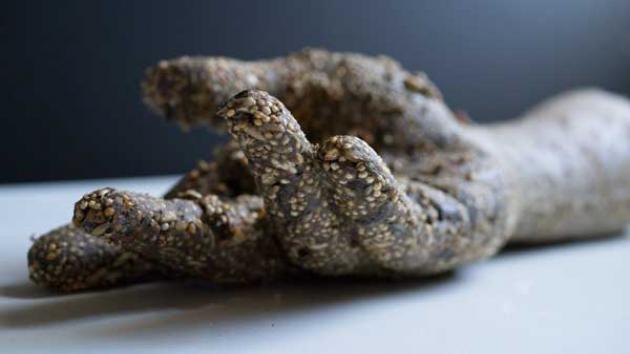
    Marco Chiandetti, 'The hand of the artist in bird seed', 2015, bird seed, 40 x 10 x 9 cm. Courtesy the artist.  © Photograph: Marco Chiandetti

    Marco Chiandetti, ‘The hand of the artist in bird seed’, 2015, bird seed, 40 x 10 x 9 cm. Courtesy the artist. © Photograph: Marco Chiandetti

    Christoph Schlingensief’s (b. 1960 d. 2010) The African Twintowers, 2005–07 will also be exhibited at the Embassy of Spirits. Schlingensief’s last cinematic work was effectively a documentary and experimental film about an unfinished film. Shot in the townships surrounding Lüderitz, Namibia, the former German African colony, Schlingensief’s original film would have told the story of a megalomaniac theatre director wanting to re-stage the events of September 11 in Africa. Curatorial collective Don’t Follow the Wind, featured at Carriageworks (Embassy of Disappearance), will present two new works for the Biennale: Information Counter, 2016 and A Walk in Fukushima 2016. Reclaimed, decontaminated and transported to Australia, Information Counter comprises physical artefacts from the Fukushima exclusion zone. A Walk in Fukushima is an immersive 360-degree video piece viewed through the headsets made in workshops with former residents of the city. Filmed in and around the uninhabited radioactive area, the video presents an intimate experience of the inaccessible zone and the power plant. At the Museum of Contemporary Art Australia (Embassy of Translation) French artist Céline Condorelli will present Structure for Communicating with Wind 2012–13/2016. The installation is one of a series of five sculptures-as-installations produced in 2012–13 as part of a year-long collaborative project initiated by filmmaker Beatrice Gibson and typographer Will Holder. Called The Tiger’s Mind, the project was based on the 1967 character-driven, improvisational score written by avant-garde British composer Cornelius Cardew. Dutch artist Germaine Kruip will present a one-on-one 20-minute performance work titled A Square, Spoken, 2015 at the MCA Australia (Embassy of Translation) on weekends and Cockatoo Island (Embassy of the Real) during the week. The script for this performance is drawn from historical quotes around ‘the square’ by artists, scientists and historians, including: Kazimir Malevich, Josef Albers, Carl Jung, Claes Oldenburg, Galileo Galilei, Ad Reinhardt, Lygia Pape and Chinese proverbs. In the process, A Square, Spoken re-visits and re-contextualises historical and art historical shifts in understandings of the square, as a form and concept, as well as the new meanings it has acquired over time.

    Germaine Kruip, 'A Square, Spoken', 2015, one-on-one performance, 18 mins. Courtesy the artist; The Approach, London; and Gallery Sofie van de Velde, AntwerpPhotograph: Maxime Fauconnier

    Germaine Kruip, ‘A Square, Spoken’, 2015, one-on-one performance, 18 mins. Courtesy the artist; The Approach,
    London; and Gallery Sofie van de Velde, AntwerpPhotograph: Maxime Fauconnier

    Specially commissioned for the Embassy of Spirits, ghost telephone, curated by Adrian Heathfield, is a one-month long daily chain performance comprised of new interlinked works from internationally renowned artists; Philipp Gehmacher, Benoît Lachambre, Chrysa Parkinson and Hahn Rowe. Working in situ in the Art Gallery of New South Wales the commissioned artists will channel and transform the spirits of specially chosen works currently on display at the Gallery. Each artist will spend a week in residence with a selected artwork, attuning to its resonances and mutating its immaterial affects through their creative actions and words. The residency of each artist overlaps for several days with another artist, generating new correspondences and reverberations between the artists and their work.

    Alexis Teplin’s practice explores the experience of movement and sound in painting. Known for her brightly coloured abstract paintings, her canvases often extend to form the backdrop, shape, and even costume, for her sculptures and performance works. Teplin’s work for the 20th Biennale, Arch (Politics of Fragmentation), 2016 will be presented at Cockatoo Island (Embassy of the Real). As part of The Future of Disappearance, a project curated by André Lepecki for the 20 th Biennale, Brazilian artist Ricardo Basbaum will create one of his large-scale diagrams on a billboard at 95 Commonwealth Street, Surry Hills. Evan Roth will present Internet Landscapes: Sydney, 2016, a web-based project that aims to offer simultaneous experiences of the internet’s physical, digital and cultural landscape. Roth’s blending of the physical and virtual is very much in line with the 20th Biennale’s interest in new ways of folding the world ‘into’ the self, but also alludes to the slowly eroding optimistic and egalitarian values that characterised earlier incarnations of the internet. Visit 20bos.com from 18 March to view Roth’s work.

    Opens 18 March: entry to the Biennale of Sydney exhibition is free. To view more detailed information on artists presented in the 20th Biennale of Sydney please visit 20bos.com.


    20th BIENNALE OF SYDNEY ARTIST LIST:

    1. Korakrit Arunanondchai (Thailand/USA) 2. Ricardo Basbaum (Brazil) 3. Samuel Beckett (Ireland/France) 4. Nina Beier (Denmark/Germany) 5. Richard Bell (Australia) 6. boychild (USA/Hong Kong) 7. Daniel Boyd (Australia) 8. Lauren Brincat (Australia) 9. Brown Council (Kate Blackmore, Kelly Doley, Francis Barrett, Diana Smith) (Australia) 10. Lee Bul (South Korea) 11. Johanna Calle (Colombia) 12. Joyce Campbell (New Zealand) 13. Boris Charmatz (France) 14. Yin-Ju Chen (Taiwan) 15. Chen Chieh-jen (Taiwan) 16. Marco Chiandetti (England) 17. Neha Choksi (USA/India) 18. Heman Chong (Malaysia/Singapore) 19. Céline Condorelli (France/England) 20. Yannick Dauby (France/Taiwan) and WanShuen Tsai (Taiwan) 21. Keg de Souza (Australia) 22. Don’t Follow the Wind 23. Mette Edvardsen (Norway/Belgium) 24. Cevdet Erek (Turkey) 25. Erub Arts (Australia) 26. Noa Eshkol (Israel) 27. Cécile B. Evans (USA/Germany/England) 28. William Forsythe (United States/Germany) 29. Philipp Gehmacher (Austria) 30. Agatha Gothe-Snape (Australia) 31. Nilbar Güreş (Turkey/Austria) 32. FX Harsono (Indonesia) 33. Camille Henrot (France/USA) 34. Sheila Hicks (USA/France) 35. Mella Jaarsma (The Netherlands/Indonesia) 36. Bharti Kher (England/India) 37. Germaine Kruip (The Netherlands) 38. Benoît Lachambre (Canada) 39. Bo Christian Larsson (Sweden/Germany) 40. Lee Mingwei (Taiwan/USA) 41. Charles Lim (Singapore) 42. Minouk Lim (South Korea) 43. Adam Linder (Australia/Germany/USA) 44. Gerald Machona (Zimbabwe/South Africa) 45. Kazimir Malevich (Ukraine/Russia) 46. Jumana Manna (USA/Germany) 47. Helen Marten (England) 48. Emma McNally (England) 49. Karen Mirza and Brad Butler (England/Turkey) 50. Dane Mitchell (New Zealand) 51. Archie Moore (Australia) 52. Oscar Murillo (Colombia/England) 53. Yuta Nakamura (Japan) 54. Shahryar Nashat (Switzerland/Germany/USA) 55. Otobong Nkanga (Nigeria/Belgium) 56. Jamie North (Australia) 57. Melik Ohanian (France/USA) 58. Bernardo Ortiz (Colombia/Brazil) 59. Mike Parr (Australia) 60. Chrysa Parkinson (USA/Belgium) 61. Falke Pisano (The Netherlands/Germany) 62. Robert Zhao Renhui (Singapore) 63. Miguel Ángel Rojas (Colombia) 64. Evan Roth (USA/France) 65. Hahn Rowe (USA) 66. María Isabel Rueda (Colombia) 67. Aura Satz (Spain/England) 68. Christoph Schlingensief (Germany) 69. Maaike Schoorel (The Netherlands) 70. Sudarshan Shetty (India) 71. Taro Shinoda (Japan) 72. Chiharu Shiota (Japan/Germany) 73. Dayanita Singh (India) 74. Rodel Tapaya (Philippines) 75. Alexis Teplin (USA/England) 76. Ken Thaiday Snr (Australia) 77. Charwei Tsai (Taiwan/Vietnam) 78. Apichatpong Weerasethakul (Thailand) 79. Justene Williams (Australia) 80. Ming Wong (Singapore/Germany) 81. Xu Zhen (Produced by Madeln Company) (China) 82. Yao Jui-chung + Lost Society Document (Taiwan) 83. Nyapanyapa Yunupingu (Australia)

    “Unbound: Narrative Art of the Plains” Offers Rarely Seen Historic Native American Masterworks, Unveils Contemporary Works by 16 Artists

    National Museum of the American Indian Exhibition Traces Evolution of the Narrative Tradition

    Vibrant storytelling of society, war and peacetime, repression and expression is found within the historic narrative artworks of Native peoples of the Great Plains. “Unbound: Narrative Art of the Plains,” an exhibition opening Saturday, March 12, at the Smithsonian’s National Museum of the American Indian, George Gustav Heye Center in New York, presents rarely seen works by some of the most important figures to have used this style, including Bear’s Heart (Southern Cheyenne), Zo-tom (Kiowa) and Long Soldier (Hunkpapa Lakota). Their narratives exist along a continuum that carries tradition through to artists working in this style today.

    “Unbound” celebrates these narratives with the debut of nearly 50 new works by contemporary Native artists commissioned exclusively for this exhibition. Often referred to as “ledger art” because of the many Plains artists who illustrated ledger notebooks in the 19th century, narrative art employs a dynamic range of imagery to express the ‘now’ of generations of Native people—voices too strong to be bound to any medium.

    “When we look at American history that involves Native Americans, especially as it is frequently taught in schools, too often the narratives that come forth are from the viewpoints of non-Native people,” said Kevin Gover (Pawnee), director of the museum. “The artists showcased in ‘Unbound’ reflect nearly two centuries of Native self-expression and with that, a fuller, vastly more contextualized view of the indigenous experience, regardless of the time period.”

    The narrative tradition takes root in warrior artists of the 18th century who recorded visionary experiences and successes in battle on buffalo-hide tipis, robes and shirts. Artists also began pictorially recording significant events from each prior year; these became known as “winter counts.” As trade with settlers broadened in the 19th century, new media and tools became available to artists, including pencils, crayons, canvas, muslin and paper.

    The beginning of the Reservation Era (1870–1920) saw a transformation in narrative content. As policies set by the U.S. government encroached upon the Native identities of people of the Plains, pictorial drawings became a crucial means of addressing cultural upheaval. Many Native artists recorded their experiences in surplus government accounting notebooks, leading the style to be referred to as “ledger art,” which today is used interchangeably with “narrative art.” This style was revived in the 1960s, burgeoned during the American Indian Movement of the 1970s and continues in various media to this day.

    Dallin Maybee (Arapaho), Conductors of Our Own Destiny, 2013.  On view in “Unbound: Narrative Art of the Plains,” opening March 12, 2016, at the Smithsonian’s National Museum of the American Indian in New York. Photo by Ernest Amoroso, National Museum of the American Indian

    Dallin Maybee (Arapaho), Conductors of Our Own Destiny, 2013. On view in “Unbound: Narrative Art of the Plains,” opening March 12, 2016, at the Smithsonian’s National Museum of the American Indian in New York.
    Photo by Ernest Amoroso, National Museum of the American Indian

    Native artists selected for “Unbound” who are currently working in the narrative style confront modern and historic issues through a mix of approaches. Humorous illustrations byDwayne Wilcox (Oglala Lakota) offer societal commentary on everyday Native life, a reflection of self-described personal sensibility similar to entertainer Stephen Colbert. Dallin Maybee (Northern Arapaho/Seneca), an attorney and chief operating officer for the Southwestern Association for Indian Arts, uses his art to explore Native identity and the influence of tradition on contemporary life. Terrance Guardipee(Blackfeet) reflects his heritage and culture through vivid illustrations of Blackfeet history. Other notable artists includeRonald Burgess (Comanche), Sherman Chaddlesone(Kiowa), David Dragonfly (Blackfeet/Assiniboine), Lauren Good Day Giago (Arikara/Hidatsa/Blackfeet/Plains Cree),Darryl Growing Thunder (Assiniboine/Sioux), Juanita Growing Thunder-Fogarty (Assiniboine/Sioux), Vanessa Jennings (Kiowa/Pima), Chester Medicine Crow(Apsáalooke [Crow]), Chris Pappan (Osage/Kaw/Cheyenne River Lakota), Joel Pulliam (Oglala Lakota), Martin E. Red Bear (Oglala/Sicangu Lakota), Norman Frank Sheridan(Southern Cheyenne/Arapaho) and Jim Yellowhawk(Cheyenne River Lakota).

    National Museum of the American Indian
    Broadway, New York, NY 10274
    www.nmai.si.edu


    Courtesy of the National Museum of the American Indian

    April 16 – June 11, 2016
    Opening Reception: Friday, April 15, 6–8pm

    Luhring Augustine is pleased to present The Marionette Maker, Janet Cardiff and George Bures Miller’s fourth solo exhibition with the gallery. The artists have been collaborating since 1995, and are internationally recognized for their immersive multimedia works that often engage viewers in mysterious and dreamlike narratives.
    Cardiff and Miller’s kinetic installation The Marionette Maker (2014) comprises a full-scale vintage caravan that houses myriad characters in a haunting environment. The interior of the trailer reveals the fantastic world of a marionette maker (a marionette himself), who is hunched over a desk drafting designs. At the other end of the caravan, a lifelike model of Cardiff rests peacefully, as if entranced by her environs, while puppets dart, dance, and play instruments around her slumbering body. Viewers are able to walk around the camper and peer inside the marionettes’ domain, as well as sit in theater seats adjacent to the trailer to watch the puppets perform an opera. Recordings of forests and rainstorms emanate from rotating speakers above the trailer, overlapping with music made by the robotically controlled marionettes positioned throughout the installation. The audio elements continually intermingle, further enveloping the audience into the immersive, voyeuristic environment.

    Cardiff and Miller’s interactive Experiment in F# Minor (2013) will be on view in the second gallery. The work is an instrument of the artists’ creation, consisting of an array of speakers on a large table. As the viewer approaches it, his or her shadow triggers light sensors, causing individual speakers to emit diverse recordings in the key of F# minor. As the visitors’ movement “plays” the piece, their motion creates a unique musical arrangement, synthesizing tracks and creating unforeseen compositions that at times results in a cacophony of sound.
    Cardiff (1957, Brussels, Ontario) and Miller (1960, Vegreville, Alberta) work in Grindrod, British Columbia. The artists have had solo shows at international venues including ARoS Aarhus Art Museum; Vancouver Art Gallery; Art Gallery of Ontario, Toronto; Museum of Contemporary Art San Diego, La Jolla, CA; The Menil Collection, Houston, TX; Hamburger Bahnhof, Berlin; Modern Art Oxford; Miami Art Museum; Museu d’Art Contemporani de Barcelona; and Mathildenhöhe, Darmstadt. Their work has also been included in recent group exhibitions and biennales such as the 19th Biennale of Sydney in 2014 and dOCUMENTA (13) in 2012. Representing Canada at the 2001 Venice Biennale, the artists received the Biennale’s Premio Prize and Benesse Prize. The Marionette Maker was first presented by Madrid’s Museo Nacional Centro de Arte Reina Sofía at the Palacio de Cristal in 2014.

    Luhring Augustine
    531 West 24th Street, New York, NY 10011  Tel (212) 206-9100  Fax (212) 206-9055

    www.luhringaugustine.com


    Courtesy of Luhring Augustine

    Filip Dvořák, “CDF21122012”, Full HD video, 1’57’’

    Filip Dvořák, “CDF21122012”, Full HD video, 1’57’’

    (Re)construction of the Presence: Part 2. Young Czech Artists.
    Galleria Temporanea Boccanera, Via Ventura 6, Milano – IT

    Artists: Michal Drozen, Filip Dvořák, Max Dvořák, Jozef Mrva, Iva Polanecká, Štěpánka Sigmundová, Adéla Waldhauserová

    Opening on Wednesday 16th March h 7.00 pm

    March 16 – April 8, 2016
    Visit by appointment only, limited opening times and days

    With modern communications, you can be anywhere – you have the world at your fingertips. This is also the everyday reality of the upcoming generation of artists in the Czech Republic. This is also a connecting element for the group exhibition “(Re)construction of The Presence: Part 2″. All participating artists were born in 1988 (Jozef Mrva), in 1989 (Michal Drozen) and 1990 (Filip Dvořák, Max Dvořák, Iva Polanecká, Štěpánka Sigmundová, Adéla Waldhauserová), grew up in a fully democratic society after the fall of the Eastern Bloc. Therefore it is no surprise that their present artistic practice is on the same level as the rest of the current international art world. One can observe a return to traditional media such as painting and drawing, but also work with photography, video and audio. Their use of various action forms like performance or stepping out from the classical gallery situation is common for the young generation. The openness of contemporary society can be seen in their approach. One of the basic elements is the creation of “bridges” between galleries and other spaces (real or fictional) and time. Thanks to these “transfers” in their works we meet with criticism of a depersonalized society in the information age, but we can also rediscover principles stemming from art history and subject them to new questions corresponding to the current view of the world. There will be seven young artists presented at the exhibition, who were selected by the curator Jan Vitek for their innovative ideas and a great prospect of further growth in the future, not only in the Czech Republic, but primarily in the context of the whole world.

    Artist Štěpánka Sigmundová proves the fact that personal memories of individuals can become part of the collective consciousness of the work. Her records of everyday life consisting of photographs (more than 20,000 photos) and also collection of souvenirs become her “external memory”. Her works are characterized by long-term observations and classification. This archive with strong visual aspects makes the individual parts become placeholders of sites and situations, in which they can reflect memories for each of us. The work of Michal Drozen uses another approach, not capturing the whole world, but mainly himself, using painted auto-portraits and figurative paintings. The author solves the theme of constant exploration of being with painting. The classic theme, however, is all the more topical in the context of current everyday life of changing who you are and how are you viewed in a social network environments. Filip Dvořák also explores painting as a medium, sometimes he moves from surface dimensions to 3D and also to video performance, where he puts himself in different roles. He is fascinated with the historical legacy of art, especially from Romanticism. He adapts his interest and translates it into contemporary art language. One can observe great themes such as truth, sensuality, sincerity, beauty, refinement – themes, which are missing in fine art today, perhaps because we cannot see it in our daily life. Jozef Mrva, like Filip Dvořák, cites art history in his work, but he examines, deconstructs and reconstructs modernist processes of work, with new points of view. His “raw“ style has roots in philosophy, music and underground culture. Mrva is not scared of grand gestures and political opinions. He also works with the world of computers, seeing it as a theme and material of the 21th century. Another artist, Adéla Waldhauserová, works with photography, not only with the immediate capturing of an image, but she also works with photographs as a physical material – as objects. She is interested in landscape and human environments. She recycles her own as well as found photographs and books, and by creating small changes she destroys the narrative style of reading the images and puts new meaning to them, for example social themes, such as the most current one concerning migration. Iva Polanecká also has a strong relationship with nature and the environment. She works on displaying the invisible and the imperceptible. Polanecká uses multimedia installations, video, but the main body of her work is connected with sound. She tries to rouse interest in the viewer about things, which are overlooked in everyday life. Her specialty is making situations for visitors not only in gallery space, but in non-gallery spaces and outdoor. These events are usually arranged as walks with audio guides recorded by the artist, which are given out to participating visitors. One can observe her endeavor to find balance, meditation and the spiritual essence of being. Conceptual video maker and visual artist Max Dvořák has a different way of working. His impersonal maybe even cold moving images and “proof materials” reveal the background of scientific experiments. Stories on the border of fiction and reality force one to think about his or her position as an individual in a society.

    www.arteboccanera.com

    News | Exhibitions