•  

    Sometimes, although it’s rare, formal propositions can actually be politically influential. When the two meet, it’s a beautiful intersection. Albanian artist, Anri Sala, loves intersections; specifically the intersection of language, syntax, history and cultural memory. His primary medium is film, but his work encompasses a larger range to include performance and installation. Anri Sala is the winner of the 2011 Absolut Art Award, a Swedish annual award donned to an artist of significant merit. I recently had the opportunity to catch up with Sala to discuss his latest work.

    “The syntax had changed. It no longer served the same reality.”

    Anri Sala, Intervista, 1998. Courtesy of the artist. Photograph of the artist.

    Around The World: Jason Stopa Interviews Anri Sala

    Sometimes, although it’s rare, formal propositions can actually be politically influential. When the two meet, it’s a beautiful intersection. Albanian artist, Anri Sala, loves intersections; specifically the intersection of language, syntax, history and cultural memory. His primary medium is film, but his work encompasses a larger range to include performance and installation. Anri Sala is the winner of the 2011 Absolut Art Award, a Swedish annual award donned to an artist of significant merit. I recently had the opportunity to catch up with Sala to discuss his latest work.

    Jason Stopa: My first introduction to your work was Give Me The Colors (2003) which is on view at Tate Modern in London. That work reflects on the transformation of Tirana, replete with a conversation with Tirana’s mayor, Edi Rama. Taxiing around the city, Rama discusses politics, art, and social issues as we, as viewers, slowly notice how the entire city is hand-painted. This dynamic is incredibly powerful in that the work posits these two distinct aspects into the same “conversation,” so to speak.

    Anri Sala: Yes, there is a sense of translation from one medium to another. The colors of the city, which is an act of transformation, and the discussion, which is focused on transformation in a larger sense.

    JS: When did this interest in a rupture between mediums begin?

    AS: It began with my film entitled Intervista (1998). While in the process of moving into a new home with my family, I discovered a twenty-year-old 16mm newsreel film, containing images of a congress of the Albanian Communist Party. To my surprise I recognized my mother giving a speech, and later being interviewed. But I could not make out what she was saying, because the sound had been lost.

    So I went to a school for the listening impaired. They were able to decipher the words by mouthing the words on film. What was most surprising was to hear how the language was used. 30 years ago it was used to serve the system. And the syntax had changed. It no longer served the same reality. Syntax is interesting in that it becomes translated and, as a result, altered. I’m interested when there is a rupture in the syntax.

    JS: I really think it comes across in a more direct, but also strange way in the film Spurious Emission, where two songs are competing for the same radio frequency.

    AS: Yes, in Spurious Emission. The country song and the symphony made for an unexpected contrast.

    JS: On a side note, are you interested in noise or noise music?

    AS: Not necessarily, or not as a genre of music per say. But, I do enjoy using noise and sound as a medium. I’m interested in everything before it becomes articulated: the moment prior to music.

    JS: I feel as though time is another medium that you are using in a discursive way. There are ruptures, as you say, in the way you are using time. Memory, history, and reality collude into an indefinable structure that is startling and also enlightening. As we talk about language in depth it strikes me that there might be a connection to post-structuralism. I’m curious what your background was whilst growing up …

    AS: Growing up in a closed society, without popular movies, or literature, things had to come in “under the radar”, so to speak. We were forbidden to have any foreign magazines or books, but when things did trickle in, they did not respect chronology. First, we would get music or a book from the 80’s, and then something else from the 70’s. This was an interesting social rupture. Things did not flow organically. I’m sensitive to it, but not necessarily in a theoretical way. I enjoy theory, but the work comes first.

    JS: Is there also a sense of utopia or hope? That somehow formal changes in our world can bring about political changes, social changes?

    AS: I think you could say that. In the narratives, in the films, people are projected onto the screen while we are also projected onto them. We identify with their time, sounds, and architecture. I want to create an open structured reality in film that also opens itself up to an open structure in the world. In the syntax of mediums, I juggle, I play with the syntax. Ultimately, when you open up the medium you open it up to new meanings.

    *** This article was published by NY Arts Magazine, 2011. NY Arts Magazine is published by Abraham Lubelski.  Sponsored by Broadway Gallery, NYC and World Art Media.


    “I concentrate water scene genre painting.”

    Courtesy of the artist.

    Sophie Schubakoff
    www.schubakoff.com

    I concentrate water scene genre painting. And I paint with three M’s in mind: Media, Medium, and Mirror. Media is for the fascination of the tool of water, the independent characteristics that it develops when meeting with another living organism where they form one unit and are extensions of one another. Medium is for the technique and substance that I use, although I use mainly acrylics it is combined with water to replicate the cognitive fluidity of the element and visual representation. Lastly, Mirror symbolizes a shell for which you can escape to and view your world objectively, in the motions and timelessness of the painting.


    “With the pressures of an increasingly urban existence I hope that my paintings will offer a more sympathetic relationship with our natural world, awakening sentiments of empathy and harmony with nature rather than one of discord and conflict.”


    Melissa Egan
    www.artegan.com.au

    My latest body of work was largely inspired by my travels to Spain. The beautiful Gardens of Montjuic, the Majorcan coastline, Valencia and Torledo provide backdrops for my sumptuously clad muses to reenact their adventures.

    My protagonists for this series include, Pepa and Christabel Blackman, plus an array of other friends, foes and animals encountered on my journeys. Christabel’s penchant for exotic culinary delights, renders her, “the Mean Paella Queen”, while Pepa, depicted as a “Lolita”, encompasses all that is beautiful and innocent. In the painting “Harvest”, Pepa is painted wearing a cornucopia gown of fruit and vegetables, accompanied by her guardians, a sheep and a cow. In other works, Goya and Velaquez inspired muses, don hats of trees or dresses of fish tied up with pearls.

    Within these parameters I explore themes of friendship, loss and our relationship with nature, resulting in paintings that are both humorous and nostalgic. With the pressures of an increasingly urban existence I hope that my paintings will offer a more sympathetic relationship with our natural world, awakening sentiments of empathy and harmony with nature rather than one of discord and conflict. I live in rural Queensland, Australia. My studio overlooks a fruit orchard and is encircled by a vegetable garden and fishpond.

    “This table made of brush with oil paint on canvas is an idyllic, but mystical image.”

    Courtesy of the artist.

    Jipé Fronton
    www.jipe-art.listoo.biz

    This table made of brush with oil paint on canvas; is an idyllic, but mystical image. I represented the twelve apostles in the form of animals, and two people, a man and woman swirling in the sky and connected to a cord of birth. The peaceful forest hides animals concealedfrom you, asking you to find them.

    “In my earlier works the human figure was very dominant.”

    Courtesy of the artist.

    Gisela Krause
    www.giselakrause.ch

    In my earlier works the human figure was very dominant. I offered a broad scale of theme, from dark and mysterious to humorous, even grotesque. In recent years the human figure has become less important. However, the characteristic handwriting of a drawer is still lightweight and now provides the basis of the new abstract paintings. Forms are created, crossed, reduced, and captured again. I have taken a further step and refine my forms as a free rhythmic organization of lines and planes of the so-called “structure paintings.”

    “Mainly I care about the world, religions, and cultures and above all: about all we cannot see!”

    Courtesy of the artist.

    K.E.M.
    www.kem4art.com

    I prefer to paint with lacquer, acryl and lacquer-pens, but also with other materials! On cotton, woods and any items, which can be painted! I pour it, brush it and at last: refine it with pens. I developed my own technique and it is called: “K.E.M.-LOGIE”. My works are very colorful and abstract, a little bit naive but always very fantastic. Forms, figures, signs, scriptures and geometric lines can always be recognized clearly! I am a perfectionist, who is living his chaos very strongly. There are also spontaneous pictures, as well as my collages, which are reduced on black, white, silver and grey colors – nevertheless well known – by “K.E.M.”! Mainly I care about the world, religions, and cultures and above all: about all we cannot see! I’m also interested in themes such as love and violence, which are important. When I am painting, my hands are lead along, which comes from my intuition! From visions or just from simple moments! And so I pass the messages from my work to humanity! As long as I live! 175 exhibitions….


    “Combined techniques allow me to express myself in a more complex way, as well as to satisfy my need for experimenting.”

    Dragan Markovic

    Courtesy of the artist.

    Dragan M. Markovic
    www.artgalerija.net

    Works of art of a narrative type were created using combined techniques, and gathered under the name “Occult Realism.” These works mirror my interest in magical and alchemical symbolism and I create works that utilize these themes shown expressed in actual events from my imagination. Combined techniques allow me to express myself in a more complex way, as well as to satisfy my need for experimenting.

    The portraits, characters ever-present in my works point to an everlasting desire to discover the essence of people close to me. These works were created in a longer time period and, as such, unify various painting elements.


    My name is 2Fik and I am a multidisciplinary artist. I’m the artistic director, photographer and model of my artwork: this includes photographs, video installations, and performance. “2Fik Or Not 2Fik” (**www.2fikornot2fik.com**) is the name of my debut exhibition in New York City that takes place at “The Invisible Dog Art Center” in Brooklyn from September 17th to November 6th. For this exhibit, I created various characters that evolve as a sort of highly political photographic reality show: the notions of gender, multiple identities, prejudice and statelessness are my favorite subjects to explore.

    “For this exhibit, I created various characters that evolve as a sort of highly political photographic reality show.”

    2Fik, Fagger Rangers Vs Musulmen, 2011. Courtesy of The Invisible Dog Art Center.

    2Fik: Surrogate Overload
    2Fik

    My name is 2Fik and I am a multidisciplinary artist. I’m the artistic director, photographer and model of my artwork: this includes photographs, video installations, and performance. “2Fik Or Not 2Fik” (**www.2fikornot2fik.com**) is the name of my debut exhibition in New York City that takes place at “The Invisible Dog Art Center” in Brooklyn from September 17th to November 6th. For this exhibit, I created various characters that evolve as a sort of highly political photographic reality show: the notions of gender, multiple identities, prejudice and statelessness are my favorite subjects to explore.

    *** This article was published by NY Arts Magazine, 2011. NY Arts Magazine is published by Abraham Lubelski.  Sponsored by Broadway Gallery, NYC and World Art Media.

    Sometimes our understanding of even the most basic physical object can be subverted as it later becomes apparent that what we see is not the truth of what we once knew. It is in this shifty nether-space of understanding that Mike Womack’s work really finds its fertile ground. The latest of his work is now on view through October 15, 2011 at ZieherSmith.

    His current exhibition, Spectres, Phantoms and Poltergeists, centers around a contraption which breaks projected light down into its primaries of red, green, and blue. This experience awaits the viewer in the back room of the exhibition space, sonic evidence of its movement bleeding into the viewing experience in the front room, calling the viewer to look further.

    “The artist’s gestures are familiar and utilitarian in their transparency of intention; yet open us up to an experiential space where conventional perception is challenged.”


    Mike Womack. Threshold, 2011. Bluestone from the stoop of Walt Whitman, book page from Leaves of Grass and wood, 32 x 48 in.

    Mike Womack: Spectres, Phantoms, and Poltergeists
    Matthew Hassell

    Sometimes our understanding of even the most basic physical object can be subverted as it later becomes apparent that what we see is not the truth of what we once knew. It is in this shifty nether-space of understanding that Mike Womack’s work really finds its fertile ground. The latest of his work is now on view through October 15, 2011 at ZieherSmith.

    His current exhibition, Spectres, Phantoms and Poltergeists, centers around a contraption which breaks projected light down into its primaries of red, green, and blue. This experience awaits the viewer in the back room of the exhibition space, sonic evidence of its movement bleeding into the viewing experience in the front room, calling the viewer to look further.

    In the entrance space, Womack has placed works serving as an enticing lead-in to his approach of phenomenological investigation. He wastes no time in situating himself among quasi-heroic historical art figures by creating relationships between his own work and the likes of Muybridge and Walt Whitman.

    In the work Threshold authenticity of appearance is questioned in the positioning of a weathered slab of bluestone next to a page from Walt Whitman’s Leaves of Grass. Here the artist has circled a passage in which the author describes his own stoop, drawing the connection that this is that very same piece of stone.

    Mining images from his work in the back exhibition space, the front room of the gallery also draws a confident line through visual art history. Here framed captures of Muybridge’s iconic horse motion studies are shown broken down into RGB by Womack’s investigation.

    Continuing on to the main gallery space, one is finally able to encounter the meat of his work. Titled We are a Particle Stream, the heart of the exhibition is a wall-mounted kinetic sculpture created by calibrating a DVD, projector, motor, timer, fishing pole, chair, bedpost, and a string. Pedestrian as these objects may seem, when assembled and set in motion as Womack has constructed, they create a fleeting situation which shows us that what we see is often not so much physical truth as it is the best that our brains can put together given the available stimuli.

    It’s pleasing here to find technology folded into itself in such a way that it sharpens our attention to the nuances available at the limits of our senses, rather than covering them over by diverting attention elsewhere or occupying our cognition.

    The artist’s gestures are familiar and utilitarian in their transparency of intention; yet open us up to an experiential space where conventional perception is challenged. Using his cunning aptitude with assembling physical materials to show us something we may never have otherwise realized about the way we view the world around us, Mike Womack is an aesthetic John Henry; repositioning our view of the perception machine one hammer strike at a time—minus of course the tragic ending.

    *** This article was published by NY Arts Magazine, 2011. NY Arts Magazine is published by Abraham Lubelski.  Sponsored by Broadway Gallery, NYC and World Art Media.

    There is no doubt that Willem de Kooning (l904-l997) is one of the most significant artists of the New York School. In this exhibition that will continue through January 12, 2012 at the Museum of Modern Art of almost 200 works within seven decades of the artist’s development the viewer can certainly agree with the curator John Elderfield that “de Kooning opened radical options for painting that ask us to reconsider how its modernist history should be told.” Here is an artist who worked not only in painting but also on drawings, prints, sculptures and created unusual works on paper. He is an artist who made statements about art that were always forceful and provocative.

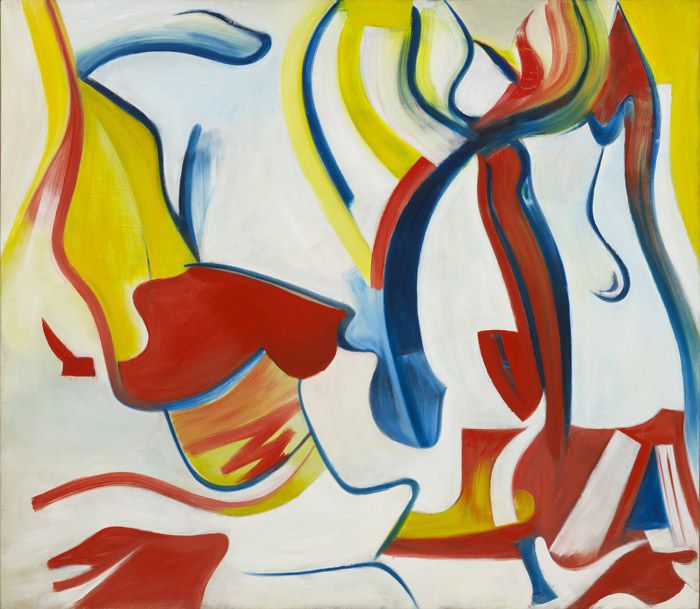
    “His late works, which some thought little of, are actually complex compositions suggesting figures that sway in foliage blown by the wind.”

    Willem-de-Kooning-Rider-Untitled-VII-1985

    Willem de Kooning, Rider (Untitled VII), 1985. Oil on canvas, 70″ x 6′ 8″ in. Courtesy of The Museum of Modern Art, New York. Purchase and gift of Milly and Arnold Glimcher


    Willem de Kooning Re-Writes Modernism at MoMA
    Harriet Zinnes

    There is no doubt that Willem de Kooning (l904-l997) is one of the most significant artists of the New York School. In this exhibition that will continue through January 12, 2012 at the Museum of Modern Art of almost 200 works within seven decades of the artist’s development the viewer can certainly agree with the curator John Elderfield that “de Kooning opened radical options for painting that ask us to reconsider how its modernist history should be told.” Here is an artist who worked not only in painting but also on drawings, prints, sculptures and created unusual works on paper. He is an artist who made statements about art that were always forceful and provocative. In 1949, for instance, he declared that “flesh was the reason why oil painting was invented.” And he believed in change in art, its constant new refinements. “Art,” he said, “should not have to be a certain way.” And in these seven decades of the artist’s work, by way of seven galleries, it is clear that his art is not done only in one way. Abstraction sits side by side with figuration, and both are glowing art. Consider, for example, his “Pink Angels” (1945).

    De Kooning, was an artist who at age 12, could paint a still life in Rotterdam and as a teenager working in a commercial design firm, learned such techniques as tracing, copying, and layering. But he left Rotterdam for the United States in 1926-actually by stowing away on a freighter. He was a prolific artist, one whose change of scenery naturally changed his art. Evidenced in his tranquil work of the late l950s, disturbing women paintings, and bronze sculptures such as “Cross-Legged Figure” of l972. And then there are the spare paintings of the 1980s, with large areas of whites, narrow bands and thin lines and shadowy figuration. The last paintings in the exhibition were done when the artist was suffering from Alzheimer’s disease, an ailment that took his life in 1997. His late works, which some thought little of, are actually complex compositions suggesting figures that sway in foliage blown by the wind.

    News | Exhibitions