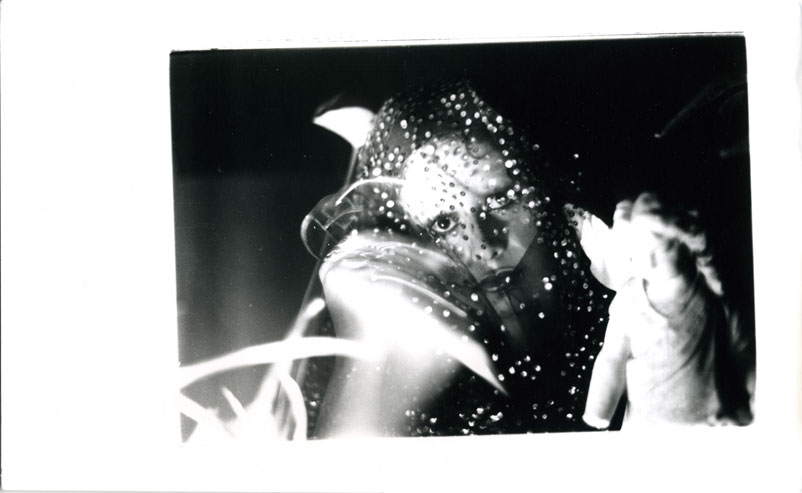
• Valentina Ciarallo: Who is Dephect?

    Ian Tweedy: Dephect is an alter ego of mine. I have had others but Dephect was most widely used and also known to the public. Dephect was a strategy, a way to penetrate different playing fields at one time, an artist, a guide, an activist, and a vandal.

    “When I paint today I try to emulate that feeling and continue with creating that perfect combination of painter, paint, space, and place.”

    Ian Tweedy, Retracing My Steps, 2011. Performance, painting (still frame). Courtesy of Complesso Monumentale Santo Spirito in Sassia, Rome and the artist.

    Around The World: Valentina Ciarallo Interviews Ian Tweedy

    Valentina Ciarallo: Who is Dephect?

    Ian Tweedy: Dephect is an alter ego of mine. I have had others but Dephect was most widely used and also known to the public. Dephect was a strategy, a way to penetrate different playing fields at one time, an artist, a guide, an activist, and a vandal.

    VC: What or who made you want to become an artist?

    IT: Still under the name of Dephect and a few others, I entered into a museum, I saw large artworks by Richter, De Kooning. There was one in particular that struck me, Motherwell’s Reconciliation. I thought, I’m already doing that, but on freight trains and walls. I still remember that day. I ran back to the hotel and busted out a ton of drawings. I drew consistently, even more than I was already making at that point. From there on, I went to as many modern and contemporary museums as possible. I started to appreciate art history and began to teach myself just out of pure curiosity. So I would say I was an artist from the age of fourteen on, but art museums helped me clarify what I had wanted from art, and specifically from painting.

    VC: You were born in Germany, on a U.S. military base, how has the military discipline influenced your works?

    IT: It’s not so much the base that influenced my work but the constant relocation from one base or country to the other. The bases where flat, boring, old, and decrepit. Not a lot of inspiration can come from that. Although when I was living in Frankfurt for a few years, right before moving to study art in Milano, I really enjoyed the nostalgia of these bases, some of them completely abandoned and cordoned off. I enjoyed exploring them and even squatted my first studio in one, actually in the same building where I worked in, a large apartment building used as a hotel for military and diplomats.

    VC: You started as a graffiti artist: what do you feel when you illegally paint on a wall, in the streets, as opposed to when you do it on a canvas, in your studio?

    IT: There is a very big difference between painting on a city wall or train and on a canvas. One is very pro-active and mostly relays on adaptation, instinct and the urban skills you learn from going out late every night prowling through the streets for places to paint on. Painting on canvas is a whole other story, it relays on a lot more. Now when I paint or draw, I don’t work anymore so much on canvas, although lately I’m getting back into it, but not stretching them, no need. I want the objectivity of a canvas instead, a sort of skin. Most of the time I work on objects that I can form a relationship with, or emulating objects/cut-out images that I have bonded with. It’s been awhile since I did graffiti, more than five years maybe. I do miss it. It felt great especially to step back in the end, take the photo and leave knowing you accomplished what you came there to do. Leaving the piece to stand on its own as a trace of what I stood for and made. There was a lot of magic involved with graffiti, that feeling you get when you come across an incredible painting on the wall found in the most unlikely and roughest of places. When I paint today I try to emulate that feeling and continue with creating that perfect combination of painter, paint, space, and place.

    VC: What would you like to achieve via your artistic research?

    IT: That’s a big question. I’m not sure how to approach it. I want to achieve a lot, yes…I want anarchy. I want direction and clarity or at least that’s what I strive for.

    VC: How did the Complesso Santo Spirito in Sassia inspire you and how do you relate Retracing my Steps to the ancient Complesso?

    IT: Starting off as a graffiti writer in Rome has definitely left its mark, especially its architecture, its use, and sense of space, the anarchic reality of daily life. The Complesso was once a place for pilgrims to stay, a place of healing, physically and spiritually. You can say that Retracing my Steps is an act of healing, even cleaning, not to say that there was any wrong done, but there is always a need to move on, to reconcile with the past.

    *** This article was published by NY Arts Magazine, 2011. NY Arts Magazine is published by Abraham Lubelski. Sponsored by Broadway Gallery, NYC and World Art Media.


    “I use strong colors, sometimes almost pure-ones.”

    Courtesy of the artist.

    Noris Maria Dias

    www.noris.no

    Searching for simplicity; I want to express emotions, opinions combined with a vibrating mixture of colors and figurative symbolism. I want to tell a story from the beginning, initiate a discussion, make people think and let them dream. The painting is universal. There is no hindrance of language. It’s visual emotion. It’s magic. I mix experiences from different places I have lived. Being a woman and mother; I see the world from a feminine point of view. I am questioning my situation and I identify myself with Mother Nature. I dislike the direction our society has taken and the choices taken by our leaders. We urgently need a global, feminine and social re-thinking.

    I love beauty, ethics, the subtle balance and the dualism of our existence. I use strong colors, sometimes almost pure-ones. Working with oil on canvas, I let the colors almost dry, each time creating new layers, enjoying my imagining that I create sculptures of colors.


    “When I am painting, music is omnipresent.”

    Courtesy of the artist.

    Kathy Clavette
    www.kathyclavette.com

    As a former drafter, I prefer flowers and ponds as subjects. They allow me to paint other things than straight lines, making room for gesture. Flowers need water, which is the reason it is almost always present in my painting. I like when my paintings shows lots of movements, letting the wind flow through them. The foreground catches the eyes, but always leaves room to see the immensity in the background. When I am painting, music is omnipresent. It is a pleasure to translate the rhythm and character of it. Through painting, I wish to offer dynamic, happiness, and peace to those who stop for a moment in front of it.

    The work of Massachusetts based artist, Jonathan Prince—currently on view until November 18 at the Sculpture Garden in the atrium of the old IBM building in New York City, under the title “Torn Steel”—like the artist himself who resembles Julian Schnabel, is big, bold, and undeniably ambitious. But underneath the swagger of the man and his work – this based on an in-depth studio visit, a couple of wide-ranging conversations of the inquiring kind, and of course the four, eye to mind-grabbing, sculptures on view–lives a sensitive soul.

    “seduced into conjuring up images of the earth’s fiery center, overflowing lava, and thoughts the human body housing an active soul.”

    Jonathan Prince, Torus 340, 2011. Oxidized and stainless steel, 13.5 x 12 x 8 ft. Photo Credit: Timur Civan. Courtesy of the artist.

    Jonathan Prince, Vestigial Block, 2011. Oxidized and stainless steel, 6 x 6 x 6 ft. Photo Credit: Timur Civan. Courtesy of the artist.

    Big, Bold, and Undeniably Ambitious: Jonathan Prince at the Sculpture Garden in NYC
    Edward Rubin

    The work of Massachusetts based artist, Jonathan Prince—currently on view until November 18 at the Sculpture Garden in the atrium of the old IBM building in New York City, under the title “Torn Steel”—like the artist himself who resembles Julian Schnabel, is big, bold, and undeniably ambitious. But underneath the swagger of the man and his work – this based on an in-depth studio visit, a couple of wide-ranging conversations of the inquiring kind, and of course the four, eye to mind-grabbing, sculptures on view–lives a sensitive soul.

    Though relatively new to the art world, that is, as a full time practitioner–Prince has only been sculpting 24/7 for the past eight years, a somewhat unbelievable fact given the sure footedness of his work–as a young boy he was drafted into the world of art through a series of visits with his father to the studio of artist Jacques Lipchitz. It was here that he was first exposed to contemporary art, to Lipchitz’s extensive collection of pre-Columbian sculpture, and experienced first hand–with a few demonstrations by the master himself–of what it means to be an artist.

    As a teenager, still smitten with the lesson of Lipchitz, Prince turned both hands to sculpting in stone, clay, as well as plaster. As fate would have it–following in his father’s footsteps like a good son–his trajectory led him to the art of dentistry and maxillofacial surgery. After three years in this highly precisioned eye to hand occupation, Prince turned to directing and producing films and computer animated special effects projects. After successfully embracing the art and science of filmmaking for a number of decades, he returned – an argument could be made that he never left it –to his first love, that of sculpting.

    In Torn Steel, his newest series, Prince—although known primarily for his work in black granite, stone, and marble, each harboring traces of Noguchi and Brancusi—uses steel, oxidized and stainless, to implement his vision. “Steel is less tight than stone. It gives me the opportunity to cut something or to weld it back,” he told one interviewer. “What I’m hoping to create is the intersection between chaos theory and refined geometry.” True to his word, the artist’s four, geometrically shaped works, set down among the atrium’s elegant stand of bamboo trees–the cellular softness of nature embraces our industrial civilization–does just that.

    At first glance, Prince’s monumental sculptures appear to be nothing more than simple geometric forms, a square with a broken edge, a column with its top gouged, and a couple of circular sculptural riffs, one resembling a large distressed pill set on edge, the other a partially eaten donut doing a clever balancing act. On closer examination, the lively quartette begins to take on an otherworldly, if not quasi-religious cast. We ask ourselves, refraining from the act of praying, are these objects relics of worship from a lost civilization, artifacts left behind by a race that died off, Hollywood studio props leftover from some Roman epic, or are they really post-modern sculptures waiting to be transported to some city plaza.

    Though each sculpture, massive in appearance but deceptively hollow in actuality, is simply dressed in its mostly oxidized appearance the labor-intensive process to get them there is anything but. It all begins with Prince sketching out a concept. After refining it on the computer, he creates a urethane foam model, along with a series of engineering drawings, which enable him to order the necessary materials for fabrication. After he constructs a geometric work, he marks the sections to be “torn” out from the sculpture with a plasma cutter. Then the stainless steel plates are shaped, welded into the form, the patterns are overlaid onto the plates with a MIG welder in stainless steel, and all areas smoothed and blended with a TIG welder. Finally, the stainless steel areas are smoothed and polished with various abrasives.

    The most satisfying and easily digestible-also the most challenging in its simplicity- of the four sculptures on view is Vestigial Block, Prince’s six foot square cube. It is here at the six by six foot cube, unfettered by the jagged cuts and molten steel plating found at the top of Totem, at the two ends of Torus, and on the of Disc Fragment, that Prince’s technique of exposing the soft molten innards buried within the sculpture’s hard outer shell appears at its least forced and most natural. It is also at this stop, while basking gently in light of this daringly modest sculpture, that our mind is gently seduced into conjuring up images of the earth’s fiery center, overflowing lava, and thoughts the human body housing an active soul.

    Note: The Torn Steel exhibition at the Sculpture Garden at 590 Madison Avenue and 57th Street, New York City, runs through November 18, 2011. For those unable to make it to the exhibition a beautiful video filmed during the exhibition’s installation with Ghostland Observatory singing Sad Sad City from their 2006 Paparazzi Lightning Album in the background, will put you front and center.

    www.youtu.be/JtFQnQc-b0g .

    *** This article was published by NY Arts Magazine, 2011. NY Arts Magazine is published by Abraham Lubelski. Sponsored by Broadway Gallery, NYC and World Art Media.

    Jennie C. Jones’ new show at the Kitchen places the viewer within the divide between the physical permanence of material and the ethereality of the sonic. The gallery space serves as a venue to situate a series of paintings in direct relation to a darkly resonant sonic backdrop.

    Jones has used a process she has dubbed “micro-sampling.” This appropriation borrows single notes from existing compositions, rather than whole musical phrases or measures. The artists sampled range widely: from the great jazz composer Charles Mingus to musical genius J.S. Bach; while at the same time pulling from work by contemporary artists such as the XX and Edgar Meyer, to name a few.

    “[The] paintings both operate as contemplative minimal abstractions as well as structural intrusions into the gallery space…”

    Jennie C. Jones, Installation View from left (Bar-Line Shift (Grey), From The Low, Diffuse With Undertone, All works 2011.

    Jennie C. Jones: Absorb/Diffuse
    Matthew Hassell

    Jennie C. Jones’ new show at the Kitchen places the viewer within the divide between the physical permanence of material and the ethereality of the sonic. The gallery space serves as a venue to situate a series of paintings in direct relation to a darkly resonant sonic backdrop.

    Jones has used a process she has dubbed “micro-sampling.” This appropriation borrows single notes from existing compositions, rather than whole musical phrases or measures. The artists sampled range widely: from the great jazz composer Charles Mingus to musical genius J.S. Bach; while at the same time pulling from work by contemporary artists such as the XX and Edgar Meyer, to name a few. The sonic glue that Jones applies to hold all the samples together is a tendency towards deep, rumbling bass and intermittently placed ringing squeals and sharper pitches.

    Entitled From The Low, Jones’ samples have been assembled into a collection of three hauntingly beautiful tracks. The work plays in stereo, both from a large square speaker in the far right corner of the exhibition space as well as from speakers placed above the viewer throughout the gallery.

    As one stands alone in the gallery space, the intermittent silences between tracks in Jones’ sonic appropriation call to mind the pregnant silences often used to great effect in cinema. As I move about studying the painting works, the music starts up again, seemingly presenting ominous dramatic accompaniment to my movement around the exhibition space. The low bass selected by Jones is a fitting partner to the deeply receding visual voids she creates out of black acrylic on canvas and sound reduction paneling. Lit evenly from above so that their resulting shadow presence on the wall announces their object-hood, these paintings both operate as contemplative minimal abstractions as well as structural intrusions into the gallery space, subtly dampening the resonance of the sound projected throughout the exhibition.

    Aside from actually being constructed from sonic diffusion panels, the paintings also reference musical arrangement in their positioning from each other on the wall and in the use of titles such as Deep Tone and End Measure.

    Dubbed Acoustic Paintings, the suggestion here is that the painting and sound work play off of each other in a symbiotic environment. The projected sound reflects and is absorbed by the paintings, which are in turn receiving and gently altering the music. The visual work’s relationship to the weight of the sonic presence is perhaps most overtly illustrated in the piece entitled Long, Low, Rest (semibreve). Here five framed pieces of paper are hung along side one another to create one horizontal composition 100 inches long. The top of each piece in the work is adorned with a swath of meaty dark grey acrylic paint. Hung at knee height, the work seems to have succumbed to the sonic pressure over the course of the exhibition. It has come to rest here, having been slowly pushed down the wall away from the constantly projected sound.

    Jones is reminding us that we are not the only ones feeling the effect of sound waves bouncing errantly throughout our environment. Objects have a largely unseen relationship to the wear and tear of regular sonic bombardment. It would be an interesting experiment here to disassemble the sound panels from the canvas for the purpose of studying whether there is a discernable line between protected and exposed areas of painting. Whether or not this would be the case, pondering the implications of this unseen interaction is rather alluring. One can imagine a hardly perceptible world, oblivious to human interaction–an existence where objects are constantly caressed by invisible fingers of sound.

    *** Jennie C. Jones, “Absorb/Diffuse” was on view at The Kitchen September 8 – October 29, 2011.

    ***This article was published by NY Arts Magazine, 2011. Sponsored in part by Broadway Gallery, NYC.


    “Each work celebrates life”


    Courtesy of the artist.

    Nora Garcia
    gabeaar@yahoo.com.ar


    My work is self-referential. The objects comprise a reunion between chance and my own experience in life.

    Each work celebrates life, rescuing elements that memory had relegated and deep affections of my own existence.

    Combining lost and recuperated memories; I try to establish a harmony with the material object and the immensity of an uninhabited space without any anecdotal referent.

    Like a long-forgotten punk band from the 1970s—perhaps the art world’s equivalent to the New York Dolls—Asco makes a vibrant return to public consciousness with an elegant, formal retrospective at the Los Angeles County Museum of Art.

    As is often the case when talent has been long unrecognized, the exhibition is a bittersweet and somewhat ironic twist in the history of the group. Legend has it that, in an attempt to ingratiate themselves with a curator in the early 70s, this group of artists made a visit to LACMA to present some of their work. The curator dismissed the work, and more importantly, dismissed the culture that had created it. “Chicanos aren’t artists. They’re gang members.”


    “The curator dismissed Asco’s work: ‘Chicanos aren’t artists.
    They’re gang members.’”

    05-Scissors_1

    Asco, Scissors, 1974. Collage on paper, 8.5 x 11 in. Courtesy of the Department of Special Collections, Stanford University Library.

    Disgust in LA: Asco Returns
    Roberto Bentivegna

    Like a long-forgotten punk band from the 1970s—perhaps the art world’s equivalent to the New York Dolls—Asco makes a vibrant return to public consciousness with an elegant, formal retrospective at the Los Angeles County Museum of Art.

    As is often the case when talent has been long unrecognized, the exhibition is a bittersweet and somewhat ironic twist in the history of the group. Legend has it that, in an attempt to ingratiate themselves with a curator in the early 70s, this group of artists made a visit to LACMA to present some of their work. The curator dismissed the work, and more importantly, dismissed the culture that had created it. “Chicanos aren’t artists. They’re gang members.” If this were a Hollywood narrative, that meeting would be the inciting incident that propels the story forward. And so it did.

    Asco, which means “disgust” or “nausea” in Spanish, was formed in 1971 in the rough neighborhood of East Los Angeles by Gronk (Glugio Nicandro), Willie F. Herron III, Harry Gamboa Jr., and Patssi Valdez. The group’s art pieces ranged from graffiti to performance art to photography.

    Inevitably, Los Angeles culture plays a large part in the group’s work. One of their central projects, “No Movies,” is a witty and biting critique of fame, equality, and materialism in Hollywood. It chronicles the filmmaking process, down to the awards ceremony, by presenting … no film at all. The focus is placed on appearance, on pretense. It is perhaps the most symbolic of Asco’s projects, and illustrates the overriding theme throughout their work: Los Angeles as a city of narcissism, of cultural elitism, and of hopeless hopefulness.

    NY ARTS MAGAZINE

    Asco, Instant Mural, 1974. Photograph, 16 x 20 in. Courtesy of Harry Gamboa Jr.

    One of the most striking photographs on display is Decoy Gang War Victim. Asco members went at night to neighborhoods marred by gang violence and created fake crime scenes in which Gronk would play a young corpse on the pavement, surrounded by police flares. The scene would be photographed and the pictures would be sent to newspapers and television stations, as a way to sow confusion both in the news media—which Asco saw as perpetuating gang violence—and even among the gangs themselves, to prevent more violence. The shot, with its metallic blue tint, symmetrical flares and shallow depth of field, is inherently cinematic. It could be taken from a Michael Mann film, but this is art imitating reality and throwing it back in reality’s face—a jab at sensationalist news reports and crime photography.

    A particularly telling display takes us through the relationship between Gronk and Jerry Dreva, a fellow artist he met at a gay bar in Silverlake. A letter from Dreva gives us some insight into the hardships, both practical and emotional, that came with the lifestyle. He writes that he is “often very happy (…) often very sad” and that he has to focus on “day by day survival.” He sends Gronk a series of photo booth shots of himself, framed by Gilette razor blades. “Careful when you open the package. It’s razor art.”

    Just like 70s punk music, the achievements of Asco work primarily on a visceral level. This is not art for the elite, nor is it the product of a specific school. It is a violent reaction by a group of young, unbridled artists with nothing to lose and a reputation to gain. One of the baffling contradictions of Los Angeles is the cultural suppression that Chicanos have endured. Unlike, say, Miami, where Cubans are a pillar of society and the recognized force behind industry, Chicanos have had to overcome a wall of ignorance in California. For some, it was easier to try and assimilate, to somehow leave the past behind and move forward.

    To Asco, the issue of identity was the fire that fuelled their creativity. But it also led to some powerful and unexpected foresight. We live at a time in which people create impressions of themselves on social networking websites, parading achievements as though they were Hollywood stars. And a time in which fame is as attainable as a stolen sex video. To be sure, much has changed since the Asco days, but then again much has not, which explains the group’s continuing relevance nearly four decades later. Everyone is a star in his or her very own “No Movie,” but few are as relevant today as Asco themselves.

    *** This article was published by NY Arts Magazine, 2011. NY Arts Magazine is published by Abraham Lubelski. Sponsored by Broadway Gallery, NYC and World Art Media.

    Zaha Hadid, one of the most innovative architects of the 21st century and the first woman to receive the renowned Pritzker Architecture Prize, in 2004, has advanced the language of contemporary architecture and design, exploring complex fluid geometries and using cutting-edge digital design and fabrication technologies. For Zaha Hadid: Form in Motion, an exhibition at the Philadelphia Museum of Art. Hadid will create an all-encompassing environment to display examples of the furniture, objects, and footwear she has designed in recent years as well as the prototype for her Z-Car I (2005).

    “Hadid will create an all-encompassing environment to display examples of the furniture, objects, and footwear she has designed in recent years as well as the prototype for her Z-Car I (2005).”

    Zaha Hadid, Z-Chair, 2011. Stainless steel, 34 5/8 x 24 x 36 ¼ in, silver. Enrico Sua Ummarino. Courtesy of Sawaya & Moroni.

    Installation Design by Zaha Hadid at the Philadelphia Museum of Art
    Norman A. Keyes, Gigi Lamm

    Zaha Hadid, one of the most innovative architects of the 21st century and the first woman to receive the renowned Pritzker Architecture Prize, in 2004, has advanced the language of contemporary architecture and design, exploring complex fluid geometries and using cutting-edge digital design and fabrication technologies. For Zaha Hadid: Form in Motion, an exhibition at the Philadelphia Museum of Art. Hadid will create an all-encompassing environment to display examples of the furniture, objects, and footwear she has designed in recent years as well as the prototype for her Z-Car I (2005). This exhibition will be the first in this country to feature Hadid’s product designs in a setting of her own creation. “As an architect, Zaha Hadid has challenged many perceived ideas in the field of architecture and design, exploring and exploiting new technologies in the service of creating a new language of space and structure,” said Timothy Rub, Director of the Philadelphia Museum of Art. “We are delighted that she has created for us an installation design that provides a dynamic setting for the presentation of her recent designs and will both challenge and delight our visitors.”

    Combining architecture and design, Zaha Hadid: Form in Motion will display an undulating environment of finished polystyrene and vinyl structures based on curvilinear geometries. Exploiting a formal language of fluid movement, the design of Hadid’s exhibition emphasizes the continuous nature of her work and how the fields of architecture, urbanism, and design are closely interrelated in her practice.

    “Hadid envisions the gallery as an active element in the display of her own designs, and will create an immersive environment from top to bottom,” said Kathryn Bloom Hiesinger, Curator of European Decorative Arts after 1700. “She is interested in the interface between architecture, landscape, and geology, and explores the intersection of these elements with a spatial composition that ebbs and flows in wave-like movements, manipulating the viewer’s understanding of space with constantly shifting perspectives.”

    Sleekly curving sofas, tables, and chairs made of materials ranging from steel and aluminum to polyurethane will inhabit the gallery, while jewelry, shoes, and tableware installed together in small groups along a rippling wall represent the wide variety of new and unusual shapes Hadid has introduced into the language of design. The Mesa Table is supported by branching, lofted connectors, more void than solid, while a table made of polished aluminum appears to hover close to the floor supported only by the same invisible forces that generate the craters on its surface. The striated video wall, sinuous floor and wall graphics will transform the gallery and its contents into a singular, fluid, dynamic composition.

    Some works are disguised as micro-architecture, such as the Coffee & Tea Set (1997), nearly unidentifiable as a set of containers for tea, coffee, milk, and sugar. Others, including WMF Flatware and Crevasse Vases, are more transparent in function. Among the highlights are a collection of Swarovski crystal-encrusted necklaces and bracelets, and spiraling, strappy shoes made for Lacoste and Melissa. Hadid’s three-wheeled Z-Car I, an aerodynamic prototype mimicking several of Hadid’s sculptural forms, will be on view in the Perelman Atrium.

    Zaha Hadid: Form in Motion is on view at the Philadelphia Museum of Art from September 17, 2011 through March 25, 2012.

    *** This article was published by NY Arts Magazine, 2011. NY Arts Magazine is published by Abraham Lubelski. Sponsored by Broadway Gallery, NYC and World Art Media.

    The New Museum presents the first New York survey exhibition of the work of the artist Carsten Höller (b.1961, Brussels, lives and works Stockholm). Over the past twenty years, Höller has created a world that is equal parts laboratory and fun house, exploring such themes as safety, childhood, love, happiness, transportation, and the future. Höller left his early career as a scientist in 1994 to devote himself exclusively to art making, and his work is often reminiscent of research experiments. His pieces are designed to explore the limits of human sensorial perception and logic through carefully controlled participatory experiences.

    “Höller’s pieces are designed to explore the limits of human sensorial perception and logic through carefully controlled participatory experiences.”

    NY Arts Magazine

    Carsten Höller, Maison Ronquières (The Laboratory Of Doubt), 2000. Installation view, Museum Boijmans Van Beuningen, Rotterdam, 2011. Photo Credit: Atillio Maranzano. Courtesy of Fondazione Prada, Milan.

    New Museum Presents First Survey of Works by Carsten Höller in New York
    Gabriel Einsohn

    The New Museum presents the first New York survey exhibition of the work of the artist Carsten Höller (b.1961, Brussels, lives and works Stockholm). Over the past twenty years, Höller has created a world that is equal parts laboratory and fun house, exploring such themes as safety, childhood, love, happiness, transportation, and the future. Höller left his early career as a scientist in 1994 to devote himself exclusively to art making, and his work is often reminiscent of research experiments. His pieces are designed to explore the limits of human sensorial perception and logic through carefully controlled participatory experiences.

    The New Museum’s exhibition includes work produced over the past twenty years in an immersive, interactive installation choreographed in collaboration with the artist. Höller actively engages the Museum’s architecture, with each of the three main gallery floors and the lobby of the building presenting a focused selection of pieces that demonstrate different visual or experiential dimensions of his work. Included are be Höller’s signature stroboscopic light installations, disorienting architectural environments, a spinning mobile, a spectacular mirrored carousel, a sensory deprivation pool, and a number of smaller works installed throughout the entire building. The works emphasize the experimental quality of Höller’s work and reveal the complex universe of one of the most significant European artists to emerge in the past twenty years. He came to prominence alongside a group of artists in the 1990s including Maurizio Cattelan, Pierre Huyghe, Philippe Parreno, Rirkrit Tiravanija, and Andrea Zittel who worked across disciplines to re-imagine the experience and the space of art. Höller stands out from this group for the manner in which his installations drew on the history and method of scientific experimentation to destabilize the viewer’s perception of physical space and time. In providing this first opportunity for the public here to examine the full scope of Höller’s artistic experiments, the exhibition follows in the New Museum’s tradition of introducing the most adventurous international artists to an American audience.

    Carsten Höller, Mirror Carousel, 2005. Mirrors mounted on MDF panels, lightbulbs, stainless steel seats, stainless steel chains, steel construction, electric motor, cables, Height: 470 cm. Footprint: 750 X 750 cm (CH 615). Installation view: Logic, Gagosian Gallery, London. Photo Credit: Attilio Maranzano. Courtesy of the New Museum.

    Carsten Höller’s work is first and foremost concerned with altering our basic assumptions about what we see, feel, and understand as humans. Over the years, the artist has employed psychotropic drugs, flashing lights, and architectural alterations to overwhelm viewers with visual stimuli and challenge accepted self-perceptions. For example, the immersive installation Light Room (2008) uses a sequence of flashing lights to give viewers the sensation that the space around them is rotating. Höller also has exhibited a variety of adapted amusement park rides whose speeds slowed down until they move almost imperceptibly. His Mirror Carousel (2005) provides riders with a physical experience radically different from the traditional fairground merry-goround, while at the same time reflecting and illuminating the space surrounding it. In such works, Höller invites us to reconsider the meanings of play and participation. Höller’s art has often taken the form of proposals for radical new ways of living. He has created sculptures and diagrams for visionary architecture and transportation alternatives like his renowned slide installations. These concepts may seem impossible in the present day, but suggest new models for the future. The artist’s proposals and structures invite the viewer to re-imagine the social and sensorial possibilities of domestic space. During the 1990s, Höller collaborated with artist Rosemarie Trockel to create structures shared between humans and animals such as pigs, birds, and mosquitoes, calling into question hierarchies of species and the roles of the observer and the observed. Recently, Höller has invited viewers to share the exhibition space with a variety of creatures from reindeer to canaries to mice. At the New Museum, viewers are encouraged to test a variety of sculptural experiences. In one of Höller’s Psycho Tanks, visitors will float weightlessly on the surface of a sensory deprivation pool, providing a strange, out-of- body experience. In these scenarios, as in his other work, Höller treats the viewer as the subject and audience for his radical and disorienting experiments.


    ***Carsten Höller: Experience will be on view at the New Museum, New York, from October 26, 2011 – January 15, 2012, and is curated by Massimiliano Gioni, Associate Director and Director of Exhibitions.

    Valerie Margolis, OK Harris Works of Art, NYC, Oct. 29


    Valerie Margolis
    OK Harris Works of Art

    383 West Broadway
    Soho

    October 29 – December 3, 2011 

    Opening: Saturday, October 29, 3 – 5 PM

    News | Exhibitions