• For as long as I can remember, the camera has enticed me to explore the world through its lens. As a result, I have employed the camera to express my conscious or subconscious imaginings.  Sometimes it is to share with others.  At other times, it is to engage in a solitary and personal revelry in the moment, with work that might only be discovered upon my passing.  An artist shows his strength and bravery the moment he allows an honest representation of his deepest impulses to emerge onto the medium.  My honest expression tends to generate work which is subtle, and allows space for viewers to fill with their imaginations.

    “The camera becomes an extension of my hand”


    Mack Sturgis (Alter Ego of Richard Bettinger) Church and State, 2010.  Digital, Nikon D3S print.  Courtesy of the artist.


    Richard Bettinger:  Provocation or Shock?
    Richard Bettinger

    For as long as I can remember, the camera has enticed me to explore the world through its lens. As a result, I have employed the camera to express my conscious or subconscious imaginings.  Sometimes it is to share with others.  At other times, it is to engage in a solitary and personal revelry in the moment, with work that might only be discovered upon my passing.  An artist shows his strength and bravery the moment he allows an honest representation of his deepest impulses to emerge onto the medium.  My honest expression tends to generate work which is subtle, and allows space for viewers to fill with their imaginations.

    During a shoot I experience a loss of self, a oneness with the light dancing on the subject, or with the light simply dancing on its own as the subject itself.   It is this light source that conveys an energy which to me represents the essence of life.  The camera becomes an extension of my hand, whether focusing on details or taking in the entire environment, moving toward that which is beyond the tenuous grasp of reality.  The moment the shutter releases, what is captured becomes history. 

    By using a crafted combination of camera movement, shutter speed and lens manipulation, I am able to take a subject away from being ‘real’, or compressed, into something having the appearance of being de-contextualized and made free.  In this way I have recorded movement with a still camera, making my subject appear as if it were echoing itself or being followed by its own history.   These images complement my series of Essence portraits, which through movement and creative focus, capture the mood and spirit of the person before the camera – their essence.

    This article was published by NY Arts Magazine, 2011. NY Arts Magazine is published by Abraham Lubelski. Sponsored by Broadway Gallery, NYC and World Art Media.


    New York-based artist Josiah McElheny is a sculptor, performance artist, writer and filmmaker, best known for his use of glass with other materials. For his Bloomberg Commission he uses light and mirrors to transform the Whitechapel Gallery into a hall of mirrors.

    Josiah McElheny is the latest artist invited to create a new work of art for The Bloomberg Commission sited in the former Whitechapel library (now part of the Gallery), built in 1892 as a ‘lantern for learning’.

    “The sculptures will reflect and refract the projected film selection, saturating the whole gallery and visitors in images and light.”


    Josiah McElheny, The Past Was a Mirage I’d Left Far Behind, 2011.  Courtesy of Whitechapel Gallery, London.


    Josiah McElheny: The Past Was a Mirage I’d Left Far Behind
    Whitechapel Gallery London

    New York-based artist Josiah McElheny is a sculptor, performance artist, writer and filmmaker, best known for his use of glass with other materials. For his Bloomberg Commission he uses light and mirrors to transform the Whitechapel Gallery into a hall of mirrors.

    Josiah McElheny is the latest artist invited to create a new work of art for The Bloomberg Commission sited in the former Whitechapel library (now part of the Gallery), built in 1892 as a ‘lantern for learning’.

    Seven large-scale, mirrored sculptures will be arranged as multiple reflective screens for the artist’s interpretation of groundbreaking, experimental abstract films, programmed to change throughout the year. The sculptures will reflect and refract the projected film selection, saturating the whole gallery and visitors in images and light. Refracted, distorted and multiplied, the moving images explore how abstraction is used to depict an image of visual enlightenment.

    The Bloomberg Commission: Josiah McElheny is displayed in Gallery 2, a dedicated space for site-specific works of art that was previously the reading room of the former Whitechapel Library. Inspired by the history of the Library as a creative haven for early modernist thinkers such as Isaac Rosenberg and Mark Gertler, McElheny’s new work explores the history of abstraction in film and video, reinterpreting them by presenting fractured, constantly morphing versions.

    Drawing on the history of the former library as a centre for social reform and modernist ideals in Britain, this major installation is accompanied by a series of film presentations, lectures and events exploring the notion of abstraction in the moving image.

    Josiah McElheny, The Past Was a Mirage I’d Left Far Behind, 2011.  Courtesy of Whitechapel Gallery, London.


    Josiah McElheny (b. 1966) lives and works in New York. His work combines a conceptually rigorous examination of history with an ability to create deeply engaging sensory experiences.

    The Bloomberg Commission invites an international artist to create an annual site-specific artwork inspired by the rich history of the former library. Previous commissions were created by artists Goshka Macuga (2009) and Claire Barclay (2010). Bloomberg’s support reflects its commitment to innovation, and its ongoing efforts to expand access to art, science and the humanities.

    The Bloomberg Commission: Josiah McElheny: The Past Was a Mirage I’d Left Far Behind is on view from September 7 – July 2012 at Whitechapel Gallery in London.

    This article was published by NY Arts Magazine, 2011. NY Arts Magazine is published by Abraham Lubelski. Sponsored by Broadway Gallery, NYC and World Art Media.


    Feb 16-19, 2012

    The New Museum has announced its list of participating artists in the 2012 Triennial, the only recurring exhibition in the United States devoted to presenting young artists from around the globe. Opening to the public on February 15, the Triennial will feature thirty-four artists, artist groups, and temporary collectives, totaling over fifty participants, born between the mid-1970s and mid- 1980s, many of whom have never before exhibited in the US. This second New Museum Triennial, titled “The Ungovernables,” is curated by Eungie Joo, Keith Haring Director and Curator of Education and Public Programs. The exhibition will be on view throughout the entire Museum until April 22, 2012.

    “The Ungovernables is meant to suggest both anarchic and organized resistance and a dark humor about the limitations and potentials of this generation.”


    Adrián Villar Rojas, Ahora estaré con mi hijo, el asesino de tu herencia (Now I Will Be with My Son, the Murderer of Your Heritage), 2011. Clay, cement, burlap, and wood, dimensions variable. Installation view: Argentinian Pavilion, 54th Venice Biennale. Courtesy the artist. Photo: Oliver C. Haas


    New Museum Announces 2012 Triennial Artists
    The New Museum

    The New Museum has announced its list of participating artists in the 2012 Triennial, the only recurring exhibition in the United States devoted to presenting young artists from around the globe. Opening to the public on February 15, the Triennial will feature thirty-four artists, artist groups, and temporary collectives, totaling over fifty participants, born between the mid-1970s and mid- 1980s, many of whom have never before exhibited in the US. This second New Museum Triennial, titled “The Ungovernables,” is curated by Eungie Joo, Keith Haring Director and Curator of Education and Public Programs. The exhibition will be on view throughout the entire Museum until April 22, 2012. The exhibition’s title sponsor is the Joe Fresh brand, a new-to-New-York fashion line.

    “The Ungovernables” is an exhibition about the urgencies of a generation who came of age after the independence and revolutionary movements of the 1960s and 1970s. Joo conducted primary research for the Triennial in more than twenty countries over the course of eighteen months, visiting hundreds of artists in the process. “In many ways this generation was formed by the instability of a period marked by military dictatorships, the IMF crises of the 1980s and 1990s, the spread of global capitalism and the rise of fundamentalism,” Joo says. “But what I encountered were artists whose practices demonstrate remarkable resiliency, pragmatism, flexibility and hopefulness.”

    Through both materials and form, works included in “The Ungovernables” explore impermanence and an engagement with the present and future. Many of the works are provisional, site-specific, and performative reflecting an attitude of possibility and resourcefulness. In the sculpture of Adrián Villar Rojas, monumentality is juxtaposed with transience. Rendered in clay, the works depend on cracks on their surfaces—the inevitable failure of the object, of meaning, and the guaranteed transformation of all ideas and objects back to dust. But it is dust that is then repurposed, re-imagined, and re-formed. When Danh Võ learned that the Statue of Liberty is simply a steel armature covered by a copper skin the thickness of two pennies, he researched the hammering process that gave her shape, then employed craftsmen to replicate the statue’s skin for his work WE THE PEOPLE.

    Abigail DeVille, What Happens to a Dream Deferred…Supernova, 2009. Cardboard, paint, paper, and plastic, 20 x 12 sq. ft (6 x 3.6 sq. m). Installation view: Bronx River Art Center, Bronx, NY. Courtesy the artist. Photo: LaToya Ruby Frazier


    Julia Dault manipulates materials of modernity such as Formica and Plexiglas in temporal arrangements that can never be repeated. In her works, the artist’s labor is dependent on the conditions of a certain space, her strength to execute a work at a particular time, and the uncontrollable accidents her materials determine. House of Natural Fiber, a new media collective and alternative space, has recently combined microbiology and art to teach locals about safe ways to brew homemade fruit wine while amplifying and sampling the sounds of the distillation process to make electronic music. Jonathas de Andrade’s Ressaca Tropical (Tropical Hangover) is an installation of over one hundred photographs linked to pages of a romantic diary found in the trash. In isolation, the components of Ressaca are historical documents. However, pieced together, they comprise a larger fiction of what a city is and can be—how the past can remain alive, not through conservation, but instead through the invisible energy of living.

    “The Ungovernables” is testimony to the breadth and vitality of cultural production outside of familiar, Western market centers,” says Lisa Phillips, Toby Devan Lewis Director. “The New Museum recognizes that this signals an important paradigm shift for the twenty-first century.”

    The exhibition title takes its inspiration from the concept of “ungovernability” and its transformation from a pejorative term used to describe unruly “natives” to a strategy of civil disobedience and self-determination embraced by the African National Congress in South Africa in 1986. “The Ungovernables” is meant to suggest both anarchic and organized resistance and a dark humor about the limitations and potentials of this generation.

    “The Ungovernables” Opens to the public February 15, 2012

    This article was published by NY Arts Magazine, 2011. NY Arts Magazine is published by Abraham Lubelski. Sponsored by Broadway Gallery, NYC and World Art Media.


    I believe that bringing diverse groups of people together to listen to each other’s stories is an end in itself.  Life stories have the power to dispel fear, challenge one’s values and inspire compassion.  There is urgency in the impulse to tell these particular stories, considering that one out of every 30 Santa Monicans is homeless on any given day, and that many more are food-insecure.  

    “Food insecurity” is defined as existing “whenever the availability of nutritionally adequate and safe foods or the ability to acquire acceptable foods in socially acceptable ways is limited or uncertain.”

    “My collaborators and I want our work to be judged as much for its artistic achievement as for its social impact.”


    Courtesy of Who’s Hungry, 2011.


    Art & Urgency
    Dan Froot

    I believe that bringing diverse groups of people together to listen to each other’s stories is an end in itself.  Life stories have the power to dispel fear, challenge one’s values and inspire compassion.  There is urgency in the impulse to tell these particular stories, considering that one out of every 30 Santa Monicans is homeless on any given day and that many more are food-insecure.  

    “Food insecurity” is defined as existing “whenever the availability of nutritionally adequate and safe foods or the ability to acquire acceptable foods in socially acceptable ways is limited or uncertain.” Even at its most local, food insecurity is the nexus of so many systematic social predicaments: health-care, education, the economy, trade policies, and more.  I want to stop seeing hunger as an issue, and begin understanding, from the perspective of the street, forces that come between the world’s abundance and so many of the people around me.

    I also believe that the way a story is told is as important as the story itself.  My collaborators and I want our work to be judged as much for its artistic achievement as for its social impact.  Our intent is to bear witness to our neighbors’ otherwise untold stories, rather than to compose broad statements about “hunger in America.”

    Everything about this project is small: these are local narratives, embodied in small-scale handcrafted worlds.  Skilled puppeteers animate handheld objects; a band of three musicians sets the tone for each play.  Our audiences too will be small: each performance will accommodate a maximum of 90 people. This intimate gathering of economically diverse audiences from neighborhoods surrounding the shows’ venues is
    one of the project’s main purposes.  Foregoing the anonymity of larger groups, our audiences will huddle together for optimal viewing of the miniature objects.

    Immediately afterward they will be invited to participate in facilitated discussions between the artists and community narrators, as well as representatives from local social service agencies and fellow audience members.

    * National Research Council: Food Insecurity and Hunger in the United States: An Assessment of the Measure; 2006, The National Academies Press.

    This article was published by NY Arts Magazine, 2011. NY Arts Magazine is published by Abraham Lubelski. Sponsored by Broadway Gallery, NYC and World Art Media.


    “Human beings and the body have been the main focus of Martina Reinhart’s work since 2004.”


    Courtesy of the artist.


    Martina Reinhart
    www.artreinhart.at


    Human beings and the body have been the main focus of Martina Reinhart’s work since 2004. First it was a cycle of The Image of Woman, then the cycle of The Image of Man, followed by the cycle The Image of Children. She exhibits the different stages of life and their respective perceptions. In the year 2007, Reinhart created the cycle ´Chimeras´. In the cycle ´Dream-Creatures´ the artist goes one step further in confronting the viewer with our modern society, where people become more or less fantasy figures themselves. Therefore, she starts with the stylized Barbie-Doll. And then creates mixed entities: half human, half doll, half human, half animal, fabled creatures; all of which we already know from Greek mythology, yet with an additional dimension. 

    Reinhart works primarily with acrylics on canvas. In addition to purely painting, Reinhart has also experimented with various print techniques. These techniques have inspired her to a more intensive confrontation with the construction of reality in a socio-aesthetic context, and have added complexity and depth to her works. Her latest cycle is about knowledge and its structures

    –Bettina Nezval

    Martina Reinhart studied painting at the Academy of Fine Arts in Vienna and did her PhD in philosophy. She has won different prizes and her work has been exhibited in solo and group shows nationally and internationally. Featured in March 2012, International Artist at Home and Abroad Exhibition Series are these 3 works. It is part of a body of work called Dream-Creatures and Bodies.

    — Edmund Steirer


    “I am interested in competing levels of information.”


    Courtesy of the artist.


    Mark Moffett
    www.moffko.com


    My current work explores encaustic as a vehicle for a line that is part of the surface rather than painted on the surface. By carving into and backfilling smooth, built-up panels of the beeswax medium, I obtain a direct, stamp-like simplicity. Projecting greater complexity, the built-up panels offer impressionable grounds that may receive any number of embedded representations as simultaneous information.

    As an artist, I am interested in competing levels of information—ways of representing multiplicity and the harmonic incoherence of mixed signals. The general malleability of wax and the crisp outlay of variously descriptive elements allow me to pose, preserve, and strategize an overall effect of accumulated energy. While my uses of subject matter veer between the self-evident and the enigmatic, the clustering of references is meant to promote readings that are less dependent on the imagery itself than on the distracted abstractions that result.


    “The original task of every artist is to communicate messages with his artwork.”

    Image courtesy of the artist.

    Image courtesy of the artist. 

    Manuella Muerner-Marioni
    www.arte-manuella.ch


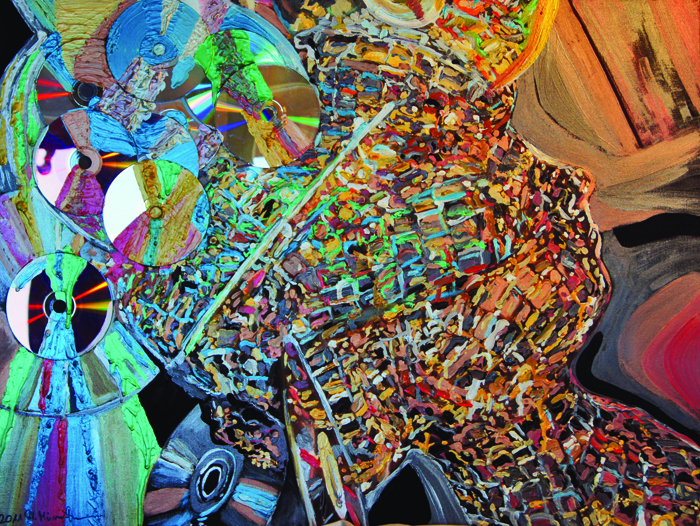
    The original task of every artist is to communicate messages with his artwork. Unfortunately this task by many artists of today is no longer perceived. For various reasons I selected my new artwork entitled Brainstorming.

    Brainstorming consists of a head with integrated CD’s. Why? Do you have sometimes a thought in your head, which does not want to disappear? Or perhaps a piece of music? And always the same piece of music and the same bad thought? I think, we all know this! For this reason I put the CD’s on the painting!

    Why are they so colored? Because we have different thoughts. Every thought has its colors to be expressed. I wanted to portray the thoughts. The thoughts are sometimes like a rainbow or a thunderstorm. But in your mind you have the liberty to switch back and forth. For instance, you consider a picture from different locations, you can also share your thoughts with different viewpoints. That means think about it!


    “My present focus is centered on drawing as a meditative practice.”


    Courtesy of the artist.


    Claudia Ongaro
    http://www.claudiaongaro.com


    My present focus is centered on drawing as a meditative practice. Referencing mythological symbols, my current abstract works invoke a re-emergence of ancient narratives within a contemporary context, drawing parallels between ‘The Golden Age’ and contemporary visions of ‘The New Earth’.


    “My pictures develop from the relationship of tensions between intellect and emotion.”


    Courtesy of the artist.

    Brigitta Westphal
    http://www.brigitta-westphal.de


    Humans and nature stand as the main themes of my work. My pictures develop from the relationship of tensions between intellect and emotion. I find inspiration from the artistic creative process in the works of important writers such as Robert Musil and Hermann Hesse but also in personal events, which reach far beyond everyday experiences. Since 1986 transferring world literature into adequate picturesque works is a special challenge for me. In recent years I have changed the center of my life between my Franconian homeland (Germany) and Southern Tuscany (Italy).

    Disruptions between the work periods, due to changing life situations, have left marks in my oeuvre.


    News | Exhibitions