• “UNDER THE CUBAN SUN”

    Iconic photographs from 1933 to 2007
    Capture the tumultuous changes in Cuba’s iconography and culture

    at Throckmorton Fine Art
    June 16– September 17, 2016

    “What is so moving in these 42 photographic images is how the consequences of each period of political upheaval in Cuba, — from the 1930s dictatorship to the 1960s Revolution to its abandonment by the Soviet Union in the 1990s — wrought a different focus to the photographers who used their genius to capture the souls and resiliency of the Cuban people.  Too often the world has seen only Cuba’s crumbling cities and decaying automobiles, rather than the personalities and souls of the populous, not just in Havana but in its desperate rural outposts.  Now we see seven decades that portray the real heart of the Cuban people.”

    -Spencer Throckmorton

    Throckmorton Fine Art (www.throckmorton-nyc.com) has announced a special show of 42 vintage photographic images of Cuba created over a seven decade period beginning in the 1930s by renowned artists, to be staged at its New York gallery from June 16 – September 17, 2016.

    “UNDER THE CUBAN SUN” is what Spencer Throckmorton has titled the show.  He says, “What is so moving in these 42 photographic images is how the consequences of each period of political upheaval in Cuba, — from the 1930s dictatorship to the 1960s Revolution to its abandonment by the Soviet Union in the 1990s — wrought a different focus to the photographers who used their genius to capture the souls and resiliency of the Cuban people.  Too often the world has seen only Cuba’s crumbling cities and decaying automobiles, rather than the personalities of the populous, not just in Havana but in its desperate rural outposts.  Now we see seven decades that portray the real heart of the Cuban people.”

    He adds that it is important to cast a spotlight on vintage images created by pioneering photographers who found ways to visit the island of Cuba over the past half century despite the restrictions. Among these are many Latin American photographers Throckmorton Fine Art has shown and published over the past two decades in its New York gallery.

    “This week the first American cruise ship entered the port of Havana in over four decades, a striking example of the new relationship being ever so tentatively pursued by the communist government of Cuba and the United States.  In the half century since Fidel Castro took power few people would have believed such an event could occur in their lifetimes. With controls being lifted on island visits, more and more people are expected to make the trip, following in the footsteps of the select few who found a way, either working as photo-journalists, or by other means, to go to the island to photograph the Cuban people, its landscapes and the many changes the island has endured in the past seventy years.”

    Among photographers and images represented in this show, visitors to the Throckmorton gallery will see iconic portraits of Fidel Castro taken by Jesse A. Fernandez, Alberto Korda, Leo Matiz, and Liborio Noval, of Castro with Pope John Paul II in 1998; and the well-known images of Ernesto “Che” Guevara by Hector Garcia and Rodrigo Moya.  Noval, who died in 2012, spent 50 years photographing Fidel Castro who deftly employed photographic images as a tool in his propaganda arsenal. He credited these images with shaping the Cuban, and world, view of the significance of the revolutionary movement.  When he allowed photographers to accompany him on visits to the mountains where the rebels began their campaign he saw it as a way of reinforcing the public’s appreciation of what the forces did to change the Cuban experience.

    The earliest images of Cuba in this exhibition were taken in 1933 by Walker Evans, who is best known for his images of American life in the 1930s.  Describing himself as a “transcendent documentarian,” Evans was asked by the publishing company J.B. Lippincott to produce photographs of Cuba for a book by a firebrand journalist, Carleton Beals, “The Crime of Cuba.”  It vigorously attacked the regime of then dictator Gerardo Machado, who was, in fact, forced from office shortly after Evans visited Cuba.  Evans is credited with using some innovative photographic techniques during this assignment, creating both wide angle and close-up compositions that he combined in rapid sequence to better express his reaction to what he termed “a revolution” and the subsequent havoc it produced.

    From 1933 to the Socialist Revolution Castro successfully engineered in 1959 the Cuban people’s frustration with the ongoing power struggle grew until it ended with the fall of the Batista regime and the emergence of the Soviet Union as a key supporter of Castro’s newly declared Socialist regime.

    Jesse A. Fernandez (1925-1986) was distinctive among Cuban photographic artists for capturing in portraits of the 1950s the passion and ferocity of the Cuban people during this time.  His portraits of Fidel Castro and Wilfredo Lam are featured in the Throckmorton show.

    “Most of us have seen images conveying the harsh realities of everyday life in Cuba since the US embargo began in the 60s, and especially once Soviet support for the Castro regime evaporated as the Cold War ended in the 1990s,” Throckmorton states.  “Poverty and deprivation worsened, particularly in the rural areas, and the inability of Cuba to trade with the US caused great hardships for individual Cubans, who were also restricted from leaving the island.  Everyone has heard of the dangerous voyages Cubans took to cross the strait to get to America, and how many died in the process.”

    Throckmorton is also showing a series of photos taken in the 1960s by Henri Cartier-Bresson and Venancio Diaz’s portraying memorable images of combatants in the 1959 uprising.  Cartier-Bresson made his second visit to Cuba on assignment for Life magazine in 1963. The images here show the main plaza in Bayamo, and arcades and modern stores in Holguin, both in Providence Oriente as well as peddlers with mangoes on a Santiago street. Venancio Diaz is represented with a 1959 photograph “Entrada de la Rebeldes, en la Habana,” with rebel firearms raised at the height of the revolution.

    Michael Scalisi’s images of 1993-94 capture Havana’s post-Revolution street life, showing decaying automobiles with distinctive 50s-style tail fins, children playing stick ball in the street, and the city’s skyline.  Scalisi came to New York to act but changed course at the suggestion of his mentor, legendary photographer Bruce Weber.  Scalisi spent a year in Cuba using a $38. Olympus camera he had bought at Weber’s suggestion.  Nancy Stout also visited Cuba in the mid-90s, shooting Cuban churches and the Paseo de Prado in Havana. Jose Antonio Carrera’s “Jinetera in La Habana” from 1992 captures both the resignation and fatigue of the Cuban people.

    A portfolio of eight Cuban images taken by Mario Algaze in 2000 center on the people, villages and coastal landscapes of Cuba 40 years after the Communist regime took power.  Algaze left his native Cuba at 13 for the US and did not return to the island until 40 years later. He reflected on leaving a political revolution at a time a cultural revolution was underway in the US.  He has said he never really felt a sense of belonging in the US and that it was only when he returned to Cuba and smelled the aroma of the ocean there that he realized the lasting imprint his early years in Cuba had on his psyche. Cuba’s seaweed has a distinct aroma from being caught in coral reef there, something Algaze had never sensed at Miami beaches.

    Contemporary Cuban photographer Juan Carlos Alum also shot Cuba soon after the turn of the century, as did Raul Canibano, a gifted storyteller who began life as a Cuban welder and at age 30 found his passion in photography. He has been particularly skilled shooting Cuban rural villages and portraying the special challenges ageing Cubans face. Alum, also an experimental filmmaker, created haunting portraits and still life images. The people in the streets of Havana also captured the imagination of photographer Christophe Von Hohenberg who in 2000 spent time shooting Cubans in the capital.

    Throckmorton Fine Art has earned a reputation over the past two decades promoting contemporary Latin American photography largely created by artists who were born there or spent time in residence.  Among the best known artists represented by the gallery in its shows and publications you’ll find Tina Modotti, Flor Garduno, Christian Cravo, Mario Algaze, Lola Alvarez Bravo, Manuel Alvarez Bravo, Hector Garcia, Cristina Kahlo, Graciela Iturbide, Leo Matiz, Javier Silva Meinel, Rodrigo Moya, Nickolas Muray, Mario Cravo Neto, Luis Gonzalez Palma, Lucien Clergue,  Colette Urbajtel, and Edward Weston.

    Throckmorton Fine Art is the premier dealer offering vintage and contemporary Latin American photography, Pre-Columbian art, Chinese jades and Tribal art. The gallery participates in internationally acclaimed fairs, including The Winter Antiques Show in New York each January, The Photography Show (AIPAD) in April, and during March, offering ancient artifacts and Chinese Jades during ASIA WEEK.  The gallery’s commitment to connoisseurship is underscored by its sales to such major museums as The Museum of Modern Art, The Metropolitan Museum of Art, The Getty and The Museum of Fine Arts, Houston, along with the Reina Sofia in Madrid. Portions of collections the gallery was instrumental in forming have been donated to the Louvre.  The gallery loans examples on a regular basis to such significant institutions as the National Gallery in London.


    Throckmorton Fine Art presents
    “UNDER THE CUBAN SUN”
    Iconic Photographs of Cuba from 1933 – 2007
     
    June 16 – September 17, 2016

    THROCKMORTON FINE ART

    © Throckmorton Fine Art. Courtesy of Throckmorton Fine Art.


    NY Arts editorial selection by Jolanta Gora-Wita


    Kristina Stretkova, World of Light, Artist in Installation

    Kristina Stretkova, World of Light, Artist in Installation

    „Kristina Sretkova is a hot, accomplished young painter. … Some of her paintings carry the fast, bombastic nature of a Mozart allegro others carry the sweet, melancholy refrain of a Chopin nocturne. … This is most easily seen in works like My Heart, (Oil on Canvas, 100x100cm, 2010). Bisecting the canvas at a diagonal, an aorta-like shape is captured in cerulean blues, bright yellows, rose reds, and deep black. It is suspended and dangling in the center, surrounded by a smoky, deep blue-black field. The heart shape is an amorphous amalgamation of impasto swirls deftly applied and overlapping like flower petals in bloom. The central form functions as a gateway to Sretkova’s

    subjectivity. She disarms us with the wistful, organic paint handling and invites us into an inner-world of mesmerizing beauty. Her work shares an affinity with the other highly influential, abstract painters. She is the contemporary bridge between the sublime, evocative vegetative imagery of Georgia O’Keefe and the gestural,

    heroism of Cy Twombly. This work in particular is reminiscent of Twombly’s Peony Blossom Paintings series.“

    NY ARTS Magazine, Spring 2011,

    Abraham Lubelski, New York City/USA


    Abraham Lubelski – Publisher of NY Arts Magazine talks to Mark Halperin on ABC News:


    I value only those artists, who really are artists, that is, who consciously or unconsciously, in an entirely original form, embody the expression of the inner life; who work only for this end and cannot work otherwise. — Wassily Kandinsky, Concerning the Spiritual in Art

    Self Expression. This is ostensibly the aim of all artists, and certainly the most common euphemism employed to describe abstract artwork. For Kandinsky, in his classic text,Concerning the Spiritual in Art (1911), self-expression and the aim of art was a spiritual endeavor, one that led the artist on a journey into his/her interior wellspring of mystical and sacred inspiration, and that compelled him/her to express this to an audience, and for the audience to share in it.

    While the concept of “self-expression” may have lost its meaning since Kandinsky’s era, I am pleased to proclaim that the concept of “the spirituality in art” is still intact, a fact that is well evidenced by the thoughtful and delicate acrylic abstractions of Israeli artist, Rotem Reshef.

    Reflective of her own interior emotional landscape, Reshef’s paintings evidence herinterest in biomorphic forms.Loosely based on natural forms (plants, water, cells, molecules, particles), her richly saturated colors leak and bleed into each other and toward the edges of her compositions. Following on in the tradition first set out by Kandinsky himself, and successively explored by creative greats including Emile Nolde, Marsden Hartley, Lee Krasner, and Terry Winters, Reshef’s images evoke the ways in which nature is inherently abstract, from its most microscopic molecular units to its macroscopic cosmic expansiveness.

    Employing a technique that is similar to true fresco, Reshef paints wet into wet, using diluted acrylics on water-primed damp canvases, which enables her pigments to flow and merge into pools, rivulets, floods, and puddles of color (much like watercolor). There is a fresh improvisational feel to her images that is comparative to music, and again evidences their lineage from Kandinsky, paralleling his own inspiration from the music of Schonberg. Sharing a similar sense of immediacy and experimentation, and a continued relationship with nature, these works demonstrate a great variety of mark making—from impasto swirling lines, to Rorschach test-like blots, to tadpole-esque dotted patterning. Fresh and elegant, her works substantiate her keen sensibility and adroit handling of delicate media, and highlight her playful sense of experimentation.

    It is sometimes difficult to tell in looking at these images whether Reshef is depicting a bouquet of blossoming flowers, a cluster of luscious jellyfish, or a microscopic view of cellular forms. Though reminiscent of botanical imaging, Reshef has a less than scientific interest in these images as she invents hybridized images of life and phenomena. Even so, some of her images clearly refer to the microscopic, molecular, and scientific. Take Hovering (2008), for example, a compelling canvas depicting six suspended rotund forms evocative of cells or microbes floating in a gelatinous pool. Carefully rendered in diluted hues of watery grays, browns, and greens, the abstracted forms demonstrate a gentle and careful touch that is reminiscent of the kind of feminine ovular forms Eva Hesse explored in her proto-feminist post-minimalist sculptures. Similarly,Break Through(2008) evokes a petri dish cross section of squishy fecund microscopic structures, which squeeze and push against each other in a tight and compact composition of organic flesh-colored forms. Similar to this work is Moving Along(2009), a horizontal composition depicting two worm-like forms extending from the two opposing ends of the composition, over which Reshef has applied numerous interruptions of squiggly aquamarines, olives, and oranges. Such images trade on a logic of systematic methodologies to provoke deeper understandings of the more numinous qualities of such regimented contexts.

    Her titles often key us into which specific element of nature was her point of departure. In Butterfly II(2009),for example, one of her most striking works, we are presented with a bloody bulls-eye out of which fluid streams of violets, peaches, ochres, and grays radiate. Like a multicolored stain left behind from an unintended spill of liquid onto paper, the image references the Dadaist and Surrealist “chance operations,” and yet is so clearly precise and exacting in its graceful, yet off-kilter composition. Cloud(2008) similarly arresting, yet completely contrasting in ambience, depicts a gray/black/brown scrubbily-brushed ground of sorts, out of which a tornado-like funneling plume of grays and browns emerges. Elegant and modest in its simple presentation, the image is straightforward and undemanding, and yet completely sophisticated and absorbing. The same is true of Tacoma Stans (2009), an image obviously sourced from a loosely bunched collection of yellow trumpet bush—bright golden trumpet-shaped flowers—and yet within the abstracted gushing swells of her agile brush stokes, it expands into something more supernatural, lyrical, and soulful.

    Other works boast less indicative titles, yet still evince that same sense of mystery and wonder that Kandinsky so vigorously sought. Images such as Pink Flash (2009)—a satin-like mellifluence of cloud-like fuchsias and pinks, and Orange Celebration(2009)—hovering flows of reds, oranges, olives, and aquamarines—draw to mind the organic and rotund forms of Georgia O’Keefe’s works. While some images, such as Rust(2008), a handsome, yet somewhat gloomy all-over composition of grays, browns, and blacks, transport us to that London-fog-rainy-day sentiment of longing and alienation, others such as One Chilly Morning(2008), send an icy shiver up the spine through its frosty arctic blues and seaweed greens that expand out over a ground of gessoed white canvas.

    In fact, in most of these images, it is the negative space, which carries the most significance. Take, for instance,In Statu Nascendi(2009), a festive and radiant multihued image of bulbous clusters and spindles that dance across the canvas surface. Here, however, it is the power of the white ground that sets off the composition and draws out the strength of the image to its pinnacle. Similarly, inShine(2010)—a florid and expansive composition of unfurling emollient hues of peaches, goldenrods, umbers, and blues—the negative space is made even more prominent by Reshef’s supple pours of pure white pigment that resonate crisply at the edges of the color flows. Sinuous orchid-like strands of paint surge outward from the center toward the edge of the canvas, emboldened by the cavernous hollows of negative space circumscribing their presence and defining the composition.

    Reshef’s reliance on her inner intuition and feel for the pure sensations of color—elements that were also key to Kandinsky’s approach—are unambiguous. Her images are joyous and celebratory, protective and soft, almost womb-like. She reveals her process, leaving the traces of herpractice exposed and available to the viewer to experience both visually and viscerally in their watery layering. Yet, she pushes beyond the possibilities of watercolor, exploiting acrylic’s innate intensity of pigments to maximize the emotional content of the imagery.

    Ultimately, it is through her sprightly touch, her broad vocabulary of painterly technique, and her approach to color, that as critic Joshua Simon describes, her work “suggest[s] something that is beyond our familiarity with the world.” Perhaps it is just this that Kandinsky was on to. By using what we are most familiar with—nature—and using its mystical presence and force as a point of departure into abstraction, the art itself transports us to another place that is familiar, and yet not. Reshef’s powerfully spiritual paintings transport us to other realms that enable us to gain insight into our own inner natures. In the end, perhaps, this is the greatest form of self-expression.

    – Abraham Lubelski, NY Arts

    Abraham 2 (1)
    Abraham Lubelski publisher artist and Marika Malorova curator, film screen writer
    take a walk on the Highline with a Matelli’s somnammbulist.

    somnambulism. n. 1786, “walking in one’s sleep or under hypnosis,” from French somnambulisme, from Modern Latin somnambulus “sleepwalker,” from Latin somnus “sleep” (see Somnus) + ambulare “to walk” (see amble (v.)).
    Wrapping of the Ringturm 2016: "Unburdened"

    Wrapping of the Ringturm 2016: “Unburdened”

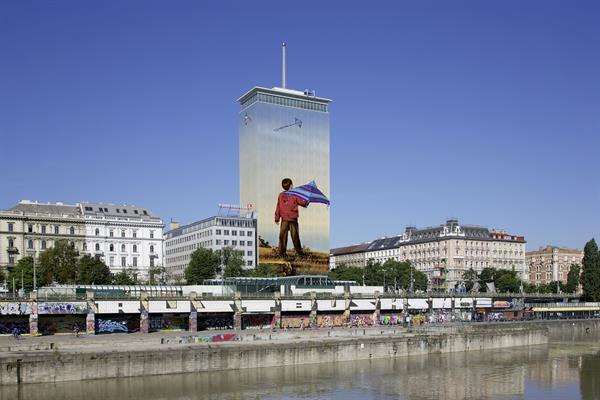
    In celebration of the 25th anniversary of the group’s Czech Group company Kooperativa in 2016, the Ringturm building is being transformed into a monumental art installation designed by the Czech artist Ivan Exner.

    This will be the ninth time that the historic office building on Vienna’s Ringstraße is enveloped by huge printed netting sheets. Work will shortly commence on preparing the building’s façade to display Ivan Exner’s work “Unburdened” throughout the summer. Since 1993, the Czech artist has cooperated closely in numerous art projects with the Kooperativa pojišťovna, a.s., Vienna Insurance Group, celebrating its 25th anniversary this year. “Every year, the Ringturm’s wrapping conveys new approaches and perspectives and invites people who see it to let their minds wander. In 2016, Ivan Exner presents his own vision of growth and future, his work reflecting a part of our company’s history. “Unburdened” symbolizes and celebrates the 25th anniversary of our Czech Group company Kooperativa,” explains Günter Geyer, CEO of the main shareholder of the Vienna Insurance Group (VIG), the Wiener Städtische Versicherungsverein.

    The work “Unburdened”
    Exner’s work, entitled “Unburdened”, shows a boy standing on a hill flying a kite. The child’s raised head and his tensed, straight back show that he is fully absorbed in his lively play. The boy is a symbol of ease and carefreeness. Another important element in the painting is the endless sea horizon lying before the child. Instead of the office building, passers-by will gaze at the open sea in the middle of a densely built-up area of their city. Between the child and the distant horizon lies endless vastness. The colourful kites are flying in different spheres: while two are flying high in the sky, one is drifting towards the horizon and a fourth one is soaring vertically into the sky.

    “If we look at the painting’s composition, the vertical is emphasized by the shape of the child and the horizontal by the sea horizon. The vertical and horizontal lines symbolize growth and the future, and the Ringturm building in Vienna’s cityscape reflects these same themes,” explains the artist Ivan Exner of his work and the special exhibition surface.

    AKOM160002_2

    John Akomfrah

    24 June – 12 August 2016
    504 West 24th Street, New York

    Lisson Gallery New York presents the first major exhibition in the United States by acclaimed British artist and filmmaker John Akomfrah. Akomfrah first came to attention in the 1980s as a founding member of the influential Black Audio Film Collective alongside the artists David Lawson and Lina Gopaul, with whom he still collaborates today. Known for his use of archival film footage, still photography and newsreel combined with new material, Akomfrah’s works are informed by their investigations into memory, post-colonialism, temporality and aesthetics and often explore the experience of the African diaspora in Europe and the United States. He recently garnered international acclaim at the 2015 Venice Biennale for his three-screen film installation Vertigo Sea, which uses the sea as a vehicle to comment on the cruelty of the whaling industry and the diasporic condition.

    For his American debut, Akomfrah will present two film installations, first shown at Lisson Gallery London in January 2016, rich with historical reference and contemporary resonance. Characterized by beautifully composed imagery and immersive sound design, these recent films uniquely employ original footage rather than archival imagery. The Airport, a three-screen film installation conceived as a meditation on Greek history and its recent financial crisis, set around the landscapes of Southern Greece and an abandoned airfield near Athens, recalls the work of two filmmaking greats: Stanley Kubrick (1928-1999) and Theo Angelopolous (1935-2012). Accompanied by a new soundtrack composed by Akomfrah, the film’s elliptical narrative weaves together cinematic, literary, philosophical and artistic traditions, where spaces of human ruin and natural beauty abound. Populated by displaced and anachronistic characters, including an elderly man in a tuxedo who re-lives moments from his past and his future, a wandering astronaut, marauding gorilla and forlorn travellers, the film contemplates the significance of empire and the ghosts which linger in our collective consciousness – both physically through architecture and metaphorically through traces of previous generations. The film’s elastic sense of time references Kubrick’s 2001: A Space Odyssey (1968), while Angelopolous’ technique of employing constant movement between camera, characters and locations is also employed to a poetic effect.

    The second work, Auto Da Fé (2016) or Acts Of Faith, is a diptych that looks at migration through the lens of religious persecution and continues Akomfrah’s longstanding interest in the transmutations brought about by relocation. Presented as a lyrical period drama, the film lays bare colonial and post-colonial experience through its documentation of eight historical migrations over the last 400 years, starting with the little known 1654 fleeing of Sephardic Jews from Catholic Brazil to Barbados and ending with present day migrations from Hombori, Mali and Mosul, Iraq. As the film develops, viewers are presented with multiple tales of displaced populations and attendant feelings of dislocation and alienation. The work is inspired by the writings of George Lamming, who wrote about the quotidian nature of 20th century life in Barbados and migrants’ hopes for a better future, only to find harsher conditions when arriving elsewhere. The work was filmed on location in Barbados, but the landscape is deliberately anonymous, reflecting the universal nature of these stories.

    Learn More

    Known for his work on the civil war in Algeria and Sudan, his street installation for his
    series on drug in Switzerland and the city of Varanasi in India, and more recently for his
    series on the Oktoberfest in Munich (published as Bierfest by Steidl editions), Michael
    von Graffenried had traveled all around the world with the exception of South America.
    The Swiss photographer recently discovered this continent and this visual portrait of
    Rio de Janeiro is the result of several stays in the metropolis during the last two years.

    © Michael von Graffenried, Courtesy Galerie Esther Woerdehoff

    © Michael von Graffenried, Courtesy Galerie Esther Woerdehoff

    As Rio de Janeiro, Brazil’s second city with its 12 million inhabitants, is now preparing
    to welcome the Olympic Games this summer after hosting the World Cup two years
    ago, and whereas the country is suffering from a political crisis linked to an important
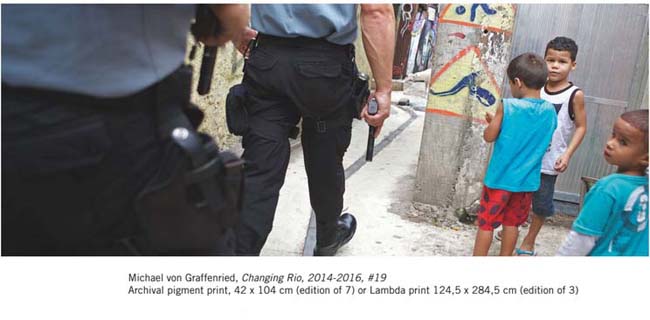
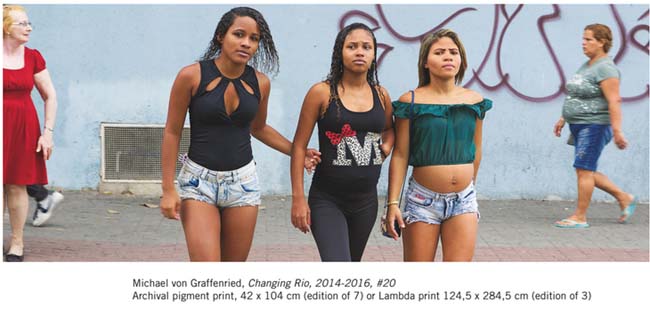
    corruption scandal, the photographer captures the transformation of the metropolis and
    its population within its diversity. Construction workers hurrying to build the Olympic
    city – but also new highways and subway lines – children playing in the favelas (where
    nearly a third of the population lives), forceful interventions by the police and soldiers
    or cariocas enjoying the beach, as usual the photographer places the people at the
    center of his pictures. He describes a city of contrasts, melting pot and social stratas, a
    city firmly committed to modernity, where festivals and religion play a major role, where
    lush nature is never far from concrete. The young population is dominant, violence is
    common but the beach and carnival always manage to bring together a fragmented
    society. The city is supposed to radiate a bit of its old power and beauty, just like back
    then, when it had been Brazil’s capital until 1960. A policy of pacification has been
    introduced to the favelas in order to finally shake off the reputation of a city that is
    separated into rich and poor: the «Cidade Partida». For quite some time now, Rio has
    been the negative example of social inequality. Will this city of millions end up as
    a modernized and peaceful winner after the Olympic Games? Or will one only have
    memories of a big international event ? Will nothing have otherwise changed ?

    © Michael von Graffenried, Courtesy Galerie Esther Woerdehoff

    © Michael von Graffenried, Courtesy Galerie Esther Woerdehoff

    The photographer Michael von Graffenried has used these transformations as a point of
    departure for his concentrated view on a metropolitan area with millions of inhabitants.
    The fascinating result ? Large-format, double-page panorama photographs from a Rio
    de Janeiro in the zero hour.

    This exhibition is accompanied by the publication of the book Changing Rio by Slatkine
    editions. A book signing will be held at the opening reception.

    GalerieEstherWoerdehoff
    36 rue Falguière
    75015 Paris – France
    www.ewgalerie.com

    © Michael von Graffenried, Courtesy Galerie Esther Woerdehoff

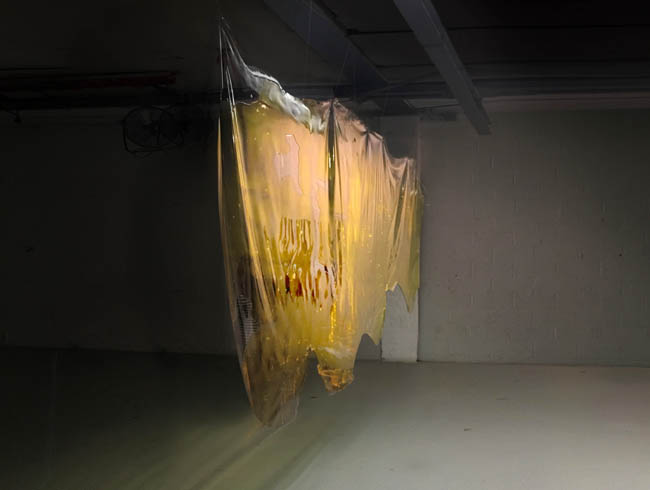
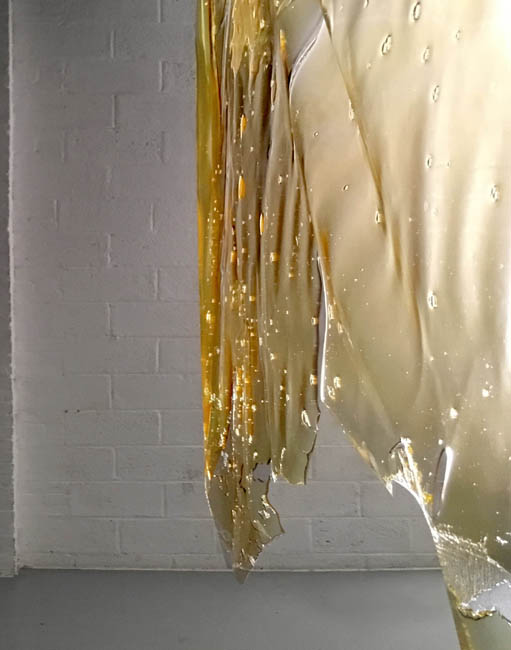
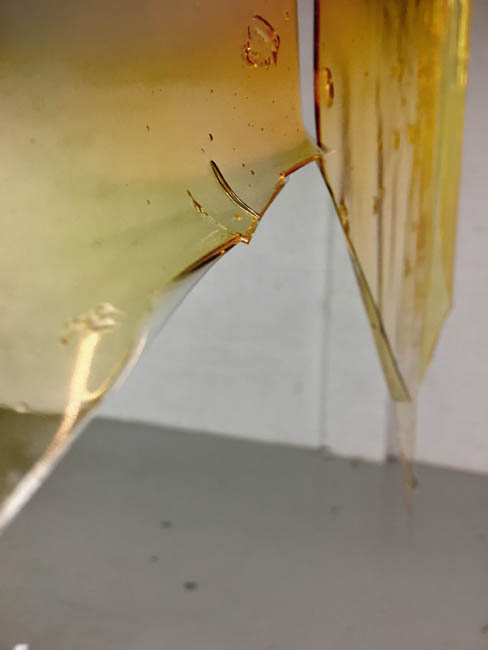
    CONSUME is a site-specific installation at Immersive Gallery, located in Brooklyn, in a former warehouse, on a site threatened to be consumed by development. The installation is edible and it remains until the audience consumes it all.
    CONSUME is the fifth of a series of installations entitled “dinner” that take place in New York City, since 2013.

    Ioannis Oikonomou has established the oiio Studio, based in Athens and New York, which has received six international design competition prizes. His work has been displayed in numerous exhibitions concerning architectural and artistic projects.

    Eirini Tsachrelia is currently practicing and teaching architecture in New York. Most recently she co-curated the Greek representation for the international design exhibition XXI Triennale in Milan.

    More information:

    Ioannis Oikonomou- oiiostudio.com
    Eirini Tsachrelia – tsachrelia.com


    CONSUME, 2016 Ioannis Oikonomou, Eirini Tsachrelia Edible translucent colored gelatin, vinyl mold, monofilament line Dimensions approximately 11’6” x 4’6” x 10” (3,5 x 1,4 x .25 m).

    CONSUME, 2016
    Ioannis Oikonomou, Eirini Tsachrelia
    Edible translucent colored gelatin, vinyl mold, monofilament line
    Dimensions approximately 11’6” x 4’6” x 10” (3,5 x 1,4 x .25 m).


    CONSUME, 2016 Ioannis Oikonomou, Eirini Tsachrelia Edible translucent colored gelatin, vinyl mold, monofilament line Dimensions approximately 11’6” x 4’6” x 10” (3,5 x 1,4 x .25 m). Detail.

    CONSUME, 2016
    Ioannis Oikonomou, Eirini Tsachrelia
    Edible translucent colored gelatin, vinyl mold, monofilament line
    Dimensions approximately 11’6” x 4’6” x 10” (3,5 x 1,4 x .25 m). Detail.


    CONSUME, 2016 Ioannis Oikonomou, Eirini Tsachrelia Edible translucent colored gelatin, vinyl mold, monofilament line Dimensions approximately 11’6” x 4’6” x 10” (3,5 x 1,4 x .25 m). View

    CONSUME, 2016 Ioannis Oikonomou, Eirini Tsachrelia Edible translucent colored gelatin, vinyl mold, monofilament line Dimensions approximately 11’6” x 4’6” x 10” (3,5 x 1,4 x .25 m). View

    social-media-apps


    SEO, Social Media, Google Analytics, Webmaster tools, Google AdWords/Sense and Online Mass Mail promotion specialist with 10 years of experience in the art field clientele.


    If you wish to spike in your followers, likes, conversions, traffic to your site and social media: Twitter, Facebook, Pinterest, Instagram, Tmblr, Google+, LinkedIn, Polyvore and more.. I can increase your online presence on popular social media networks and improve exposure for your gallery at a fraction of the cost only $20 per hr. I’m looking for a fantastic teamwork and collaboration to grow together! I’m open to freelance, part time or full time opportunity. I’m also specialized in mass email marketing, WordPress web design and development.
    Resume, references available upon request.


    Please, do not hesitate to contact me at any time at my100places@gmail.com
    News | Exhibitions