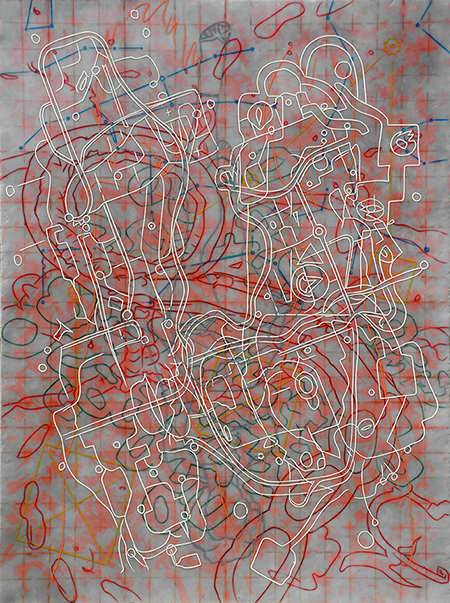
The painting is inspired by the music of Lucinda Williams, the American singer. The flow of paint goes with the sound of the lyrics in that both sound and color are intertwined.
In my artwork I seek a way to give expression to my subjective experience. All pictures are a wrestle with the essential nature of the human being, both as an individual and as part of the masses. They are an invitation to embark on a journey into the INNER-SELF that can enable the viewer to go beyond the portrayed images and unlock personal ciphers lying within the unknown.
My work is always inspired by an intuitive feeling. I regard my paintings as the outcome of a feeling at the time of their creation, not so much as the expression of visual ideas. The images seem raw, in other words: purely and simply emotional – and visual expression seems to me the best way to articulate such emotions.
I use the traditional oil painting techniques, starting with fine layers of diluted paint and ending by brushing on a final application of pure oil. I like to pay attention to values and colours in order to create the impression of a haze in the background, while working intense light effects in the foreground. I play with complementary colours in order to accentuate contrasts and create luminous effects. I like to paint peaceful environments, places where it is good to stop and just be for a moment. I take my inspiration from various locations I have visited.
Painting Time Waits For No One is a symbolic work that shows the human struggle with mortality and never-ending youth. If you choose to live your life in fear of death to come, you may be dead already. This painting displays the scene which is so often shown in television and magazines; stories of perfectly built, forever-young and life-loving bodies. Everybody wants to stay young and pretty for as long as possible and yet mortality is unyielding.
I am primarily a landscape painter. My work is about my response to the colour, space, and light in the landscape. I aim to paint the power and the spirit of the landscape, not the view of it. I am inspired by the dominance of nature over man: found in the drama of my nearby mountain landscape or in the joy of seeing the rush of wild flowers in early summer or the spring light flooding through rejuvenated greens. I am influenced by many contemporary painters but my main inspiration comes from J.M.W Turner, the great English landscape painter of light.
As long as humanity breathes, art grows in new directions. Art is a necessary element for the cultural development of man. I am considered a skilled creator, but being a master means devotion to the origin of spirit and through art, bridge the gap between this world and eternity. That is the reason why painting seems to be the easiest thing to do and more important than many other common things which normally occupy daily life. My art works undoubtedly belongs to the present time, but I consider my art to be timeless and although it includes previous technical knowledge, it makes a significant breakthrough.
Layered, transparent, mesmerizing—these are the qualities that are most present in Mark Moffett’s new encaustic paintings. Recently showing at Broadway Gallery, NYC, Moffett’s paintings are some of the most challenging pieces on view as they navigate the line between figuration and abstraction. The three pieces being exhibited are built up, glaze upon thin glaze of color, interspersed with linear patterns that feel diagrammatic and work discretely to create a rich panorama. There is a transformative, evolving quality to the works that keeps the viewer in a state of intangible suspense. They are works well suited to the digital age, where information overload lends itself to the narrative of painting. Although you can clearly see the figurative elements, Moffett’s network of lines does not tell a linear story. Rather, they are more visual motifs, icons that lead us into new ways of seeing the original image.Some of his works are very easy to absorb; one strong line marks the silhouette of a man, a woman, or an animal. In Drifter, a deep, saturated red background is the backdrop for a Pangaea image (the supercontinent formed around 300 million years ago, that began to rift and drift apart around 200 million years ago—to eventually form the continents as we know them today). The image, superimposed over, among other things, a mapping of major constellations, is presented in three stages of expansion, repeating like a fetus shape that alters and kerns slightly in space. It is quite literally drifting, seemingly floating in a void of lost and immeasurable time. This piece carries a profound affect that is poetic and mysterious.
In the case of Flèche, the diagram of a plant is presented like an image Moffett couldn’t erase no matter how many layers of information he threw at it. Set in a nebulous gray-green field, a variety of motifs vie for attention: swimming fish, organic clusters of the Ebola virus, a man steadying a woman in a handstand, a cartoonish skeletal figure in gold, a figurative fragment from what appears to be Duchamp’s Etant donnés, and finally, an elusive cupid figure who appears to have launched an arrow—which rhymes with the painting’s title, Flèche, or arrow.

Courtesy of the artist.
Taken individually or together, these elements seem to have no particular meaning, but they work with the image of the plant—like another kind of arrow, a plant shoot—in a way that suggests pollution, and coalesce into a haunting portrait of life’s tenacity under duress.In another example, LL, you can see a woman, sensually curving her body like a dancer. She is positioned against a blood red background, surrounded by falling leaves. Upon closer inspection, you notice the form of a jellyfish, like a cage or a net, by which the ballerina is taken prisoner. And then suddenly a looming presence emerges—a frenzied skeleton, roaring like a maniac. The conflation of terror with beauty makes for a gripping psychological image. This piece plays on vanitas imagery, and resonates with such works as Hans Baldung’s Der Tod und das Mädchen, from 1517. Baldung’s painting portrays death as a grizzly old figure coming from behind, pulling a nude’s hair. Her face recoils in peril. Moffett’s work in contrast implies this sensation of terror through the use of color and the layering of separate emblematic states: the woman is poised, the jellyfish entraps, and death dances a mad jig. Here death is interwoven and is more an idea of what death is.
In his “Waterland” series, Moffett uses a chessboard pattern as a background. Imagery is projected either simply or complexly into the regimented grounds. In one work, Position After, a fingerprint pattern simmers below the surface while the single image of a crouching woman is set equivocally in a field of red and green squares. In 0-0 (Compass II), against a gray chessboard field, many elements pulsate in and around the figure of a crouching boy on rollerskates. Among the elements are trace signs of skeletal remains, prehistoric figurations, and symbols for constellations, all contributing to a haze of atomized information. In 9 States of Mars (After Schiaparelli), the ‘canals’ of Mars, as observed and drawn by the 19th century Italian Astronomer Giovanni Schiaparelli, are superimposed simultaneously like a ball of confusion. Although it isn’t always possible to step away from Moffett’s work and negotiate with it as a consolidated statement, it is clear that his purview is stretched to encompass irreconcilables, or at least opposing charges. I recently had the opportunity to interview Mark to hear more about his work.

Courtesy of the artist.
Jill Smith: How did your interest in painting and art develop? When did you start to see yourself as an artist?Mark Moffett: Because my father was an editor at Life Magazine, I had the good fortune to travel a great deal as a child. I spent formative years in Paris, France, age seven to twelve, and was exposed to Africa, the former USSR, and most of Europe. (Since college, I have traveled when possible, and in 1983-84 spent eighteen months traveling on the cheap throughout Asia.) These experiences made a strong impression on me. They gave me an internationalist perspective and instilled an appreciation for cultural worth in all guises and variety. Without specific guidance, I was steeped in art from the beginning.
JS: You want to provide information in a certain way, not everything at once. You work in layers, and the spectator needs to make a little effort in order to understand the true meaning. Do you think that your artwork only reaches a specific audience, or can everyone understand it?
MM: Just as I hope to be absorbed by art, I hope to make art that absorbs people. In my art I am interested in competing levels of information. Some of the information involves painting concerns, the way an illusion is made: medium choices, color choices, imagery choices, the tension between figure and ground, and the integration of these toward a cohesive whole or toward a mystification of wholeness. Formal concerns aside, some of the information involves content itself, and how references—distinct, arbitrary, familiar, foreign—may be put into play. Sometimes I’m interested in featuring content and other times in burying it, but when I combine imagery I’m mindful of a palimpsest effect, and of how content becomes troubled. I see the approach as a form of painterliness by other means, and trust the viewer—inured, perhaps, to a mayhem of evanescent imagery in their life—to discern and read their own meaning into it. In this sense, I feel my work is approachable by anyone.
| In search of lost parts of my childhood I long to reconnect with my uninhibited childhood self… |
In search of lost parts of my childhood I long to reconnect with my uninhibited childhood self…Thinking outside of the reality I was socialized into, I reference the discovery of myself as an individual within my family, and finding my place within it. I question the boundaries between us, between love and resentment, control and passivity, expressed and reserved, real and fake in attempt to revive my unconditioned, unadulterated self. With devices of the hidden, restricted and subverted, I draw upon the unconscious- the place in which our boundaries merge- and through suggestion our own desires and fears stare back at us. As a role reversal of the idyllically staged family photography, photomontage, the cartoonesque and the performative allow me to escape the normal, look back and recapture childhood nature through my conditioned adult eye.
|
Less well known are the exquisitely rendered spider drawings of French artist Odilon Redon (1840-1916) which takes on a friendly anthropomorphic view of the spider. In Smiling, an 1881 lithograph described by J.K. Huysmans in his classic novel of decadence A Rebours (1884) – translated Against Nature – a grinning spider, with ten legs rather than the usual eight, is seen performing a lopsided dance. In Crying Spider (1881), the artist adds a human face to the spider’s body which art historians Katarzyna and Sergiuze Michalski suggest – in their fine little book Spider (Reaktion Books – 2010) — might be a depiction of the artist’s own mental anguish. |
|

Spiders! You may love them like Wilbur the pig in Charlotte’s Web, E. B. White’s classic children’s book or they may frightened you away like Little Miss Muffet eating her curds and whey. As for me, well, I wouldn’t want to find one climbing up my arm or falling on my head unexpectedly – I want to know exactly where they are at all times – but I have spent many a fascinating hour reading about them, watching them spin their webs, catch their prey, enjoy their meals, mate, tend to their eggs, and hatch the next generation. For a short time during my junior high school days I even kept a family of Black Widows in our garage, that is, until a roly-poly classmate of mine – there’s always one in every group – deliberately killed the entire widow family by spilling a beaker of sulfuric acid on them following a Show & Tell session. I suppose he thought he was saving the neighborhood.
Spiders have always fascinated me. And I am not alone. For decades, writers, artists, jewelry, fashion designers, as well as filmmakers – the 1950s were especially rife with mutant killer spider B-movies – have turned hand and eye to bringing the spider to the public’s attention, frequently in demonic situations that stroke our unconscious, though deeply seated fear of being bitten by a spider. Those suffering from arachnophobia (an active fear of spiders) have it worse. Amplifying this fear, they conjure up visions of being caught in a spider’s web, wrapped in silk, and having their blood sucked dry, a thought not too far removed from being attacked by a vampire. Movies have successfully capitalized on these themes. Think Twilight and Spiderman, both the multi-billion dollar movie franchises. You can also throw in for good measure the play Spiderman: Turn Off the Dark, currently one of Broadway’s top moneymakers.
Out of the thousands of spider-centric artworks that have crossed my path – and I do collect them visually – the work of three artists, each portraying the spider in a different manner and medium, have managed to etch itself onto my brain. More often than not, first to come to mind when I think of spiders, is Arachnophobia (1990), the American made horror comedy film. Hawked with the tag line, Eight Legs. Two Fangs. And Lots of Attitude, the story, which had audiences brushing imaginary spiders off their shoulders, centers on a newly discovered race of deadly Venezuelan spiders. A male spider accidentally transported to a small American town – in a coffin with a dead body no less – finds himself a mate who doing double duty multiplies aplenty. Soon, countless offspring begin to pick off the town’s residents one by one. Three hundred and seventy-four, live but totally harmless, creepy crawly Avondale spiders from New Zealand were used in the movie.

Odilon Redon, Crying Spider, 1881
Less well known are the exquisitely rendered spider drawings of French artist Odilon Redon (1840-1916) which takes on a friendly anthropomorphic view of the spider. In Smiling, an 1881 lithograph described by J.K. Huysmans in his classic novel of decadence A Rebours (1884) – translated Against Nature – a grinning spider, with ten legs rather than the usual eight, is seen performing a lopsided dance. In Crying Spider (1881), the artist adds a human face to the spider’s body which art historians Katarzyna and Sergiuze Michalski suggest – in their fine little book Spider (Reaktion Books – 2010) — might be a depiction of the artist’s own mental anguish. In a letter written to his wife just before he began his series, Redon relates the story of a spider he found on his red bolster, which he subsequently befriended and placed on a wall so ‘she’ could watch him work. Perhaps remembering Michelet’s description of the love life of spiders as the ‘dark romances of our ceiling’, the artist associates the spider with his beloved spouse.
The most wondrous spiders in art – “an ode to my mother” the artist is quoted as saying – belongs to Louise Bourgeois (1911-2010). Though producing art since the 1940s, it wasn’t until Maman (Mother) Bourgeois’ late nineties series of humungous spider sculptures – one sculpture is over 30 feet tall and 33 feet wide – that fame began to attach itself to her with museum’s all over the world standing in line to show, as well as buy one. “My mother was my best friend,” Bourgeois liked to say. “Like a spider, my mother was a weaver. My family was in the business of tapestry restoration, and my mother was in charge of the workshop. Like spiders, my mother was very clever. Spiders are friendly presences that eat mosquitoes. We know that mosquitoes spread diseases and are therefore unwanted. So, spiders are helpful and protective, just like my mother.” In 2011 one of Bourgeois’ Spider works sold for $10.7 million, a record price for the artist at auction, and the highest price paid for a work by a woman artist.
Cleverly cashing in on this Spiderman craze – Why not! They do house the world’s largest research collection of spiders – is the American Museum of Natural History’s mini-blockbuster Spider’s Alive! Populated by hordes of excited children with parents in tow, this show which runs through December 2 appears to be the most popular exhibition in the city. Lots of yellow school buses were lined up the day I visited. Essentially an introductory Spiders 101 course, using real live spiders – a spider zoo if, you will – as the big draw, the exhibition, boosted by videos, lots of signage, and mesmerizing Tarantula demonstrations magnified on a video screen – highlights the spider’s anatomy, behavior and unique characteristics. Adding a playfulness to the event – no doubt to let the little ones know that spiders can also be lots of fun – the exhibition also includes a colorful gigantic spider sculpture on which visitors’ can sit to have their picture taken.
The exhibition, with some 20 spiders, each residing in their own aquarium-like habitat, reminiscent of the tropical fish section of a pet shop, is situated in three, or is it four, large rooms. The overall lighting of the exhibition, a mood-setting, frisson adding a darkness that emphasizes that it is just you and the spiders, is bit scary, like a horror movie. The trick, as well as the fun, since many of the spiders seem to r lost” among the foliage of their habitat, if not hiding from all the peering eyes, is to find the spider and hope that it does not jump out and get you. Not that that can happen but the thought continues to lurk. Tarantulas demonstrations aside – due to their large size, black hairy body, and seemingly docile demeanor, they always get the starring role – it is the poisonous spiders with ‘killer’ reputations like the Black Window, or the South American Brown Recluse, the so-called supporting stars of the exhibition, appear to get the most attention. I can still hear one child, excitedly jumping up and down, asking his father is it really true that this tiny weenie spider with the red mark on it belly can kill a person. The father’s answer, “Only if it bites you.”
While many people think they know everything there is to know about spiders, after all they have been around for at least 350 million years, the exhibition lets us know that there is a lot more to these little creatures than meets the eye. Signage tells us that there are more than 43,000 species of spiders to date. They inhabit every continent but Antarctica. Less than 1% have venom dangerous to humans. An acre of woodland spiders can consume more than 80 pounds of insects a year. All spiders have 8 legs, eight eyes, arranged in patterns that vary for particular groups of spiders, and fangs. Most web-based spiders have lousy eyesight. However, non-web spiders that actively stalk and hunt down their prey have excellent vision. Spider silk is produced in glands inside the abdomen. Each silk gland leads to a particular spigot that opens to the outside through one of several paired spinnerets. A spider “reels” out silk by gently pulling it from a spigot with its two hind legs. Spiders taste and smell through sensory organs on their legs as well as on their pedipalps (“feelers” on the face). They also hear by sensing vibrations through the hair and tiny slits distributed over much of their body.
The most exciting, and visually informative part of the exhibition – certainly for those viewers who want to see some action, as most of the spiders just sit and watch you watching them, are the videos which accompany each individual spider type. It is here that we get to see various species of spiders court their spouses, weave their webs, stalk, trap, catch, and kill their prey, as well as mate. The species of spiders on display, as well as in the videos are manifold in their personalities. It may come as a shock to many, but not all spiders live in web. Some spend most of their time in underground burrow, emerging mainly to grab prey. The Wolf spider, aided by sharp vision and it ability to sense vibrations, searches for food on foot. The Fishing spider rests it legs on the surface of the water on the shoreline and when some gets close it pounces, while the Bolas spider lures male moths into their grasp by creating a suspended ball of sticky silk with chemical properties that mimic female moths. The Goliath bird eater, one of the largest spiders in the world, preys on snakes, mice and frogs but, despite the name, rarely birds.
“Spiders Alive!” runs through Dec. 2 at the American Museum of Natural History, Central Park West at 79th Street; (212) 769-5200, amnh.org. Visitors can purchase tickets online at the American Museum of Natural History. The entrances are timed in order to keep the crowds small which means you will have a chance to see some once in a lifetime spiders.

|
The painted “Narcissus”, attributed to Michelangelo Merisi da Caravaggio ca 1599, is the focal image of Francine LeClercq’s installation, whereas the erring gaze of Narcissus, the visual echo reverberating between the illusionistic picture plane and the actual gallery setting, the existential reciprocity between the subject and object, form and content,… are parallel notions and traits that LeClercq uses to investigate the modern context. LeClerq recently caught up with NY Arts to talk about his show on view. |
|

The painted “Narcissus”, attributed to Michelangelo Merisi da Caravaggio ca 1599, is the focal image of Francine LeClercq’s installation, whereas the erring gaze of Narcissus, the visual echo reverberating between the illusionistic picture plane and the actual gallery setting, the existential reciprocity between the subject and object, form and content,… are parallel notions and traits that LeClercq uses to investigate the modern context. LeClerq recently caught up with NY Arts to talk about his show on view.
“My work has found its ground in the process of painting and the “idea” of painting, with a deeper focus on a complementary dialogue between materiality, content, the exhibition space, and the encounter with the viewer.
Often times my projects consist of multiples works, grouped around a specific theme related to painting and the question of viewing art. In this respect, I have always felt that there is something quite modern in the way Narcissus in Caravaggio’s painting is kneeling, looking down, utterly immersed, not too unlike a painter mesmerized by a pool of paint on the floor, and quite in contrast with the casual upright viewer in front of a painting, and I like this idea of the hybrid viewer/painter because it reaffirms the notion for me that the viewer is very much a component of the work; and by extension, the arrangement of the work in the space and the way the viewer enters a work, that is the choreographic aspect needed to be addressed.
Placed below a black spatial demarcation drawn at 60 inches above the floor (a convention of hanging art on center in a gallery to align with the eye of the spectator), two elliptical canvases, one depicting the isolated knee of the original painting (“Narcissus’ Knee”), and the other the reflected image without its counterpart ( “Narcissus’ Other”), face each other. Their low position invite the viewer to echo the physical genuflect and the lowered gaze of the mythical character in order to immerse himself in the compositional horizontality of the space. The third piece is a low horizontal reflecting puddle of black resin where the slightly raised outlines of Narcissus create distortion of the reflected space and viewer.”
“Francine LeClercq: Narcissus” on view until October 27, 2012 at SOHO2O CHELSEA Gallery