• ABB16_CF_module

    Designed specifically for non-profit visual arts organizations, the Art Basel Crowdfunding Initiative offers visibility and support to a wide variety of artistic projects, selected by an independent jury. In partnership with Kickstarter, this initiative directly connects art lovers and patrons to innovative project worldwide. The Crowdfunding Lab will present a program of talks and discussions; please see the online program for schedule and information. Learn about exciting projects that have already come to life as a result of this global initiative, discover how to support currently running campaigns, and learn what makes for a successful Kickstarter campaign. Meetings with team members available upon request.


    Messe Basel
    Messeplatz 10
    4005 Basel
    Switzerland

    Lear More

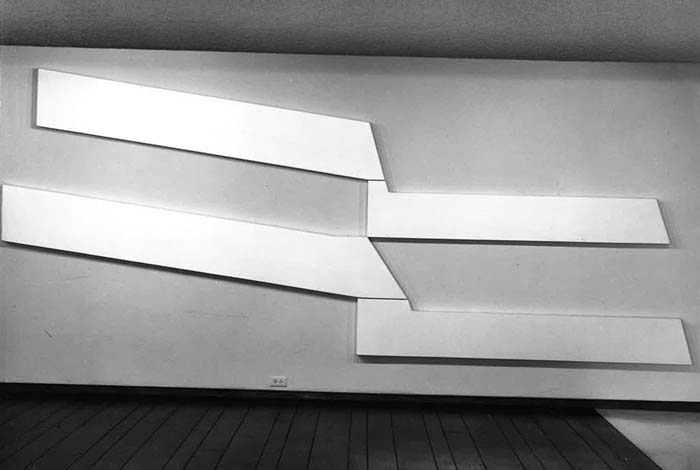
    David Novros, 4:30, 1966, Acrylic on canvas, 6 x 16 feet, © David Novros; Courtesy of the artist

    David Novros, 4:30, 1966, Acrylic on canvas, 6 x 16 feet, © David Novros; Courtesy of the artist

    Luhring Augustine
    “Shapeshifters”

    June 27 – August 12, 2016
    Opening Reception: Thursday, June 30, 6–8pm

    Luhring Augustine is pleased to present Shapeshifters, a group exhibition including works by Joe Bradley, Jeremy DePrez, Jeff Elrod, Ron Gorchov, Ralph Humphrey, Martin Kippenberger, Imi Knoebel, Robert Mangold, Jeremy Moon, Elizabeth Murray, Kenneth Noland, David Novros, Blinky Palermo, Steven Parrino, Joanna Pousette-Dart, Ruth Root, Frank Stella, Philip Taaffe, and Richard Tuttle.

    The exhibition takes its name from the mythological phenomenon known as “shapeshifting,” in which an object or being is capable of assuming another form. The works in this exhibition evoke this phenomenon by deviating from the standard rectilinear format of the frame and defying succinct categorization as paintings. In creating these works, the artists used various techniques including altering the outline of the canvas, building up relief, cutting into the plane, and using materials alternate to traditional canvas as support.

    Shaped canvas works became popular in the 1960s as artists sought to emphasize the potential for paintings to be considered objects. Recognizing this movement, curator Lawrence Alloway organized the definitive exhibition The Shaped Canvas at the Solomon R. Guggenheim Museum in 1964. Alloway presented works by five artists he recognized to be the primary protagonists of this movement, one of whom was Frank Stella. Shapeshifters includes a piece by Stella from that period, along with Richard Tuttle’s 1967 Red Brown Canvas, a late ‘60s multipart work by David Novros, and a rarely seen ‘60s work by the late British artist Jeremy Moon.

    The works in this exhibition explore the way that this subgenre of painting has evolved in the work of artists who may identify as painters, but who explore the space between painting and sculpture. While early practitioners such as Robert Mangold embraced a minimal sensibility, the next generation of artists such as Elizabeth Murray and Ralph Humphrey further evolved the practice; Murray’s canvases are explosive and energetic, and Humphrey’s paintings are tactile, with thick and textured surfaces. Contemporary artists such as Jeff Elrod, Jeremy DePrez, and Ruth Root continue to investigate these ideas by using a variety of methods and mediums. Elrod uses the computer to render imagery, questioning the importance of the handmade mark on the canvas; DePrez’s work is illusionistic and optically challenging; and Root’s paintings integrate patterned textiles and varied surface textures.

    Luhring Augustine
    531 West 24th Street,
    New York, NY 10011

    Stuart Davis (1892–1964) is one of the preeminent figures of American modernism. With a long career that stretched from the early twentieth century well into the postwar era, he brought a distinctively American accent to international modernism. Faced with the choice between realism and pure abstraction early in his career, Davis invented a vocabulary that harnessed the grammar of abstraction to the speed and simultaneity of modern America. By merging the bold, hard-edged style of advertising with the conventions of European avant-garde painting, he created an art endowed with the vitality and dynamic rhythms that he saw as uniquely modern and American. In the process, he achieved a rare synthesis: an art that is resolutely abstract, yet at the same time exudes the spirit of popular culture.

    The exhibition is unusual in its focus on Davis’s mature career and on his working method of using preexisting motifs as springboards for new compositions. From 1939 on, Davis rarely painted a work that did not make reference, however hidden, to one or more of his earlier compositions. Such “appropriation” is a distinctive aspect of his mature art. This presentation will be the first major exhibition to consistently hang Davis’s later works side by side with the earlier ones that inspired them. With approximately one hundred works, from his paintings of consumer products in the early 1920s to the work left on his easel at his death in 1964, the exhibition will highlight Davis’s unique ability to transform the chaos of everyday life into a structured yet spontaneous order that communicates the wonder and joy that can be derived from the color and spatial relationships of everyday things.

    Stuart Davis: In Full Swing is co-organized by Barbara Haskell, Curator, Whitney Museum of American Art, New York, and Harry Cooper, Curator and Head of Modern Art, National Gallery of Art, Washington, DC, with Sarah Humphreville, Curatorial Assistant, Whitney Museum of American Art, New York.

    Stuart Davis: In Full Swing is organized by the Whitney Museum of American Art, New York, and the National Gallery of Art, Washington, DC.


    Courtesy of The Whitney Museum of American Art

    Beatrice Scaccia | Call the Bluff
    May 5 – June 11, 2016

    Cara Gallery
    508 West 24th Street
    New York, NY 10011

    Cara Gallery is pleased to present Call the Bluff, a visual narrative by Italian born artist Beatrice Scaccia specifically designed for the gallery space.

    The artist’s first exhibition with Cara Gallery will present a new body of work. A sequence of large drawings (made with graphite, gesso, and wax applied with an iron) and a series of small works on panel, act as an antechamber for the presentation of the artist’s sizable paintings on canvas, which were never exhibited to the public before.

    2016 Call the bluff 10 60x44 inches copy

    Call the Bluff 10, 2016, Pencil, oil, gesso & wax on paper, 60 x 44 in | 152 x 112 cm. Courtesy of the artist.

    Always interested on randomness and repetitivity, as an expression of human existentiality, Scaccia’s most recent work develops her personal investigation of identity, awareness and inauthentic existence, displaying characters suspended in a state of indecision between the mutual interaction or resistance, frozen in the incompleteness of their actions.

    Born and raised in a solid painting background, Scaccia’s study of the human figures reports elements of Renaissance and late Eighteenth Century. A fragmented story emerges through the almost “frame by frame” sequence of Scaccia’s work, expressing the idea that repetition can also create a sense of instability. In her work identities, genders and ages are lost behind oversized coats, striped patterns and futile but unavoidable and unpredictable movements.

    Call the Bluff 11, 2016, Pencil, oil, gesso & wax on paper, 60 x 44 in | 152 x 112 cm. Courtesy of the artist.

    Call the Bluff 11, 2016, Pencil, oil, gesso & wax on paper, 60 x 44 in | 152 x 112 cm. Courtesy of the artist.

    Scaccia’s work has often been described as “ frames loaded with movement, coming from a missing film” and yet in these canvases, for the first time, there is a richer and more layered composition. It is like being in front of some overturned tableaux vivants where a group of overwhelmed performers are blocked in their movements and in their delusion-illusion of coexisting.

    Through a fresh and original approach, Call the Bluff reveals the unsubstantial, the unreality, the vacuum, and the pantomime.

    Paintings, drawings, sketches are accompanied by an installation of ceramics by Japanese artist Toshiaki Noda.

    Call the Bluff  4, 2016, Pencil, oil, gesso & wax on paper, 60 x 44 in | 152 x 112 cm. Courtesy of the artist.

    Call the Bluff 4, 2016, Pencil, oil, gesso & wax on paper, 60 x 44 in | 152 x 112 cm. Courtesy of the artist.


    About the artist:
    Beatrice Scaccia was born in Veroli, Frosinone in 1978. She studied and taught in Rome, at the Academy of Arts, before moving to New York in 2011. She has worked as painter at Jeff Koons Studio. Her work has been the subject of solo shows in the United States and abroad. She has also been included in some group exhibitions at institutions and museums internationally, such as the National Cultural Institute, Seoul; The Crocetti Foundation, Rome; the Pan Museum, Naples, the Palaexpo, Rome and the Golden Thread, Belfast. She currently lives and works in New York.

    Please join the conversation on Facebook (@caragalleryofficial), Instagram (@caragalleryofficial), Google+ (@
    +caragallery), Twitter (@caragallerynyc) and Pinterest (@caragallery0041) – #beatricescaccia #callthebluff #caragallery #508W24


    caragallery-llc.com
    508 West 24th Street New York, NY 10011

    Opening and Artist talk: Friday June 10, 2016, 6-8 pm.
    @ STUDIO 26 GALLERY, 179 East 3rd Street, New York, NY.
    On view: June 8 – July 3, 2016.

    image1

    STUDIO 26 GALLERY invites you to join the opening of WHEN MADNESS MEETS HUNGER. This is an ongoing series of ink drawings by Aphrodite Désirée Navab. Her work is known to haunt “…our imagination with its beauty and complexity, inviting us to engage in a third space of transnational and cross-cultural initiations, leaving domination and demonization outside the picture,’ –collector of the series and NY Times #1 Best Seller author Reza Aslan of Zealot: The Life and Times of Jesus of Nazareth (2013) writes. “Her art is the aching inquiry of an uprooted consciousness seeking new roots.”

    WHEN MADNESS MEETS HUNGER consists of thirteen ink drawings “serving a site of critical dialogue and debate” where Navab imagines an invented encounter between the protagonist of Iranian writer Sadeq Hedayat’s novella The Blind Owl and the protagonist of Czech writer Franz Kafka’s short story, “The Hunger Artist.”

    “I do weeks of research for my art, collecting primary sources,” says Navab. “For this series, I re-read Hedayat’s novella The Blind Owl, and I re-read Kafka’s “The Hunger Artist.” I read secondary sources, examining and critiquing their art. I read historical sources on the Czech republic and Austria during Kafka’s time and Iran during Hedayat’s time, then researched the internet for photographs of the writers from birth until death…It is no accident that Hedayat translated several of Kafka’s work into Farsi.” Metaphors, allegories, and themes are explored of the artists in voluntary exile, the nature of performance art, the real and the ideal, rituals of insanity, the existential crises of the artists and their autobiographical narratives.

    image02

    Aphrodite Désirée Navab is an artist and writer based in New York City of Iranian and Greek descent (b. Isfahan, Iran). In 2004 she completed an Ed. Doctorate in Art Education at Columbia University. She received her BA magna cum laude in Visual and Environmental Studies from Harvard College in 1993.

    Navab’s art has been featured in over one hundred exhibitions and is included in a number of permanent collections including: The Lowe Art Museum, the Harn Museum of Fine Arts, Casoria Contemporary Art Museum, Naples, Italy, and the Museum of Fine Arts, Arkansas State University.

    Navab was recruited by STUDIO 26 GALLERY in October, 2015. Her artwork has been represented by the gallery ever since, featuring the new series on its website; www.studio26eastvillage.com/dsire-navab-portfolio. Her work was exhibited by Studio 26 Gallery at the following fairs: Art on Paper, Art Basel Miami, December 1-6, 2015, and Art New York/Context, NYC, May 3-8, 2016.

    In the process of making art Navab dislocates and relocate her place between Greece, Iran and the United States. Each exhibition or installation provides a material reference, each series places a foundation stone into a new home that she is building away from home, but always in critical dialogue with the memory of that first home.

    STUDIO 26 GALLERY is happy to provide a home to Navab’s current vision, WHEN MADNESS MEETS HUNGER for four summer weeks: June 8 through July 3, 2016. We are hosting a special event at the opening reception on Friday, June 10th, at 7 pm: an informal and interactive artist’s talk, where Navab will share her concepts for this series, her artistic practice and creative process, and take questions from the audience. Please mark your calendars.

    Opening & Artist talk: Friday June 10, 2016, 6-8 pm.
    @ STUDIO 26 GALLERY, 179 East 3rd Street, New York, NY.
    On view: June 8 — July 3, 2016.

    Curated by Marika Maiorova.

    On a sunny, hot day in late May, finding the new location of Alison Milne Gallery was a challenge. Located in a quiet neighbourhood, between two grey buildings, there is a sanctuary of art and design, the gallery being an addition to Alison Milne Design. Walking through the white metal gate you step into a patio, that could easily be anywhere in California – all white from floor to walls to reclining chairs, a very stylish preface to the exhibition itself – where the strong white light dominates the gallery’s space and also radiates from the large photographs of Dean West.

    Dean West Palm Springs 2

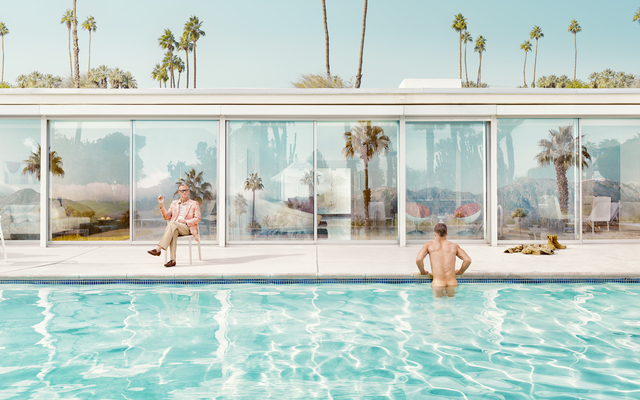
    Dean West, Palm Springs #2, 2015,Type C Photographic Print, Image Courtesy of Alison Milne Gallery

    A sparkling pool greets us invitingly in “Palm Springs #2.” David Hockney’s pool paintings come to mind immediately. Looking at Hockney’s series of pools and West’s photograph there is indeed a strong relationship, not only in the theme but in the elements used and in the way the scene is depicted. The rivulets of water and the way they reflect the strong sunshine is similar. The young man emerging from the pool, showing his back to us, has the same posture as the young male nude on Hockney’s “Swimming Pool” (1982, Los Angeles exhibition). The seated, elegant man looking over the scene is also familiar – the photograph has a ‘Hockney’ atmosphere. While the eye of the viewer gorges itself on the amazing scenario there is still another surprise – the glass wall. At first it seems to be only a background but a closer look at it reveals that it is a very busy visual treat itself. It is something like a focal point where everything gathers. It reflects all the elements: the water, the furniture on the other side of the pool and also lets us see the palm trees behind the wall. Wait a minute. Is the furniture on the other side of the pool or behind the wall? Are the palm trees behind the wall or on the other side of the pool? What we know for sure is that the larger palm trees and the top of a building are behind the wall. The glass wall works like a mirror that is also see-through, creating a maze-like illusion. West challenges the viewer to think twice about what they think they’re seeing. This photograph is so perfect both in its details and the atmosphere of a hot day at the pool, that it couldn’t be better – my apologies to Mr. Hockney – and looks very much like an oil painting, hence the title of the show, The Painted Photograph.

    Dean West Palm Springs 1

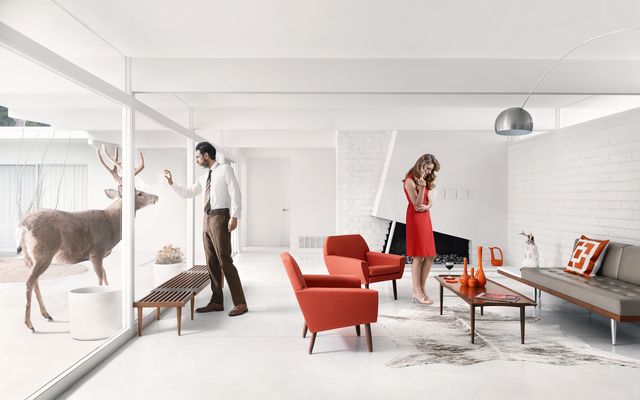
    Dean West, Palm Springs #1, 2015,Type C Photographic Print, Image Courtesy of Alison Milne Gallery

    “Palm Spring #1” is also about rich Californians but now inside their home. West captures the pristine architecture of a modern home. It is a painstakingly designed environment, all color coded. White dominates again: all the floors, walls (inside and outside), the sofa is greyish white while the Flos Arco floor lamp is silver. This blinding white creates emptiness, symbolizing the couple’s relationship. They happen to be in the same room physically but couldn’t be more far away from each other emotionally. They turn their backs on each other, seemingly alone in their self-imposed bubble of self-deception. A deer stands in the garden and the man is touching the glass wall in the hope of connecting with it. Does the deer symbolize nature or is it taxidermy? The pretty, fashionably dressed young woman – wearing the same red color as the armchairs in the room – blends into the color coded decoration. The glass of red wine in front of her hints that this should be a social time. Their clothing suggest that they are going out or coming in from an outing, theatre, dinner or party. We don’t know what time of the day it is. We see only a bit of greenery in the form of a tree at the top left corner – all natural elements are cut out. The couple lives in this artificial environment, locked in their misery.

    dean-west--beverly-hills-galle

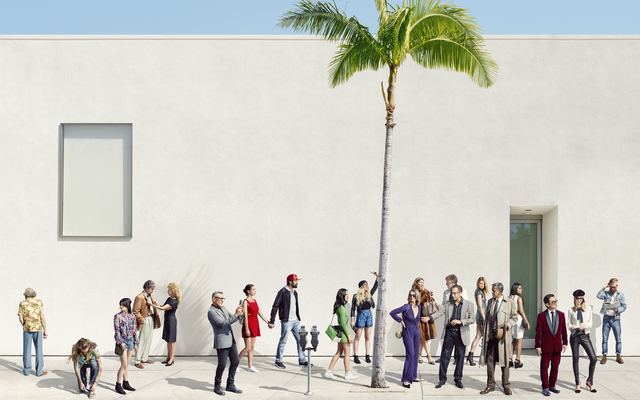
    Dean West, Beverly Hills Gallery, February 25th, 2016,Type C Photographic Print, Image Courtesy of Alison Milne Gallery

    Both “Beverly Hills Gallery, February 25th, 2016” and “Orient Point Ferry” depict crowds of people, so we hope for some interaction between them.  A large group of people gathers in front of a white wall in “Beverly Hills Gallery, February 25th, 2016”. The wall is so blindingly white and high, with a tall palm tree, that the people in front of it are belittled, seemingly unimportant. It is a busy composition – West incorporates a lot of narrative: a girl tying her shoelace, a woman tidying up a man’s jacket, an elegant lady near the tree, someone checking his e-mail or taking a selfie, a couple walking by, etc. Only one person might be going into the gallery. None of them – even people who seem to be interacting – look at each other. They are all separate entities lost in front of that large white wall.

    The five people pictured in the hazy light in “Orient Point Ferry” seem statuesque. Though their positions are static, there is actually a lot of movement in the image as they all look in different directions. What they see outside the image must be very interesting. They are fully occupied by it. The little girl stops eating her ice cream; the man stops reading his newspaper; the old lady seems to be so mesmerized that her lips open slightly. Once again they are disengaged, they just happen to be at the same place at the same time.

    Why are these characters so isolated and the images so perfect, even to the smallest detail? The New York Based, Australian born artist, “one of the world best emerging photographers” (Capture Magazine) received worldwide recognition with his series “Fabricate” in 2009. His intricately staged photographs are ‘fabrications’ indeed as they are planned down to the smallest detail. The artist has a vision, then assembles an eclectic cast of characters in rich, nuanced settings, and plans the lighting – a procedure that sometimes takes a few months. Through the shooting, he wants to draw out as much emotion as possible from the actors and actresses. Each character is photographed separately and then digitally put into the composition. The artist then manipulates and refines the images until he satisfied with them. As West mentioned, computers and digital images make everything possible, and provide limitless opportunities for creativity.

    West embraces reality. As he said, he takes “everyday occurrences beyond the realm of banality and showcase the psychology and emotion that’s involved in real-life situations. Nothing can ever be more than the real itself — yet art has the ability to inspire a consciousness of what is real and what is not.” (Christine Hogg, beautiful.bizarre, November 13, 2014). His images may not reflect the actual world, but an imagined one that could be just as real. These hyper-realist photographs seem so real that they become unreal. In this show West outlines a new American aesthetic through a modern mythology of disengagement.

    Emese Krunák-Hajagos

    *Exhibition information: April 27 – June 25, 2016, Alison Milne Gallery, 134 Osler Street, Suite 3, Toronto. Gallery hours: Wed – Sat, 12 – 6 pm.


    The Smithsonian’s National Portrait Gallery recognizes the life and accomplishments of “The Greatest”—Muhammad Ali—with a photograph by Yousuf Karsh. The image, taken in 1970, is installed in the museum’s In Memoriam space on the first floor, near the north entrance. The Portrait Gallery has 14 images of the boxer, including a 1981 painting on the third-floor mezzanine, titled “Cat’s Cradle,” by Henry C. Casselli Jr. Media on display since June 6, 2016.


    Portrait on display beginning June 6, 2016

    From his gold medal at the 1960 Olympics through his epic fights with George Foreman and Joe Frazier to his late-life battle with Parkinson’s disease, Muhammad Ali never left the public eye in a tumultuous, controversial, and electrifying life as a boxer and spokesman of conscience. Brash and outspoken, he burst onto the sports scene in the 1960s, creating a new model for the African American athlete. His conversion to the Nation of Islam and opposition to the Vietnam War made him a lightning rod for criticism, exposing the cultural fault lines of that decade. Stripped of the heavyweight title, he was vindicated in the courts and regained his title in 1974. Post-boxing, he became a citizen of the world, involving himself in global social and humanitarian causes that showed a commitment and compassion that made him a uniquely historic and beloved figure.


    Courtesy of The Smithsonian’s National Portrait Gallery

    Lakin Ogunbanwo, From the series ‘The human condition’© LagosPhoto 2013

    Lakin Ogunbanwo, From the series ‘The human condition’© LagosPhoto 2013

    Exhibition: 17.06 – 04.09.2016

    With over 250 photos and 5 videos by 24 contemporary artists, the exhibition paints a contemporary picture of life in Lagos, the economic capital of Nigeria, which has experienced a massive population explosion in recent decades, becoming a megalopolis of an estimated 21 million inhabitants.
    A glimpse into the future of ‘urbanity’.

    Dey your lane! Lagos Variations is right on this year’s theme of Urban Vibes. It is one of the key exhibitions in the international photography biennial, Summer of Photography 2016.

    In recent years, Lagos, the economic capital of Nigeria, has undergone unprecedented urbanisation. The population grew from less than half a million at the time independence was declared in 1960, to an estimated 21 million inhabitants in 2016. The expanding city has absorbed the surrounding suburbs in record time and has overtaken Cairo as Africa’s biggest metropolis. In spite years of the economic growth and the country’s enormous petroleum reserves, the rapid urbanisation has resulted in various growing pains. Since the late 1990s, when the Dutch architect Rem Koolhaas grew interested in the city, architects, town planners, intellectuals and artists have been trying to fathom the fascinating city. In spite of infrastructural challenges, enormous population pressure and institutions that are inchoate and in other contexts would be declared as not-fit-for purpose, the megalopolis does seem to be functioning. Contemporary creativity is thriving in the hustle and bustle of city life. The city isn’t only the commercial and financial heart of Nigeria, but also the center of Africa’s music, fashion and film industry (‘Nollywood’).

    ‘Dey your lane!’ is a common expression on the streets of Lagos and pretty much means: ‘mind your own business’. This is where the notion of individuality comes in, a trait that is key to life in Lagos: the city remains livable through creativity, innovation and the sense of adventure adopted by individual citizens. Without much help of neither the government nor overseas organisations, inhabitants manage to organise daily life in an organic way. A great example of this is the ‘Danfo-bus’ – used by millions of passengers every day, an informal system that replaces the non-existent public transport.

    Dey Your Lane! Lagos Variations displays different visions of Lagos through the recent work (2008-2016) of 24 African and international photographers who have experienced the intriguing city from the inside. Their work takes a look at, not just the busy, crowded, noisy Lagos, but also the intimate, darker Lagos, and the dreams, aspirations and fears of ordinary people who populate the city. The city, with its ultra-modern skyscrapers squeezed in alongside hastily erected settlements, is a sort of gigantic laboratory in which people experiment on a daily basis as they look for new forms of society. The exhibition presents a new image of urban contemporary Africa and gives us an announcement of the future: a taste of the direction towards which our urbanised world could evolve. 

    The exhibition is organised around 3 chapters which shed light on the numerous facets of urbanised Lagos. The individual in the city is central to the introductory chapter. In Lagos you are surrounded by masses of people, isolation and solitude are never far away in a metaphorical sense. There is a sense of urgency that is common to all large cities. The next chapter opens into the intangible, multifaceted character of the city itself. The final chapter focuses on the intimate tales, dreams and aspirations and fears of Lagosians. Visitors are welcomed by a real Danfo-bus at the Place Horta entrance to the Centre for Fine Arts.

    The exhibition has received generous support from and will be opened by Lagos State Governor Mr. Ambode himself. He, as BOZAR, believes in the power of art to change the image of the city and country.

    BOZAR / Centre for Fine Arts
    Rue Ravensteinstraat 23,
    1000 Brussels
    www.bozar.be


    Manuella Muerner Marioni, the Swiss painter and sculptor, has shown her artwork in New York, Chicago, Las Vegas, and Italy. Recently the winner of the First International Leonardo da Vinci Award, her paintings and sculptures continue to gain attention and influence across the globe.

    Marioni studied fine art and fashion design in at the New Art School in Zurich, but her art education did not end there. She collaborated for 7 years with her friend and mentor Niki de St. Phalle, the French artist, filmmaker, and sculptor. Together they worked in France, Switzerland, Germany, and the United States.

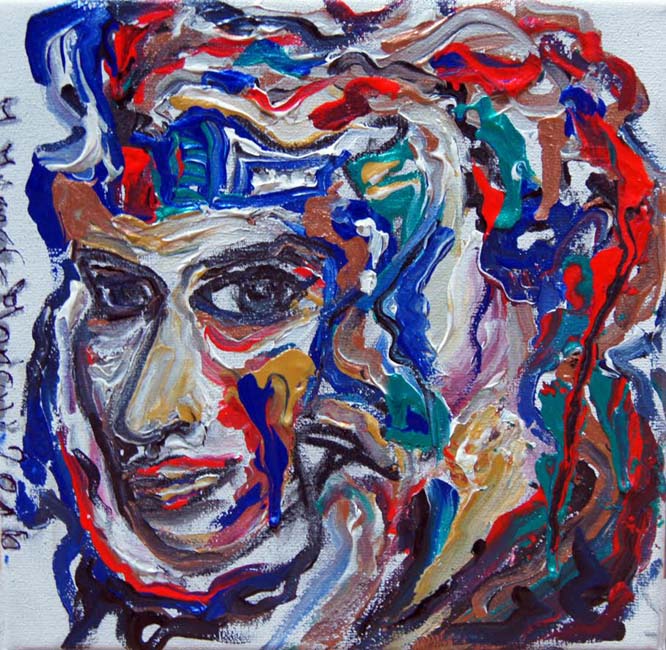
    Marioni’s newest body of work explores the immediacy of human emotion.  The series consists of thick, layered perl acrylic paint mixed directly on canvas. The utter freedom and emotion of her work is visible. Each painting has it’s own thesis, from the ode to David Bowie’s death, or commenting on the roles we all play in society that mask our own true purpose, Marioni’s work moves the viewer with her pure and genuine intentions.

    Sad Bowie Medium: Acrylic on Canvas Size: 20 x 20 cm / 7.90 x 7.90 inches (Height x Width) Year: 2016

    Sad Bowie
    Medium: Acrylic on Canvas
    Size: 20 x 20 cm / 7.90 x 7.90 inches (Height x Width)
    Year: 2016

    Marioni states, “My intention in making art, is to express something meaningful in an aesthetically delightful way. The greatest challenge is maintaining the subjects complexity but not confusing or complicating the viewer.” When looking at her newest body of work, one connects with the distilled essence of the theme. All filters have been removed.  And while the rich colors warm the viewer, the frenzied brushstrokes reveal the passion and intensity of the subject.

    Sad Bowie (2016) is an ode to David Bowie’s death, the role he played in moving our society forward, and the gifts of music and performance he gave the world. His death affected Marioni intensely.

    The Mask Medium: Acrylic on Canvas Size: 20 x 20 cm / 7.90 x 7.90 inches (Height x Width) Year: 2016

    The Mask
    Medium: Acrylic on Canvas
    Size: 20 x 20 cm / 7.90 x 7.90 inches (Height x Width)
    Year: 2016

    The Mask (2016) is a commentary on the mask many wear that hides deeper intentions and truths. The face or mask was painted with muted colors and has flat eyes.  Behind the mask are intense heaped colors, almost bursting. Some spill onto the face, speaking to the futility of repressing these emotions and desires.

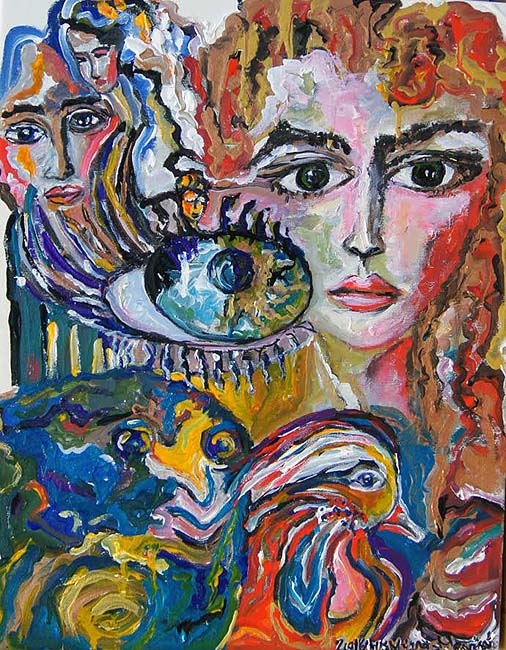
    My Univers Medium: Acrylic on Canvas Size: 50 x 40 x 5 cm / 19.7 x 15.75 x 2 inches (Height x Width x Depth) Year: 2016

    My Univers
    Medium: Acrylic on Canvas
    Size: 50 x 40 x 5 cm / 19.7 x 15.75 x 2 inches (Height x Width x Depth)
    Year: 2016

    My Universe (2016) is an interesting portrayal of those that are hurt by modern industrial culture. The self-portrait in the upper right corner is accompanied by other female figures as well as mythical looking creatures. The creatures are painted in swirling movements, as if they are almost unreal, or extinct. She pleads us to consider our effect on the environment, and care for the earth instead of damaging it.

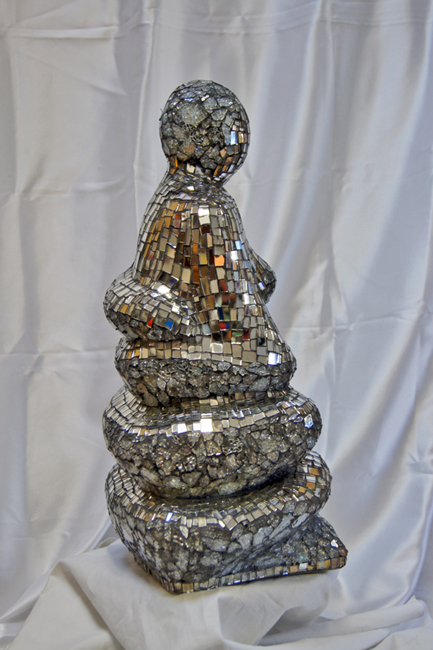
    Rotella Medium: Mirror-Sculpture Size: 50 x 30 x 23 cm / 19.70 x 11.80 x 9 inches (Height x Width x Depth) Year: 2015

    Rotella
    Medium: Mirror-Sculpture
    Size: 50 x 30 x 23 cm / 19.70 x 11.80 x 9 inches (Height x Width x Depth)
    Year: 2015

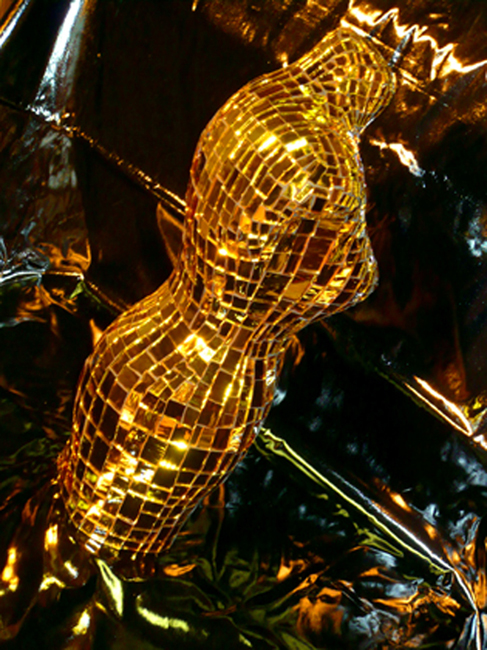
    To understand these pieces it is necessary to examine her sculptures. The sculptures Marioni is most well known for are figurative and covered in mosaics of mirrors, reflecting tinkling light throughout a whole room. They encapsulate her transcendent beliefs and uplift the viewer into a higher frequency universe. The viewer and the light of the room become part of the artwork, and their image is reflected out in various forms through these sculptures.

    Torso Gold Medium: Mirror-Sculpture Size: 50 x 20 x 30 cm / 19.70 x 7.90 x 11.90 inches (Height x Width x Depth) Year: 2010

    Torso Gold
    Medium: Mirror-Sculpture
    Size: 50 x 20 x 30 cm / 19.70 x 7.90 x 11.90 inches (Height x Width x Depth)
    Year: 2010

    In Marioni’s recent series of paintings, she has stepped back from reflecting the viewer, and instead chooses to express her own beliefs in pure unadulterated form. Her truths shock us with their grace and simplicity.  Marioni comes to us humbly with her own emotions, her own truths, and we are deeply moved, because they are pleasing the visual senses.

    – Farrell Mason, NY Arts

    Over the past five years Fabio Bucciarelli has dedicated his life to document the major conflicts in Africa and Middle East, revealing to the world the cruelty of war and its devastating effects on the civilian populations.

    In 2011, Fabio started to develop The Dream, a photographic project on the largest exodus of migrants and refugees after the Second World War. In 2016, the work has become a book, published by FotoEvidence, a prestigious publishing house in New York.
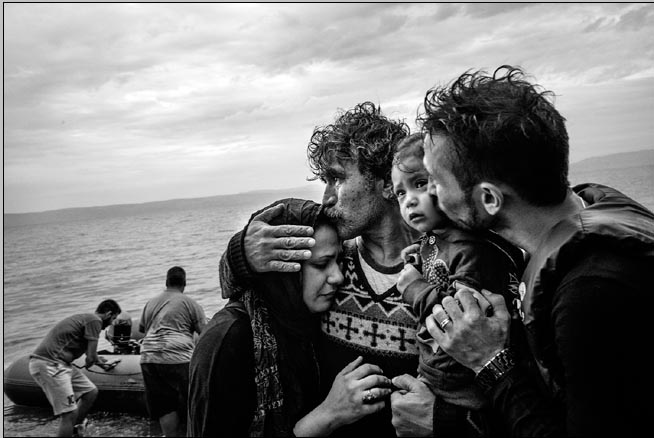
    Syrian refugee family just landed after reaching, on a rubber boat from Turkey, the village of Skala Sykaminias located on the northeastern Greek island of Lesbos, on October 9, 2015. For many thousands of refugees and migrants heading to Europe from the Middle East, the long route to a new life lies through Greece and the Western Balkans with the ultimate destination in Germany and other northern EU countries. According to the UN Refugee Agency, more than 850.000 arrivals by sea were registered in Greece in 2015.

    Syrian refugee family just landed after reaching, on a rubber boat from Turkey, the village of Skala Sykaminias located on the northeastern Greek island of Lesbos, on October 9, 2015. For many thousands of refugees and migrants heading to Europe from the Middle East, the long route to a new life lies through Greece and the Western Balkans with the ultimate destination in Germany and other northern EU countries. According to the UN Refugee Agency, more than 850.000 arrivals by sea were registered in Greece in 2015.

    Within her exhibition space (which already housed, in 2014, Bucciarelli’s solo show, Maiores Nostri, dedicated to the South Sudan), from June 7, Raffaella De Chirico presents a selection of images contained in The Dream, thus giving a programmatic continuity of research through reportage photography, pertaining to social issues.

    In a refined – and masterfully realized – authorial experiment, poised between the classic photojournalism and artistic photography, The Dream is a reflection deep on the universal condition of men become migrant; the focus on the human being rather than on refugee becomes the starting point of a long journey, where the dream is revealed as the true motor of an excruciating journey seeking refuge.

    An Italian Red Cross doctor measures - with an electronic thermometer - the temperature of a Sub-Saharan boy, during the medical check in the tent set up at the dock in the port of Messina (Italy). On July 31st 2015, 392 people were disembarked from the Italian Coast Guard ship Diciotti at the Sicilian port of Messina. Most of the people came from Sub-Saharan countries like Gambia, Senegal, Mali, Ivory Coast, Togo, Ghana, Cameroon, Nigeria, Burkina Faso, Guinea Conakry and Guinea Bissau. There were also refugees coming from Sudan, Somalia and Libya.

    An Italian Red Cross doctor measures – with an electronic thermometer – the temperature of a Sub-Saharan boy, during the medical check in the tent set up at the dock in the port of Messina (Italy). On July 31st 2015, 392 people were disembarked from the Italian Coast Guard ship Diciotti at the Sicilian port of Messina. Most of the people came from Sub-Saharan countries like Gambia, Senegal, Mali, Ivory Coast, Togo, Ghana, Cameroon, Nigeria, Burkina Faso, Guinea Conakry and Guinea Bissau. There were also refugees coming from Sudan, Somalia and Libya.

    The selection of shots in the exhibition aims to reproduce the project concept. On June 7, also the book, realized through the crowdfunding of 197 people who have financially supported the production, will be officially presented.

    The Dream is a lucidly oneiric photographic tale for a book that comes to light at a time when the refugee crisis has become the biggest exodus in contemporary history, often documented by the media in an impersonal way, generating indifference if not hostility among public opinion.

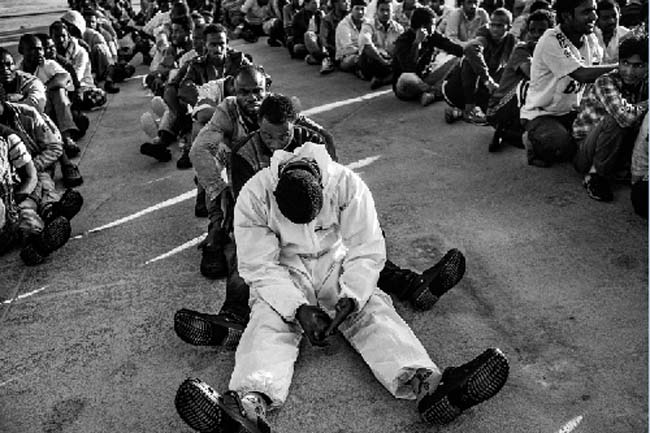
    Migrants and refugees coming from Sub-Saharan countries are seen in line for the identification process at the dock of the port of Messina (Italy). On July 4th 2015, 306 people were disembarked from the Italian Coast Guard ship at the Sicilian port of Messina. They were rescued from 3 different boats departed from Libya. Most of the people came from Sub-Saharan countries like Gambia, Senegal, Mali, Ivory Coast, Ghana, Nigeria, Mauritania, Guinea Conakry, Guinea Bissau, Ethiopia and Sudan.

    Migrants and refugees coming from Sub-Saharan countries are seen in line for the identification process at the dock of the port of Messina (Italy). On July 4th 2015, 306 people were disembarked from the Italian Coast Guard ship at the Sicilian port of Messina. They were rescued from 3 different boats departed from Libya. Most of the people came from Sub-Saharan countries like Gambia, Senegal, Mali, Ivory Coast, Ghana, Nigeria, Mauritania, Guinea Conakry, Guinea Bissau, Ethiopia and Sudan.

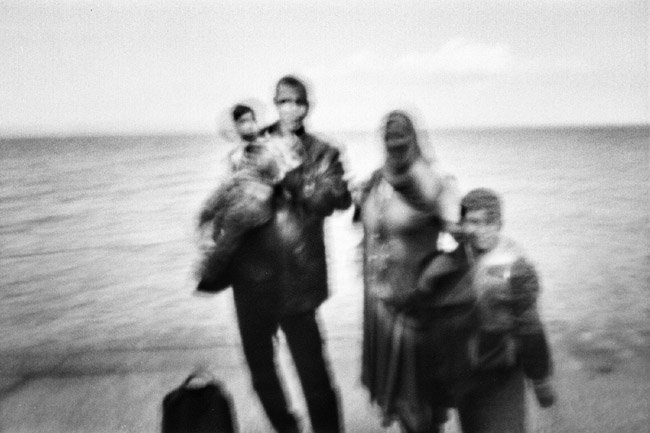
    During the creation of The Dream, Fabio has made use of various technical tools to suggest to the reader a different perspective on migrants’ conditions today. The use of pinhole images, created with Pinolina (a unique camera, built specifically for this project development) gives rhythm to the book, leading the reader towards a participant experience.
    The Dream, Fabio Bucciarelli. @ Raffaella De Chirico Contemporary Art.

    The Dream, Fabio Bucciarelli. @ Raffaella De Chirico Contemporary Art.

    The book has a limited edition of 1000 copies, in which black and white pictures, diptychs, composites and color images are alternated among the 180 pages. 100 copies are Special Edition, distributed in a “book vest” made by refugees – hosted in Pikpa reception camp (Lesbos island) – with those same life jackets used by themeselves to reach Europe. Each book vest is unique and unrepeatable, a product that seals the collaboration between the author and the protagonists.
    The Dream, Fabio Bucciarelli. @ Raffaella De Chirico Contemporary Art.

    The Dream, Fabio Bucciarelli. @ Raffaella De Chirico Contemporary Art.

    The Special Edition also contains one of the four selected photographs with 25 editions printed on fine art paper Hahnemuhle German Etching 310gsm.

    The Dream will be on display from June 7 to September 15, 2016 at Raffaella De Chirico Contemporary Art.

    Raffaella De Chirico Contemporary Art
    Via della Rocca, 19
    10123 – Turin

    THE DREAM
    FABIO BUCCIARELLI

    opening 7 june | 19h00 – 22h00
    7 june – 15 september 2016

    Courtesy of Raffaella De Chirico Contemporary Art


    News | Exhibitions