

• jean-marc schwaller

    jean-marc schwaller

    By Allison A Van Spankeren
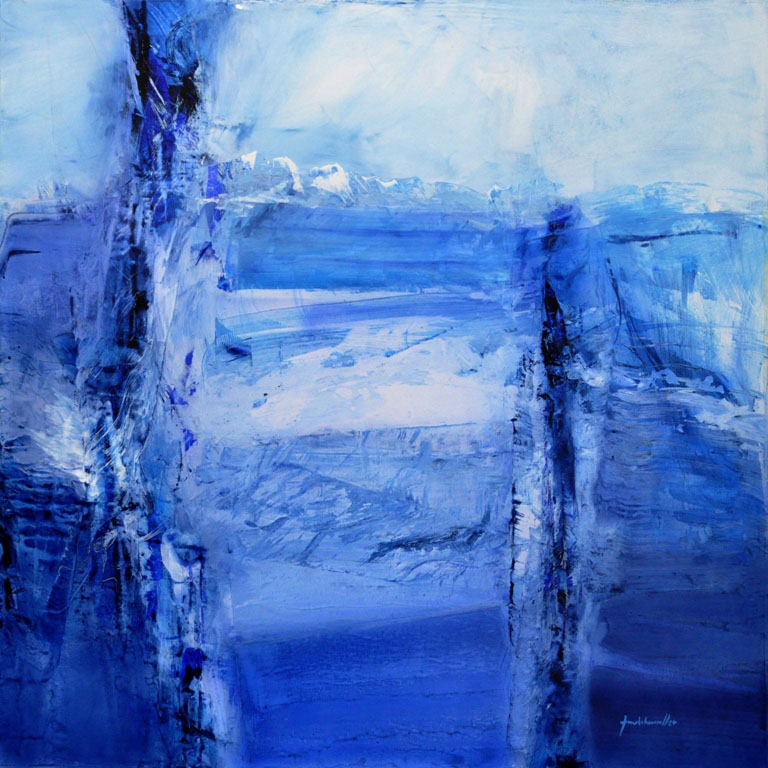
    While not a figurative painter in the traditional sense, Swiss artist Jean-Marc Schwaller gives attention and emphasis to the tangible world, as his work often focuses on the abstraction of nature.  Schwaller brilliantly transforms realistic subjects, such as water gardens and landscapes, into visceral compilations of light and color. Schwaller is a master at giving a sense of emotion, movement, and life to his often conceptual pieces.

    Born in 1949, Schwaller grew up in the small town of Ponthaux, Switzerland. He attended College St-Michel in Fribourg, and later graduated from the University of Bern in Switzerland, with the intent to teach visual arts. Schwaller taught for ten years, before leaving to focus on his own work.

    Truly a man of the world, Schwaller’s work has been exhibited across the globe. Schwaller has a passion for travel and often looked to other cultures and landscapes for inspiration. For instance, in 1998, he was a part of the exhibition for the centenary of the SPSAS “Beware of the Journey,” where he painted eight watercolors representing the Taklimakan Desert in China. In 2003, he exhibited two paintings from his series Lords of War at the First International Art Biennale in Beijing. Shortly after, he exhibited Landscape of Earth-Water Landscapes at the Museum of Singinois Tavel.

    In addition to painting, Schwaller recently completed a sculpture based on the theme of divers in the port of Gletterens. Schwaller constructed glass walls, in which his rendering of five human bodies live. These bodies seem to have been frozen in a moment of intense movement: contorted and thrashing in a dance-like way, as if they were captured in the perfect storm.

    Most recently, Schwaller has exhibited his work at the Armani Hotel in Dubai and at Emirate Palace in Abu Dhabi. Opening just this past June, Schwaller’s exhibit entitled “The Rhythm of Earth-Passage” is a collection of his monumental oil paintings, which were previously displayed in Broadway Gallery, New York. Like much of Schwaller’s work, the paintings in “The Rhythm of the Earth-Passage” translate the natural world into a medley of color and light. Schwaller draws inspiration for much of his work from the world around him, as he is particularly interested in landscapes, mountains, windows, interior vs. exterior, and the male and female body.

    Schwaller also draws much inspiration and influence from the Color Field period of the 1950s and 1960s. In this period, artists shied away from the realistic representation of objects or subjects, and instead, abstracted their subjects with an emphasis on large, flat, solid planes of color. Schwaller takes these elements of the Color Field period and elevates, updates, and applies them to the level of his contemporary work. Schwaller is often likened to Mark Rothko and Barnett Newman, two highly regarded masters of the Color Field period.  Like Rothko, Schwaller still places much emphasis on color blocking, however Schwaller is a bit more playful, as he lets his colors interact and blend at some points.

    We see this focus on the potential of color in the harmonic blending of pigment in Schwaller’s recent work. In his first piece here, each shade of blue seems to fade into another, easily transitioning from one hue to the next, truly conjuring the sensation of flowing water. In this rendering of a water garden, soft brushstrokes of yellow and orange pigment are fluidly interwoven within the deep blues and blacks of the piece. This medley of colors, leads your eye inwards, to a patch of negative space in the center of the canvas. The juxtaposition of this harsh white center, with the bursts of dark, almost violent, color emerging from it’s center, gives the piece a sense of intense emotion, truly evoking elements of the spectacle of nature.

    In this second piece, another one of Schwaller’s large scale watercolors, he continues to show a remarkable concentration and emphasis on light and fluidity. Again, numerous hues of blue flawlessly run into each other, giving the piece of an active and gestural quality. While still displaying this fluidity, Schwaller makes strong use of lines in this piece. Large vertical areas of color run up the two sides of this painting, while simultaneously, light, smooth, horizontal lines run across the painting. Schwaller is able turn these lines and colors into something more, something that transmits emotion and relates Schwaller’s interpretation of a water garden.

    In contrast to the last two of Schwaller’s pieces, here, Schwaller’s third canvas deviates from the strong blues, and utilizes on wider palette of colors. The brushstrokes of these earth tones transition from deep blues, moss greens, and blacks, to colors of copper, rust, and orange. The paint appears to be applied thickly to the canvas, creating texture, and giving the painting a sense of density. However, the painting never seems to be heavy or weighty, due to the translucent and luminous presence of light in the piece. The light and visceral component of this piece streams from the right hand corner of the piece and downward, with the smooth, soft use of the hazy light orange.  The paint looks almost feather-like, as the airy orange fades slowly to lighter shades as the paint floats down the canvas, until this delicate color is interrupted by earth tones in a set of undulating horizontal lines.

    While these three pieces, and much of Schwaller’s work, draw from the Color Field period, Schwaller gives texture, energy and excitement to the usual flat planes of color that are integral to Color Field work.  The dynamic and dramatic nature of his pieces are produced by this feeling of movement. Schwaller creates with his brushstrokes. His is a fluid stroke, yet highly visible and dramatic, creating a unique sense of texture and vitality in these pieces, that actively and effectively conjure notions of the natural world. When Jean-Marc Schwaller paints a water garden, he is not just painting a water garden, he is painting the essence of a water garden, he is painting our interaction with a water garden, and how it feels, smells, tastes, and sounds, to stand amidst the softly rippling waters.

    sutured images


    courtesy of the artist


    Alessandro Di Cola: Sutured Images

    By Paul Gost

    Alessandro Di Cola is an artist whose work captures memory, color and imagination and stitches it into a sublime moment for all eternity.  Since his graduation from the Academy of Fine Arts in Rome, the Italian painter and sculptor has shown his work at festivals and galleries around Italy, including the GlobArt Gallery and the Crocetti Museum.  His work first appeared in the U.S. at New York’s Broadway Gallery in their September 2012 chapter of the Artists at Home and Abroad series, which features collections from up-and-coming artists.  Most significant is that his work explores issues of materiality and the horizon with a deeply felt emotional undercurrent.

    Di Cola’s work includes both paintings and sculptures that, despite their apparent lack of complete or distinct images, still seem to burst with life; di Cola attributes this effect to the idea that his pieces are “imbued with the nuances of the infinite.”
    He compares his works to old pictures that have “passed through the wallets of several generations” but still retain their “essence,” a reminder of what they once were along with the changes they’ve undergone with time.

    Works like Papaveri are rich in texture.  Split between a pale whitish grey and a deep forest green this work is reminiscent of Mark Rothko’s “multiform” paintings.  This one is stitched or sutured with red fleck in the center that fade out over the right bottom half of the painting.  It is a near literal sense of sky and earth.  Like his other works, this piece focusses on emotional and spiritual expression and seeks to achieve a representation of the sublime rather than a realistic portrayal of nature.

    Di Cola’s works share an affinity with past color field painters but are wholly contemporary with his use of washed-out color on a stitched, jute canvas. The vast differences among these choices in landscape depicted in di Cola’s paintings highlight the artist’s cyclical and everlasting representation of life regardless of setting.

    His abstract representations of these various scenes indicate a higher beauty than the mind can firmly pin down and one that is granted equally to many different aspects of life.  To find out more about his work and themes, I sat down with Alessandro for an interview:

    Paul Gost: How long have you been painting? Did you always know you would be an artist?

    Alessandro Di Cola: “I’d say since I was very small!’ My attention has always verged towards drawing, – shapes,  imagining, perceiving things differently from how they actually looked.

    Did I know I would be an artist? Well! I’ve never really stopped to think about it. I can only say, now that I have, I realize that that one is an artist in thought and intuition … everything else is pure being.

    PG: Tell me about your process, do you create a painting in one sitting or over time?

    ADC: My pictures, like most of my sculptures, are born from and are expressions of the sensations and mood of the moment since tomorrow might be different or be perceived, felt differently. I don’t like long processes. Metabolization times might be long, becoming one with the feeling, making the sensation ‘mine’, before beginning a work. 

    PG: Your work is rich in texture and minimal in color, there is also a deeply emotive quality to them. What is the message behind these works?

    ADC: At the base of my pictorial works there is a focus on “image retrieval”, “stitching” together the pieces as in old photographs that are torn, peeled or faded. I want to create a meeting point between sky and earth both real and reflected; to stitch together a memory made up of colors that have almost completely vanished but are still discernible in their transparency. The message is definitely that we need to “mend” what was worthy, important, underlining the idea of  “rebuilding.”

    PG: There is a earthy quality to your works. What relationship to nature does your work have?

    ADC: I believe the relationship of my works to nature is in their likenesses, with nature in the foreground, a nature which must continue to exist through time and that needs, at times, to be rescued.
    We are part of this world and are aware of its importance.

    courtesy of the artist

    Di Cola’s enthusiasm rather than hesitance in showing the backbone of his canvas, as seen in his emphasizing the stitching rather than hiding it, brings to mind artists such as Alberto Burri and Robert Rauschenberg, whose revolutionary use of unexpected materials and similar eagerness in showing them off in their work indicated a preference for using common, everyday materials to depict larger themes and deeper meanings.

    Similar to the bare bones style found in his paintings, di Cola‘s sculptures are forms stripped down to their own essence, thereby eliminating visual distractions that take away from the true focal point of the image.

    The careful elimination of heads, legs and arms from individual works allows viewers to focus on the still movement of the body parts remaining. Sculptures of faces with only aluminum wiring to outline the back of the head that was once there draw our attention to the passage of time as the faces begin to appear more like death masks that remind us again of the cycle of life.

    The themes and forms found in di Cola’s work are shared by several of his contemporaries: di Cola’s face sculptures are not dissimilar from artist Suzanne Fortin’s similarly grim African-inspired works on canvas. The world, as depicted by di Cola and his contemporaries, is one of reflective sensitivity that places its focus on the everlasting wheel of life and its moments of beauty.

    With Yayoi Kusama at the Whitney Museum and Cindy Sherman at MoMA, this past year has seated women artists at the forefront of the New York art scene. These impressive retrospectives called attention not only to the force and depth of the artistic creation of women, but also to the woman as subject matter in contemporary art. The woman’s body lies at the core of a complex iconography that spans over hundreds of years within the history of art. This heritage is burdened with imagery that reveals issues of sexism, misogyny, and exoticism.

    Mickalene Thomas, You’re Gonna Give Me the Love I Need, 2010. Rhinestones, acrylic and enamel on wood panel, 96 x 144 in. Courtesy Susanne Vielmetter Gallery.


    Feminist and Post-Feminist Art: A Dialogue With The Past
    By Sonia Coman


    With Yayoi Kusama at the Whitney Museum and Cindy Sherman at MoMA, this past year has seated women artists at the forefront of the New York art scene. These impressive retrospectives called attention not only to the force and depth of the artistic creation of women, but also to the woman as subject matter in contemporary art. The woman’s body lies at the core of a complex iconography that spans over hundreds of years within the history of art. This heritage is burdened with imagery that reveals issues of sexism, misogyny, and exoticism. Contemporary artists, particularly women artists, still respond to this overwhelming visual repertory of representations of women when they decide to focus their own art on the female body, feminine sexuality, and gender identity.

    Between artist and model, as well as between portrait and beholder, there is an interplay of gazes—gendered gazes—that adds a strata of meaning to even the most innocuous representations of women (as many of Cindy Sherman’s images seem to be). The work of feminist artists such as Barbara Kruger exposes and denounces the masculine gaze. Activist images of women reveal or invert the stereotypes associated with women, fighting against empty identities generated by societal norms and sociopolitical conventions. In her famous essay “Visual Pleasure and Narrative Cinema,” Laura Mulvey uses the phrase “woman as image” to emphasize the dichotomy between looking and being looked at and to ground voyeurism and fetishism in the pleasure derived by men from looking at women. This understanding of the gaze can be further complicated in a number of ways, from focusing on the queer gaze to subverting the desire that accompanies the act of looking. Young artists such as Nikki S. Lee and K8 Hardy obscure the identity of the women and destabilize a fixed position for the beholder, creating artwork with a chameleon-like subject matter.

    The woman as image is still pervasive today, from painting to cinema, and especially in advertisement, which makes the work of artists like Judith Bernstein particularly significant. On display at the New Museum under the exhibition title “Hard,” Bernstein’s images carry explicit sexual meaning. As a woman and an artist, Bernstein creates phallic pictorial signs that reference the graffiti in men’s restrooms and protest against sexual violence, understood as stemming from the same root as political and military aggression. Her monumental drawing HORIZONTAL from the early 1970’s confronts the viewer with the image of a swirling screw, bearing immediate sexual connotations. The shape dominates the surface of the paper, the spiraling lines and the softness of the charcoal emphasize its organic dimension. Under this jarring representation, the signature of the artist is enormous and clearly legible, shouting the artist’s endorsement of the image’s activist message.     

    Feminism has run parallel to postmodernism in many respects, and with important points of junction. In its manifold manifestations, contemporary art rushes beyond postmodernism—what is there beyond postmodernism?—and responds to post-feminist lines of thought. In a broadened field, the representation of the woman’s body and of female sexuality continues to be politically charged and to express the tension between personal and public identity.

    In this period, when artists are struggling to move beyond –isms, it is encouraging and useful to see art that constructs feminine identity and sexuality in a larger framework, with an inquisitive attitude. The mixed media works of Mickalene Thomas reframe the identity of African American women and engage with notions of beauty in an historical perspective. Thomas’ images are the result of an assiduous process of transformation. On the one hand, her portraits of women are paintings or collages based on the artist’s photographs. The use of rhinestones emphasizes the lush quality of the surface.  On the other hand, the contexts in which the figures are depicted bear art historical references; Thomas’ work thus elaborates a sophisticated critique of the stereotypes around and attacks on female black sexuality.

    “The Origin of the Universe” is the artist’s most recent exhibition, currently on view at the Brooklyn Museum. According to the exhibition catalog, the paintings focus on the woman’s body in landscape, exploring how feminine presence adds the dimension of gender to the environment. The title of the exhibition refers to Gustave Courbet’s L’Origine du Monde (Origin of the World). The art historical legacy built in her work, the mixed media technique of the paintings, and the installations created for the Brooklyn Museum show reflect the multimedia character of her artistic vision and her holistic approach to redefining gender and racial identity.

    References to art history are interwoven in the creation of other contemporary artists, as well, increasing the level of depth and complexity of the work’s iconography. Carina Linge’s photographic series include stills reminiscent of Flemish Masters, staged by the artist with objects found in the domestic environment of her female models. These fragments of daily life echo the cropped portraits of her sitters, where the beholder is refused visual access to the entire body of the woman. Ted Lawson’s sculptures of women evoke the rococo or the Art Nouveau, not necessarily in order to condemn a disparaging attitude about women in those periods (as Mickalene Thomas does), but in order to recreate the effect of fascination toward an ideal woman that pervaded those periods in history. In an effort to capture time and to cope with its irreversible character, Lawson’s exploration of female sexuality focuses on its anatomical and physiological dimension.

    Limitations of time and space also haunt the photographs of the Mozambican artist Camila de Sousa, who depicts incarcerated women with a history of domestic violence. The standard format of her photographic series replicates the standardization of life for the confined women she represents. Carefully staged photographs in bold colors, Sousa’s powerful images reflect the energy of these women, despite their state of detention, the provisional character of the spaces they inhabit, and the different sense of time they are experiencing.  

    These artists and themes are but a cross-section of the overwhelming multitude of approaches to feminine sexuality. This selection particularly emphasizes the activist role of female imagery and the engagement of several contemporary artists with an art historical dialogue. With a more or less overt investigation of feminine sexuality, focusing on various aspects of the female body in its diverse environments, contemporary images of women not only reflect, but also construct new feminine identities.


    Fraternal twins Alan and Michael Fleming have been living together since childhood, and collaborating in their shared space since 2005. That is, until Alan moved from Chicago to New York. With time apart, their dynamic evolved. “This exhibition marks a temporary hiatus in our collaboration. Not that we stopped making work, but that after many years of collaborating, we were suddenly forced to make our work in a new way since we were now living in two different cities,” says Michael.

    Alan and Michael Fleming, Rock Paper Scissors, 2011. Courtesy of the artists.


    Brothers’ Game
    By Maria Anderson


    Fraternal twins Alan and Michael Fleming have been living together since childhood, and collaborating in their shared space since 2005. That is, until Alan moved from Chicago to New York. With time apart, their dynamic evolved. “This exhibition marks a temporary hiatus in our collaboration. Not that we stopped making work, but that after many years of collaborating, we were suddenly forced to make our work in a new way since we were now living in two different cities,” says Michael.

    For “GAME ON,” the Fleming brothers created two distinct bodies of work: one from the year they were separate, and the other from after they reunited. Their collaborations take various forms, including performance, video, drawing, and sculpture. “We are both interested in the shift toward sculpture in our practice, but we wanted to maintain the physicality of our prior performance and video work. I think we achieved that through certain pieces in the show like Rock Paper Scissors (2012),” says Alan. No matter the form, play and physicality are deeply involved, and their surroundings are treated as locations for experimentation, escape, and play.

    We’re all aware of the myth of twins possessing a psychic connection that surpasses sibling intuition. The Fleming dizygotes aren’t necessarily drinking the Kool-Aid, but they do play around with the idea of twin ESP to try to get a sense of what their collaboration means in both situations, together and apart.

    While separated, the two attempted to continue their collaborative art-making through objects such as postcards and Polaroids, calendars and clairvoyance games. These served as records of communication, and provided fodder for “GAME ON.” They even mailed an empty box back and forth, titled A Sea Shanty, which accumulated postage like barnacles over the year. Rock Paper Scissors (2011) took form as hand sculptures embodying three games Alan and Michael played in which neither knew the result until they installed the Chicago iteration of “GAME ON.” In an interview for Threewalls Gallery, Michael explains why they chose to portray Rock, Paper, Scissors. “We were really interested in this idea of a really ephemeral game that we would play when we were younger that was kind of a low-stakes game. But, that if we stretch it out over time and distance, and we embody it in this classical medium, it becomes something larger than itself, or something larger than a game between us. It becomes this metaphorical, conceptual object.” For Psychic Color Calendars (2011), they tried to focus on the same color every day for thirty days, and recorded the results on the calendars. These exercises and games were a way to stay connected despite the separate studios and thinking environments, and reflect an effort at examining each side of communication, its antecedents, pauses, and erasures. French sociologist Roger Caillois believed games must contain the following traits: fun, separate, uncertain, non-productive, governed by rules, and accompanied by the awareness of a different reality. Though the Flemings’ play does not adhere to all of these, it is interesting to note that many of these qualities are key elements in their games as well as in their collaborations.


    Alan and Michael Fleming, Psychic Color Calendars, 2011. Courtesy of the artists.


    In the second body of work, the Flemings examined the mechanics of a mental reunion and resumed play. One of the pieces, Who’s Bad? (2012), is a single-channel video of Alan teaching Michael to dance. Alan has years of training in hip-hop, break dance and other styles. The backdrop is the Brooklyn subway stop Hoyt Schermerhorn, where Martin Scorsese filmed Michael Jackson’s music video, “Bad.” According to critics, the video helped MJ’s image become edgier, and the video has over 53 million views on youtube. Alan describes how they decided to create a rawer, unrehearsed video. “After I had been teaching Mike the moves, we were becoming precise, performing the whole combination. But when we started to look at the footage, we were struck by the moment of learning. So, I told Mike, ‘Don’t learn any choreography before you get to the subway.’ The only times he would learn were in front of the camera. So, I would introduce new material to him, explain it, and he would have to learn it on the spot, on site, with people looking.” As a result, the unedited video shows a learning experience rather than a final product.

    The Fleming brothers received their MFA from the Performance Department at the School of the Art Institute of Chicago, which they attended as a collaborative. This is the second iteration of GAME ON—the first took place in Chicago—and the brothers’ first solo exhibition in New York. The two are currently based out of Brooklyn.

    Alan and Michael Fleming have shown their collaborative works throughout the US as well as abroad. Their videos have been screened in Copenhagen, Lviv, Ukraine, Rio de Janeiro, and Berlin. They are current fellows in the AIM (Artist in the Marketplace) Program at the Bronx Museum of the Arts and International Artists in Residence at the NARS (New York Art Residency & Studio) Foundation. They have performed at the Museum of Contemporary Art Chicago, the Chicago Cultural Center, the Centre for Contemporary Arts in Glasgow, and the Factory for Art and Design in Copenhagen.


    This past Saturday FLUX Harlem hosted a panel discussion at Art Speaks! Gallery. The talk covered the controversial topic of a post-racial society.  Positing the question: how does the idea of a “post racial” America impact how we currently view the world? Can America ever look past race?  With election day ahead, this theme has resurfaced.  With Barack Obama as President and a wider acceptance of interracial marriage many Americans feel we have entered this state, while others believe that groups such as the Tea Party movement prove it has not. Though if statistics mean anything, 39% of persons of African-American descent felt they were in a better position than they had been five years ago, an increase of 19% from the previous poll taken in 2008.

    Barack Obama, Harvard Protest, 1991.


    Affirmative Action in the 21st Century?


    This past Saturday FLUX Harlem hosted a panel discussion at Art Speaks! Gallery. The talk covered the controversial topic of a post-racial society.  Positing the question: how does the idea of a “post racial” America impact how we currently view the world? Can America ever look past race?  With election day ahead, this theme has resurfaced.  With Barack Obama as President and a wider acceptance of interracial marriage many Americans feel we have entered this state, while others believe that groups such as the Tea Party movement prove it has not. Though if statistics mean anything, 39% of persons of African-American descent felt they were in a better position than they had been five years ago, an increase of 19% from the previous poll taken in 2008.

    The talk was moderated by Bridgit Antoinette Evans. Evans is an award-winning actor, producer and founder of Fuel | We Power Change (www.FuelChange.net), a culture change lab that produces artistic collaborations that promote human rights around the world.  Bridgit’s recent op-ed on Judy’s play and the role of artists in defending human rights appears on The Huffington Post. And featured panelists including Frank Roberts, Herb Boyd and Michele Shay.


    Left to Right: Michele Shay, Herb Boyd, Frank Roberts, Bridgit Antoinette Evans.


    Frank Roberts is a writer, educator, and critic based in New York City.  He is currently a lecturer professor in the Gallatin School at NYU (where he teaches “Race, Ethnicity, and Popular Culture”), the English department at Hunter College (where he teaches “Black Women Writers” and “20th Century African American Literature”) and the African American Studies department at John Jay/CUNY (where he teaches “Race and Ethnicity in America”).

    His writings on black popular culture and politics have appeared in The Village Voice, The San Francisco Chronicle,The Root.Com, The Daily Voice, and The Huffington Post, among many others.

    Herb Boyd is a journalist, activist, teacher, and has authored or edited 23 books, including his most recent one, By Any Means Necessary:  Malcolm X—Real, Not Reinvented, co-edited with Ron Daniels, Maulana Karenga, and Haki Madhubuti.  Other recent books include Civil Rights:  Yesterday & Today and Baldwin’s Harlem, a biography of James Baldwin, which was a finalist for a 2009 NAACP Image Award.  His articles can be found in such publications as The Black Scholar, The Final Call, the Amsterdam News, Cineaste, Downbeat, and The Network Journal, among others.

    Michele Shay is best known as an actress for her Tony-nominated performance in August Wilson’s Seven Guitars for which she also won a NAACP and outer Critics Circle Award. A veteran performer, she has appeared on TV and film; on and off-Broadway in Home (Negro Ensemble Company),for colored girls by Ntozake Shange, Coriolanus with Morgan Freeman, Titania in Midsummer Night’s Dream opposite William Hurt in Central Park (NYSF), Meetings by Mustapha Matura (Obie) ;  She has directed 14 plays including most recently Blues for An Alabama Sky with Robert Gossett at the Lorraine Hansberry Theater, San Francisco,  and Da Kink in my Hair by tre anthony (National Black theater Festival 2011,NYU,Tronto) with music by Carol Mailliard (Sweet Honey) and Michael McElroy.  She is currently an Acting Professor in the New Studio on Broadway at NYU’s Tisch School of the Arts.


    I almost always begin from the need to express a feeling and in response to what happens to me in real life.

    I almost always begin from the need to express a feeling and in response to what happens to me in real life. I choose the medium; oil paint on stretched canvas usually, but also water color, pencil, pastel, etc., on paper. There are alternating stages when formal aspects decide procedure and then again, I often refer back to an original perception in order to regain balance and a sense of the ground under my feet. Sometimes a painting takes off in an entirely new direction, irrespective of original intention.


    James Welling was born in Hartford, Connecticut, in 1951. He grew up in nearby Simsbury where, in 1963, he began to study art with Julie Post.

    James Welling was born in Hartford, Connecticut, in 1951. He grew up in nearby Simsbury where, in 1963, he began to study art with Julie Post. In 1965 he took drawing classes at the Wadsworth Atheneum in Hartford and began to work independently in watercolor. Welling was deeply influenced by the work of Charles Burchfield, Edward Hopper and most importantly by Andrew Wyeth.


    Marlene Dumas grew up in Stellenbosch but has lived and worked mainly in the Netherlands since 1975. Through her focus on the human figure, Dumas merges themes of race…

    Marlene Dumas grew up in Stellenbosch but has lived and worked mainly in the Netherlands since 1975. Through her focus on the human figure, Dumas merges themes of race, sexuality, and social identity with personal experience and art-historical antecedents to create a unique perspective on important and controversial issues of the day. Throughout the eighties she focused on representing the human body in ways that aggressively challenged societal norms and conventions. By the early nineties she had become a presence on the global art scene with solo exhibitions at various galleries in the world.


    Existing on the border of folk illustration and the contemporary reduced painterly gesture, my work deals with systems of classification and the relationship of philosophy to art.

    Existing on the border of folk illustration and the contemporary reduced painterly gesture, my work deals with systems of classification and the relationship of philosophy to art. My most recent works use painting as a tool for examining didactic strategies – the creative process functioning as an experiential learning process – by illustrating concepts from psychoanalytic theory. Stemming from a simultaneous fascination with and reluctance toward theoretical discourse, it addresses the discourse itself through imagery taken from concepts in the writings of Gilles Deleuze, Michel Foucault, Jacques Lacan and others, and calls to the possibility of literalness in painting.


    I was living in an artist’s loft space in Brooklyn when the owner decided to convert the building into a luxury condo. I needed enough space to live and work and I found myself north of the city…

    I was living in an artist’s loft space in Brooklyn when the owner decided to convert the building into a luxury condo. I needed enough space to live and work and I found myself north of the city. The area was filled with bankers and lawyers and diplomats — the complete antithesis of an artist community, dirty sidewalks replaced with manicured lawns. A basement became my new studio. I spent hours at a time in my own world, unaware of my surroundings, until every so often, I would come up for air. Many afternoons, I found myself walking among the virtual mansions right outside my door. I began to fixate on them, my imagination going wild as I wondered about the people inside, my neighbors. I returned to my studio and began combining luscious oils and ironic narrative to invite myself into a world that both attracts and repulses me. Whether this world is reality or strictly fantasy, it almost doesn’t matter. They’re the neighbors I’ve come to know.

    News | Exhibitions









