
A.K.BURNS & G.T. PELLIZZI
Johannes Vogt Gallery
526 West 26th Street, Suite 205
Chelsea
November 8 – December 15, 2012
Reception: Thursday, November 8, 6 – 8 PM





Temperature

Travis Boyer: Today In Me

Till We Bleed
|
This might seem like a relatively basic question but if I were to say that the experience of looking at Richard Prince’s rephotographed Marlboro ads made me weep, then what would be the difference when encountering the original as a magazine spread — would there be some kind of meaning inherent in that experience if the ad brought me to tears as well as the Prince? Surely people don’t cry when looking at these works, but there is something to be said about the nature of how we experience our world considering the ubiquity of appropriation, not just in visual culture but in music, advertising and films — all aspects of aesthetic production. What now are the mechanisms employed by art that let you know that it is art? And how are we qualifying these experiences? |
|

Sayre Gomez, 2012. Courtesy of the artist and The Hole, NYC.
Sayre Gomez Debuts at The Hole
By Amanda Schmitt
LA conceptual artist Sayre Gomez will debut his innovative and challenging works at the Hole this November in a major exhibition that will include painting, sculpture, drawing and installation. Through his iteration of imagery and subtle shifts in material and presentation, Gomez explores a very digital sensibility in relationship to image making in the 21st century, while updating tradtitions of oil painting and bronze sculpture. Recent shows at Las Cienegas Projects and a solo with Kavi Gupta in Chicago this year have shown Gomez to be a great new and critical voice in the young art scene.
“Culture’s supposed highest form of visual production: what does it mean when this sensation is found more commonly within culture’s lowest forms of visual production? Does the biological act of being brought to tears by a combination of external stimuli lose its value? Do the deceivingly calculated psychological exploits perfected by the advertising and Hollywood film industries explain this sensation? Does this prompt us to re-evaluate how we understand our experiences? How do we as viewers locate meaning in our experiences with aesthetic production be it artwork or advertisement, and how is it that we can tell them apart?

Sayre Gomez, 2012. Courtesy of the artist and The Hole, NYC.
This might seem like a relatively basic question but if I were to say that the experience of looking at Richard Prince’s rephotographed Marlboro ads made me weep, then what would be the difference when encountering the original as a magazine spread — would there be some kind of meaning inherent in that experience if the ad brought me to tears as well as the Prince? Surely people don’t cry when looking at these works, but there is something to be said about the nature of how we experience our world considering the ubiquity of appropriation, not just in visual culture but in music, advertising and films — all aspects of aesthetic production. What now are the mechanisms employed by art that let you know that it is art? And how are we qualifying these experiences?
My work sits at the locus of the formal and the conceptual and playfully investigates how these two approaches to art making inform one another. The strategies I employ are used to look at what it is that qualifies something as one designation of cultural production vs. another; how we understand these experiences and glean meaning from them.” – Sayre Gomez
|
“The exhibition will be comprised of two bodies of work: Several work on paper using graphite, oil stick and correction fluid to document Life Forms, locations, equipment and events; and a single large-scale sculpture, DEFEND_Station, that will be comprised of numerous elements from the studio, such as Floating Heads, time-collectors, blockers and shivs. The range of PEET’s media demonstrate his resourcefulness, yet however divergent the materials and processes, ultimately they filter and record PEET’s perceptive intake of transmissions of current information and socio- political views of production and consumption.”
|
|

JJ PEET, ShoulDERS anD Bags, 2012. Oil stick on paper, 27-1/2 by 21-1/4 inches (framed). Courtesy of the artist and On Stellar Rays.
On Stellar Rays presents its third solo exhibition for NY-based artist JJ PEET. In this body of work, PEET introduces heads and various figurative elements, evoking a collective human memory and thought-processes intimately tied to materials.
Floating Heads
Time Collectors
Shivs_
Communication Devices_
Peace Offerings
Least Moves Possible
Clear and Direct Moves
Intercraft
Residue
Leftovers
PinPoints/Labor Issues
Past Visions
Filter
Filtered
Filter Limiter
Open Filter
Holding Units
WORK HARDER
Blockers Individual
BLOCKERS
FUCKing FOCUS
Scepter
Release
Comes in with…
Home Base
Magic
Life Form
Fake
Real
Ships
Function
Information VS Decoration
Vitrification
Slices or Sections
“This is a list taken directly from one of the drawings. The show is first and foremost about drawing and being able to get images and ideas out of my head in a clear and direct way. The drawings show and hold this energy,” states PEET
Candice Madey from On Stellar Rays adds, “The exhibition will be comprised of two bodies of work: Several work on paper using graphite, oil stick and correction fluid to document Life Forms, locations, equipment and events; and a single large-scale sculpture, DEFEND_Station, that will be comprised of numerous elements from the studio, such as Floating Heads, time-collectors, blockers and shivs.
The range of PEET’s media demonstrate his resourcefulness, yet however divergent the materials and processes, ultimately they filter and record PEET’s perceptive intake of transmissions of current information and socio- political views of production and consumption.”
JJ PEET “DEFEND_Station” will run through December 16th, 2012 at On Stellar Rays gallery space at 133 Orchard St, New York.

JJ PEET, HiDDEN | ViEWER, 2012. Graphite, oil stick, correction fluid and ink on paper, 27-1/2 by 21-1/4 inches (framed). Courtesy of the artist and On Stellar Rays.
|
FOCUS ASIA was curated by managing editor of Yishu Journal of Contemporary Chinese Art, Zheng Shengtian and independent curator, Katherine Don. The two selected 14 galleries to participate culling from India, Japan, Taiwan, Korea and more. Greeting visitors at the foot of the stairs was Rirkrit Tiravanija’s Untitled 2008-2011 (the map of the land of feeling). Tiravanija, by now widely known as the forerunner of relational aesthetics, usually creates ephemeral, participatory pieces with larger social and political aims. So it was surprise to see the artist create a monumental 84 ft long paper work made of single sheets of paper butted up end to end. |
|

Rirkrit Tiravanija, Untitled, 2008-2011 (the map of the land of feeling)
Art Toronto, now in its 13th year appears like as a fair to watch. The fair was held at the Metro Convention Center Oct 26-29. In keeping with past fairs, the opening night preview was filled with mostly Canadian galleries sprinkled with a few U.K. Latin American and U.S. spaces. Yet this year, Toronto’s scene stepped up its game with FOCUS ASIA.
FOCUS ASIA was curated by managing editor of Yishu Journal of Contemporary Chinese Art, Zheng Shengtian and independent curator, Katherine Don. The two selected 14 galleries to participate culling from India, Japan, Taiwan, Korea and more. Greeting visitors at the foot of the stairs was Rirkrit Tiravanija’s Untitled, 2008-2011 (the map of the land of feeling). Tiravanija, by now widely known as the forerunner of relational aesthetics, usually creates ephemeral, participatory pieces with larger social and political aims. So it was surprise to see the artist create a monumental 84 ft long paper work made of single sheets of paper butted up end to end. This autobiographical work traces the artist’s various life journeys pictured in inkjet prints, offset lithography and silk screens. FOCUS ASIA was both a success critically and financially.
Jennie Biltek of Art Toronto stated “we were particularly excited this year about Focus Asia. We had a great response from galleries who specialize in contemporary Asian. Collectors and visitors to the fair have also told us how excited they were about seeing work from this part of the world. Gallery Sumukha from India sold work to the Royal Ontario Museum, while MA2 gallery from Japan sold virtually all of the work by Ken Matsubara.”
The rest of the fair staged several galleries that appeared local, provincial and tame. Scattered about were some nice gems that made it all worth it. Portugal’s Cordeiros Galeria featured a large Julian Schnabel entitled Calo (1988) among other Neo-Expressionist selections. Moore Gallery LTD had its eye on the playful abstraction of Michael Adamson. His straight from the tube aesthetic created for some delightful patterns. And Angelll Gallery featured their pride and joy, Kim Dorland. Dorland’s romantic meets grotesque work does not disappoint. His painting has become all too familiar now, yet feels entirely at home in Canada’s landscape, with groups of artists whose work centers on youth culture and hallucinatory landscapes. The most significant pieces were at ESP gallery, who had a thoughtful and serious display of abstraction. Erin Stump the gallery manager is young, ambitious and has her pulse on a NY aesthetic.

Maya Hayuk, Untitled, 2011. Mural, 6 x 20ft.
During my stay in Canada, I had the pleasure to meet with people from The Drake and Gladstone Hotels. These two art hotels reside on Queen St with nearby galleries, coffee shops and cultural curiosities. The Drakes’ luxury meets cool aesthetics was punctuated by the carefully curated selection of work by Mia Nielsen, including a Maya Hayuk LED painting installation across from the rooftop bar and an Evan Penny at the top of the lounge stairs. Down the block is The Gladstone. The Gladstone’s art collection focuses a bit more on the unique, funky and local. Yet they have the advantage of each floor having a gallery with paintings carefully hung on the surrounding walls.

Evan Penny, Back of Kelly (V.2), 2005, Silicone, Pigment, Hair, Fabric and Aluminum, 33 x 24.5 x 6in. Courtesy of the Drake Hotel.
Mia Nielsen on The Drake comments “the collection is grounded in contemporary Canadian art with works by Ken Lum, Evan Penny and Bruce LaBruce. As a hotel we welcome guests from around the world, so it’s important to create an international context for the collection with works by American and international artists including Maya Hayuk, Icelandic Love Corporation and Aakash Nihalani.”
In its 13th year, Art Toronto, and the city in general too, seem to be announcing itself as an art capital to watch.
|
Confused as to what our next step should be after grad school, we spent a lot of time trading fears and frustrations. Feeling a complete disconnect from the art culture that characterized much of Manhattan, the two of us began to talk about putting our own events together. It just so happened that the basement of the building in which Terranova had grown up in was available and we decided to give the idea a shot. Small Black Door was founded through a mixture of hard work, luck, and seized opportunity. With little expectations, we agreed to try running the space, hosting group shows for a year just for the fun of it. |
|

Courtesy of Small Black Door Project Space.
The two of us have strong family ties to Ridgewood. Jonathan was born in Ridgewood and spent the first few years of his life living in the building that now houses Small Black Door. Years later he returned to the live in the same building while attending the School of Visual Arts. Matthew was born and raised on Long Island and would often come to Ridgewood on the weekends to visit his grandparents.
We attended the same high school and met in art class. Little did we know at the time, we would be running an exhibition space together more than ten years later. After college, Mahler moved to Ridgewood in search of inexpensive rent the beginning of his art career. During this time he began attending graduate school. While Terranova, upon completing his MFA in Atlanta, moved back to Long Island with his wife.
Confused as to what our next step should be after grad school, we spent a lot of time trading fears and frustrations. Feeling a complete disconnect from the art culture that characterized much of Manhattan, the two of us began to talk about putting our own events together. It just so happened that the basement of the building in which Terranova had grown up in was available and we decided to give the idea a shot. Small Black Door was founded through a mixture of hard work, luck, and seized opportunity. With little expectations, we agreed to try running the space, hosting group shows for a year just for the fun of it.
The initial intent was use SBD as an experimental space, so the fact that we were well removed from Manhattan was not of great concern. It was our belief that if we put together interesting shows that showcased local artists, people would come out and support them; and they have. We used the tools at their disposal to do something positive for ourselves, the artists who show at SBD, and our community. The response has been overwhelming, surprising and delightful.
It is safe to say that when we set out to establish Small Black Door as an apartment/basement gallery, we had no idea what to expect. Aside from getting our friends to show up at the openings, there was little indication as to who would attend. But we did know that we were close to two subway stations and Bushwick; which already had an established art scene of its own. Also working in the favor of the gallery was Famous Accountants, a now defunct basement gallery space originally located only a few blocks away from SBD. Ultimately, Famous Accountants was integral in priming Ridgewood for apartment spaces and paved the way for Small Black Door and Valentine, another gallery in the Queens neighborhood, to progress and develop their own paths of success.
Hosting events in the basement of a Queens residence is far from ideal. However, the limitations (low ceilings, wall abnormalities, odd architectural niches) have added to the charm an of the space. SBD is literally characterized by its “small, black, hatch-like door” that visitors enter through. Clearly, the gallery is not a colossal industrial space, nor do we have a large budget for projects, but we like to think that we have a keen eye for interesting projects and a sincere hunger to showcase the work of underexposed artists.
The majority of the artists who have shown at SBD have day jobs and pursue their passion on their “free” time. It is an experience we both can relate to, as we too maintain full-time jobs outside of Small Black Door. As a consequence, it limits the amount of time we can devote to developing exhibitions and we average one show every two months. Hosting group shows guarantees large attendance and helps promote a sense of community. Openings at Small Black Door are often jammed pack from floor to ceiling with interesting and creative people with few pretentions.
The nice thing about Small Black Door and the circumstance that envelopes it, is that it allows us the flexibility to not worry about sales. It also fosters an environment where play is essential. Shows have been curated based on inspired notions of color, discipline, and even the decommodification of art, while the works have been as varied as a single internet-broadcasted performance to traditional painting. There are also shows that have been curated by guest artists and curators who are given almost free reign over the space. We are constantly encouraging the playfulness and creativity that is imbued in the space.

|
Barney Kulok was granted access to observe and photograph the construction of the highly anticipated Franklin D. Roosevelt Four Freedoms Park last Fall. The memorial park, designed in 1973 by Louis I. Kahn and situated on the southern tip of Roosevelt Island, was the last design the great modernist architect completed before his death in 1974. Revived after almost forty years, the Park will finally open to the public this coming October. |
|

Barney Kulok,Untitled (59th Street Bridge), 2011. Gelatin silver print, 29 x 40 inches. Courtesy of Nicole Klagsburn Gallery and the artist.
In honor of Archtober, Architecture and Design Month, Nicole Klagsbrun Gallery has been running “BUILDING,” a solo exhibition of Barney Kulok in conjunction with the release of the artist’s first monograph, Building, published by Aperture. On Tuesday, October 30th, Aperture Gallery and Bookstore is hosting a conversation between photographer Barney Kulok and Morgan Library & Museum photography curator Joel Smith to discuss Kulok’s new book and his experience photography the construction of Four Freedom Park on Roosevelt Island.
Barney Kulok was granted access to observe and photograph the construction of the highly anticipated Franklin D. Roosevelt Four Freedoms Park last Fall. The memorial park, designed in 1973 by Louis I. Kahn and situated on the southern tip of Roosevelt Island, was the last design the great modernist architect completed before his death in 1974. Revived after almost forty years, the Park will finally open to the public this coming October.
Kulok, free to roam the site and use it as an outdoor studio, limited his project to the boundaries of the site and the duration of its construction. Comprised largely of details of materials, objects, and their incidental arrangements, Kulok’s photographs do not illustrate the architect’s design or describe the building process. Instead, the photographs attend to the surface of the landscape and depict micro-events encountered during the building of the monument: a constellation of cobblestones splayed out on an unfinished promenade, a pebble resting precariously on the face of a 36-ton granite block, shards of light scattered across a workshop drawing. The gelatin-silver prints, dense with information and nuanced in tone, are a testament to the value of carefully articulated photographic seeing. In “Luminous Silence,” Steven Holl’s afterword in the artist’s forthcoming monograph, the architect writes, “Kulok’s photography probes material, detail and circumstance of the construction site. Rather than a documentation of construction they form a poetic parallel.”
With this body of work the artist continues to address the near-documentary photographic and pictorial concerns central to his practice. Here Kulok extends his exploration of detail, surface and fragment through precise observation of the conditions and constraints of the construction site. Kulok’s approach to picture making has in the past included video installations, light boxes and painted panels. This is the artist’s third solo exhibition at Nicole Klagsbrun Gallery. He has exhibited nationally and internationally in both group and solo exhibitions, including Galerie Hussenot, Paris; Galerie Elisabeth Kaufmann, Zürich; de Pury & Luxembourg, Zürich.
Barney Kulok: Building
Nicole Klagsbrun Gallery
September 13 – October 27, 2012
532 West 24th Street
In Conversation: Barney Kulok and Joel Smith
Tuesday, October 30th
6:30pm
Aperture Gallery and Bookstore
547 West 27th Street, 4th Floor
New York, NY 10011

Barney Kulok, Untitled (Cobble Constellation), 2011. Gelatin silver print, 29 x 40 inches. Courtesy of Nicole Klagsburn Gallery and the artist.
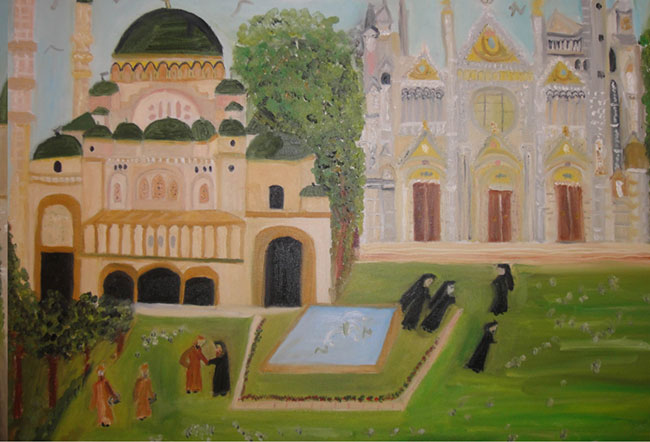
Courtesy of the artist.
My style of painting borrows from the Impressionists. Most of my work depicts stories of quaint places with added Architectural dimensions and color. I like to use oil paint and I love the effect of rich contrasting colors. My passion is to create images that impress, delight, and evoke emotions from the viewer. As a self taught artist, I am always learning from my experience and looking for new techniques to enhance my style of painting.














