
• By Ruth Lilienstein-Gatton

    Where spirituality and political activism intersect, there is also a place for visual art.

    Rosa Naparstek’s newest exhibition “what is your function…?” is on display through the end of June at the Rio Penthouse Gallery. The artist has built a set of arresting visual works around personally transformative texts. Running the lengths of the inner gallery walls, sheets of type are orderly set side-by- side. The sheets contain text fromThe Pathwork Lectures (the famously “channeled” work of Eva Pierrakos); writings by Rumi, a 13th-century Persian poet and mystic; and essays by civil rights leader Grace Lee Boggs– all which have contributed essentially to the artist’s spiritual evolution.

    Across the printed pages, larger and hand-written by the artist, run well-known quotes by Karl Marx and Saul Alinsky, again invoking social reform.

    Biographically, the text-over- text format can be seen to chart a journey through Naparstek’s lifetime involvement in social and political causes (in Detroit, California, and New York), interwoven with an embrace of metaphysical thinking that has critically informed her ideas about social and political change.

    Naparstek wants to share a truth– that the change we seek on a global societal level is dependent on, if

    not meaningless without, our personal transformations.

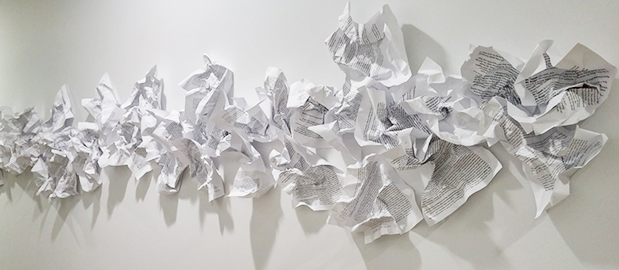
    In another part of the installation, the artist shares these truths in a heap of crumpled pages on the gallery floor. More of the same texts, they are meant to be picked up and absorbed at random by observers, who are invited to take a seat around the pile. On a wall outside the gallery, more crumpled pages are affixed to the wall, mirroring the format of the smooth ones within, as though suggesting that the ideas contained in them can withstand physical transformation.
    web

    The ideas embedded in the texts can be “read” into Naparstek’s accompanying found-object sculptures, a sampling of newer and older works of this type for which the artist is known. Naparstek fabricates from collected natural and man-made items—animal horns, dolls, doorknobs, seashells, scrap metal-sometimes framing (as with reclaimed picture frames or canvases) and sometimes assembling the ordinary into the sacred, as when a doorknob set inside bicycle gears, mounted on a bicycle seat becomes a “Third Eye.” Objects worn through human or elemental use form assemblages that can evoke nostalgia, psychological urges, and sometimes humor (used teabags hang like genitals on a male dressmaker’s form); but the artist’s compassion, the same instinct which directs her search for the divine and desire for a just society, are present in each sculpture.

    “what is your function…?” connects individual self-actualization as part of the quest for a just society with abandoned objects remade into art. Naparstek asks us equally to question the function of a thing or a person as part of a narrative of meaning.

    The artist will be at the gallery this Sun., Jun. 26th from 3:00 p.m. – 6:00 p.m.

    The Rio Penthouse Gallery is located at 10 Fort Washington Avenue, between 159th and 160th Streets.

    For more information, please visit bit.ly/28M3mSI.
     The stars are teaming up with Billboard magazine to campaign Congress to pass stricter gun regulations. Over 180 musicians and music executives signed an open letter in this week’s edition of Billboard with the cover reading, “Stop Gun Violence Now.”
    Among the stars are: Jennifer Lopez, Katy Perry, Lin-Manuel Miranda, Zayn Malik, Paul McCartney, Sting, Barbra Streisand, Britney Spears, Ellen DeGeneres, James Corden and Tony Bennett.
    The cover, which features the signatures of those who signed the letter, comes on the heels of the the deadliest mass shooting in U.S. history at an Orlando nightclub this month and the ongoing debate over legislative stalemate on the issue on Capitol Hill. Also mentioned in the letter is the murder of singer Christina Grimmie, who was killed the night before the Pulse shooting at a fan meet and greet.

    150+ artists & music execs unite with us to stop gun violence and #DISARMHATE https://t.co/XVbOHsiIK0pic.twitter.com/B81n5RTkcA

    — billboard (@billboard) June 23, 2016


    CNN
    Tate Liverpool is currently presenting the largest exhibition ever staged in the north of England of the late great existential master of the 20th century: Francis Bacon. ‘Invisible Rooms’ features approximately 30 paintings by the artist alongside a group of rarely seen drawings on paper, but more significantly the exhibition turns out to be a survey of a particular painting device employed by the artist, a curatorial decision designed to shed new light on what is now Bacon’s well known obsession with the entropy of the flesh, and ‘the valves of feeling’.

     
    Curated by Kasia Redzisz and Lauren Barnes, the exhibition brings together works that share the artist’s particular device of framing his figures. For such a long time we have all focused on Bacon’s preoccupation with the visceral subversion of our physical form, while certainly paying less attention to the artist’s spatial constructs: the world in which his figures reside. This architectural form serves to isolate Bacon’s raw screaming lumps of meat – this we already knew. But the artist’s cages are his recurring ‘leitmotif’ embodying a specific idea: that Bacon’s approach to space was of equal importance to the artist’s approach to the human form. The space frame was the essential context for his existentially wrought bodies.

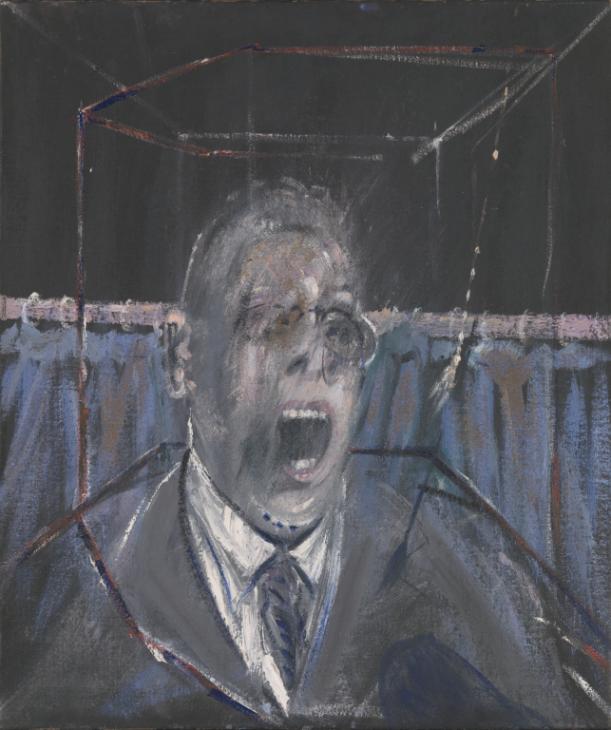
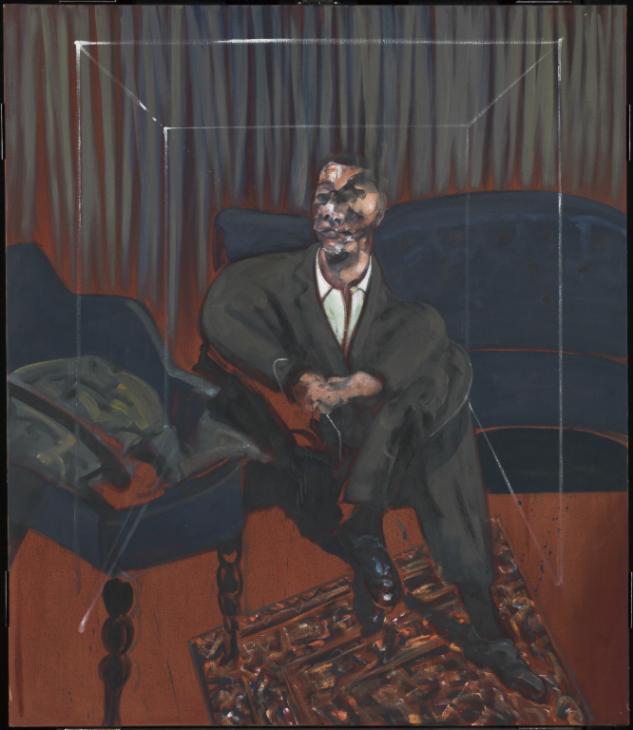
    Seated Figure 1961 Francis Bacon 1909-1992 Presented by J. Sainsbury Ltd 1961 http://www.tate.org.uk/art/work/T00459

    Seated Figure 1961 Francis Bacon 1909-1992 Presented by J. Sainsbury Ltd 1961 http://www.tate.org.uk/art/work/T00459

    This is never more apparent than in Bacon’s ‘Man in Blue IV, 1954′ and ‘Man in Blue V, 1954′, displayed midway through the exhibition – devoid of the artist’s later cavorting carcuses – instead the central lone figure of each painting is placed in an abstracted space evocative of a room-like environment through the demarcation of space. The faces of these two figures [The paintings being placed together in situ] are closer to traditional portraiture than in other works by the artist, but with a ghostly transparency. These are reminiscent of many other of Bacon’s works from the 50’s, where there is a subtlety to the figures that would later become unusual: forms slightly closer to traditional figuration which would be discarded in later paintings. This gives rise to an increased focus on the spatial environment of the painting; a mixture of representational and abstract lines. The isolated male figure, possibly Bacon’s lover Peter Lacy – is thought to reference the ongoing illegality of homosexuality during the period – leans trapped in an architectural space: a dark and empty room inundated with a superabundance of claustrophobia and social estrangement. With these works the device of the cage is highlighted, the power of Bacon’s space frames are apparent and create that essential context.

    Study for a Portrait 1952 Francis Bacon 1909-1992. Bequeathed by Simon Sainsbury 2006, accessioned 2008 http://www.tate.org.uk/art/work/T12616

    Study for a Portrait 1952 Francis Bacon 1909-1992. Bequeathed by Simon Sainsbury 2006, accessioned 2008 http://www.tate.org.uk/art/work/T12616

    It is now no wonder the artist considered creating sculpture (and why Damien Hirst ‘converted’ certain paintings by Bacon into vitrine-enclosed three-dimensional works). Perhaps Bacon could have worked with ‘actual’ space in light of his interior design background, which obviously had a greater influence on his later work than was ever truly realised. As here there is an acute awareness of the spatial properties of the artist’s compositions. Bacon understood and manipulated the architectural space of his paintings to effect his figures. While our eyes were all focused on twisted meat and screaming nurses, Bacon was manipulating their place in the psychological halls of our minds, adding pathos and isolation to the violence of the flesh.

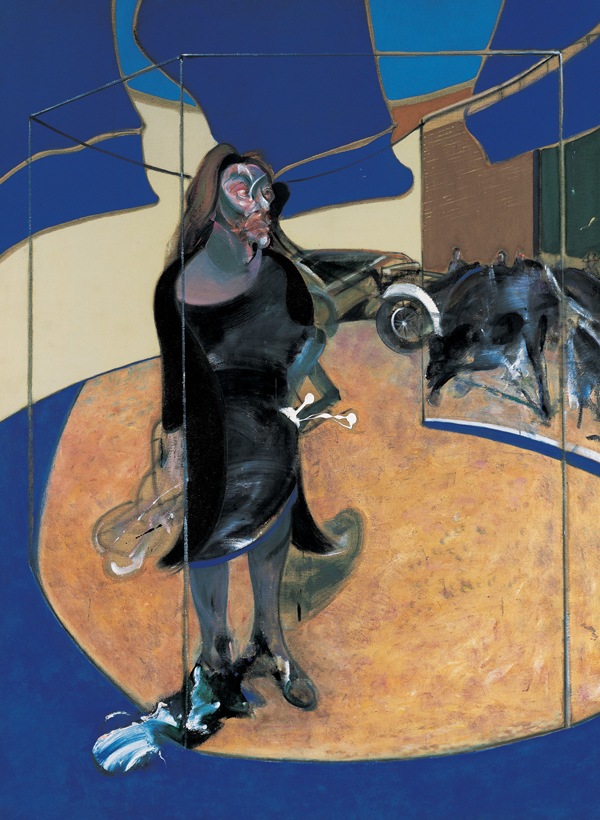
    These space frames of late 50s have a greater complexity in later works as the ongoing motif evolves. With ‘Three Figures and Portrait, 1975′ elliptical and circular ‘lenses’ focus on the corrupt body of a suicidal George Dyer with a sense of sadomasochistic voyeurism. These architectural devices not only focus our attention, but also the intent of the artist’s vision, in this particular work the device is a reflection of  the artist’s own history with the subject. When British art critic and curator David Sylvester asked Bacon about the artist’s cages and space frames, Bacon replied: “I cut down the scale of the canvas by drawing in these rectangles which concentrate the image down. They are there to highlight, to focus, to point to the figure. They are intensifiers.”

    Francis Bacon, 1909–1992 Portrait of Isabel Rawsthorne Standing in a Street in Soho 1967 Oil paint on canvas 1980 x 1475 mm © The Estate of Francis Bacon. All rights reserved. DACS 2016. Staatliche Museen zu Berlin, Nationalgalerie. Acquired by the state of Berlin

    Francis Bacon, 1909–1992 Portrait of Isabel Rawsthorne Standing in a Street in Soho 1967 Oil paint on canvas 1980 x 1475 mm © The Estate of Francis Bacon. All rights reserved. DACS 2016. Staatliche Museen zu Berlin, Nationalgalerie. Acquired by the state of Berlin

    These cubic cages give a solitary existential angst to the artist’s contorted flesh, as behind the visceral screams simmers  a neurosis. The rawness of ‘being’ belies paranoia, angst, loneliness and loss. A theatrical stage for the artist’s writhing spines and tortured faces: there is nothing beyond those walls. Nothing beyond the frame. Cages, chambers, and fenced frames lock Bacon’s subjects into a temporal Godless eternity. The flesh rendered all the more futile because of its architectural prison.

    The curatorial decisions made in this exhibition highlight the artist’s Godless architecture. It is apparent that Bacon’s ‘theatre’ was of the same importance as the artist’s ‘players’. With all of the myth surrounding Bacon as an instinctive painter, immediate and visceral – from the existential angst of the 50’s to what is sometimes described as almost the self-parody of the artist’s final works – Bacon maintained the physiological complexity and considered structure of his spaces. The real existential horror of the artist’s environments was never really to be found in Bacon’s renditions of screaming haunted meat, but in the voids surrounding them.

    By Paul Black
    NY Arts
     
    Francis Bacon: Invisible Rooms –  Tate Liverpool, UK – until 18 September 2016

    Hauser & Wirth to Present the Group Exhibition
    ‘A Modest Proposal’

    ‘A Modest Proposal’
    Hauser & Wirth
    511 West 18th Street Showroom
    New York City
    23 June – 29 July 2016


    New York NY… Beginning 23 June, Hauser & Wirth is pleased to present ‘A Modest Proposal’, featuring work by artists Lucas Blalock, Naotaka Hiro, Sanya Kantarovsky, Nicola L, Tala Madani, and Jakub Julian Ziolkowski – artists who humorously critique our relationship to the bodily and abject. The exhibition takes its title from Jonathan Swift’s satirical essay of 1729, commenting upon the extreme poverty and famine in Ireland. His proposed solution is simple: eat the children.

    ‘A Modest Proposal’ will be on view in the Showroom at the gallery’s West 18th Street location through 29 July 2016.

    In Lucas Blalock’s recent work, the artist uses a large-format camera to create digitally distorted still-lifes of mundane household items, flea market finds, and other junk. These images often appear as though someone has just tampered with the composition, creating a palpable sense of interference and a distinct unease to the scene. Through unexpected juxtapositions, Blalock challenges viewers’ tendency to look at an image too quickly.

    Naotaka Hiro’s self-casting sculptures begin with a performative act: the artist sculpts his own body, confronting limitations of putting oneself into a plaster mold. Hiro created ‘Sixteen Terminals’ (2016) by drawing lines of plaster from the top of his head to the end of each appendage. Cast fingers and toes became deformed and fell off in this challenging and lengthy process. The resulting sculpture is an abstract representation, somewhere between the artist’s actual form and internal self-image. As Hiro puts it, it’s ‘me versus me.’

    Sanya Kantarovsky’s richly colored paintings offer a glimpse into deceptively quotidien scenes of single figures at an uncanny moment. Plucked from a narrative context, his figures are trapped within their frames in atmospheres tense with anticipation. In his largest works on paper to date, Kantarovsky contemplates the everyday confrontation between the self and the external world.

    Concerned with body politics and human relationships, Nicole L’s Penetrables are canvases that take the form of bodies suspended from the wall like flayed skins. With mouths agape, ‘Antarctica Penetrables’ (1980) and ‘Fire Penetrables’ (1980) are manifestations of unease, frustration, and thwarted protest. In another series called Functional Objects, Nicola L offers surreal representations of the human form to humorous and dreamlike effect. These works offer a pointed critique of our relationships to one another. Part of this series is ‘Femme Commode White’ (1968), a dresser shaped like a woman whose corpus has been broken into drawers with knobs in all the right places.

    The self-abasing characters in Tala Madani’s paintings confront their bodies and sexuality to create witty and messy – and sometimes-deadly – scenes of self-discovery. In Madani’s work, revelations of pleasure are also realizations of mortality. ‘The Ritual’ (2016), presents Madani’s recurring characters Dick and Jane in a signature cinematic style, with red and green deployed to suggest a 3-D effect. The viewer witnesses a deadly shift in power between these two characters: smears of paint on canvas suggest the shapes of bodies in the repetition of a cycle, a closed loop from which there is no exit.

    Jakub Julian Ziolkowski paints hallucinatory scenes that are simultaneously fantastical and terrifying. In his lurid and meticulously painted images, surreal bodily forms reveal primitive interests and impulses. In ‘Untitled’ (2015), the bodies of two faceless figures morph into a landscape that stretches from the glimmering heavens to the depths of hell. Observing Ziolkowski’s psychosexual universe, the viewer is left to wonder if these figures are enjoying themselves and one another, or if this is a contemporary re-envisioning of Bosch’s ‘The Garden of Earthy Delights.’

    Hauser & Wirth’s Summer Hours:
    20 June – 29 July 2016
    Monday – Friday 10 am – 6 pm

    Hauser & Wirth New York will be closed Monday 4 July 2016


    Cortesey of Hauser & Wirth New York


    6 July – 30 October 2016

    A rare opportunity to see over 100 remarkable paintings by this pioneer of twentieth-century art

    Georgia O’Keeffe is best known for her paintings of magnified flowers, animal skulls, and New Mexico desert landscapes. This exhibition brings together some of her most important works, including Jimson Weed/White Flower No. 1 1932, the most expensive painting by a female artist ever sold at auction.

    Making her debut a century ago, in 1916, O’Keeffe was immediately recognised as a trailblazing artist, while today her legacy as an American art icon and a pioneer of twentieth-century art is widely recognised.

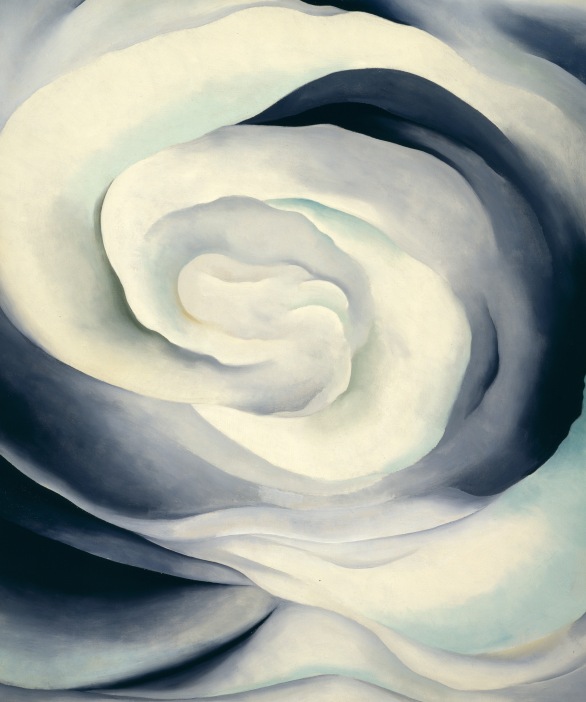
    Georgia O’Keeffe Abstraction White Rose 1927 Oil on canvas 36 x 30 (91.4 x 76.2) Georgia O'Keeffe Museum. Gift of The Burnett Foundation and Georgia O’Keeffe Foundation © Georgia O'Keeffe Museum

    Georgia O’Keeffe
    Abstraction White Rose
    1927
    Oil on canvas
    36 x 30 (91.4 x 76.2)
    Georgia O’Keeffe Museum. Gift of The Burnett Foundation and Georgia O’Keeffe Foundation
    © Georgia O’Keeffe Museum

    With no works by O’Keeffe in UK public collections this exhibition is a rare chance to see the beauty and skill of her remarkable paintings outside the US.

    Men put me down as the best woman painter…
    …I think I’m one of the best painters.
    Georgia O’Keeffe


    Courtesy of Tate Modern

    Learn More


    Lorenzo Chinnici

    Lorenzo Chinnici

    9 – 19 July 2016, Lecco

    « The artistic event of the summer on lake Como – Italy – 2016 »
    – Made in world –
    OPENING SHOW

    9 July 2016,19.00 – NH Hotel Pontevecchio
    Via Azzone Visconti, 84 – Lecco – Italy –

    ART EXHIBITION

    10 – 19 July 2016 – Art Gallery
    Via Pietro Nava, 45 – Lecco

    Monday – Thursday: 10.00 – 12.00 / 17.00 – 20.00
    Friday – Sunday: 10.00 – 12.00 / 17.00 – 23.00  

    This multi-focused exhibition presented by Dorothy De Rubeis – the most extroverted Italian gallery owner – presents an intriguing mix of hallmark pieces and new works and is set to become the Artistic Event of Summer on Lake Como.

    Fire on the Water is a celebration of the many forms of Italian creativity, including poetry, painting, theatre, fashion, and music. Such complete, multi-faceted, engaging and glamorous artistic events are rarely seen in Italy.

    Curator Emanuela Catalano describes the exhibition as “a frame surrounding the figurative art from Maestro Lorenzo Chinnici.”

    The goal of the event is to create an unforgettable memory of MADE IN ITALY. Rather than art being confined in solemn, lifeless exhibitions that don’t engage the public, Fire on the Water aims to create a dialogue with the observer and give the art work the glamour it deserves.

    FIRE ON THE WATER
    The event will be illuminated by the colours of Lorenzo’s paintings, which speak of humanity in opulent yet defeated forms, and the art photography of Nini Ferrara, whose work depicts precise portraits of humanity.

    The creativity and the strength which have brought to us the birth of MADE IN ITALY are represented in these pieces.

    Live performances will feature high fashion models showcasing dresses created specifically for this exhibition by Katerina Budnikova and inspired by Master Lorenzo Chinnici’s paintings.

    An enchanting piano will accompany the magnificent voices of Soprano Anna Gorbachyova and the Tenor Rodolfo Maria Bordini who will sing melodies of the Italian Masters. Jazz singer Beatrice Zanolini will remind the audience that with only seven signs of a pentagram, creativity can give rise to endless, infinitely different music combinations.

    Poetry readings by Nini Ferrara and Giusy Nicosia will remind us of the delicacy and beauty of words, which can act as a soothing balm for the spirit of the listener.

    As in “La Grande Bellezza” of Sorrentino, this artistic meeting – which also has gained the interest of FAI (Fondo Ambiente Italiano) – will celebrate an incredible number of protagonists to create a truly Beautiful Event.

    Ampellio Ramaioli, director of this production, has curated everything down to the last detail with the collaboration of Domenico Parisi and his staff at Six Inch. In addition, the owner of the famous Cantina Valenti will be present in order to raise a glass and host a toast with all the guests. He will be at the disposal of the public to showcase and discuss his purple nectar in detail.

    We would like to acknowledge and thank World Fashion Channel TV – our official partner for the event.

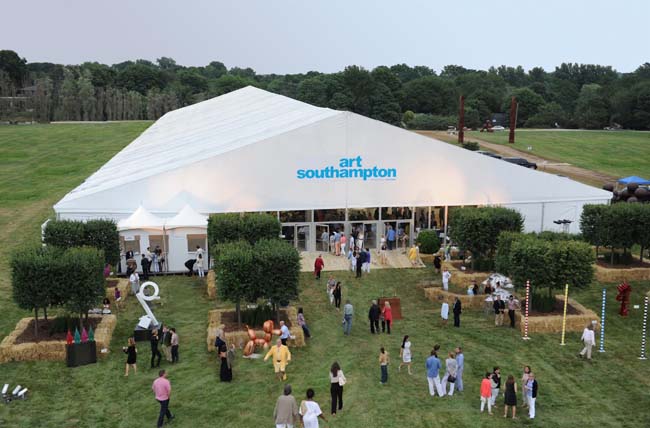
    anniewatt_14044-Art-Southampton-2015-ADJ2
    After a phenomenally successful fourth edition, Art Southampton, the premier international contemporary and modern art fair in the Hamptons, will return July 7 – 11, at the height of the summer social and cultural season. Art Southampton is the most important destination for acquiring the finest investment quality works of contemporary and modern art along with design. The fair quickly has become the ‘can’t miss’ event of the summer for all serious collectors, museum professionals, curators, interior designers and art enthusiasts to acquire works from more than 60 leading international galleries.

    Art Southampton’s unique ambience and design is unrivaled by any other art fair in the Hamptons. The elegant, air conditioned Pavilion will showcase emergent, cutting edge and modern works, along with a focus on design, paintings, photography, prints, drawings, video art, sculpture, and indoor and outdoor curated projects of the highest quality.

    The fair is located on the world-renowned pastoral grounds of Nova’s Ark Project in Bridgehampton. Art Southampton’s ample on-site complimentary parking and convenient hours make this ‘can’t miss’ fair accommodating even for guests who are visiting the fair and the Hamptons just for the day.

    unnamed


    Learn More

    unnamed
    Sinister Feminism. We fortify veneer into armor. We appropriate from misogynist sources. We exceed the cinematic ideal. We vibrate the sound of the city. We endure. Our physicalizations we know are transgressive. We are a halation of line. We throw shadow across the page. We teach the tongues of the past. We mock the habit of metonymy. We transmit the sense of hysterics. We smell. We hurl what we are required to withstand: our bodies, our selves. We are trying to reach you.We wildly grin.
     
    The Biennial is a survey exhibition open to artists throughout the US and internationally which reflects conceptual and aesthetic concerns by emerging and mid-career artists.Piper Marshall is an independent curator and writer based in New York City. She is a second year PhD student in the Department of Art History and Archaeology at Columbia University.  Marshall has curated monographic exhibitions of artists Ryan McNamara, John Miller, Caitlin Keogh, Robert Barry, Sadie Benning, Ericka Beckman, Judith Bernstein, Hannah Weinberger, and Angela Bulloch. Formerly curator at the Swiss Institute / Contemporary Art New York, she organized the group exhibition “Descartes’ Daughter,” and edited the accompanying exhibition reader. Marshall writes for periodicals including Texte Zur Kunst, Art in America Magazine, Kaleidoscope Magazine, Spike Magazine, The Third Rail and artforum.com. Other notable projects include “The Body As Techno-Base,” an ongoing collaborative research project with artist Rochelle Goldberg.


    DEADLINE
    Monday August 1, 2016 at 11:59pm
    3 images or 1 video for $35 (each additional image is $5)APPLY EARLY & SAVE
    Applications by July 15th are $35
    Applications submitted after July 15th are $40ELIGIBILITY
    All media are welcome
    Installations will ONLY be reviewed if complete


    A.I.R. GALLERY
     | 155 Plymouth Street, Brooklyn, NY 11201 | info@airgallery.org | (212) 255 6651


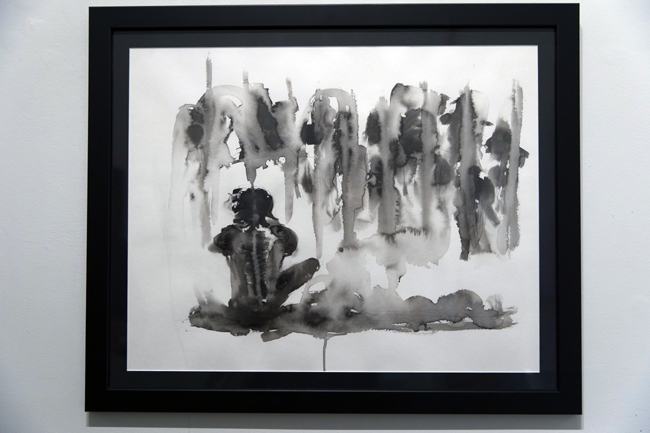
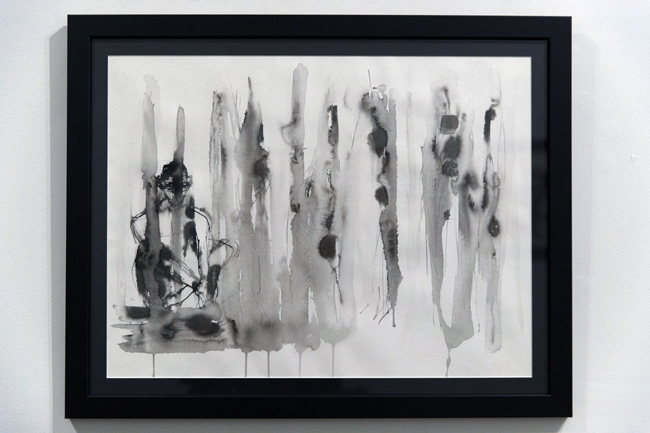
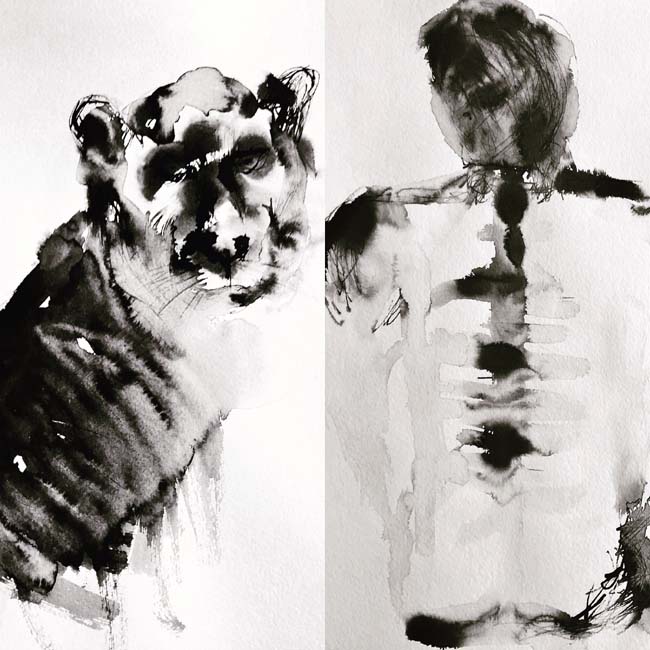
    East Village’s favorite Studio 26 Gallery which is located in the Eastvillager building on East 3rd St. between Avenues A and B, is exhibiting a spectacular series, “When Madness Meets Hunger,” by artist Aphrodite Désirée Navab.  Navab’s latest work is an ongoing series of ink drawings where she imagines an invented encounter between the protagonist of Iranian writer Sadeq Hedayat’s novella, The Blind Owl and the protagonist of Czech writer Franz Kafka’s short story, “The Hunger Artist.”

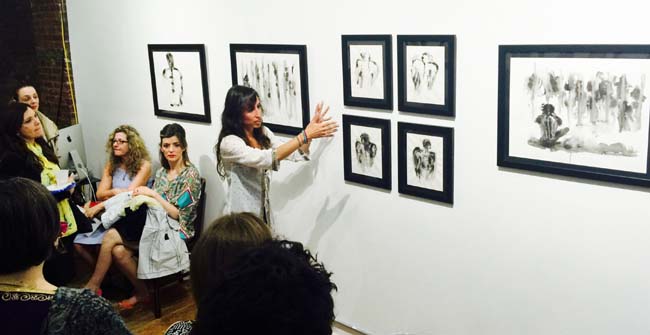
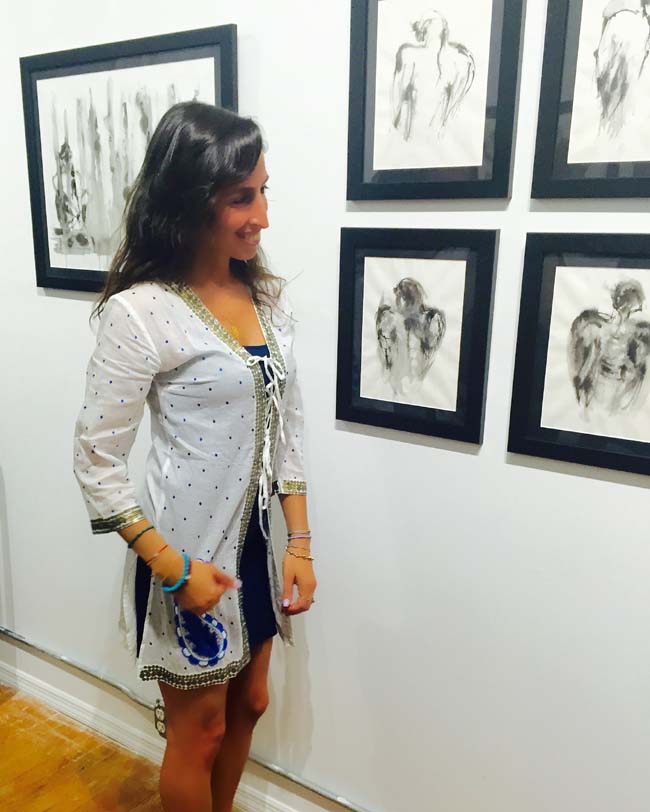
    At the opening on June 10th, Navab gave an artist talk where she shared her concepts for this series, her artistic practice and creative process, and took questions from the audience: “I do weeks of research for my art, collecting primary sources,” says Navab. “For this series, I re-read Hedayat’s novella The Blind Owl, and I re-read Kafka’s “The Hunger Artist.” I read secondary sources, examining and critiquing their work. I read historical sources on the Czech republic and Austria during Kafka’s time and Iran during Hedayat’s time, then researched the internet for photographs of the writers from birth until death…It is no accident that Hedayat translated several of Kafka’s works into Farsi.” Metaphors, allegories and themes are explored of the artists in voluntary exile, the nature of performance art, the real and the ideal, rituals of insanity, the existential crises of the artists and their autobiographical narratives. A video of the opening and artist talk will be released during this week.

    The exhibition is on view until July 3rd. We encourage everyone who is visiting NYC or walking through the East village to visit this fascinating  exhibition and see, closely, the work of Aphrodite Désirée Navab.

    “Her art is the aching inquiry of an uprooted consciousness seeking new roots.” – Collector of this series and NY Times #1 Best Seller author Reza Aslan of Zealot: The Life and Times of Jesus of Nazareth (2013).


    GUL_3743

    From the series: The Blind Owl Meets the Hunger Artist.


    GUL_3760

    From the series: The Blind Owl Meets the Hunger Artist.


    image2

    From the series: The Blind Owl Meets the Hunger Artist.


    image3

    Aphrodite Désirée Navab giving an artist talk.


    image1

    Aphrodite Désirée Navab giving an artist talk.


    GUL_3785

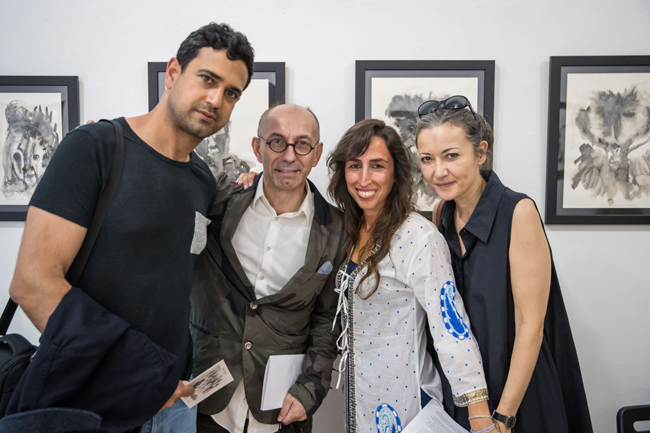
    Close artist friends of Navab: Chervine Dalaeli, Francine LeClercq, and Ali Soltani.

    News | Exhibitions