



By Meakin Armstrong
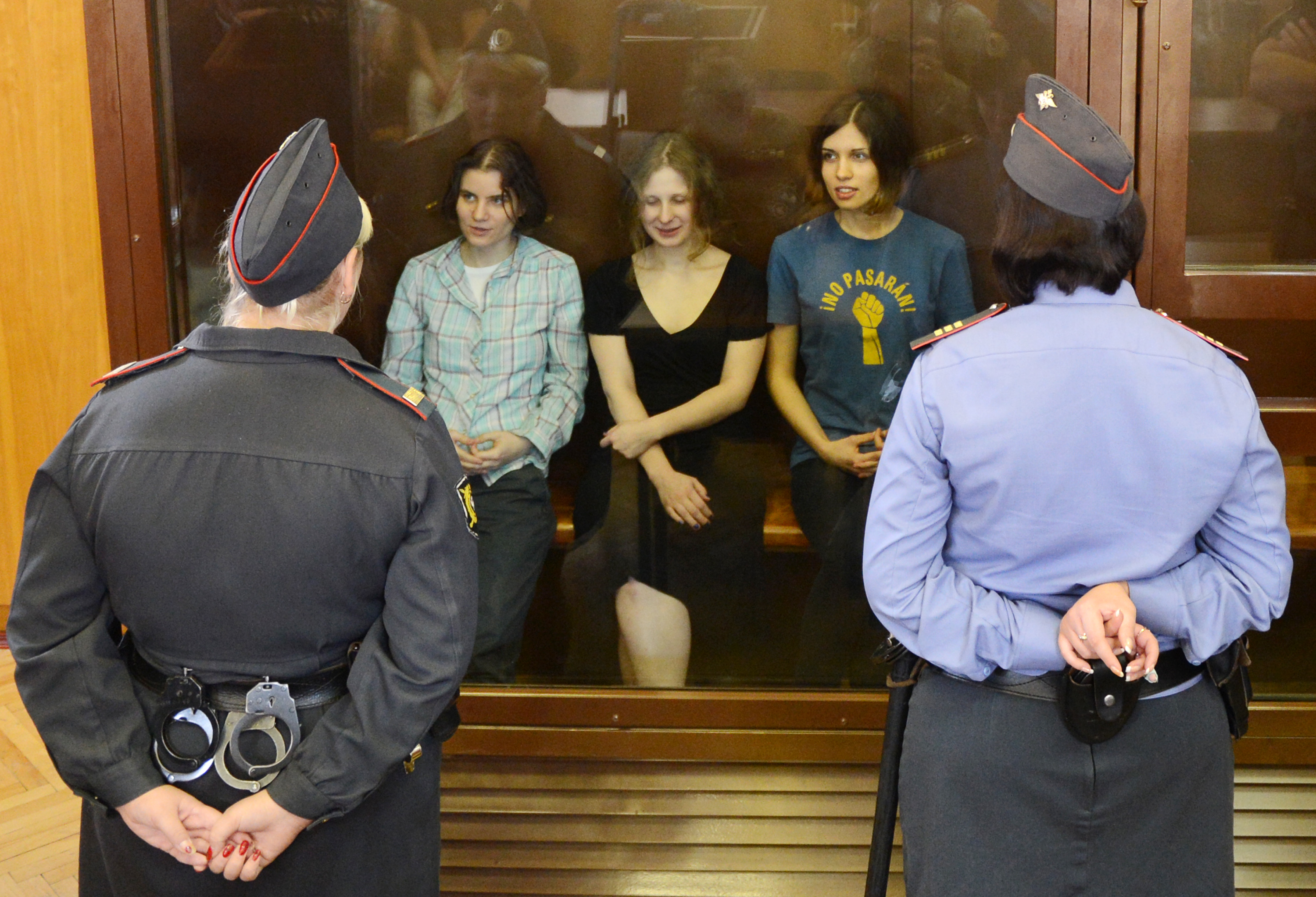
The show trial of 2012: three women are locked in a glass booth like Adolf Eichmann. Prosecution witnesses accuse them of “devilish” dancing. Bearded priests bemoan their “sin against God.” Reporters say “pussy” on national TV. Condemnations ring out around the world. There is a torrent of speeches. And support from Madonna and Bjork…but as with the Olympics, the Russian judge shows no pity—for the crime of “hooliganism,” Pussy Riot is packed off for the gulag.
Go on You Tube and look for the Pussy Riot “performance.” See four women rush into Moscow’s Christ the Saviour Cathedral, cover their faces, and rip off their winter coats. Outraged shouting, from everywhere, the Pussy Rioters wave their arms like an errant pep squad. One Rioter is on her knees in a “punk prayer,” crossing herself and calling on the Virgin Mary to become a feminist and save Russia from Putin. Security guards end it. It lasts only seconds.
For Americans, this “hooliganism” brings to mind the protests at New York’s St. Patrick’s Cathedral at the height of the AIDS crisis. It was a regular stop on the protest circuit, practically de rigueur. More recently, a couple was arrested for having sex there: it was even broadcast live over mainstream radio. The act was stopped, in flagrante. No one was sent to a gulag.
“Religion is a unified system of beliefs and practices relative to sacred things, that is to say, things set apart and forbidden”—Émile Durkheim
A sacred place is clean, surrounded by the filthy and profane. When adherents are in the sacred place, they too are clean; those in the profane places are not.
Organized religion is about the interests of the group. It’s about us, we who are saved—versus them, who are not.
Mircea Eliade said religion is a way for us to return to an earlier time. A period of mythical events, the birth of humankind.
Again: “Religion is a unified system of beliefs and practices relative to sacred things, that is to say, things set apart and forbidden.” It re-creates the Garden of Eden.
The Cathedral where the Pussy Rioters created a ruckus is home base for Russian Orthodoxy. It’s super-sized, the tallest Orthodox church in the world. It’s laden with gold, bejeweled, muraled, and festooned with bibelots and bric-à-brac. It’s grand, but like the colonial furniture in any Ethan Allen showroom, it’s also a replica. It still has that new-cathedral smell.
The original Cathedral of Christ the Saviour was obliterated. Stalin had it removed from the skyline in the same manner as he purged an un-person: he disgraced the building first then erased it. The hollowed out foundation was turned into a swimming pool.
After the fall of the USSR, the church was rebuilt. It can be regarded as a phoenix, but it’s also an erasure of bad choices, bad luck, bad times, and bad Stalin.
I visited the Catherine Palace near St. Petersburg: occasionally when the tour guide wasn’t looking, I tapped its walls: the hollow sound of Sheetrock. I observed speed screws. It felt like Disney, like Vegas. The same with the Peterhof. The same with so many other places and destroyed then rebuilt.
Can something be sacred art if it’s a reproduction? Isn’t that why we don’t like forgeries, even when they’re perfect? Doesn’t it matter that the original creative drive is no longer there?
This ersatz wonderland is overseen by Kirill I, Patriarch of Moscow and all the Rus’ and Primate of the Russian Orthodox Church. Kirill I has a personal wealth in the billions—his church was granted a license to import duty-free cigarettes. For a while, Kirill was the cigarette kingpin. Kirill supports Vladimir Putin, and has called him a “miracle of God.” He also supports Alexander Lukashenko, president of Belarus and the last dictator of Europe. Rumor has it, Kirill had ties to the KGB and may have been an agent. Recently, he was photographed wearing a Breguet that retails for over $25,000. When called on it, Kirill had the watch photoshopped away from his pictures, erased.
For ye have the poor always with you; but me ye have not always—Matthew 26:11
Kirill said the women of Pussy Riot were “doing the work of Satan.” At the 200th anniversary celebration of the Battle of Borodino, he (like an Orthodox Pope Urban II) called upon all Russians to battle for their churches. Soon, God-fearing hooligans roamed the cemeteries and churches, hunting for would-be Pussy Rioters.
Russians get their news from oligarchy-safe TV. The medium is the message: watch TV and you’re in a weak state: you’re on a couch but your mind is pinned to the wall like a wriggling bug. In your room, your little Eden, you’re slack jawed and like a baby in the crib staring at sweet, moving lights.
Despite the world, most Russians supported the erasure of Pussy Riot—their TVs told them to. Pussy Riot was a menace. Everywhere was Pussy Riot, the Al Qaeda of apostasy.
After the trial, there was a festival in St. Petersburg in support of Pussy Riot. The police arrested attendees for small crimes such as jaywalking.
For an American, this brings back images of Occupy, because after all, America is not a paradise. America doesn’t like to be questioned because no government likes to be questioned. America saved the world in World War II; never forget that. Never forget that America is good. Police across the U.S. have arrested members of Occupy for doing little more than jaywalking. All over the world, people-driven movements are under attack. 2012 may be a watershed year for worldwide movements: what’s next for the Arab Spring? For Occupy? For protests against Putin?
The cure for any society isn’t erasure. It doesn’t work to fill-in a destroyed foundation with false beauty.
Meanwhile in the Russian hinterlands, blogger Maksim Yefimov offended Kirill. Because the state is in near-symphonia with Orthodoxy, Yefimov was charged with the same offense as Pussy Riot. He faces two years imprisonment. But first, they tried to prove him insane.
Luckily for Yefimov, he was able to escape. Now, Yefimov is a wanted man, hiding out in Estonia. His fate is unknown.
Meakin Armstrong is Senior Editor / Fiction Editor of Guernica. He’s a freelance writer, and a former employee of The New Yorker. Most recently, his work has appeared in Wigleaf, Noö Journal, elimae, and various anthologies. His nonfiction has been featured in Mr. Beller’s Neighborhood, TheAtlantic.com, TheAlanticWire.com, Time Out New York, and the books, New York Calling: From Blackout to Bloomberg and Museyon Guides Film + Travel North America. He was a 2012 Guest Editor for the DISQUIET conference in Lisbon and has received scholarships from the Bread Loaf Writers’ Conference and Summer Literary Seminars. Find him on Twitter at @meakinarmstrong.













