• BCypher

    Image courtesy of Schema Projects.

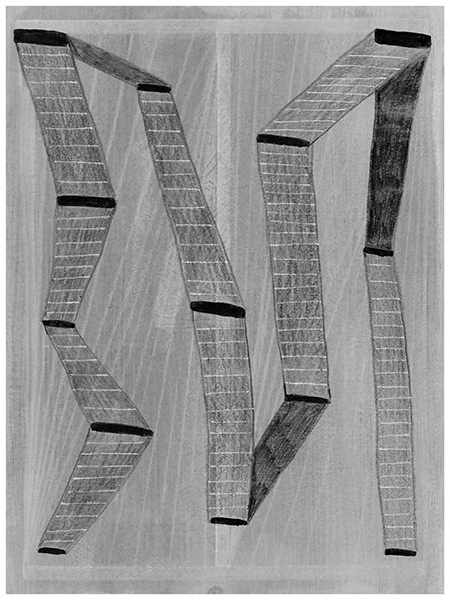
    Brian Cypher isn’t afraid to do his thing. Working prolifically with all kinds of drawing and painting materials throughout his career, he seems to be comfortable producing powerful yet whimsical abstractions, no matter the scale he chooses. Schema Projects being a space specializing in works on paper, Cypher’s drawings on display here are a selection from work produced over a twenty year span. Amazingly, one finds it a challenge to figure which works were created when. All of the works share a visual relationship governed by Cypher’s ability to make seriously considered abstractions appear playful and easy.

    Relationships between works become more prevalent and visual tropes can be traced between works as the cunningly composed layers of paint open up into vibrant abstract spaces. Cypher is a master of playing with the reveal/obscure abilities of paint, and has a skilled eye in composing the relationship his layers have to one another.  Mostly modest in size, the work is able to open up to the viewer the longer one spends time in the gallery.

    A highlight on view are his smaller works of cut cardboard from food packaging collaged with circular graph paper. The works all play with the given radius of the graph paper, in a cutting exercise that creates abstractions which are determined by the parameters of the materials. The restriction of their dimensions creates a visual folding of space into itself, which produces various forms, all of which take part in the same formal conversation.

    The exhibition is a “must see” and will be on view through April 28th.

    schemaprojects.com


    TripleCanopy-BWurtz

    Working in tandem with Triple Canopy, B. Wurtz’s work at Bureau spans a lifetime of sculptural and media exploration. An artist who has become known for a sensitive touch in the careful regard for the use of the everyday object, Wurtz is here shown to have been creating in this vein for much of his life.

    Beginning with a family of sculptures the artist completed as a child displayed in the front window of the space, the exhibition also includes work from the artist’s Photo/Object series. These pieces investigate viewer perception in presenting a new work of sculpture situated along side a photographic image of the same work taken from an alternate perspective.

    Having worked to collaborate with Triple Canopy for a number of months, the exhibition coincides with a viewing of Wurtz’s early video work on April 17th. This will be followed by a discussion with the artist Josh Tonsfeldt and Triple Canopy contributing editor Hannah Whitaker.

    For more information regarding coinciding events surrounding the exhibition, please consult the following links.

    bureau-inc.com
    canopycanopycanopy.com

    April 14 – 25, 2013
    Bureau
    127 Henry Street
    New York NY 10002

    Image courtesy of B.Wurtz

    Courtesy of the artist.

    Courtesy of the artist.

    My painting is about conjuring up layered views. Painting is one of the most complex and expressive visual forms.   The method of application itself demands revision through contemplation – colours being mixed, loaded onto brushes and marks being made. I use colour as a celebration and for accessing something beyond the rational.  It is the means by which space must be expressed. Not necessarily an illusion of space but a living vibrant pictorial space.  I want to use colour to liberate space and create a fundamental beauty. The inspiration for my work may be triggered through events; human or historical, mythical or geographical.  The work isn’t illustrative, events provide a jumping off point.  The paintings are a way to describe the world and our place in it, not as a narrative but through the shadows, footprints and artefacts that mark our journey through life.

    simonjonesart.com

    HarlanJTT

    Image courtesy of JTT

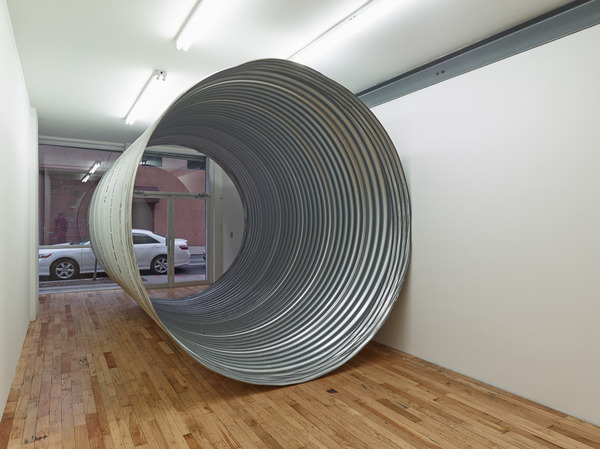
    Many young artists today feel the need to bust into the scene flailing like a whirling dervish, splashing bits and pieces of their expressive output in every direction as boldly as possible. As an emerging artist who seems to be enjoying a bit of success, Charles Harlan knows how to make an impact while keeping it simple. Do less, just make it really big.

    This isn’t to say that his current show Cave at JTT in the Lower East Side was easy to put together. In fact, the installation of an enormous piece of pipe into the intimate gallery space must have been some kind of engineering feat. Harlan respects the viewer enough to operate on an artistic program guided by economy of expression in such a way that leaves ample room for the experience and imagination of the audience to fill in the empty spaces. In this case the sensual reverberation can be dizzying. Closing April 14th, this show is one you have to experience to believe.

    http://jttnyc.com


    PingInglett
    Stacked together and leaned against the wall, identical panes of safety glass seem to have been the recipient of a blow in this state, shattered ripple tracing the energy’s transference. The press release reveals that this glass is cut in the same ratio as the standard for 35mm movie film, a similarly impressionable medium. This is the work of Eli Ping, currently on view at Susan Inglett Gallery.

    Joining this work in the selectively installed exhibition is a long format video depicting the artist walking the length of Manhattan on Broadway while making a concerted effort never to place his foot on a line. This conceptually pregnant linear motif happens twice more in the exhibition.

    The first example confronts the viewer immediately in the form of a floor to ceiling pillar constructed of an aluminum I-beam cut into equal sections and re-stacked in such a way as to lock together. The result creates an ordered but semi-precarious  alignment of elements conceivably once composing a single rigid architectural bone. The second linear element is on black enamel reverse-painted glass laid on the floor to create a threshold which must be crossed over in order to experience the rest of the work.

    The show is economic in it’s expressive elements while employing largely communicable aesthetic themes of serious conceptual weight. Go see it.

    inglettgallery.com


    IMAGE:Syncopated Descent, 2013. Video, 4:36 hours. Edition of 3.


    All pieces of my seven-part series of “levensdingen” (life episodes) represent universal experiences during the life of a human being: love, hatred, joy, sorrow, friendship, animosity, fear, security, victory, defeat life and death.The pictures are painted with strong contrasts as vigorous brushstrokes in sober colors work to depict strong emotions. The skin is rendered vulnerable, soft, and transparant. The fierce red hair stands for passion, for survival instinct. The large scale of the pieces make it impossible to deny the inescapable facts of life they describe.

    marlieskoster.nl

    My paintings reflect a search for reconciliation between apparent contradictions. Whether it be creation and destruction, sexuality and spirituality, light and dark, or accidental and intentional, I express these dichotomies through process. My pieces are created by layering, collaging, glazing, and painting different elements together. I then destroy certain parts of the image by stripping away layers to reveal my contradicting techniques. I work with encaustic (a blend of beeswax and oil paint) as well as some acrylics with inclusions.

    naydene.com 

    My art is emotional, sentimental. It is painting in motion—everything flows, everything passes quickly, like life itself. This painting depicts the poet of the infinite, the world and his inner strength and I attempt to pass this along to the audience. I aim to make my paintings feel alive, strong and full of hope. It is the concrete abstraction, the rational representation of colors and nature harmonious with shapes that leave everything to the imagination, the ability to represent something that isn’t there with a sensation that coincides with fantasy.

    mariopassarello.com

    Kevin Sudeith, Chandra Observatory over Winter Wheat Fields; November 2010; Rim rock capstone (collapsed),
    carving, 21 & 23 carat gold leaf, varnish; 16″x12″; Sumatra Hills, Montana.

    Kevin Sudeith practices the oldest extant art form—petroglyph carving—an unusual direction for a contemporary artist whose training includes an MFA from SVA, a BA from San Francisco Art Institute, and summers at Skowhegan and the Yale Norfolk program. Inspired by the human activity surrounding the rock outcroppings that serve as his canvas, Sudeith uses transportation motifs to explore his primary subjects: food, energy, and scientific exploration. He’s also an expert on Afghan war rugs and has introduced them to US audiences through gallery and museum exhibitions and talks. He’s currently at large carving petroglyphs somewhere in the American landscape.

    Kris Scheifele: How did your artistic practice become rock carving?
    Kevin Sudeith: In 2003, I began making charcoal drawings on rock outcroppings. I quickly realized the work would last longer if it were carved. Experiments in carving ignited my lifelong interest in contemporary imagery and ancient forms. In 2010, I gave up my Long Island City apartment to live on the road making petroglyphs.

    Kris: It’s interesting that you feel compelled to make something that’ll last and yet the work is out of the way and anonymous to a degree.
    Kevin: Whether people know the name ‘Sudeith’ isn’t as important to me as people seeing the work and responding to it. Afghan war rugs, for example, are great art, but the makers of the rugs are anonymous; this doesn’t temper my love of their work.
    And while the stone carvings are remote to most viewers, they serve their local communities where they are reasonably accessible. People near the carvings identify with the carved images. A goal for me is to make large-scale public art in larger communities.

    Kris: What are you imagining?
    Kevin: There are high rock walls along a section of Interstate 80 heading west as it descends from Wyoming into Utah. The road follows an old wagon trail and I’d like to carve monumental wagon trains next to the freeway. I’d also like to carve and gild life-size satellites. A moose or ocean liner would be challenging.

    Kris: How do you decide where you’ll go and what you’ll carve there? Do you embed yourself in the community before you get to work?
    Kevin: I work strictly by invitation from friends, their friends, and people I meet on the road. When I arrive somewhere it takes a few weeks of exploring the landscape to find the best carving site. Simultaneously, I explore the local culture, activities, and industry, and I take lots of photographs. For instance, in North Dakota it took a couple of weeks to look for sites while simultaneously photographing farmers, beehives, and oil wells.

    Kris: Since you’re invited, have you been accused of trespassing or defacement, things graffiti artists encounter?
    Kevin: The vitriol from some people is surprising. In August 2011, a feature ran in the Billings Gazette about my carving in Montana. The website edition featured some angry comments suggesting I was defacing the beautiful wild.

    Kris: Scary!
    Kevin: Most local people like what I’m doing and are very supportive. After I’ve been working in a community for a while, people are eager to show me their rock outcroppings.

    Kris: Have you inspired anyone to make carvings in collaboration with you or on his or her own? It seems like an enticement to add on to your carvings since they are arranged like specimens or catalogs.
    Kevin: I would never append a petroglyph made by an ancient, and like contemporary graffiti artists, I’d take it hard if someone messed with my stuff. Territoriality is definitely at play.

    Kris: I ask because I read about your watershed trip to Australia where you saw contemporary and ancient Aboriginal images in close proximity. That’s a very different kind of thing serving as an ongoing historical record for a specific society. It seems to me this mixing of time was what inspired you, as opposed to the Native American rock art that surrounded you growing up in Minnesota.
    Kevin: There’s a lot more rock art in NW Australia than in Minnesota. The work of the ancients is poignant because it spans thousands of years and is punctuated by the arrival of western figures. The combination of old and new interests me very much and is also at play with the war rugs.

    Kris: Tell me about how you’re documenting this work.
    Kevin: From the carvings, I make embossed impressions on paper. Time-lapse video documents the time making both the carvings and the impressions. Maps and my database are meant as keys to the whole body of work. Still photos document local life as well as the relationship of the petroglyphs to the landscape. I’m also documenting the stories about the people I meet. For me, this has become one of the most important aspects of the project.
    The hundreds of gigabytes of data I’m generating are probably very ephemeral, but the carvings themselves will (most likely) persevere and that’s both satisfying and motivating.

    You can see more of Kevin Sudeith’s work at petroglyphist.com

    For me, the process of creating is what is important. The energy and feeling in those moments, the process … is what breathes life. Through my work, I want the audience to see the beauty that I see, a beauty that some people fail to notice. My artwork is not a copy of reality but my own representation of it. It is a world that brings back memories and records time, a complete sensory experience. Everything that surrounds me is interesting and new; everyday brings something to include in my work.

    leydanarts.com

    News | Exhibitions