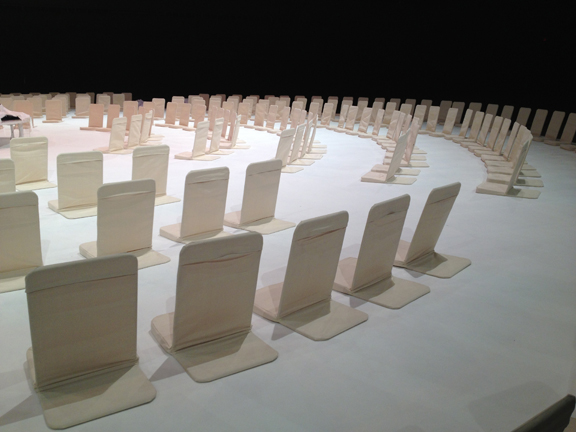
• cabinetDeath

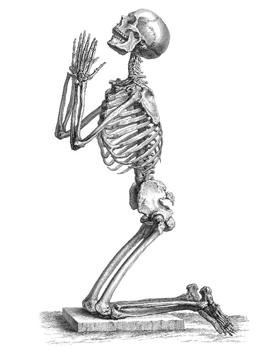
    Image courtesy of Cabinet Magazine

    “If the examined life is not worth living, then is death not worth examining?”

    It’s a clever thing to postulate, and this is precisely the program of a new collaboration featuring Cabinet Magazine with Philosopher Simon Critchley at Family Business of 520 West 21st street.

    The project bears the ominous title School of Death and will apparently be just that. A new “lesson” pertaining to the above topic will be written on a chalkboard at Family Business each day to accompany a series of evening talks and gatherings at the exhibition space.

    This project combines an eternally relevant topic with some of the most intriguing and culturally gifted minds of our time, amounting to an experience that promises to be as fun as it is cerebral and stimulating.

    May 7 – May 18 2013
    Family Business,
    520 West 21st Street, New York

    familybusiness.us
    cabinetmagazine.org

    William Crump, Rise After Rise Bow the Phantoms Behind Me
    linen, brass, glass, gouache, flashe, wood frame, various dimensions, 2012

    Leah Oates: How did you become an artist and did you know early on that you would be in the arts or did you begin as something else?  Where there other artists in your family?
    William Crump: Growing up I always knew that I wanted be an artist. I went to school for painting. My uncle, Walter Crump, is an amazing artist living and working in Boston. He was more or less my example for leading the artists’ life. If it weren’t for him, I don’t know that I would have had the same outlook as I do today. That same thing can be said about the friends and artists I surround myself with. It took me a long time to find my way in NY, but once I did, I realized I wasn’t alone. After I received my B.F.A. I went to Boston thinking I would continue on with a Master’s, but I was so poor and miserable I seriously considered doing something else. It was during this time I had begun to visit NY, where a few friends were living and making work. I quickly realized there was nothing for me in Boston, and so I moved to Williamsburg in 1998. It was there that I met a couple of friends that I’m still close to today. We’ve clawed our way up as artists ever since. I would say I’ve been “all in” since day one, despite the many rejections, epic failures, and burned bridges along the way. I keep working. There is nothing that can prepare you when you are young for just how hard it is and how committed you have to be from the start.


    LO: What are the themes of your work and what inspires your work?
    WC: The images I’ve presented here represent something of a new direction for me. My work and my themes began evolving over the last year. I’ve made a commitment to liberate ideas about painting from my sketchbook. I don’t feel like I could have made the work I am making now without having spent time working with other mediums. All of it has led me to this point. More than anything else, my goal with painting is to start fresh and to look at this next decade as wide open. The starting point here, with the work I’m currently making, is to rebuild things. By that I mean using all that I’ve done before as the foundation for building off of new ideas, making something new from what has come before.

    This series of paintings, drawings, and mixed media works, titled; Gathering Ground mines themes of spiritual rebirth, reconstruction, and longing. In reexamining my work and reasons for becoming an artist, I began with the idea of literal reconstruction of materials, and the suggested reconstruction of nature and the human spirit.

    As far as inspiration, I had a moment while viewing Monet’s Cathedral paintings, at the Musée d’Orsay over the summer. Those few paintings, grouped together, under glass, clicked with me in a way that I didn’t expect. It wasn’t just that they were beautiful, but they reminded me of what a radical shift that time period was in art history, and how artists can define themselves by breaking away from what’s going on around them.

    I try to keep a critical eye on what is going on around me, and whether or not it’s a passing phase or someone breaking new ground by pushing things forward. It’s still early in this decade, and the century for that matter. We’ll see where things go and who is taking the risks. In that regard, I’m always influenced and inspired by my artist friends and the exchange of ideas that we share in critique. There is a motivation that comes from having an honest dialogue with other artists who I respect, and that keeps me pushing myself to make better work.


    LO: What is your working process? Do you plan things out or play in the studio?
    WC: At this moment I’m doing all I can to keep things as unplanned as possible. That is not to say that I don’t work off of ideas in my sketchbook, I do. It’s just that the execution of my current work allows for play and experimentation. The work I’ve made previously has been planned down to the last detail. It’s only been in the last year that I’ve been open to letting the process guide me. I have a long way to go, but I’m happy with this approach. If anything it’s sped up my thought process, and opened up new possibilities in my studio. The biggest change in the way I’ve been working has been in my drawings. I’ve begun to draw from pure mark making. No planning. It’s been challenging to keep these pieces purely spontaneous and undefined. I’ve wanted to move as far away from a figure or a narrative as possible with this series. Each time I sit down to begin one of these drawings I have to remember to ignore all my impulses regarding defining space, composition, line, color, etc. A friend recently mentioned that I’m finally moving towards abstraction … Not sure about that, but I’m certainly moving away from everything else.
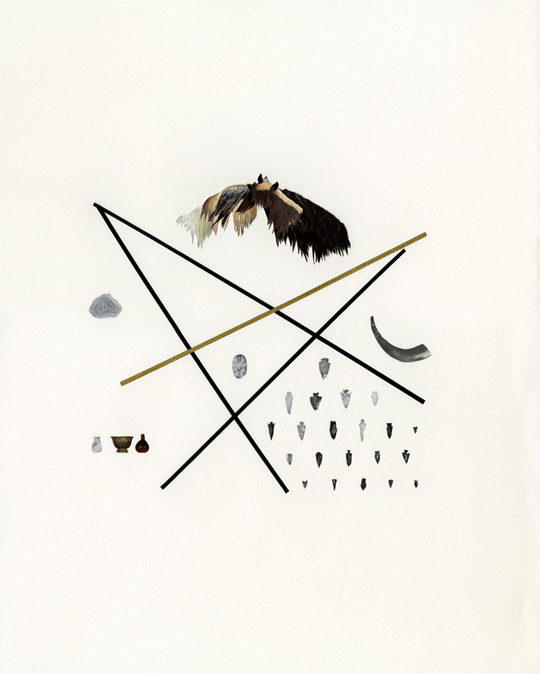
    WalterCrump_02

    William Crump, Untitled no.3 (Spirit)
    collage on paper, 16″ x 20″, 2012

    LO: Each artist is so different in how they approach their work. How do you approach the creation of your work?
    WC: The first thing I do when approaching these paintings, is to try and leave all distraction outside of the studio. It’s about keeping my focus and discipline. There are times when I want to dive in head first, but that can lead to not seeing your work with a critical eye. I spend a lot of time arranging and rearranging the materials I work with until something new happens. Experimenting with new materials has been key for me lately. Cut glass or wrapped linen. The older I get, the more time I spend with my work, I realize I’m not as interested in what the viewer thinks. I remember reading about Albert Oehlen wanting to be taken seriously as the decade changed and his work shifted. That struck a chord with me. If anything is brought into the studio with me it’s just that, “Take your work seriously, think about the long road.” This approach has been more rewarding and has led to a broader exploration in my practice. I just keep trying to push myself, and my ideas into a new place.


    LO: Why do you think art is important for the world and why is it important for you as an individual artist?
    WC: That is an extremely broad question and could be answered a million ways. I’m sure that artists in any part of the world would relate their answers to their own experiences. I feel that having the drive and the will to be an artist is something I was born with. It has been the force that has given me purpose and direction. It’s either just in you, or it isn’t. I won’t try say that I have a definitive answer as to why art is important to the world. I suppose in some sense, it’s about giving perspective to the times we live in. We look at the artists of the 40’s, 50’s, and 60’s through some great historical lens, but that time wasn’t very long ago. I only hope artists right now will think about the decade they are in, and how they will be remembered. Are you part of something important? Are you really doing something groundbreaking or original? You had better get busy. This goes not only for the work being made around us, but also for the words and actions the artists too. It’s about shifting ideas in our culture and being in the forefront of influence and social change. I think the artists, when we are at our best, our most playful, our most ironic or spiritual, truthful, bitter, etc., are reshaping the times we live in while also knocking down walls. The next generation can then build on those new ideas and move things forward.


    LO: Has being a dad changed your work if at all?
    WC: It has, but I don’t talk about that anymore. I’m keeping my personal life is just that, personal.


    LO: What advice would you give other artists who are emerging?
    WC: I did it all wrong from the beginning, so what can I say? I mentioned some things related to this in the previous question, but if I know anything at all it’s this: Stay hungry. Just don’t ever stop working, no matter how successful you do or don’t become. Time is your best friend.

    After much duress and rhetoric, Fountain by Duchamp as lowly as it once appeared, has been chastened by Meister Eckhart, who proclaimed: “And behold! All in One.”  Not merely a gaff of raw Dadaist vulgarity, but a heightened amplification usurping the serene bypass taken by artists on the aftermath of Duchamp’s storm of acrimony. R. Mutt, after all, is none other than a piss-wad, a rant, a sullen exorcist, at best, an industrial designer. Where lies his offal desire, his exterminating lethargy that makes him Fountain’s true protagonist? A howling indecency for some (William Glackens, for sure) admits a reclusive gambit for others. At the close of the Armory, heathen Duchamp had no other choice. With all the recourse mustered within his petulant breath, Duchamp waited in the wings over four impetuous years, then broke free with this canonical fodder – a Cubo-futurist Madonna wound into the lid off Buddha’s brisket.  And there anointed by the halo’d historians donned in galvanized suits. The magpies howled, the lizards held their leap. Duchamp had turned a furnace valve into a ribald fricassee. Four years!  He waited to release his uronic substance that would transform the reality of art in all hemispheres, waiting for the unctuous touting of post-art. He let go into the porcelain mist. The cauldron of distinct believers, left alone, fraught with utopian scorn: by necessity, his anesthetic provocation. Fountain’s psychic mixture of altruistic pain and frivolous insouciance, opened the threshold of twentieth century art, a forecast none could expect, yet came to know, to frolic, and denounce, only until the psychic charge became reeled on screens of lost consciousness.  The death of Armory humiliation was a long-lasting triumph, as it would have been for Arsenal Craven. Indeed, Fountain has regained its force to dispel the laggards whose art still remained petrified on museological walls.

    Robert C. Morgan is an international critic, art historian, wanderer, and painter, who lives in New York City.

    Image: The original Fountain by Marcel Duchamp, 1917, photographed by Alfred Stieglitz at the 291 after the 1917 Society of Independent Artists exhibit. Stieglitz used a backdrop of The Warriors by Marsden Hartley to photograph the urinal. The exhibition entry tag can be clearly seen.

    56

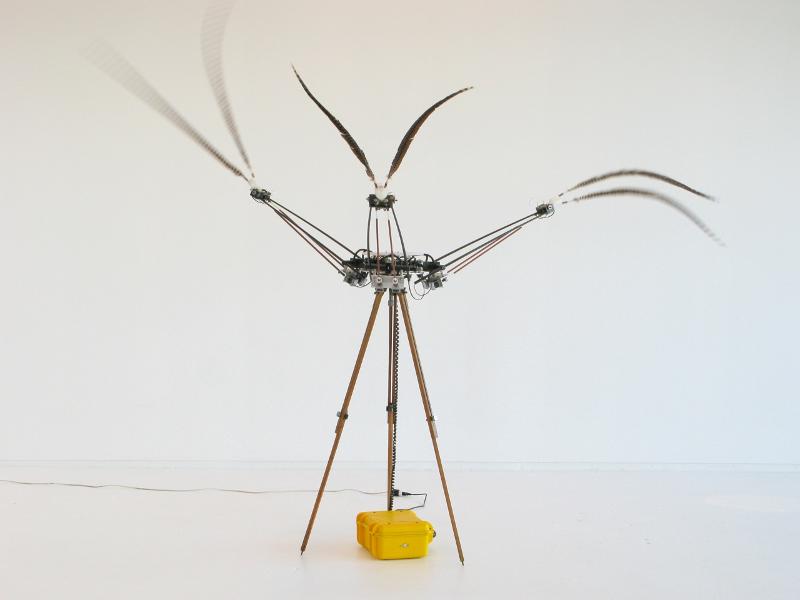
    Alan Rath, Lala ZaZa, image courtesy of Alan Rath and Hosfelt Gallery, San Francisco


    Utilizing many different kinds of energy from standard electricity to solar cells, the artists in this exhibition create sculptures that engage the viewer by seemingly coming alive. Sculpture’s approach to the kinetic is one that continues to grow and thrive as technology marches steadily forward. These artists stay at the cusp of scientific  experimentation, pulling varied kinds of machinery into their studios and emerging with kinetic sculpture that has the ability to assert itself in a way most art fails to approach.

    Closing soon, this exhibition is one that can’t be seen outside of actual experience. The work was curated by Nick Battis and Linda Lauro Lazin. Artists included in the exhibition are U-Ram Choe, Casey Curran, Chico MacMurtrie, Reuben Margolin, Alan Rath, Adriana Salazar, Björn Schülke, Che-Wei Wang, and Zimoun.

    Exhibition ends April 27, 2013. Pratt Manhattan Gallery, 144 West 14th Street, New York, NY 10011

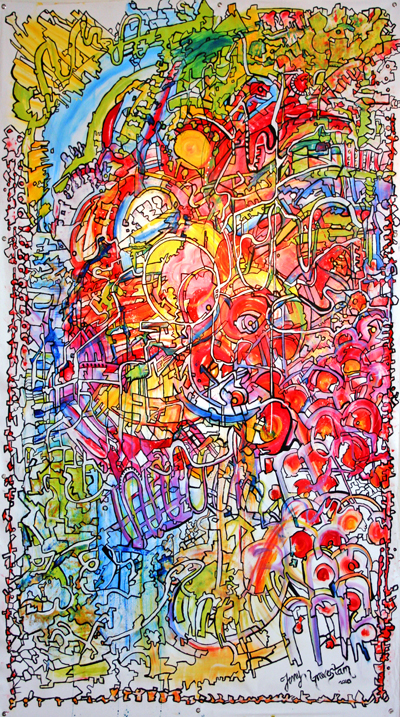
    Street Fusion, 2.5 meter high 145 cm wide 15 000 Sek


    Street Fusion came to life in 2010. A colorful explosion with an urban street feeling, this piece was inspired by old school funk music and street art.

    My aim is to make people feel happy while enjoying my art. Enjoy color, enjoy life!

    www.gravestam.com 

    Rex Bruce is the founder and director of the Los Angeles Center for Digital Art. He took some time earlier this year to share some insight with NY Arts about the vitality of the L.A. art scene.

    I was introduced to computer technology from an early age: my father was a programmer in the late ’60’s. He would bring me parts from giant computers to play with and gave me Radio Shack kits to build electronic gizmos. I also have a background in music and was introduced by composers I was studying under programming computers to control voltages going to analog synthesizers. Decades of electronic art, film, video, performance and music utilizing digital media followed, surfing the wave of emergent technologies as they came out. This led to a leadership position amongst peers in this particular genre and organizing exhibits and performances. I have been curating and showing in the art and technology scene since the 1980’s.
    I had done so much organizing and exhibiting in the media art scene in commercial, non-profit, guerrilla and academic environments that it made sense to start my own gallery space to continue on that mission in a more focused and structured kind of way. We have had three locations and each time we have become much larger. 2014 will mark the ten-year anniversary for L.A. Center for Digital Art.

    My focus in digital art, new media, or art and technology (as it is described variously) cuts a very wide swath in terms of the kinds of works that are out there. I try to represent the best of everything, be it academic or not, sellable or not. My interests are not that commercial, that part is an experiment in this genre at this point, really.  I do support community exhibits by non-professionals as well, this is an important aspect of what we do at LACDA. I try to stay open to many types of people making efforts they are very invested in and create opportunities to support their work. Some are very famous professionals, some are high level academics holding important university posts. Others are simply people who are driven to create and devote much of their lives to it.

    The look and feel of L.A. often informs the work we show here; the wide open sky, the pop mid-century sensibility of the architecture, suburban banality, the movie industry and so on. You get images of gas stations, cars, hollywood stuff, big skies and vast panoramas. Lots of media art, too. There is a big video and new media scene here.

    There is a “lowbrow” scene here that is enormous. This pop surreal art is where hot rod, surfer and latino low-rider sensibilities collided to form a genre that has matured over many decades into an extremely viable style. This popular “Juxtapose” scene is very L.A. and has been found to be very viable commercially.You can find a huge number of viable commercial galleries on the West Side of L.A., but that scene is completely dwarfed in comparison to New York.  Los Angeles is less expensive all around, so you find more DIY situations and non-profits often thrive here. There are almost 400,000 visual artists living here, and our art scene is very diverse and thriving. The artists here are not so on top of each other and don’t copy each other as much, I believe. New York generates more fads, and also more enormous dramatic installations, big flashy stuff. Speaking in the most general way, the work in L.A. is more individual and studio oriented.

    The energy in Los Angeles is gargantuan. This is a project city and nothing else but that. If you find yourself doing something that people in the various creative communities like you get picked up in this incredibly dynamic energy that draws you upward with opportunity and collaborations. I have found this kind of support here in countless ways, my work here thrives and will continue to do so, of that I am certain.

    Tofer Chin’s solo booth as presented by Lu Magnus Gallery at the Untitled Art Fair

    Amongst the extensive list of fairs exhibited at last week’s Art Basel, an underdog outshined the competitors with its fresh take on environmentally-minded art. Untitled, directed by curator Omar Lopez-Chahoud, made its debut this year by setting up camp right on Miami Beach. Showcasing up-and-coming artists from all over the world, Omar selected the appropriate galleries whose art was not only intertwined via commonalities, but had also complimented the airy space within the billowing tent. Given enough room to run caravans through its halls, Untitled offered wide paths bathing in sunlight that penetrated through several beach panoramas, as well as the thin ceilings of the tent. Working with architects and artists alike, Omar’s ambitions led him to create a fantastic art show within a refreshing space, which differentiated the fair from the stale, overcrowded indoor galleries we’ve all become accustomed to in the art world.

    Omar Lopez-Chahoud states, “One of the important things about presenting your work in the right way is having architects involved. In conversation with the K/R architectural firm, we all understood that we needed to create a space that is pleasant to navigate and facilitates a platform for the artist’s work to be presented.”

    THE POOL NYC gallery reflects Omar’s approach by delivering a multilayered exhibition through the pieces of Martin Roth and Patrick Jacobs. Building from the ground up, Roth creates a living piece in which he revives old Persian rugs by nurturing plant life that sprouts from the garden-woven design. Ascending to the nearby walls, we have the microscapes of Jacobs; the voyeuristic peepholes allow the viewers to perceive luscious landscapes that blur the division between photo imagery and deliberate construction. Both sets of works breathe in their own rights, coinciding perfectly with the space of Untitled.
    “One main idea behind this is to have something living—in the process of living. Often we see art objects that are considered “living” when in fact they are dead, a sort of mausoleum…[My] artwork asksme for something, and I must love and care for it in order to see it grow,” explains Roth.

    With long-established galleries dominating the scene for Miami’s Art Basel, it is energizing to see original ideas permeating the structures of the art world, remaining true to the purpose of art by not only pushing boundaries with the artwork, but with the atmosphere as well.

    Barnaby_1

    Image courtesy of Barnaby Ruhe

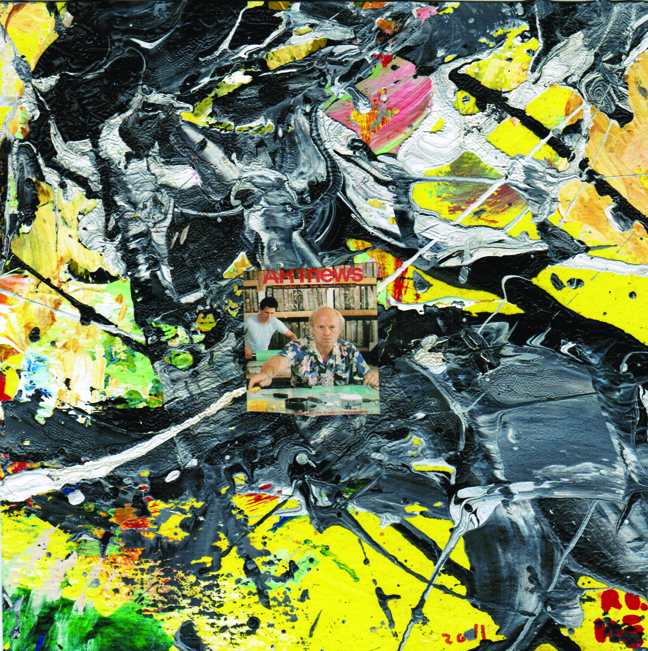
    I first really got to know Barnaby Ruhe as the actor who portrayed Jackson Pollock, while I did a much more minor turn as Clement Greenberg, in Bill Rabinovitch’s fantastic fiasco “Pollock Squared.” Ruhe is foremost a painter, while also practicing moving energy around as a healer, a shaman, and a boomerang thrower, he transfers his quick-witted dynamism into his handling of paint. Sometimes, he dresses the part to take on another character. His opus is as much about his character as it is about being a plastic visual artist.

    His canvases are sometimes slapdash, less De Kooning than Morris Katz. Over the last few years, in a series of art history vignettes in the form of collages and painterly essays on boxes, Ruhe has tuned toward art history and momentarily veered away from the fun, party-time vanity his portrait marathons have sometimes engendered.

    There was a great array to choose from among the exhibition at Dorfman Projects, including “Full Disclosure,” the Hunter S. Thompson piece. (The sometime poet wrote the piece for the catalog, which he composed right after being offered a series of choices in an email he read the morning after returning from California.) In a buffet of history, nothing was to be taken lightly from this man who channels other beings, very often, quite believably. Later, in the exhibition’s short run, Ruhe focused in on a very small work whose subject was not Kostabi but Qaddafi.

    Barnaby_2

    Image courtesy of Barnaby Ruhe


    Fascinated as I am by Italo-Arabia, the colors of the two flags, the turnover chromatics from Mussolini to the present day, the wavering paint, and the almost defacement of the dictator’s countenance in this work speaks volumes. Then perhaps it should be remembered that at times, this man did as much good for his formerly impoverished land as the well-recorded evil which he has been immortalized by.

    Now while giving a tour of NYC (to what seemed to be the Algerian Foreign Service Training Corps at the end of a hostile trip) this writer warmed them up with a story about giving a tour to terminal cancer patients. Followed by an offhanded mention that I wished to venture to post-Muammar Libya, and that furthermore I wished to survey the art, especially the Roman antiquities. I was told, “Go there and they will really take care of you.”

    All the while, having read Ann Marlowe’s horrendous piece criticizing the post-conflict worthiness of visiting Tripoli to see what was there, made this international shopping mall correspondent all the more curious after seeing pictures of the treasures online: “Libya was a backwater during the empire…it is substandard.” What is she reviewing, a new Cuban deli in Miami Beach? She had just described the wonderful pop sensibility or surrealist juxtaposition of Qaddafi’s autos amidst antiquities and was now a disapproving art tourist. Or maybe she was being sarcastic rather than problematic? It surely has to be one of the most insulting and flippant pieces on the far-flung realms of art to be published by a major United States newspaper in sometime.

    Back to Ruhe’s Michelangelo redux which was so Rubenesque so as not to be Buonorattian at all. It got me thinking. Research brought me to “Beyond the Candelabra,” a forthcoming HBO biopic on the ivory twinkle across the Sistine chapel, redone on the master bedroom’s ceiling of Wladziu Valentino’s now abandoned Las Vegas home. A descendant of the immortal Florentine supposedly painted it. Further, in order to recreate the life of the virtuoso, a re-staging of his funeral in Palm Springs took place in (of all places) Palm Springs with extras on hand such as photographer Jim Budman.

    Now back to Thompson. This Ruhe work has a hallucinogenic, pop fluidity in its rippling suggestion of repeated images. In the truncated double image of Gonzo himself smoking, the palette seems taken from the carpeting of one of the themed Las Vegas hotels he was so famous for roaming the convention-filled corridors of.

    Ruhe’s takes on Warhol and DeKooning left me baffled for quite a while. He takes on who the platinum wigged painter was as a spiritual entity—but then again, the art prince was really more of a Jonathan Swift: making a comment and moving on (until later waylaid). However, Ruhe’s works here are rather enjoyable as conversation pieces. They are stops on a tour as Ruhe integrates them into his/our consciousness which is deep enough for him to pay a visit to all of them, perhaps though just one at a time; pulling off the interstate to stay at the Rubens, the Dali or even the Frida Kahlo.

    Image courtesy of Masha Froliak

    Entering the darkened auditorium of the Park Avenue Armory’s Drill Hall served as a perfect setting for Karlheinz Stockhausen’s OKTOPHONIE. The audience was immediately invited into a mysterious world where the musical and the visual combined to take one on a meditative journey.

    As a pioneer of electronic music, a master of sound manipulations, research scientist, and composer, Karlheinz Stockhausen not only pushed the boundaries of sound limits and capabilities, but also invented a new language of musical aesthetic. OKTOPHONIE is a 70 minute electronic piece which is the second act of Dienstag (Tuesday) from a cycle of seven operas titled Licht (Light), each dedicated to a separate day of the week. This work opened Armory’s 2013 season and once again demonstrated the composer’s fascination with spatial movement.

    The audience donned white cloaks and took seats in a circle surrounded by 16 speakers positioned in four corners as if to form a cube. Kathinka Pasveer, a sound projectionist and Stockhausen’s long time collaborator, sat in the middle of the audience and controlled the overall dynamic. Eight different layers of music simultaneously moved through the space, creating an octophonic sound. The specific arrangement of the loudspeakers allowed vertical, horizontal, and diagonal movements which were initially composed by Stockhausen himself.

    OKTOPHONIE depicted a battle between two opposing forces, the archangel Michael and Lucifer. Rhythmic pulses of whistling, spinning, and crashing sounds alternated with longer lasting layers of sounds; a dark consistent drone being consistent throughout the whole piece. Strangely the musical composition and the complex variety of sounds did not create an immediate emotional reaction, but rather evoked a hypnotizing sense of desolation and stillness. The dark world filled with sonic invasions could be reminiscent of Stockhausen’s childhood experience of being near a battlefield in Germany during World War II. The composer imagined this piece, as with most of his other works, to be listened to in total darkness or with a little source of light, such as the image of a moon projected on the wall.

    Image courtesy of Masha Froliak

    Image courtesy of Masha Froliak


    The accompanying visual installation by Rirkrit Tiravanija helped shape the overall experience and sent the audience on a journey through space, just the way the composer himself had envisioned. The set was composed of a large disk representing a lunar surface and was designed to hold both the performers and members of the audience. As the music of OKTOPHONIE was filling the house, the lights were beautifully choreographed, moving from darkness, to total eclipse, into blinding light. The embracing form of the stage with the audience adorned in white, that made everyone blend with the lunar surface as the ligthing was projected on it, added a ritualistic aspect to the performance.

    The mystical spiritual mood of this massive sound composition was aimed at creating a separate dimension of a transcending character. Having no physical connection to sounds the piece was yet set up for the audience to have a strong sensory experience. Depending on where each person was seating the perception of sounds would differ.

    Stockhausen is known for his cosmological ideas and interest in universal wanted to expand and train our perceptual senses with his music. The only way to better understand it was to listen.

    As the last notes of OKTOPHONIE, which was composed by Stockhausen 23 years ago, filled Armory’s Drill Hall the lights illuminated the stage bringing us back to the worldly reality. The musical spatial journey that tested our perception was also a test for the composer, who died in 2007 without experiencing whether the world was accepting of his work.

    By Masha Froliak

    wurmfeld

    Image courtesy of Minus Space.

    Few have such a compelling hold on the use of color as Sandford Wurmfeld. A life-long student of the perceptual nuances of pigment, Wurmfeld’s current show highlights his ability to subtly infuse canvasses with a spectrum of hues. Initially coming across as monochromes, the work in Light and Dark reveals itself to be just the opposite.

    The artist has created complicated polychromes of gently nuanced gradients of pigment. They are structured around a tightly ordered iteration of his signature grid compositions and initially appear to be either black or white. Upon closer inspection, the plethora of subdued hues begin to delight the eye and open the works up as veiled worlds of chromatic encounters.

    March 29th – May 4th
    Minus Space
    111 Front Street, Suite 226
    Brooklyn, NY 11201 USA

    The exhibition closes May 4th and is very worth an extended visit.

    News | Exhibitions