• Leah Oates: How did you become an artist and did you know early on that you would be in the arts or did you begin as something else?  Where there other artists in your family?
     
    Conrad Bakker: As a child I was always curious about the world and interested in making useless things, but becoming an artist was never really presented as a viable option. My parents immigrated from the Netherlands to Canada when they were younger, and I was born in Canada and then moved with my family to the gulf coast of Florida when I was six— there was very little exposure to art in this subculture dominated by retirement and vacation. There were no artists in my immediate family, but even as my creative impulses were not completely understood outside of a protestant-like appreciation for hard work and self-reliance, I was never really discouraged from pursuing art. During college I wandered through a number of temporary jobs that included working in an aluminum foundry, a neon sign company, and a commercial frame shop—and then switched majors during my last year from graphic design to painting because the commercial field felt limited. I think I ended up choosing the vocation of a studio artist because it allowed me to do what I wanted to do with access to the widest range of creative and critical inquiry. 
     
    LO: What is your working process? Do you plan things out or play in the studio?
    Each artist is so different in how they approach their work. How do you approach the creation of your work?
     
    CB: My studio process is a mix of intensive research and formal play. Sometimes a project starts with a set of specific conditions related to a site, a moment of time, or a cultural phenomenon. At other times a project begins with an impulsive response to a certain form or color. Because I make simulated objects, sculptures of carved wood and paint, that look and act like real things, many of my projects are based on direct observations of everyday things and their habits, their relational networks, and their economies. 
     
    My studio practice occupies a number of pragmatically determined spaces that have distinct and sometimes overlapping durations: a camera/notebook for collecting/drawing as site-specific research, a computer and desk space for thinking and planning, a wood shop space for construction and sawdust, a painting space for finishing, and then the site of installation or intervention for display and public reception.  
     
    LO: Your work deals with consumerism and desire and you create objects out of wood to replicate actual consumer goods like detergent, watches or books and then place them in the shelved of stores next to the actual object. What kind of reactions do people have when they select one of your works off the shelves and what type of reaction would you like them to have?
     

    CB: A number of my projects involve the placement of carved and painted sculptures in vernacular settings that range from store shelves and public plazas to city sidewalks and ebay auctions. This strategy is purposely designed to extend the double-take of the formal illusion into the larger context so that the carved and painted sculptures look and momentarily act like their originals. One of the goals of this work is to create objects that are strange, fake things that reveal alienation, that sustain tension, and provide momentary pause to the quickness of consumption. So as these sculptures are forced into and move awkwardly through a specific site or economic system, they bump and dent a trail that begins to make tangible their underlying forms, uses, and trajectories.

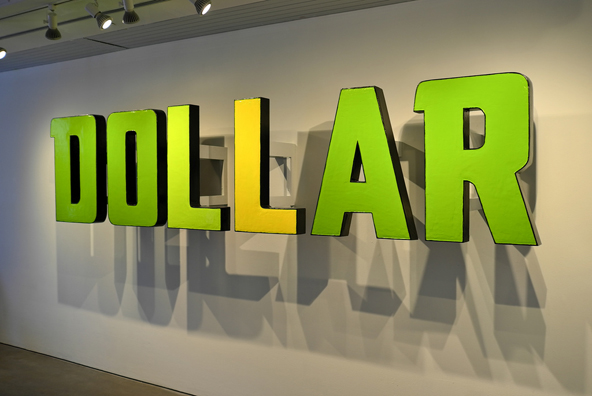
    Conrad Bakker, Untitled Project, Dollar store

    Conrad Bakker, Untitled Project, Dollar Store

    LO: Why do you think art is important for the world and why is it important for you as an individual artist?

    CB: I think art is as important as anything else. All too often art gets overrated in regards to its cultural significance and/or economic value, but art can happen in a lot of places without special recognition or privileged status. If I were to declare what makes art important for me, it would center on the idea that art makes room for both creative pleasure and critical analysis, it allows for the strange and the beautiful, it permits the anomaly, it questions the normative, it resists expectations, it represents our best moments and our worst fears, it can even provide an escape from reality and sometimes, if we are lucky, a return.
     
    LO: What advice would you give other artists who are emerging or mid-career?
     
    CB: Advice is so contextual, so this obviously will suffer in its generalization: find a place where your work and the world you inhabit are not at odds with each other and then do whatever possible to make that sustainable. 
     
    LO: Please talk about upcoming bodies of work, shows etc that you have coming up.
     
    CB: I have a new project underway called Untitled Project: ANY THING YOU WANT which is something like a small scale commission service for which I am offering to make custom carved and painted sculptures of any thing one might want, including but not limited to: lost items, desired commodities, functional tools, surrogate stand-ins, estranged artifacts, vintage souvenirs, hard evidence, or ambiguous matters of concern. The idea for this project came out of a series of conversations with viewers and participants of projects who would often make casual suggestions of specific things I should make next. These suggestions invariably had more to do with their interests than mine, but they also opened up a natural space for talking about things and our connections to them. I guess this project is also an awkward attempt to open up my studio practice to taking requests just to see what happens. Maybe I will discover a niche market of fake things for real spaces, or perhaps this project really only exists in the conceptual space of that open question: what thing would one choose to have simulated and why? 
     
    I have a few other large scale projects and exhibitions in various stages of development, including a series of objects and images that are inspired by Robert Smithson’s essay The Crystal Land and William Carlos Williams epic poem Paterson. Another upcoming project is focused on the 1964 Honda Superhawk CB77, a rather specific vintage motorcycle. 

    May_Fairs_Nyarts

    These days a new art fair seems to pop up every month. May is no exception. Showcasing some of the most well known artists and galleries are Pool, Frieze, NADA, Parallax AF, Verge, Cutlog, Red Dot, and Pulse. Make it out to see these exhibitions, but make sure you bring a snack. The volume of excellent work available will keep you occupied for some time.


    Pool Art Fair:
    Berend Bode
    Kristians Brekte
    Linda Fardoe
    Manuella Muerner Marioni
    Marcel Bastiaans
    Alessandro di Cola
    Sophie Hedderwick
    Tonya Smith
    Hye Ja Moon
    Davor Vukovic
    Jean-Marc Schwaller

    Frieze:
    Aaron Young
    Abraham Cruzvillegas
    Adrian Lohmüller
    Adrian Paci
    Adriana Bustos
    Aernout Mik
    Agnieszka Kurant
    Ai Weiwei
    Akram Zaatari
    Ala Ebtekar
    Alain Biltereyst
    Alan Charlton
    Aleksey Kallima
    Alessandro Balteo Yazbeck
    Alexander Gutke
    Alexander Tovborg
    Alexandra Bircken
    Alexandre da Cunha
    Alfredo Jaar
    Alice Browne
    Alicja Kwade
    Amanda Ross-Ho
    Ana Mendieta
    Andrea Bowers
    Andreas Gursky
    Andreas Lolis
    Andreas Mühe
    Andy Boot
    Anish Kapoor
    Ann Cathrin November Høibo
    Ann Veronica Janssens
    Anna Barriball
    Anna Maria Maiolino
    Anne Collier
    Anne Neukamp
    Annette Kelm
    Anri Sala
    Anselm Reyle
    Anthony Pearson
    Antonis Donef
    Ariel Schlesinger
    Armando Andrade Tudela
    Armin Boehm
    Art & Language
    Attila Csörgő
    B. Wurtz
    Barbara Bloom
    Barbara Kruger
    Becky Beasley
    Ben Schumacher
    Benjamin Butler
    Berlinde De Bruyckere
    Berta Fischer
    Billy Sullivan
    Birgit Brenner
    Blair Thurman
    Boetti-Paladino
    Brian Calvin
    Brice Marden
    Bruno Perramant
    Byron Kim
    Callum Innes
    Cameron Platter
    Candice Breitz
    Caragh Thuring
    Carl Andre
    Carl Andre
    Carl Ostendarp
    Carla Busuttil
    Carlos Bunga
    Carlos Bunga
    Carlos Garaicoa
    Carsten Nicolai
    Catherine Opie
    Charlotte Posenenske
    Chris Evans
    Chris Martin
    Chris Ofili
    Chuang Liu
    Cildo Meireles
    Clare Rojas
    Claudia Wieser
    Cornelia Parker
    Cyprien Gaillard
    Dale Frank
    Damian Moppett
    Dan Finsel
    Dan Graham
    Dan Perjovschi
    Daniel Gordon
    Daniel Gustav Cramer
    Daniel Lergon
    Daphne Wright
    Darren Almond
    David Brian Smith
    David Goldblatt
    David Hominal
    David Maljkovic
    David Noonan
    David Raymond Conroy
    David Schnell
    David Sherry
    Davide Balula
    Dayanita Singh
    Dennis Oppenheim
    Dianna Molzan
    Dirk Stewen
    Djordje Ozbolt
    Do Ho Suh
    Dorothy Cross
    Douglas Gordon
    Edith Dekyndt
    Eileen Quinlan
    Elizabeth Price
    Ellen Berkenblit
    Elliott Hundley
    Elmgreen & Dragset
    Elodie Pong
    Ernesto Neto
    Erwin Wurm
    Etel Adnan
    Fabrice Samyn
    Farhad Moshiri
    Fergus Feehily
    Fiona Banner
    Fiona Tan
    Folkert de Jong
    Francesca Woodman
    Francis Upritchard
    Frank Heath
    Frédéric Moser & Philippe Schwinger
    Gabriele Beveridge
    Gardar Eide Einarsson
    Gareth Moore
    Gary Hill
    Gary Simmons
    Geert Goiris
    Georg Baselitz
    George Condo
    Gerold Miller
    Gerwald Rockenschaub
    Geta Bratescu
    Ghada Amer
    Gilbert & George
    Gillian Wearing
    Gimhongsok
    Gitte Schäfer
    Giulio Paolini
    Glen Rubsamen
    Glenn Ligon
    Guillaume Leblon
    Günter Brus
    Haegue Yang
    Haifeng Ni
    Hank Willis Thomas
    Hans Op de Beeck
    Hans-Peter Feldmann
    Hany Armanious
    Harmony Hammond
    Haroon Mirza
    Helmut Middendorf
    Hermann Nitsch
    Horia Bernea
    Hüseyin Bahri Alptekin
    Ian Wallace
    Imi Knoebel
    Isabel Nolan
    Ivan Morley
    Ivan Seal
    J. Parker Valentine
    Jac Leirner
    Jack Early
    Jack Pierson
    Jacob Kassay
    James Nares
    Jason Meadows
    Jenny Holzer
    Jeppe Hein
    Jesse Wine
    Jessica Rankin
    Jimmie Durham
    Jiří Kovanda
    Joachim Koester
    Joan Semmel
    Joana Hadjithomas & Khalil Joreige
    Jochen Lempert
    John Armleder
    John Mason
    John Riddy
    John Wesley
    Johnny Abrahams
    Jon Pestoni
    Jonas Wood
    Jonathan Meese
    Jonathan Monk
    Jonathan Wateridge
    Jorge Macchi
    João Maria Gusmão + Pedro Paiva
    Juan Uslé
    Judith Hopf
    Julia Dault
    Julia Rommel
    Julia Schmidt
    Kailiang Yang
    Kaoru Arima
    Kathryn Andrews
    Katinka Bock
    Katinka Bock
    Kaz Oshiro
    Kendell Geers
    Kibong Rhee
    Kimsooja
    Kirsi Mikkola
    Kris Martin
    Krzysztof Wodiczko
    Kudzanai Chiurai
    Lari Pittman
    Latifa Echakhch
    Laurent Grasso
    Lawrence Weiner
    Leo Gabin
    Lesley Vance
    Leyla Gediz
    Liam Gillick
    Lily van der Stokker
    Liu Wei
    Liz Larner
    Liz Magor
    Liza Lou
    Loris Cecchini
    Lorraine O’Grady
    Luca Frei
    Luca Trevisani
    Luigi Ghirri
    Mac Adams
    MadeIn Company
    Maja Vukoje
    Marc Desgrandchamps
    Marcel van Eeden
    Marcello Maloberti
    Marco Neri
    Mariana Castillo Deball
    Mariana Castillo Deball
    Marie Cool Fabio Balducci
    Marina Abramovic / Ulay
    Markus Amm
    Martha Friedman
    Martin Dammann
    Marzena Nowak
    Mathieu Mercier
    Matt Connors
    Matt Saunders
    Matthew Brannon
    Matthew Darbyshire
    Matthew Monahan
    Matthias Bitzer
    Matthias Weischer
    Mauro Restiffe
    Melissa Kretschmer
    Meredyth Sparks
    Meschac Gaba
    Michael Bauch
    Michael Krebber
    Michaela Meise
    Michaela Melián
    Michel François
    Michelangelo Pistoletto
    Mikala Dwyer
    Miri Segal
    Miriam Cahn
    Miroslaw Balka
    Mladen Stilinović
    Mona Hatoum
    Monica Bonvicini
    Monica Majoli
    Monika Baer
    Moshekwa Langa
    Mounira Al Solh
    Mungo Thomson
    Nancy Spero
    Nari Ward
    Nedko Solakov
    Nedko Solakov
    Nevin Aladag
    Newell Harry
    Nick van Woert
    Niele Toroni
    Nilbar Güres
    Nina Canell
    Otto Muehl
    Pae White
    Pascale Marthine Tayou
    Patrick Tosani
    Paul Graham
    Paul McCarthy
    Paul Neagu
    Pavel Pepperstein
    Perino & Vele
    Peter Fischli & David Weiss
    Philippe Decauzat
    Philippe Decrauzat
    Phillip Allen
    Phillip Allen
    Piero Golia
    Pouran Jinchi
    Rachel Harrison
    Raqs Media Collective
    Raymond Pettibon
    Rayyane Tabet
    Rebecca Morris
    Renaud Regnery
    Renee So
    Ricarda Roggan
    Richard Aldrich
    Richard Wentworth
    Rita McBride
    Robert Barry
    Robert Breer
    Robert Irwin
    Robert Longo
    Robert Mapplethorpe
    Robin Rhode
    Rodney Graham
    Rohini Devasher
    Roman Ondák
    Roman Signer
    Ross Knight
    Rosy Keyser
    Rudolf Schwarzkogler
    Ryan Gander
    Ryan Gander
    Saadane Afif
    Saint Clair Cemin
    Sam Gilliam
    Sam Moyer
    Sam Samore
    Sandeep Mukherjee
    Santi Moix
    Santo Tolone
    Sara VanDerBeek
    Sarah Sze
    Sarnath Banerjee
    Sean Landers
    Sergej Jensen
    Sergey Bratkov
    Sergey Zarva
    Servet Kocyigit
    Sharon Ya’ari
    Simon Evans
    Simon Fujiwara
    Slavs and Tatars
    Sol LeWitt
    Sora Kim
    Stefan Burger
    Stelios Faitakis
    Steve Bishop
    Svenja Deininger
    Sylvie Fleury
    Tal R
    Tejal Shah
    Terry Fox
    Thilo Heinzmann
    Thomas Bayrle
    Thomas Dozol
    Thomas Hirschhorn
    Thomas Lawson
    Thomas Scheibitz
    Tim Eitel
    Tobias Madison
    Tom Burr
    Tom Friedman
    Tomasz Kowalski
    Tomislav Gotovac
    Tony Clark
    Tony Cragg
    Tracey Moffatt
    Trenton Doyle Hancock
    Tsuruko Yamazaki
    Ulay
    Uwe Kowski
    Valeska Soares
    Vera Lutter
    Victor Alimpiev
    Virginia Overton
    Walead Beshty
    Walid Raad
    Wallace Berman
    Walter Dahn
    Werner Feiersinger
    Whitney Bedford
    Will Fowler
    William E. Jones
    William Kentridge
    William Wegman
    Wolfgang Laib
    Wu Shanzhuan
    Yael Bartana
    Yang Shaobin
    Yann Sérandour
    Yayoi Kusama
    Yehudit Sasportas
    Yiorgos Lazongas
    Yoko Ono
    Yto Barrada
    Yu Hong
    Zander Blom
    Zhan Wang
    Zhang Hui
    Zhu Yu
    Zoe Leonard

    Cutlog:
    Aperto Projects Montpellier
    Art Amalgamated New York
    Art Connections Tel aviv
    B. Pailley Projects France
    Be-poles Paris
    Céline Moine Lyon
    Cirrus Los Angeles
    Clemente Soto Vélez Center Projects New York
    Concept Art Paris
    Creative Growth Oakland
    Dix9 Paris
    Edward Cutler Milano
    Fragmental Museum New York
    Frants Gallery Space New York
    Front Room Brooklyn
    Galerie Charlot Paris
    Gama Istanbul
    Garis & Hahn New York
    Gurfinkel Projects New York
    House of the Nobleman London
    Hübner and Hübner Germany
    Jag Modern Philadelphia
    L’Inlassable Paris
    Lambert New York
    LEBENSON Paris
    LETC/LAND Brooklyn
    L’Aléatoire Paris
    Marion de Cannière Antwerp
    Microscope Gallery New York
    Molin Corvo Gallery Milano
    Olivier Waltman Paris
    Per Partes Projects New York
    Renaud Siegman Projects Paris
    Rox New York
    Seymour Projects Paris
    Spinello Projects Miami
    spree Paris
    The Apartment Vancouver
    The Hole New York
    The Impermanent Collection Los Angeles
    The July 16 London
    The Noise Index USA
    The Proposition New York
    TIME IN New York
    TURF London, New York
    White Box New York
    Yael Rosenblut Santiago

    NADA
    247365
    Alden Projects
    American Contemporary
    Art F City
    Dan Asher Estate
    Nicelle Beauchene Gallery
    Bischoff Projects
    BLACKSTON
    Thomas Brambilla Gallery
    Braverman Gallery
    Brennan & Griffin
    Callicoon Fine Arts
    CHRISTOPHER CRESCENT
    Churner and Churner
    COLE
    Lisa Cooley
    COOPER COLE
    COPE PROJECTS
    Corbett vs. Dempsey
    DUVE Berlin
    Anat Ebgi
    Eleven Rivington
    Derek Eller Gallery
    Et Al.
    Daniel Faria Gallery
    Feature Inc.
    Fitzroy Gallery
    Gavlak Gallery
    Green on Red Gallery
    The Green Gallery
    Halsey McKay Gallery
    The Hostess’s Treasure Chest
    Independent Curators International (ICI)
    Interstate Projects
    Invisible-Exports
    Louis B. James
    KANSAS
    Nathalie Karg/Cumulus Studios
    Parisa Kind
    Klaus von Nichtssagend Gallery
    Know More Games
    Elaine Levy Project
    Galerie Christian Lethert
    Patricia Low Contemporary Gstaad/St. Moritz
    LOYAL
    ltd los angeles
    Luce Gallery
    M+B
    Macauley Fine Art
    Marlborough Chelsea
    Martos Gallery
    New Galerie
    Newman Popiashvili Gallery
    Night Gallery
    On Stellar Rays
    ROBERTO PARADISE
    David Petersen Gallery
    Eli Ping
    QUEEN’S NAILS
    Rawson Projects
    Redling Fine Art
    REGINA REX
    ribordy contemporary
    Petra Rinck Galerie
    SCHMIDT & HANDRUP
    Kerry Schuss
    SCHWARZ CONTEMPORARY
    SculptureCenter
    Joe Sheftel Gallery
    Jacky Strenz
    Temnikova & Kasela
    Rachel Uffner
    Kate Werble Gallery

    Ian Toms, Untitled (K as a Haunted House), 2011 oil, enamel, tape and sharpie on linen 32 x 26

    Ian Toms, Untitled (K as a Haunted House), 2011
    oil, enamel, tape and sharpie on linen
    32 x 26 inches

    In collaboration with The New Museum and The They Co, one of our favorite independent curators has an exciting show open from May 4th-11th at the Old School, 233 Mott St. in Nolita. Adam Mignanelli of Ballast Projects has really been killin’ it lately. This show seems to be another exhibition that very worth our time.

    Ballast Projects is pleased to present five painters sharing their passion and gift of artistic thinking, storytelling, image making, and purpose. Their works, made with both local community and global audiences in mind, are governed by values and social structures put in place to help their artistic wishes become reality. These artists share a common sense of daring and risk, utilizing art materials from all corners of their lives in order to find success through their work.

    It takes more than just talent. Reaching deep into their own wells of inspiration, each of these artists live, breathe, and dream their artistic pursuits at every moment. They may be at different stages of their development, but they each maintain a vital gut of artistic passion. This is what it takes to continue to make captivating paintings; ability, drive, forethought, and confidence. It’s not enough to expect that everyone else will see how hard you are working. You have to make your own luck.

    The artists included in the exhibition are Samuel T. Adams, Devin Powers, Jenna Ransom, Ian Toms, and Russell Tyler.

    Austrian graphic designer Stefan Sagmeister’s pitch book for The Happy Film fits in my palm—it is short and sweet, bright and charmingly … delightful. The book works to communicates Sagmeister’s desire to answer and visualize the following questions through film, “Is it possible to train your mind in the same way you train your body?” and, “Can you change your behavior to make yourself happier?” Though it does not promise to make readers any happier when they opened the book’s pages, The Happy Film Book is comprised of a series of aphorisms that Sagmeister has acquired throughout his life that he feels have helped him understand why we are unhappy, and how that can be changed. The positive maxims are visualized in spaces and styles normally reserved for advertising campaigns through Sagmesiter’s unique approach to typography. Metal coils floating in a pool and duct tape stuck to a fence become a part of the phrase, “Trying to look good limits my life.” His aesthetic approach to these simple words of wisdom are even more powerful given his lively approach.

    Interspersed with the photographed adages are other elements of the Happy Show, an exhibit organized by Sagmeister and Claudia Gould for the Institute of Contemporary Art in Pennsylvania. Visual statistics related to happiness, anecdotes from Sagmeister’s own life story, and his inspirations for making the exhibit, (and ultimately the film) tie the photographic typography series presented in the book with supporting dialogue. The Happy Film, a book intended to pitch Sagmeister’s unmade documentary, becomes more than a mode of self-promotion. In advertising itself, this little book not only hints at what is (hopefully) to come from Sagmeister and his team, but supplies a dose of wisdom and thoughtful pleasure to its readers.

    By Gabrielle Jensen

    This world, and the world of art in particular, is so often filled with largely superfluous gestures that sometimes the best work attracts attention for displaying an economy of gesture. The best of this work can go so far as to display little or no gesture at all.

    Craig Dworkin’s latest book from MIT press investigates this very vein of contemporary art. Art that is overly-considered in its sparseness of expression is often immediately dismissed by the uninterested or intellectually cynical. For the rest of us, these works can be the most bold and intriguing.

    The less you do to an object, the more important each decision you make becomes. The work remains more open to interpretation and wider in possible connection both to allegory and the work of others.

    Dworkin investigates the importance and under-recognized influence of a massive range of works such as Rauschenberg’s Erased DeKooning Drawing to the publishing of a blank ream of paper by lesser known Aram Saroyan. The work of John Cage makes a repeated appearance and there is a detailed appendix of audio work, all of which deal with artists who approach the use of silence.

    The authors’ skill at turning over the impact and significance of a seemingly minimal artistic pursuit is such that the reader finds oneself drawn completely into the writing, digging deeper and deeper as Dworkin connects pieces of art across lifetimes and genres. One emerges from the writing reinitiated to the world of art, with a new appreciation of the impact afforded even the most minute of aesthetic decisions. It is a meaty 219 pages dealing in the best possible way with work that engages an academically pregnant state of nothingness.


    By Matthew Hassell

    mitpress.mit.edu/


    by Tony Zaza

    For movie fans who are partial to movies without closure, the 2013 Tribeca Film Festival provides many good movies without complete endings. You can use your imagination to project a conclusion. Perhaps life has become so subtle and arbitrary, endings are no longer relevant. What might matter more is what brings people to the edge.

    Hollywood of the 30’s and 40’s excelled at creating non-realities that a majority of moviegoers sought and accepted.  The fields of dreams today are difficult to share. They are “private Idahos” that are so self-centered and bravely egocentric as to be pure cinematic narcissism.  This festival had very varied and strong offerings. Here are some of the more personal films.

    AT ANY PRICE (by Ramin Bahrani)

    Nestled within the context of the Midwestern Iowa agribusiness and farm life, this story sets up a rather wicked conflict of interests within one family. The plot assumes bioengineering has one out over organic farming as the narrative focuses on how a father’s expectation conflicts with a son’s ambition. Lead actor Dennis Quaid saw the tale as “Willy Loman on the Prairie”.  He and Zac Ephrom propel what is essentially a character-driven drama.  Corporate and moral crime ensue, and you are left to decide if this tale is about personal greed or the slow decay of American values.

    FRESH MEAT (by Danny Mulheron)

    This is the ultimate commentary upon how we define “normalcy” as a society. It is a fresh twist on the gory horror genre because it boldly attempts to be butch, goth, Dadaist, slice’n’dice, and socially relevant. So when a gang of murderous thugs led by a merciless goth girl invade the suburban home of a traditional New Zealand family of Maori ancestry, equal parts of mayhem and sardonic humor ensue. Fresh Meat questions the authenticity of professional reputation, the deception that engenders even minor celebrity (mom is a talk show chef, dad is a novelist), and the male propensity for compulsive obsessive religious cultism.

    THE ROCKET  (by Kim Mordaunt)

    The inspirational story of little ten year old Laotian waif, Ahlo, who through the spirit of invention and survival builds a homemade rocket from bat dung, urine and other natural materials. This work follows a convention in third world cinema that pits the enthusiasm and will of the individual against the collective corruption of societies, even tribal societies. The “feel good” expectation is admirably met, but without much insight into what keeps ancient societies ensnared in their superstitious and impractical folkways.  When Ahlo’s hipster “uncle” who seems to be ex-Laotian military, gives him an encouraging wink at the end of the story, one feels that his new found talents may find darker purposes in a story yet to be told.

    The Rocket

    The Rocket

    BEFORE MIDNIGHT (by Richard Linklater)

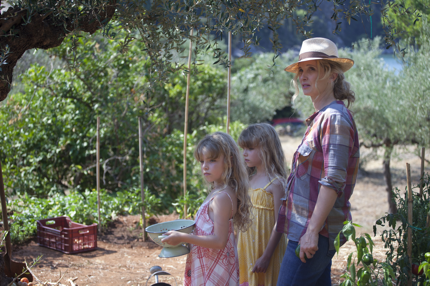
    Jesse (Ethan Hawke) and Celine (Julie Delpy) continue the saga of their shameless, passionate relationship. Set during a vacation in Greece and a visit with friends, and using long take narrative style, the plot centers around shattering the feminine mystique once and for all while exposing male inflexibility. The issue is who wins out, the director or his muse, Julie Delpy? It’s very theatrical, a tale of bonding versus enduring. Ms Delpy expresses nearly every mid-life crisis issue a woman can harbor and voices eloquently the need for simpatico. The type of indifference she faces is not unlike that expressed in another festival film, The Patience Stone in which male-dominated social mores block self-determinism.

    Before Midnight

    Before Midnight

    THE PATIENCE STONE (by Atiq Rahimi)

    A woman cares for her injured rebel fighter husband in Kabul. Her loyalty is soon eroded by her desire to liberate herself from centuries of female oppression. She is a woman under the influence of memory and she seeks a saving grace. Rahimi weaves a tapestry of claustrophobic interiors and hazardous interactions with the dangerous war-scape of Afghanistan. Like a soliloquy, the narrative unfolds as a struggle to assert the rights of women through the poetic device of signification. When the dutiful wife frees herself, her fate is an echo of psychic crucifixion.

    JIN (by Reha Erdem)

    There is always room for a perspective on how war punishes the innocent. In this somber tone poem, a teen rebel Kurd struggles to survive alone in hostile yet beautiful mountains of Turkey. In between bombings and gunfire, Kin communes with the wonders and tranquility of the natural world and its creatures. A pensive and eloquent anti-war symphony of silences, the reverie is brutally interrupted by reminders of merciless and senseless conflict.

    TABOOR (by Vahid Vakilifar)

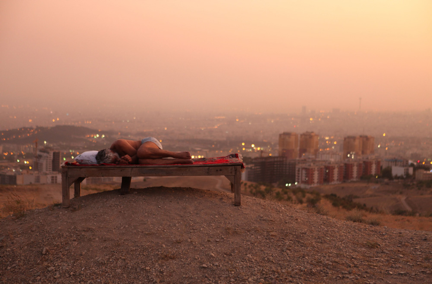
    Nearly silent but making exquisite use of aural imagery, this example of minimalist cinema exhibits all of the classical facets of the language of cinema to create mystery, a sense of danger, symbolic gesture, and a surreal portrait of a simple man in Tehran. This man carries out his life as a nocturnal exterminator expressed in a manner reminiscent of the animated films of Walerian Borowczyk. Part allegory, part absurdist cartoon, it is pervaded by a sense of great humanity and dignity.

    Taboor

    Taboor

    WHAT RICHARD DID (by Lenny Abrahamson)

    As hormones rage, a seemingly accidental death changes the relationships between teens and their extended families. This drama set amidst the landscape of affluence and urbanity, examines the power of jealousy and conscience in motivating behavior. To more subtle extent, this is an examination of narcissism and youthful anomie. In another era it would depict the lost generation, but in this era, it’s a novel “gotcha” melodrama.

    DARK TOUCH (by Marina De Van)

    As a symbolic expression of the failure of parenting, the horror elements of this tale are rather mild. Nevertheless, there is a careful delineation of parental self-deception and communal dislocation.  The film’s somber tones and overall melancholia are apt metaphors for the child abuse at the heart of its theme, but the plotline translates into rambunctious bloody psychophysical vigilantism.

    MOBIUS (by Eric Rochant)

    As smooth and seductive as a leopard, Mobius reveals a tapestry of intricate personae and sub-plots. The chemistry between double agents Jean Dujardin and Cecile De France is as extreme as it gets in cinema. When Tim Roth inspires their reactive ambitions, sex and quiet terror commingle in a spy vs spy soup that is as savory as it is clever. The Monaco background is elegant and sensual like the main characters. Rochant develops an intense feeling of intimacy in scenes both  of love and violent confrontation, and leaves the door open for your own conclusion.

    BLUEBIRD (by Lance Edmands)

    An aire of hopelessness pervades the lives of the inhabitants of a small Maine logging town that seems isolated from the American Dream machine. Biblical in its sentiment, the narrative plummets the “down and out” characters further into Job like despair when a tragic inexplicable oversight occurs. Two families are challenged to remain civil in the face of a dead preteen.  Everyone, including the viewer, looks for signs of grace and redemption, but justice does not seem to be possible.

    THE BROKEN CIRCLE BREAKDOWN (by Felix von Groeningen)

    This zany, sexy creative cocktail of music, quirky romance, tragedy, and dissolution plunks the heartstrings as a bluegrass team struggles to keep devotion to each other alive. There is a subtle weaving of past and present that gets shattered when director von Groeningen has his main character denounce nearly every known social institution for supporting war instead of life.

    ALI BLUE EYES (by Claudio Giovanessi)

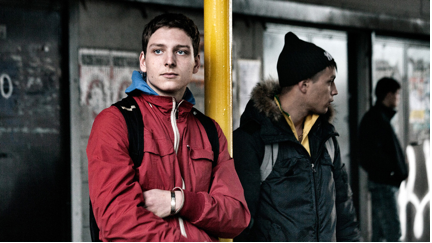
    The plight of ethnic minorities in a foreign land is given poetic vision in this drama centered around survival in the streets and the inflexibility of religious convictions.  Islamic teen Nadir demands autonomy from his family beliefs and wants to be more Italian but demands his sister remain fundamentalist. When his best friend shows interest in his sister, Nadir becomes violent. His trajectory up and down results in the unexpected actions and reactions that give a verite’ feeling to emotions and to the lies hidden in the street life of a gritty city reminiscent of Napoli.

    Ali Blue Eyes

    Ali Blue Eyes

    DEEP POWDER (by Mo Ogrodnik)

    Essentially a “trip” movie, Deep Powder comments about the differences between the affluent and the needy. It also explores the power of young girls to seduce boys into doing anything. Peer group pressure also accounts for some plot conventions, but the real focus is upon personal responsibility.

    PRINCE AVALANCHE (by David Gordon Green)

    Surveying loss and disappointment, this humane “buddy film” is not very cinematic except for one exceptional aural space/time psychic zoom. Streaking to the back of a girl who dumps one of the protagonists, in an awkward way, it’s about men dealing unwell with complex women.  Paul Rudd and Emile Hirsch are waiting for Godot as they spend their days isolated in the forests painting roadway lines. Like absurdist boy scouts, they brave the rustic life outdoors living in tents and eating what nature provides. When potential or renewed romance enters their lives, they both seek a private kind of revelation.

    SOME VELVET MORNING (by Neil LaBute)

    In the theatrical world of Neil LaBute, life is defined as much by what is said as how it is said. In this closet drama, a middle-aged lawyer tries to reconnect with a former lover. The dialogue can be misleading and acting can be deception transformed into belief. The tragic denouement is not quite what it appears to be. As actors play-acting, Stanley Tucci and Alice Eve make complicit fools of all of us.


    Mark Sengbusch is a painter, curator, and Sudoku Master living in New York City. Jeffrey Scott Mathews is a painter, writer and musician based in Brooklyn. They met in Detroit, in 1997 at College for Creative Studies. They later studied at Cranbrook Academy of Art where they picked up on a dialogue that will carry on in perpetuity.

    JSM: You and I have had a continuous and lasting dialogue regarding abstraction. In preparing for this piece we reminisced over a particular quote from Azerbaijani crystallographer Khudu Mamedov where he asserts:

                Townsfolk= geometric surroundings / natural art

                Nomads= natural surroundings / geometric art

    Could you elaborate on how you view this phenomenon in relation to your own work?

    MS: You told me about this essay like 6 years ago and it’s always in the back of my head, especially when I travel. (I notice my dreams change when I travel, too).  I moved from MI to NYC in 2008. As in Mamedov’s theory, I ended up making gestural, natural art while surrounded by the pattern and geometry of the Big Apple. The result was the Strata Paintings. (See Central Wave Strata, 2010) Very loose, colorful, organic, detailed. Strata as in layers – sediment. That Simpsons cut scene of the layers of earth under their house with dinosaur bones, etc and that poster from High school of the different eons, like layers of a cake, upwards from bacteria to fish to dinosaurs to mammals. Perhaps this phenomenon Mamedov posits can be explained as easily as a longing for what one has not.

    In January of 2011, I was at Vermont Studio Center for two months. I went with no plan as to what kind of work I’d make. I made the Comb paintings (See Whorl Stasis, 2011).  Loosely based, (and for reference sake), on Ancient African Combs and tools. Could I have been subconsciously summoning the skyscrapers of New York 350 miles away? I wasn’t thinking about buildings and highways while I was in the small, old mining town of Johnson, Vermont. I had a studio visit with Katherine Bradford (or maybe it was Carrie Moyer) and upon telling her about combs, blueprints, and NES she said, “Why do they have to have a real-world reference?” I thought “Bitch…she’s so fucking right.”

    Then it hit me. It was there the whole time: overhead view vs. normal horizontal or human view. Scale and scale shift, what is the map and what is the idea of the place? Viewing the painting like an Island or a window? In other words – division of space; positive/negative push-pull, no overlapping, no layers.

    In hindsight it seems too perfect. That I would make the Organic “Strata” painting in the city and make the Structural “Comb” paintings in the country. Maybe just a coincidence, but I think Mamedov was on to something. I haven’t totally figured it out yet.

    JSM: One could view the phenomenon of inverse as tying into the debate of existentialism (finding meaning through making) vs. structuralism (reducing meaning or relationships through editing/structuring). Do you see yourself as an Existentialist or a Reductive Structuralist?

    MS: I guess the latter – Reductive Structuralist. I consider all the work I make to be more about “the idea” or “feeling” of something rather than that thing (itself) as an endpoint or finale. (i.e. the idea of early language/design and not a specific re-creation or re-interpretation of say, the Rosetta Stone or Hamarabi’s Code).

    Last week Katherine Bradford told me a quote by painter Suzan Frecon, “My decisions are visual.” That is poetry – damn. The ultimate epitome of a simple, honest, ideal artists statement. I told K-Brad immediately, “Imma steal that!” It goes back to a term I bit off of you many years ago, Jeff. You mentioned a “Non-circuitous” way of making art. I dig it.

    We don’t make art in a cave, of course, far from it. We went to grad school and we live in NYC. But I try and steer clear of the tentacles of art history and contemporary trends. So, by allowing a natural puree to waft through me and into the paintings, I create as close to an objective product as possible. I avoid becoming immersed into/blinded by the objectifying gaze, thus becoming the player and the critic.

    Back to reducing meaning by editing/structuring, I make between 50-200 drawings for each Comb painting. Making the drawings and editing them down make up 1/3 of the whole process (but is really the only creative part!). My criteria in editing is 3 fold (loosely):

    1. Too Op-Art-y

    2. Too design-y (rugs, etc)

    3. Too busy (i.e. more than one to two cornerstone elements before reaching full circle to a field)

    By choosing the drawing that lacks 1-3, the final painting exists in limbo. No affiliation to known scale, orientation, or basic design shticks – intentionally anonymous. It’s like Superman losing the race or Goku losing to Mr. Satan. “The stone that the builders refuse will become the cornerstone.”
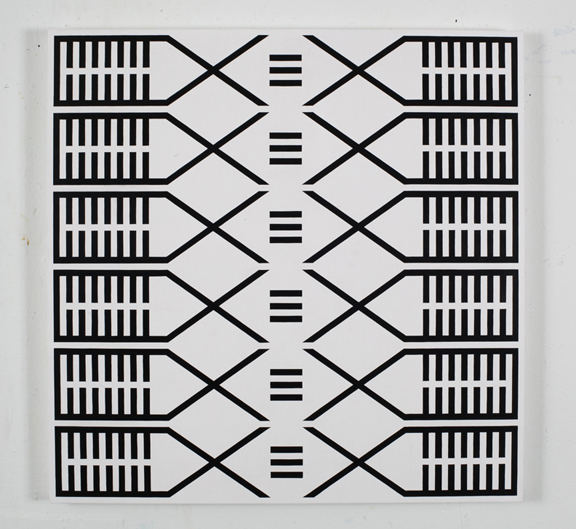
    Whorl Stasis, 2011, Scrimshawed Acrylic on Panel, 31" x 31"

    Whorl Stasis, 2011, Scrimshawed Acrylic on Panel, 31″ x 31″

    JSM: In ANTI-OEDIPUS Gilles Deleuze and Felix Guatarri postulate that a schizophrenic out for a walk is better than a neurotic on an analyst’s couch. I am taking this to mean that breaking structure is a better solution than trying to find it thorough analysis. In relation to your work, I wonder if you feel that the process of making is your schizoid walk, or if it is commanding the importance of rigidity of form? Rational or Anti-Rational? Perhaps this is the ultimate painters paradox – synthesizing the rational (paint, alchemy, spectral composition) with the non-rational (the mystical, spiritual, or spectral walk.)

    MS: Fuck you, Jeff! That’s like 5 questions in one! And you’ve only given me A or B options, yo! Remember, my decisions are visual. Paint is paint AND language. I try to simplify shape and line to its most base form.

    When was visual communication born? Did “design” exist before? Could the first written communication have pre-dated Sumer, a land cloaked by design? Was the zig-zag line just a frivolous, decorative, subconscious mark on a pot? Was it strategically, naturally, or instinctually decided to be a zig-zag line representing mountains as opposed to parallel horizontal lines, which would have signified desert plains?

    I think about these things – but not in my studio. Yes, my schizoid walk is stumbling backwards to a time/feeling/state of mind before written language.

    JSM: Could you talk about language in relation to your work? I recall we shared an interest in Lewis Carrol’s Symbolic Logic.

    MS: Yes, there is a logic to the work, way more in the new Kuba Comb paintings, though. Raffia or Kuba cloths are ceremonial textiles from the Congo, worn as ceremonial skirts and at times used as currency. You put it on the floor, wear it, hang it on the wall! It’s a hard but natural balance for me but I think about the diversity in perception of things like Kuba cloths. When I draw, the line creates a thing and a place. It is also a re-presentation or illustration of that thing – and a map of that place. One may think, “Hey, but it’s really only the latter” or, “You’re only a sculptor”. But no – especially when it becomes a painting (from the drawing), the line width is what it is: A = A.

    When I was a kid I loved making mazes. Of course, in the back of my mind it was a map of some sort, but not really. It wasn’t make-believe. I was invested in the real thing – pen on paper. Maybe that’s the ultimate trickery of design; that you cannot ever fully remove the signifier from the sign.

    JSM: Considering solitude, have you ever had a conversation with yourself? Who was doing the asking and who was answering?

    MS: Not sure. But, recently I was at Alicia Gibson’s studio and Yasamin Keshtkar queried, “who is the speaker of text in a painting?” Like who is the maker and why did she make/say this? Or is it a story and the speaker is different than the maker? When one reads text, whether in a zine or on a painting, who is speaking? Is it in first, second, or third person? This conversation made me think about who is the “speaker” of my paintings or images in my paintings. I guess I like to leave that ambiguous. If you’re hunting for arrowheads – it’s hard to know if it’s just a freakin’ rock or an authentic man-made object. That is the ever quiet and rhetorical conversation between “I” as a maker of things and “I” as storyteller, historian, or magician.

    JSM: How do you view the concept of time in relation to the concrete materiality of painting?

    MS: When we met in Detroit in undergrad I walked into the dorm room behind mine in the smoking back tower of the ACB building. You, Ted, Kobie, and the gang were playing Rampart on the NES. In Rampart, you build your castle (overhead view like a map or a drawing) and you bomb your enemy’s castle, he bombs yours – then you rebuild. This destruction/creation was like a time-lapse.

    I see my paintings like this, kinda; a scale model or a blueprint is a re-presentation. I can pick it up and feel it – so it becomes some thing, not an idea.

    I made a mouse maze out of two by fours when I was a kid. This was real, not a scale model. English garden mazes, corn mazes, etc. can be experienced from an objective view as in the map or the mouse maze, or as a participant such as in a corn maze. Video games have given these things names: First person shooters, overhead-view God games, etc. So yes, I consider the element of time inherent in my work. There are different stages in the life of a thing. First, it is not there, then it is there. It exists, then it maybe changes, it fades or crumbles or grows, and eventually all things disappear and are again “not there”.

    JSM: Could you name the three of your least influential painters?

    MS: Peter Halley, Matthew Ritchie, Francis Bacon.


    marksengbusch.com

    Zurier01

    Image courtesy of Peter Blum Gallery

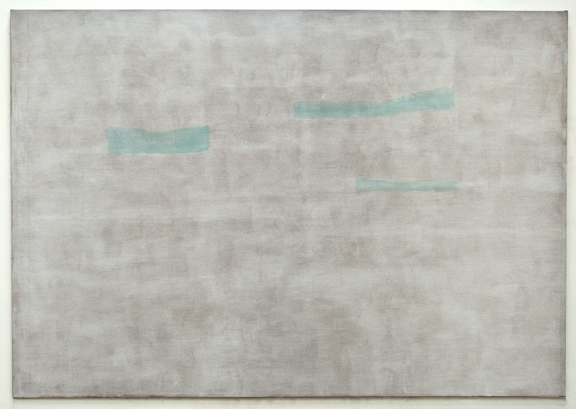
    When it comes to scale, an artist usually knows his or her strengths and sticks to one size or another. It’s a rarity to find an individual who has compelling aesthetic chops both when creating smaller as well as larger works. John Zurier is one individual who seems comfortable creating reductive abstractions in any size he sees fit.

    As is readily evident in his exhibition of new paintings at Peter Blum Gallery, Zurier has a compelling ability to apply sensitively considered passages of muted color. Billed as monochromes, these works highlight Zurier’s acuity to touch and knowing when to pull back, never straying into stale waters. He works both in oil and distemper, a primitive blend of rabbit skin glue and raw pigment. His material decisions allow for meticulously implemented subtleties to steal the show. Hazy washes applied to the linen amount to cloudy abstractions opening up to spaces as vast as the viewer can imagine. His compositions are sparse and highly considered, while the artist’s sense of touch seems raw and immediate.

    It is a show to be seen by anyone typically seduced by the importance of the hand. Selecting his painterly moves carefully, Zurier has carved out a niche for himself; one that is appreciated by those who find excitement in some good old visual poetry.

    cooper_union_holocaustWorld renowned architect Daniel Libeskind, the master planner for Ground Zero and the architect of one of Europe’s most visited museums, the Jewish Museum Berlin, explains the role that memory played in his work. He also speaks about the acute sense of responsibility he feels when accepting commissions for projects addressing Jewish history, to create work that testifies to both the traumas of that history and the resilience of the Jewish spirit.

    Co-sponsored by The Cooper Union Hillel as a Holocaust Remembrance Event
    Located in The Great Hall, in the Foundation Building, 7 East 7th Street, between Third and Fourth Avenues

    Jim Gaylord, Call on the Carpet, 2013, gouache on cutout paper, 36 x 50 inches
    courtesy of the artist and Jeff Bailey Gallery

     
    CHRISTIAN MAYCHACK: I was thinking about the title of your last show with Gregory Lind, Skipping Over Damaged Area, and about that sort of technological breakdown that happens with the damaged area of a DVD, and it seems like that moment you’re picking is also about the fallibility of our perceptions, like we sort of smooth over that moment and don’t really notice it.

    JIM GAYLORD: Right, and when that actually happens on a DVD you don’t see it at all. It’s missed and isn’t even perceived, but there is something very pertinent about the way we see moving images in cinema and television, where it’s a series of frames and our minds fill in the spaces to create the illusion of motion.

    CM: It sort of happens in our day to day, too. Our peripheral vision is mostly made up of a smoothing over of details that we don’t really see, but we make sense of them narratively. Do you see that as something similar?

    JG: I think we have to tune out a lot of that information in the periphery just in order to function. If we paid attention to every piece of visual stimulus detected by our eyes, we would go nuts. Part of what I’m interested in is the information in the periphery of understanding, where you think you know what you’re seeing just because there’s an intrinsic logic in the way it was put together, and a very deliberate specificity, but there’s no way to come up with a complete narrative. It just keeps turning itself over, leading you back to different parts of the image, so that you have to keep second-guessing your assumptions. There’s a kind of false sense of understanding in the initial perception and then you realize, “oh, I really don’t know what that is.”

    CM: It seems with this work, you’ve stopped giving as many clues to a viewer about what things are.

    JG: Yeah, I’ve really lost my interest in representation in painting. There was a phase when I was using realism as a way to counter the abstraction that I was playing with, and then the realism slowly disappeared because I realized there were two different languages trying to operate at the same time.

    CM: Well, you let go of representation, but the way these things are cut out, they still can’t help but reference representation. I just went to see the Thomas Nozkowski show, and in that same way he’s sort of probing representation without actually going there, and I feel like your new work does that without going towards the object that was its source.

    JG: Nozkowski is definitely an important reference. I often have difficulty with the idea of simply abstracting a representational image and making it into something else, which is why the film stills were interesting to me. I’m finding frames in these movies that are already abstract, so there’s something about them that’s more honest in a way, versus abstracting something from life. And Nozkowski is coming up with interesting relationships between forms that don’t necessarily come from observation, but there is something very bodily about the work in his two shows that are up right now. Something that I’ve often thought about with abstract painting is that people ultimately look for a figure.

    CM: People can’t help but Rorschach.

    JG: Right, and that ‘s a very relevant concept for me right now in terms of the symmetry that’s happening in some of the work. I was thinking about why a Rorschach image is symmetrical, and there seems to be a reference to the body—our bodies and faces are symmetrical, and we’re used to seeing symmetry in life. So, I think a Rorschach image is such a provocative psychological device, and makes sense to us on such an instinctive level, because of that. If we saw half of a Rorschach, it would just be meaningless blotches, but when there is order imposed on it via symmetry, our mind says that it’s something we should recognize, and we make the next leap.

    The kind of symmetry that I’m working with isn’t reflective, but “point” symmetry, like you would see in a playing card. But there are portions that I obstruct with forms that aren’t referenced in the other half, so it is deliberately disrupted. Symmetry is sometimes too easy of a solution for a composition, so I’m grappling with it and trying to decide how it serves the work, as in the sense of rightness vis a vis the Rorschach concept.

    Mirror_Repair-opt

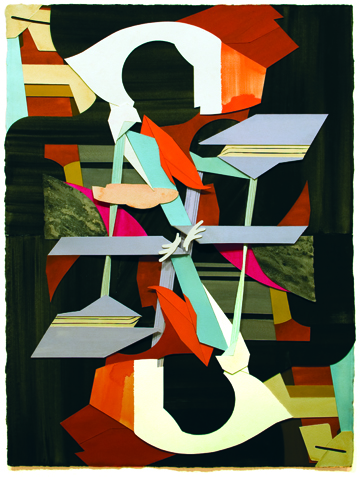
    Jim Gaylord, Mirror Repair, 2013, gouache on cutout paper, 30 x 22 inches courtesy of the artist and Jeff Bailey Gallery

    CM: I think symmetry can really ground an image and make it static, but there is something about this process, the way you use collage that’s not flattened. All the pieces seem as if they could return to movement at any moment, which makes sense given that the source materials are stills from films. And your history with film—you went to school for film and studied animation, right? The symmetry doesn’t become static; it can operate both ways.

    JG: It’s volatile. I think the surfaces of the cutout pieces are important. With the first one I did, I flattened it out completely and now I realize that it’s so much more interesting to leave the fragments popping out a little bit.

    CM: They seem sort of theatrical to me in the way they used to light theater sets by candlelight, and they were painted in such a way that it would create movement. I see something similar in the way light reacts with the surfaces of these that gives them a theatricality.

    JG: My first job ever was as a scenic painter for the theater, and I’ve actually thought about the possibility that some of these could be adapted as theatrical sets. I don’t know where that idea will go, but you’re right that there is something similar about the way sets are constructed, where there are a lot of flat planes in front of each other to create a sense of foreshortened space. For example, the old trick of the waves moving back and forth, so yeah, there’s something about the effect of each layer that’s kind of like that.

    Folk_Eye-PRINT

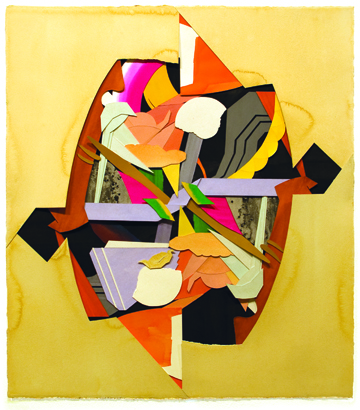
    Jim Gaylord, Folk Eye, 2013, gouache on cutout paper, 30½ x 28 inches courtesy of the artist and Gregory Lind Gallery


    News | Exhibitions