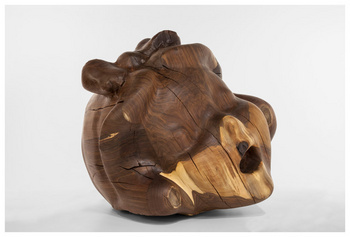
• White Snow, Cindy, 2012. Black Walnut, 114.3 x 129.5 x 129.5 cm / 45 x 51 x 51 in, Photo: Melissa Christy

    White Snow, Cindy, 2012. Black Walnut, 114.3 x 129.5 x 129.5 cm / 45 x 51 x 51 in, Photo: Melissa Christy

    Paul McCarthy unleashes debauchery and desire with extreme technical daring, charting a territory where our fundamental impulses collide with our most cherished myths and hypocritical societal norms.

    Paul McCarthy Sculptures
    Hauser & Wirth
    511 West 18th Street, NYC
    May 10 – June 1, 2013
    Opening: May 10, 6 – 8 pm
    hauserwirth.com

    Tom Shannon
    Employing hidden mechanisms, magnets, and motion in his sculptures, Tom Shannon explores the ways of the natural world. While underlining the fundamental conditions—gravity, weight, location, time—the works embody long study and share vast insight in a collection of deceptively simple motions.

    Tom Shannon: Nothing
    Show Room
    170 Suffolk Street
    May 9 – June 9
    Opening reception: May 9th, 6 – 8 PM
    showroom170.com

    Cristin_Tierney

    Concrete Remains examines Brazilian art of the 20th and 21st centuries, specifically Concrete art and Neoconcretism. Artworks by significant figures such as Amilcar de Castro and Hélio Oiticica will be juxtaposed with pieces by contemporary Brazilian artists. Participating artists:Geraldo de Barros, Sergio Camargo, Amilcar de Castro, Lygia Clark, Iran do Espirito Santo, Fernanda Gomes, Jac Leirner, Hélio Oiticica, and Daniel Steegmann Mangrané.

    Concrete Remains: Postwar and Contemporary Art from Brazil
    May 9 – June 22, 2013
    Cristin Tierney Gallery
    546 West 29th Street, NYC
    cristintierney.com

    1. Everything looks better in a tent. The natural light in that fair was amazing!

    2. Large NYC Galleries are still killing it, but smaller international galleries are holding their own by showing insightful and poetic work. (Which is often easier to ship and just as fun to look at.)

    3. Liam Gillick and Carl Andre can look really sharp together.

    4. Richard Aldrich is an artist that is highly unpredictable. We were pleasantly surprised by this quiet painting of forms meticulously adhered to canvas.

    5. Jack Early knows that everyone likes a good Beatles joke.

    6. James Nares’ road paint works really bring the heat, commanding attention with their bold contrast and recognizably durable materials.

    7. Dan Colen’s work is often as fashionable as it is art historically clever.

    8. We’ve always loved Linda Benglis’ panache, and her work for being beautiful – but didn’t see her sculpture as dangerous until some little kid crawled under her piece.

    9. Imi Knoebel’s intimate paintings don’t get enough credit for their stunning use of color.

    10. Tom Friedman’s work really summed it all up; fun, large, tempting, and ultimately impossible to fully digest. (Yeah, everyone else took this picture too, we know.)

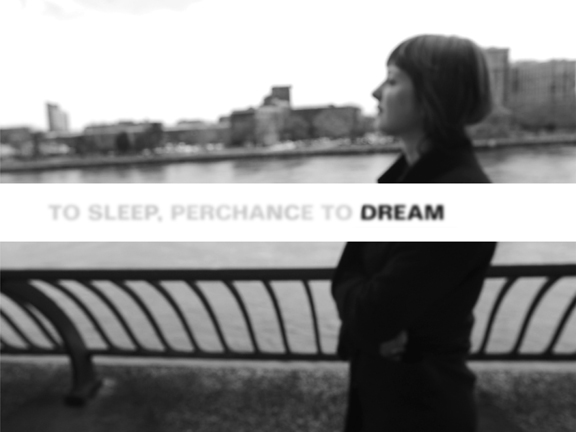
    Anita Sto_optThursday, May 23rd, 2013 independent curators Anita Sto and Giorgio Savona will present TO SLEEP, PERCHANCE TO DREAM, a preview of a work in progress by conceptual multimedia artist, Anita Sto and Professional Photographer Giorgio Savona.

    The exhibition will be held at Broadway Gallery, 473 Broadway, 7th Floor, New York, NY 10013.

    TO SLEEP, PERCHANCE TO DREAM, is a work based on the idea of Giorgio Savona. This event at Broadway Gallery would be the preview of theirs work on suicide. Savona and Sto’s project consists in representing five forms of suicide: Seppuku, hanging, drowning, poisoning and wrist cutting. The intention of their piece is to capture the intimate emotions and solitude within which one might be overwhelmed to the point  that they decide to interrupt life.

    Suicide and is a form of expression to communicate a message. One who commits a suicide is nothing more than the director of a play in which there are an actor and a stage. The body is the actor, the stage is the place. The decisions are final in many of these cases; in so far as death is the lowest common denominator.

    There are various suicide methods (romantic, exhibitionist, apathetic, ideological), each one hides its own message (guilt, revenge, blackmail, disappointment…) The body –– even the dead body, is the element which confers life to this message.

    Suicide methods can be classified according to two modes of interrupting one’s life processes: physical or chemical. Chemical methods of suicide produce latent evidence of action, whereas physical methods provide direct evidence –– body and stage carry the message.

    “This work is all about Life and Passion”.

    For more information contact:
    Anita Sto: mail@anitasto.com
    www.anitasto.com
    Giorgio Savona: giorgeone@gmail.com
    www.giorgiosavona.com


    It’s pretty rare to have the opportunity to see the work of a living legend. There are very few artists who ever achieve this status, standing head and shoulders above the rest of us. If the measure of influence is equated to height, Ellworth Kelly is way up there. Turning 90 this year, this art titan is ripe for some celebration and seems poised to receive it; his work is scheduled to be exhibited in a series of museum-quality shows to ring in his ninetieth year.

    The first of these exhibitions has just opened in three of the Matthew Marks spaces in Chelsea. Kelly’s recent works on joined panel, canvas, and aluminum can be viewed at 522 and 502 West 22nd Street as well as in another Matthew Marks location at 523 West 24th.

    In his signature style of bold layers of oil on lively spatially referential works, Kelly is now squeezing more out of low relief as he joins colored panels to white supports in a carefully considered series of compositions. The binding of panel onto panel highlights the light and shadow created by the physicality of the form and adds a nuanced layer to the way his paintings operate in space. Most readily available in his works of white on white, subtle shifts of shadow lines move ever so slightly, emphasizing the floating nature of the forms and adding a welcome levity to the work.

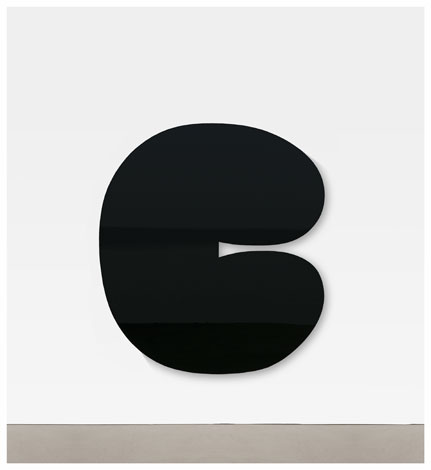
    Black Form II, 2011. courtesy of Matthew Marks Gallery

    Black Form II, 2011. courtesy of Matthew Marks Gallery

    Always one to be precise, Kelly is calculated in the way he adds elements to his work  in his later years, exhibiting a work for the first time here that features metallic paint. The painted forms alternate between serious feeling hard-edged abstractions to more whimsical shapes such as a chubby letter “c” in the work Black Form II. This construction of more reflective luster pigment on aluminum is essentially a circular form with a carved intrusion that cuts in from the right of the piece. The opening acts as a counterpoint to the heaviness of the black form, allowing for play between light and shadow to activate the hollow space that extends into the center of the work.

    The gallery on West 24th street houses a lyrical series of Kelly’s works titled Curves on White (Four Panels). Joining brightly colored half circular panels onto white rectangular supports, the series is set into space so that the viewer can dance her eyes across the forms, completing a visual sentence in tracing scale and proportion shifts between the separate paintings.

    Seemingly unbound by age, Kelly’s work continues to progress even in the twilight of his career. Having already cemented his status as a monumental figure of NY abstraction, it must feel great to have the freedom to breathe a bit, experimenting with new materials in a way that is distinctly his own. This show is a fitting launch to what promises to be a landmark year for one of our most celebrated abstractionists. Eight different museums are set to exhibit the artist’s work throughout 2013, and we think it would be foolish to skip even one.

    By Matthew Hassell

    Ellsworth Kelly At Ninety , May 11 – June 29, 2013


    Ah, art fair season. What’s not to love, right?

    Sometimes art fairs take your money, pour an unbelievable amount of closely-hung work into your brain via your wandering eyeballs, and kick you in the ass as you exit. You are stuck on the sidewalk wondering whether you ever need to see a work of art in person again.

    Pulse is not that art fair.

    We were happy to visit last night and found it quite enjoyable. The following is a rundown of some of our favorite moments.

    Generally, the bottom floor was a bit more difficult to digest. Set traditionally in the art fair format of one gallery and many artists per booth, it took a minute to adjust to after entering. By the time we got to the second floor, the restriction of one artist per booth was a welcome change of pace. The quality of work between the two floors was a pretty evenly split.

    Charles Hinman courtesy of Marc Straus Gallery

    Charles Hinman courtesy of Marc Straus Gallery

    Charles Hinman of Marc Straus Gallery (NYC) is making brightly painted gem-like constructions of armatures covered in stretched canvas. The planes of the wall-based work are selectively painted to utilize the contrast between vibrant and more subtle color shifts of paint. Hinman makes lovely use of the light and shadow created by the form’s relationship to selective gallery lighting. He also paints some reverse facing planes of the work in radiant pigments, bouncing colored light off of the wall behind the constructions.

    Eric Cahan Courtesy of Eric Firestone Gallery

    Eric Cahan Courtesy of Eric Firestone Gallery

    Eric Cahan of Eric Firestone Gallery (East Hampton NY) is showing a vertically installed stack of images that at first come across as polychromatic pigment bleeds similar to Cory Archangel. On second inspection these are actually images of the sky at sunrise and sunset. Mounted on panel and covered in what appeared to be resin, the work is sickly sweet in it’s use of candy colors under surfaces which are slick and seductive, but at the same time make one wonder whether the images could possibly be altered. In the end, its just nice work and we don’t actually care to know.

    Pius Fox courtesy of Patrick Heide Contemporary Art

    Pius Fox courtesy of Patrick Heide Contemporary Art

    Patrick Heide Contemporary Art (London) had a booth with a nice variety of different work. The most compelling of which was a series of paintings by Pius Fox, a young German painter. His intimate works are of paint on a canvas-paper like material applied to panel. All around the size of printer paper or smaller, these works use paint applied many different ways in beautifully muted tones. They play between painterly passages and tightly controlled geometries that reference recognizable internal spaces. Fox’s compositions here utilize a broken frame of color around the boarder, which serves to suggest looking into a fragmented space through a window or a door.

    Image courtesy of David E. Peterson and Krause Gallery

    Image courtesy of David E. Peterson and Krause Gallery

    David E. Peterson, showing with Krause Gallery (NYC) is making paintings and wall-based constructions that both utilize and actualize hard-edged geometric abstraction. His resin covered acrylic works on MDF are carefully composed abstractions, of high contrast of hues sunken into sexy high gloss resin environments. From intimate to quite large in scale, Peterson has a knack for making attractive wall based work that dances between painting and object. Their formal compositions allude to space while their reflective exteriors seem to keep the viewer out, creating a divide that is tempting to cross.

    Two single work standouts in the show served to blow the art hung around them out of the water. The first was a one-of-a-kind tondo construction by Frank Stella. Showing in the booth of Zemack Contemporary (Tel Aviv) this work was something to behold not just because of its singular status, but because it was executed in typical vibrant Stella colors embedded in a support of formed paper and fiberglass.

    Frank Gerritz Courtesy of Pablo's Birthday

    Frank Gerritz Courtesy of Pablo’s Birthday

    The other object that left us wanting more was a work by Frank Gerritz shown by Pablo’s Birthday (NYC). A painter of many talents, one body of Gerritz’s work is reductive abstraction that appear to be black oil on aluminum. Inspection of the edges reveals that Gerritz is actually filling channels cut in the metal support with oil stick gestures amassed so that they evenly fill the empty space. Simplicity of form here disguises what must have been a brainy process to conceive.

    The art that made a real impression on us was all carefully composed abstraction and experimentation with material, but maybe that’s due to personal taste. Pulse truly has something for everyone and is a fair that is curated so as to resist overwhelming the viewer. If you skip all the rest, we suggest you still consider Pulse. Go take the chance. This is one that won’t disappoint.

    Wish Meme is an art fair for those who want something fresh and different. Put on by The They Co. in collaboration with the New Museum and a whole slew of great curators, its a welcome change. Enough words though, here’s a recap featuring photos snapped by our photographer, Anna Carnochan. Feast your eyes.

    One of the most elegant and thought-provoking exhibitions this year is Maya Lin’s Here and There.

    Lin became the center of controversy in 1981 when she won the competition to design the Vietnam Veterans Memorial. Still a student, and virtually unknown, her design was chosen from over 1,400 submissions.  I remember seeing an exhibit of many of those entries and being astonished at the judges’ insightful choice of a delicate series of small color pencil drawings over the extensive technical plans and sculptured memorial models surrounding them. Lin’s clear vision was to create a “v” shape cut in the earth of dark granite with the names of those lost listed by the years they had fallen. It is a quiet and powerful timeline of the ravages of war. Originally derided by many veterans, business leaders and politicians, a more customary sculpture of uniformed soldiers was added nearby. But it is the stark, haunting memorial itself that became the site of grief and healing that the nation needed.

    Since then Lin has created environments, architecture, and sculptures throughout the world. She is visually eloquent about a variety of subjects but none more so than environmental issues. These are often meditations on geography and topography. She is brilliant in her depiction of elements that represent the transformations of the passing of time. Her work is both cerebral yet profoundly recognizable and always deeply moving.

    Image courtesy of Pace Gallery

    Image courtesy of Pace Gallery

    In 2006 Lin started making studies of all of the world’s major rivers. These large sculptures penetrate the gallery’s walls with aerial views. Using recycled silver and steel pins she has turned flowing water into abstract shapes of cool, silvery light.

    The Pin River series is particularly ethereal. The images are created, not only with the vertical shafts and dotted heads of the thousands of pins themselves, but by the translucent shadows extending their space, dependant and changing by the surrounding source of light, like the earth itself.

    On the floor area you will find dense sculptures of longitudinal and latitudinal sections of the meridian that passes through Manhattan. Their weight is in stark contrast to the delicacy of the River series. Beginning with drawings informed from computer analysis to track the terrain of the ocean floor, models were created and translated into marble.

    “It’s a process that balances scientific data with the handmade.” says Lin. If the end form looks only like the idea of the information, then it fails. It has to become its own form – evocative, beautiful, strange.  I start with extremely complex scientific data points and then, through a visual editing process, I find the scale and simplicity of the form – revealing a landscape both visually discernible and compelling.”

    In a separate room we are enveloped by videos, music and text from her “What is Missing” project and website, a poetic and meticulously researched consideration of earth’s vanishing forests, waterways and animals. The effect we’ve had on our environment and the fury of time’s passing are the subject of this multi-dimensional project. Viewers are encouraged to add their own memories of lost habitats or species to the site. Started more than 20 years ago, and added to continually, installations of the project will continue to be exhibited worldwide. Lin says this all-encompassing project will be her final memorial.

    By A. Bascove

    whatismissing.net/#/home

    April 26th through June 22nd, 2013     Pace, 32 E 57th Street     New York, NY, 10022

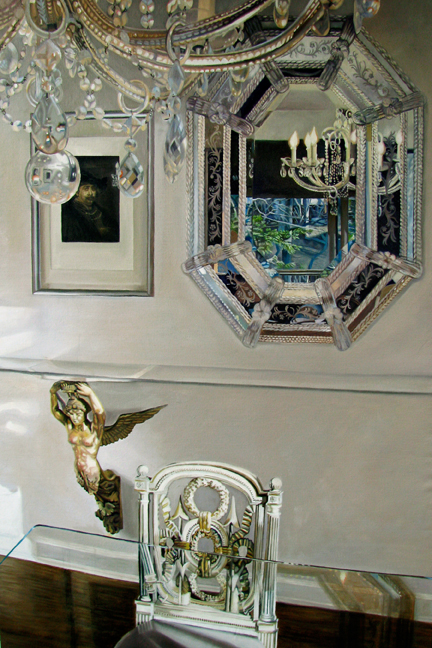
    Clarity, 2009, 58 x 42 inches, oil on canvas

    Clarity, 2009, 58 x 42 inches, oil on canvas

    Being an artist is all about vulnerability. Some artists are pretty afraid of this, creating a product that feels very closed-off and protected from the prying eyes of their viewers. Becky Franco is not one of these artists.

    Her large realist works on canvas are now on view through May 18th at SOHO20 Gallery in Chelsea.

    Franco puts herself right out there, finding a connection with the viewer by exposing them to the most intimate moments of her own life. Her work displays the most intimate corners of her domestic life, chandeliers, mirrors, tables, and chairs all peer back towards the viewer. Titled Chosen, the show posits the idea that these objects are actually the ones that chose us, and not the other way around. They make one reflect on who they are as we contemplate our relationship to these objects that are common signifiers of a certain level of comfort and affluence.

    As stated by the artist in a recent statement,

    “My interiors are concept driven and  at first sight seem clichéd, passé and give a conventional appearance, but on second inspection possess emotional and cultural tension. The objects subsist together in ‘space’ and start to stare back at us, becoming somewhat unsettling to the viewer, once we adapt to the incongruity one welcomes the unusual viewpoint.”

    Franco’s chops as a painter are on vivid display, so much so that the engaging concepts her work is loaded with come to the forefront secondarily. Once they hit you though, their grip is unavoidable. Its an engaging show that is worth repeated visits. Go see it before it’s too late.


    By Matthew Hassell

    News | Exhibitions