• While other fine arts venues continue to exploit the unwashed and uneducated, Blain-DiDonna Gallery continues to offer opportunities to re-examine artists whose work reinterprets our notions of the nature of artistic expression, while at the same time preserving their integrity and mystery. Following their stimulating Hans Arp show comes the enigma of Paul Delvaux, whose painterly gaze extends into imaginative mindscapes.

    Delvaux lived for nearly a century. More an orphan from than a practitioner of the Surrealist agenda, the artist had been given a comfortable childhood and a classical education, but had no enthusiasm for the law career his father desired of him. After World War I, having briefly studied drawing for a possible architect career, he appears to have been seduced by the sensuality of art, and took to painting. At first, he worked on conventional landscapes of no particular significance. Later he mastered the skills that would characterize his most mature work.

    He was blessed with the luxury of being able to travel at will, and this provided the source of his haunting imagery. In 1934, Delvaux entered the Walloon village of Spy, where he harvested the fruit for his fertile dreamstates in obscurity and solitude. From then on, each work was a ticket he gave to the viewer, enabling their journey through his hallucinatory landscapes.

    These sojourns take us through the mind of the artist, a psychic universe inhabited most predominantly by naked women. By 1946, some of renderings of these curvaceous females were labeled obscene after being exposed at the Julien Levy gallery in New York.

    Perhaps it is the tuffets of body hair or the vain disengagement of their gaze, but these nudes have a silent agenda that the viewer must decode. The foreground tears apart one’s focus from the architectonics carefully placing the formal elements in perspective. While his attention to detail was extraordinary, his palette was quite limited to mauves, lavenders, burnt sienna, and deathly pallid flesh tones. Deep rose, deep crimson, and violet predominate the oils. Grays and purples define the tone of his print work. These Lenten hues suggest the women are not “nude” objects, but rather, naked penitents existentially vulnerable and awaiting their judgment in the halfway house between heaven and hell. They are babes in limbo.

    One might consider that his obsession with women was a kind of prison from which he was powerless to escape, except within the confines of the canvas, and later the mural. In his life, women were powerful figures. Yet, he is seemingly an incurable romantic, allowing us to delve ever deeper into his erotic neurosis. He takes a slight detour from this endless fleshy trek in 1949. This is when he populated his canvases with the iconography of medical skeletons, often thrusting them into biblical tableaux. Curiously, these paintings when shown in the 1954-56 Venice Biennial resulted in the Patriarch of Venice (future Pope John 23rd) to label the works as heretical.

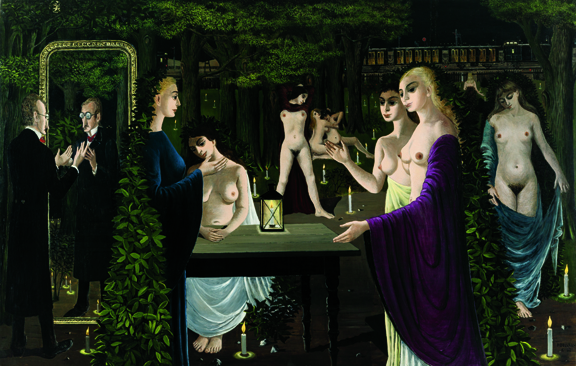
    Paul Delvaux, Le Sabbat, Oil on canvas, 160 by 260 cm, 1962, Private Collectionry

    Paul Delvaux, Le Sabbat, 1962. Oil on canvas, 160 by 260 cm, Private Collection.

    This voyage, pregnant with overt symbolism and trite voyeurism, spectacularly male-oriented, includes a formative detour in 1951 when Delvaux, reunited with his forbidden love, Tam, (Ann-Marie de Martelaere) built a cottage. It was in the style of a fishing cottage in the dunes of Saint-Idesbald and, in 1952 they were married after he and Magritte were exhibited in the Casino at Knikke-le-Zoute. His new work included murals and large frescos increasingly using icons of urbanity like trains, streetcars, stations. These elements were placed alongside Grecian balustrades within murky forests inhabited by nocturnal beings.

    In Le Sabbat of 1962, Delvaux indulges in an almost divine serenity. Like an Ingres on acid, this work moves deeper into psychic space. His more complex storytelling tableaus render the unconscious accessible wherein daylight and moonlight devolve. Le Sabbat comments on Georges de la Tour’s candlelit portraits while moving toward the cartoonish simplicity of Medieval fresco. The gaze is the passive lover’s gaze, submissive, resigned, dutiful, yet a distant. Draped in temptation, it is dangerous and perhaps, lethal.

    Delvaux never leaves these cubicles of impending seduction and anticipatory pleasure. Everything exudes that which is forbidden, and when his mother makes him promise to abandon the love of his life, he spends a good portion of his time re-creating painterly landscapes of desire and passion deferred. In retrospect, perhaps this had always been the essence of his vision.

    NY Arts recently got in touch with two writer/poets and art theorists Amir Parsa and Ammiel Alcalay. In a fascinating roundtable, the two discuss world literature, interactions between art and literature, the Lebanese poet Nadia Tueni, and the nature of formal innovation.

    Amir Parsa: Ammiel Alcalay, two of your books have just been published. If I could read only one, which one would you recommend? And if both, which should I go with first?
    Ammiel Alcalay: I would say: find more time to read! I think all my books circle back on each other, turning the prism to other facets each time around. Both books were long in the making, but very differently composed. from the warring factions is a book length poem that occupied me from 1992 to 2001. It involved an ongoing engagement with and gathering of historical materials dealing with the Gulf War, the war in ex-Yugoslavia, the massacre of some 7,000 Muslim men and boys in the town of Srebrenica, the Cold War, Native America, the Roman Empire, and all kinds of other things. a little history includes materials of mine dating from the 1970s but is centered around three public lectures, now turned into texts, concentrating on the poet Charles Olson in the context of the Cold War, but a Cold War situated in present U.S. policy, particularly regarding the so-called Middle East. The structure is somewhat unique and, I hope, will provide a very new framework for how we might think about the thought and investigative research work of poets in the larger political, historical, and cultural context.

    AP: Both are inventive and stylistically surprising. The collage-like aesthetic that is at play also works. Risky, but I’m appreciative of the risks you have taken. The aesthetic position is also in tune with the content and the modality that you felt you need to explore it in, or rather, write it in. These are very “writerly” performances.
    AA: I remember very clearly the blue paperback, Women of the Fertile Crescent, edited by Kamal Boullata, that came out from Three Continents Press in 1978, the only American press then publishing work translated from Arabic; it was where I first encountered Nadia Tueni and other Arab women poets that most people still haven’t heard of. I remember Tueni’s poetry vividly, and the photograph of her. I only realize now, as I bring this up, that I also used photographs of writers in my anthology, Keys to the Garden, because I wanted to prove that these people actually existed. Now, 35 years later, your translation of Nadia Tueni’s French poetry is appearing with the same press involved in publishing two books of mine: tell me about the circumstances of your encounter with Tueni, how she came to exist for you.

    AP: I went to French schools all my life, both in Iran and in the U.S. I had a lot of Francophone Lebanese friends, so there is a bit of an emotional connection. Also, every translational act, for me, is both a writerly engagement and a social and cultural intervention. I have recently been interested in translating (and I use that word with much trepidation) writings that are at the borders, but powerful and emotional, and also where my own relationships with both the target language and culture and the source language and culture are transformed. The choices of the texts, the stylistic strategies you adopt, along with many other decisions that go into the endeavor, to me, are important elements of any translatory project, which is, again, both a literary contribution and an activistic cultural intervention. Translating a woman writer’s first books, one from the Francophone world operating at the periphery, was not an occasion I wanted to pass up. You are a translator too and a student of translation history and theory. How does this connect to your other writings?
    AA: I also grew up in a multi-lingual environment, since my parents and the extended family had been Second World War immigrant/refugees. So I’d been translating since I was born; it’s only when distinctly, different languages are involved that it becomes apparent. In that sense, I see translation the way a dancer might think of joints or muscles, the way a painter might think of their palette, the way a musician thinks of notes: words, the essential material of writing.

    AP: I also use it as a method for writing, and a times, as a verification process for my own literary work: in order to write using the unique features and registers of any one language, making sure a text is fundamentally untranslatable (as a complex ensemble) is one way of checking my own work!
    AA: I was struck by your piece “The General on the Roof”, though I’ve never seen it performed. One passage in particular, the invocation of the date: “On February 15, 1979, where were you,” reminds me of the first poem in from the warring factions where a date, almost in the form of a riddle, is invoked. In both cases, I think, the reader is challenged to account for themselves and their relationship to these dates. I was also struck by the stage directions, all taking place around and under the Brooklyn Bridge.

    AP: “The General on the Roof” was a performative scriptage, a writing-in-motion, and all about the lack of interest of the ‘passerby’ in the terrible tragedies lived by others. We had ten ‘textspots’, that is, ten spots around the Brooklyn Bridge where perfomers were reading different fragments, structurally speaking, of a story. The whole point was to explore the unlistenability, untellability of an event related to the revolution. In the midst of the crowd, the frenzy, shouting voices, troubled voices, unheard… With your work too, looking at and reading from the warring factions, I can’t help but notice the play with various aspects of the visuality and aurality of language itself (letters, word lengths etc…), but maybe more importantly even, of parameters of the book and of the reading experience: the page, its materiality… I was struck by that because I also constantly ‘perform writing’ and perform the various modalities of reading…
    AA: Thanks for paying attention to that! Yes, absolutely. I’m not sure if it’s “visual” in the traditional sense of that term but perhaps more spatially and temporally oriented. The book, then, the page, also needs to be a score for its reading, and that reading takes place, most definitively, in time. I would also say that I’ve ‘seen’ a few of my books before they were written—certainly the spatial formations of from the warring factions are something I clearly envisioned. I don’t think I’m under the tyranny of this rule but the big prose blocks that have been in my imaginative sightlines the past couple of years may signal a need to move differently.

    AP: Very interesting. I also ‘see’ the book, the page, the passage of one block of text to another. The beginning, the end, various flows…
    AA: At various times in history, it was normal to write in different languages for different purposes and/or different audiences. Outside of colonial situations in the nation/state era, languages have generally stood in for or been used in opposition to an implicitly nationalist conception. Your multi-lingualism is quite exceptional in that you haven’t fetishized opposition, hybridity, marginality, exile, and so many of the other now fashionable categories: you simply operate in and across a broad range of linguistic materials and languages. How do you account for this? Are you striving towards some new definitions or categories or do you see this as a simple outgrowth of the direction you’ve chosen to pursue your own circumstances?

    AP: I’d say both: a resolute decision to continue in a direction that I think is innovative at the formal, stylistic, and linguistic levels, and also at the discursive level—but also because yes, I do want to create new categories and new definitions. I do think it is crucial to create new genres and new forms that use many of the tools and possibilities at our disposal. Literature is made of language, the stuff of language, the material of language, and thus, multilinguality can help us venture into territories without names, the most exciting spaces of course: new forms, new worlds. My new unfolding epic is a work that I consider a type of new world literature—I don’t mean ‘world literature’ as in literature from around the world, but one whose ‘space’ is not any one place or nation. And I hope I’ve gone pretty far in the whole multilingualism realm: writing entire works in different languages, and also creating works that are plurilingual— they unfold through different languages at the lexical, syntaxic level—and multilingual—where big blocks in one language juxtapose big blocks in others. I’ve even coined polylingual for works that involve both plurilingual and multilingual unfoldings. Rigorous theoretically, but also adventurous and liberating!
    AA: I think in many ways I may be striving for similar things but within one language, American English, a place I’m more and more immersed in. But I also think my work in other languages has let me dislodge in certain ways how I actually work: that is, it has allowed me to think of some of my own different work as taking place in different kinds of languages, and finding the links between those realms.

    AP: Ammiel, we started this with a rather silly question about your books by me. What’s the question you like least when people talk to you about your books? What’s your favorite?
    AA: Having taught for so long now, I would like to think that all questions are good, as long as they’re really questions. I can’t really put my finger on a question I like least. I always try to respond to where I think the question is coming from. And my favorite questions are those that I’ve never been asked!

    AP: I’ll say that one my least favorite is the one I think can undermine literature and that is: ‘What’s you book about?’ That assumes a certain relationship between literary form/language and the world. The more desirable questions are: ‘What happens when one reads you book.’ Or ‘What’s the experience like when one engages with your book?’ I know, probably won’t catch on, but the fairer questions they are… I’ll say this though since this is an art publication: for my and your painter friends who are heard complaining on occasion, at least no one ever asks them what their painting is about.

    Image courtesy of the artist

    Image courtesy of the artist

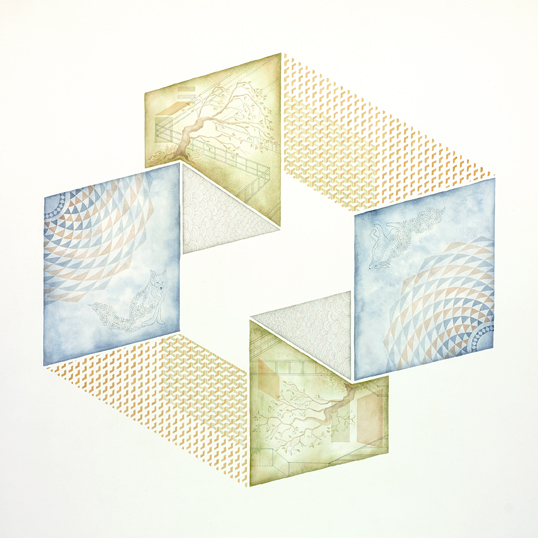
    Through my work, I explore the duality and the unity of physical and metaphysical worlds. I make an inquiry into the meaning of our existence from different perspectives including animist beliefs, religion, spirituality, and science.

    I incorporate images inspired by religious architecture, animal totems, landscapes, scientific illustrations, and geometric shapes; through which I aim to represent the metaphysical.

    The concept of Sacred geometry is based on the notion that geometric shapes and patterns are the fundamental principles of all manifestations. By harmoniously combining geometry with representational drawings, I investigate the idea of the cosmos, interconnectedness, and order in nature.

    yuriaokamura.com

    Image courtesy of the artist.

    Image courtesy of the artist.

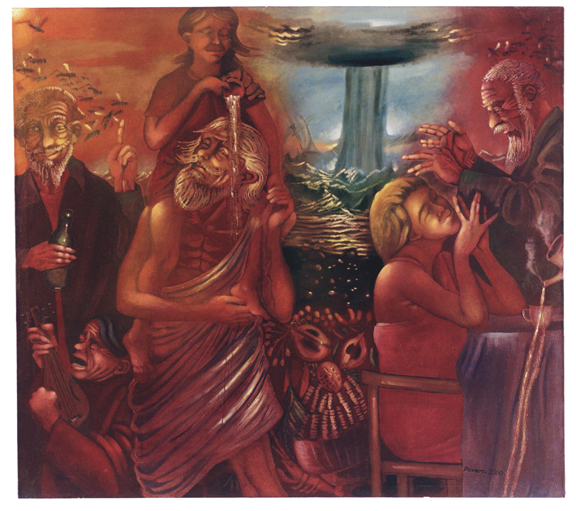
    I think that from the very beginning of my painting I was interested in people, in all of them milling around. I liked looking into their faces, trying to read them like in the books I’ve always loved.

    It’s just like one poet and journalist wrote about me and my work – I’m a painter of big canvases – a figuralist, who in today’s rushed world seeks for his audience moments of standstill and rest, dreaming away. A painter loving baroque mysticism, surrealism, a dream, a contemplation; giving the people in my paintings the roles of prophets in today’s world.

    Image courtesy of the artist

    Image courtesy of the artist

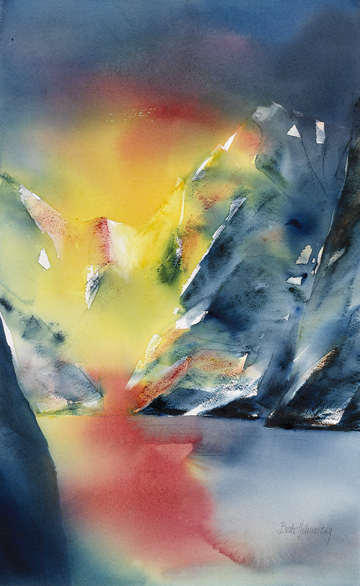
    My watercolor paintings are a combination of floating pigments and strict, more solid elements. The light atmosphere this creates exposes my mindset of the changing light in the landscape of the Lofoten Islands in Norway, where I was born and grew up.

    In wintertime there is almost no daylight, But the light that is left creates a mysterious mood with an orange, red color.
    Quite opposite from during the short and hectic summer when the sun never sets, and the small villages are living day and night. The light and colors are overwhelming. My paintings are based on these natural contrasts.

    bentehelmersen.no

    Vessels: Nicole Cherubini, Francesca DiMattio, Brie Ruais, Beverly Semmes, and Betty Woodman.

    The Horticultural Society of New York – a growing community of urban gardeners who strive to maintain the relationship of plants and people – gives hospitality to an exciting group exhibition of contemporary ceramic sculptures by five New York-based female artists: Nicole Cherubini, Francesca DiMattio, Brie Ruais, Beverly Semmes, and Betty Woodman. The ceramic sculptures in Vessels pull influences from traditional ceramic objects such as storage vessels, pots, and vases, but use the capabilities of clay to challenge form and surface, allowing viewers to ponder further than the basic ideas of traditional ceramic objects. Through pattern and color, the gap between a two-dimensional and three-dimensional presence is lessened, and the mark of the artists’ hands in the clay creates sensitive surfaces that allow viewers to see the artist within the vessel. From figurative forms to historical allusions, these five artists both break down and complicate the ideas of function, feminine form, antiquity, and decoration. Have an experience outside the standard gallery setting, go see Vessels at The Hort while surrounded by plant life.

    The Horticultural Society of New York
    148 West 37th St, 13th Floor
    New York, NY 10018
    May 7 through July 3, 2013
    thehort.org

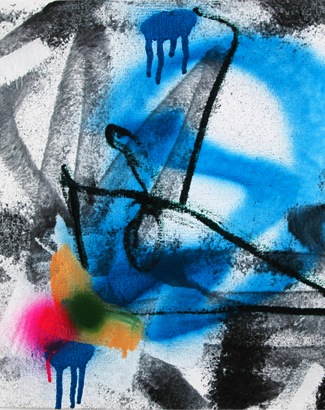
    Ocean Greatness (for J.P.) 14"X16" oil, alkyd, spray paint on canvas, 2012 Photo: Brian Morris Gallery

    Ocean Greatness (for J.P.) 14″X16″ oil, alkyd, spray paint on canvas, 2012.
    Photo: Brian Morris Gallery

    Genius of Love, curated by Jason Stopa, brings together a group of contemporary painters. Many of these works, both abstract and figurative, relish in hybrid painting techniques. Using varying approaches, the works allude to painting as love. Genius of Love includes Rick Briggs, Jaqueline Cedar, Farrell Brickhouse, Shara Hughes, EJ Hauser, Emily Noelle Lambert and Andrea Belag.

    The opening reception is Thursday, May 23rd from 6:00 – 8:00 PM.

    Brian Morris Gallery
    163 Chrystie Street
    New York, NY 10002
    May 23 through June 23, 2013
    brianmorrisgallery.com

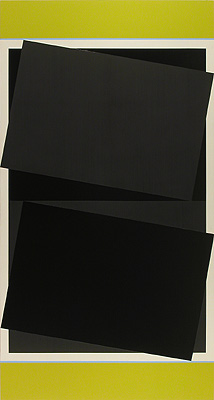
    Tumble, 2011-12 Oil on wood panel 60 x 32 inches Photo: McKenzie Fine Art

    Tumble, 2011-12
    Oil on wood panel
    60 x 32 inches
    Photo: McKenzie Fine Art

    McKenzie Fine Art presents work by Don Voisine, best known for his hard-edged oil abstractions on wood panels. The compositions are muscular and elegant with rich surfaces, nuanced black tones varying from piece to piece. Working within a characteristically narrow structure of compositional elements, Voisine is able to squeeze an unbelievable amount of mileage out of such a restricted formal vocabulary. Voisine explores the relationship of surface and tableau through overlapping geometric the fields of black, situating high-gloss blacks which reflect local color with more dull luster passages alluding to deeper space. The work is quite remarkable and only able to be fully grasped in person, so swing by Mackenzie Fine Art and take a peek for yourself.

    McKenzie Fine Art
    55 Orchard Street
    New York, NY 10002
    May 3 through June 9, 2013
    mckenziefineart.com

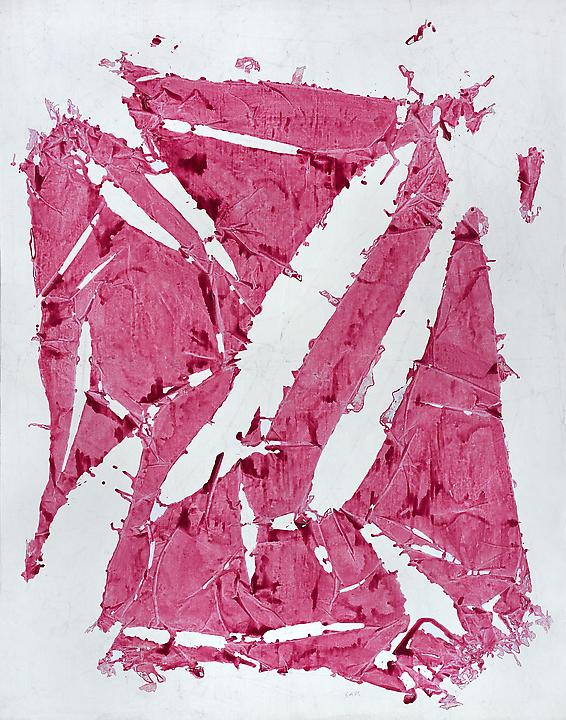
    Tabula, 1981 60 5/8 x 48 inches Photo: Paul Kasmin Gallery

    Tabula, 1981
    60 5/8 x 48 inches
    Photo: Paul Kasmin Gallery

    Paul Kasmin Gallery presents never before seen works by Hungarian-born artist Simon Hantai. Hantai’s work can be distinguished by his signature technique “pillage,” or folded, tied, and dyed un-stretched canvas. His work  interplays between positive and negative space, resulting in both geometric and botanical patterns. A massive figure in Europe, his work deserves more recognition here in America. Go see this show.

    Simon Hantai
    Paul Kasmin Gallery
    515 W 27th St
    New York, NY 10001
    May 8 through June 22, 2013
    paulkasmingallery.com

    Nightfall / Alkony New tendencies in figurative painting
    Galerie Rudolfinum, Prague, Czech Republic, March 29 – May 24, 2013
    MODEM, Debrecen, Hungary October 7, 2012 – February 10, 2013

    Mankind has always been fascinated by darkness. In the beginning as the Bible says, “darkness covered the face of the deep” and since then looking into the abyss is part of human history. We associate the unknown with darkness and surely darkness will accompany our end. Why do we love dark visions such as the end of the world? Why is shivering with fear so appealing to our fantasies? Why do we always go for the worst possible scenario?

    The answers to these questions might be very different if the show was in North America. In Europe, generations of people have suffered greatly and struggled just to survive. Memories fill their minds and bodies as much as blood and bones do. The fall of communism didn’t bring the positive changes Europeans expected — and even brought the opposite for Central and Eastern Europe. Materialism replaced morality and little hope was left for the individual. That’s why it is not surprising that all of the pieces in this show are dark and depressing.

    The word Nightfall, the title of the show, suggests threatening shadows, foreboding, and anxiety about the end of an era and an uncertain future. The original idea came from Isaac Asimov’s science fiction short story of the same name (1941) about the coming of darkness to the people of a planet ordinarily illuminated at all times on all sides. As the catalogue’s foreword states, quoting William Orville Douglas, “As nightfall does not come at once, neither does oppression. In both instances, there’s a twilight where everything remains seemingly unchanged, and it is in such twilight that we must be aware of change in the air, however slight, lest we become unwitting victims of the darkness.”

    Most of the exhibiting artists were born during the Cold War, so being alert to lurking political, ideological or even physical danger is second nature to them. The fall of the Berlin Wall in 1989 and the euphoric feelings of freedom that followed made the 1990’s a big, happy party in Europe. Shadows of social and intellectual disillusionment started to creep in by the end of the decade and the new millennium brought 9/11, wars against terrorism and natural catastrophes like tsunamis and famines. The party was over and the “New Dark Age” came in with depression and economic instability in the European Union.

    MODEM organized this very impressive and expensive show – works were coming from all over the globe with sky rocketing amounts for insurance and shipping – in order to put Hungary on the map of the contemporary art world. The show fulfilled all the artistic expectations and became one of the most exciting and complex exhibitions of 2013.

    British curator Jane Neal grouped the paintings around five themes: Broken Landscape and Twisted Beauty; Portraiture; Struggle for Identity and the Hidden; Under Cover of Darkness; Painting and Cinema and Home but not Safe. Sometimes it is almost impossible to distinguish between the categories since portrait, identity, and home are often overlapping themes and a cinematic approach can accompany any style.

    Swedish artist Karin Mamma Andersson’s paintings are good examples covering more than one theme. In Night Guest an electric storm is brewing with monster-shaped clouds overhanging a farmhouse and a small group of people. Will they be able to outrun the storm? It seems that they not even trying as they are involved in their talk. Maybe they don’t even recognize the approaching danger. Andersson creates tension by making the foreground look ‘normal’, an ordinary farmhouse, people walking toward it, nothing special. The sky seems to be a different world, not connected to the people. The light coming from it is heavy with the foreboding that something terrible is about to happen. The confrontation of the dark blues of the sky and the yellows of the ground is nerve racking. Neither the landscape nor the house is safe.

    Andersson’s other paintings in the show focus on home but don’t fare any better. In Coming Home the mother and child face a ruined place where only the gate remains, but rocks and mountains separate them from their home – peaceful and inviting but far out of reach. Hernan Bas, a Miami-born and Detroit-based artists’ work also takes place in the outdoors. His fall 2012 exhibition at Galerie Perrotin, Paris, Thirty-six Unknown Poets (or, decorative objects for the homosexual home) shows the influence of the literature and artistic culture at the end of the 19th century, as well as television and digital imaging. The acid hues and pixelated texture depicts young men in romantic poses so they remind us equally of images from Egon Schiele and British fairies. In The Hallucination of Poets, a pair of those fairies/poets are placed in a landscape that looks beautiful at first sight, until we recognize that all the trees are dead and painted with bright colors The two young men are mesmerized by this vision – real or imaginary – but at the same time they are also shocked and threatened by being trapped in this forest. The poets’ walk becomes a gothic vision that fills the forest with their hallucination but also emphasizes their loneliness in nature.

    German artist Martin Eder is also a photographer as you can easily recognize from his realistic paintings. The two young women in their sexy underwear in Fortress could be printed in a magazine if they didn’t look so sad and vulnerable. Their pose is almost provocative but the flesh on their legs is diseased, caused most likely by the strange atmosphere of the alien planet behind them. Where are they? Not on Earth but out somewhere in an unknown universe that is not friendly towards them. They seem to be lost and lonely. Eder said that he wants to depict the “whole disaster and monstrosity of our relationships.” The girls became victims of their trust in someone who put them in this miserable Fortress.

    Most of the Central and Eastern European artists comment on home and safety as what they lost and find hard to replace. Serban Savu paints the Romanian urban cityscape and its ugly, grey, concrete buildings occupied by people forced to move there from their villages. They surround the buildings with small gardens, a nostalgic attempt to keep their identity. In a similar landscape Marius Bercea makes abandoned buildings look bearable by painting them with beautiful colors. David Schnells’ landscapes cry out for some stabilization. In Bay, they depict an abstracted version of the cityscape and the surrounding nature in a state of explosion. We are further confused by several vanishing points that make our heads spin and give us a feeling of disorientation, presumably caused by the coming disaster.

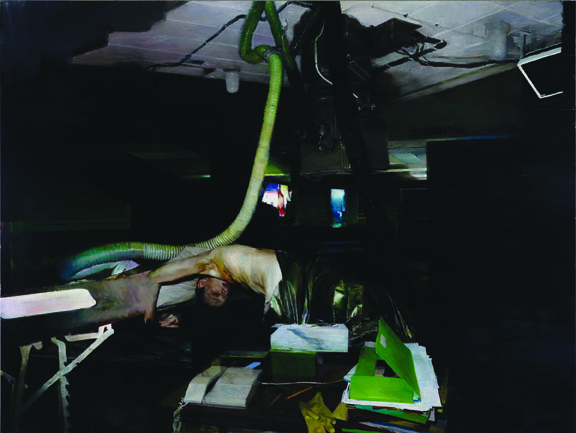
    Justin Mortimer, Bureau, 2011. Oil on canvas, 184 x 224 cm. AmC Collezione Coppola, Italy. Photo Anna Anca.

    Justin Mortimer, Bureau, 2011. Oil on canvas, 184 x 224 cm. AmC Collezione Coppola, Italy. Photo Anna Anca.

    Justin Mortimer’s paintings are outstanding with their cruel beauty and virtuous figurative style. Mortimer uses bruised colors to paint scenes of isolation, decay and collapse. They record ghastly events in seemingly abandoned buildings and grand narratives of modern violence. The exquisitely painted figures and objects are held in one area of the composition and emphasized by the vast amount of dark empty space. Mortimer’s stories engage us with untold horrors and brutality in a manner that forces us out of our comfort zone. His paintings are loaded with ambiguities and he is careful not to tell us the whole story. Born with a twisted tibia the artist had to go through many operations and hospital visits. His work draws on his vivid memories and nightmares of that time. The man in Bureau is in physical and psychological distress, surrounded by medical apparatus. The ‘office’ is represented by a desk, a phone, and a beautifully painted green folder. Behind it there is another, very different world. A half-naked man tries to hold onto a hospital gurney while large air-tubes are released from a broken ceiling. What does his strange swimming movement mean? Is he trying to escape from the room or find safety within it? What kind of monster is lurking in this maze and confusing him? It seems that he doesn’t really know where he is, only that he is lost and alienated in this place. Like Mortimer’s other protagonists, he is a prisoner of his surroundings as well as his own body.

    Chantal Joffe with her single figures creates a hybrid representation of feminine identity. The women are posing in generic positions but it is the paint itself rather than socio-political ideas that gives her paintings complexity. Her splashy brushstrokes and dripping paint give us the feeling that her models are crying. The Hungarian Attila Szücs surrounds his figures with empty space and strange otherworldly light. He tries to “dissolve the already defined and often false structures, and introduce new types of looking” to show unseen auras and “kinetic” fields.

    There are a lot of sad, even tragic, portraits in the show. Victor Man paints two men who are trying to bury their faces in snow. Mircea Sucin’s figure is covering his face with his hands in Human Stain. In Alexander Tinei’s Family everyone’s eyes are covered with some unknown material making them look like criminals, and indeed the standing boy seems to be trying to choke the seated one. Daniel Pitin’s Little Horse is falling apart. The horseman is wounded and faceless but still poses as a hero.

    If there was ever any doubt about figurative painting in the last 30 years, then this show is proof of its resurrection. These artists make a heroic effort to find the answers to the question: Can we face the world and ourselves in it? As the poet David Whyte asks in Self-Portrait, “if you know / how to melt into that fierce heat of living / falling forward / the center of your longing. I want to know / if you are willing / to live, day by day, with the consequence of love / and the bitter / unwanted passion of your sure defeat.” The artists in this show seem to find a solution to this cruel dilemma by escaping into the present, facing their fears and embracing the darkness.

    Nightfall / Alkony New tendencies in figurative painting
    Galerie Rudolfinum, Prague, Czech Republic, March 29 – May 24, 2013
    MODEM, Debrecen, Hungary October 7, 2012 – February 10, 2013

    News | Exhibitions