• Image courtesy of the artist

    Image courtesy of the artist

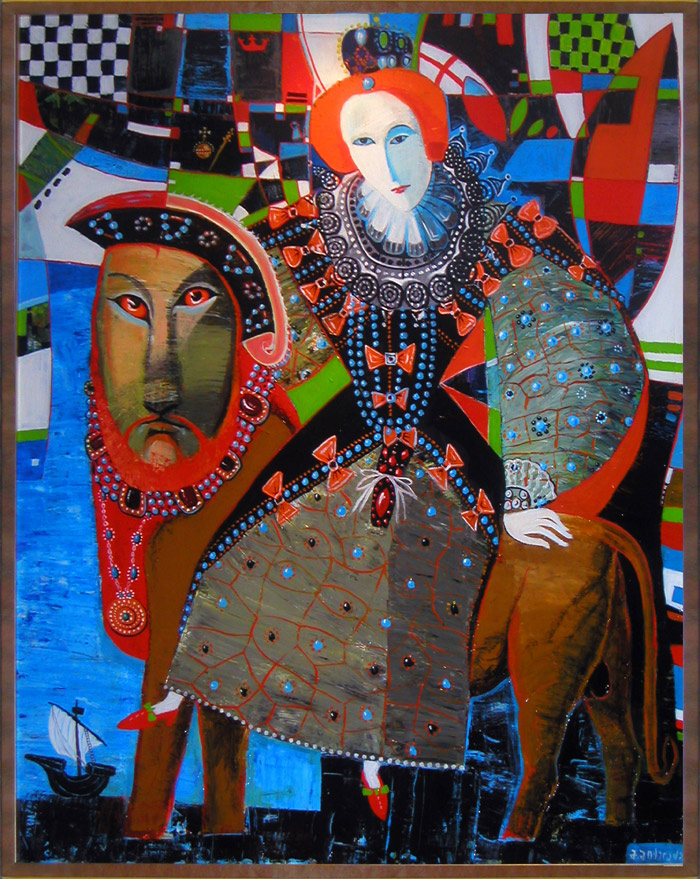
    My art is based on good will and harmony. The concern about disharmony and inhumanity in the world is a source of constant inspiration in my work. The information I receive from mythology, the Bible and everyday reality become the spiritual instruments in my mind, the material for mental observation.

    MY rhythmical fantasies and discoveries can be regarded as the image of freedom. Due to deformation, generalization, expressiveness, and original combination of characters, the paintings bear the slight hint of unreality. My principle utilizes an abundance of symbols, stylistic diversity – poly stylistics, which I characterize as neo-expressionist and representative of the new figuration.

    mamukamikeladze.com

    Image courtesy of the artist

    Image courtesy of the artist

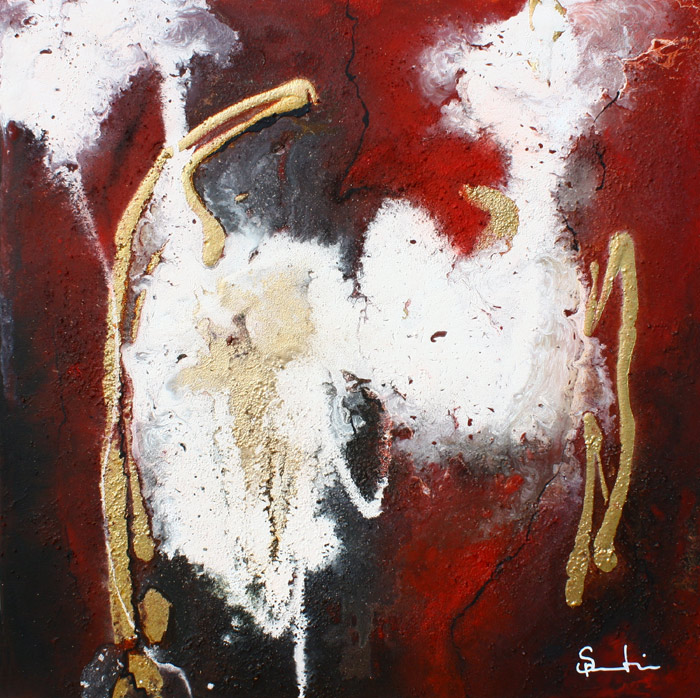
    Every time when I start to create a painting, I already have a concrete idea in my mind. What is going to happen? I am not making the painting, the painting is creating me! The result is – without surprise – definitely different. All the paintings, which were done this way, became my favorites. It is always important to find the right balance of release and to allow.

    I love it to engage myself in the unknown, to work with different materials and colors. My work is representing my feelings. And every person that knows me would confirm, these feelings are tremendous. Welcome to my world!

    www.bluechilli.ch/‎

    While the writer Richard Sennett presumes that contemporary art has been endeavoring to exclude the human hand in art, this notion appears in opposition to the work of artist DARU-Jung Hyang Kim. In examining her work, one may find a very different direction. Kim’s works possess a vibrant delivery of the brush that engages bold sweeping gestures. In the process, she creates a depth of space through a repetition of semi-transparent layers of pigment. Her work presents the artist’s intuitive pleasure through the use of oil paint, pencil, oil stick, and charcoal.  Kim’s magical release of energy in her work is an extension of the body – the tactile sensibility – rather than a form of abstract digitalization. Her paintings further reveal not merely an external visual phenomenon but a clearly defined internal manifestation that evolves within the surface. The metamorphosis of nature in her work evokes a hidden feminine desire to live with freedom, dignity, and equality.

    DARU-Jung Hyang Kim is a painter and public installation artist who has lived and worked in New York since 1977.  She is one of the pioneers of Korean-American art. Kim was accepted into the graduate program of fine arts at Pratt Institute and earned her MFA in 1980. During this period, Kim absorbed many new ideas through her interaction with international artists in New York. Since then, she has maintained a clear direction in her creative experimentation and exploration of new mediums. Her earlier works are diptychs that employ two styles of painting: figuration and abstraction. These opposing elements present different perspectives in her work. In formal terms, her paintings reveal a synthesis between the two. She seeks her own way by creating unique forms that are fundamentally connected to the fluidity of nature and humanist concerns.

    In 2013, Kim presented ten paintings in her solo show at Gallery Ho in West Chelsea. These recent works of Kim echo the basic theme on which she has worked over the past three decades. Abstract forms and figurative imagery are integrated on one canvas. Here Kim continues her exploration of abstract forms and shapes as abstraction becomes more predominant in her work. The largest work in this show, Listening Figure-moonlight (2013) focuses on circles and curvilinear shapes overlaid on one another or spread across the surface of the canvas. The circle as an abstract form transmits nuances and offers a rhythmical cadence. Circles are full of spatial volume like the variations in Baroque music. Another work, Listening-swirl (2013), also vibrates with images of circles, which are portrayed as diverse, repeated, and geometric shapes. Their richly varied colors and plastic balance maintains a strong aesthetic value.

    In Kim’s work, the circle is the primary element in her visual vocabulary and is laden with symbolic context. Her paintings ultimately belong to the tradition of Korean culture.  Kim believes that the variation of circles in her work evokes the qi and invokes the cycle of nature in life, death, and self-renewal. As a critical observer, the philosophical context of her circles is further related to the Eastern (Taoist) concept of Yin and Yang, which is symbolic of positive and negative energy in the universe.  Therefore Kim’s circles are not absolutely separated, but are always floating.  Kim’s subject matter can be interpreted as a reconciliation of balance, a harmony between opposites, the Eastern world and Western world, including physical limitations and spiritual abundance.   Kim’s work is borrowed from her Korean heritage and recontextualized on foreign soil. Her carefully articulated aesthetic discipline brings Eastern depth and Western classicism into a gradually new focus.


    Image courtesy of the artist

    Image courtesy of the artist

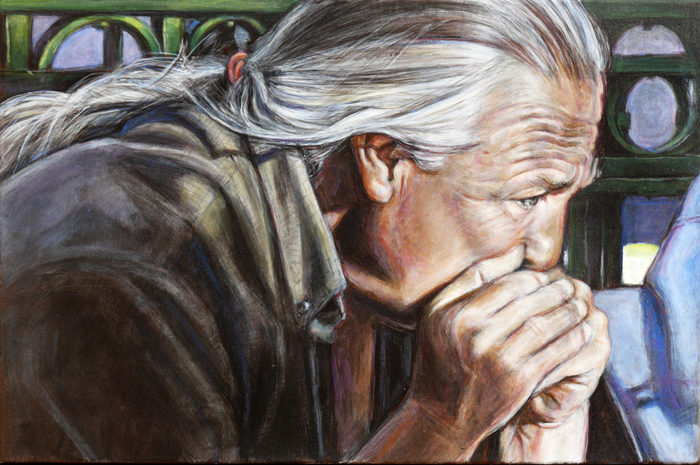
    “My name is John Ford and I make Westerns”. Many western and thriller movies of his era are important sources of inspiration for me. Most of my portraits are “narrative” and are referring to cinematographic projections, close-up shots. I never ask people to pose but rather observe from a distance, waiting for the right “take”. “Harmonica” is a typical example, somehow paying tribute to a character from a famous Italo western.

    Thus, with Ford I am sharing his forename, his fascination for motion pictures and the simplicity of the artistic credo: “My name is Hans and I make pictures”.

    HansBertschi.com

    Image courtesy of the artist

    Image courtesy of the artist

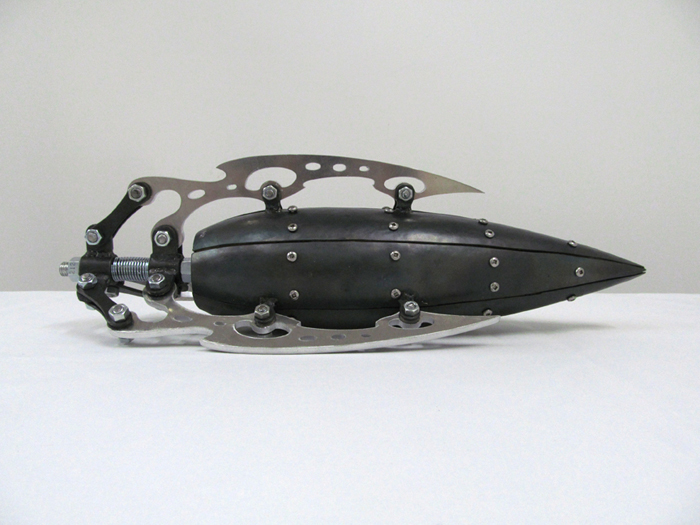
    The aesthetic of industrial use of metal has always fascinated me. I like the idea of blending the destructive, strong, resistant, powerful, sides of industrial pieces and machinery with the more emotional and aesthetic purpose of art. It is like absurd creations of robust and indestructible (even destructive) objects in contrast with the cheaper ones we see in our everyday life. Our experience of life allows us to judge the performance and the resistance of an object. I make use of the way we perceive our world by visually exaggerating these characteristics.

    jeanphilipperoysculpture.com

    Image courtesy of the artist

    Image courtesy of the artist


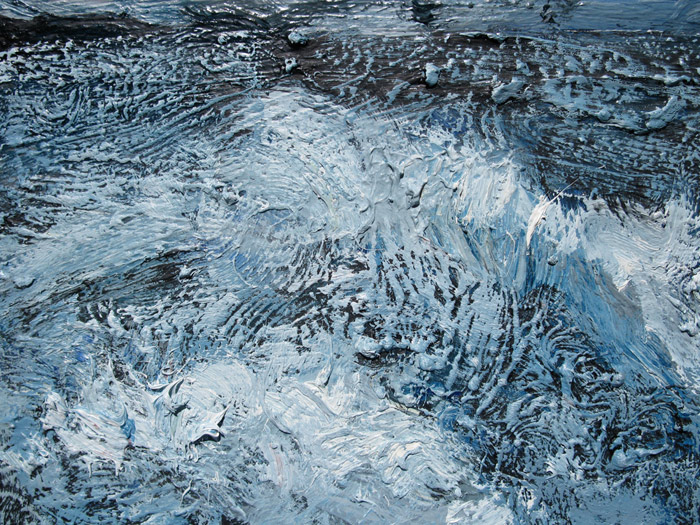
    The sea is a mirror of the human unconscious. When I paint the sea, I channel the spirits that come to me from the Ocean, and from Atlantis. I am irresistibly drawn to the sea, and on stormy nights I hear “an mordros”, the sound of the sea from my bedroom window. I believe that I have lived on Atlantis in a past life. In my latest paintings, I have expressed the symbolic nature of the sea, and I have painted the awesome power of the ocean which can overwhelm humanity in an instant.

     Douglaslyell.com

    Image courtesy of the artist

    Image courtesy of the artist

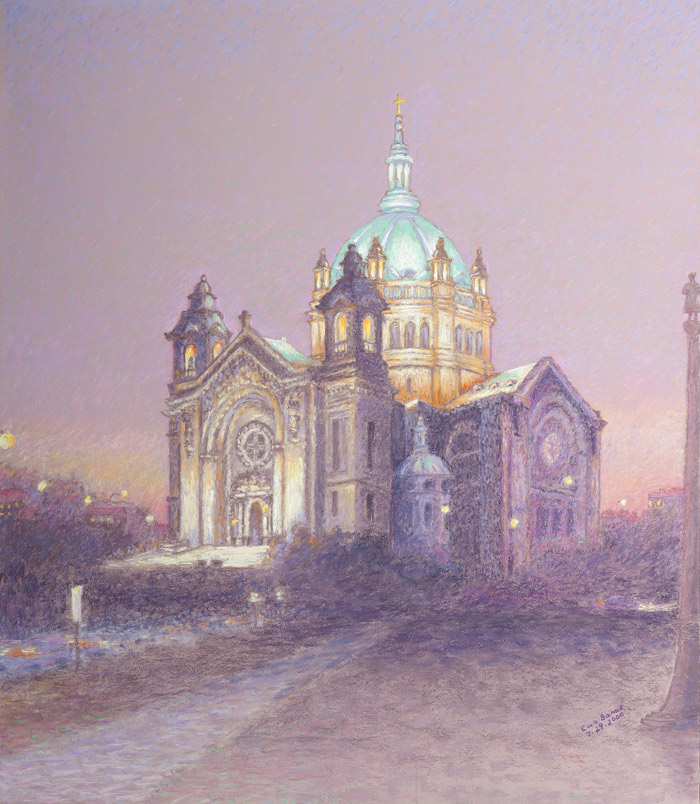
    In my art I would like to depict the best that I can the beauty of the world wonderfully made for us by our Creator. I can see this beauty everywhere—in a smile of a small child, in a bouquet of the wild flowers, in the shady forests and peaceful waters of the lakes, on the summits of the soaring mountains, and in the monumental, as well as in the simple, pieces of architecture.

    Some of my paintings and drawings have symbolic meaning and through them I express my feelings of friendship, love, or respect. I never studied fine arts. During many years I worked in the biomedical field which I finally quit in the fall of 1999, after I had created a very beautiful volunteer art project, which forever changed my life.

    ewabanasfineart.com

    Caitlin Diaz: Where and when was Nucleo brought into existence?
    Nucleo: Nucleo was born 15 years ago, in Turin, as a collective from a heterogeneous group of people: photographers, artists, architects, industrial designers and graphic designers.
    Nucleo is now a design studio based in Torino, Italy. The collective is active in contemporary art, design and architectural fields.

    CD: What was the overall design aesthetic and philosophy?
    N: The work of Nucleo consists of innovative, unique objects longing to continue the tradition of Italian artists. The pieces are an intensified investigation about human beings and the exploration of space and time – past, present, and future. Our handmade objects are collectively made, shared, and discussed.
    Each artwork is original, made entirely by hand. Crafted without the use of molds, the finished pieces reveal signs of imperfections, making them one-of-a-kind and unrepeatable. Our designs are a composite of new and up-cycled materials.

    CD: What changes, material or conceptual, has the studio experienced through the years?
    N: Over the past 15 years a lot has changed. Projects have been born as a result of consequences. The most radical change has been the starting points for our new projects. We continue to research errors made in our past work and let them influence us; a drop of color that falls to the floor and explodes, or the fear that arises when something turns out not as we planned.
    The origination of new work comes from “errors” and so-called negative emotions, like ‘fear,’ that come about while making the work.

    CD: What is Nucleo working on at the moment?
    N: Investigating the themes central to human life: love, fear, family, work, religion, politics, sex – Nucleo is working on a new project, a mirror of our society. Using a series of histograms, statistics, and a control group, Nucleo will make its first attempt at an open-loop collaboration. The final design will be presented at Design Miami at Art Basel.

    We are also researching our first two-dimensional process. Using laser engraving we are exploring the usage and formation of “lines.” Lines as graphics without color, lines as the traces left by moving points, and lines as tension.

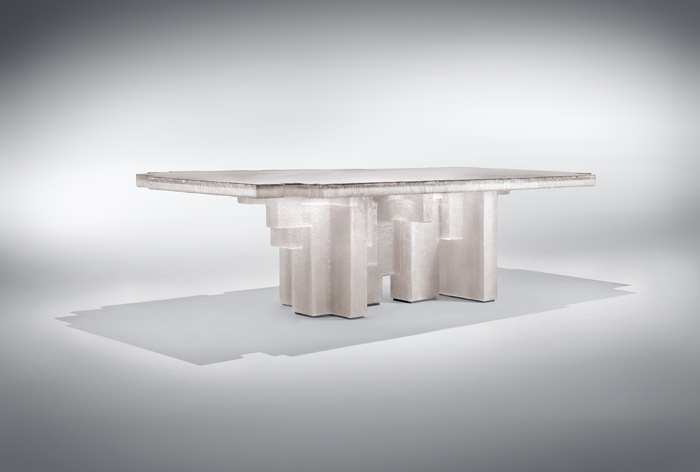
    Resinite table courtesy of Nucleo

    Resinite table courtesy of Nucleo

    CD: At Design Miami last December. The Resin Fossil Table was the highlight of my experience. What inspired its creation?
    N: The idea behind the Resin Fossil Table is the ever-present presumption that the future of our designs will be fossils themselves. Resin is a “materic” trace, where we find an imprint of the original item, in the same way that the implementation of the process that creates the object leads to the destruction of the original. The table consists of a single empty block that accurately traces the object from which it takes shape.

    CD: I reviewed the making-of photos on your website, the process is fascinating! Could you elaborate more about the process and what makes it so unique?
    N: The making becomes so unique because it is obtained through a destruction process. First, we made a true-scale model of the table in polystyrene. This model became the mold of the resin table. The model was covered with resin and fiberglass. When the resin became strong enough, the model was destroyed using a solvent. That definitely makes it a unique piece.

    CD: I also loved how, when lit properly, the table looks like a glowing, frosted artifact that could exist somewhere in the Arctic. How does lighting affect your designs, in particular The Resin Fossil Table? Do you experiment with different methods of presentation? Ideally, where would this table live?
    N: Really, I never imagined the Resin Fossil Table in the Arctic, because the inspiration was the fossil. But you aren’t the first to have said that it looks like frosted ice. But, of course, one of my secret dreams is to design the ice hotel in Sweden.

    Light and shadow play an important role in our pieces. Light plays with transparency and reflection while shadow defines volume and density. Though we rarely use lights inside our objects. Playing with different thicknesses between the top of the table and the sides produces the effects of light. The top is more transparent than the sides, which allows the light to run through the table and glow from all angles.
    Ideally, the table would live in Brazil in a concrete house of Oscar Niemeyer.

    CD: What appeals to me about the Wood Fossil pieces is the relationship between preservation and mystery. What was the first piece from this series and what influenced the creation of the following pieces? Where is the wood sourced from and is there a significance about their origins? Would you say these pieces take discarded, yet loaded, information (the wood) and encapsulate them to preserve their meaning?
    N: Since I was a child I was fascinated with fossils. I loved the insects that were encapsulated in the resin. With resin we started thinking about fossilization, with wood, we open ourselves to the amber chapter.

    What is impressive about fossils is that they are like a time machine; the inclusion in the resin makes the fossil eternal. On one hand, it is a great responsibility. On the other hand, it is the relation between people 1000 years from now that will find our work.

    The first objects of the Wood Fossil Series are single pieces of wood encased in a block of epoxy resin. The wood is up-cycled, found in an old storage timber. The block of resin keeps the relationship alive with the dissolving piece of wood; it is a game of presence and absence, lightness and weight, challenging the laws of gravity.

    The type of wood used in making the Wood Fossil’s isn’t important. The fact that it is a “souvenir of the last century” is crucial. It is a collection of memories, up-cycled into new forms. The souvenir as an evidence of memories, the souvenir as a gift for those who were not there, the souvenir as a triumph of life experienced.

    Nucleo explores materiality and experiences as well as points of reference, fragile, lost, and strong. The memories of the past century have been re-found through discarded materials marked from an era. Full of scars, the material holds stronger characteristics than when it was new.

    Nucleo has restored and preserved memories, mummifying fragments of the past, mixed up with physical presence, and their contemporary existence. By creating “souvenirs of the last century,” Nucleo’s objects are innately designed for the future.

    Leah Oates: How did you become an artist and what is your family background?
    Julie Peppito: When I was in the second grade I drew a picture of a turkey and it won first prize in a statewide elementary school competition in Oklahoma. My mom put me in art classes. In my free time I would draw, sculpt and make jewelry at our dining room table or at a desk in my room. When I was older I became a thrift store and junk shop fanatic. That is when I began to notice the beauty in things others discarded.

    LO: What are the ideas in your work and what is your working process?
    JP: I wonder why I am drawn to some things and not others. What makes some things valuable and other things trash, or on their way to becoming trash? Sometimes I feel like my purpose is to rescue them. I want to make them have meaning for more time than they are in fashion. I have a love/hate relationship with fashion and consumerism. I have the “I want everything” disease of our culture. I desperately want to buy things, and then I feel incredibly guilty because I know the harm that materialism causes the planet and people. My work is a manifestation of this conflict. It is also a manifestation of my need to connect with others and the world, while at the same time desiring escape and disconnection.

    My process begins with collecting. I used to collect only funky Americana statues and nostalgic “collectable-ish” things. Then the lines got fuzzier. Now they are really fuzzy. I collect things that most people would consider trash, along side more notably valuable stuff. Then I mash, bind, and merge them together with wire, clay, cords, fabric, and thread. I paint and draw patterns and images on it. If it is a work on paper there is more imagery. This imagery is narrative, expressing the ideas of connection, disconnection, and value mentioned previously.

    LO: Your work uses found materials, drawing and collage and is a unique blend of the whimsical, fantastic, and scary. Please elaborate on how you came to work this way and what this mix represents thematically.
    JP: On found materials, collage, whimsical, and fantastical:
    When I was very young I used to play in the roots of trees. My dad helped me make little boats out of walnut shells, toothpicks, and paper, and I would pour water in between the elaborate root systems and sail the boats. My dad was an Eagle Scout from Brooklyn turned engineer who had a strong belief in do-it-yourself everything. I was also born in Tulsa, Oklahoma in 1970, at a time when people still made things instead of instantly buying them. It was a place where craft was held in much higher esteem than art (although I hadn’t realized this until I went to Cooper Union for my BFA and learned that what I thought was art was actually considered craft in the NYC fine art world.)

    I learned very young that almost anything could be repurposed to make another thing. That led to my thrift/junk obsession. (That obsession was also influenced by my lower middle class budget; plus it was the 80’s and it had recently become fashionable to thrift. Remember “Sixteen Candles”? I was 14 when it came out.)

    On Drawing:
    I have always loved to draw, and because I was good at it I was always encouraged to do it. I have observed that everyone, regardless of class or culture, can appreciate a good drawing. For a long time I had stopped doing it in rebellion to that realization. Now I draw as an appreciation of that observation, and for my love of the connection to the moment that I feel when I do it.

    On Scary:
    My mom was a stay-at-home mom from Long island who later got her MSW and became a therapist. She was a feminist baby boomer who took me to march on the capital OKC for the ERA when I was 10 (I think). She had always infused me with a sense of justice even though growing up I was more concerned with boys, fashion, and making things over anything else. After I moved to NYC to go to art school in 1988, I gradually began to learn things about our country and the world that I had never known before. I learned more when I started listening to Democracy Now! on WBAI and reading Howard Zinn’s People’s History of The United States of America. The culmination of all of that was a deep anger for being lied to by the media, history books, and politicians. I believe the “scary” in my work usually comes from this.

    What this mix represents thematically:
    We are complex creatures. We have all of this amazingly detailed, gross and beautiful stuff on the outsides of our bodies: skin, hair, eyes, pores, butts, appendages, etc… Then there is all of that equally detailed, gross and beautiful stuff on the insides of us. As if that wasn’t enough, there is all of that other stuff that goes on in our brains and our hearts. When you put it all together there is a complete being and each one has a poignant and unique story. I’ve always had an inner drive to make art that is just as complete.

    Julie Peppito Snoopy Homeboy Cake, 2009. Wood, Found Objects, Epoxy Clay, Aqua Resin, Gouache, Acrylic, Pen, Pencil, Thread.  Variable Dimensions 8 x 10 x 4 in. Image courtesy of the artist

    Julie Peppito
    Snoopy Homeboy Cake, 2009.
    Wood, Found Objects, Epoxy Clay, Aqua Resin, Gouache, Acrylic, Pen, Pencil, Thread.
    Variable Dimensions 8 x 10 x 4 in. Image courtesy of the artist

    LO: Why do you think art is important to people and what does art do exactly for the world?
    JP: I have struggled with this question a lot in my life. I have often felt that being a visual artist is looked upon as selfish and unhelpful. The results are not usually quantifiable like they are with a doctor, lawyer, scientist, teacher, or social worker. I have always had a strong sense of justice and a desire to help and be selfless. What I have realized is that it does help. Art connects us. We spend much of our lives trying not to feel or being cut off from our feelings by the monotony of daily tasks or the horribleness and scary parts of our lives and world events. Art is like love. It makes us feel and it makes it okay to feel. Feeling makes life worth living. So, to pull it all together, art helps make life worth living.

    LO: What advice would you give an artist who has just arrived in NYC and who is not sure where to begin?
    JP: Network. Show up. Or don’t, and just make art. Or leave, and just make art. Before anything though, come to terms with why you have come here to make art. If you are going to stay and want to make a career out of it realize that you will spend a large amount of your time working a job to support your art while simultaneously running a separate online and in-person networking and PR business. This is all unless you are already well connected and independently wealthy.

    There are some contradictions in this amazing city. This is where the critical mass of like-minded people are, but you rarely have time to meet with them (especially if you have procreated). If you do, you can’t make art that takes time to make. There is also a critical mass of people who appreciate art, but it is difficult to figure out where the ones are that will appreciate your particular brand of “making life worth living art” and have the time and money to appreciate it in a way that will sustain you so that you can focus on making their life (and yours!) worth living.

    LO: Who are you favorite artists and why?
    JP: So many!  I like art that insists I look at it for more than a minute. For me this usually means it is well crafted and detailed with visual power. The essential component is that it helps me see the world in a new way. To put it another way, it must make me fall in love with it. When I am making a piece of art I know it is working if I fall in love with it. I want other artists’ work to inspire the same feeling in me. (See previous question “Why do you think art is important and what does art do for the world?)

    My list: Niki De Saint Phalle, Mark Ryden, Joyce Scott, Robert Rauschenberg, Sigmar Polke, Vermeer, MC Escher, Swoon, Murakami, Amy Cutler, Gideon Kendall, Paul Klee, Alexander Calder, Dr. Suess, Ernst Haeckel, Banksy, Kim Holleman, Anton Gaudi, Friedensreich Hundertwasser, Norman Rockwell and so many more. Genres: folk, medieval, Baroque, and Renaissance sculpture, painting and jewelry, 19th and early 20th century botanical and animal illustration and decorative objects such as Faberge eggs.

    LO: What are your upcoming projects?
    JP: For my third show at Heskin Contemporary in the fall of 2013, I am taking personalized commissions. My multi-media collages and sculptures, which incorporate objects from the sitter’s everyday life, are not traditional portraits. This series of work is from my “Connected Portrait Project.” In keeping with my philosophy, each piece explores our complex and varied relationships with objects. Why do we do cherish some items and easily discard others?

    To create the portraits, I require ten small objects and/or images. These should be a selection of both commonplace items and items of sentimental value. Three titles of the sitter’s favorite pieces from my website (www.juliepeppito.com) to help inform me about the sitters tastes. And five words from the sitter’s imagination.

    I have a longstanding interest in environmental issues and will donate ten percent of the proceeds from the “Connected Portraits Project” to Hurricane Sandy and climate change relief efforts.

    If you are interested in participating in the project, please contact me (juliepeppito@gmail.com) for further details and pricing.

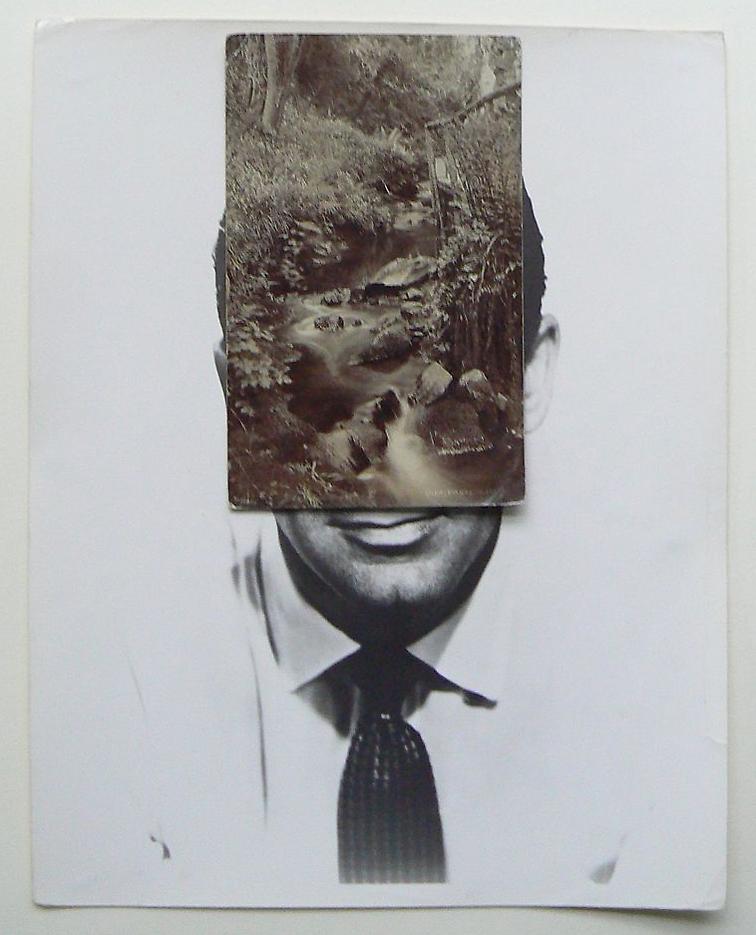
    John Stezaker Mask CXLVI 2009 Collage 10 x 8 inches

    John Stezaker, Mask, 2009. Collage, 10 x 8 in. Image courtesy of Petzel Gallery.

    John Stezaker graces Petzel Gallery for the third time, presenting his latest exhibit—John Stezaker: Nude and Landscape. Stezaker, a native of the United Kingdom, uses the photographic image as a platform to challenge our understanding and the limitations of the photographic medium. Subtly combining a variety of vintage images Stezaker elegantly creates a space that evokes nostalgia, while simultaneously subverting notions of the past through the splicing of the images. The theories of philosophers and critics, such as Walter Benjamin, have further galvanized our understanding of Stezaker’s body of work, launching the artist’s reputation and practice to the forefront of the mixed media milieu.

    May 8 – June 13, 2013
    Opening reception: Friday, May 10th, from 6:00 – 8:00 PM
    Petzel Gallery
    456 W 18th Street New York NY 10011

    News | Exhibitions